

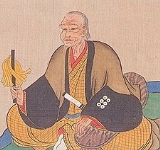
Sanada Masayuki

Encyclopedia
was a Japan
ese Sengoku period
daimyo
. He was the third son of Sanada Yukitaka
, a vassal daimyo to the Takeda family
in Shinano province
. He is known as a master strategist. Sanada Nobuyuki
and Sanada Yukimura
were his sons.
, who discovered his talent at a young age and of whom Masayuki became a close servant. After Shingen's death, he continued to serve Takeda Katsuyori
. However, during the Battle of Nagashino
of 1575, both of Masayuki's elder brothers, Nobutsuna and Masateru, were killed. Masayuki changed his name back to Sanada so that he could claim his inheritance.
In 1577, immediately after Uesugi Kenshin
's death, Masayuki took advantage of the internal turmoil within the Uesugi clan
and seized Numata Castle in Kozuke province
, an act that first demonstrated his strategic abilities.
After the fall of the Takeda clan in 1582, Masayuki temporarily yielded to Oda Nobunaga
. However, Nobunaga died within a year at the Incident at Honnō-ji. Upon Nobunaga's death, the Sanada clan was left alone in Shinano province
surrounded by hostile powers such as the Uesugi clan, the Hōjō clan
, and the Tokugawa clan
. By drifting through temporary alliances and fickle allegiances, the Sanada clan managed to survive.
In 1585, the Sanada clan stood opposed to Tokugawa Ieyasu
. With 7,000 men, the Tokugawa forces lay siege to Ueda Castle
, which was defended by only 2,000 soldiers. However, Masayuki was able to inflict 3,000 casualties on Tokugawa and won an overwhelming victory. This was the First Battle of Ueda Castle, a victory that earned Masayuki national prominence.
In 1589, Sanada retainers had disputes with the Hōjō clan, which eventually led to the fall of the Hōjō clan by Toyotomi Hideyoshi
's invading armies.
After Hideyoshi's death, in 1600, Masayuki joined Ishida Mitsunari
's side during the Battle of Sekigahara
. Masayuki sent his eldest son, Nobuyuki, to the eastern side, while Masayuki and his younger son, Yukimura, fought on the western side, a move that ensured the Sanada clan's survival. Fortifying Ueda Castle, Masayuki fought against Tokugawa Hidetada
's 38,000 men with only 2,000 soldiers. This was the Second Battle of Ueda Castle, and, whilst it was not exactly a victory, Masayuki was able to deliver a heavy blow to Hidetada and delay his forces for long enough that they were unable to show up at the main battlefield on time.
However, the western side, led by Ishida Mitsunari, lost the main battle, and the victorious Tokugawa Ieyasu was able to redistribute fiefs at will. Masayuki and Yukimura were initially going to be executed, but, given Nobuyuki's participation in the eastern army, they were instead exiled to Kudoyama
in Kii province
. The Sanada clan
was inherited by Sanada Nobuyuki.
Sanada Masayuki died in Kudoyama in 1611.
, he has been more extolled than vilified.
Japan
Japan is an island nation in East Asia. Located in the Pacific Ocean, it lies to the east of the Sea of Japan, China, North Korea, South Korea and Russia, stretching from the Sea of Okhotsk in the north to the East China Sea and Taiwan in the south...
ese Sengoku period
Sengoku period
The or Warring States period in Japanese history was a time of social upheaval, political intrigue, and nearly constant military conflict that lasted roughly from the middle of the 15th century to the beginning of the 17th century. The name "Sengoku" was adopted by Japanese historians in reference...
daimyo
Daimyo
is a generic term referring to the powerful territorial lords in pre-modern Japan who ruled most of the country from their vast, hereditary land holdings...
. He was the third son of Sanada Yukitaka
Sanada Yukitaka
was a daimyō of Shinano Province who became one of Takeda Shingen's 'Twenty-four Generals' , submitting to become Takeda's vassal after a long and difficult struggle against him....
, a vassal daimyo to the Takeda family
Takeda family
The ' was a famous clan of daimyō in Japan's late Heian Period to Sengoku period.The Takeda were descendants of Emperor Seiwa and are a branch of the Minamoto clan , by Minamoto no Yoshimitsu , brother to the Chinjufu-shogun Minamoto no Yoshiie...
in Shinano province
Shinano Province
or is an old province of Japan that is now present day Nagano Prefecture.Shinano bordered on Echigo, Etchū, Hida, Kai, Kōzuke, Mikawa, Mino, Musashi, Suruga, and Tōtōmi Provinces...
. He is known as a master strategist. Sanada Nobuyuki
Sanada Nobuyuki
was a Japanese samurai of the Sengoku period. He was the son of daimyo Sanada Masayuki and the older brother of Sanada Yukimura.-Biography:At an early age, Nobuyuki's father served under the daimyo Takeda Shingen and sent Nobuyuki as a hostage to prove the Sanada clan's loyalty to the Takeda clan...
and Sanada Yukimura
Sanada Yukimura
was a Japanese samurai, second son of the Sengoku period daimyo Sanada Masayuki . His proper name was Sanada Nobushige , named after Takeda Shingen's younger brother Takeda Nobushige, who was a brave and respected warrior. He and his father were known as being excellent military tacticians...
were his sons.
Biography
Initially, Masayuki changed his name to Mutō Kihei to inherit the Mutō clan, a branch of the Takeda family. He was favoured by Takeda ShingenTakeda Shingen
, of Kai Province, was a preeminent daimyo in feudal Japan with exceptional military prestige in the late stage of the Sengoku period.-Name:Shingen was called "Tarō" or "Katsuchiyo" during his childhood...
, who discovered his talent at a young age and of whom Masayuki became a close servant. After Shingen's death, he continued to serve Takeda Katsuyori
Takeda Katsuyori
was a Japanese daimyo of the Sengoku Period, who was famed as the head of the Takeda clan and the successor to the legendary warlord Takeda Shingen. He was the son of Shingen by the , the daughter of Suwa Yorishige...
. However, during the Battle of Nagashino
Battle of Nagashino
The ' took place in 1575 near Nagashino Castle on the plain of Shitaragahara in the Mikawa province of Japan. Forces under Takeda Katsuyori had besieged the castle since the 17th of June; Okudaira Sadamasa , a Tokugawa vassal, commanded the defending force...
of 1575, both of Masayuki's elder brothers, Nobutsuna and Masateru, were killed. Masayuki changed his name back to Sanada so that he could claim his inheritance.
In 1577, immediately after Uesugi Kenshin
Uesugi Kenshin
was a daimyo who ruled Echigo province in the Sengoku period of Japan.He was one of the most powerful lords of the Sengoku period. While chiefly remembered for his prowess on the battlefield, Kenshin is also regarded as an extremely skillful administrator who fostered the growth of local industries...
's death, Masayuki took advantage of the internal turmoil within the Uesugi clan
Uesugi clan
The was a Japanese samurai clan, descended from the Fujiwara clan and particularly notable for their power in the Muromachi and Sengoku periods ....
and seized Numata Castle in Kozuke province
Kozuke Province
was an old province located in the Tōsandō of Japan, which today comprises Gunma Prefecture. It is nicknamed as or .The ancient provincial capital was near modern Maebashi. During the Sengoku period, Kōzuke was controlled variously by Takeda Shingen, Uesugi Kenshin, the late Hōjō clan, and...
, an act that first demonstrated his strategic abilities.
After the fall of the Takeda clan in 1582, Masayuki temporarily yielded to Oda Nobunaga
Oda Nobunaga
was the initiator of the unification of Japan under the shogunate in the late 16th century, which ruled Japan until the Meiji Restoration in 1868. He was also a major daimyo during the Sengoku period of Japanese history. His opus was continued, completed and finalized by his successors Toyotomi...
. However, Nobunaga died within a year at the Incident at Honnō-ji. Upon Nobunaga's death, the Sanada clan was left alone in Shinano province
Shinano Province
or is an old province of Japan that is now present day Nagano Prefecture.Shinano bordered on Echigo, Etchū, Hida, Kai, Kōzuke, Mikawa, Mino, Musashi, Suruga, and Tōtōmi Provinces...
surrounded by hostile powers such as the Uesugi clan, the Hōjō clan
Late Hojo clan
The ' was one of the most powerful warrior clans in Japan in the Sengoku period and held domains primarily in the Kantō region.The clan is traditionally reckoned to be started by Ise Shinkurō, who came from a branch of the prestigious Ise clan, a family in the direct employment of the Ashikaga...
, and the Tokugawa clan
Tokugawa clan
The was a powerful daimyo family of Japan. They nominally descended from Emperor Seiwa and were a branch of the Minamoto clan by the Nitta clan. However, the early history of this clan remains a mystery.-History:...
. By drifting through temporary alliances and fickle allegiances, the Sanada clan managed to survive.
In 1585, the Sanada clan stood opposed to Tokugawa Ieyasu
Tokugawa Ieyasu
was the founder and first shogun of the Tokugawa shogunate of Japan , which ruled from the Battle of Sekigahara in 1600 until the Meiji Restoration in 1868. Ieyasu seized power in 1600, received appointment as shogun in 1603, abdicated from office in 1605, but...
. With 7,000 men, the Tokugawa forces lay siege to Ueda Castle
Ueda Castle
Ueda Castle was the original home of the Sanada clan, built by Sanada Masayuki.It was this castle that the Sanada defended twice from the Tokugawa, first in 1583 and again in 1600, putting up a very impressive defense both of those times....
, which was defended by only 2,000 soldiers. However, Masayuki was able to inflict 3,000 casualties on Tokugawa and won an overwhelming victory. This was the First Battle of Ueda Castle, a victory that earned Masayuki national prominence.
In 1589, Sanada retainers had disputes with the Hōjō clan, which eventually led to the fall of the Hōjō clan by Toyotomi Hideyoshi
Toyotomi Hideyoshi
was a daimyo warrior, general and politician of the Sengoku period. He unified the political factions of Japan. He succeeded his former liege lord, Oda Nobunaga, and brought an end to the Sengoku period. The period of his rule is often called the Momoyama period, named after Hideyoshi's castle...
's invading armies.
After Hideyoshi's death, in 1600, Masayuki joined Ishida Mitsunari
Ishida Mitsunari
Ishida Mitsunari was a samurai who led the Western army in the Battle of Sekigahara following the Azuchi-Momoyama period of the 17th century. Also known by his court title, Jibunoshō...
's side during the Battle of Sekigahara
Battle of Sekigahara
The , popularly known as the , was a decisive battle on October 21, 1600 which cleared the path to the Shogunate for Tokugawa Ieyasu...
. Masayuki sent his eldest son, Nobuyuki, to the eastern side, while Masayuki and his younger son, Yukimura, fought on the western side, a move that ensured the Sanada clan's survival. Fortifying Ueda Castle, Masayuki fought against Tokugawa Hidetada
Tokugawa Hidetada
was the second shogun of the Tokugawa dynasty, who ruled from 1605 until his abdication in 1623. He was the third son of Tokugawa Ieyasu, the first shogun of the Tokugawa shogunate.-Early life :...
's 38,000 men with only 2,000 soldiers. This was the Second Battle of Ueda Castle, and, whilst it was not exactly a victory, Masayuki was able to deliver a heavy blow to Hidetada and delay his forces for long enough that they were unable to show up at the main battlefield on time.
However, the western side, led by Ishida Mitsunari, lost the main battle, and the victorious Tokugawa Ieyasu was able to redistribute fiefs at will. Masayuki and Yukimura were initially going to be executed, but, given Nobuyuki's participation in the eastern army, they were instead exiled to Kudoyama
Kudoyama, Wakayama
is a town located in Ito District, Wakayama, Japan.As of 2003, the town has an estimated population of 5,801 and a density of 131.27 persons per km². The total area is 44.19 km².-External links:*...
in Kii province
Kii Province
, or , was a province of Japan in the part of Honshū that is today Wakayama Prefecture, as well as the southern part of Mie Prefecture. Kii bordered Ise, Izumi, Kawachi, Shima, and Yamato Provinces. The Kii Peninsula takes its name from this province....
. The Sanada clan
Sanada clan
The was a Japanese clan which rose to prominence in the Sengoku period. During the Edo era, the Sanada ruled the Matsushiro Domain, where they remained until the Meiji Restoration.-Sengoku period:...
was inherited by Sanada Nobuyuki.
Sanada Masayuki died in Kudoyama in 1611.
Legacy
Even though Masayuki was never able to expand his territories as well as other daimyo, he is nevertheless often considered a talented daimyo, doomed by misfortune and the inconvenient terrains which surrounded his home domain. Toyotomi Hideyoshi had called Masayuki a person whose inside did not match his outside, that his allegiance was fickle and not to be trusted. Nevertheless, it was exactly his drifting alliances that helped the Sanada clan survive the onslaught of hostile clans, and, since the Edo periodEdo period
The , or , is a division of Japanese history which was ruled by the shoguns of the Tokugawa family, running from 1603 to 1868. The political entity of this period was the Tokugawa shogunate....
, he has been more extolled than vilified.