


Asadi Tusi

Encyclopedia
Abu Mansur Ali ibn Ahmad Asadi Tusi (born: Tus
, Iran
ian province of Khorasan
- died: 1072 Tabriz
, Iran
) is arguably the second most important Persian
poet of the Iranian national epic
s, after Ferdowsi
who also happens to come from the same town of Tus
. He was a poet, a linguist and copyist of ancient manuscripts.
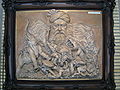
province was under violent attack from various rival Turkic groups. Many native intellectuals left Khorasan
as a result of these conflicts, while many of those who remained lived in seclusion. As a result of the violence, Asadi, who lived the first twenty years of his life in Khorasan
, left Khorasan
for the Iran
ian province of Azarbaijan
and stayed there until his death. He first served as a poet in the court of the Daylamite Abu Nasr Jastan. Later he went to Nakhjavan and in 1065-1066, completed his seminal work, the Garshapnama. He dedicated this work to Abu Dolaf, the ruler of Nakhjavan. Later on, he went to serve at the court of the Shaddadid
king Manuchehr who ruled over Ani
. His tomb is located in city of Tabriz
.
). His other important contribution is a lexicon of the Modern Persian
language (فرهنگ لغت فرس). Five of his
Monāẓarāt (Debates in the form of poetry between two people or objects or concepts) are also extant.
, the father of Kariman, and great grandfather of Sam) Šam, who is identified in the Shahnameh
with the ancient Iranian hero, Kərəsāspa- (Avesta), In Avesta he was the son of Θrita-, of the clan Yama. The poet took the story from a book called the adventures of Garshasp and he states that it is a complement to the stories of the Shahnameh
. The poem is thus based on written sources although it was part of the folklore of the common people and the poet invokes the Dehqan mentioned in Avesta was killed by Garshasp the son of Yama.
The story starts with Yama
or Jamshid
, the father of Garshasp who was overthrown by Zahak and flees to King Ghurang, the king of the country called Zabolistān the region expended from modern Quetta
includes province of Zabul, Kandahar
, central region Helmand all the way to edge of small Iranian Sistan which still holds the name Zabol
, combined as part of Balochistan province. In Zabulistan Jamshid falls in love with the king's daughter and gives birth to Garshasp. Jamshid
though was forced to flee again despite king Ghorang's promise to her daughter that King Ghurang will support Jamshid
will give him army and money, and face Zehak if he has to, but Jamshid knew that Zehak's Army was much stronger that he did wanted the country of Sistan to be destroyed therefore he went to Ind (India) and from India to Chin (China). Garshasp's mother takes poison and kill herself, Garshasp spends much of his life with his grandfather and grows to be one mighty warrior like Jamshid himself. After Death of Ghurang, he was to become king, although the secret remains until birth of Kariman, he sends his son to help Fereydun
the enemy of Zahak. Kariman comes with sorrow and reads Garshasp's letter which states that country of Zabulistan, Kabul is sided with Fereydun
and that Fereydun shares same blood from bother side and that Garshasp is the only son of Yama the great, therefore unity between Army of Kabulistan, and Fridon means defeat to Zahak. For the next many generations son of Nariman as well as grandson of Kariman Sam became supporters of Fridon's administarion.
Early Age
When Garshasp is born, Zahak is still the king and pays a visit to Zābolestān. Zahak's eye is captured by the valiant of Garshasp and challenges him to slay a ferocious dragon. Equipped with a special antidote against dragon-poison, and armed with special weapons, Garshāsp succeeds in killing the monster. Impressed by the child's prowess, Zahhāk now orders Garshāsp to (Kabul)India, where the king – a vassal of Zahhāk's – has been replaced by a rebel prince, Bahu, who does not acknowledge Zahhāk's rule. Garshāsp defeats the rebel and then stays in India for a while to observe its marvels and engage in philosophical discourse. Garshasp then proceedes to Sarandib (Ceylon) where he observers the footprint of the Buddha
(in Muslim sources identified with the footprint of Adam). Asadi then conveys many legends about Adam, the father of mankind. Garshasp then meets a Brahman
, whom he questions in detail about philosophy and religion. The actual words Asadi Tusi relates from the Brahman's mouth are actually related to his Islamic Neo-Platonism. Garshasp visits some of the islands of India
afterwards and observes supernatural wonders, which are described at great length in the story. India has always been a place of marvel for Muslim
authors.
The hero then returns home and pays homage to Zahak, who was still the ruler at the time. Garshāsp then goes on to woo a princess of Rum
, restores his father Eṯreṭ to his throne in Zābol after the king of Kābol defeats him, and builds the city of Sistān
. He has further anachronistic adventures in the Mediterranean, fighting in Kairouan
and Córdoba
. In the West, he meets a "Greek Brahman
" and again indulges in philosophical discourse with the wise-man. Returning home after his father passes away, Garshasp now becomes the king of Zābolestān.
When he returns to Iran, his father dies, and Garshāsp becomes king of Zābolestān. Although he has no son of his own, he adopts Narēmān as his heir, who would become Rostam
's great-grandfather. During this era, Ferēdūn
defeats Zahak and becomes king of Iran, and Garšāsp swears allegiance to Ferēdūn
. Garšāsp and his nephew then adventure unto Turan
and defeat the Faghfūr(Iranian title for the ruler of Central Asia and China probably of Sogdian
origin) of Chin. They take him as a captive to Ferēdūn
thereby showing their allegiance to the King of Iran
. Nariman, the has a son, Sām, who is the grandfather of Rostam
. Garshasp then does one final battle with the king of Tanger and slays another dragon. He then returns home to Sistān
and Zābolestān where he passes away.
dictionary based on examples from poetry. It also preserves information concerning the names of some of the poets of the 4th/10th century. Several very different manuscripts exist in Iran and elsewhere. The oldest extant manuscript seems to be at the Malek Library in Tehran (dated 722/1322) although the manuscript written in Safina-yi Tabriz
is also from the same period. The manuscript of 1302 states that Asadi composed it at the request of his son.
shows that this form of debate has had a long history. The five surviving debates are called "Arab o 'Ajam" (The Arab vs the Persian), Mogh o Mosalman (the Magian vs the Muslim), Shab o Ruz (the night vs the Day), Neyza o Kaman (the spear vs the Bow) and the Asman o Zamin (the Sky vs the Earth). In the Persian vs Arab debate, the Persian wins while in the Muslim vs Zoroastrian debate, the Muslim Wins. Asadi, seem to have reasoned that an Iran
ian Muslim
was superior to an Arab
Muslim, but a Muslim, whatever his nationality, was superior to a Zoroastrian.
Tous, Iran
Tus also spelled as Tous, Toos or Tūs, is an ancient city in the Iranian province of Razavi Khorasan. To the ancient Greeks, it was known as Susia...
, Iran
Iran
Iran , officially the Islamic Republic of Iran , is a country in Southern and Western Asia. The name "Iran" has been in use natively since the Sassanian era and came into use internationally in 1935, before which the country was known to the Western world as Persia...
ian province of Khorasan
Greater Khorasan
Greater Khorasan or Ancient Khorasan is a historical region of Greater Iran mentioned in sources from Sassanid and Islamic eras which "frequently" had a denotation wider than current three provinces of Khorasan in Iran...
- died: 1072 Tabriz
Tabriz
Tabriz is the fourth largest city and one of the historical capitals of Iran and the capital of East Azerbaijan Province. Situated at an altitude of 1,350 meters at the junction of the Quri River and Aji River, it was the second largest city in Iran until the late 1960s, one of its former...
, Iran
Iran
Iran , officially the Islamic Republic of Iran , is a country in Southern and Western Asia. The name "Iran" has been in use natively since the Sassanian era and came into use internationally in 1935, before which the country was known to the Western world as Persia...
) is arguably the second most important Persian
Persian language
Persian is an Iranian language within the Indo-Iranian branch of the Indo-European languages. It is primarily spoken in Iran, Afghanistan, Tajikistan and countries which historically came under Persian influence...
poet of the Iranian national epic
National epic
A national epic is an epic poem or a literary work of epic scope which seeks or is believed to capture and express the essence or spirit of a particular nation; not necessarily a nation-state, but at least an ethnic or linguistic group with aspirations to independence or autonomy...
s, after Ferdowsi
Ferdowsi
Ferdowsi was a highly revered Persian poet. He was the author of the Shahnameh, the national epic of Iran and related societies.The Shahnameh was originally composed by Ferdowsi for the princes of the Samanid dynasty, who were responsible for a revival of Persian cultural traditions after the...
who also happens to come from the same town of Tus
Tous, Iran
Tus also spelled as Tous, Toos or Tūs, is an ancient city in the Iranian province of Razavi Khorasan. To the ancient Greeks, it was known as Susia...
. He was a poet, a linguist and copyist of ancient manuscripts.
Life
The information on Asadi's lifetime is scant. During Asadi's time, and for some time after, much of the KhorasanGreater Khorasan
Greater Khorasan or Ancient Khorasan is a historical region of Greater Iran mentioned in sources from Sassanid and Islamic eras which "frequently" had a denotation wider than current three provinces of Khorasan in Iran...
province was under violent attack from various rival Turkic groups. Many native intellectuals left Khorasan
Greater Khorasan
Greater Khorasan or Ancient Khorasan is a historical region of Greater Iran mentioned in sources from Sassanid and Islamic eras which "frequently" had a denotation wider than current three provinces of Khorasan in Iran...
as a result of these conflicts, while many of those who remained lived in seclusion. As a result of the violence, Asadi, who lived the first twenty years of his life in Khorasan
Greater Khorasan
Greater Khorasan or Ancient Khorasan is a historical region of Greater Iran mentioned in sources from Sassanid and Islamic eras which "frequently" had a denotation wider than current three provinces of Khorasan in Iran...
, left Khorasan
Greater Khorasan
Greater Khorasan or Ancient Khorasan is a historical region of Greater Iran mentioned in sources from Sassanid and Islamic eras which "frequently" had a denotation wider than current three provinces of Khorasan in Iran...
for the Iran
Iran
Iran , officially the Islamic Republic of Iran , is a country in Southern and Western Asia. The name "Iran" has been in use natively since the Sassanian era and came into use internationally in 1935, before which the country was known to the Western world as Persia...
ian province of Azarbaijan
Provinces of Iran
Iran is subdivided into thirty one provinces , each governed from a local center, usually the largest local city, which is called the capital of that province...
and stayed there until his death. He first served as a poet in the court of the Daylamite Abu Nasr Jastan. Later he went to Nakhjavan and in 1065-1066, completed his seminal work, the Garshapnama. He dedicated this work to Abu Dolaf, the ruler of Nakhjavan. Later on, he went to serve at the court of the Shaddadid
Shaddadid
The Shaddadids were a Kurdish dynasty who ruled in various parts of Armenia and Arran from 951-1174 AD. They were established in Dvin. Through their long tenure in Armenia, they often intermarried with the Bagratuni royal family of Armenia....
king Manuchehr who ruled over Ani
Ani
Ani is a ruined and uninhabited medieval Armenian city-site situated in the Turkish province of Kars, near the border with Armenia. It was once the capital of a medieval Armenian kingdom that covered much of present day Armenia and eastern Turkey...
. His tomb is located in city of Tabriz
Tabriz
Tabriz is the fourth largest city and one of the historical capitals of Iran and the capital of East Azerbaijan Province. Situated at an altitude of 1,350 meters at the junction of the Quri River and Aji River, it was the second largest city in Iran until the late 1960s, one of its former...
.
Works
Asadi's most significant work is Garshasp-nama (The Book (or Epic) of GarshaspGarshasp
Garshāsp is the name of a monster-slaying hero in Iranian mythology. The Avestan form of his name is Kərəsāspa and in Middle Persian his name is Kirsāsp.-Kərəsāspa / Kirsāsp in Zoroastrian literature:...
). His other important contribution is a lexicon of the Modern Persian
Persian language
Persian is an Iranian language within the Indo-Iranian branch of the Indo-European languages. It is primarily spoken in Iran, Afghanistan, Tajikistan and countries which historically came under Persian influence...
language (فرهنگ لغت فرس). Five of his
Monāẓarāt (Debates in the form of poetry between two people or objects or concepts) are also extant.
Garshaspnama (The epic of Garshasp)
The Garshaspnama epic is the major work of Asadi Tusi containing 9000 couplets. The hero of the poem is GarshaspGarshasp
Garshāsp is the name of a monster-slaying hero in Iranian mythology. The Avestan form of his name is Kərəsāspa and in Middle Persian his name is Kirsāsp.-Kərəsāspa / Kirsāsp in Zoroastrian literature:...
, the father of Kariman, and great grandfather of Sam) Šam, who is identified in the Shahnameh
Shahnameh
The Shahnameh or Shah-nama is a long epic poem written by the Persian poet Ferdowsi between c.977 and 1010 AD and is the national epic of Iran and related societies...
with the ancient Iranian hero, Kərəsāspa- (Avesta), In Avesta he was the son of Θrita-, of the clan Yama. The poet took the story from a book called the adventures of Garshasp and he states that it is a complement to the stories of the Shahnameh
Shahnameh
The Shahnameh or Shah-nama is a long epic poem written by the Persian poet Ferdowsi between c.977 and 1010 AD and is the national epic of Iran and related societies...
. The poem is thus based on written sources although it was part of the folklore of the common people and the poet invokes the Dehqan mentioned in Avesta was killed by Garshasp the son of Yama.
The story starts with Yama
Yama
Yama , also known as Yamarāja in India and Nepal, Shinje in Tibet, Yanluowang or simply Yan in China, Yeomla Daewang in South Korea and Enma Dai-Ō in Japan, is the lord of death, in Hinduism and then adopted into Buddhism and then further into Chinese mythology and Japanese mythology. First...
or Jamshid
Jamshid
Jamshid is a mythological figure of Greater Iranian culture and tradition.In tradition and folklore, Jamshid is described as having been the fourth and greatest king of the epigraphically unattested Pishdadian dynasty . This role is already alluded to in Zoroastrian scripture Jamshid (Middle-...
, the father of Garshasp who was overthrown by Zahak and flees to King Ghurang, the king of the country called Zabolistān the region expended from modern Quetta
Quetta
is the largest city and the provincial capital of the Balochistan Province of Pakistan. Known as the "Fruit Garden of Pakistan" due to the diversity of its plant and animal wildlife, Quetta is home to the Hazarganji Chiltan National Park, which contains some of the rarest species of wildlife in the...
includes province of Zabul, Kandahar
Kandahar
Kandahar is the second largest city in Afghanistan, with a population of about 512,200 as of 2011. It is the capital of Kandahar Province, located in the south of the country at about 1,005 m above sea level...
, central region Helmand all the way to edge of small Iranian Sistan which still holds the name Zabol
Zabol
Zabol is a city in and the capital of Zabol County, Sistan and Baluchestan Province, Iran. Zabol lies on the border with both Afghanistan and Pakistan. At the 2006 census, its population was 130,642, in 27,867 families....
, combined as part of Balochistan province. In Zabulistan Jamshid falls in love with the king's daughter and gives birth to Garshasp. Jamshid
Jamshid
Jamshid is a mythological figure of Greater Iranian culture and tradition.In tradition and folklore, Jamshid is described as having been the fourth and greatest king of the epigraphically unattested Pishdadian dynasty . This role is already alluded to in Zoroastrian scripture Jamshid (Middle-...
though was forced to flee again despite king Ghorang's promise to her daughter that King Ghurang will support Jamshid
Jamshid
Jamshid is a mythological figure of Greater Iranian culture and tradition.In tradition and folklore, Jamshid is described as having been the fourth and greatest king of the epigraphically unattested Pishdadian dynasty . This role is already alluded to in Zoroastrian scripture Jamshid (Middle-...
will give him army and money, and face Zehak if he has to, but Jamshid knew that Zehak's Army was much stronger that he did wanted the country of Sistan to be destroyed therefore he went to Ind (India) and from India to Chin (China). Garshasp's mother takes poison and kill herself, Garshasp spends much of his life with his grandfather and grows to be one mighty warrior like Jamshid himself. After Death of Ghurang, he was to become king, although the secret remains until birth of Kariman, he sends his son to help Fereydun
Fereydun
Fereydūn also pronounced Farīdūn or Afrīdūn , also called Apam Napat, "Son of the Waters", is the name of an Iranian mythical king and hero who is an emblem of victory, justice and generosity in the Persian literature.-Etymology:All of the forms of...
the enemy of Zahak. Kariman comes with sorrow and reads Garshasp's letter which states that country of Zabulistan, Kabul is sided with Fereydun
Fereydun
Fereydūn also pronounced Farīdūn or Afrīdūn , also called Apam Napat, "Son of the Waters", is the name of an Iranian mythical king and hero who is an emblem of victory, justice and generosity in the Persian literature.-Etymology:All of the forms of...
and that Fereydun shares same blood from bother side and that Garshasp is the only son of Yama the great, therefore unity between Army of Kabulistan, and Fridon means defeat to Zahak. For the next many generations son of Nariman as well as grandson of Kariman Sam became supporters of Fridon's administarion.
Early Age
When Garshasp is born, Zahak is still the king and pays a visit to Zābolestān. Zahak's eye is captured by the valiant of Garshasp and challenges him to slay a ferocious dragon. Equipped with a special antidote against dragon-poison, and armed with special weapons, Garshāsp succeeds in killing the monster. Impressed by the child's prowess, Zahhāk now orders Garshāsp to (Kabul)India, where the king – a vassal of Zahhāk's – has been replaced by a rebel prince, Bahu, who does not acknowledge Zahhāk's rule. Garshāsp defeats the rebel and then stays in India for a while to observe its marvels and engage in philosophical discourse. Garshasp then proceedes to Sarandib (Ceylon) where he observers the footprint of the Buddha
Gautama Buddha
Siddhārtha Gautama was a spiritual teacher from the Indian subcontinent, on whose teachings Buddhism was founded. In most Buddhist traditions, he is regarded as the Supreme Buddha Siddhārtha Gautama (Sanskrit: सिद्धार्थ गौतम; Pali: Siddhattha Gotama) was a spiritual teacher from the Indian...
(in Muslim sources identified with the footprint of Adam). Asadi then conveys many legends about Adam, the father of mankind. Garshasp then meets a Brahman
Brahman
In Hinduism, Brahman is the one supreme, universal Spirit that is the origin and support of the phenomenal universe. Brahman is sometimes referred to as the Absolute or Godhead which is the Divine Ground of all being...
, whom he questions in detail about philosophy and religion. The actual words Asadi Tusi relates from the Brahman's mouth are actually related to his Islamic Neo-Platonism. Garshasp visits some of the islands of India
India
India , officially the Republic of India , is a country in South Asia. It is the seventh-largest country by geographical area, the second-most populous country with over 1.2 billion people, and the most populous democracy in the world...
afterwards and observes supernatural wonders, which are described at great length in the story. India has always been a place of marvel for Muslim
Muslim
A Muslim, also spelled Moslem, is an adherent of Islam, a monotheistic, Abrahamic religion based on the Quran, which Muslims consider the verbatim word of God as revealed to prophet Muhammad. "Muslim" is the Arabic term for "submitter" .Muslims believe that God is one and incomparable...
authors.
The hero then returns home and pays homage to Zahak, who was still the ruler at the time. Garshāsp then goes on to woo a princess of Rum
Rûm
Rûm, also Roum or Rhum , an indefinite term used at different times in the Muslim world to refer to the Balkans and Anatolia generally, and for the Byzantine Empire in particular, for the Seljuk Sultanate of Rûm in Asia Minor, and referring to Greeks living outside of Greece or non-muslims...
, restores his father Eṯreṭ to his throne in Zābol after the king of Kābol defeats him, and builds the city of Sistān
Sistan
Sīstān is a border region in eastern Iran , southwestern Afghanistan and northern tip of Southwestern Pakistan .-Etymology:...
. He has further anachronistic adventures in the Mediterranean, fighting in Kairouan
Kairouan
Kairouan , also known as Kirwan or al-Qayrawan , is the capital of the Kairouan Governorate in Tunisia. Referred to as the Islamic Cultural Capital, it is a UNESCO World Heritage site. The city was founded by the Arabs around 670...
and Córdoba
Córdoba, Spain
-History:The first trace of human presence in the area are remains of a Neanderthal Man, dating to c. 32,000 BC. In the 8th century BC, during the ancient Tartessos period, a pre-urban settlement existed. The population gradually learned copper and silver metallurgy...
. In the West, he meets a "Greek Brahman
Brahman
In Hinduism, Brahman is the one supreme, universal Spirit that is the origin and support of the phenomenal universe. Brahman is sometimes referred to as the Absolute or Godhead which is the Divine Ground of all being...
" and again indulges in philosophical discourse with the wise-man. Returning home after his father passes away, Garshasp now becomes the king of Zābolestān.
When he returns to Iran, his father dies, and Garshāsp becomes king of Zābolestān. Although he has no son of his own, he adopts Narēmān as his heir, who would become Rostam
Rostam
Rostam is the national hero of Greater Iran from Zabulistan in Persian mythology and son of Zal and Rudaba. In some ways, the position of Rostam in the historical tradition is parallel to that of Surena, the hero of the Carrhae. His figure was endowed with many features of the historical...
's great-grandfather. During this era, Ferēdūn
Fereydun
Fereydūn also pronounced Farīdūn or Afrīdūn , also called Apam Napat, "Son of the Waters", is the name of an Iranian mythical king and hero who is an emblem of victory, justice and generosity in the Persian literature.-Etymology:All of the forms of...
defeats Zahak and becomes king of Iran, and Garšāsp swears allegiance to Ferēdūn
Fereydun
Fereydūn also pronounced Farīdūn or Afrīdūn , also called Apam Napat, "Son of the Waters", is the name of an Iranian mythical king and hero who is an emblem of victory, justice and generosity in the Persian literature.-Etymology:All of the forms of...
. Garšāsp and his nephew then adventure unto Turan
Turan
Tūrān is the Persian name for Central Asia, literally meaning "the land of the Tur". As described below, the original Turanians are an Iranian tribe of the Avestan age. As a people the "Turanian" are one of the two Iranian peoples both descending from the Persian Fereydun but with different...
and defeat the Faghfūr(Iranian title for the ruler of Central Asia and China probably of Sogdian
Sogdian language
The Sogdian language is a Middle Iranian language that was spoken in Sogdiana , located in modern day Uzbekistan and Tajikistan ....
origin) of Chin. They take him as a captive to Ferēdūn
Fereydun
Fereydūn also pronounced Farīdūn or Afrīdūn , also called Apam Napat, "Son of the Waters", is the name of an Iranian mythical king and hero who is an emblem of victory, justice and generosity in the Persian literature.-Etymology:All of the forms of...
thereby showing their allegiance to the King of Iran
Iran
Iran , officially the Islamic Republic of Iran , is a country in Southern and Western Asia. The name "Iran" has been in use natively since the Sassanian era and came into use internationally in 1935, before which the country was known to the Western world as Persia...
. Nariman, the has a son, Sām, who is the grandfather of Rostam
Rostam
Rostam is the national hero of Greater Iran from Zabulistan in Persian mythology and son of Zal and Rudaba. In some ways, the position of Rostam in the historical tradition is parallel to that of Surena, the hero of the Carrhae. His figure was endowed with many features of the historical...
. Garshasp then does one final battle with the king of Tanger and slays another dragon. He then returns home to Sistān
Sistan
Sīstān is a border region in eastern Iran , southwestern Afghanistan and northern tip of Southwestern Pakistan .-Etymology:...
and Zābolestān where he passes away.
Loḡat-e fors (The Khorasani-Persian lexicon)
This lexicon was written in order to familiarize the unfamiliar phrases found in Eastern Persian (Darī) poetry for the people of Arran and Azerbaijan. It is the oldest extant PersianPersian language
Persian is an Iranian language within the Indo-Iranian branch of the Indo-European languages. It is primarily spoken in Iran, Afghanistan, Tajikistan and countries which historically came under Persian influence...
dictionary based on examples from poetry. It also preserves information concerning the names of some of the poets of the 4th/10th century. Several very different manuscripts exist in Iran and elsewhere. The oldest extant manuscript seems to be at the Malek Library in Tehran (dated 722/1322) although the manuscript written in Safina-yi Tabriz
Safina-yi Tabriz
Safīna-yi Tabriz is an important encyclopedic manuscript from 14th century Ilkhanid Iran compiled by Abu'l Majd Muhammad b. Mas'ud Tabrizi between 1321 and 1323....
is also from the same period. The manuscript of 1302 states that Asadi composed it at the request of his son.
Monazerat (Debates)
Five of these have survived and they are in the Persian poetic form of Qasida. Such a form of poetry is unprecedented in Arabic or New Persian, but it is part of the Middle Persian (Pahlavi) tradition. The Pahlavic poetic debate Draxt i AsurikDrakht-i Asurig
Drakht-i Asurig is a Parthian language poem from the Arscacid era.The poem is framed as a dialogue between a goat and a palm tree. It is one of the oldest existing texts in Arscacid Middle Persian, and of the few remaining examples of the Parthian language....
shows that this form of debate has had a long history. The five surviving debates are called "Arab o 'Ajam" (The Arab vs the Persian), Mogh o Mosalman (the Magian vs the Muslim), Shab o Ruz (the night vs the Day), Neyza o Kaman (the spear vs the Bow) and the Asman o Zamin (the Sky vs the Earth). In the Persian vs Arab debate, the Persian wins while in the Muslim vs Zoroastrian debate, the Muslim Wins. Asadi, seem to have reasoned that an Iran
Iran
Iran , officially the Islamic Republic of Iran , is a country in Southern and Western Asia. The name "Iran" has been in use natively since the Sassanian era and came into use internationally in 1935, before which the country was known to the Western world as Persia...
ian Muslim
Muslim
A Muslim, also spelled Moslem, is an adherent of Islam, a monotheistic, Abrahamic religion based on the Quran, which Muslims consider the verbatim word of God as revealed to prophet Muhammad. "Muslim" is the Arabic term for "submitter" .Muslims believe that God is one and incomparable...
was superior to an Arab
Arab
Arab people, also known as Arabs , are a panethnicity primarily living in the Arab world, which is located in Western Asia and North Africa. They are identified as such on one or more of genealogical, linguistic, or cultural grounds, with tribal affiliations, and intra-tribal relationships playing...
Muslim, but a Muslim, whatever his nationality, was superior to a Zoroastrian.
See also
- Persian literaturePersian literaturePersian literature spans two-and-a-half millennia, though much of the pre-Islamic material has been lost. Its sources have been within historical Persia including present-day Iran as well as regions of Central Asia where the Persian language has historically been the national language...
- List of Persian poets and authors
- Nozhat al-MajalesNozhat al-MajalesNoz'hat al-Majāles is an anthology which contains around 4,100 Persian quatrains by some 300 poets of the 5th to 7th11th-13th centuries. The anthology was compiled around the middle of the 7th/13th century by the Persian poet Jamal al-Din Khalil Shirvani...