


Rubaiyat

Encyclopedia
"Rubāʿī" is Arabic
for "quatrain
", and is used to describe a Persian quatrain, or its derivative form in English and other languages. The plural form of the word, rubāʿiyāt (رباعیات ),often anglicised rubaiyat , is used to describe a collection of such quatrains.
There are a number of possible rhyme scheme
s to the rubaiyat form, e.g. AABA, AAAA. In Persian
verse
, a ruba'i visually contains only four lines, its rhyme falling at the middle and end of the lines.
Rubai is like a poetry (Sher in Urdu) which contains four lines. Generally sher in Urdu contains two lines.
Example: (Sher) Ulti ho gayi sab tadbeeren kuchh dawa na kaam kiya. Dekha is bimari dil ne aakir kaam tamam kiya. (Rubai) Mar mar ke musafir ne basaya hai tujhe. Rukh sab se phira ke munh dikhaya hai tujhe. Kyon na lipat kar soun tujh se aye qabra. Aakir maine bhi jaan de kar paaya hai tujhe.
in his famous 1859 translation, The Rubaiyat of Omar Khayyam
. Algernon Charles Swinburne
, one of the first admirers of FitzGerald's translation of Khayyam's
medieval Persian verses, was the first to imitate the stanza form, which subsequently became popular and was used widely, as in the case of Robert Frost's
1922 poem "Stopping by Woods on a Snowy Evening
".
Fitzgerald's translation became so popular by the turn of the century that hundreds of American humorists wrote parodies using the form and, to varying degrees, the content of his stanzas, including The Rubaiyat of Ohow Dryyam, The Rubaiyat of A Persian Kitten, The Rubaiyat of Omar Cayenne and The Rubaiyat of Omar Khayyam, Jr.
In extended sequences of ruba'i stanzas, the convention is sometimes extended so that the unrhymed line of the current stanza becomes the rhyme for the following stanza. The structure can be made cyclical by linking the unrhymed line of the final stanza back to the first stanza: ZZAZ. These more stringent systems were not, however, used by FitzGerald in his Rubaiyat.
Sa'd Bin Ard is a poet from Rangpur who wrote some English ruba'is. He wrote some ruba'is in Bangla and transformed some of those into English by himself in ruba'i form. One example is as follows.
Fireflies are flying over a coppice. I wonder
They are flakes of gold flying together.
Stars are smiling in the sky by twinkling.
Can the gifts of God be counted with a finger?
According to Sa'd Bin Ard, a writer of Bangla ruba'is Rabindranath Tagore, the great Bangla Noble Prize winning poet has also written at least some ruba's in Bangla. One of his famous rubai is
Foole foole dhole dhole bohe kiba mridu bay.
Totini hilol tuli kollole bohia jay.
Piko kiba kunje kunje kuhu kuhu kuhu gay.
Ke jane kishero lagi praano kore haay haay!
It means, "Wind continues blowing on flowers moving those. Rivers go on murmerring making waves. It seems cuckoos are cooing in different bushes of plants. The mind is wishing for an unknown thing."
Ms. Sultana Begum Dulari has a book named Rubaiyat-e-Dulari which contains 47 ruba'is. One of those is-
Din kete jaay, Raat kete jaay, amon kore bochhor je jaay!
Keu ki taha bujhte paare bishoy ashoy kisher borai!
Taar haate to ghurir latai jamon ichchha tamon khalen!
Taar kothai to bhaabchhi boshe ondhokarer omanishay!
It means,
Days pass. Nights pass. Years pass this way.
Nobody knows that who has the pride of this world.
It is He Who has the spool of the kite in His hand, He uses it in His own Way.
I am rather thinking of him in this darkness.
Mr. ATM. Mostafa Kamal has written a book named 'Bangala Rubai' in Bangla which contains 50 Bangla rubai's.
Sa'd Bin Ard has written many ruba'is in Bangla. His ruba'is which number about 200 include Lajuk Meye, Videshi Sahaya, Shomoy-5 etc.
Aap jayse log haame kuchh khaas lagte hai.
Manme har-wakt ek aas rakhte hai.
Jaane cub ajaye SMS aapka
Iss lea cellco dilke pass rakhte hai.
It means, "People like you seem very special to me. I always keep a wish in my mind and that is to get your SMS. That is the reason why I keep the mobile always by the heart."
Another beautiful Ruba'i by Tanwir Phool is as under:
Jo lamha guzarta hai woh keya deta hai
Dauraania-e-zeest bataa deta hai
Aie Phool ! ghaTaa umr se ik aur baras
Jaata huwaa har saal sadaa deta hai
It means, "What is given by the moment passed?It tells one the spent period of his or her life.Every passing year is saying that one more year is being decreased/deducted from one's life."
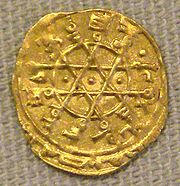
In the Islamic world the "ruba'i" designated a quarter-dinar
, weighing 1.05 grams of gold. The ruba'i had been minted by the Muslims in Sicily
, unlike the Muslim rulers of North Africa, who preferred the larger dinar. It became highly popular as it was smaller and therefore more convenient than the large-sized 4.25-gram dinar. This type of coin was named tarì
by Christians and was largely adopted in Sicily and mainland Italy.
Arabic language
Arabic is a name applied to the descendants of the Classical Arabic language of the 6th century AD, used most prominently in the Quran, the Islamic Holy Book...
for "quatrain
Quatrain
A quatrain is a stanza, or a complete poem, consisting of four lines of verse. Existing in various forms, the quatrain appears in poems from the poetic traditions of various ancient civilizations including Ancient Greece, Ancient Rome, and China; and, continues into the 21st century, where it is...
", and is used to describe a Persian quatrain, or its derivative form in English and other languages. The plural form of the word, rubāʿiyāt (رباعیات ),often anglicised rubaiyat , is used to describe a collection of such quatrains.
There are a number of possible rhyme scheme
Rhyme scheme
A rhyme scheme is the pattern of rhyme between lines of a poem or song. It is usually referred to by using letters to indicate which lines rhyme. In other words, it is the pattern of end rhymes or lines...
s to the rubaiyat form, e.g. AABA, AAAA. In Persian
Persian language
Persian is an Iranian language within the Indo-Iranian branch of the Indo-European languages. It is primarily spoken in Iran, Afghanistan, Tajikistan and countries which historically came under Persian influence...
verse
Verse (poetry)
A verse is formally a single line in a metrical composition, e.g. poetry. However, the word has come to represent any division or grouping of words in such a composition, which traditionally had been referred to as a stanza....
, a ruba'i visually contains only four lines, its rhyme falling at the middle and end of the lines.
Etymology
The word "rubāʿī" is derived from the same Arabic root as "arbaʿa" (أربعة), meaning "four".Rubai is like a poetry (Sher in Urdu) which contains four lines. Generally sher in Urdu contains two lines.
Example: (Sher) Ulti ho gayi sab tadbeeren kuchh dawa na kaam kiya. Dekha is bimari dil ne aakir kaam tamam kiya. (Rubai) Mar mar ke musafir ne basaya hai tujhe. Rukh sab se phira ke munh dikhaya hai tujhe. Kyon na lipat kar soun tujh se aye qabra. Aakir maine bhi jaan de kar paaya hai tujhe.
Ruba'i in English
The verse form AABA as used in English verse is known as the Rubaiyat Quatrain due to its use by Edward FitzGeraldEdward FitzGerald (poet)
Edward FitzGerald was an English writer, best known as the poet of the first and most famous English translation of The Rubaiyat of Omar Khayyam. The spelling of his name as both FitzGerald and Fitzgerald is seen...
in his famous 1859 translation, The Rubaiyat of Omar Khayyam
Rubaiyat of Omar Khayyam
The Rubáiyát of Omar Khayyám is the title that Edward FitzGerald gave to his translation of a selection of poems, originally written in Persian and of which there are about a thousand, attributed to Omar Khayyám , a Persian poet, mathematician and astronomer...
. Algernon Charles Swinburne
Algernon Charles Swinburne
Algernon Charles Swinburne was an English poet, playwright, novelist, and critic. He invented the roundel form, wrote several novels, and contributed to the famous Eleventh Edition of the Encyclopaedia Britannica...
, one of the first admirers of FitzGerald's translation of Khayyam's
Omar Khayyám
Omar Khayyám was aPersian polymath: philosopher, mathematician, astronomer and poet. He also wrote treatises on mechanics, geography, mineralogy, music, climatology and theology....
medieval Persian verses, was the first to imitate the stanza form, which subsequently became popular and was used widely, as in the case of Robert Frost's
Robert Frost
Robert Lee Frost was an American poet. He is highly regarded for his realistic depictions of rural life and his command of American colloquial speech. His work frequently employed settings from rural life in New England in the early twentieth century, using them to examine complex social and...
1922 poem "Stopping by Woods on a Snowy Evening
Stopping by Woods on a Snowy Evening
"Stopping by Woods on a Snowy Evening" is a poem written in 1922 by Robert Frost, and published in 1923 in his New Hampshire volume. Imagery and personification are prominent in the work...
".
Fitzgerald's translation became so popular by the turn of the century that hundreds of American humorists wrote parodies using the form and, to varying degrees, the content of his stanzas, including The Rubaiyat of Ohow Dryyam, The Rubaiyat of A Persian Kitten, The Rubaiyat of Omar Cayenne and The Rubaiyat of Omar Khayyam, Jr.
In extended sequences of ruba'i stanzas, the convention is sometimes extended so that the unrhymed line of the current stanza becomes the rhyme for the following stanza. The structure can be made cyclical by linking the unrhymed line of the final stanza back to the first stanza: ZZAZ. These more stringent systems were not, however, used by FitzGerald in his Rubaiyat.
Sa'd Bin Ard is a poet from Rangpur who wrote some English ruba'is. He wrote some ruba'is in Bangla and transformed some of those into English by himself in ruba'i form. One example is as follows.
Fireflies are flying over a coppice. I wonder
They are flakes of gold flying together.
Stars are smiling in the sky by twinkling.
Can the gifts of God be counted with a finger?
Ruba'i in Bangla
There are many ruba'i writers in Bangla. Rubayyat-e-Omar Khayyam has about 50 translations in the market of Bangla books, many of which preserve the original ruba'i form. The notable ones among these are Rubayat-e-Omar Khayam and Rubayat-e-Hafiz by Kazi Nazrul Islam, Omar Khayamer Rubai by Shakti Chatterjee etc.According to Sa'd Bin Ard, a writer of Bangla ruba'is Rabindranath Tagore, the great Bangla Noble Prize winning poet has also written at least some ruba's in Bangla. One of his famous rubai is
Foole foole dhole dhole bohe kiba mridu bay.
Totini hilol tuli kollole bohia jay.
Piko kiba kunje kunje kuhu kuhu kuhu gay.
Ke jane kishero lagi praano kore haay haay!
It means, "Wind continues blowing on flowers moving those. Rivers go on murmerring making waves. It seems cuckoos are cooing in different bushes of plants. The mind is wishing for an unknown thing."
Ms. Sultana Begum Dulari has a book named Rubaiyat-e-Dulari which contains 47 ruba'is. One of those is-
Din kete jaay, Raat kete jaay, amon kore bochhor je jaay!
Keu ki taha bujhte paare bishoy ashoy kisher borai!
Taar haate to ghurir latai jamon ichchha tamon khalen!
Taar kothai to bhaabchhi boshe ondhokarer omanishay!
It means,
Days pass. Nights pass. Years pass this way.
Nobody knows that who has the pride of this world.
It is He Who has the spool of the kite in His hand, He uses it in His own Way.
I am rather thinking of him in this darkness.
Mr. ATM. Mostafa Kamal has written a book named 'Bangala Rubai' in Bangla which contains 50 Bangla rubai's.
Sa'd Bin Ard has written many ruba'is in Bangla. His ruba'is which number about 200 include Lajuk Meye, Videshi Sahaya, Shomoy-5 etc.
Ruba'i in Hindi
Hindi has a long tradition of ruba'is. Throughout eons many muslim Urdu poets have written many Urdu ruba'is. One of them is Mirza Asadullah Khan Ghalib. In recent times a poet has written a nice poem regarding how a woman answers to her husband or boyfriend's inquiry about why she keeps her mobile in the front pocket of her shirt. The poems isAap jayse log haame kuchh khaas lagte hai.
Manme har-wakt ek aas rakhte hai.
Jaane cub ajaye SMS aapka
Iss lea cellco dilke pass rakhte hai.
It means, "People like you seem very special to me. I always keep a wish in my mind and that is to get your SMS. That is the reason why I keep the mobile always by the heart."
Another beautiful Ruba'i by Tanwir Phool is as under:
Jo lamha guzarta hai woh keya deta hai
Dauraania-e-zeest bataa deta hai
Aie Phool ! ghaTaa umr se ik aur baras
Jaata huwaa har saal sadaa deta hai
It means, "What is given by the moment passed?It tells one the spent period of his or her life.Every passing year is saying that one more year is being decreased/deducted from one's life."
Coinage
In the Islamic world the "ruba'i" designated a quarter-dinar
Dinar
The dinar is the official currency of several countries.The history of the dinar dates to the gold dinar, an early Islamic coin corresponding to the Byzantine denarius auri...
, weighing 1.05 grams of gold. The ruba'i had been minted by the Muslims in Sicily
Sicily
Sicily is a region of Italy, and is the largest island in the Mediterranean Sea. Along with the surrounding minor islands, it constitutes an autonomous region of Italy, the Regione Autonoma Siciliana Sicily has a rich and unique culture, especially with regard to the arts, music, literature,...
, unlike the Muslim rulers of North Africa, who preferred the larger dinar. It became highly popular as it was smaller and therefore more convenient than the large-sized 4.25-gram dinar. This type of coin was named tarì
Tarì
A tarì was the Christian designation of a type of gold coin of Islamic origin minted in Sicily, Malta and South Italy from about 913 to 1859.-History:...
by Christians and was largely adopted in Sicily and mainland Italy.