


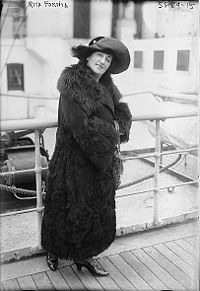
Rita Fornia

Encyclopedia
Opera
Opera is an art form in which singers and musicians perform a dramatic work combining text and musical score, usually in a theatrical setting. Opera incorporates many of the elements of spoken theatre, such as acting, scenery, and costumes and sometimes includes dance...
singer. She began her career in Europe at the beginning of the 20th century singing coloratura soprano
Coloratura soprano
A coloratura soprano is a type of operatic soprano who specializes in music that is distinguished by agile runs and leaps. The term coloratura refers to the elaborate ornamentation of a melody, which is a typical component of the music written for this voice...
roles. Early on in her career her voice darkened and dropped slightly causing her to focus more within the mezzo-soprano
Mezzo-soprano
A mezzo-soprano is a type of classical female singing voice whose range lies between the soprano and the contralto singing voices, usually extending from the A below middle C to the A two octaves above...
repertoire while still singing some soprano roles. She joined the Metropolitan Opera
Metropolitan Opera
The Metropolitan Opera is an opera company, located in New York City. Originally founded in 1880, the company gave its first performance on October 22, 1883. The company is operated by the non-profit Metropolitan Opera Association, with Peter Gelb as general manager...
company in 1907 where she performed regularly in mostly supporting roles until her retirement in 1922. She is best remembered today for portraying the role of the Abbess in the original production of Puccini's Suor Angelica
Suor Angelica
Suor Angelica is an opera in one act by Giacomo Puccini to an original Italian libretto by Giovacchino Forzano. It is the second opera of the trio of operas known as Il trittico...
in 1918.
Career
Fornia was born in San Francisco with the name Regina Newman in 1878. Her parents were immigrants from PrussiaPrussia
Prussia was a German kingdom and historic state originating out of the Duchy of Prussia and the Margraviate of Brandenburg. For centuries, the House of Hohenzollern ruled Prussia, successfully expanding its size by way of an unusually well-organized and effective army. Prussia shaped the history...
and her father owned a successful business as a wholesale jeweller. At the age of 12, she attended Adelina Patti
Adelina Patti
Adelina Patti was a highly acclaimed 19th-century opera singer, earning huge fees at the height of her career in the music capitals of Europe and America. She first sang in public as a child in 1851 and gave her last performance before an audience in 1914...
's 1890 concert in San Francisco which inspired her to become an opera singer. Her father eventually allowed her to move to New York City
New York City
New York is the most populous city in the United States and the center of the New York Metropolitan Area, one of the most populous metropolitan areas in the world. New York exerts a significant impact upon global commerce, finance, media, art, fashion, research, technology, education, and...
in 1898 to pursue her desire.
While in New York, Fornia studied with Emil Fischer and Sofia Scalchi
Sofia Scalchi
Sofia Scalchi was an Italian operatic contralto who could also sing in the mezzo-soprano range. Her career was international, and she appeared at leading theatres in both Europe and America.-Singing career:...
in New York City and then, under Fischer's advice, moved to Berlin in 1899 to study under Selma Nicklass-Kempner. Kempner, later the teacher of Frieda Hempel
Frieda Hempel
Frieda Hempel was a German soprano singer in operatic and concert work who had an international career in Europe and the United States.-Biography:...
, trained her as a coloratura soprano. She made her professional début with the Hamburg State Opera
Hamburg State Opera
The Hamburg State Opera is one of the leading opera companies in Germany.Opera in Hamburg dates back to 2 January 1678 when the "Opern-Theatrum" was inaugurated with a performance of a biblical Singspiel by Johann Theile...
in 1901 as Eudoxie in Halévy
Fromental Halévy
Jacques-François-Fromental-Élie Halévy, usually known as Fromental Halévy , was a French composer. He is known today largely for his opera La Juive.-Early career:...
's La Juive
La Juive
La Juive is a grand opera in five acts by Fromental Halévy to an original French libretto by Eugène Scribe; it was first performed at the Opéra, Paris, on February 23, 1835.-Composition history:...
. Over the next two years she sang mostly coloratura soprano roles in Germany and France, largely with the Hamburg State Opera who offered her a contract. Her other roles in Hamburg included Rosina in The Barber of Seville
The Barber of Seville
The Barber of Seville, or The Futile Precaution is an opera buffa in two acts by Gioachino Rossini with a libretto by Cesare Sterbini. The libretto was based on Pierre Beaumarchais's comedy Le Barbier de Séville , which was originally an opéra comique, or a mixture of spoken play with music...
and the Queen of the Night in The Magic Flute
The Magic Flute
The Magic Flute is an opera in two acts composed in 1791 by Wolfgang Amadeus Mozart to a German libretto by Emanuel Schikaneder. The work is in the form of a Singspiel, a popular form that included both singing and spoken dialogue....
. From the Fall of 1902 through the summer of 1903 she studied with Jean de Reszke
Jean de Reszke
Jean de Reszke, born Jan Mieczyslaw, , was a Polish tenor. Renowned internationally for the high quality of his singing and the elegance of his bearing, he became the biggest male opera star of the late 19th century....
in Paris
Paris
Paris is the capital and largest city in France, situated on the river Seine, in northern France, at the heart of the Île-de-France region...
. Reszke was convinced the Fornia was actually a mezzo-soprano and trained her voice accordingly. Under Reszke's recommendation to Henry Savage
Henry Wilson Savage
Henry Wilson Savage was an American theatrical manager. He was born in New York City and graduated from Harvard in 1880. He became president of the Henry W. Savage Company, Inc., and of the Castle Square Opera Company of Boston, and director of the National Association of Theatrical Producing...
, Fornia returned to America in August 1903 to join the Savage English Grand Opera Company where she sang both mezzo-soprano and soprano roles until 1906. Her first performance with the company was as Siébel in Charles Gounod
Charles Gounod
Charles-François Gounod was a French composer, known for his Ave Maria as well as his operas Faust and Roméo et Juliette.-Biography:...
's Faust
Faust (opera)
Faust is a drame lyrique in five acts by Charles Gounod to a French libretto by Jules Barbier and Michel Carré from Carré's play Faust et Marguerite, in turn loosely based on Johann Wolfgang von Goethe's Faust, Part 1...
at the Brooklyn Academy of Music
Brooklyn Academy of Music
Brooklyn Academy of Music is a major performing arts venue in Brooklyn, a borough of New York City, United States, known as a center for progressive and avant garde performance....
on 21 September 1903. Her other roles with Savage's company included Musetta in Giacomo Puccini
Giacomo Puccini
Giacomo Antonio Domenico Michele Secondo Maria Puccini was an Italian composer whose operas, including La bohème, Tosca, Madama Butterfly, and Turandot, are among the most frequently performed in the standard repertoire...
's La bohème
La bohème
La bohème is an opera in four acts,Puccini called the divisions quadro, a tableau or "image", rather than atto . by Giacomo Puccini to an Italian libretto by Luigi Illica and Giuseppe Giacosa, based on Scènes de la vie de bohème by Henri Murger...
, Nedda in Pagliacci
Pagliacci
Pagliacci , sometimes incorrectly rendered with a definite article as I Pagliacci, is an opera consisting of a prologue and two acts written and composed by Ruggero Leoncavallo. It recounts the tragedy of a jealous husband in a commedia dell'arte troupe...
, Santuzza in Cavalleria rusticana
Cavalleria rusticana
Cavalleria rusticana is an opera in one act by Pietro Mascagni to an Italian libretto by Giovanni Targioni-Tozzetti and Guido Menasci, adapted from a play written by Giovanni Verga based on his short story. Considered one of the classic verismo operas, it premiered on May 17, 1890 at the Teatro...
, both Brünnhilde and Sieglinde in The Valkyrie, both Elisabeth and Venus in Wagner's Tannhäuser
Tannhäuser (opera)
Tannhäuser is an opera in three acts, music and text by Richard Wagner, based on the two German legends of Tannhäuser and the song contest at Wartburg...
, and both Leonora and Azucena in Verdi's Il trovatore
Il trovatore
Il trovatore is an opera in four acts by Giuseppe Verdi to an Italian libretto by Salvadore Cammarano, based on the play El Trovador by Antonio García Gutiérrez. Cammarano died in mid-1852 before completing the libretto...
.
In 1907 Heinrich Conried
Heinrich Conried
Heinrich Conried was a theatrical manager and director of the Metropolitan Opera in New York City.-Biography:...
hired Fornia to join the roster at the Metropolitan Opera
Metropolitan Opera
The Metropolitan Opera is an opera company, located in New York City. Originally founded in 1880, the company gave its first performance on October 22, 1883. The company is operated by the non-profit Metropolitan Opera Association, with Peter Gelb as general manager...
for the 1907—1908 season. Her first performance with the company was as the Geisha in Mascagni's Iris
Iris (opera)
Iris is an opera in three acts by Pietro Mascagni to an original Italian libretto by Luigi Illica. Its first performance was at the Teatro Costanzi in Rome on 22 November 1898.The opera is through-composed and set in Japan during legendary times...
on December 6, 1907 where her name was billed as Rita Fornia for the first time. She notably sang with Geraldine Farrar
Geraldine Farrar
Geraldine Farrar was an American soprano opera singer and film actress, noted for her beauty, acting ability, and "the intimate timbre of her voice." She had a large following among young women, who were nicknamed "Gerry-flappers".- Early life and opera career :Farrar was born in Melrose,...
and Enrico Caruso in a performance of Faust for the opening of the new Brooklyn Academy of Music in 1908. Also of interest during this season was her last minute replacement of an ailing Emma Eames
Emma Eames
Emma Eames was an American soprano renowned for the beauty of her voice. She sang major lyric and lyric-dramatic roles in opera and had an important career in New York, London and Paris during the last decade of the 19th century and the first decade of the 20th century.-Early life:The daughter of...
as Leonora in Il trovatore in March 1908 which caused a sensation among New York audiences. The New York American reported the following about her performance:
"To the amazement of those who had not heard the singer in important parts, Mme. La Fornia made a pronounced and brilliant hit. Though she had had no rehearsal, she sang admirably. In the dramatic passages she had power, and suggested passion. In her florid music, she had taste, charm, and remarkable facility. Her voice is fresh and of a delightful quality. She acts intelligently. And she is handsome. Why has the Metropolitan management kept a singer of Mme. La Fornia’s caliber in the background all these months?"
The success of this first season led Conried to offer Fornia a lengthy contract and she continued to perform with the company through 1922. She sang in more than 400 performances with the Metropolitan Opera, where she occasionally performed leading roles but more frequently was heard in a wide range of smaller supporting parts. Musicologist and biographer Mary Watkins Cushing said the following about Fornia's career with the company:
"In the period of opera which included many of the greatest singers the Metropolitan has ever known, Madame Fornia did not stand out, although she was gifted with an excellent and useful voice, artistic stamina, and a kindly and accommodating disposition. Were she a member of the company today, she would doubtless be considered a top-flight singer. She was, during her time, an invaluable asset; the sort of hard-working, uninspired, but competent artist every company needs……She was a pleasant, fairly placid woman, of no great personal distinction either on or off the scene. She was, in short, not the material of which the so-called stars of the musical world are made, but she was beyond all doubt a first-rate example of what the Europeans call a routinière."
Most notably, Fornia created the parts of Enya in the original 1912 production of Horatio Parker
Horatio Parker
Horatio William Parker was an American composer, organist and teacher. He was a central figure in musical life in New Haven, Connecticut in the late 19th century, and is best remembered as the teacher of Charles Ives....
's Mona
Mona (opera)
Mona is an opera in three acts by composer Horatio Parker with an English libretto by Brian Hooker. The opera premiered at the Metropolitan Opera on 14 March 1912 after the work won the Met's composition competition in 1911.- Roles :...
, Giulia in the original 1915 production of Umberto Giordano
Umberto Giordano
Umberto Menotti Maria Giordano was an Italian composer, mainly of operas.He was born in Foggia in Puglia, southern Italy, and studied under Paolo Serrao at the Conservatoire of Naples...
's Madame Sans-Gêne
Madame Sans-Gêne (opera)
Madame Sans-Gêne is an opera in three acts by Umberto Giordano. The libretto was taken from Victorien Sardou and Emile Moreau's play, adapted for the opera by Renato Simoni.-Performance history:...
and the Abbess in the original 1918 production of Puccini's Suor Angelica
Suor Angelica
Suor Angelica is an opera in one act by Giacomo Puccini to an original Italian libretto by Giovacchino Forzano. It is the second opera of the trio of operas known as Il trittico...
. Her other roles with the company included Amarante in La fille de Madame Angot
La fille de Madame Angot
La fille de Madame Angot is an opéra comique in three acts by Charles Lecocq. The French text was by Clairville, Paul Siraudin and Victor Koning.-Performance history:...
, Barbarina in Le Nozze di Figaro, Donna Elvira in Don Giovanni
Don Giovanni
Don Giovanni is an opera in two acts with music by Wolfgang Amadeus Mozart and with an Italian libretto by Lorenzo Da Ponte. It was premiered by the Prague Italian opera at the Teatro di Praga on October 29, 1787...
, Eleanora in Le Donne Curiose
Le donne curiose
Le donne curiose is an opera in three acts by Ermanno Wolf-Ferrari to a text by Luigi Sugana after Carlo Goldoni's play.-Performance history:...
, Eurydice in Monteverdi's Orfeo
Orfeo
L'Orfeo , sometimes called L'Orfeo, favola in musica, is an early Baroque opera by Claudio Monteverdi, with a libretto by Alessandro Striggio. It is based on the Greek legend of Orpheus, and tells the story of his descent to Hades and his fruitless attempt to bring his dead bride Eurydice back to...
, Flowermaiden in Parsifal
Parsifal
Parsifal is an opera in three acts by Richard Wagner. It is loosely based on Wolfram von Eschenbach's Parzival, the 13th century epic poem of the Arthurian knight Parzival and his quest for the Holy Grail, and on Chrétien de Troyes' Perceval, the Story of the Grail.Wagner first conceived the work...
, Frasquita in Carmen
Carmen
Carmen is a French opéra comique by Georges Bizet. The libretto is by Henri Meilhac and Ludovic Halévy, based on the novella of the same title by Prosper Mérimée, first published in 1845, itself possibly influenced by the narrative poem The Gypsies by Alexander Pushkin...
, Geltrude in Il maestro di cappella
Il maestro di cappella
Il maestro di cappella is an operatic intermezzo in one act by Domenico Cimarosa. The first known performance of the work was on July 2, 1793 in Berlin, Germany...
, Gertrud in Hänsel und Gretel, Giulietta in Les Contes d'Hoffmann
Les contes d'Hoffmann
Les contes d'Hoffmann is an opéra by Jacques Offenbach. The French libretto was written by Jules Barbier, based on short stories by E. T. A...
, Gutrune in Götterdämmerung
Götterdämmerung
is the last in Richard Wagner's cycle of four operas titled Der Ring des Nibelungen...
, Helmwige in Die Walküre
Die Walküre
Die Walküre , WWV 86B, is the second of the four operas that form the cycle Der Ring des Nibelungen , by Richard Wagner...
, the Innkeeper's Daughter in Königskinder
Königskinder
Königskinder is a stage work by Engelbert Humperdinck that exists in two versions: as a melodrama and as an opera or more precisely a Märchenoper...
, Leonora in Il Trovatore
Il trovatore
Il trovatore is an opera in four acts by Giuseppe Verdi to an Italian libretto by Salvadore Cammarano, based on the play El Trovador by Antonio García Gutiérrez. Cammarano died in mid-1852 before completing the libretto...
, Marianne in Der Rosenkavalier
Der Rosenkavalier
Der Rosenkavalier is a comic opera in three acts by Richard Strauss to an original German libretto by Hugo von Hofmannsthal. It is loosely adapted from the novel Les amours du chevalier de Faublas by Louvet de Couvrai and Molière’s comedy Monsieur de Pourceaugnac...
, Marzelline in Fidelio
Fidelio
Fidelio is a German opera in two acts by Ludwig van Beethoven. It is Beethoven's only opera. The German libretto is by Joseph Sonnleithner from the French of Jean-Nicolas Bouilly which had been used for the 1798 opera Léonore, ou L’amour conjugal by Pierre Gaveaux, and for the 1804 opera Leonora...
, Nedda in Pagliacci
Pagliacci
Pagliacci , sometimes incorrectly rendered with a definite article as I Pagliacci, is an opera consisting of a prologue and two acts written and composed by Ruggero Leoncavallo. It recounts the tragedy of a jealous husband in a commedia dell'arte troupe...
, Pepa in Tiefland
Tiefland (opera)
Tiefland is an opera in a prologue and three acts by Eugen d'Albert, to a libretto in German by Rudolph Lothar. Based on the 1896 Catalan play Terra baixa by Àngel Guimerà, Tiefland was d'Albert's seventh opera, and is the one which is now the best known.-Performance history:Tiefland was first...
, Poussette in Manon
Manon
Manon is an opéra comique in five acts by Jules Massenet to a French libretto by Henri Meilhac and Philippe Gille, based on the 1731 novel L’histoire du chevalier des Grieux et de Manon Lescaut by the Abbé Prévost...
, the Priestess in Aida
Aida
Aida sometimes spelled Aïda, is an opera in four acts by Giuseppe Verdi to an Italian libretto by Antonio Ghislanzoni, based on a scenario written by French Egyptologist Auguste Mariette...
, Rosina in Il Barbiere di Siviglia, Santuzza in Cavalleria Rusticana
Cavalleria rusticana
Cavalleria rusticana is an opera in one act by Pietro Mascagni to an Italian libretto by Giovanni Targioni-Tozzetti and Guido Menasci, adapted from a play written by Giovanni Verga based on his short story. Considered one of the classic verismo operas, it premiered on May 17, 1890 at the Teatro...
, the Second Lady in Die Zauberflöte, the Shepherd in Tannhäuser
Tannhäuser (opera)
Tannhäuser is an opera in three acts, music and text by Richard Wagner, based on the two German legends of Tannhäuser and the song contest at Wartburg...
, Siebel in Faust
Faust (opera)
Faust is a drame lyrique in five acts by Charles Gounod to a French libretto by Jules Barbier and Michel Carré from Carré's play Faust et Marguerite, in turn loosely based on Johann Wolfgang von Goethe's Faust, Part 1...
, Stéphano in Roméo et Juliette
Roméo et Juliette
Roméo et Juliette is an opéra in five acts by Charles Gounod to a French libretto by Jules Barbier and Michel Carré, based on The Tragedy of Romeo and Juliet by William Shakespeare. It was first performed at the Théâtre Lyrique , Paris on 27 April 1867...
, and Wellgunde in Das Rheingold
Das Rheingold
is the first of the four operas that constitute Richard Wagner's Der Ring des Nibelungen . It was originally written as an introduction to the tripartite Ring, but the cycle is now generally regarded as consisting of four individual operas.Das Rheingold received its premiere at the National Theatre...
among others. Her last performance at the Met was in her most celebrated role, Suzuki in Madama Butterfly
Madama Butterfly
Madama Butterfly is an opera in three acts by Giacomo Puccini, with an Italian libretto by Luigi Illica and Giuseppe Giacosa. Puccini based his opera in part on the short story "Madame Butterfly" by John Luther Long, which was dramatized by David Belasco...
, on April 7, 1922.
In April 1909 Fornia married James P. Labey, a New York art dealer, with whom she enjoyed a happy marriage. According to her friend and colleague, renowned singer Geraldine Farrar
Geraldine Farrar
Geraldine Farrar was an American soprano opera singer and film actress, noted for her beauty, acting ability, and "the intimate timbre of her voice." She had a large following among young women, who were nicknamed "Gerry-flappers".- Early life and opera career :Farrar was born in Melrose,...
, Fornia began experiencing health problems in 1915. Her retirement in 1922 seems likely to have been related to her health as she underwent an operation in New York not too long after her last stage appearance. She died six months after her retirement, during a visit to her sister's home in Paris, France, on October 27, 1922.
Recordings
Fornia was among the first generation of musicians to be recorded. Her few recordings were all made by the Victor Talking Machine CompanyVictor Talking Machine Company
The Victor Talking Machine Company was an American corporation, the leading American producer of phonographs and phonograph records and one of the leading phonograph companies in the world at the time. It was headquartered in Camden, New Jersey....
. Among the recordings she left are trio from Madama Butterfly ("Lo so che alle sue pene") with Antonio Scotti
Antonio Scotti
Antonio Scotti was an Italian baritone. He was a principal artist of the New York Metropolitan Opera for more than 33 seasons, but also sang with great success at London's Royal Opera House, Covent Garden, and Milan's La Scala.-Life:Antonio Scotti was born in Naples, Italy...
and Riccardo Martin
Riccardo Martin
Riccardo Martin was an American tenor.Born Hugh Whitfield Martin in Hopkinsville, Kentucky, Martin was granted an endowment which allowed him, in 1901, to go to Paris to study with Giovanni Sbriglia and Jean de Reszke; he later completed his studies with Vincenzo Lombardi in Florence and Beniamino...
, Stéphano’s aria ("Que fais-tu, blanche tourterelle") from Roméo et Juliette, Siebel's aria ("Faites-lui mes aveux") from Faust, and a number of French and German art songs. Marston Records has recently released a number of these recordings on CD.
Sources
- J.B. SteaneJ.B. SteaneJohn Barry Steane was an English music critic, musicologist, literary scholar and teacher, with a particular interest in singing and the human voice...
: "Rita Fornia", Grove Music Online ed. L. Macy (Accessed November 14, 2008), (subscription access) - Rita Fornia biography from Operissimo.com (In German)
- Metropolitan Opera Archives