


Jean de Reszke

Encyclopedia
Jean de Reszke, born Jan Mieczyslaw, (14 January 1850 – 3 April 1925), was a Polish
tenor
. Renowned internationally for the high quality of his singing and the elegance of his bearing, he became the biggest male opera
star of the late 19th century.
in 1850. Both his parents were Poles; his father was a state official and his mother a capable amateur singer, their house being a recognized musical centre. He sang as a boy in Warsaw's cathedral and later studied law at the city's university
; but after a few years he abandoned his legal training and went to Milan
in Italy to study voice. The most acclaimed of the pedagogues consulted by the young de Reszke was Antonio Cotogni
, an eminent baritone
who was a favorite of Giuseppe Verdi
's.
In January 1874, de Reszke made his debut, undertaking the baritone part of Alfonso in a production of Donizetti's La Favorita
in Venice
. The following April, he sang for the first time in London
, performing at the Theatre Royal, Drury Lane
, and a little later in Paris
, essaying an array of different baritone roles.
De Reszke displayed limitations as a baritone and he withdrew from the stage to allow for a further period of study, this time with Giovanni Sbriglia
in Paris. Under Sbirgilia's tutelage, his voice gained remarkably in the freedom of its upper register. Accordingly, when he made his first operatic reappearance in 1879 (in Madrid
), it was as a tenor, scoring a success in the title-role of Meyerbeer's Robert le Diable
. Indeed, the then 29-year-old de Reszke's immense fame as a singer dates from this moment.
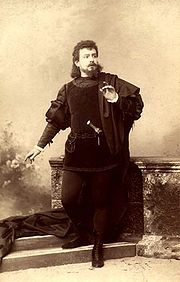
. The following year he was heard again in London, appearing no longer at Drury Lane but at the Royal Opera House
, Covent Garden
, lending his unique blend of dash and charm to the following roles: Vasco da Gama in L'Africaine
and Raoul in Les Huguenots
(both by Meyerbeer), Faust in Faust
(by Gounod), Lohengrin in Lohengrin
(by Wagner), Riccardo in Un Ballo in Maschera
(by Verdi), and Radames again.
De Reszke's 1888 Covent Garden appearances proved exceedingly popular with audiences. Indeed, they were mainly responsible for the revival of the operatic art form as a fashionable amusement in London. He would sing in the British capital nearly every year until 1900, adding a number of new roles to his canon during this time. They included, among others, John of Leyden in Meyerbeer's Le Prophéte
, Don José in Bizet's Carmen
, Roméo in Gounod's Roméo et Juliette
, and Wagner's Tristan in Tristan und Isolde
, Walther von Stolzing in Die Meistersinger von Nürnberg
and Siegfried in Siegfried
. He also gave (in 1894) a single performance as the tenor lead in Massenet's Werther
. De Reszke's singing was admired by Queen Victoria, and between 1889 and 1900 he was invited to take part in a number of royal galas mounted at Covent Garden or command performances held privately at Windsor Castle
.
In 1891, de Reszke sang in the United States for the first time. From 1893 to 1899 he starred in every season at the Metropolitan Opera House
in New York City
, virtually duplicating his London list of operatic roles and having an equally charismatic effect on trans-Atlantic audiences. One of De Reszke's colleagues, the Australian lyric soprano
Nellie Melba
, became a close personal friend of his during this period. She replaced the ageing star Adelina Patti
as the most celebrated of his various stage partners, and she speaks admiringly of him in her memoirs.
He was closely associated with the French and Wagnerian operatic repertoires during the peak of his career at Covent Garden and the Met. His French signature parts were considered to be Meyerbeer's three big tenor heroes (Vasco, Jean and Raoul), Gounod's Faust and Romeo, and the title role in Massenet's Le Cid
(which was written expressly for him).
De Reszke was equally successful singing in German, and his appearances as Lohengrin
, Walther von Stolzing
, Siegfried
and Tristan
were lauded by music critics, who praised him for demonstrating how the extremely demanding and often declamatory music that Wagner wrote for his heldentenors could be sung with beauty of tone and, wherever practicable, a smooth legato line. American-born Lillian Nordica
was the most illustrious of the dramatic sopranos that partnered him in Wagner's operas.
During his heyday, De Reszke sang Italian operas less frequently than French or Wagnerian ones. Indeed, in 1891, his keenly awaited interpretation of the title role in Verdi's last tragic masterpiece, Otello
, had disappointed the critics somewhat; while expertly sung, it lacked the clarion ring and elemental force that his main tenor rival, Francesco Tamagno
(1850-1905), had brought to the part.
He subsequently busied himself breeding racehorses in Poland and teaching singing in Paris and at Nice
on the French Riviera
. His pupils came from a variety of countries and included Bidú Sayão
, Louise Edvina, Claire Croiza
, Arthur Endrèze, Vladimir Rosing
, Mafalda Salvatini
, Clive Carey
, Maggie Teyte
and Miriam Licette
. The already well established Austrian tenor Leo Slezak
also took lessons from de Reszke in 1908-1909, seeking advice on how to further improve his vocal technique.
De Reszke died at his villa in Nice in 1925, having contracted influenza. He was aged 75.
Noted for his rounded timbre and matchless ability to combine a virile singing style with an exceptional degree of gracefulness and vocal refinement, de Reszke is generally regarded as being one of the very greatest tenors of all time. It is therefore highly unfortunate that the release of his only two commercial gramophone record
s, cut in Paris in 1905 for the Fonotipia label, never took place as intended. The matrices and test pressings appear to have been destroyed when de Reszke expressed his disappointment with the results. (Rumours of the survival of one of these discs, current in the 1950s, are to be discounted). Only a few Mapleson Cylinders
, primitive recordings made privately during actual performances at the New York Metropolitan Opera in 1901, exist to give us a faint souvenir of him at work. They have been released on CD by the Symposium label, together with transfers of similar cylinders bearing snatches of the voices of other Met artists of the era.
, born in Warsaw on 22 December 1853, was also internationally famous as an operatic singer—but in the basso
range. Edouard appeared for the first time in an opera, Aida, in Paris in April 1876, under Verdi's baton. His debut was a success and he proceeded to sing with distinction alongside his brother for many years on the London-Paris-New York circuit. Edouard was said to have had an even more impressive voice than the one possessed by his older brother; but music critics considered Jean to have been the more cultured, conscientious and sophisticated artist of the two.
The de Reszke brothers were siblings of the soprano Josephine de Reszke
(1855-1891), who gave up a promising operatic career in Paris in 1885 at the request of her aristocratic husband. Edouard, however, continued to sing opera until 1903. After living for a time in London, he went back to Poland where he passed away in reduced circumstances in 1917. Unlike Jean, Edouard left a few commercial recordings of his voice. Unfortunately these were made by Columbia Records
in New York when he was past his prime as a singer. (See the entry for Edouard de Reszke in vocal historian Michael Scott
's The Record of Singing, Volume One, published by Duckworth, London, 1977.)
Poland
Poland , officially the Republic of Poland , is a country in Central Europe bordered by Germany to the west; the Czech Republic and Slovakia to the south; Ukraine, Belarus and Lithuania to the east; and the Baltic Sea and Kaliningrad Oblast, a Russian exclave, to the north...
tenor
Tenor
The tenor is a type of male singing voice and is the highest male voice within the modal register. The typical tenor voice lies between C3, the C one octave below middle C, to the A above middle C in choral music, and up to high C in solo work. The low extreme for tenors is roughly B2...
. Renowned internationally for the high quality of his singing and the elegance of his bearing, he became the biggest male opera
Opera
Opera is an art form in which singers and musicians perform a dramatic work combining text and musical score, usually in a theatrical setting. Opera incorporates many of the elements of spoken theatre, such as acting, scenery, and costumes and sometimes includes dance...
star of the late 19th century.
Early years
De Reszke was born into comfortable circumstances in the City of WarsawWarsaw
Warsaw is the capital and largest city of Poland. It is located on the Vistula River, roughly from the Baltic Sea and from the Carpathian Mountains. Its population in 2010 was estimated at 1,716,855 residents with a greater metropolitan area of 2,631,902 residents, making Warsaw the 10th most...
in 1850. Both his parents were Poles; his father was a state official and his mother a capable amateur singer, their house being a recognized musical centre. He sang as a boy in Warsaw's cathedral and later studied law at the city's university
University of Warsaw
The University of Warsaw is the largest university in Poland and one of the most prestigious, ranked as best Polish university in 2010 and 2011...
; but after a few years he abandoned his legal training and went to Milan
Milan
Milan is the second-largest city in Italy and the capital city of the region of Lombardy and of the province of Milan. The city proper has a population of about 1.3 million, while its urban area, roughly coinciding with its administrative province and the bordering Province of Monza and Brianza ,...
in Italy to study voice. The most acclaimed of the pedagogues consulted by the young de Reszke was Antonio Cotogni
Antonio Cotogni
Antonio Cotogni was an Italian baritone of the first magnitude. Regarded internationally as being one of the greatest male opera singers of the 19th century, he was particularly admired by the composer Giuseppe Verdi...
, an eminent baritone
Baritone
Baritone is a type of male singing voice that lies between the bass and tenor voices. It is the most common male voice. Originally from the Greek , meaning deep sounding, music for this voice is typically written in the range from the second F below middle C to the F above middle C Baritone (or...
who was a favorite of Giuseppe Verdi
Giuseppe Verdi
Giuseppe Fortunino Francesco Verdi was an Italian Romantic composer, mainly of opera. He was one of the most influential composers of the 19th century...
's.
In January 1874, de Reszke made his debut, undertaking the baritone part of Alfonso in a production of Donizetti's La Favorita
La favorite
La favorite is an opera in four acts by Gaetano Donizetti to a French-language libretto by Alphonse Royer and Gustave Vaëz, based on the play Le comte de Comminges by Baculard d'Arnaud...
in Venice
Venice
Venice is a city in northern Italy which is renowned for the beauty of its setting, its architecture and its artworks. It is the capital of the Veneto region...
. The following April, he sang for the first time in London
London
London is the capital city of :England and the :United Kingdom, the largest metropolitan area in the United Kingdom, and the largest urban zone in the European Union by most measures. Located on the River Thames, London has been a major settlement for two millennia, its history going back to its...
, performing at the Theatre Royal, Drury Lane
Theatre Royal, Drury Lane
The Theatre Royal, Drury Lane is a West End theatre in Covent Garden, in the City of Westminster, a borough of London. The building faces Catherine Street and backs onto Drury Lane. The building standing today is the most recent in a line of four theatres at the same location dating back to 1663,...
, and a little later in Paris
Paris
Paris is the capital and largest city in France, situated on the river Seine, in northern France, at the heart of the Île-de-France region...
, essaying an array of different baritone roles.
De Reszke displayed limitations as a baritone and he withdrew from the stage to allow for a further period of study, this time with Giovanni Sbriglia
Giovanni Sbriglia
Giovanni Sbriglia , was an Italian tenor and prominent teacher of singing.A native of Naples, Sbriglia attended the city's music conservatory before making his debut, aged 21, at the Teatro San Carlo. He then performed throughout Italy before being engaged by Max Maretzek for New York City's...
in Paris. Under Sbirgilia's tutelage, his voice gained remarkably in the freedom of its upper register. Accordingly, when he made his first operatic reappearance in 1879 (in Madrid
Madrid
Madrid is the capital and largest city of Spain. The population of the city is roughly 3.3 million and the entire population of the Madrid metropolitan area is calculated to be 6.271 million. It is the third largest city in the European Union, after London and Berlin, and its metropolitan...
), it was as a tenor, scoring a success in the title-role of Meyerbeer's Robert le Diable
Robert le diable
Robert le diable may refer to:* Robert le diable by Giacomo Meyerbeer* Robert the Devil, a medieval legend...
. Indeed, the then 29-year-old de Reszke's immense fame as a singer dates from this moment.
Fame
He sang regularly at the Paris Opéra during the ensuing years of his vocal prime and, in 1887, was re-engaged by the management at London's Drury Lane, delivering among other things a notable Radames in Verdi's AidaAida
Aida sometimes spelled Aïda, is an opera in four acts by Giuseppe Verdi to an Italian libretto by Antonio Ghislanzoni, based on a scenario written by French Egyptologist Auguste Mariette...
. The following year he was heard again in London, appearing no longer at Drury Lane but at the Royal Opera House
Royal Opera House
The Royal Opera House is an opera house and major performing arts venue in Covent Garden, central London. The large building is often referred to as simply "Covent Garden", after a previous use of the site of the opera house's original construction in 1732. It is the home of The Royal Opera, The...
, Covent Garden
Covent Garden
Covent Garden is a district in London on the eastern fringes of the West End, between St. Martin's Lane and Drury Lane. It is associated with the former fruit and vegetable market in the central square, now a popular shopping and tourist site, and the Royal Opera House, which is also known as...
, lending his unique blend of dash and charm to the following roles: Vasco da Gama in L'Africaine
L'Africaine
L'africaine is a grand opera, the last work of the composer Giacomo Meyerbeer. The French libretto was written by Eugène Scribe. The opera is about fictitious events in the life of the real historical person Vasco da Gama...
and Raoul in Les Huguenots
Les Huguenots
Les Huguenots is a French opera by Giacomo Meyerbeer, one of the most popular and spectacular examples of the style of grand opera. The opera is in five acts and premiered in Paris in 1836. The libretto was written by Eugène Scribe and Émile Deschamps....
(both by Meyerbeer), Faust in Faust
Faust
Faust is the protagonist of a classic German legend; a highly successful scholar, but also dissatisfied with his life, and so makes a deal with the devil, exchanging his soul for unlimited knowledge and worldly pleasures. Faust's tale is the basis for many literary, artistic, cinematic, and musical...
(by Gounod), Lohengrin in Lohengrin
Lohengrin (opera)
Lohengrin is a romantic opera in three acts composed and written by Richard Wagner, first performed in 1850. The story of the eponymous character is taken from medieval German romance, notably the Parzival of Wolfram von Eschenbach and its sequel, Lohengrin, written by a different author, itself...
(by Wagner), Riccardo in Un Ballo in Maschera
Un ballo in maschera
Un ballo in maschera , is an opera in three acts by Giuseppe Verdi with text by Antonio Somma. The libretto is loosely based on an 1833 play, Gustave III, by French playwright Eugène Scribe who wrote about the historical assassination of King Gustav III of Sweden...
(by Verdi), and Radames again.
De Reszke's 1888 Covent Garden appearances proved exceedingly popular with audiences. Indeed, they were mainly responsible for the revival of the operatic art form as a fashionable amusement in London. He would sing in the British capital nearly every year until 1900, adding a number of new roles to his canon during this time. They included, among others, John of Leyden in Meyerbeer's Le Prophéte
Le prophète
Le prophète is an opera in five acts by Giacomo Meyerbeer. The French-language libretto was by Eugène Scribe.-Performance history:...
, Don José in Bizet's Carmen
Carmen
Carmen is a French opéra comique by Georges Bizet. The libretto is by Henri Meilhac and Ludovic Halévy, based on the novella of the same title by Prosper Mérimée, first published in 1845, itself possibly influenced by the narrative poem The Gypsies by Alexander Pushkin...
, Roméo in Gounod's Roméo et Juliette
Roméo et Juliette
Roméo et Juliette is an opéra in five acts by Charles Gounod to a French libretto by Jules Barbier and Michel Carré, based on The Tragedy of Romeo and Juliet by William Shakespeare. It was first performed at the Théâtre Lyrique , Paris on 27 April 1867...
, and Wagner's Tristan in Tristan und Isolde
Tristan und Isolde
Tristan und Isolde is an opera, or music drama, in three acts by Richard Wagner to a German libretto by the composer, based largely on the romance by Gottfried von Straßburg. It was composed between 1857 and 1859 and premiered in Munich on 10 June 1865 with Hans von Bülow conducting...
, Walther von Stolzing in Die Meistersinger von Nürnberg
Die Meistersinger von Nürnberg
Die Meistersinger von Nürnberg is an opera in three acts, written and composed by Richard Wagner. It is among the longest operas still commonly performed today, usually taking around four and a half hours. It was first performed at the Königliches Hof- und National-Theater in Munich, on June 21,...
and Siegfried in Siegfried
Siegfried (opera)
Siegfried is the third of the four operas that constitute Der Ring des Nibelungen , by Richard Wagner. It received its premiere at the Bayreuth Festspielhaus on 16 August 1876, as part of the first complete performance of The Ring...
. He also gave (in 1894) a single performance as the tenor lead in Massenet's Werther
Werther
Werther is an opera in four acts by Jules Massenet to a French libretto by Édouard Blau, Paul Milliet and Georges Hartmann based on the German epistolary novel The Sorrows of Young Werther by Johann Wolfgang von Goethe....
. De Reszke's singing was admired by Queen Victoria, and between 1889 and 1900 he was invited to take part in a number of royal galas mounted at Covent Garden or command performances held privately at Windsor Castle
Windsor Castle
Windsor Castle is a medieval castle and royal residence in Windsor in the English county of Berkshire, notable for its long association with the British royal family and its architecture. The original castle was built after the Norman invasion by William the Conqueror. Since the time of Henry I it...
.
In 1891, de Reszke sang in the United States for the first time. From 1893 to 1899 he starred in every season at the Metropolitan Opera House
Metropolitan Opera House (39th St)
The Metropolitan Opera House was an opera house located at 1411 Broadway in New York City. Opened in 1883 and demolished in 1967, it was the first home of the Metropolitan Opera Company.-History:...
in New York City
New York City
New York is the most populous city in the United States and the center of the New York Metropolitan Area, one of the most populous metropolitan areas in the world. New York exerts a significant impact upon global commerce, finance, media, art, fashion, research, technology, education, and...
, virtually duplicating his London list of operatic roles and having an equally charismatic effect on trans-Atlantic audiences. One of De Reszke's colleagues, the Australian lyric soprano
Soprano
A soprano is a voice type with a vocal range from approximately middle C to "high A" in choral music, or to "soprano C" or higher in operatic music. In four-part chorale style harmony, the soprano takes the highest part, which usually encompasses the melody...
Nellie Melba
Nellie Melba
Dame Nellie Melba GBE , born Helen "Nellie" Porter Mitchell, was an Australian operatic soprano. She became one of the most famous singers of the late Victorian Era and the early 20th century...
, became a close personal friend of his during this period. She replaced the ageing star Adelina Patti
Adelina Patti
Adelina Patti was a highly acclaimed 19th-century opera singer, earning huge fees at the height of her career in the music capitals of Europe and America. She first sang in public as a child in 1851 and gave her last performance before an audience in 1914...
as the most celebrated of his various stage partners, and she speaks admiringly of him in her memoirs.
He was closely associated with the French and Wagnerian operatic repertoires during the peak of his career at Covent Garden and the Met. His French signature parts were considered to be Meyerbeer's three big tenor heroes (Vasco, Jean and Raoul), Gounod's Faust and Romeo, and the title role in Massenet's Le Cid
Le Cid
Le Cid is a tragicomedy written by Pierre Corneille and published in 1636. It is based on the legend of El Cid.The play followed Corneille's first true tragedy, Médée, produced in 1635. An enormous popular success, Corneille's Le Cid was the subject of a heated polemic over the norms of dramatic...
(which was written expressly for him).
De Reszke was equally successful singing in German, and his appearances as Lohengrin
Lohengrin (opera)
Lohengrin is a romantic opera in three acts composed and written by Richard Wagner, first performed in 1850. The story of the eponymous character is taken from medieval German romance, notably the Parzival of Wolfram von Eschenbach and its sequel, Lohengrin, written by a different author, itself...
, Walther von Stolzing
Die Meistersinger von Nürnberg
Die Meistersinger von Nürnberg is an opera in three acts, written and composed by Richard Wagner. It is among the longest operas still commonly performed today, usually taking around four and a half hours. It was first performed at the Königliches Hof- und National-Theater in Munich, on June 21,...
, Siegfried
Siegfried (opera)
Siegfried is the third of the four operas that constitute Der Ring des Nibelungen , by Richard Wagner. It received its premiere at the Bayreuth Festspielhaus on 16 August 1876, as part of the first complete performance of The Ring...
and Tristan
Tristan und Isolde
Tristan und Isolde is an opera, or music drama, in three acts by Richard Wagner to a German libretto by the composer, based largely on the romance by Gottfried von Straßburg. It was composed between 1857 and 1859 and premiered in Munich on 10 June 1865 with Hans von Bülow conducting...
were lauded by music critics, who praised him for demonstrating how the extremely demanding and often declamatory music that Wagner wrote for his heldentenors could be sung with beauty of tone and, wherever practicable, a smooth legato line. American-born Lillian Nordica
Lillian Nordica
Lillian Nordica was an American opera singer who had a major stage career in Europe and her native country....
was the most illustrious of the dramatic sopranos that partnered him in Wagner's operas.
During his heyday, De Reszke sang Italian operas less frequently than French or Wagnerian ones. Indeed, in 1891, his keenly awaited interpretation of the title role in Verdi's last tragic masterpiece, Otello
Otello
Otello is an opera in four acts by Giuseppe Verdi to an Italian libretto by Arrigo Boito, based on Shakespeare's play Othello. It was Verdi's penultimate opera, and was first performed at the Teatro alla Scala, Milan, on February 5, 1887....
, had disappointed the critics somewhat; while expertly sung, it lacked the clarion ring and elemental force that his main tenor rival, Francesco Tamagno
Francesco Tamagno
Francesco Tamagno was an operatic tenor from Italy who sang with enormous success throughout Europe and America. On 5 February 1887, he cemented his place in musical history by creating the role of Otello in Giuseppe Verdi's masterpiece of the same name...
(1850-1905), had brought to the part.
Retirement activities, the 'lost' recordings & death
De Reszke married a countess in 1896. He reduced his performance load during the opening years of the 20th century. Prudently, in 1904, he decided to retire while his voice was still in good shape, citing illness as the reason for his departure. Enrico Caruso, 23 years de Reszke's junior, took up his mantle as the world's most famous tenor. (Unlike de Reszke, however, Caruso did not choose to become an exponent of Wagnerian opera.)He subsequently busied himself breeding racehorses in Poland and teaching singing in Paris and at Nice
Nice
Nice is the fifth most populous city in France, after Paris, Marseille, Lyon and Toulouse, with a population of 348,721 within its administrative limits on a land area of . The urban area of Nice extends beyond the administrative city limits with a population of more than 955,000 on an area of...
on the French Riviera
French Riviera
The Côte d'Azur, pronounced , often known in English as the French Riviera , is the Mediterranean coastline of the southeast corner of France, also including the sovereign state of Monaco...
. His pupils came from a variety of countries and included Bidú Sayão
Bidu Sayão
Bidú Sayão was a Brazilian opera soprano. One of Brazil's most famous musicians, Sayão was a leading artist of the Metropolitan Opera in New York City from 1937 to 1952.-Life and career:...
, Louise Edvina, Claire Croiza
Claire Croiza
Claire Croiza was a French mezzo-soprano and an influential teacher of singers.-Career:Claire Croiza was born in Paris, the daughter of an expatriate American father and an Italian mother, and as a child she excelled at piano and singing...
, Arthur Endrèze, Vladimir Rosing
Vladimir Rosing
Vladimir Sergeyevich Rosing , aka Val Rosing, was a Russian-born operatic tenor and stage director who spent most of his professional career in England and the United States...
, Mafalda Salvatini
Mafalda Salvatini
Mafalda Salvatini was an Italian opera singer who was primarily active in Germany during the first half of the 20th century. She excelled in the dramatic soprano repertoire of the Italian language and was one of the leading operatic sopranos in Berlin from 1908-1932...
, Clive Carey
Clive Carey
Francis Clive Savill Carey CBE , known as Clive Carey, was a British baritone, singing teacher, composer, opera producer and folk song collector.-Biography:Clive Carey was born at Sible Hedingham, Essex in 1883...
, Maggie Teyte
Maggie Teyte
Dame Maggie Teyte DBE was an English operatic soprano and interpreter of French art song.-Early years:Margaret Tate was born in Wolverhampton, England, one of ten children of Jacob James Tate, a successful wine and spirit merchant and proprietor of public houses and later lodgings. Her parents...
and Miriam Licette
Miriam Licette
Miriam Licette was an English operatic soprano whose career spanned 35 years, from the mid-1910s to after World War II. She was also a singing teacher, and created the Miriam Licette Scholarship.-Career:...
. The already well established Austrian tenor Leo Slezak
Leo Slezak
Leo Slezak was a world-famous Moravian tenor. He was associated in particular with German opera as well as the title role in Verdi's Otello.- Beginnings :...
also took lessons from de Reszke in 1908-1909, seeking advice on how to further improve his vocal technique.
De Reszke died at his villa in Nice in 1925, having contracted influenza. He was aged 75.
Noted for his rounded timbre and matchless ability to combine a virile singing style with an exceptional degree of gracefulness and vocal refinement, de Reszke is generally regarded as being one of the very greatest tenors of all time. It is therefore highly unfortunate that the release of his only two commercial gramophone record
Gramophone record
A gramophone record, commonly known as a phonograph record , vinyl record , or colloquially, a record, is an analog sound storage medium consisting of a flat disc with an inscribed, modulated spiral groove...
s, cut in Paris in 1905 for the Fonotipia label, never took place as intended. The matrices and test pressings appear to have been destroyed when de Reszke expressed his disappointment with the results. (Rumours of the survival of one of these discs, current in the 1950s, are to be discounted). Only a few Mapleson Cylinders
Mapleson Cylinders
The Mapleson Cylinders are a group of more than 100 phonograph cylinders recorded live at the Metropolitan Opera, primarily in the years 1901–1903, by the Met librarian Lionel Mapleson ....
, primitive recordings made privately during actual performances at the New York Metropolitan Opera in 1901, exist to give us a faint souvenir of him at work. They have been released on CD by the Symposium label, together with transfers of similar cylinders bearing snatches of the voices of other Met artists of the era.
His sibling singers
Jean de Reszke's younger brother, Edouard de ReszkeEdouard de Reszke
Édouard de Reszke, originally Edward, was a Polish bass from Warsaw. Born with an impressive natural voice and equipped with compelling histrionic skills, he became one of the most illustrious opera singers active in Europe and America during the late-Victorian Era.-Career:Édouard de Reszke was...
, born in Warsaw on 22 December 1853, was also internationally famous as an operatic singer—but in the basso
Bass (voice type)
A bass is a type of male singing voice and possesses the lowest vocal range of all voice types. According to The New Grove Dictionary of Opera, a bass is typically classified as having a range extending from around the second E below middle C to the E above middle C...
range. Edouard appeared for the first time in an opera, Aida, in Paris in April 1876, under Verdi's baton. His debut was a success and he proceeded to sing with distinction alongside his brother for many years on the London-Paris-New York circuit. Edouard was said to have had an even more impressive voice than the one possessed by his older brother; but music critics considered Jean to have been the more cultured, conscientious and sophisticated artist of the two.
The de Reszke brothers were siblings of the soprano Josephine de Reszke
Josephine de Reszke
Joséphine de Reszke, in Polish Józefina Reszke, was a Polish soprano. Born in Warsaw, she was the sister of the bass Edouard and the tenor Jean de Reszke, famous singers in their own rights. She began her studies with her mother and with a Mme...
(1855-1891), who gave up a promising operatic career in Paris in 1885 at the request of her aristocratic husband. Edouard, however, continued to sing opera until 1903. After living for a time in London, he went back to Poland where he passed away in reduced circumstances in 1917. Unlike Jean, Edouard left a few commercial recordings of his voice. Unfortunately these were made by Columbia Records
Columbia Records
Columbia Records is an American record label, owned by Japan's Sony Music Entertainment, operating under the Columbia Music Group with Aware Records. It was founded in 1888, evolving from an earlier enterprise, the American Graphophone Company — successor to the Volta Graphophone Company...
in New York when he was past his prime as a singer. (See the entry for Edouard de Reszke in vocal historian Michael Scott
Michael Scott (artistic director)
Michael Scott is the founder of the London Opera Society. In his role as the society's sole artistic director, he brought to London Marilyn Horne, Joan Sutherland, and Boris Christoff. He was also responsible for introducing Sherrill Milnes, Ruggero Raimondi, and Montserrat Caballe...
's The Record of Singing, Volume One, published by Duckworth, London, 1977.)
Jean de Reszke's appearances at the Royal Opera House, Covent Garden
- 1888 - Royal Italian Opera Season (15 May - 21 July)
- as Vasco da Gama in L'AfricaineL'AfricaineL'africaine is a grand opera, the last work of the composer Giacomo Meyerbeer. The French libretto was written by Eugène Scribe. The opera is about fictitious events in the life of the real historical person Vasco da Gama...
(2, debut at Covent Garden in this role on 4 June) - as Radames in AidaAidaAida sometimes spelled Aïda, is an opera in four acts by Giuseppe Verdi to an Italian libretto by Antonio Ghislanzoni, based on a scenario written by French Egyptologist Auguste Mariette...
(1) - as Riccardo in Ballo in maschera (1)
- as Faust in FaustFaust (opera)Faust is a drame lyrique in five acts by Charles Gounod to a French libretto by Jules Barbier and Michel Carré from Carré's play Faust et Marguerite, in turn loosely based on Johann Wolfgang von Goethe's Faust, Part 1...
(7, shared) - as Raoul in Les HuguenotsLes HuguenotsLes Huguenots is a French opera by Giacomo Meyerbeer, one of the most popular and spectacular examples of the style of grand opera. The opera is in five acts and premiered in Paris in 1836. The libretto was written by Eugène Scribe and Émile Deschamps....
(4) - as Lohengrin in LohengrinLohengrin (opera)Lohengrin is a romantic opera in three acts composed and written by Richard Wagner, first performed in 1850. The story of the eponymous character is taken from medieval German romance, notably the Parzival of Wolfram von Eschenbach and its sequel, Lohengrin, written by a different author, itself...
(6)
- as Vasco da Gama in L'Africaine
- 1889 - Royal Italian Opera Season (18 May - 27 July)
- as Radames in AidaAidaAida sometimes spelled Aïda, is an opera in four acts by Giuseppe Verdi to an Italian libretto by Antonio Ghislanzoni, based on a scenario written by French Egyptologist Auguste Mariette...
(3, shared) - as Raoul in Les HuguenotsLes HuguenotsLes Huguenots is a French opera by Giacomo Meyerbeer, one of the most popular and spectacular examples of the style of grand opera. The opera is in five acts and premiered in Paris in 1836. The libretto was written by Eugène Scribe and Émile Deschamps....
(3) - as Lohengrin in LohengrinLohengrin (opera)Lohengrin is a romantic opera in three acts composed and written by Richard Wagner, first performed in 1850. The story of the eponymous character is taken from medieval German romance, notably the Parzival of Wolfram von Eschenbach and its sequel, Lohengrin, written by a different author, itself...
(6, shared) - as Walther von Stolzing in Die Meistersinger (4)
- as Romeo in Roméo et JulietteRoméo et JulietteRoméo et Juliette is an opéra in five acts by Charles Gounod to a French libretto by Jules Barbier and Michel Carré, based on The Tragedy of Romeo and Juliet by William Shakespeare. It was first performed at the Théâtre Lyrique , Paris on 27 April 1867...
(7)
- as Radames in Aida
- 1890 - Royal Italian Opera Season (19 May - 28 July)
- as Don Josè in CarmenCarmenCarmen is a French opéra comique by Georges Bizet. The libretto is by Henri Meilhac and Ludovic Halévy, based on the novella of the same title by Prosper Mérimée, first published in 1845, itself possibly influenced by the narrative poem The Gypsies by Alexander Pushkin...
(5) - as Phoebus in Esmeralda (3)
- as Faust in FaustFaust (opera)Faust is a drame lyrique in five acts by Charles Gounod to a French libretto by Jules Barbier and Michel Carré from Carré's play Faust et Marguerite, in turn loosely based on Johann Wolfgang von Goethe's Faust, Part 1...
(6, shared) - as Lohengrin in LohengrinLohengrin (opera)Lohengrin is a romantic opera in three acts composed and written by Richard Wagner, first performed in 1850. The story of the eponymous character is taken from medieval German romance, notably the Parzival of Wolfram von Eschenbach and its sequel, Lohengrin, written by a different author, itself...
(5, shared) - as Walther von Stolzing in Die Meistersinger (4)
- as Jean de Leyden in Le ProphèteLe prophèteLe prophète is an opera in five acts by Giacomo Meyerbeer. The French-language libretto was by Eugène Scribe.-Performance history:...
(5) - as Romeo in Roméo et JulietteRoméo et JulietteRoméo et Juliette is an opéra in five acts by Charles Gounod to a French libretto by Jules Barbier and Michel Carré, based on The Tragedy of Romeo and Juliet by William Shakespeare. It was first performed at the Théâtre Lyrique , Paris on 27 April 1867...
(5)
- as Don Josè in Carmen
- 1891 - Royal Italian Opera Season (6 April - 27 July)
- as Don Josè in CarmenCarmenCarmen is a French opéra comique by Georges Bizet. The libretto is by Henri Meilhac and Ludovic Halévy, based on the novella of the same title by Prosper Mérimée, first published in 1845, itself possibly influenced by the narrative poem The Gypsies by Alexander Pushkin...
(7, shared) - as Faust in FaustFaust (opera)Faust is a drame lyrique in five acts by Charles Gounod to a French libretto by Jules Barbier and Michel Carré from Carré's play Faust et Marguerite, in turn loosely based on Johann Wolfgang von Goethe's Faust, Part 1...
(12, shared) - as Raoul in Les HuguenotsLes HuguenotsLes Huguenots is a French opera by Giacomo Meyerbeer, one of the most popular and spectacular examples of the style of grand opera. The opera is in five acts and premiered in Paris in 1836. The libretto was written by Eugène Scribe and Émile Deschamps....
(8, shared) - as Lohengrin in LohengrinLohengrin (opera)Lohengrin is a romantic opera in three acts composed and written by Richard Wagner, first performed in 1850. The story of the eponymous character is taken from medieval German romance, notably the Parzival of Wolfram von Eschenbach and its sequel, Lohengrin, written by a different author, itself...
(9, shared) - as Walther von Stolzing in Die Meistersinger (2, shared)
- as Otello in OtelloOtelloOtello is an opera in four acts by Giuseppe Verdi to an Italian libretto by Arrigo Boito, based on Shakespeare's play Othello. It was Verdi's penultimate opera, and was first performed at the Teatro alla Scala, Milan, on February 5, 1887....
(4) - as Jean de Leyden in Le ProphèteLe prophèteLe prophète is an opera in five acts by Giacomo Meyerbeer. The French-language libretto was by Eugène Scribe.-Performance history:...
(3) - as Romeo in Roméo et JulietteRoméo et JulietteRoméo et Juliette is an opéra in five acts by Charles Gounod to a French libretto by Jules Barbier and Michel Carré, based on The Tragedy of Romeo and Juliet by William Shakespeare. It was first performed at the Théâtre Lyrique , Paris on 27 April 1867...
(8)
- as Don Josè in Carmen
- 1892 - Royal Opera Season (16 May - 28 July)
- as Don Josè in CarmenCarmenCarmen is a French opéra comique by Georges Bizet. The libretto is by Henri Meilhac and Ludovic Halévy, based on the novella of the same title by Prosper Mérimée, first published in 1845, itself possibly influenced by the narrative poem The Gypsies by Alexander Pushkin...
(2, shared) - as Lancelot in ElaineElaineElaine may refer to:* Elaine , name shared by several different female characters in Arthurian legend* "Elaine" , 1945 short story by J. D...
(5) - as Lohengrin in LohengrinLohengrin (opera)Lohengrin is a romantic opera in three acts composed and written by Richard Wagner, first performed in 1850. The story of the eponymous character is taken from medieval German romance, notably the Parzival of Wolfram von Eschenbach and its sequel, Lohengrin, written by a different author, itself...
(5, shared) - as Jean de Leyden in Le ProphèteLe prophèteLe prophète is an opera in five acts by Giacomo Meyerbeer. The French-language libretto was by Eugène Scribe.-Performance history:...
(1) - as Romeo in Roméo et JulietteRoméo et JulietteRoméo et Juliette is an opéra in five acts by Charles Gounod to a French libretto by Jules Barbier and Michel Carré, based on The Tragedy of Romeo and Juliet by William Shakespeare. It was first performed at the Théâtre Lyrique , Paris on 27 April 1867...
(3)
- as Don Josè in Carmen
- 1893 - Royal Opera Season (15 May - 29 July)
- as Faust in FaustFaust (opera)Faust is a drame lyrique in five acts by Charles Gounod to a French libretto by Jules Barbier and Michel Carré from Carré's play Faust et Marguerite, in turn loosely based on Johann Wolfgang von Goethe's Faust, Part 1...
(6, shared) - as Raoul in Les HuguenotsLes HuguenotsLes Huguenots is a French opera by Giacomo Meyerbeer, one of the most popular and spectacular examples of the style of grand opera. The opera is in five acts and premiered in Paris in 1836. The libretto was written by Eugène Scribe and Émile Deschamps....
(2) - as Lohengrin in LohengrinLohengrin (opera)Lohengrin is a romantic opera in three acts composed and written by Richard Wagner, first performed in 1850. The story of the eponymous character is taken from medieval German romance, notably the Parzival of Wolfram von Eschenbach and its sequel, Lohengrin, written by a different author, itself...
(6, shared) - as Walther von Stolzing in Die Meistersinger (2)
- as Romeo in Roméo et JulietteRoméo et JulietteRoméo et Juliette is an opéra in five acts by Charles Gounod to a French libretto by Jules Barbier and Michel Carré, based on The Tragedy of Romeo and Juliet by William Shakespeare. It was first performed at the Théâtre Lyrique , Paris on 27 April 1867...
(7, shared)
- as Faust in Faust
- 1894 - Royal Opera Season (14 May - 30 July)
- as Radames in AidaAidaAida sometimes spelled Aïda, is an opera in four acts by Giuseppe Verdi to an Italian libretto by Antonio Ghislanzoni, based on a scenario written by French Egyptologist Auguste Mariette...
(2, shared) - as Lancelot in ElaineElaineElaine may refer to:* Elaine , name shared by several different female characters in Arthurian legend* "Elaine" , 1945 short story by J. D...
(2) - as Faust in FaustFaust (opera)Faust is a drame lyrique in five acts by Charles Gounod to a French libretto by Jules Barbier and Michel Carré from Carré's play Faust et Marguerite, in turn loosely based on Johann Wolfgang von Goethe's Faust, Part 1...
(7, shared) - as Lohengrin in LohengrinLohengrin (opera)Lohengrin is a romantic opera in three acts composed and written by Richard Wagner, first performed in 1850. The story of the eponymous character is taken from medieval German romance, notably the Parzival of Wolfram von Eschenbach and its sequel, Lohengrin, written by a different author, itself...
(4, shared) - as Walther von Stolzing in Die Meistersinger (1)
- as Romeo in Roméo et JulietteRoméo et JulietteRoméo et Juliette is an opéra in five acts by Charles Gounod to a French libretto by Jules Barbier and Michel Carré, based on The Tragedy of Romeo and Juliet by William Shakespeare. It was first performed at the Théâtre Lyrique , Paris on 27 April 1867...
(7) - as Werther in WertherWertherWerther is an opera in four acts by Jules Massenet to a French libretto by Édouard Blau, Paul Milliet and Georges Hartmann based on the German epistolary novel The Sorrows of Young Werther by Johann Wolfgang von Goethe....
(1)
- as Radames in Aida
- 1896 - Royal Opera Season (11 May - 28 July)
- as Faust in FaustFaust (opera)Faust is a drame lyrique in five acts by Charles Gounod to a French libretto by Jules Barbier and Michel Carré from Carré's play Faust et Marguerite, in turn loosely based on Johann Wolfgang von Goethe's Faust, Part 1...
(6) - as Lohengrin in LohengrinLohengrin (opera)Lohengrin is a romantic opera in three acts composed and written by Richard Wagner, first performed in 1850. The story of the eponymous character is taken from medieval German romance, notably the Parzival of Wolfram von Eschenbach and its sequel, Lohengrin, written by a different author, itself...
(5) - as Walther von Stolzing in Die Meistersinger (5)
- as Romeo in Roméo et JulietteRoméo et JulietteRoméo et Juliette is an opéra in five acts by Charles Gounod to a French libretto by Jules Barbier and Michel Carré, based on The Tragedy of Romeo and Juliet by William Shakespeare. It was first performed at the Théâtre Lyrique , Paris on 27 April 1867...
(8) - as Tristan in Tristan und IsoldeTristan und IsoldeTristan und Isolde is an opera, or music drama, in three acts by Richard Wagner to a German libretto by the composer, based largely on the romance by Gottfried von Straßburg. It was composed between 1857 and 1859 and premiered in Munich on 10 June 1865 with Hans von Bülow conducting...
(4)
- as Faust in Faust
- 1897 - Royal Opera Season (10 May - 28 July)
- as Lohengrin in LohengrinLohengrin (opera)Lohengrin is a romantic opera in three acts composed and written by Richard Wagner, first performed in 1850. The story of the eponymous character is taken from medieval German romance, notably the Parzival of Wolfram von Eschenbach and its sequel, Lohengrin, written by a different author, itself...
(7, shared) - as Walther von Stolzing in Die Meistersinger (3)
- as Romeo in Roméo et JulietteRoméo et JulietteRoméo et Juliette is an opéra in five acts by Charles Gounod to a French libretto by Jules Barbier and Michel Carré, based on The Tragedy of Romeo and Juliet by William Shakespeare. It was first performed at the Théâtre Lyrique , Paris on 27 April 1867...
(6, shared) - as Siegfried in SiegfriedSiegfried (opera)Siegfried is the third of the four operas that constitute Der Ring des Nibelungen , by Richard Wagner. It received its premiere at the Bayreuth Festspielhaus on 16 August 1876, as part of the first complete performance of The Ring...
(4) - as Tristan in Tristan und IsoldeTristan und IsoldeTristan und Isolde is an opera, or music drama, in three acts by Richard Wagner to a German libretto by the composer, based largely on the romance by Gottfried von Straßburg. It was composed between 1857 and 1859 and premiered in Munich on 10 June 1865 with Hans von Bülow conducting...
(3)
- as Lohengrin in Lohengrin
- 1898 - Royal Opera Season (9 May - 16 July)
- as Siegfried in Gottardammerung (3)
- as Lohengrin in LohengrinLohengrin (opera)Lohengrin is a romantic opera in three acts composed and written by Richard Wagner, first performed in 1850. The story of the eponymous character is taken from medieval German romance, notably the Parzival of Wolfram von Eschenbach and its sequel, Lohengrin, written by a different author, itself...
(7, shared) - as Walther von Stolzing in Die Meistersinger (4)
- as Siegfried in SiegfriedSiegfried (opera)Siegfried is the third of the four operas that constitute Der Ring des Nibelungen , by Richard Wagner. It received its premiere at the Bayreuth Festspielhaus on 16 August 1876, as part of the first complete performance of The Ring...
(3, shared) - as Tristan in Tristan und IsoldeTristan und IsoldeTristan und Isolde is an opera, or music drama, in three acts by Richard Wagner to a German libretto by the composer, based largely on the romance by Gottfried von Straßburg. It was composed between 1857 and 1859 and premiered in Munich on 10 June 1865 with Hans von Bülow conducting...
(4)
- 1899 - Royal Opera Season (8 May - 24 July)
- as Faust in FaustFaust (opera)Faust is a drame lyrique in five acts by Charles Gounod to a French libretto by Jules Barbier and Michel Carré from Carré's play Faust et Marguerite, in turn loosely based on Johann Wolfgang von Goethe's Faust, Part 1...
(8, shared) - as Lohengrin in LohengrinLohengrin (opera)Lohengrin is a romantic opera in three acts composed and written by Richard Wagner, first performed in 1850. The story of the eponymous character is taken from medieval German romance, notably the Parzival of Wolfram von Eschenbach and its sequel, Lohengrin, written by a different author, itself...
(6, shared) - as Walther von Stolzing in Die Meistersinger (2)
- as Romeo in Roméo et JulietteRoméo et JulietteRoméo et Juliette is an opéra in five acts by Charles Gounod to a French libretto by Jules Barbier and Michel Carré, based on The Tragedy of Romeo and Juliet by William Shakespeare. It was first performed at the Théâtre Lyrique , Paris on 27 April 1867...
(5, shared) - as Tristan in Tristan und IsoldeTristan und IsoldeTristan und Isolde is an opera, or music drama, in three acts by Richard Wagner to a German libretto by the composer, based largely on the romance by Gottfried von Straßburg. It was composed between 1857 and 1859 and premiered in Munich on 10 June 1865 with Hans von Bülow conducting...
(4)
- as Faust in Faust
- 1900 - Royal Opera Season (14 May - 30 July)
- as Lohengrin in LohengrinLohengrin (opera)Lohengrin is a romantic opera in three acts composed and written by Richard Wagner, first performed in 1850. The story of the eponymous character is taken from medieval German romance, notably the Parzival of Wolfram von Eschenbach and its sequel, Lohengrin, written by a different author, itself...
(6, shared) - as Walther von Stolzing in Die Meistersinger (2)
- as Romeo in Roméo et JulietteRoméo et JulietteRoméo et Juliette is an opéra in five acts by Charles Gounod to a French libretto by Jules Barbier and Michel Carré, based on The Tragedy of Romeo and Juliet by William Shakespeare. It was first performed at the Théâtre Lyrique , Paris on 27 April 1867...
(5, shared)
- as Lohengrin in Lohengrin
Gala appearances with Edouard de Reszke at Covent Garden & command performances at Windsor Castle
- 2 July 1889 - Gala in honour of the ShahShahShāh is the title of the ruler of certain Southwest Asian and Central Asian countries, especially Persia , and derives from the Persian word shah, meaning "king".-History:...
of Persia:- Eduoard as Mephistofele in Act I of MefistofeleMefistofeleMefistofele is an opera in a prologue, four acts and an epilogue, the only completed opera by the Italian composer-librettist Arrigo Boito.-Composition history:...
and as Mefistofele in Act 4 of FaustFaust (opera)Faust is a drame lyrique in five acts by Charles Gounod to a French libretto by Jules Barbier and Michel Carré from Carré's play Faust et Marguerite, in turn loosely based on Johann Wolfgang von Goethe's Faust, Part 1... - Jean as Faust in Act 4 of FaustFaust (opera)Faust is a drame lyrique in five acts by Charles Gounod to a French libretto by Jules Barbier and Michel Carré from Carré's play Faust et Marguerite, in turn loosely based on Johann Wolfgang von Goethe's Faust, Part 1...
- Eduoard as Mephistofele in Act I of Mefistofele
- 8 July 1891 - Visit of the Emperor and Empress of Germany
- Edouard as Enrico in Act 1 of LohengrinLohengrin (opera)Lohengrin is a romantic opera in three acts composed and written by Richard Wagner, first performed in 1850. The story of the eponymous character is taken from medieval German romance, notably the Parzival of Wolfram von Eschenbach and its sequel, Lohengrin, written by a different author, itself...
, as Laurent in Act 4 of Roméo et JulietteRoméo et JulietteRoméo et Juliette is an opéra in five acts by Charles Gounod to a French libretto by Jules Barbier and Michel Carré, based on The Tragedy of Romeo and Juliet by William Shakespeare. It was first performed at the Théâtre Lyrique , Paris on 27 April 1867...
and as San Bris in Act 4 of Les HuguenotsLes HuguenotsLes Huguenots is a French opera by Giacomo Meyerbeer, one of the most popular and spectacular examples of the style of grand opera. The opera is in five acts and premiered in Paris in 1836. The libretto was written by Eugène Scribe and Émile Deschamps.... - Jean as Lohengrin in Act 1 of LohengrinLohengrin (opera)Lohengrin is a romantic opera in three acts composed and written by Richard Wagner, first performed in 1850. The story of the eponymous character is taken from medieval German romance, notably the Parzival of Wolfram von Eschenbach and its sequel, Lohengrin, written by a different author, itself...
, as Romeo in Act 4 of Roméo et JulietteRoméo et JulietteRoméo et Juliette is an opéra in five acts by Charles Gounod to a French libretto by Jules Barbier and Michel Carré, based on The Tragedy of Romeo and Juliet by William Shakespeare. It was first performed at the Théâtre Lyrique , Paris on 27 April 1867...
and as Raoul in Act 4 of Les HuguenotsLes HuguenotsLes Huguenots is a French opera by Giacomo Meyerbeer, one of the most popular and spectacular examples of the style of grand opera. The opera is in five acts and premiered in Paris in 1836. The libretto was written by Eugène Scribe and Émile Deschamps....
- Edouard as Enrico in Act 1 of Lohengrin
- 4 July 1893 - Gala in honour of the marriage of the Duke of YorkDuke of YorkThe Duke of York is a title of nobility in the British peerage. Since the 15th century, it has, when granted, usually been given to the second son of the British monarch. The title has been created a remarkable eleven times, eight as "Duke of York" and three as the double-barreled "Duke of York and...
and Princess Mary of Teck- Edouard as Laurent in Roméo et JulietteRoméo et JulietteRoméo et Juliette is an opéra in five acts by Charles Gounod to a French libretto by Jules Barbier and Michel Carré, based on The Tragedy of Romeo and Juliet by William Shakespeare. It was first performed at the Théâtre Lyrique , Paris on 27 April 1867...
- Jean as Romeo in Roméo et JulietteRoméo et JulietteRoméo et Juliette is an opéra in five acts by Charles Gounod to a French libretto by Jules Barbier and Michel Carré, based on The Tragedy of Romeo and Juliet by William Shakespeare. It was first performed at the Théâtre Lyrique , Paris on 27 April 1867...
- Edouard as Laurent in Roméo et Juliette
- 23 June 1897 - 60th Anniversary of Queen Victoria's accession
- Edouard as Laurent in Act 3 of Roméo et JulietteRoméo et JulietteRoméo et Juliette is an opéra in five acts by Charles Gounod to a French libretto by Jules Barbier and Michel Carré, based on The Tragedy of Romeo and Juliet by William Shakespeare. It was first performed at the Théâtre Lyrique , Paris on 27 April 1867...
- Jean as Romeo in Act 3 of Roméo et JulietteRoméo et JulietteRoméo et Juliette is an opéra in five acts by Charles Gounod to a French libretto by Jules Barbier and Michel Carré, based on The Tragedy of Romeo and Juliet by William Shakespeare. It was first performed at the Théâtre Lyrique , Paris on 27 April 1867...
- Edouard as Laurent in Act 3 of Roméo et Juliette
- 27 June 1898 - Command Performance at Windsor CastleWindsor CastleWindsor Castle is a medieval castle and royal residence in Windsor in the English county of Berkshire, notable for its long association with the British royal family and its architecture. The original castle was built after the Norman invasion by William the Conqueror. Since the time of Henry I it...
(no data on programme) - 24 May 1899 - Command Performance at Windsor Castle
- Edouard as Enrico in LohengrinLohengrin (opera)Lohengrin is a romantic opera in three acts composed and written by Richard Wagner, first performed in 1850. The story of the eponymous character is taken from medieval German romance, notably the Parzival of Wolfram von Eschenbach and its sequel, Lohengrin, written by a different author, itself...
- Jean as Lohengrin in LohengrinLohengrin (opera)Lohengrin is a romantic opera in three acts composed and written by Richard Wagner, first performed in 1850. The story of the eponymous character is taken from medieval German romance, notably the Parzival of Wolfram von Eschenbach and its sequel, Lohengrin, written by a different author, itself...
- Edouard as Enrico in Lohengrin
- 16 July 1900 - Command Performance at Windsor Castle
- Edouard as Mefistofele in FaustFaust (opera)Faust is a drame lyrique in five acts by Charles Gounod to a French libretto by Jules Barbier and Michel Carré from Carré's play Faust et Marguerite, in turn loosely based on Johann Wolfgang von Goethe's Faust, Part 1...
- Edouard as Mefistofele in Faust