
All Topics  
Manon


   Email Print
   Bookmark   Link


Manon


Manon is an opéra comique
Opera Comique

The Opera Comique was a 19th-century opera house constructed between Wych Street and Holywell Street with entrances on the East Strand, London. The theatre opened in 1870 and was demolished in 1902, for the construction of the Aldwych and Kingsway....
 in five acts by Jules Massenet
Jules Massenet

Jules Massenet was a France composer best known for his operas. His compositions were very popular in the late 19th and early 20th centuries, and he ranks as one of the greatest melodists of his era....
 to a French libretto
Libretto

A libretto is the text used in an extended musical work such as an opera, operetta, masque, sacred or secular oratorio and cantata, Musical theater, and ballet....
 by Henri Meilhac
Henri Meilhac

Henri Meilhac , was a France dramatist and opera librettist....
 and Philippe Gille
Philippe Gille

Philippe Gille was a France dramatist and opera librettist. He wrote over twenty librettos between 1857 and 1893, the most famous of which are Massenet's Manon and L?o Delibes' Lakm?....
, based on L’histoire du chevalier des Grieux et de Manon Lescaut by Abbé Prévost. It was first performed at the Opéra-Comique
Opéra-Comique

The th??tre national de l?Op?ra-Comique is an opera company and opera house in Paris. It is located in the place Boieldieu, in the IIe arrondissement of Paris, near the Paris Stock Exchange and not far from the Palais Garnier, home of the Op?ra National de Paris....
 in Paris on January 19, 1884.

Manon is Massenet's most popular and enduring opera, having maintained an important place in the repertory since its creation. It is the quintessential example of the charm and vitality of the music and culture of the Parisian Belle Époque
Belle Époque

The Belle ?poque was a period in history of Europe that began during the late 19th century and lasted until World War I. Occurring during the time of the French Third Republic and the German Empire, the "Belle ?poque" was named in retrospect, when it began to be considered a "golden age" for the upper classes, as peace prevailed among the m...
.


Discussion
Ask a question about 'Manon'
Start a new discussion about 'Manon'
Answer questions from other users
Full Discussion Forum


Encyclopedia


Manon is an opéra comique
Opera Comique

The Opera Comique was a 19th-century opera house constructed between Wych Street and Holywell Street with entrances on the East Strand, London. The theatre opened in 1870 and was demolished in 1902, for the construction of the Aldwych and Kingsway....
 in five acts by Jules Massenet
Jules Massenet

Jules Massenet was a France composer best known for his operas. His compositions were very popular in the late 19th and early 20th centuries, and he ranks as one of the greatest melodists of his era....
 to a French libretto
Libretto

A libretto is the text used in an extended musical work such as an opera, operetta, masque, sacred or secular oratorio and cantata, Musical theater, and ballet....
 by Henri Meilhac
Henri Meilhac

Henri Meilhac , was a France dramatist and opera librettist....
 and Philippe Gille
Philippe Gille

Philippe Gille was a France dramatist and opera librettist. He wrote over twenty librettos between 1857 and 1893, the most famous of which are Massenet's Manon and L?o Delibes' Lakm?....
, based on L’histoire du chevalier des Grieux et de Manon Lescaut by Abbé Prévost. It was first performed at the Opéra-Comique
Opéra-Comique

The th??tre national de l?Op?ra-Comique is an opera company and opera house in Paris. It is located in the place Boieldieu, in the IIe arrondissement of Paris, near the Paris Stock Exchange and not far from the Palais Garnier, home of the Op?ra National de Paris....
 in Paris on January 19, 1884.

Manon is Massenet's most popular and enduring opera, having maintained an important place in the repertory since its creation. It is the quintessential example of the charm and vitality of the music and culture of the Parisian Belle Époque
Belle Époque

The Belle ?poque was a period in history of Europe that began during the late 19th century and lasted until World War I. Occurring during the time of the French Third Republic and the German Empire, the "Belle ?poque" was named in retrospect, when it began to be considered a "golden age" for the upper classes, as peace prevailed among the m...
. The first Manon was Marie Heilbron
Marie Heilbron

Marie Heilbron was a Belgian operatic soprano, particularly associated with the French repertory, creator of Jules Massenet's quintessential French heroine Manon....
 and other noted interpreters include Sybil Sanderson
Sybil Sanderson

Sybil Sanderson , born in Sacramento, California, in the United States, was a famous operatic soprano during the Parisian Belle ?poque.Her father, a wealthy gold miner who later became the Chief Justice of California, died while she was still a child....
 (Massenet's personal favorite), Fanny Heldy
Fanny Heldy

Fanny Heldy was an opera singer .Born Marguerite Virginie Emma Cl?mentine Deceuninck in Ath , Hainaut , Belgium. After graduating from the Li?ge Conservatoire, she made her professional debut as a substitute in premiere of Ivan the Terrible by Raoul Gunsbourg ....
, Lucrezia Bori
Lucrezia Bori

Lucrezia Bori was a celebrated Spanish operatic singer, a lyric soprano. Her real name was Lucrecia Borja y Gonz?lez de Riancho and her family were reputed to be descended from the Borgias....
, Bidu Sayao
Bidu Sayão

Bid? Say?o was Brazil most famous opera and one of the great stars of the Metropolitan Opera for fifteen years ....
, Victoria de los Ángeles
Victoria de los Ángeles

Victoria de los ?ngeles was a Spanish operatic soprano and recitalist from Catalonia whose career began in the early 1940s and reached its height in the mid 1960s....
, Beverly Sills
Beverly Sills

Beverly Sills was an American operatic soprano who enjoyed success in the 1960s and 1970s. She was famous for her performances in coloratura soprano roles in operas around the world and on recordings....
, Renée Fleming
Renée Fleming

File:Ren?e Fleming 2008.jpgRen?e Fleming is an accomplished American soprano specializing in opera and lieder. Fleming possesses an agile full lyric soprano voice endowed with ringing freedom and apparent ease near the extreme top of its range....
, Anna Netrebko
Anna Netrebko

Anna Yur?yevna Netrebko born in Krasnodar, Russia, is a Russian-Austrian operatic soprano who currently resides in Vienna....
, and Natalie Dessay
Natalie Dessay

Natalie Dessay is a France coloratura soprano. She dropped the "h" in her first name in honor of Natalie Wood when she was in grade school and subsequently simplified the spelling of her surname outside France....
. Due to its heavy vocal demands, the role of Manon was described by Beverly Sills
Beverly Sills

Beverly Sills was an American operatic soprano who enjoyed success in the 1960s and 1970s. She was famous for her performances in coloratura soprano roles in operas around the world and on recordings....
 as "the French Isolde."

Roles

RoleVoice typePremiere Cast, January 19, 1884
(Conductor: - )
Manon Lescautsoprano
Soprano

A soprano is a voice type with a vocal range from approximately to "high A" in choral music, or to "soprano C" or higher in operatic music. In four part chorale style harmony the soprano takes the highest part which usually encompasses the melody....
Marie Heilbron
Marie Heilbron

Marie Heilbron was a Belgian operatic soprano, particularly associated with the French repertory, creator of Jules Massenet's quintessential French heroine Manon....
Le Chevalier des Grieuxtenor
Tenor

The tenor is a type of male voice type and is the highest male voice within the modal register. The typical tenor voice lies between the C one octave below middle C to the A above in choral music, and up to high C in solo work....
Jean-Alexandre Talazac

Jean-Alexandre Talazac was a France operatic tenor, particularly associated with the French repertory.He studied at the National Conservatory of Music in Paris, and made his debut in 1877 at the Th??tre Lyrique....
Lescaut, Manon's cousinbaritone
Baritone

Baritone is a type of European classical music male voice type that lies between the bass and tenor voices. It is the most common male voice....
 
Cassandratenor 
Monsieur de Brétignybaritone 
Le Comte des Grieux, the Chevalier's fatherbass 
Pousette, an actresssoprano 
Javotte, an actressmezzo-soprano
Mezzo-soprano

A mezzo-soprano is a type of European classical music female voice type whose range lies between the soprano and the contralto singing voices, usually extending from the A below middle C to the A two octaves above ....
 
Rosette, an actressmezzo-soprano 


Synopsis

Time: the reign of Louis XV

Act 1

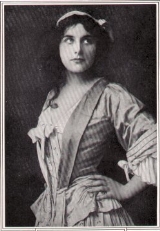
Farrarasmanon
The bustling courtyard of an inn at Amiens
Amiens

Amiens is a city and Communes of France in northern France, north of Paris. It is the capital of the Somme Departments of France in Picardie....
. De Brétigny, a nobleman, has just arrived, in the company of Guillot, an aging rake (he is the Minister of Finance), and three flirtatious young actresses, Poussette, Javotte and Rosette. While the obsequious innkeeper is serving this party with his best dinner, the townspeople collect to witness the arrival of the coach from Arras
Arras

Arras is the capital of the Pas-de-Calais Departments of France in northern France. The historic centre of the Artois region, its local speech is characterized as a Picard language dialect....
, among them Lescaut, a Guardsman, here, he informs his comrades, to meet a kinswoman. Shortly, the coach appears, and among the crowd he quickly identifies his pretty, fragile young cousin, Manon, who asks pardon for her bewilderment (Je suis toujours tout étourdie); this is, after all, her very first journey -- one which is taking her to the convent.

Left alone for a moment, Manon is accosted by the opportunistic Guillot, who tells her he has a carriage waiting, in which they can leave together. His heavy-handed seduction, however, to derision from the three young actresses, is routed by the return of Lescaut, who then subjects his cousin to a lecture (Regardez-moi bien dans les yeux) on the behavior proper to a demure young member of the Lescaut family. Drawn by the prospect of some gambling with his friends, he nevertheless leaves her unattended once more. Alone, she reflects admiringly on the fashionably decked attractions of the three actresses, but reproaches herself (Voyons, Manon), unconvincingly vowing to rid herself of all worldly visions.

A romantically inclined young chevalier, des Grieux, on a journey home for reunion with his father, catches sight of Manon, and is instantly in love; when he approaches she is at once charmed by his chivalrous address (Et je sais votre nom), and their exchange rapidly becomes a mutual avowal of love. Both their projected journeys, hers to the convent, des Grieux's to his home, are swiftly abandoned, as they decide to flee together (Nous vivrons à Paris), but already there are hints of incompatible aspirations: while he returns, over and again, to 'tous les deux' (together), the phrase she repeatedly fondles is à Paris. Making good use of the carriage provided by the disappointed Guillot, the lovers escape.

Act 2


Paris, the apartment of Manon and des Grieux. He, without much hope, is writing a letter to his father, imploring permission to marry her. There is a knock at the door, and Lescaut enters, intent on creating a scene. His concern for offended family honor is, however, only camouflage for his new and remunerative alliance with de Brétigny, who has accompanied him, masquerading as a fellow-Guardsman. To prove his honorable intentions, des Grieux shows Lescaut the letter to his father. But meanwhile, de Brétigny confidentially warns Manon that tonight des Grieux, on the orders of his father, will be seized and carried off. He points out that, protected by the de Brétigny position and wealth, she can move on to a glittering future.

After the two visitors depart, Manon appears to vacillate between accepting de Brétigny's offer and warning des Grieux, but when her lover goes out to post his letter, her touching farewell to the humble domesticity she has shared (Adieu, notre petite table) makes clear she has decided to go with de Brétigny. Returning, unaware of any change, des Grieux raptly conveys his more modest vision of their future happiness (En fermant les yeux, the once-famous 'Dream Song'). Going outside to investigate an apparent disturbance, he is indeed seized and hustled away, leaving Manon to voice her regrets.

Act 3

Scene 1: Paris, the promenade of the Cours-la-Reine on a feast-day.

Among the throng of holiday-makers and vendors of all kinds, Guillot appears, still frantically flirting with the young actresses, and Lescaut, hymning the pleasures of gambling (Pourquoi bon l'économie?). De Brétigny arrives, soon joined by Manon, now sumptuously dressed and with a retinue of admirers. She performs a little song about her new eminence (Je marche sur tous les chemins), followed by a sprightly gavotte (Obéissons quand leur voix appelle) on the joys of love and youth.

Des Grieux's father, the comte, greets de Brétigny. Manon overhears that her former lover is Chevalier no longer, but Abbé, having entered the seminary of Saint-Sulpice. Approaching the comte, Manon confirms the news, and tries to discover whether his son still loves her. The ballet follows, but Manon, seized by the desire to see des Grieux once more, hurries off to Saint-Sulpice.

Scene 2: Saint-Sulpice
From the chapel, a fashionable congregation is dispersing, enthusiastic over the sermon of the new abbé (Quelle éloquence!). Des Grieux enters, in clerical garb, and his father adds his voice to the chorus of praise, but tries to dissuade his son from this new life, so that he can perpetuate the family name (Epouse quelque brave fille).

Having failed to shake his son's resolve, he withdraws, and des Grieux, alone, wrestles against his tenacious memories of Manon (Ah! Fuyez, douce image). As he prays, Manon herself appears, to implore his forgiveness for her faithlessness. Furiously, he attempts to reject her, but when (in the deliciously serpentine N'est-ce plus ma main?) she recalls their past intimacies, his resistance is overcome, and their voices join in an impassioned avowal of love.

Act 4


A gaming salon at the Hôtel de Transylvanie. Lescaut and Guillot are among the gamblers, and the three young actresses are prepared to attach themselves to any winner. Manon arrives with des Grieux. No longer with any illusions as to her character (Manon! Manon! Sphinx étonnant) he admits his helpless thralldom. He allows himself to be persuaded to gamble, in hopes of gaining the wealth she craves. He plays at cards with Guillot and wins, winning each time when Guillot doubles and redoubles the wager. As Manon exults, Guillot accuses des Grieux of cheating. Des Grieux hotly denies the charge. Guillot leaves, but shortly returns with the police, to whom he denounces des Grieux as a cheat and Manon as dissolute.

The elder des Grieux comes on the scene, and tells his son that while he will intercede in his behalf, he will do nothing to save Manon. In a big ensemble, with Guillot exulting over his revenge, Manon lamenting the end of all joy, des Grieux swearing to defend her and the rest expressing consternation and horror, the arrested pair are led away.

Act 5


A desolate spot near the road to Le Havre
Le Havre

Le Havre is a city in the northwest region of France situated on the right bank of the mouth of the Seine River as it outlets into the Bay of the Seine section of the English Channel....
. Manon has been condemned to deportation as a woman of ill-fame. Des Grieux, freed by his father's intervention, and a penitent Lescaut, now his ally, wait to waylay the convoy in which Manon, with other convicts, is being marched to the port. A detachment of soldiers arrives with their prisoners. The would-be rescuers recognize the hopelessness of attacking so strong an escort, but Lescaut succeeds in bribing their sergeant to allow Manon to stay behind till evening. The convoy moves on, and a sick and exhausted Manon falls to the ground at des Grieux's feet.

In his arms, near delirium, she recapitulates the scenes -- and the melodies -- of former happiness. Des Grieux tells her the past can yet be reborn, but Manon, calm now, knows it is too late. With the words Et c'est là l'histoire de Manon Lescaut she dies.

Noted arias


  • Act I - Manon: "Je suis encore tout étourdie" ("I am still completely dazed")
  • Act II - des Grieux: "En fermant les yeux" ("Closing my eyes")
  • Act II - Manon: "Adieu, notre petite table" ("Goodbye, our little table")
  • Act III - Manon: "Obéissons quand leur voix appelle" ("Let us obey when their voice calls us")
  • Act III - des Grieux: "Ah, fuyez douce image" ("Ah, flee, sweet image")


Selected recordings


  • 1951 - Janine Micheau
    Janine Micheau

    Janine Micheau was a French opera singer, one of the leading lyric soprano of her era in France.Janine Micheau was born in Toulouse, France, and studied voice at the Music Conservatory there, and later at the Paris Music Conservatory....
     (Manon), Libero de Luca
    Libero de Luca

    Libero de Luca is a Swiss lyric tenor, particularly associated with the French repertory....
     (des Grieux), Roger Bourdin
    Roger Bourdin

    Roger Bourdin was a French baritone, particularly associated with the French repertory. His career was largely based in France....
     (Lescaut), Julien Giovanetti (Comte des Grieux) - Choeur et Orchestre de l'Opéra-Comique, Albert Wolff
    Albert Wolff

    Albert Wolff was a French conducting and composer of Netherlands descent. Most of his career was spent in European venues, with the exception of two years that he spent as a conductor at the Metropolitan Opera and a few years in Buenos Aires during the Second World War....
     - (Preiser)


  • 1955 - Victoria de los Ángeles
    Victoria de los Ángeles

    Victoria de los ?ngeles was a Spanish operatic soprano and recitalist from Catalonia whose career began in the early 1940s and reached its height in the mid 1960s....
     (Manon), Henri Legay
    Henri Legay

    Henri Legay was a French operatic tenor, primarily French-based and whose light lyric voice was especially suited to the French operatic repertoire....
     (des Grieux), Michel Dens
    Michel Dens

    Michel Dens was a French baritone, particularly associated with the French repertory, both opera and operetta.Born Maurice Marcel, the son of a journalist, he studied at the Academy of Music in Roubaix....
     (Lescaut), Jean Borthayre
    Jean Borthayre

    Jean Borthayre was a French operatic baritone, particularly associated with the French and Italian repertories....
     (Comte des Grieux) - Choeur et Orchestre de l'Opéra-Comique, Pierre Monteux
    Pierre Monteux

    Pierre Monteux was an orchestra conducting. Born in Paris, France, rue de la Grange Bateli?re. Monteux later became an American citizen....
     - (EMI)


  • 1970 - Beverly Sills
    Beverly Sills

    Beverly Sills was an American operatic soprano who enjoyed success in the 1960s and 1970s. She was famous for her performances in coloratura soprano roles in operas around the world and on recordings....
     (Manon), Nicolai Gedda
    Nicolai Gedda

    The Sweden tenor Nicolai Gedda is a famous opera singer and recitalist. Having made some two hundred recordings, Gedda is said to be the most widely recorded tenor in history....
     (des Grieux), Gérard Souzay
    Gérard Souzay

    G?rard Souzay was a French baritone singer, regarded as one of the best interpreters of m?lodie since Charles Panz?ra and Pierre Bernac....
     (Lescaut), Gabriel Bacquier
    Gabriel Bacquier

    Gabriel Bacquier is a French operatic baritone. One of the leading baritones of the 20th century and particularly associated with the French and Italian repertories, he is considered a fine singing-actor equally at home in dramatic or comic roles....
     (Comte des Grieux), Ambrosian Opera Chorus, New Philarmonic Orchestra, Julius Rudel
    Julius Rudel

    Julius Rudel is a major United States orchestra conductor who emigrated to the US from Austria at the age of 17 to study at the Mannes College of Music in New York City....
     - (EMI)


  • 1982 - Ileana Cotrubas
    Ileana Cotrubas

    Ileana Cotrubas is a Romanian opera soprano whose career spanned from the 1960s to the 1980s. She was much admired for her acting skills and facility for singing opera in many different languages....
     (Manon), Alfredo Kraus
    Alfredo Kraus

    Alfredo Kraus Trujillo was a distinguished Spanish people tenor of Austrian descent, particularly known for the artistry he brought to opera's bel canto roles....
     (des Grieux), Gino Quilico
    Gino Quilico

    Gino Quilico is a Canadian lyric baritone of Italian people descent and the son of Canadian baritone Louis Quilico and Lina Pizzolongo....
     (Lescaut), José van Dam
    José van Dam

    Joseph, Baron van Damme , known under the pseudonym Jos? van Dam, is a Belgium bass-baritone.Jos? van Dam was born in Brussels on August 25, 1940....
     (Comte des Grieux) - Choeur et Orchestre du Capitole de Toulouse, Michel Plasson
    Michel Plasson

    Michel Plasson is a France conducting.He is long associated with the Orchestre national du Capitole de Toulouse as principal conductor from 1968 to 2003, and is now its honorary conductor....
     - (EMI)


  • 2000 - Angela Gheorghiu
    Angela Gheorghiu

    Angela Gheorghiu in Adjud, Romania is one of the most renowned operatic singers of the 21st Century. Since her professional debut in 1990, she has sung as soprano leading roles at New York's Metropolitan Opera, Covent Garden's Royal Opera House, the Vienna State Opera, Milan's La Scala, and many other major opera houses in Europe and the U...
     (Manon), Roberto Alagna
    Roberto Alagna

    Roberto Alagna is a France operatic tenor of Sicilian descent. He was born in Clichy-sous-Bois, Seine-Saint-Denis, France....
     (des Grieux), Earle Patriarco (Lescaut), José van Dam
    José van Dam

    Joseph, Baron van Damme , known under the pseudonym Jos? van Dam, is a Belgium bass-baritone.Jos? van Dam was born in Brussels on August 25, 1940....
     (Comte des Grieux) - Chorus and orchestra of the Théâtre Royal de la Monnaie, Brussels, Antonio Pappano
    Antonio Pappano

    Antonio Pappano is a United Kingdom conducting and pianist of Italian parentage currently serving as music director at the Royal Opera House in London, and l'Orchestra dell'Accademia Nazionale di Santa Cecilia in Rome....
     - (EMI)


External links

  • from Operabase.com