

RAF Hornchurch

Encyclopedia
RAF Hornchurch was an airfield in the south of Hornchurch
in what is now the London Borough of Havering
. Known as Sutton's Farm during the First World War, it occupied 90 acres (364,217.4 m²) of the farm of the same name and was situated 14 miles (22.5 km) east north-east of Charing Cross
. Although the airfield closed shortly after the end of World War I, the land was requisitioned in 1923 due to the expansion of the Royal Air Force and it re-opened as a much larger fighter station in 1928. The airfield was ideally located in bomb alley to cover both London and the Thames
corridor from German air attacks. It was a key air force installation between both wars and in to the jet age, closing in 1962.
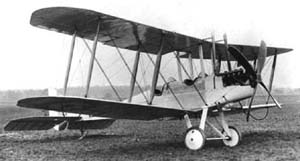
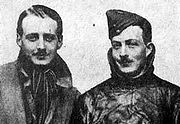 In 1915 the London Air Defence Area
(LADA) was established and a number of airfields were constructed around London with the specific aim of defending the capital from the growing threat from enemy airships. Sutton's Farm, along with its neighbour Hainault Farm, 8 miles (12.9 km) to the north-east, were selected due to their location covering the eastern approaches to London. They were designated Landing Grounds Nos. II and III respectively and joined the existing airfields of North Weald
, Rochford
and Joyce Green. Suttons Farm airfield became operational on 3 October 1915, initially with two BE2c aircraft. As the number of aircraft increased at the airfields around London, it was decided to organise them into 39 Home Defence Squadron
, which was formed in April 1916, under the command of Major (later Brigadier-General) Thomas Higgins. As the enemy threat moved from airships to aircraft, so better aircraft were introduced to counter them. The BE12, Sopwith 1½ Strutter, Sopwith Pup, FE2, Bristol Fighter, SE5a and Sopwith Camel all operated from Sutton's Farm at some stage, some with more success than others. 39 Squadron moved to North Weald in September 1917 and was replaced by 78 Squadron, under the command of Major Cuthbert Rowden, a 20 year old veteran of the air war in France and subsequent winner of the Military Cross
. 78 Squadron was later joined by 189 Night Fighter Training Squadron with Sopwith Pups and Camels.
The first recorded interception of an enemy airship over Britain was made by Lt. (later Marshal of the Royal Air Force) John Slessor
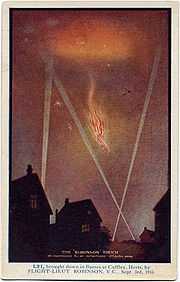
on the very day he arrived at Sutton's Farm, 13 October 1915. The attack had to be aborted, however, as the airship disappeared into cloud and he had to break off the engagement. The first victory in Britain was not recorded until nearly a year later, on 2 September 1916, and was attributed to a pilot from Sutton's Farm, Lt. William Leefe Robinson
. Robinson shot down a Schütte-Lanz SL11
, one of a 16-strong raiding force over London, using the recently developed Brock and Pomeroy mixed incendiary ammunition, which had been adapted specifically for this task. For this action Leefe Robinson was awarded the Victoria Cross and became a National hero. Two other Sutton's Farm pilots from the First World War, Lt. Frederick Sowrey and Lt. Wulstan Tempest, were awarded the DSO
for their roles in the destruction of Zeppelins. Tempest's actions were particularly notable; even though his fuel pump was broken and he was having to pump fuel manually whilst flying the aircraft with his other hand, he still managed to engage and destroy an enemy airship and then find his way home in thick fog. These pilots, together with many others, are commemorated by street names in South Hornchurch.
Following the decision in the early 1920s to expand the Royal Air Force, former World War I airfields were inspected to ascertain their suitability for use. Although small, Suttons Farm was ideally located to be able to defend the north-eastern approaches to London. After protracted negotiations, the original land was re-purchased, together with some further land to the south of the original airfield.
The new airfield took four years to build and opened, as RAF Sutton’s Farm, in April 1928. Two months later the name was changed to RAF Hornchurch and the first unit to take up residency was No. 111 Squadron, led by Squadron Leader Keith Park, who also became the first station commander.
the station was a Sector Airfield
of RAF Fighter Command
's 11 Group, covering London and the south east of England during the Battle of Britain
in 1940. By this time, its command centre was in Romford, and a satellite station (an advanced attack outpost; RAF Rochford) was unpopular with the Hornchurch crews sent there from time to time because of the canvas accommodation. Following the war, Hornchurch was home to Flying Training Command's Aircrew Selection Centre for 10 years before it moved to RAF Biggin Hill
and the RAF station at Hornchurch closed in July 1962.
.jpg)
.jpg) Following a period of gravel extraction and infilling with rubbish in the 1970s, the airfield was extensively landscaped to create Hornchurch Country Park
Following a period of gravel extraction and infilling with rubbish in the 1970s, the airfield was extensively landscaped to create Hornchurch Country Park
, with work commencing in 1980. Most of the former administrative and technical areas, including the two Type A and one Type C hangars, were levelled in the 1960s and the area is now a housing estate. The names of the streets of the estate commemorate the airfield and its pilots (such as Bouchier
Walk, Kirton Close, Tempest Way, Robinson
Close, Tuck
Road, Bader
Way and Malan
Square). The former Officers' Mess is now a medical centre in Astra Close. The Officers' Mess (Astra House), Officers' Quarters (Astra Court East, West & North) and WO Quarters (89-99 (odd numbers) Wood Lane) are included in the RAF Hornchurch Conservation Area.
A local school, The R. J. Mitchell
School, was named after the man who designed the Spitfire
, and a large monument to this effect, with wreaths placed on Remembrance Day, is within the school railings. Another local school (Suttons School) was re-named Sanders Draper School
in 1973, after an American pilot, Flying Officer Raimund (Smudge) Sanders Draper
, flying with the Royal Air Force at the time, had an engine failure on take-off and stayed at his controls to ensure his aircraft didn't crash on the building, which was full of children at the time.
A number of pillboxes, command bunkers and gun positions, together with the largest number of surviving Tett Turrets in England, still exist within the boundaries of the former airfield and can be seen on the Eastern edge of the country park. RAF Hornchurch artefacts and memorabilia are housed in the Purfleet Heritage & Military Centre.
RAF Hornchurch was the subject of one of the programmes in the BBC TV series Two Men in a Trench. In the programme, several of the defences were examined. One of the Tett Turrets was excavated, the backfill of which contained a pair of 1940 RAF pilot's goggles along with material from the hospital.. The fire trench, a partially buried pillbox and an E pen were excavated, while the gun emplacement on the northern end of the site was cleared of vegetation.
The Good Intent pub, formerly with a large concrete, planetarium-like dome next door (used for training airgunners), still exists on the Hornchurch Road, was popular with the aircrews, and has an interesting collection of photos of the Station.
A DVD about RAF Hornchurch was produced by Mike Jones for Streets Ahead Productions.
The airfield is said to be haunted and was the subject of a paranormal investigation in 2004. Click here for the report.
shortly after arriving in France. The awarding of the VC was, undoubtedly, partly politically motivated, although it must be remembered that any form of flying was inherently dangerous in 1916, particularly at night and at these tremendous heights without oxygen. Robinson also managed to single-handedly lift the spirit of a nation that had suffered the new terror of aerial bombardment from the apparently invincible airships.
of 56 Squadron
. On 6 September 1939, three days after the declaration of war, a searchlight battery on Mersea Island
incorrectly identified a friendly aircraft crossing the Essex coast. A message was relayed to HQ 11 Group, which ordered Hurricanes from North Weald to investigate. They were subsequently misidentified as hostile aircraft themselves by the Chain Home
Radar at Canewdon
. Further aircraft from North Weald were scrambled to intercept their comrades, but they too were misidentified through a combination of miscommunication, inexperience and over-enthusiasm. A tragic, but inevitable mistake was now just minutes away; Spitfires from 74 Squadron, led by “Sailor” Malan
, took off from Hornchurch and quickly engaged two Hurricanes, shooting them both down.
Pilot Officer
Montague Hulton-Harrop was killed whilst the other pilot, Pilot Officer Tommy Rose, baled out and landed safely. The two pilots responsible for the attack, Pilot Officer John Freeborn and Flying Officer
Paddy Byrne were placed under arrest upon their return to Hornchurch. Freeborn had been the squadron adjutant and had distributed orders that single engined aircraft should not be engaged as it was assumed that enemy fighters would not have the fuel to be able to fly a return sortie from Germany and, therefore, any single engined aircraft would be friendly.
A court-martial was held on 7 October 1939, at which, Freeborn later claimed, that Malan said he never gave the order to attack. All three were acquitted, with the judge claiming that the case should never have been brought to trial. The proceedings have never been made public.
Click here for a complete list of Station Commanders
Hornchurch
Hornchurch is a large suburban town in England, and part of the London Borough of Havering. Hornchurch is in North-East London .It is located east-northeast of Charing Cross and is one of the locally important district centres identified in the London Plan. It comprises a number of shopping...
in what is now the London Borough of Havering
London Borough of Havering
The London Borough of Havering is a London borough in North East London, England and forms part of Outer London. The principal town in Havering is Romford and the other main communities are Hornchurch, Upminster and Rainham. The borough is mainly characterised by suburban development with large...
. Known as Sutton's Farm during the First World War, it occupied 90 acres (364,217.4 m²) of the farm of the same name and was situated 14 miles (22.5 km) east north-east of Charing Cross
Charing Cross
Charing Cross denotes the junction of Strand, Whitehall and Cockspur Street, just south of Trafalgar Square in central London, England. It is named after the now demolished Eleanor cross that stood there, in what was once the hamlet of Charing. The site of the cross is now occupied by an equestrian...
. Although the airfield closed shortly after the end of World War I, the land was requisitioned in 1923 due to the expansion of the Royal Air Force and it re-opened as a much larger fighter station in 1928. The airfield was ideally located in bomb alley to cover both London and the Thames
River Thames
The River Thames flows through southern England. It is the longest river entirely in England and the second longest in the United Kingdom. While it is best known because its lower reaches flow through central London, the river flows alongside several other towns and cities, including Oxford,...
corridor from German air attacks. It was a key air force installation between both wars and in to the jet age, closing in 1962.
History
London Air Defence Area
The London Air Defence Area was the name given to the organisation created to defend London from the increasing threat from enemy airships during World War I...
(LADA) was established and a number of airfields were constructed around London with the specific aim of defending the capital from the growing threat from enemy airships. Sutton's Farm, along with its neighbour Hainault Farm, 8 miles (12.9 km) to the north-east, were selected due to their location covering the eastern approaches to London. They were designated Landing Grounds Nos. II and III respectively and joined the existing airfields of North Weald
North Weald Airfield
North Weald Airfield is an operational airfield, near the village of North Weald Bassett in Epping Forest, Essex, England. It was an important fighter station during the Battle of Britain, when it was known as the RAF Station RAF North Weald. It is the home of North Weald Airfield Museum...
, Rochford
London Southend Airport
London Southend Airport or Southend Airport is a regional airport in the district of Rochford within Essex, England.During the 1960s, Southend was the third-busiest airport in the United Kingdom. It remained London's third-busiest airport in terms of passengers handled until the end of the 1970s,...
and Joyce Green. Suttons Farm airfield became operational on 3 October 1915, initially with two BE2c aircraft. As the number of aircraft increased at the airfields around London, it was decided to organise them into 39 Home Defence Squadron
No. 39 Squadron RAF
No. 39 Squadron of the Royal Air Force operates the MQ-9 Reaper since 2007, operating from Creech AFB, Nevada, USA.-World War I:39 Squadron was founded at Hounslow Heath Aerodrome in April 1916 with B.E.2s and Royal Aircraft Factory B.E.12s in an attempt to defend against German Zeppelin raids on...
, which was formed in April 1916, under the command of Major (later Brigadier-General) Thomas Higgins. As the enemy threat moved from airships to aircraft, so better aircraft were introduced to counter them. The BE12, Sopwith 1½ Strutter, Sopwith Pup, FE2, Bristol Fighter, SE5a and Sopwith Camel all operated from Sutton's Farm at some stage, some with more success than others. 39 Squadron moved to North Weald in September 1917 and was replaced by 78 Squadron, under the command of Major Cuthbert Rowden, a 20 year old veteran of the air war in France and subsequent winner of the Military Cross
Military Cross
The Military Cross is the third-level military decoration awarded to officers and other ranks of the British Armed Forces; and formerly also to officers of other Commonwealth countries....
. 78 Squadron was later joined by 189 Night Fighter Training Squadron with Sopwith Pups and Camels.
The first recorded interception of an enemy airship over Britain was made by Lt. (later Marshal of the Royal Air Force) John Slessor
John Slessor
Marshal of the Royal Air Force Sir John Cotesworth Slessor GCB, DSO, MC was a senior commander in the Royal Air Force . A pilot in the Royal Flying Corps during World War I, he held operational commands in World War II and served in the RAF's most senior post, Chief of the Air Staff, from 1950 to...
on the very day he arrived at Sutton's Farm, 13 October 1915. The attack had to be aborted, however, as the airship disappeared into cloud and he had to break off the engagement. The first victory in Britain was not recorded until nearly a year later, on 2 September 1916, and was attributed to a pilot from Sutton's Farm, Lt. William Leefe Robinson
Leefe Robinson
William Leefe Robinson VC was the first British pilot to shoot down a German airship over Britain during the First World War. For this he was awarded the Victoria Cross, the highest award for gallantry in the face of the enemy that can be awarded to British and Commonwealth forces...
. Robinson shot down a Schütte-Lanz SL11
Schütte-Lanz
Schütte-Lanz is the name of a series of rigid airships designed and built by the Luftschiffbau Schütte-Lanz company from 1909 until the last LS22 was delivered in 1917. One research and four passenger airships were planned for post-war use, but were never built...
, one of a 16-strong raiding force over London, using the recently developed Brock and Pomeroy mixed incendiary ammunition, which had been adapted specifically for this task. For this action Leefe Robinson was awarded the Victoria Cross and became a National hero. Two other Sutton's Farm pilots from the First World War, Lt. Frederick Sowrey and Lt. Wulstan Tempest, were awarded the DSO
Distinguished Service Order
The Distinguished Service Order is a military decoration of the United Kingdom, and formerly of other parts of the British Commonwealth and Empire, awarded for meritorious or distinguished service by officers of the armed forces during wartime, typically in actual combat.Instituted on 6 September...
for their roles in the destruction of Zeppelins. Tempest's actions were particularly notable; even though his fuel pump was broken and he was having to pump fuel manually whilst flying the aircraft with his other hand, he still managed to engage and destroy an enemy airship and then find his way home in thick fog. These pilots, together with many others, are commemorated by street names in South Hornchurch.
Inter War Years
Soon after the war ended it was decided that Suttons Farm was surplus to requirements and the airfield was decommissioned, although it was retained on “List C” (stations temporarily retained for Service purposes) until 27 February 1920. The land was returned, most of the buildings demolished and farming resumed once more.Following the decision in the early 1920s to expand the Royal Air Force, former World War I airfields were inspected to ascertain their suitability for use. Although small, Suttons Farm was ideally located to be able to defend the north-eastern approaches to London. After protracted negotiations, the original land was re-purchased, together with some further land to the south of the original airfield.
The new airfield took four years to build and opened, as RAF Sutton’s Farm, in April 1928. Two months later the name was changed to RAF Hornchurch and the first unit to take up residency was No. 111 Squadron, led by Squadron Leader Keith Park, who also became the first station commander.
World War II
During World War IIWorld War II
World War II, or the Second World War , was a global conflict lasting from 1939 to 1945, involving most of the world's nations—including all of the great powers—eventually forming two opposing military alliances: the Allies and the Axis...
the station was a Sector Airfield
Battle of Britain airfields
During the Battle of Britain, the defence of the UK's airspace was divided up within RAF Fighter Command into four Groups, each comprising several airfields and squadrons....
of RAF Fighter Command
RAF Fighter Command
RAF Fighter Command was one of three functional commands of the Royal Air Force. It was formed in 1936 to allow more specialised control of fighter aircraft. It served throughout the Second World War, gaining recognition in the Battle of Britain. The Command continued until 17 November 1943, when...
's 11 Group, covering London and the south east of England during the Battle of Britain
Battle of Britain
The Battle of Britain is the name given to the World War II air campaign waged by the German Air Force against the United Kingdom during the summer and autumn of 1940...
in 1940. By this time, its command centre was in Romford, and a satellite station (an advanced attack outpost; RAF Rochford) was unpopular with the Hornchurch crews sent there from time to time because of the canvas accommodation. Following the war, Hornchurch was home to Flying Training Command's Aircrew Selection Centre for 10 years before it moved to RAF Biggin Hill
London Biggin Hill Airport
London Biggin Hill Airport is an airport at Biggin Hill in the London Borough of Bromley, located south southeast of Central London, United Kingdom...
and the RAF station at Hornchurch closed in July 1962.
The Airfield Today
Hornchurch Country Park
Hornchurch Country Park is a park on the former site of Hornchurch Airfield, south of Hornchurch in the London Borough of Havering, east London.The River Ingrebourne passes through the park and if forms part of Thames Chase Community Forest...
, with work commencing in 1980. Most of the former administrative and technical areas, including the two Type A and one Type C hangars, were levelled in the 1960s and the area is now a housing estate. The names of the streets of the estate commemorate the airfield and its pilots (such as Bouchier
Sir Cecil Bouchier
Air Vice Marshal Sir Cecil Arthur Bouchier KBE, CB, DFC served with the British Army, Royal Flying Corps, Indian Air Force and Royal Air Force from 1915 to 1953....
Walk, Kirton Close, Tempest Way, Robinson
Leefe Robinson
William Leefe Robinson VC was the first British pilot to shoot down a German airship over Britain during the First World War. For this he was awarded the Victoria Cross, the highest award for gallantry in the face of the enemy that can be awarded to British and Commonwealth forces...
Close, Tuck
Robert Stanford Tuck
Wing Commander Roland Robert Stanford Tuck DSO, DFC & Two Bars, AFC was a British fighter pilot and test pilot.Tuck joined the RAF in 1935. Tuck first engaged in combat during the Battle of France, over Dunkirk, claiming his first victories...
Road, Bader
Douglas Bader
Group Captain Sir Douglas Robert Steuart Bader CBE, DSO & Bar, DFC & Bar, FRAeS, DL was a Royal Air Force fighter ace during the Second World War. He was credited with 20 aerial victories, four shared victories, six probables, one shared probable and 11 enemy aircraft damaged.Bader joined the...
Way and Malan
Adolph Malan
Adolph Gysbert Malan DSO & Bar DFC & Bar , better known as Sailor Malan, was a famed South African World War II RAF fighter pilot who led No. 74 Squadron RAF during the height of the Battle of Britain. Malan was known for sending German bomber pilots home with dead crews as a warning to other...
Square). The former Officers' Mess is now a medical centre in Astra Close. The Officers' Mess (Astra House), Officers' Quarters (Astra Court East, West & North) and WO Quarters (89-99 (odd numbers) Wood Lane) are included in the RAF Hornchurch Conservation Area.
A local school, The R. J. Mitchell
R. J. Mitchell
Reginald Joseph Mitchell CBE, FRAeS, was an aeronautical engineer, best known for his design of the Supermarine Spitfire.-Early years:...
School, was named after the man who designed the Spitfire
Supermarine Spitfire
The Supermarine Spitfire is a British single-seat fighter aircraft that was used by the Royal Air Force and many other Allied countries throughout the Second World War. The Spitfire continued to be used as a front line fighter and in secondary roles into the 1950s...
, and a large monument to this effect, with wreaths placed on Remembrance Day, is within the school railings. Another local school (Suttons School) was re-named Sanders Draper School
Sanders Draper School
The Sanders Draper School is a mixed-gender secondary school for students aged between 11 and 16 located in Hornchurch, London Borough of Havering, UK. It was a specialist science schooluntil recent and it shares its grounds with Sutton's Junior & Infant school, just off Suttons Lane...
in 1973, after an American pilot, Flying Officer Raimund (Smudge) Sanders Draper
Raimund Sanders Draper
Flying Officer Raimund Sanders Draper , known as "Smudge", was an American volunteer World War II Royal Air Force pilot of No. 64 Squadron...
, flying with the Royal Air Force at the time, had an engine failure on take-off and stayed at his controls to ensure his aircraft didn't crash on the building, which was full of children at the time.
A number of pillboxes, command bunkers and gun positions, together with the largest number of surviving Tett Turrets in England, still exist within the boundaries of the former airfield and can be seen on the Eastern edge of the country park. RAF Hornchurch artefacts and memorabilia are housed in the Purfleet Heritage & Military Centre.
RAF Hornchurch was the subject of one of the programmes in the BBC TV series Two Men in a Trench. In the programme, several of the defences were examined. One of the Tett Turrets was excavated, the backfill of which contained a pair of 1940 RAF pilot's goggles along with material from the hospital.. The fire trench, a partially buried pillbox and an E pen were excavated, while the gun emplacement on the northern end of the site was cleared of vegetation.
The Good Intent pub, formerly with a large concrete, planetarium-like dome next door (used for training airgunners), still exists on the Hornchurch Road, was popular with the aircrews, and has an interesting collection of photos of the Station.
A DVD about RAF Hornchurch was produced by Mike Jones for Streets Ahead Productions.
The airfield is said to be haunted and was the subject of a paranormal investigation in 2004. Click here for the report.
Controversy
William Leefe Robinson
Although Robinson was awarded the Victoria Cross for shooting down Schütte-Lanz SL11 in 1916, it wasn't celebrated in all quarters, particularly by serving pilots in France. Home Defence was viewed as a relatively easy role and Robinson had trouble earning the respect of his fellow pilots when he was subsequently posted to France. These views were compounded when Robinson was shot down by aircraft led by Manfred von RichthofenManfred von Richthofen
Manfred Albrecht Freiherr von Richthofen , also widely known as the Red Baron, was a German fighter pilot with the Imperial German Army Air Service during World War I...
shortly after arriving in France. The awarding of the VC was, undoubtedly, partly politically motivated, although it must be remembered that any form of flying was inherently dangerous in 1916, particularly at night and at these tremendous heights without oxygen. Robinson also managed to single-handedly lift the spirit of a nation that had suffered the new terror of aerial bombardment from the apparently invincible airships.
Use of Incendiary Ammunition
Although effective in destroying enemy airships, the use of incendiary ammunition was banned under the terms of the Hague Convention of 1899 and pilots using it had to have signed orders from their commanding officer. This type of ammunition was issued only to squadrons in Home Defence roles and never to squadrons serving overseas. On his return to Sutton's Farm, William Leefe Robinson's CO ordered him to keep quiet about it as it was thought the propaganda value for the enemy would be invaluable should it leak out, even though the Germans had already broken the terms of the convention by using gas in 1915. Later in the war the use of incendiary ammunition became officially recognised.The Battle of Barking Creek
The first aircraft to be shot down by the British in the Second World War was a HurricaneHawker Hurricane
The Hawker Hurricane is a British single-seat fighter aircraft that was designed and predominantly built by Hawker Aircraft Ltd for the Royal Air Force...
of 56 Squadron
No. 56 Squadron RAF
Number 56 Squadron is one of the oldest and most successful squadrons of the Royal Air Force, with battle honours from many of the significant air campaigns of both World War I and World War II...
. On 6 September 1939, three days after the declaration of war, a searchlight battery on Mersea Island
Mersea Island
Mersea Island is the most easterly inhabited island in the United Kingdom, located marginally off the coast of Essex, England, to the southeast of Colchester. It is situated in the estuary area of the Blackwater and Colne rivers and has an area of around...
incorrectly identified a friendly aircraft crossing the Essex coast. A message was relayed to HQ 11 Group, which ordered Hurricanes from North Weald to investigate. They were subsequently misidentified as hostile aircraft themselves by the Chain Home
Chain Home
Chain Home was the codename for the ring of coastal Early Warning radar stations built by the British before and during the Second World War. The system otherwise known as AMES Type 1 consisted of radar fixed on top of a radio tower mast, called a 'station' to provide long-range detection of...
Radar at Canewdon
Canewdon
Canewdon is a village in north Rochford District of Essex in England, approximately 4 miles northeast of the town of Rochford. Canewdon is situated on one of the highest hills of the Essex coastline from which St. Nicholas church affords wide views of the Crouch estuary. Canewdon parish extends...
. Further aircraft from North Weald were scrambled to intercept their comrades, but they too were misidentified through a combination of miscommunication, inexperience and over-enthusiasm. A tragic, but inevitable mistake was now just minutes away; Spitfires from 74 Squadron, led by “Sailor” Malan
Adolph Malan
Adolph Gysbert Malan DSO & Bar DFC & Bar , better known as Sailor Malan, was a famed South African World War II RAF fighter pilot who led No. 74 Squadron RAF during the height of the Battle of Britain. Malan was known for sending German bomber pilots home with dead crews as a warning to other...
, took off from Hornchurch and quickly engaged two Hurricanes, shooting them both down.
Pilot Officer
Pilot Officer
Pilot officer is the lowest commissioned rank in the Royal Air Force and the air forces of many other Commonwealth countries. It ranks immediately below flying officer...
Montague Hulton-Harrop was killed whilst the other pilot, Pilot Officer Tommy Rose, baled out and landed safely. The two pilots responsible for the attack, Pilot Officer John Freeborn and Flying Officer
Flying Officer
Flying officer is a junior commissioned rank in the Royal Air Force and the air forces of many countries which have historical British influence...
Paddy Byrne were placed under arrest upon their return to Hornchurch. Freeborn had been the squadron adjutant and had distributed orders that single engined aircraft should not be engaged as it was assumed that enemy fighters would not have the fuel to be able to fly a return sortie from Germany and, therefore, any single engined aircraft would be friendly.
A court-martial was held on 7 October 1939, at which, Freeborn later claimed, that Malan said he never gave the order to attack. All three were acquitted, with the judge claiming that the case should never have been brought to trial. The proceedings have never been made public.
Notable Station Commanders
| Name | Rank as CO | From | To | Died | Later Career | |
|---|---|---|---|---|---|---|
 |
Air Chief Marshal Sir Keith Park Keith Park Air Chief Marshal Sir Keith Rodney Park GCB, KBE, MC & Bar, DFC, RAF was a New Zealand soldier, First World War flying ace and Second World War Royal Air Force commander... |
Sqn Ldr | 01/04/28 | 16/03/29 | 05/02/75 | AOC No 11 Gp, C in C, Air Command South East Asia |
 |
Air Marshal Sir Leonard Slatter Leonard Slatter Air Marshal Sir Leonard Horatio Slatter KBE, CB, DSC & Bar, DFC, RAF was a naval aviator during World War I and a senior Royal Air Force commander during World War II. Slatter ended his career as the commander-in-chief of Coastal Command.-Early life and World War I:Slatter was born in Durban,... |
Sqn Ldr | 25/10/29 | 01/04/30 | 14/04/61 | AOC Coastal Command RAF Coastal Command RAF Coastal Command was a formation within the Royal Air Force . Founded in 1936, it was the RAF's premier maritime arm, after the Royal Navy's secondment of the Fleet Air Arm in 1937. Naval aviation was neglected in the inter-war period, 1919–1939, and as a consequence the service did not receive... |
 |
Air Vice-Marshal Sir Matthew Frew | Wng Cdr | 02/04/37 | 27/07/38 | 28/0574 | AOC Training HQ SAAF South African Air Force The South African Air Force is the air force of South Africa, with headquarters in Pretoria. It is the world's second oldest independent air force, and its motto is Per Aspera Ad Astra... |
|
Air Vice Marshall Sir Cecil Bouchier Sir Cecil Bouchier Air Vice Marshal Sir Cecil Arthur Bouchier KBE, CB, DFC served with the British Army, Royal Flying Corps, Indian Air Force and Royal Air Force from 1915 to 1953.... |
Wng Cdr | 20/12/39 | 21/12/40 | 15/06/79 | AOC British Commonwealth Air Forces of Occupation Japan |
|
Air Chief Marshal Sir Harry Broadhurst Harry Broadhurst Air Chief Marshal Sir Harry Broadhurst GCB, KBE, DSO & Bar, DFC & Bar, AFC, RAF , commonly known as Broady, was a senior Royal Air Force commander.-Early life:... |
Wng Cdr | 20/12/40 | 12/05/42 | 29/08/95 | AOC Bomber Command RAF Bomber Command RAF Bomber Command controlled the RAF's bomber forces from 1936 to 1968. During World War II the command destroyed a significant proportion of Nazi Germany's industries and many German cities, and in the 1960s stood at the peak of its postwar military power with the V bombers and a supplemental... , Managing Director A V Roe & Co Avro Avro was a British aircraft manufacturer, with numerous landmark designs such as the Avro 504 trainer in the First World War, the Avro Lancaster, one of the pre-eminent bombers of the Second World War, and the delta wing Avro Vulcan, a stalwart of the Cold War.-Early history:One of the world's... |
Click here for a complete list of Station Commanders
Squadrons
During its relatively short life, RAF Hornchurch became home to many RAF squadrons:| Squadron | Identification | Equipment | From | To | Commanding Officer | ||
|---|---|---|---|---|---|---|---|
| No. 39 Squadron No. 39 Squadron RAF No. 39 Squadron of the Royal Air Force operates the MQ-9 Reaper since 2007, operating from Creech AFB, Nevada, USA.-World War I:39 Squadron was founded at Hounslow Heath Aerodrome in April 1916 with B.E.2s and Royal Aircraft Factory B.E.12s in an attempt to defend against German Zeppelin raids on... |
Royal Aircraft Factory B.E.2c | 15/04/16 | 09/17 | North Weald North Weald Airfield North Weald Airfield is an operational airfield, near the village of North Weald Bassett in Epping Forest, Essex, England. It was an important fighter station during the Battle of Britain, when it was known as the RAF Station RAF North Weald. It is the home of North Weald Airfield Museum... |
Maj Thomas Higgins | ||
| No. 78 Squadron No. 78 Squadron RAF No. 78 Squadron of the Royal Air Force operates the Merlin HC3/3A transport helicopter from RAF Benson.Until December 2007 it was the operator of two Westland Sea King HAR3s from RAF Mount Pleasant, Falkland Islands.-History:No... |
 |
Sopwith Camel Sopwith Camel The Sopwith Camel was a British First World War single-seat biplane fighter introduced on the Western Front in 1917. Manufactured by Sopwith Aviation Company, it had a short-coupled fuselage, heavy, powerful rotary engine, and concentrated fire from twin synchronized machine guns. Though difficult... |
09/17 | 31/12/19 | Disbanded | Maj Cuthbert Rowden | |
| No. 189 Squadron No. 189 Squadron RAF -History:No. 189 Squadron was formed at Ripon on 20 December 1917 as a night-flying training unit, moving shortly afterwards to Sutton's Farm to continue their work until the end of World War I. On 1 March 1919, the squadron was disbanded.... |
|
Sopwith Camel Sopwith Camel The Sopwith Camel was a British First World War single-seat biplane fighter introduced on the Western Front in 1917. Manufactured by Sopwith Aviation Company, it had a short-coupled fuselage, heavy, powerful rotary engine, and concentrated fire from twin synchronized machine guns. Though difficult... |
4/18 | 01/03/19 | Disbanded | Maj H S Powell | |
| No. 111 Squadron No. 111 Squadron RAF No. 111 Squadron of the Royal Air Force operated the Panavia Tornado F3 from RAF Leuchars, Scotland until March 2011, when the squadron was disbanded, ending the Tornado F3's RAF service.-In World War I:... |
 |
Armstrong Whitworth Siskin IIIA Armstrong Whitworth Siskin The Armstrong Whitworth Siskin was a British biplane single-seat fighter aircraft of the 1920s produced by Armstrong Whitworth Aircraft. The Siskin was one of the first new RAF fighters to enter service after the First World War; it was noted for its aerobatic qualities.-Design and development:The... |
01/04/28 | Sqn Ldr Keith Park Keith Park Air Chief Marshal Sir Keith Rodney Park GCB, KBE, MC & Bar, DFC, RAF was a New Zealand soldier, First World War flying ace and Second World War Royal Air Force commander... |
|||
 |
Bristol Bulldog IIA Bristol Bulldog |-See also:-References:NotesBibliography* Andrews, C.F. The Bristol Bulldog . Leatherhead, Surrey, UK: Profile Publications Ltd., 1965.* Barnes, C.H. Bristol Aircraft Since 1910. London: Putnam, 1964.... |
01/31 | 12/07/34 | Northolt RAF Northolt RAF Northolt is a Royal Air Force station situated in South Ruislip, east by northeast of Uxbridge in the London Borough of Hillingdon, West London. Approximately north of London Heathrow Airport, the station also handles a large number of private civil flights... |
|||
| No. 54 Squadron | |
Bristol Bulldog IIA Bristol Bulldog |-See also:-References:NotesBibliography* Andrews, C.F. The Bristol Bulldog . Leatherhead, Surrey, UK: Profile Publications Ltd., 1965.* Barnes, C.H. Bristol Aircraft Since 1910. London: Putnam, 1964.... |
15/01/30 | Sqn Ldr W E G Bryant | |||
 |
Gloster Gauntlet Gloster Gauntlet -See also:-References:NotesBibliography* Crawford, Alex. Bristol Bulldog, Gloster Gauntlet. Redbourn, UK: Mushroom Model Publications, 2005. ISBN 83-89450-04-6.... |
09/36 | Sqn Ldr Cecil Bouchier Sir Cecil Bouchier Air Vice Marshal Sir Cecil Arthur Bouchier KBE, CB, DFC served with the British Army, Royal Flying Corps, Indian Air Force and Royal Air Force from 1915 to 1953.... |
||||
 |
Gloster Gladiator Gloster Gladiator The Gloster Gladiator was a British-built biplane fighter. It was used by the Royal Air Force and the Royal Navy and was exported to a number of other air forces during the late 1930s. It was the RAF's last biplane fighter aircraft and was rendered obsolete by newer monoplane designs even as it... |
05/37 | Sqn Ldr H M Pearson | ||||
| DL (KL) |  |
Supermarine Spitfire Mk I | 03/03/39 | 03/09/40 | Catterick RAF Catterick RAF Catterick is a former Royal Air Force airfield located near Catterick, North Yorkshire in England.-History:Catterick airfield first opened in 1914 as a Royal Flying Corps aerodrome with the role of training pilots and to assist in the defence of the North East of England... |
Sqn Ldr James Leathart | |
|
Supermarine Spitfire Mk IIa | 23/02/41 | Sqn Ldr T.P.R. Dunworth | ||||
 |
Supermarine Spitfire Mk Va | 05/41 | Sqn Ldr R F Boyd | ||||
|
Supermarine Spitfire Mk Vb | 07/41 | 17/11/41 | Castletown Isle of Man Airport Isle of Man Airport , also known as Ronaldsway Airport and, in Manx, Purt Aer Vannin, is the main civilian airport on the Isle of Man. It is located in the south of the island at Ronaldsway near Castletown, southwest of Douglas, the island's capital. Along with the Isle of Man Sea Terminal, it is... |
Sqn Ldr N Orton | ||
| No. 65 Squadron No. 65 Squadron RAF No. 65 Squadron was a squadron of the Royal Air Force.-World War I:The squadron was first formed at Wyton on 1 August 1916 as a squadron of the Royal Flying Corps with a core provided from the training ground at Norwich. By the end of World War I, it had claimed over 200 victories... |
 |
Hawker Demon | 12/07/34 | ||||
|
Gloster Gauntlet Gloster Gauntlet -See also:-References:NotesBibliography* Crawford, Alex. Bristol Bulldog, Gloster Gauntlet. Redbourn, UK: Mushroom Model Publications, 2005. ISBN 83-89450-04-6.... |
09/36 | |||||
| FZ | |
Gloster Gladiator Gloster Gladiator The Gloster Gladiator was a British-built biplane fighter. It was used by the Royal Air Force and the Royal Navy and was exported to a number of other air forces during the late 1930s. It was the RAF's last biplane fighter aircraft and was rendered obsolete by newer monoplane designs even as it... |
04/37 | ||||
| FZ (YT) | |
Supermarine Spitfire Mk I | 21/03/39 | 27/08/40 | Turnhouse Edinburgh Airport Edinburgh Airport is located at Turnhouse in the City of Edinburgh, Scotland, and was the busiest airport in Scotland in 2010, handling just under 8.6 million passengers in that year. It was also the sixth busiest airport in the UK by passengers and the fifth busiest by aircraft movements... |
Sqn Ldr A L Holland | |
| No. 74 Squadron No. 74 Squadron RAF No. 74 Squadron RAF, also known as a "Tiger Squadron" from its tiger head motif, is a squadron of the Royal Air Force. It operated fighter aircraft from 1917 to the 1990s.-First World War:... |
|
Hawker Demon | 21/09/36 | Sqn Ldr Donald Brookes | |||
|
Gloster Gauntlet Gloster Gauntlet -See also:-References:NotesBibliography* Crawford, Alex. Bristol Bulldog, Gloster Gauntlet. Redbourn, UK: Mushroom Model Publications, 2005. ISBN 83-89450-04-6.... |
04/37 | Sqn Ldr Donald Brookes | ||||
| JH (ZP) | |
Supermarine Spitfire Mk I | 13/02/39 | 14/08/40 | Wittering RAF Wittering RAF Wittering is a Royal Air Force station within the unitary authority area of Peterborough, Cambridgeshire. Although Stamford in Lincolnshire is the nearest town, the runways of RAF Wittering cross the boundary between Cambridgeshire and Northamptonshire.... |
Sqn Ldr Donald Brookes | |
| No. 222 Squadron No. 222 Squadron RAF -In World War I:The Squadron was formally formed at Thasos on 1 April 1918 from A squadron of the former No. 2 Wing, RNAS when the Royal Air Force was formed. Later, 6 April 1918 former Z Squadron of No. 2 Wing, RNAS was added to the strength. Renumbered No. 62 Wing and consisting of Nos... |
ZD | |
Supermarine Spitfire Mk I | 30/08/40 | 11/11/40 | Coltishall RAF Coltishall The former Royal Air Force Station Coltishall, more commonly known as RAF Coltishall , was a Royal Air Force station, a military airbase, North-North-East of Norwich, in the English county of Norfolk, East Anglia, from 1938 to 2006.... |
Sqn Ldr John Hamar Hill John Hamar Hill Group Captain John Hamar “Johnnie” Hill CBE, was born on December 28 1912 and educated at Dover College where he had been a College Prefect and a good games player.... |
 |
Supermarine Spitfire Mk IX | 29/04/43 | 30/12/43 | Woodvale RAF Woodvale RAF Woodvale is a Royal Air Force Station located south of Southport, Merseyside in a small town called Formby. Although constructed as an all-weather night fighter airfield for the defence of Liverpool, it did not open until 7 December 1941... |
Sqn Ldr E J F Harrington | ||
|
Supermarine Spitfire Mk IX | 10/03/44 | 04/04/44 | Selsey | |||
| No. 41 Squadron No. 41 Squadron RAF No. 41 Squadron of the Royal Air Force is currently the RAF's Test and Evaluation Squadron , based at RAF Coningsby, Lincolnshire. Its official title is "41 TES". The Squadron celebrates its 95th anniversary in 2011, and is one of the oldest RAF squadrons in existence.-First World War, 1916–1919:No... |
PN (EB) | |
Supermarine Spitfire Mk I | 26/07/40 | 23/02/41 | Catterick RAF Catterick RAF Catterick is a former Royal Air Force airfield located near Catterick, North Yorkshire in England.-History:Catterick airfield first opened in 1914 as a Royal Flying Corps aerodrome with the role of training pilots and to assist in the defence of the North East of England... |
Sqn Ldr Donald Finlay Donald Finlay Group Captain Donald "Don" Osborne Finlay, DFC, AFC was a British athlete and Royal Air Force officer. He was born in Christchurch, Hampshire and died in Great Missenden.-Athletics career:... |
| No. 266 Squadron No. 266 Squadron RAF -World War I:The squadron was formed from No's 437 and 438 Flights at Mudros, Greece on 27 September 1918 to carry out anti-submarine patrols in that area, flying Short 184s and 320s along with Felixtowe F.3s. In February 1919 it was transferred to the Caucasus on HMS Engadine. It operated from... |
UO | |
Supermarine Spitfire Mk I | 14/08/40 | 21/08/40 | Wittering RAF Wittering RAF Wittering is a Royal Air Force station within the unitary authority area of Peterborough, Cambridgeshire. Although Stamford in Lincolnshire is the nearest town, the runways of RAF Wittering cross the boundary between Cambridgeshire and Northamptonshire.... |
Sqn Ldr R L Wilkinson |
| No. 600 Squadron No. 600 Squadron RAF No. 600 Squadron RAuxAF is a squadron of the RAF Reserves. It was formed in 1925 and operated as a night fighter squadron during the Second World War with great distinction. After the war, 600 Squadron went on to operate jet fighters until 1957. Reactivated in 1999, 600 Squadron is the only RAF... |
BQ |  |
Bristol Blenheim Bristol Blenheim The Bristol Blenheim was a British light bomber aircraft designed and built by the Bristol Aeroplane Company that was used extensively in the early days of the Second World War. It was adapted as an interim long-range and night fighter, pending the availability of the Beaufighter... |
22/08/40 | 15/09/40 | Redhill Redhill Aerodrome Redhill Aerodrome is located southeast of Redhill, Surrey, England, in green belt land.Redhill Aerodrome has a CAA Ordinary Licence that allows flights for the public transport of passengers or for flying instruction as authorised by the licensee .-Early history:The airfield came into use in the... |
Sqn Ldr David Clark |
 |
Bristol Beaufighter Mk 1F Bristol Beaufighter The Bristol Type 156 Beaufighter, often referred to as simply the Beau, was a British long-range heavy fighter modification of the Bristol Aeroplane Company's earlier Beaufort torpedo bomber design... |
01/09/40 | |||||
| No. 264 Squadron No. 264 Squadron RAF No. 264 Squadron RAF also known as No 264 Squadron was a squadron of the Royal Air Force formed from two former Royal Naval Air Service flights, No. 439 and No. 440, on 27 September 1918 at Souda Bay, Crete to perform anti-submarine patrols. It operated the Short 184 floatplanes on patrols in the... |
PS |  |
Boulton Paul Defiant Boulton Paul Defiant The Boulton Paul Defiant was a British interceptor aircraft that served with the Royal Air Force early in the Second World War. The Defiant was designed and built by Boulton Paul Aircraft as a "turret fighter", without any forward-firing guns. It was a contemporary of the Royal Navy's Blackburn Roc... |
22/08/40 | 28/08/40 | ||
| No. 41 Squadron No. 41 Squadron RAF No. 41 Squadron of the Royal Air Force is currently the RAF's Test and Evaluation Squadron , based at RAF Coningsby, Lincolnshire. Its official title is "41 TES". The Squadron celebrates its 95th anniversary in 2011, and is one of the oldest RAF squadrons in existence.-First World War, 1916–1919:No... |
EB | |
Supermarine Spitfire Mk Supermarine Spitfire The Supermarine Spitfire is a British single-seat fighter aircraft that was used by the Royal Air Force and many other Allied countries throughout the Second World War. The Spitfire continued to be used as a front line fighter and in secondary roles into the 1950s... |
03/09/40 | |||
| No. 603 Squadron No. 603 Squadron RAF No. 603 Squadron is a squadron of the Royal Auxiliary Air Force, based in Edinburgh, Scotland. The primary role of 603 Squadron, since reforming on 1 October 1999, has been as a Survive to Operate squadron, as well as providing Force Protection.-Formation and early years:No... |
XT | |
Supermarine Spitfire Mk | 27/08/40 | |||
| No. 64 Squadron No. 64 Squadron RAF No. 64 Squadron was a squadron of the Royal Air Force. It was first formed on 1 August 1916 as a squadron of the Royal Flying Corps. It was last disbanded on 31 January 1991 at RAF Leuchars.- 1916 to 1919 :... |
XQ (SH) | |
Supermarine Spitfire Mk IIa | 11/11/40 | 16/05/41 | Turnhouse Edinburgh Airport Edinburgh Airport is located at Turnhouse in the City of Edinburgh, Scotland, and was the busiest airport in Scotland in 2010, handling just under 8.6 million passengers in that year. It was also the sixth busiest airport in the UK by passengers and the fifth busiest by aircraft movements... |
|
|
Supermarine Spitfire Mk Vb | 16/11/41 | 28/03/43 | Turnhouse Edinburgh Airport Edinburgh Airport is located at Turnhouse in the City of Edinburgh, Scotland, and was the busiest airport in Scotland in 2010, handling just under 8.6 million passengers in that year. It was also the sixth busiest airport in the UK by passengers and the fifth busiest by aircraft movements... |
|||
| No. 122 Squadron No. 122 Squadron RAF No. 122 Squadron was a Royal Air Force fighter squadron during the first and second world wars.-History:The squadron was formed on 1 January 1918 at Sedgeford as a day bomber unit with the Airco DH.4, the intention was to train the squadron for operations on the de Havilland DH.9 but the squadron... |
WM (MT) | |
Supermarine Spitfire Mk Vc | 01/04/42 | |||
|
Supermarine Spitfire Mk IX | 03/10/42 | 18/05/43 | Eastchurch RAF Eastchurch RAF Eastchurch was a Royal Air Force station near Eastchurch village in the English County of Kent. The history of aviation at Eastchurch stretches back to the first decade of the 20th century when it was used as an airfield by members of the Royal Aero Club... |
|||
See also
- Battle of BritainBattle of BritainThe Battle of Britain is the name given to the World War II air campaign waged by the German Air Force against the United Kingdom during the summer and autumn of 1940...
- Battle of Britain AirfieldsBattle of Britain airfieldsDuring the Battle of Britain, the defence of the UK's airspace was divided up within RAF Fighter Command into four Groups, each comprising several airfields and squadrons....
- Battle of Britain Squadrons
External links
- The RAF Hornchurch Project website
- RAF Hornchurch Conservation Area
- Detailed historic record about RAF Hornchurch
- The South East Echo - Local history site
- Google Community map showing location of airfield remains
- Airfield remains on WorldWar2Airfields.net
- Aerial View of the airfield in 1947
- Ordnance Survey map from 1945
- The R J Mitchell Primary School
- The Sanders Draper School