
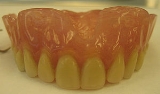
Dentures are
prostheticIn medicine, a prosthesis is an artificial extension that replaces a missing body part. It is part of the field of biomechatronics, the science of fusing mechanical devices with human muscle, skeleton, and nervous systems to assist or enhance motor control lost by trauma, disease, or defect...
devices constructed to replace missing teeth, and which are supported by surrounding soft and hard tissues of the oral cavity. Conventional dentures are removable, however there are many different denture designs, some which rely on bonding or clasping onto teeth or dental implants. There are two main categories of dentures, depending on whether they are used to replace missing teeth on the
mandibular archThe mandible or inferior maxillary bone forms the lower jaw and holds the lower teeth in place. It also refers to both the upper and lower sections of the beaks of birds; in this case the "lower mandible" corresponds to the mandible of humans while the "upper mandible" is functionally equivalent...
or the
maxillary archThe maxilla is a fusion of two bones along the palatal fissure that form the upper jaw. This is similar to the mandible , which is also a fusion of two halves at the mental symphysis. Sometimes , the maxilla is sometimes called "upper maxilla", with the mandible being the "lower maxilla"...
. There are many colloquial terms for dentures such as
dental plate, false teeth, choppers falsies & gnashers
Causes of tooth loss
Patients can become entirely edentulous (without teeth) due to many reasons, the most prevalent being removal because of dental disease typically relating to
oral flora controlTeeth cleaning is the removal of dental plaque from teeth, to prevent cavities , gingivitis, and periodontitis. It is part of a complete program of oral hygiene.-Brushing:...
ie:
periodontal diseasePeriodontitis refers to a number of inflammatory diseases affecting the periodontium — that is, the tissues that surround and support the teeth. Periodontitis involves progressive loss of the alveolar bone around the teeth, and if left untreated, can lead to the loosening and subsequent loss of...
and tooth decay. Other reasons include tooth developmental defects caused by severe
malnutritionMalnutrition is the insufficient, excessive or imbalanced consumption of nutrients.A number of different nutrition disorders may arise, depending on which nutrients are under or overabundant in the diet....
, genetic defects such as
Dentinogenesis imperfectaDentinogenesis imperfecta is a genetic disorder of tooth development. This condition causes teeth to be discolored and translucent. Teeth are also weaker than normal, making them prone to rapid wear, breakage, and loss. These problems can affect both primary teeth and permanent teeth...
,
traumaBlunt force trauma may refer to:* Blunt trauma, a medical term referring to a type of physical trauma* Blunt Force Trauma , a band from Austin, Texas...
, or drug use.
Advantages
Dentures can help patients in a number of ways:
1.
Mastication - chewing ability is improved by replacing edentulous areas with denture teeth.
2.
AestheticsAesthetics is commonly known as the study of sensory or sensori-emotional values, sometimes called judgments of sentiment and taste...
- the presence of teeth provide a natural
facial appearanceVariations in the physical appearance of humans, known as human looks, are believed by anthropologists to be an important factor in the development of personality and social relations, in particular, physical attractiveness. There is a relatively low sexual dimorphism between human males and...
, and wearing a denture to replace missing teeth provides support for the lips and cheeks and corrects the collapsed appearance that occurs after losing teeth.
3.
PhoneticsPhonetics is a branch of linguistics that comprises the study of the sounds of human speech. It is concerned with the physical properties of speech sounds , and their physiological production, auditory perception, and neurophysiological status.Phonetics was studied as early as 2500 years ago in...
- by replacing missing teeth, especially the
anteriorsThere are numerous commonly used terms of relationship and comparison that refer to different aspects of teeth and are frequently utilized in articles about dentistry...
, patients are better able to speak by improving pronunciation of those words containing sibilants or fricatives.
4.
Self-Esteem"Self Esteem" is a song by punk rock group The Offspring. It is the eighth track from their third studio album Smash and was released as the second single from the album. The song was a worldwide hit, reaching #1 in Latvia, Norway, and Sweden and was one of the most successful singles released by...
- Patients feel better about themselves.
Removable partial dentures
Removable partial dentures are for patients who are missing some of their teeth on a particular arch.
Fixed partial denturesA bridge, also known as a fixed partial denture, is a dental restoration used to replace a missing tooth by joining permanently to adjacent teeth or dental implants....
, better known as "crown and bridge", are made from crowns that are fitted on the remaining teeth to act as abutments and pontics made from materials to resemble the missing teeth. Fixed bridges are more expensive than removable appliances but are more stable.
Complete dentures
Conversely, complete dentures or full dentures are worn by patients who are missing all of the teeth in a single arch (i.e the maxillary (upper) or mandibular (lower) arch).
History
Around 700BC,
EtruscansEtruscan civilization is the modern English name given to the culture and way of life of a people of ancient Italy and Corsica, residing between the Apennines and the River Tiber, whom the ancient Romans called Etrusci or Tusci...
, in northern Italy, made dentures out of human or other animal teeth. These deteriorated quickly but, being easy to produce, were popular until the mid 19th century
The first
EuropeEurope is, by convention, one of the world's seven continents. Comprising the westernmost peninsula of Eurasia, Europe is generally divided from Asia to its east by the water divide of the Ural Mountains, the Ural River, the Caspian Sea, the Caucasus Mountains , and the Black Sea to the southeast...
an sets of dentures date from the 15th century and most probably existed before that time. They were carved from
boneBones are rigid organs that form part of the endoskeleton of vertebrates. They function to move, support, and protect the various organs of the body, produce red and white blood cells and store minerals. Bone tissue is a type of dense connective tissue...
or
ivoryIvory is formed from dentine and constitutes the bulk of the teeth and tusks of animals such as the elephant, hippopotamus, walrus, mammoth and narwhal....
, or made up of teeth sourced from graveyards, the recent dead or living donors who exchanged their teeth for profit. These dentures were uncomfortable, attached visibly to a base supported by any remaining teeth with a thread of metal or silk. The false teeth were often made with ivory from the
hippopotamusThe hippopotamus or hippo is a large, mostly plant-eating mammal in sub-Saharan Africa, and one of only two extant species in the family Hippopotamidae...
or
walrusThe walrus is a large flippered marine mammal with a discontinuous circumpolar distribution in the Arctic Ocean and sub-Arctic seas of the Northern Hemisphere. The walrus is the only living species in the Odobenidae family and Odobenus genus. It is subdivided into three subspecies: the Atlantic...
, and usually rotted after extended use.
London[]London is the capital of England and the United Kingdom. It has been a major settlement for two millennia, and the history of London goes back to its founding by the Romans, when it was named Londinium. London's core, the ancient City of London, the 'square mile', retains its medieval boundaries...
's Peter de la Roche is believed to be one of the first 'Operators for the Teeth', men who fashioned themselves as specialists in dental work. Often these men were professional
goldsmithA goldsmith is a metalworker who specializes in working with gold and other precious metals. Since ancient times the techniques of a Goldsmith have evolved very little in order to produce items of jewelry of quality standards. In modern times actual Goldsmiths are rare...
s, ivory turners or students of
barber-surgeonsThe barber surgeon was one of the most common medical practitioners of medieval Europe - generally charged with looking after soldiers during or after a battle...
.
The first
porcelainPorcelain is a ceramic material made by heating raw materials, generally including clay in the form of kaolin, in a kiln to temperatures between and...
dentures were made around 1770 by Alexis Duchâteau. In 1791 the first
BritishThe Kingdom of Great Britain, also known as the United Kingdom of Great Britain, was a sovereign state in northwest Europe, in existence from 1707 to 1801...
patent was granted to Nicholas Dubois De Chemant, previous assistant to Duchateau, for "De Chemant's Specification", "a composition for the purpose of making of artificial teeth either single double or in rows or in complete sets and also springs for fastening or affixing the same in a more easy and effectual manner than any hitherto discovered which said teeth may be made of any shade or colour, which they will retain for any length of time and will consequently more perfectly resemble the natural teeth." He began selling his wares in 1792 with most of his porcelain paste supplied by
WedgwoodWedgwood, strictly Josiah Wedgwood and Sons, is a British pottery firm, founded on May 1 1759 by Josiah Wedgwood, which in 1987 merged with Waterford Crystal, creating Waterford Wedgwood, the Ireland-based luxury brands group. The company still exists as a subsidiary within the group, with its own...
. Perhaps the most famous early denture user was George Washington. He was fitted with them no later than 1764. President Washington's dentures are part of a new display on exhibit at Mount Vernon. Despite the rumors, the famous dentures aren't made of wood, they're made of hippopotamus ivory.
In London in 1820,
Claudius Ash-Personal life:The second son of Sarjeant Ash and Lydia Ash née Smith, Claudius Ash was born in Bethnal Green, London, on 2 March 1792. He married Sarah Butler on 11 March 1813 and had eight children, four of whom, along with other members of the Ash family and their descendants, were engaged in...
, a goldsmith by trade, began manufacturing high-quality porcelain dentures mounted on 18-carat gold plates. Later dentures were made of
VulcaniteVulcanization or vulcanisation refers to a specific curing process of rubber involving high heat and the addition of sulfur or other equivalent curatives. It is a chemical process in which polymer molecules are linked to other polymer molecules by atomic bridges composed of sulfur atoms or carbon...
from the 1850s on, a form of hardened rubber (Claudius Ash’s company was the leading European manufacturer of dental Vulcanite) into which porcelain teeth were set, and then, in the 20th century, acrylic resin and other
plasticPlastic is the general common term for a wide range of synthetic or semisynthetic organic amorphous solid materials suitable for the manufacture of industrial products...
s. In Britain in 1968 79% of those aged 65-74 had no natural teeth, by 1998 this proportion had fallen to 36%.
Problems with complete dentures
Problems with dentures include the fact that patients are not used to having something in their mouth that is not food. The
brainThe brain is the center of the nervous system in all vertebrate, and most invertebrate, animals. Some primitive animals such as jellyfish and starfish have a decentralized nervous system without a brain, while sponges lack any nervous system at all...
senses this appliance as "food" and sends messages to the salivary glands to produce more
salivaSaliva is the watery and usually frothy substance produced in the mouths of humans and most other animals. Saliva is produced in and secreted from the salivary glands...
and to secrete it at a higher rate. This will only happen in the first 12 to 24 hours, after which, the salivary glands return to their normal output. New dentures can also be the cause of sore spots as they compress the soft tissues mucosa (denture bearing soft tissue). A few
denture adjustments for the days following insertion of the dentures can take care of this issue. Gagging is another problem encountered by a minority of patients. At times, this may be due to a denture that is too loose, too thick or extended too far posteriorly onto the
soft palateThe soft palate is the soft tissue constituting the back of the roof of the mouth. The soft palate is distinguished from the hard palate at the front of the mouth in that it does not contain bone.-Function:...
. At times, gagging may also be attributed to psychological denial of the denture. (Psychological gagging is the most difficult to treat since it is out of the dentist's control. In such cases, an implant supported
palateThe palate is the roof of the mouth in humans and vertebrate animals. It separates the oral cavity from the nasal cavity. The palate is divided into two parts, the anterior bony hard palate, and the posterior fleshy soft palate or velum...
less denture may have to be constructed or a hypnotist may need to be consulted). Sometimes there could be a gingivitis under the full dentures, which is caused by accumulation of dental plaque.
One of the most common problems for new full upper denture wearers is the loss of taste.
Another problem with dentures is keeping them in place. There are three rules governing the existence of removable oral appliances:
support,
stability and
retention.
Support
Support is the principle that describes how well the underlying mucosa (oral tissues, including gums and the vestibules) keeps the denture from moving vertically towards the arch in question, and thus being excessively depressed and moving deeper into the arch. For the mandibular arch, this function is provided by the
gingivaThe gingiva , or gums, consists of the mucosal tissue that lies over the alveolar bone.-General description:Gingiva are part of the soft tissue lining of the mouth. They surround the teeth and provide a seal around them...
(gums) and the
buccal shelf (region extending laterally (beside) from the posterior (back) ridges), whereas in the maxillary arch, the palate joins in to help support the denture. The larger the denture flanges (part of the denture that extends into the
vestibuleThe vestibule of mouth is the anteriormost portion of the oral cavity. It is the space between the cheek/lips and the teeth....
), the better the support.
Stability
Stability is the principle that describes how well the denture base is prevented from moving in the
horizontal plane, and thus from sliding side to side or front and back. The more the denture base (pink material) runs in smooth and continuous contact with the edentulous ridge (the hill upon which the teeth used to reside, but now consists of only residual alveolar bone with overlying mucosa), the better the stability. Of course, the higher and broader the ridge, the better the stability will be, but this is usually just a result of patient anatomy, barring surgical intervention (bone grafts, etc.).
Retention
Retention is the principle that describes how well the denture is prevented from moving
vertically in the opposite direction of insertion. The better the topographical mimicry of the
intaglio (interior) surface of the denture base to the surface of the underlying mucosa, the better the retention will be (in
removable partial denturesA removable partial denture is for a partially edentulous dental patient who desires to have replacement teeth for functional or aesthetic reasons, and who cannot have a bridge for any number of reasons, such as a lack of required teeth to serve as support for a bridge A removable partial...
, the clasps are a major provider of retention), as surface tension, suction and just plain old friction will aid in keeping the denture base from breaking intimate contact with the mucosal surface. It is important to note that the most critical element in the retentive design of a full maxillary denture is a complete and total border seal (complete peripheral seal) in order to achieve 'suction'. The border seal is composed of the edges of the anterior and lateral aspects AND the posterior palatal seal. The posterior palatal seal design is accomplished by covering the entire hard palate and extending not beyond the soft palate and ending 1-2 mm from the vibrating line.
As mentioned above, implant technology can vastly improve the patient's denture-wearing experience by increasing stability and saving his or her bone from wearing away. Implant can also help with the retention factor. Instead of merely placing the implants to serve as blocking mechanism against the denture pushing on the alveolar bone, small retentive appliances can be attached to the implants that can then snap into a modified denture base to allow for tremendously increased retention. Options available include a metal
Hader bar or precision balls attachments, among other things.
Complications and recommendations
The fabrication of a set of complete dentures is a challenge for any denturist, including those who are experienced. There are many axioms in the production of dentures that must be understood, of which ignorance of one axiom can lead to failure of the denture case. In the vast majority of cases, complete dentures should be comfortable soon after insertion, although almost always at least two adjustment visits will be necessary to remove sore spots. One of the most critical aspects of dentures is that the impression of the denture must be perfectly made and used with perfect technique to make a model of the patient's edentulous (toothless) gums. The denturist must use a process called border molding to ensure that the denture flanges are properly extended. An endless array of never-ending problems with denture may occur if the final impression of the denture is not made properly. It takes considerable patience and experience for a denturist to know how to make a denture, and for this reason it may be in the patient's best interest to seek a specialist, either a
DenturistA denturist, clinical dental technician or a dental prosthetist, is a member of the oral health care team who provides an oral health examination, takes impressions of the surrounding oral tissues, constructs and delivers removable oral prosthesis directly to the patient.They differ from...
or a
ProsthodontistProsthodontics is one of nine dental specialties recognized by the American Dental Association, Royal College of Dentists of Canada, and Royal Australasian College of Dental Surgeons...
, to make the denture. A general dentist may do a good job, but only if he or she is meticulous and usually he or she must be experienced.
The maxillary denture (the top denture) is usually relatively straightforward to manufacture so that it is stable without slippage. The lower full denture tends to be the most difficult because there is no "suction" holding it in place. For this reason, dentists in the late 1990s have come to a general conclusion that a lower full denture should or must be supported by 2-4 implants placed in the lower jaw for support. A lower denture supported by 2-4 implants is a far superior product than a lower denture without implants, held in place with weak lower mouth muscles. It is routine to be able to bite into an apple or corn-on-the-cob with a lower denture anchored by implants. Without implants, it is quite difficult or even impossible to do so.
Some patients who believe they have "bad teeth" may think it is in their best interests to have all their teeth extracted and full dentures placed. However, statistics show that the majority of patients who actually receive this treatment wind up regretting they did so. This is because full dentures have only 10% of the chewing power of natural teeth, and it is difficult to get them fitted satisfactorily, particularly in the mandibular arch. Even if a patient retains one tooth, that will contribute to the denture's stability. However, retention of just one or two teeth in the upper jaw does not contribute much to the overall stability of a denture, since a full upper denture tends to be very stable, in contrast to a full lower denture. It is thus advised that patients keep their natural teeth as long as possible, especially their lower teeth.