

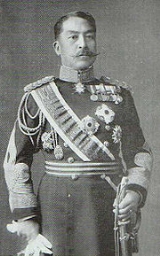
Prince Kan'in Kotohito

Encyclopedia
, was
the sixth head of a cadet branch
the Japanese imperial family, and a career army officer who served as Chief of the Imperial Japanese Army General Staff from 1931 to 1940.
on November 10, 1865 as the sixteenth son of Prince Fushimi Kuniye
(1802–1875). His father was twentieth head of the Fushimi-no-miya
, one of the four shinnōke
, branches of the Imperial Family which were eligible to succeed to the throne if the main line should die out. Since the infant mortality
rate in the main imperial household was quite high, Emperor Kōmei
, the father of Emperor Meiji
, adopted Prince Kotohito as a potential heir. Prince Kotohito was thus the adopted brother of Emperor Meiji
and a great uncle to both Emperor Shōwa and his consort, Empress Kōjun
.
Prince Kotohito was initially sent to Sambō-in monzeki
temple at the age of three to be raised as a Buddhist monk, but was selected in 1872 to revive the Kan'in-no-miya
, another of the shinnōke
households, which had gone extinct upon the death of the fifth head, Prince Naruhito
.
. The couple had seven children: five daughters and two sons:
to France in 1882 to study military tactics and technology. He graduated from the Army Staff College
in 1894, specializing in cavalry
. He commanded the 1st Cavalry Regiment from 1897 to 1899.
Prince Kan'in became a veteran of both the First Sino-Japanese War
(1894–1895) and the Russo-Japanese War
(1904–1905). He was appointed to command the 2nd Cavalry Brigade in 1901. He rose to the rank of lieutenant general
in 1905 and became the commander of the IJA 1st Division in 1906, and the Imperial Guard Division
in 1911. He was promoted to the rank of full general
and became a Supreme War Councilor
in 1912. He was further promoted to become the youngest field marshal
in the Imperial Japanese Army in 1919.
Hirohito
on his tour of Europe. He became Chief of the Imperial Japanese Army General Staff on December 1, 1931, replacing General Kanaya Hanzo.
During his mandate, the Imperial Japanese Army
has been accused of committing many exactions against Chinese civilians including the Nanking massacre
and the use of chemical and bacteriological weapons. Chemical weapons, such as tear gas, were used only sporadically in 1937, but in the spring of 1938, however the Imperial Japanese Army
began full-scale use of sneeze and nausea gas (red), and from summer 1939, mustard gas (yellow) was used against both Kuomintang and Communist Chinese troops. Prince Kan'in transmitted to the Army the emperor's first directive (rinsanmei) authorizing the use of chemical weapons on July 28, 1937. He transmitted a second order on September 11 authorizing the deployment of special chemical warfare units to Shanghai
. On April 11, 1938, Directive Number 11 was issued in his name, authorizing further use of poison gas in Inner Mongolia
.
Prince Kan'in, among others within the army, opposed Prime Minister
Yonai Mitsumasa's efforts to improve relations with the United States and the United Kingdom. He forced the resignation of War Minister
General Hata Shunroku (1879–1962), thus bringing down the Yonai cabinet in July 1940. The Prince was a participant in the liaison conferences between the military chiefs of staff and the second cabinet of Prince Konoe Fumimaro (June 1940–July 1941). Both he and Lieutenant General Tojo Hideki, the newly appointed War Minister, supported the Tripartite Pact
between the Empire of Japan, Nazi Germany
, and Fascist Italy
.
Prince Kan'in retired as Chief of the General Staff on October 3, 1940 and was succeeded by Sugiyama Hajime. He remained a member of the Supreme War Council and a senior advisor to the emperor on army matters. Field Marshal Prince Kan'in died in Odawara, Kanagawa
at the Kan'in summer residence, possibly due to an infection due to inflamed hemorrhoids on May 21, 1945 and was accorded a state funeral
.
The Prince was a strong supporter of State Shinto
. With Kiichiro Hiranuma
he set up the "Shintoist Rites Research Council" to research all ancient Shinto rites and practices. Other associates were Kuniaki Koiso
, Heisuke Yanagawa
, who directed the Taisei Yokusankai
and Chikao Fujisawa, member of the Diet of Japan
, who proposed a law that Shinto should be reaffirmed as Japan's state religion
.
His only son, Prince Kan'in Haruhito
, succeeded him as the seventh and last head of the Kan'in-no-miya household.
His decorations included the Grand Order of Merit
, Order of the Golden Kite
(1st Class), and the Collar of the Supreme Order of the Chrysanthemum
.
the sixth head of a cadet branch
Shinnoke
was the collective name for the four cadet branches of the Imperial Household of Japan, which were until 1947 entitled to provide a successor to the Chrysanthemum throne if the main line failed to produce an heir...
the Japanese imperial family, and a career army officer who served as Chief of the Imperial Japanese Army General Staff from 1931 to 1940.
Early years
Prince Kotohito was born in KyotoKyoto
is a city in the central part of the island of Honshū, Japan. It has a population close to 1.5 million. Formerly the imperial capital of Japan, it is now the capital of Kyoto Prefecture, as well as a major part of the Osaka-Kobe-Kyoto metropolitan area.-History:...
on November 10, 1865 as the sixteenth son of Prince Fushimi Kuniye
Prince Fushimi Kuniye
was a Japanese minor royal, he was the 20th prince Fushimi-no-miya 1817/1848, married and had issue, at least 17 sons and 4 daughters....
(1802–1875). His father was twentieth head of the Fushimi-no-miya
Fushimi-no-miya
The ' is the oldest of the four shinnōke, branches of the Imperial Family of Japan which were eligible to succeed to the Chrysanthemum Throne in the event that the main line should die out....
, one of the four shinnōke
Shinnoke
was the collective name for the four cadet branches of the Imperial Household of Japan, which were until 1947 entitled to provide a successor to the Chrysanthemum throne if the main line failed to produce an heir...
, branches of the Imperial Family which were eligible to succeed to the throne if the main line should die out. Since the infant mortality
Infant mortality
Infant mortality is defined as the number of infant deaths per 1000 live births. Traditionally, the most common cause worldwide was dehydration from diarrhea. However, the spreading information about Oral Re-hydration Solution to mothers around the world has decreased the rate of children dying...
rate in the main imperial household was quite high, Emperor Kōmei
Emperor Komei
was the 121st emperor of Japan, according to the traditional order of succession. Kōmei's reign spanned the years from 1846 through 1867.-Genealogy:Before Kōmei's accession to the Chrysanthemum Throne, his personal name was ;, his title was ....
, the father of Emperor Meiji
Emperor Meiji
The or was the 122nd emperor of Japan according to the traditional order of succession, reigning from 3 February 1867 until his death...
, adopted Prince Kotohito as a potential heir. Prince Kotohito was thus the adopted brother of Emperor Meiji
Emperor Meiji
The or was the 122nd emperor of Japan according to the traditional order of succession, reigning from 3 February 1867 until his death...
and a great uncle to both Emperor Shōwa and his consort, Empress Kōjun
Empress Kojun
' was empress consort of Emperor Hirohito of Japan. Born , she was the mother of the present Emperor .Her posthumous name is Kōjun, which means "fragrant purity"...
.
Prince Kotohito was initially sent to Sambō-in monzeki
Monzeki
Monzeki were Japanese Buddhist priests of aristocratic or imperial lineage. The term was also applied to the temples in which they lived....
temple at the age of three to be raised as a Buddhist monk, but was selected in 1872 to revive the Kan'in-no-miya
Kan'in-no-miya
The ' is the youngest of the four shinnōke, branches of the Imperial Family of Japan which were eligible to succeed to the Chrysanthemum Throne in the event that the main line should die out. It was founded by Prince Naohito, the son of Emperor Higashiyama....
, another of the shinnōke
Shinnoke
was the collective name for the four cadet branches of the Imperial Household of Japan, which were until 1947 entitled to provide a successor to the Chrysanthemum throne if the main line failed to produce an heir...
households, which had gone extinct upon the death of the fifth head, Prince Naruhito
Prince Kan'in Naruhito
was the 5th head of the Kan'in-no-miya line of shinnōke cadet branches of the Imperial Family of Japan.He became the 5th head in 1828 after the passing of Prince Kan'in Tatsuhito....
.
Marriage & family
On December 19, 1891, Prince Kotohiko married Sanjō Chieko (January 30, 1872 – March 19, 1947), a daughter of Prince Sanjō SanetomiSanjo Sanetomi
Prince was an Imperial court noble and statesman at the time of the Meiji Restoration. He held many high-ranking offices in the Meiji government.-Biography:Born in Kyoto, Sanjō was the son of Naidaijin Sanjō Sanetsumu...
. The couple had seven children: five daughters and two sons:
Military career
Prince Kan'in entered the Imperial Japanese Army Academy in 1877 and graduated in 1881. Emperor Meiji sent him as a military attachéMilitary attaché
A military attaché is a military expert who is attached to a diplomatic mission . This post is normally filled by a high-ranking military officer who retains the commission while serving in an embassy...
to France in 1882 to study military tactics and technology. He graduated from the Army Staff College
Army War College (Japan)
The ; Short form: of the Empire of Japan was founded in 1882 in Minato, Tokyo to modernize and Westernize the Imperial Japanese Army. Much of the empire's elite including prime ministers during the period of Japanese militarism were graduates of the college....
in 1894, specializing in cavalry
Cavalry
Cavalry or horsemen were soldiers or warriors who fought mounted on horseback. Cavalry were historically the third oldest and the most mobile of the combat arms...
. He commanded the 1st Cavalry Regiment from 1897 to 1899.
Prince Kan'in became a veteran of both the First Sino-Japanese War
First Sino-Japanese War
The First Sino-Japanese War was fought between Qing Dynasty China and Meiji Japan, primarily over control of Korea...
(1894–1895) and the Russo-Japanese War
Russo-Japanese War
The Russo-Japanese War was "the first great war of the 20th century." It grew out of rival imperial ambitions of the Russian Empire and Japanese Empire over Manchuria and Korea...
(1904–1905). He was appointed to command the 2nd Cavalry Brigade in 1901. He rose to the rank of lieutenant general
Lieutenant General
Lieutenant General is a military rank used in many countries. The rank traces its origins to the Middle Ages where the title of Lieutenant General was held by the second in command on the battlefield, who was normally subordinate to a Captain General....
in 1905 and became the commander of the IJA 1st Division in 1906, and the Imperial Guard Division
Imperial Guard of Japan
The Japanese is an organization which is dedicated to protection of the Emperor of Japan and his family, palaces and other imperial properties. Following the end of World War II the traditional Guard, which also served as a unit in the Imperial Japanese Army, was dissolved and in 1947 a civil...
in 1911. He was promoted to the rank of full general
General
A general officer is an officer of high military rank, usually in the army, and in some nations, the air force. The term is widely used by many nations of the world, and when a country uses a different term, there is an equivalent title given....
and became a Supreme War Councilor
Supreme War Council (Japan)
The Supreme War Council was established during the development of representative government in Meiji period Japan to further strengthen the authority of the state. Its first leader was Yamagata Aritomo , a Chōshū native who has been credited with the founding of the modern Japanese army and was to...
in 1912. He was further promoted to become the youngest field marshal
Field Marshal (Japan)
was the highest title in the prewar Imperial Japanese Military.The term gensui, which was used for both the Imperial Japanese Army and the Imperial Japanese Navy, was at first a rank held by Saigō Takamori as the Commander of the Armies in 1872...
in the Imperial Japanese Army in 1919.
Political career
In 1921, Prince Kan'in accompanied then-Crown PrinceCrown Prince
A crown prince or crown princess is the heir or heiress apparent to the throne in a royal or imperial monarchy. The wife of a crown prince is also titled crown princess....
Hirohito
Hirohito
, posthumously in Japan officially called Emperor Shōwa or , was the 124th Emperor of Japan according to the traditional order, reigning from December 25, 1926, until his death in 1989. Although better known outside of Japan by his personal name Hirohito, in Japan he is now referred to...
on his tour of Europe. He became Chief of the Imperial Japanese Army General Staff on December 1, 1931, replacing General Kanaya Hanzo.
During his mandate, the Imperial Japanese Army
Imperial Japanese Army
-Foundation:During the Meiji Restoration, the military forces loyal to the Emperor were samurai drawn primarily from the loyalist feudal domains of Satsuma and Chōshū...
has been accused of committing many exactions against Chinese civilians including the Nanking massacre
Nanking Massacre
The Nanking Massacre or Nanjing Massacre, also known as the Rape of Nanking, was a mass murder, genocide and war rape that occurred during the six-week period following the Japanese capture of the city of Nanjing , the former capital of the Republic of China, on December 13, 1937 during the Second...
and the use of chemical and bacteriological weapons. Chemical weapons, such as tear gas, were used only sporadically in 1937, but in the spring of 1938, however the Imperial Japanese Army
Imperial Japanese Army
-Foundation:During the Meiji Restoration, the military forces loyal to the Emperor were samurai drawn primarily from the loyalist feudal domains of Satsuma and Chōshū...
began full-scale use of sneeze and nausea gas (red), and from summer 1939, mustard gas (yellow) was used against both Kuomintang and Communist Chinese troops. Prince Kan'in transmitted to the Army the emperor's first directive (rinsanmei) authorizing the use of chemical weapons on July 28, 1937. He transmitted a second order on September 11 authorizing the deployment of special chemical warfare units to Shanghai
Shanghai
Shanghai is the largest city by population in China and the largest city proper in the world. It is one of the four province-level municipalities in the People's Republic of China, with a total population of over 23 million as of 2010...
. On April 11, 1938, Directive Number 11 was issued in his name, authorizing further use of poison gas in Inner Mongolia
Inner Mongolia
Inner Mongolia is an autonomous region of the People's Republic of China, located in the northern region of the country. Inner Mongolia shares an international border with the countries of Mongolia and the Russian Federation...
.
Prince Kan'in, among others within the army, opposed Prime Minister
Prime Minister of Japan
The is the head of government of Japan. He is appointed by the Emperor of Japan after being designated by the Diet from among its members, and must enjoy the confidence of the House of Representatives to remain in office...
Yonai Mitsumasa's efforts to improve relations with the United States and the United Kingdom. He forced the resignation of War Minister
Ministry of War of Japan
The , more popularly known as the Ministry of War of Japan, was cabinet-level ministry in the Empire of Japan charged with the administrative affairs of the Imperial Japanese Army...
General Hata Shunroku (1879–1962), thus bringing down the Yonai cabinet in July 1940. The Prince was a participant in the liaison conferences between the military chiefs of staff and the second cabinet of Prince Konoe Fumimaro (June 1940–July 1941). Both he and Lieutenant General Tojo Hideki, the newly appointed War Minister, supported the Tripartite Pact
Tripartite Pact
The Tripartite Pact, also the Three-Power Pact, Axis Pact, Three-way Pact or Tripartite Treaty was a pact signed in Berlin, Germany on September 27, 1940, which established the Axis Powers of World War II...
between the Empire of Japan, Nazi Germany
Nazi Germany
Nazi Germany , also known as the Third Reich , but officially called German Reich from 1933 to 1943 and Greater German Reich from 26 June 1943 onward, is the name commonly used to refer to the state of Germany from 1933 to 1945, when it was a totalitarian dictatorship ruled by...
, and Fascist Italy
Kingdom of Italy (1861–1946)
The Kingdom of Italy was a state forged in 1861 by the unification of Italy under the influence of the Kingdom of Sardinia, which was its legal predecessor state...
.
Prince Kan'in retired as Chief of the General Staff on October 3, 1940 and was succeeded by Sugiyama Hajime. He remained a member of the Supreme War Council and a senior advisor to the emperor on army matters. Field Marshal Prince Kan'in died in Odawara, Kanagawa
Odawara, Kanagawa
is a city located in western Kanagawa Prefecture, Japan. As of 2010, the city had an estimated population of 198,466 with a population density of 1,740 persons per km² . The total area was .-Geography:...
at the Kan'in summer residence, possibly due to an infection due to inflamed hemorrhoids on May 21, 1945 and was accorded a state funeral
State funeral
A state funeral is a public funeral ceremony, observing the strict rules of protocol, held to honor heads of state or other important people of national significance. State funerals usually include much pomp and ceremony as well as religious overtones and distinctive elements of military tradition...
.
The Prince was a strong supporter of State Shinto
State Shinto
has been called the state religion of the Empire of Japan, although it did not exist as a single institution and no "Shintō" was ever declared a state religion...
. With Kiichiro Hiranuma
Kiichiro Hiranuma
Baron was a prominent pre–World War II right-wing Japanese politician and the 35th Prime Minister of Japan from 5 January 1939 to 30 August 1939. The modern Japanese politician, Takeo Hiranuma, is his adopted son.- Early life :...
he set up the "Shintoist Rites Research Council" to research all ancient Shinto rites and practices. Other associates were Kuniaki Koiso
Kuniaki Koiso
- Notes :...
, Heisuke Yanagawa
Heisuke Yanagawa
- Notes :...
, who directed the Taisei Yokusankai
Taisei Yokusankai
The was Japan's para-fascist organization created by Prime Minister Fumimaro Konoe on October 12, 1940 to promote the goals of his Shintaisei movement...
and Chikao Fujisawa, member of the Diet of Japan
Diet of Japan
The is Japan's bicameral legislature. It is composed of a lower house, called the House of Representatives, and an upper house, called the House of Councillors. Both houses of the Diet are directly elected under a parallel voting system. In addition to passing laws, the Diet is formally...
, who proposed a law that Shinto should be reaffirmed as Japan's state religion
State religion
A state religion is a religious body or creed officially endorsed by the state...
.
His only son, Prince Kan'in Haruhito
Kan'in Haruhito
- Notes :...
, succeeded him as the seventh and last head of the Kan'in-no-miya household.
His decorations included the Grand Order of Merit
Order of Merit
The Order of Merit is a British dynastic order recognising distinguished service in the armed forces, science, art, literature, or for the promotion of culture...
, Order of the Golden Kite
Order of the Golden Kite
The ' was an order of the Empire of Japan, established on 12 February 1890 by Emperor Meiji "in commemoration of Jimmu Tennō, the Romulus of Japan."-Background:...
(1st Class), and the Collar of the Supreme Order of the Chrysanthemum
Order of the Chrysanthemum
is Japan's highest order. The Grand Cordon of the Order was established in 1876 by Emperor Meiji of Japan; the collar of the Order was added on January 4, 1888. Although technically the order has only one class, it can either be awarded with collar , or with grand cordon...
.