

Prehistoric Central North Africa

Encyclopedia
Early and middle Paleolithic
Earlier inhabitants of central North AfricaNorth Africa
North Africa or Northern Africa is the northernmost region of the African continent, linked by the Sahara to Sub-Saharan Africa. Geopolitically, the United Nations definition of Northern Africa includes eight countries or territories; Algeria, Egypt, Libya, Morocco, South Sudan, Sudan, Tunisia, and...
have left behind equally significant remains. Early remnants of hominid occupation in North Africa
North Africa
North Africa or Northern Africa is the northernmost region of the African continent, linked by the Sahara to Sub-Saharan Africa. Geopolitically, the United Nations definition of Northern Africa includes eight countries or territories; Algeria, Egypt, Libya, Morocco, South Sudan, Sudan, Tunisia, and...
, for example, were found in Ain el Hanech, near Saïda (c. 200,000 BCE); in fact, more recent investigations have found signs of Oldowan technology there, and indicate a date of up to 1.8 million BC. Later, Neandertal tool makers produced hand axes in the Levalloisian and Mousterian
Mousterian
Mousterian is a name given by archaeologists to a style of predominantly flint tools associated primarily with Homo neanderthalensis and dating to the Middle Paleolithic, the middle part of the Old Stone Age.-Naming:...
styles (c. 43,000 BCE) similar to those in the Levant. According to some sources, North Africa was the site of the highest state of development of Middle Paleolithic flake-tool techniques. Tools of this era, starting about 30,000 BCE, are called Aterian
Aterian
The Aterian industry is a name given by archaeologists to a type of stone tool manufacturing dating to the Middle Stone Age in the region around the Atlas Mountains and the northern Sahara, it refers the site of Bir el Ater, south of Annaba.The industry was probably created by modern humans ,...
(after the site Bir el Ater, south of Annaba) and are marked by a high standard of workmanship, great variety, and specialization.
Late Paleolithic and Mesolithic
The earliest blade industries in North Africa are called Ibero-Maurusian or Oranian (after a site near OranOran
Oran is a major city on the northwestern Mediterranean coast of Algeria, and the second largest city of the country.It is the capital of the Oran Province . The city has a population of 759,645 , while the metropolitan area has a population of approximately 1,500,000, making it the second largest...
). The industry appears to have spread throughout the coastal regions of North Africa between 15,000 and 10,000 BCE. Between about 9000 and 5000 BCE, the Capsian culture began influencing the IberoMaurusian, and after about 3000 BCE the remains of just one human type can be found throughout the region. Neolithic civilization (marked by animal domestication and subsistence agriculture) developed in the Saharan and Mediterranean North Africa between 6000 and 2000 BCE. This type of economy, so richly depicted in the Tassili n'Ajjer
Tassili n'Ajjer
Tassili n'Ajjer is a mountain range in the Algerian section of the Sahara Desert. It is a vast plateau in south-east Algeria at the borders of Libya, Niger and Mali, covering an area of 72,000 sq...
cave paintings, predominated in North Africa until the classical period.
Painting
Painting is the practice of applying paint, pigment, color or other medium to a surface . The application of the medium is commonly applied to the base with a brush but other objects can be used. In art, the term painting describes both the act and the result of the action. However, painting is...
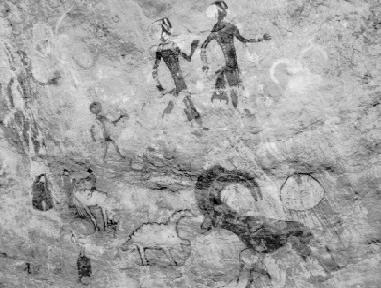
s found at Tassili n'Ajjer
Tassili n'Ajjer
Tassili n'Ajjer is a mountain range in the Algerian section of the Sahara Desert. It is a vast plateau in south-east Algeria at the borders of Libya, Niger and Mali, covering an area of 72,000 sq...
, north of Tamanrasset, Algeria, and at other locations depict vibrant and vivid scenes of everyday life in central North Africa
North Africa
North Africa or Northern Africa is the northernmost region of the African continent, linked by the Sahara to Sub-Saharan Africa. Geopolitically, the United Nations definition of Northern Africa includes eight countries or territories; Algeria, Egypt, Libya, Morocco, South Sudan, Sudan, Tunisia, and...
during the Neolithic Subpluvial
Neolithic Subpluvial
The Neolithic Subpluvial — sometimes called the Holocene Wet Phase — was an extended period of wet and rainy conditions in the climate history of northern Africa...
period (about 8000 to 4000 BCE). They were executed by a hunting people in the Capsian period of the Neolithic age who lived in a savanna region teeming with giant buffalo
African Buffalo
The African buffalo, affalo, nyati, Mbogo or Cape buffalo is a large African bovine. It is not closely related to the slightly larger wild Asian water buffalo, but its ancestry remains unclear...
, elephant
Elephant
Elephants are large land mammals in two extant genera of the family Elephantidae: Elephas and Loxodonta, with the third genus Mammuthus extinct...
, rhinoceros
Rhinoceros
Rhinoceros , also known as rhino, is a group of five extant species of odd-toed ungulates in the family Rhinocerotidae. Two of these species are native to Africa and three to southern Asia....
, and hippopotamus
Hippopotamus
The hippopotamus , or hippo, from the ancient Greek for "river horse" , is a large, mostly herbivorous mammal in sub-Saharan Africa, and one of only two extant species in the family Hippopotamidae After the elephant and rhinoceros, the hippopotamus is the third largest land mammal and the heaviest...
, animals that no longer exist in the now-desert area. The pictures provide the most complete record of a prehistoric African culture. Various populations of pastoralists
Pastoralism
Pastoralism or pastoral farming is the branch of agriculture concerned with the raising of livestock. It is animal husbandry: the care, tending and use of animals such as camels, goats, cattle, yaks, llamas, and sheep. It may have a mobile aspect, moving the herds in search of fresh pasture and...
have left paintings of abundant wildlife, domesticated animals, chariots, and a complex culture that dates back to at least 10,000 BCE in Northern Niger
Niger
Niger , officially named the Republic of Niger, is a landlocked country in Western Africa, named after the Niger River. It borders Nigeria and Benin to the south, Burkina Faso and Mali to the west, Algeria and Libya to the north and Chad to the east...
and neighboring parts of Algeria
Algeria
Algeria , officially the People's Democratic Republic of Algeria , also formally referred to as the Democratic and Popular Republic of Algeria, is a country in the Maghreb region of Northwest Africa with Algiers as its capital.In terms of land area, it is the largest country in Africa and the Arab...
and Libya
Libya
Libya is an African country in the Maghreb region of North Africa bordered by the Mediterranean Sea to the north, Egypt to the east, Sudan to the southeast, Chad and Niger to the south, and Algeria and Tunisia to the west....
. Several former northern Nigerian villages and archeological sites date from the Green Sahara period of 7500-7000 to 3500-3000 BCE
Neolithic and Bronze Age
Some parts of North AfricaNorth Africa
North Africa or Northern Africa is the northernmost region of the African continent, linked by the Sahara to Sub-Saharan Africa. Geopolitically, the United Nations definition of Northern Africa includes eight countries or territories; Algeria, Egypt, Libya, Morocco, South Sudan, Sudan, Tunisia, and...
began to participate in the Neolithic revolution
Neolithic Revolution
The Neolithic Revolution was the first agricultural revolution. It was the transition from hunting and gathering to agriculture and settlement. Archaeological data indicates that various forms of plants and animal domestication evolved independently in 6 separate locations worldwide circa...
in the 6th millennium BC, just before Saharan desertification.
Clement and fertile conditions during the Neolithic Subpluvial supported increased human settlement of the Nile Valley in Egypt
Egypt
Egypt , officially the Arab Republic of Egypt, Arabic: , is a country mainly in North Africa, with the Sinai Peninsula forming a land bridge in Southwest Asia. Egypt is thus a transcontinental country, and a major power in Africa, the Mediterranean Basin, the Middle East and the Muslim world...
, as well as neolithic
Neolithic
The Neolithic Age, Era, or Period, or New Stone Age, was a period in the development of human technology, beginning about 9500 BC in some parts of the Middle East, and later in other parts of the world. It is traditionally considered as the last part of the Stone Age...
societies in Sudan
Sudan
Sudan , officially the Republic of the Sudan , is a country in North Africa, sometimes considered part of the Middle East politically. It is bordered by Egypt to the north, the Red Sea to the northeast, Eritrea and Ethiopia to the east, South Sudan to the south, the Central African Republic to the...
and throughout the present-day Sahara.
Cultures producing rock art
Saharan rock art
Saharan rock art is a significant area of archaeological study focusing on the precious treasures carved or painted on the natural rocks found in the central Sahara desert. There are over three thousand sites discovered that have information about Saharan rock art...
(notably that at Tassili n'Ajjer
Tassili n'Ajjer
Tassili n'Ajjer is a mountain range in the Algerian section of the Sahara Desert. It is a vast plateau in south-east Algeria at the borders of Libya, Niger and Mali, covering an area of 72,000 sq...
in southeastern Algeria
Algeria
Algeria , officially the People's Democratic Republic of Algeria , also formally referred to as the Democratic and Popular Republic of Algeria, is a country in the Maghreb region of Northwest Africa with Algiers as its capital.In terms of land area, it is the largest country in Africa and the Arab...
) flourished during this period.
In Prehistoric Egypt, Neolithic settlements appear from about 6000 BC.
Oher regions in Africa independently developed agriculture at about the same time: the Ethiopian highlands
Ethiopian Highlands
The Ethiopian Highlands are a rugged mass of mountains in Ethiopia, Eritrea , and northern Somalia in the Horn of Africa...
, the Sahel
Sahel
The Sahel is the ecoclimatic and biogeographic zone of transition between the Sahara desert in the North and the Sudanian Savannas in the south.It stretches across the North African continent between the Atlantic Ocean and the Red Sea....
, and West Africa
West Africa
West Africa or Western Africa is the westernmost region of the African continent. Geopolitically, the UN definition of Western Africa includes the following 16 countries and an area of approximately 5 million square km:-Flags of West Africa:...
.
The beginning of the Bronze Age in Egypt is conventionally identified as the Protodynastic Period, following the Neolithic Naqada
Naqada
Naqada is a town on the west bank of the Nile in the Egyptian governorate of Qena. It was known in Ancient Egypt as Nubt and in classical antiquity as Ombos. Its name derives from ancient Egyptian nub, meaning gold, on account of the proximity of gold mines in the Eastern Desert.Naqada comprises...
culture about 3200 BC.
Iron Age
The amalgam of peoples of North Africa by the Iron Age coalesced into a distinct native population that came to be called BerbersBerber people
Berbers are the indigenous peoples of North Africa west of the Nile Valley. They are continuously distributed from the Atlantic to the Siwa oasis, in Egypt, and from the Mediterranean to the Niger River. Historically they spoke the Berber language or varieties of it, which together form a branch...
.
While Egypt as a part of the wider Ancient Near East
Ancient Near East
The ancient Near East was the home of early civilizations within a region roughly corresponding to the modern Middle East: Mesopotamia , ancient Egypt, ancient Iran The ancient Near East was the home of early civilizations within a region roughly corresponding to the modern Middle East: Mesopotamia...
had entered historicity since the Bronze Age, the Maghreb
Maghreb
The Maghreb is the region of Northwest Africa, west of Egypt. It includes five countries: Morocco, Algeria, Tunisia, Libya, and Mauritania and the disputed territory of Western Sahara...
remained in the prehistoric period longer.
Some Phoenicia
Phoenicia
Phoenicia , was an ancient civilization in Canaan which covered most of the western, coastal part of the Fertile Crescent. Several major Phoenician cities were built on the coastline of the Mediterranean. It was an enterprising maritime trading culture that spread across the Mediterranean from 1550...
n and Greek colonies were established along the Mediterranean coast during the 7th century BC.
See also
- Synoptic table of the principal old world prehistoric culturesSynoptic table of the principal old world prehistoric culturesThe synoptic table of the principal old world prehistoric cultures gives a rough picture of the relationships between the various principal cultures of prehistory outside the Americas, Antarctica, Australia and Oceania...
- Prehistoric Egypt
- African archaeologyAfrican archaeologyThe continent of Africa has the longest record of human activity of any part of the world and along with its geographical extent, it contains an enormous archaeological resource...
- Ancient LibyaAncient LibyaThe Latin name Libya referred to the region west of the Nile Valley, generally corresponding to modern Northwest Africa. Climate changes affected the locations of the settlements....
- GaramantesGaramantesThe Garamantes were a Saharan people who used an elaborate underground irrigation system, and founded a prosperous Berber kingdom in the Fezzan area of modern-day Libya, in the Sahara desert. They were a local power in the Sahara between 500 BC and 700 AD.There is little textual information about...
- RokniaRokniaRoknia is a necropolis in the Guelma region of north-east Algeria consisting of more than 7000 dolmens spread over an area of 2 km.- External links :*...