


Contax

Encyclopedia
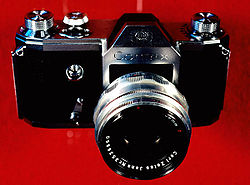
Camera
A camera is a device that records and stores images. These images may be still photographs or moving images such as videos or movies. The term camera comes from the camera obscura , an early mechanism for projecting images...
brand noted for its unique technical innovation and a wide range of Zeiss lenses
Photographic lens
A camera lens is an optical lens or assembly of lenses used in conjunction with a camera body and mechanism to make images of objects either on photographic film or on other media capable of storing an image chemically or electronically.While in principle a simple convex lens will suffice, in...
, noted for their high optical quality. Its final incarnation was a line of 35 mm
135 film
The term 135 was introduced by Kodak in 1934 as a designation for cartridge film wide, specifically for still photography. It quickly grew in popularity, surpassing 120 film by the late 1960s to become the most popular photographic film format...
, medium format and digital cameras engineered and manufactured by Kyocera
Kyocera
is a multinational manufacturer based in Kyoto, Japan. It was founded as in 1959 by Kazuo Inamori and renamed in 1982. The company has diversified its founding technology in ceramic materials through internal development as well as strategic mergers and acquisitions...
, and featuring modern Zeiss optics. In 2005, Kyocera announced that they would no longer produce Contax cameras.
Historical Overview
While the firm of Ernst Leitz of Wetzlar established the 24 mm × 36 mm negative format on perforated 35 mm movie film as a viable photographic system, Zeiss Ikon of Dresden decided to produce a competitor designed to be superior in every way. The name Contax was chosen after a poll among its employees. Dr. Ing. Heinz Küppenbender was its chief designer.Made between 1932 and 1936, the original Contax, known as Contax I after later models were introduced, was markedly different from the corresponding Leica. Using a die-cast alloy body it housed a vertically travelling metal focal-plane shutter
Focal-plane shutter
In camera design, a focal-plane shutter is a type of photographic shutter that is positioned immediately in front of the focal plane of the camera, that is, right in front of the photographic film or image sensor.-Two-curtain shutters:...
reminiscent of the one used in Contessa-Nettel cameras, made out of interlocking blackened brass slats somewhat like a roll-up garage door. This complex shutter became the characteristic of the Contax camera and its Super-Nettel derivative. By contrast, the competitive Leica followed the established design of using rubberized fabric shutter curtains wound around rollers, moving horizontally. The Contax design allowed a higher maximum shutter speed: the top speed was 1/1000s, then increased to 1/1250s in the Contax II. The fact the shutter ran across the shorter dimension of the format area was a significant factor for achieving this technical feat. The interlocking slats were aligned by specially woven silk ribbons, which were very strong but subject to wear.
One of the key design features was a coupled rangefinder with a very long baseline, with its own eyepiece next to that of the viewfinder. To enhance accuracy, a novel rotating wedge system was employed in lieu of the common swinging mirror mechanism. Other main features included focusing drive built into the camera body for use with standard lens, removable back, shutter speed knob integral with film wind knob placed at the front of the camera body, and black enamelled finish.
The young lens designer Ludwig Bertele
Ludwig Bertele
Ludwig Jakob Bertele was a German optics constructor. His developments received universal recognition and serve as a basis for considerable part of optical designs, which are used in modern world.-Biography:...
, formerly of Ernemann, was charged with the responsibility of designing the lenses. It can be said that with a few exceptions, Contax lenses were superior to equivalent contemporary Leica lenses for more than two decades.
The greatest advantage of the Zeiss lenses was the reduced number of air-to-glass surfaces in Bertele's designs. In the years before lens coating was generally practised this had advantages for contrast and resistance to lens flare. Zeiss pioneered in glass coating too and before the war coated lenses were offered. After lens coating became universal post WW2, designers were given more freedom in using extra air-to-glass surfaces in correcting lens aberrations, without fear of the ill effects of surface reflections.
In 1936 the Contax II and III models were introduced; the only difference between them was the integral exposure meter on the latter model. They introduced the combined eyepiece for both viewfinder and rangefinder, the shutter speed and film wind knob placed on the top plate, fastest shutter speed at 1/1250s. and finished in chrome plating. They became very popular among professional photographers, especially photojournalists who demanded high-performance, large-aperture lenses for available-light work and a workhorse. The vertical shutter had both variations in speed, slit and a break that was again a Zeiss first.
Dresden
Dresden is the capital city of the Free State of Saxony in Germany. It is situated in a valley on the River Elbe, near the Czech border. The Dresden conurbation is part of the Saxon Triangle metropolitan area....
factory, and some were assembled at the Carl Zeiss optical works at Jena
Jena
Jena is a university city in central Germany on the river Saale. It has a population of approx. 103,000 and is the second largest city in the federal state of Thuringia, after Erfurt.-History:Jena was first mentioned in an 1182 document...
, before production was transferred to Kiev
Kiev
Kiev or Kyiv is the capital and the largest city of Ukraine, located in the north central part of the country on the Dnieper River. The population as of the 2001 census was 2,611,300. However, higher numbers have been cited in the press....
in Ukraine
Ukraine
Ukraine is a country in Eastern Europe. It has an area of 603,628 km², making it the second largest contiguous country on the European continent, after Russia...
. During the war years, the chief designer, Hubert Nerwin, tried to convert the Contax into a single-lens reflex camera
Single-lens reflex camera
A single-lens reflex camera is a camera that typically uses a semi-automatic moving mirror system that permits the photographer to see exactly what will be captured by the film or digital imaging system, as opposed to pre-SLR cameras where the view through the viewfinder could be significantly...
but was hindered by the presence of the upper roller of the vertical focal-plane shutter. The postwar design chief Wilhelm Winzenberg started with a clean slate, which became the Contax S (Spiegelreflex), even though the "S" was not marked on the camera.
The Contax S can be said to be the camera that defined the configuration of the modern 35mm SLR camera. Not only did it introduce the M42 lens mount
M42 lens mount
The M42 lens mount is a screw thread mounting standard for attaching lenses to 35 mm cameras, primarily single-lens reflex models. It is more accurately known as the M42 × 1 mm standard, which means that it is a metric screw thread of 42 mm diameter and 1 mm thread pitch...
which became an industry standard, but it was also equipped with a horizontal focal-plane shutter, and also removed a major objection against the reflex camera by offering an unreversed, eye-level viewing image by employing a pentaprism
Pentaprism
A pentaprism is a five-sided reflecting prism used to deviate a beam of light by 90°. The beam reflects inside the prism twice, allowing the transmission of an image through a right angle without inverting it as an ordinary right-angle prism or mirror would.The reflections inside the prism are not...
. Introduced in 1949, numerous models followed including D, E, F, FB, FM and FBM. During that period, VEB Zeiss Ikon
Jenoptik
Jenoptik is an optoelectronics group located in Jena, Thuringia, Germany and a descendant of the pre-war Zeiss company. The business is divided into five divisions: Optical Systems, Lasers & Material Processing, Industrial Metrology, Traffic Solutions and Defense & Civil Systems.- Company profile...
, as the firm became known, was gradually under pressure from the new Zeiss Ikon AG in the US zone
Allied Occupation Zones in Germany
The Allied powers who defeated Nazi Germany in World War II divided the country west of the Oder-Neisse line into four occupation zones for administrative purposes during 1945–49. In the closing weeks of fighting in Europe, US forces had pushed beyond the previously agreed boundaries for the...
, so the original Zeiss Ikon and Contax names and trademarks gradually disappeared and were replaced by the new name of Pentacon
Pentacon
Pentacon is the company name of a once-important camera manufacturer in Dresden, Germany.The name Pentacon is derived from the brand Contax of Zeiss Ikon Kamerawerke in Dresden and Pentagon, as a Pentaprism for Single-Lens Reflex cameras was for the first time developed in Dresden...
, which never really caught on. Finally this line of camera was abandoned.
Meanwile in the US zone, the three main Zeiss concerns – Carl Zeiss Stiftung (Carl Zeiss Foundation), Carl Zeiss optical, and Zeiss Ikon – were reestablished. With Hubert Nerwin in charge as design chief, heavily revised Contax models, the IIa and IIIa, were produced at the new Zeiss Ikon plant at Stuttgart
Stuttgart
Stuttgart is the capital of the state of Baden-Württemberg in southern Germany. The sixth-largest city in Germany, Stuttgart has a population of 600,038 while the metropolitan area has a population of 5.3 million ....
, and they were made until 1962.
With the emergence of the Japanese camera industry, Zeiss discovered that it was essential to form an alliance with a Japanese maker. Asahi, maker of the Pentax
Pentax
Pentax is a brand name used by Hoya Corporation for its medical-related products & services and Pentax Ricoh Imaging Company for cameras, sport optics , etc. Hoya purchased and merged with the Japanese optics company on March 31, 2008. Hoya's Pentax imaging business was sold to Ricoh Company, Ltd...
, was engaged first; and it went as far as Zeiss designing a common lens mount, which became the Pentax K-mount after the two firms parted company. Then, an alliance was formed with Yashica
Yashica
Yashica was a Japanese manufacturer of cameras.-History:The company began in December, 1949 in Nagano, Japan, when the Yashima Seiki Company was founded with an initial investment of $566. Its eight employees originally manufactured components for electric clocks...
, and a new line of Contax single-lens reflex cameras was born, starting from the RTS of 1975. Numerous models followed, which also included compacts, medium-format reflex cameras, and digital cameras.
Interestingly, rival Leica in the 1970s and 80s used a couple of West German Zeiss-designed wide angle lenses for their own cameras. The 15 mm Hologon was the first super-wide lens on a Leica, and the Leica reflex had access to the 15 mm Distagon lens as part of the Leitz supplied range.
Kyocera
Kyocera
is a multinational manufacturer based in Kyoto, Japan. It was founded as in 1959 by Kazuo Inamori and renamed in 1982. The company has diversified its founding technology in ceramic materials through internal development as well as strategic mergers and acquisitions...
took over Yashica in 1983 and continued to manufacture products under the Yashica and Contax brands. However, by 2002 the company's film camera products were declining in sales, and its newer digital camera products failed to make serious inroads into the digital photographic market. In 2005, Kyocera discontinued all photographic equipment manufacture, including the Contax brand in 2005, thus bringing the Contax story to a close.
Original Contax Rangefinder Models
In contrast to the contemporary Leica which was evolved from its original concept into a photographic system, the Contax was designed as the heart of a photographic system from the start. A heavily engineered machine of tremendous complexity, it was Zeiss Ikon's showcase of the technology it possessed.The Contax I
Contax I
The Contax I, or Original Contax, is a 35 mm rangefinder camera made between 1932 and 1936 by Contax. The Contax I had six identifiable variants, but fundamentally identical; every aspect was designed to outperform the Leica...
had six identifiable variants, but fundamentally identical; every aspect was designed to be better than the Leica. For instance, the removable back was for faster loading and reloading, the bayonet lens mount was designed for rapid lens interchangeability, the long-base rangefinder was for more accurate focusing with large aperture lenses, and the vertical metal shutter not only gave a faster maximum speed but also banished the problem of shutter blinds burning.
However, its operation was something of an acquired taste, which explains the more conventional successors, the Contax II and III models. Not only was the combined shutter speed dial and film advance knob placed at the more conventional position, it became much easier and quicker to operate. The combined viewfinder and rangefinder was not the first one on the market, but it was the first on a system camera which offered significant operational advantage, a lead ahead of the Leica which remained for almost two decades.
Since the Contax was produced at the Dresden works before the war, the new Zeiss Ikon firm in Stuttgart did not have the tools to recommence production. The resultant Contax IIa and IIIa models, while sharing many similarities with the prewar forebears, also showed significant simplification and cost-cutting by using cheaper materials, due to the lack of resources. However, these simplifications were also largely responsible for making them somewhat more reliable.
While endeavouring to retain backward compatibility, the IIa and IIIa, introduced in 1950 and 1951 respectively, used the same lens mount as the prewar models, but due to the smaller dark chamber inside the lens throat, the prewar Biogon 35/2.8 wide-angle lens could not be fitted.
Dresden-built Contax SLR Models
The loss of the Contax production tools at the Dresden factories turned out to be a blessing, as it made impossible the use of the existing toolings and parts. The new design chief Wilhelm Winzenberg was not involved in the camera side of Zeiss-Ikon, this also allowed a brand-new Contax design to be developed, to follow Hubert Nerwin's wartime plan to make a Contax SLR camera.As the traditional vertical-run Contax shutter required considerable space both above and below the film gate for the drum rollers, the upper roller takes up the critical space required for the reflex housing mechanism, making it dimensionally impossible to use it for a satisfactory SLR camera. Winzenberg solved the problem by the use of a completely new horizontal-run focal-plane shutter, thus allowing space for the reflex housing.
While the 35 mm SLR camera had already appeared before the war, its major disadvantage was the waist-level finder which gave a laterally reversed image, taking away the immediacy between the photographer and his subject. In the Contax reflex, to be called the Contax S, a pentaprism was positioned directly above the focusing screen, which offered an eye-level, unreversed view of the viewfinder. This major technical advantage was critical in establishing the 35 mm SLR as the definitive camera type for the decades that followed.
Since a larger lens mount would be desirable, the Contax S adopted a screw mount of M42X1mm specification, which was to become the de-facto industry standard.
When introduced in 1949, the Contax S was not marked as such, only "Contax", but increasing pressure from the new Zeiss Ikon company in Stuttgart induced Zeiss Ikon in Dresden to progressively abandon the use of the established trademark and names. The following model, known as "Contax D", first appeared with a little "D" marked under the Zeiss Ikon logo to signify its source as Dresden, but that was not good enough: in some markets it was sold as "Pentacon", a name contrived from "Pentaprism" and "Contax". Subsequent models were also made wearing both Contax and Pentacon nameplates, the former were meant for markets where Zeiss Ikon Dresden still held the rights to its name. Eventually, the company abandoned its original identity, and was merged with KW. In all, 22 Contax/Pentacon models were built in Dresden.
35 mm SLR models
The Contax name was revived in 1975 after the production of the Contax rangefinder cameras ended in Stuttgart more than a decade before. Like the first attempt at forging an alliance with Pentax, Zeiss designed a new common lens mount, known as Contax/Yashica mount (C/Y) to be used on cameras bearing both marques. The first model, the RTS (short for "Real Time System"), was designed by Prof. Dr. Katsuiko Sugaya, styled by the Porsche Design studio, and manufactured by Yashica as Top Secret Project 130. Utilizing electronics comprehensively, it was the beginning of the new Contax line of SLR cameras which brought 13 different models, with the exception of the S2 and S2b (named after the original Dresden-built camera) being fully mechanical. The high-end professional and prosumer models were mostly exclusive to Contax, but the cheaper amateur models were in most cases identical with the cameras of Contax' partner YashicaYashica
Yashica was a Japanese manufacturer of cameras.-History:The company began in December, 1949 in Nagano, Japan, when the Yashima Seiki Company was founded with an initial investment of $566. Its eight employees originally manufactured components for electric clocks...
; e.g. the Contax 139 Quartz was identical to the Yashica FX-D quartz. The following is a brief rundown of the major models:
| Model | Year | main features |
|---|---|---|
| RTS | 1974 | professional quality SLR with fixed pentaprism and electronically controlled shutter |
| 139 Q | 1979 | aperture priority, TTL and TTL flash metering, X-synch 1/100 |
| 137 MD | 1980 | aperture priority, motor film transport (2-3 frame/s) |
| RTS II | 1982 | TTL flash metering, titanium shutter |
| 137 MA | 1981 | shutter and aperture priority modes |
| 159 MM | 1984 | program and aperture priority modes, 1/4000 sec, X-sync 1/250 sec, improved MM bayonet mount |
| 167 MT | 1986 | program, shutter, and aperture priority modes, spot metering, permanent AE-lock, automatic bracketing |
| RTS III | 1990 | pre-flash TTL spot metering, ceramic vacuum film pressure plate, 100% viewfinder |
| ST | 1992 | 1/6000 sec, X-synch 1/200, center weighted or spot metering |
| S2 | 1992 | 1/4000 sec mechanical shutter, spot metering, no TTL flash metering |
| S2b | 1994 | 1/4000 sec mechanical shutter, center weighted metering, no TTL flash metering |
| RX | 1994 | focus assist system |
| AX | 1996 | autofocus with moving film plane |
| Aria | 1998 | matrix metering |
| RX II | 2002 | simpler version of the RX (without focus assistance) |
Some special models were also made, for example
- Contax RTS Fundus - usually marked 'Medical/Scientific' on the base plate it featured a 3mm high guard around the shutter release and a lock button on the front plate for the shutter speed dial. Several of these also had enhanced mirror dampers; most RTS Fundus cameras were sold for laboratory use, especially with Zeiss ophthalmic equipment.
- Contax Preview – a non-metered body with a mechanical shutter, a Polaroid Back and a Right-Angle Finder to correct the reversed image.
- Contax CGCM – a severely stripped down 137MD used by the Swedish military and for recording images from oscilloscopes and similar screens.
- Contax Preview II – an upgraded and faster mechanical shutter than the Preview.
Some additional information
- Contax AX – This had a unique autofocus system that worked with manual focus lenses by moving the film plane inside the camera. A side benefit of this arrangement is that it allowed the AX to feature a macro mode which worked much like a built-in 10 mm extension tube, allowing for a magnification ratio higher than 1:1 without the use of bellows or extension tubes.
- The S2 and S2b were deliberately designed without exposure automation, and only required a battery for the light metering system. The S2 had a spot meter, and was popular with some Zone SystemZone systemThe Zone System is a photographic technique for determining optimal film exposure and development, formulated by Ansel Adams and Fred Archer. Adams described how the Zone System was developed: "I take this opportunity to restate that the Zone System is not an invention of mine; it is a codification...
photographers, while the S2b had a centerweighted meter favored by some photojournalists.
Contax G-Series
The G Series was a unique 35 mm autofocus rangefinder system with interchangeable lenses. Rather than displaying a typical rangefinder focusing patch and brightlines, the first G1 had a zooming viewfinder with a focus confirmation light activated by the autofocus system if manual focus was required. The actual AF system, unlike AF for SLR cameras, used a twin-window rangefinder, but the alignment determination was electronic.The G2 was the second camera body in the series, and displayed manual focus distance directly on a viewfinder LCD. The G2 was generally considered more rugged and controllable than the earlier G1. Another improvement over the G1 was its full parallax correction viewfinder. A limited edition run of black G2 bodies and lenses were produced, differing from the standard titanium finish found on the original G1 and G2.
The lenses used optical formulae not often used by Zeiss, which had specialized in SLR photographic lenses for many decades prior to the G Series. (These formulae appear to be repeated in the later Zeiss Ikon M-mount
Leica M mount
The Leica M mount is a camera lens mount introduced in 1954 with the Leica M3, and a range of lenses. It has been on all the Leica M series up to the current film Leica M7 and digital Leica M9....
rangerfinder cameras.) The G series also boasted the only true zoom available for a rangefinder system, made possible by the electronic coupling of the camera's viewfinder and the lens.
Contax T-series compact cameras
Kyocera introduced a series of highly successful T-series compact cameras, offering Zeiss-designed lenses which appealed to photographers desiring above-average picture quality.- Contax T, a compact titanium body rangefinder camera in the style of MinoxMinoxThe Minox is a subminiature camera conceived in 1922 and invented in 1936 by German-Latvian Walter Zapp, which Latvian factory VEF manufactured from 1937 to 1943. After World War II, the camera was redesigned and production resumed in Germany in 1948. Originally envisioned as a luxury item, it...
GT-E, with a five element Carl Zeiss T✻ Sonnar 38/2.8 lens - Contax T2, a titanium body autofocus compact camera, featured a retracting 5-element Sonnar 38/2.8 lens, made in silver titanium, in black and gold plated finish
- Contax T3, smaller than Contax T2, with recomputed 6-element Carl Zeiss Sonnar 35/2.8 lens
- Contax T-VS and T-VS II, compact cameras with zoom lens (Vario-Sonar)
- Contax T-VS III, with Contax T style front door cover.
- Contax Tix, an APSAPS-Education:* Army Public School, group of Army schools in India under AWES* APS Netherlands, or APS International, a Dutch educational non-governmental organization* Abbottabad Public School and College...
Contax camera.
Contax compact digital cameras
- Contax i4RContax i4RThe Contax i4R is a digital camera manufactured by Kyocera. The i4R was announced on 28 September 2004. Its design was one of the more unusual of Contax's designs. Kyocera released it to the public in November, 2004 with a price of 299 GBP. The i4R features a Carl Zeiss Tessar T* 6.5mm f/2.8 lens....
, the smallest compact Contax - Contax U4R and later on SL300R T✻, compact cameras with a Carl Zeiss Vario Tessar zoom and a rotating screen. Although very compact and simple to use, the SL300RT✻ featured some manual settings including metering and focus lock
Contax 645
A departure from the 35 mm format, the Contax 645 was an autofocus medium format SLR system, featuring an array of Zeiss lenses and interchangeable film and digital backs. One of its unique features was a film back equipped with the vacuum system originally developed for the 35 mm RTSIII SLR, which was claimed to increase sharpness by keeping the film perfectly flat in the plane of focus.In addition to 120 and 220 medium format backs with film inserts for quick loading, including the previously mentioned vacuum back, many manufacturers offer a variety of interchangeable digital backs for the Contax 645 system:
- Imacon
- Leaf
- Kodak
- Jenoptik
- Sinar-Bron
- Megavision
- Phase One
Contax N-Series
The Contax N-Series was an autofocus 35 mm SLR system, based around an entirely new electronic bayonet mount that was not compatible with previous Contax lenses. Three models were made: the N1, the NX and the N DigitalContax N Digital
The Contax N Digital was a six-megapixel digital SLR camera produced by Contax in Japan. The camera was announced in late 2000, and began to be sold in spring 2002, after several delays...
, an early full-frame digital SLR.
The N Digital was one of the very first digital cameras to feature a full-frame 24×36 mm CCD sensor. The Contax NX was the prosumer 35mm model for advanced-amateur protographers, while the N1 was aimed at professional users. The series was made in Japan by Kyocera
Kyocera
is a multinational manufacturer based in Kyoto, Japan. It was founded as in 1959 by Kazuo Inamori and renamed in 1982. The company has diversified its founding technology in ceramic materials through internal development as well as strategic mergers and acquisitions...
.
The N-series bodies used new N-Mount lenses made by Carl Zeiss
Carl Zeiss
Carl Zeiss was a German maker of optical instruments commonly known for the company he founded, Carl Zeiss Jena . Zeiss made contributions to lens manufacturing that have aided the modern production of lenses...
, with electronically controlled aperture and autofocus. Nine lenses were produced for the mount, a mixture of primes and zooms. Contax did sell an adapter allowing lenses from their 645 medium format system to be used on N bodies.
Electronic flash units
Not all Contax flash units are compatible with all cameras. There are essentially three groups of flash guns; those made for the G system, those made for the early (Yashica made) SLRs and those for the later (Kyocera made) SLRs.Flash units available included (GNs stated at ISO 100):
- TLA20 (GN 20)
- TLA30 (GN 30)
- TLA140 (GN 14) – Very compact unit originally designed for the G1
- TLA200 (GN 20) – Compact flash unit originally designed for the G Series.
- TLA280 (GN 28)
- TLA360 (GN 36) – Best used with optional PS-220 Power Pack Set for faster recycling.
- TLA480 (GN 48) – Bracket-mounted flash system requiring external Power Pack PS-120 for operation.
- RTF540 (GN 40) – Bracket-mounted system with slaves, coloured panels, AC Power Unit, High Voltage Battery and standard Power Pack sets.
Metz SCA adapters:
- SCA3802
- SCA3801
- SCA382 – Worked with the older cameras, but did not transmit ASA and aperture information on the Contax 645, Aria, RX, AX N1, NX, and N digital cameras.
Contax Interchangeable Lenses
Originally designed to be a system camera, many lenses were made for the original Contax, and this tradition carried on for all models with interchangeable lenses.Lenses for the Original Contax Rangefinder Models
Traditionally, lens makers like to mark the location of the company conspicuously on their lenses. Therefore, from the beginning of lens manufacture up to the end of the Second World War, all Zeiss lenses were marked "Carl Zeiss Jena". Since the new OberkochenOberkochen
Oberkochen is a town in the Ostalbkreis, in Baden-Württemberg, Germany.-Economy:After WWII the allied troops moved parts of the Carl Zeiss Company in Jena to Oberkochen. Today the headquarter of the Carl Zeiss AG is located in Oberkochen...
-based Carl Zeiss Optical company is not in Jena, its products are simply marked "Carl Zeiss", while the original factory carried on using the "Carl Zeiss Jena" marking. For the first few years Carl Zeiss of Oberkochen used the "Zeiss-Opton" marking.
The original series of lenses for Contax were mainly new designs by Ludwig Bertele, under the Sonnar name which was previously used by Contessa-Nettel. These lenses were mainly advanced Cooke triplet
Cooke triplet
The Cooke triplet is a photographic lens designed and patented in 1893 by Dennis Taylor who was employed as chief engineer by T. Cooke & Sons of York...
derivatives of markedly asymmetrical designs, for the purpose of maintaining maximum image contrast by reducing lens flare
Lens flare
Lens flare is the light scattered in lens systems through generally unwanted image formation mechanisms, such as internal reflection and scattering from material inhomogeneities in the lens. These mechanisms differ from the intended image formation mechanism that depends on refraction of the image...
before the era of anti-reflective surface coating, many of them also offering large maximum apertures as well. Apart from these, some existing designs were also adapted for use too.
The Contax I lenses were finished mainly in black, and offered in a wide range of focal lengths. These included the following:
- TessarTessarThe Tessar is a famous photographic lens design conceived by physicist Paul Rudolph in 1902 while he worked at the Zeiss optical company and patented by Zeiss; the lens type is usually known as the Zeiss Tessar....
28/8 (non-rangefinder coupled) - Biogon 35/2.8 (by Ludwig BerteleLudwig BerteleLudwig Jakob Bertele was a German optics constructor. His developments received universal recognition and serve as a basis for considerable part of optical designs, which are used in modern world.-Biography:...
) - Biotar 40/2.8
- Tessar 50/3.5
- Tessar 50/2.8
- Sonnar 50/2 (1931 by Ludwig Bertele)
- Sonnar 50/1.5 (1932 by Ludwig Bertele)
- Sonnar 85/2 (1932/33 by Ludwig Bertele)
- Triotar 85/4
- Sonnar 135/4 (1932/33 by Ludwig Bertele)
- Tele-Tessar 180/6.3
- Sonnar 180/2.8 (1936 by Ludwig Bertele), also called "Olympia-Sonnar"
- Tele-Tessar 300/8
- Sonnar 300/4
- Fernobjektiv 500/8
The most important lens for the Contax II and Contax III was the 180/2.8 Sonnar, designed for Sports photographers covering the 1936 Berlin Olympics allowing fast speed, and the longest lens also reached a focal length of 500 mm.
While Jena continued to make some lenses for the pre-war Contax for a few years, lenses were also made for the Stuttgart-built post-war models, some were of new designs:
- Biometar 35/2.8
- Biotar 75/1.5
- Sonnar 300/4
- Tele-Tessar 500/8
Apart from refining existing designs, Carl Zeiss of Oberkochen also designed new lenses for the post-war Contax too:
- Biogon 21/4 (1951 by Ludwig Bertele, now working at Wild Heerbrugg, Switzerland, for Zeiss)
- Topogon 25/4
- Biogon 35/2,8 had to be redone to fit into the new IIa and IIIa cameras (Smaller dark room due to thicker dural lamells in shutter)
- Planar 35/3.5
- Tessar 115/3.5
Lenses for the Dresden-built SLR Models
Lenses for the Dresden-built Contax single-lens reflex cameras used the M42X1mm screw mount, but as existing designs intruded too far into the camera body, making the swivelling mirror unable to clear the back of the lenses, a new series of lenses were made by Carl Zeiss of Jena, and later on, Hugo Meyer of Görlitz was also engaged as the second official supplier of original lenses. The following is a list of lenses made by Carl Zeiss:- Tessar 40/4.5
- Tessar 50/3.5
- Biotar 58/2
- Biotar 75/1.5
- Triotar 135/4
- Sonnar 180/2.8
- Sonnar 300/4
- Fernobjektiv 500/8
Lenses for Yashica/Kyocera-built SLR Models
The Yashica/Kyocera-built Contax cameras employed a new family of lenses. The names of these lenses generally reflect the designs and functions:- Distagon : wide-angle retrofocus lenses.
- F-Distagon : fish-eye lenses.
- PC-Distagon : wide-angle lenses with shift feature for correcting perspective convergence.
- Hologon and Biogon : non-retrofocus wide-angle lens designs.
- PlanarZeiss PlanarThe Zeiss Planar is a photographic lens designed by Paul Rudolph at Carl Zeiss in 1896. Rudolph's original was a six-element symmetrical design....
: fixed focal length primes of very large maximum aperture that range from medium wide-angles to short telephotos. - SonnarZeiss SonnarThe Sonnar is a photographic lens originally designed by Dr. Ludwig Bertele in 1924 and patented by Zeiss Ikon. It was notable for its relatively light weight, simple design and fast aperture. The name "Sonnar" is derived from the German word "Sonne", meaning sun...
and Tele-Tessar : telephoto lenses, and Tele-Apotessar and Aposonnar indicated apochromatic correction. - Vario-Sonnar : zooms lenses.
- Makro-Sonnar and Makro-Planar : macro lenses for extreme close-up work, based on the Sonnar and Planar designs.
- Tessar : 4-element lenses of medium focal length, sometimes referred to as a "Normal" lens.
- Mutar : teleconverters.
- Mirotar : mirror lensesCatadioptricA catadioptric optical system is one where refraction and reflection are combined in an optical system, usually via lenses and curved mirrors . Catadioptric combinations are used in focusing systems such as search lights, headlamps, early lighthouse focusing systems, optical telescopes,...
.
Most of these lenses were marked T✻ referring to their T✻ coating , a highly developed Zeiss multi-coating process. The 'T' came from a German word 'Tarnung', which means 'camouflaging', as in making invisible, used here in reference to making flare invisible.
While these lenses were designed by Zeiss and manufacture shared between Zeiss and Yashica's optical division Tomioka, Zeiss increasingly allowed Tomioka to take responsibility of their manufacture.
Lenses for Contax SLR Models
These cameras used the "C/Y" lens mount, short for "Contax/Yashica": YashicaYashica
Yashica was a Japanese manufacturer of cameras.-History:The company began in December, 1949 in Nagano, Japan, when the Yashima Seiki Company was founded with an initial investment of $566. Its eight employees originally manufactured components for electric clocks...
being the lower-end consumer brand SLR system made by Yashica/Kyocera that shared its lens mount with Contax SLRs. Zeiss lenses in the C/Y mount came in either AE or MM varieties. MM lenses were more recent, with a setting that allowed the camera to select the aperture as part of its autoexposure system, while the older AE lenses did not. There was often no difference between an older AE and a newer MM lens apart from this feature. Sometimes, the older AE lens may be worth more on the used market because it may be a German-made example, while the newer lens may be Japanese-made, despite their optical formula and build quality being identical.
- Distagon 15/3.5
- F-Distagon 16/2.8
- Distagon 18/4
- Distagon 21/2.8 – Noted for its unusual design and sharpness.
- Distagon 25/2.8
- Distagon 28/2 – Noted for its lack of distortion. Nicknamed the "Hollywood" due to popularity for adaptation to movie cameras.
- Distagon 28/2.8
- Vario-Sonnar 28-70/3.5-4.5
- Vario-Sonnar 28-85/3.3-4
- Distagon 35/1.4
- Distagon 35/2.8
- PC-Distagon 35/2.8 – Noted for its shift capabilities.
- Vario-Sonnar 35-70/3.4
- Vario-Sonnar 35-135/3.3-4.5
- Vario-Sonnar 40-80/3.5
- Tessar 45/2.8 – Noted for its unusual "pancake" design, being very thin and lightweight.
- Planar 50/1.7 – Noted for its sharpness.
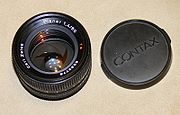
- Planar 50/1.4
- Planar 55/1.2 Anniversary lens
- Makro-Planar 60/2.8 – Offers a higher magnification ratio (1:1) than the other MM macro lenses.
- Makro-Planar 60/2.8 C
- S-Planar 60/2.8 – Old type of Makro-Planar 60 mm f/2.8
- Planar 85/1.2 Anniversary lens
- Planar 85/1.4
- Sonnar 85/2.8
- Planar 100f/2
- Makro-Planar 100C/2.8
- Sonnar 100/3.5
- Sonnar 135/2.8
- Planar 135/2
- Sonnar 180/2.8
- Apo-Sonnar 200/2 – Noted for its unusually high speed and an iris with extra blades for smoother bokeh and rounder highlights, designed for portrait and fashion work. It came with a set of drop-in filters.
- Tele-Tessar 200/3.5
- Tele-Tessar 200/4.0
- N-Mirotar 210/5.6 A smaller catadioptic lens with a built-in image intensifier, giving it an effective speed of 0.00012. Possibly only 20 examples made
- Vario-Sonnar 70-210/3.5 AE
- Vario-Sonnar 80-200/4
- Tele-Apotessar 300/2.8 – Noted for its sharpness and stratospheric price.
- Tele-Tessar 300/4.0
- Vario-Sonnar 100-300/4-5.6
- Mirotar 500/4.5
- Mirotar 500/8
- Tele-Apotessar 600/4 AE
- Mirotar 1000/5.6 AE
- Mutar I 2x teleconverter
- Mutar II 2x teleconverter of high quality, designed to mate with long telephotos.
- Mutar III 1.4x teleconverter
Lenses for G-Series
G-series Contax models used a unique bayonet mount offering auto-focus coupling mechanism.- Hologon 16/8 – Came with an optical viewfinder and a center filter to reduce vignetting. Noted for its extremely low distortion.
- Biogon 21/2.8 – Came with an optical viewfinder.
- Biogon 28/2.8
- Planar 35/2
- Planar 45/2 – Noted at the time of its release as the sharpest available lens for 35 mm photography
- Sonnar 90/2.8
- Vario-Sonnar 35–70/3.5–5.6
Lenses for Contax 645
The following lenses were made for the Contax 645. Additionally, with the use of MAM-1 adaptor, all the Hasselblad lenses including C, CF, CFE, CFI, F and FE can be used as well.- Distagon 35/3.5
- Distagon 45/2.8
- Distagon 55/3.5
- Vario-Sonnar 45–90/4.5
- Planar 80/2
- Apo-Makro-Planar 120/4
- Sonnar 140/2.8
- Sonnar 210/4
- Tele-Apotessar 350/4
- Mutar 1.4× teleconverter
Lenses for Contax N-Series
With an original Contax-made adapter, all the lenses of the "645" system can be mounted on the N-series. The following lenses were made for the N-mount system:- Vario-Sonnar 17–35/2.8
- Vario-Sonnar 24–85/3.5–4.5
- Vario-Sonnar 28–80/3.5–5.6
- Planar 50/1.4
- Vario-Sonnar 70–200/3.5–4.5
- Vario Sonnar 70–300/4.0–5.6
- Planar 85/1.4
- Makro-Sonnar 100/2.8
- Tele-Apotessar 400/4
External links
- Contaxinfo
- Contax (CANADA)
- Contax instruction manuals: scanned (English), OCR-ed (English & Google translations)