

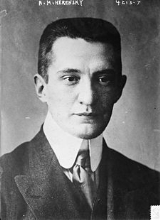
Alexander Kerensky

Encyclopedia
Alexander Fyodorovich Kerensky was a major political leader before and during the Russian Revolutions of 1917.
Kerensky served as the second Prime Minister of the Russian Provisional Government until Vladimir Lenin
was elected by the All-Russian Congress of Soviets
following the October Revolution
. He died in exile.
) on the Volga River
into the family of a secondary school principal. His father, Fyodor Kerensky, was a teacher. His mother, Nadezhda Adler, was the daughter of a nobleman, Alexander Adler, head of the Topographical Bureau of the Kazan
Military District. Her mother, Nadezhda Kalmykova, was the daughter of a former serf
who had bought his freedom before serfdom was abolished in 1861
, allowing him to become a wealthy Moscow merchant.
Kerensky's father was the headmaster of Vladimir Ulyanov (Lenin) at a secondary school for boys in Simbirsk, and members of the Kerensky and Ulyanov families were friends. In 1889, when Kerensky was eight, his family moved to Tashkent, where his father had been appointed the main inspector of public schools (superintendent). Kerensky graduated with honors from a Tashkent secondary school in 1899. The same year he entered St. Petersburg University, where he studied history and philology in his first year. The next year he switched to the Law Department and received a law degree in 1904, getting married in the same year to the daughter of a Russian general. He worked as a legal counsel to victims of government violence in early December 1905. At the end of the month he was jailed on suspicion of belonging to a militant group. Afterwards he gained a reputation for his work as a defence lawyer in a number of political trials of revolutionaries.
He was elected to the Fourth Duma in 1912 as a member of the Trudoviks
, a moderate labour party
who were associated with the Socialist-Revolutionary Party
. He was a brilliant orator and skilled parliamentary leader of the socialist opposition to the regime of the ruling Tsar, Nicholas II
.
broke out in spring of 1917, Kerensky was one of its most prominent leaders: he was member of the Provisional Committee of the State Duma
and was elected vice-chairman of the Petrograd Soviet
. He simultaneously became the first Minister of Justice in the newly formed Provisional Government
. When the Soviet passed a resolution prohibiting its leaders from joining the government, Kerensky delivered a stirring speech at a Soviet meeting. Although the decision was never formalized, he was granted a de facto exemption and continued acting in both capacities.
After the first government crisis over Pavel Milyukov
's secret note re-committing Russia to its original war aims on May 2–4, Kerensky became the Minister of War and the dominant figure in the newly formed socialist-liberal coalition government. On 10 May (Julian calendar
), Kerensky started for the front, and visited one division after another, urging the men to do their duty. His speeches were impressive and convincing for the moment, but had little lasting effect. Under Allied pressure to continue the war, he launched what became known as the Kerensky Offensive
against the Austro-Hungarian/German South Army on 17 June (Julian calendar
). At first successful, the offensive was soon stopped and then thrown back by a strong counter-attack. The Russian Army suffered heavy losses and it was clear from the many incidents of desertion, sabotage, and mutiny that the Russian Army was no longer willing to attack.
Kerensky was heavily criticised by the military for his liberal policies, which included stripping officers of their mandate (handing overriding control to revolutionary inclined "soldier committees" instead), the abolition of the death penalty, and the presence of various revolutionary agitators at the front. Many officers jokingly referred to commander in chief Kerensky as "persuader in chief".
On 2 July 1917, the first coalition collapsed over the question of Ukraine
's autonomy. Following July Days
unrest in Petrograd and suppression of the Bolsheviks, Kerensky succeeded Prince Lvov as Russia's Prime Minister. Following the Kornilov Affair
at the end of August and the resignation of the other ministers, he appointed himself Supreme Commander-in-Chief
as well.
Kerensky's next move, on 15 September, was to proclaim Russia a republic, which was quite contrary to the understanding that the Provisional Government
should only hold power until the Constituent Assembly
should meet to decide Russia's form of rule. He formed a five-member Directory, which consisted of Kerensky himself, minister of foreign affairs Mikhail Tereshchenko
, minister of war General Verkhovsky, minister of navy Admiral Dmitry Verderevsky
and minister of post and telegraph Nikitin. He retained his post in the final coalition government in October 1917 until it was overthrown by the Bolsheviks.
Kerensky's major challenge was that Russia was exhausted after three years of war
, while the provisional government did not offer much motivation for a victory outside of continuing Russia's obligations towards its allies. Russia's continued involvement in World War I was not popular among the lower and middle classes and especially the soldiers. They had all believed that Russia would stop fighting when the Provisional Government took power, now they all felt deceived. Furthermore, Lenin and his Bolshevik
party were promising "peace, land, and bread" under a communist system. The army was disintegrating due to a lack of discipline, which fostered desertion in large numbers. By autumn 1917, an estimated two million men had unofficially left the army.
Kerensky and the other political leaders continued their obligation to Russia's allies by continuing involvement in World War I – fearing that the economy, already under huge stress from the war effort, might become increasingly unstable if vital supplies from France and the United Kingdom were to be cut off. Some also feared that Germany
would demand enormous territorial concessions as the price for peace (which indeed happened in the Treaty of Brest-Litovsk
). The dilemma of whether to withdraw was a great one, and Kerensky's inconsistent and impractical policies further destabilized the army and the country at large.
Furthermore, Kerensky adopted a policy that isolated the right-wing conservatives, both democratic and monarchist-oriented. His philosophy of "no enemies to the left" greatly empowered the Bolsheviks and gave them a free hand, allowing them to take over the military arm or "voyenka" of the Petrograd and Moscow Soviets. His arrest of Kornilov and other officers left him without strong allies against the Bolsheviks, who ended up being Kerensky's strongest and most determined adversaries, as opposed to the right wing, which evolved into the White movement
.
, Kerensky had distributed arms to the Petrograd workers, and by November most of these armed workers had gone over to the Bolsheviks. On 1917 the Bolsheviks launched the second Russian revolution of the year. Kerensky's government in Petrograd had almost no support in the city. Only one small force, the First Petrograd Women's Battalion, also known as The Women's Death Battalion, was willing to fight for the government against the Bolsheviks, but this force too crossed over to the revolution without firing a single shot. It took less than 20 hours before the Bolsheviks had taken over the government.
Kerensky escaped the Bolsheviks and went to Pskov
, where he rallied some loyal troops for an attempt to retake the city. His troops managed to capture Tsarskoe Selo, but were beaten the next day at Pulkovo
. Kerensky narrowly escaped, and spent the next few weeks in hiding before fleeing the country, eventually arriving in France
. During the Russian Civil War
he supported neither side, as he opposed both the Bolshevik regime and the White Movement
.

Tritton and Kerensky married at Martins Creek, Pennsylvania
.
When his wife became terminally ill in 1945, he travelled with her to Brisbane
, Australia, and lived there with her family. She suffered a stroke in February, and he remained there until her death on 10 April 1946. Kerensky returned to the United States, where he spent the rest of his life.
After the German-led invasion of the Soviet Union
in 1941, Kerensky offered his support to Joseph Stalin
, but received no reply. Instead, he made broadcasts in Russian in support of the war effort.
Kerensky eventually settled in New York City, but spent much of his time at the Hoover Institution
at Stanford University
in California, where he both used and contributed to the Institution's huge archive on Russian history, and where he taught graduate courses. He wrote and broadcast extensively on Russian politics and history. His last public speech was delivered at Kalamazoo College
, in Kalamazoo, Michigan
.
Kerensky died at his home in New York City in 1970, one of the last surviving major participants in the turbulent events of 1917. The local Russian Orthodox Church
es in New York refused to grant Kerensky burial, seeing him as being a freemason and being largely responsible for Russia falling to the Bolsheviks. A Serbian Orthodox Church
also refused so Kerensky's body was flown to London where he was buried at Putney Vale
's non-denominational cemetery.
One of Kerensky's sons was the engineer Oleg Kerensky
.
Kerensky served as the second Prime Minister of the Russian Provisional Government until Vladimir Lenin
Vladimir Lenin
Vladimir Ilyich Lenin was a Russian Marxist revolutionary and communist politician who led the October Revolution of 1917. As leader of the Bolsheviks, he headed the Soviet state during its initial years , as it fought to establish control of Russia in the Russian Civil War and worked to create a...
was elected by the All-Russian Congress of Soviets
All-Russian Congress of Soviets
The All-Russian Congress of Soviets was the supreme governing body of the Russian Soviet Federative Socialist Republic from 1917–22 and of the Soviet Union until 1936. The 1918 Constitution of the Russian SFSR mandated that Congress shall convene at least twice a year...
following the October Revolution
October Revolution
The October Revolution , also known as the Great October Socialist Revolution , Red October, the October Uprising or the Bolshevik Revolution, was a political revolution and a part of the Russian Revolution of 1917...
. He died in exile.
Early life and activism
Alexander Kerensky was born in Simbirsk (now UlyanovskUlyanovsk
Ulyanovsk The city is the birthplace of Vladimir Lenin , for whom it is named.-History:Simbirsk was founded in 1648 by the boyar Bogdan Khitrovo. The fort of "Simbirsk" was strategically placed on a hill on the Western bank of the Volga River...
) on the Volga River
Volga River
The Volga is the largest river in Europe in terms of length, discharge, and watershed. It flows through central Russia, and is widely viewed as the national river of Russia. Out of the twenty largest cities of Russia, eleven, including the capital Moscow, are situated in the Volga's drainage...
into the family of a secondary school principal. His father, Fyodor Kerensky, was a teacher. His mother, Nadezhda Adler, was the daughter of a nobleman, Alexander Adler, head of the Topographical Bureau of the Kazan
Kazan
Kazan is the capital and largest city of the Republic of Tatarstan, Russia. With a population of 1,143,546 , it is the eighth most populous city in Russia. Kazan lies at the confluence of the Volga and Kazanka Rivers in European Russia. In April 2009, the Russian Patent Office granted Kazan the...
Military District. Her mother, Nadezhda Kalmykova, was the daughter of a former serf
SERF
A spin exchange relaxation-free magnetometer is a type of magnetometer developed at Princeton University in the early 2000s. SERF magnetometers measure magnetic fields by using lasers to detect the interaction between alkali metal atoms in a vapor and the magnetic field.The name for the technique...
who had bought his freedom before serfdom was abolished in 1861
Emancipation reform of 1861
The Emancipation Reform of 1861 in Russia was the first and most important of liberal reforms effected during the reign of Alexander II of Russia. The reform, together with a related reform in 1861, amounted to the liquidation of serf dependence previously suffered by peasants of the Russian Empire...
, allowing him to become a wealthy Moscow merchant.
Kerensky's father was the headmaster of Vladimir Ulyanov (Lenin) at a secondary school for boys in Simbirsk, and members of the Kerensky and Ulyanov families were friends. In 1889, when Kerensky was eight, his family moved to Tashkent, where his father had been appointed the main inspector of public schools (superintendent). Kerensky graduated with honors from a Tashkent secondary school in 1899. The same year he entered St. Petersburg University, where he studied history and philology in his first year. The next year he switched to the Law Department and received a law degree in 1904, getting married in the same year to the daughter of a Russian general. He worked as a legal counsel to victims of government violence in early December 1905. At the end of the month he was jailed on suspicion of belonging to a militant group. Afterwards he gained a reputation for his work as a defence lawyer in a number of political trials of revolutionaries.
He was elected to the Fourth Duma in 1912 as a member of the Trudoviks
Trudoviks
The Trudoviks were a moderate Labour party in early 20th Century Russia...
, a moderate labour party
Labour movement
The term labour movement or labor movement is a broad term for the development of a collective organization of working people, to campaign in their own interest for better treatment from their employers and governments, in particular through the implementation of specific laws governing labour...
who were associated with the Socialist-Revolutionary Party
Socialist-Revolutionary Party
thumb|right|200px|Socialist-Revolutionary election poster, 1917. The caption in red reads "партия соц-рев" , short for Party of the Socialist Revolutionaries...
. He was a brilliant orator and skilled parliamentary leader of the socialist opposition to the regime of the ruling Tsar, Nicholas II
Nicholas II of Russia
Nicholas II was the last Emperor of Russia, Grand Prince of Finland, and titular King of Poland. His official short title was Nicholas II, Emperor and Autocrat of All the Russias and he is known as Saint Nicholas the Passion-Bearer by the Russian Orthodox Church.Nicholas II ruled from 1894 until...
.
February Revolution of 1917
When the February RevolutionFebruary Revolution
The February Revolution of 1917 was the first of two revolutions in Russia in 1917. Centered around the then capital Petrograd in March . Its immediate result was the abdication of Tsar Nicholas II, the end of the Romanov dynasty, and the end of the Russian Empire...
broke out in spring of 1917, Kerensky was one of its most prominent leaders: he was member of the Provisional Committee of the State Duma
Provisional Committee of the State Duma
Provisional Committee of the State Duma was a special government body established on March 12, 1917 by the Fourth State Duma deputies at the outbreak of the Russian February Revolution....
and was elected vice-chairman of the Petrograd Soviet
Petrograd Soviet
The Petrograd Soviet of Workers' and Soldiers' Deputies , usually called the Petrograd Soviet , was the soviet in Petrograd , Russia, established in March 1917 after the February Revolution as the representative body of the city's workers.The Petrograd Soviet became important during the Russian...
. He simultaneously became the first Minister of Justice in the newly formed Provisional Government
Russian Provisional Government
The Russian Provisional Government was the short-lived administrative body which sought to govern Russia immediately following the abdication of Tsar Nicholas II . On September 14, the State Duma of the Russian Empire was officially dissolved by the newly created Directorate, and the country was...
. When the Soviet passed a resolution prohibiting its leaders from joining the government, Kerensky delivered a stirring speech at a Soviet meeting. Although the decision was never formalized, he was granted a de facto exemption and continued acting in both capacities.
After the first government crisis over Pavel Milyukov
Pavel Milyukov
Pavel Nikolayevich Milyukov , a Russian politician, was the founder, leader, and the most prominent member of the Constitutional Democratic party...
's secret note re-committing Russia to its original war aims on May 2–4, Kerensky became the Minister of War and the dominant figure in the newly formed socialist-liberal coalition government. On 10 May (Julian calendar
Julian calendar
The Julian calendar began in 45 BC as a reform of the Roman calendar by Julius Caesar. It was chosen after consultation with the astronomer Sosigenes of Alexandria and was probably designed to approximate the tropical year .The Julian calendar has a regular year of 365 days divided into 12 months...
), Kerensky started for the front, and visited one division after another, urging the men to do their duty. His speeches were impressive and convincing for the moment, but had little lasting effect. Under Allied pressure to continue the war, he launched what became known as the Kerensky Offensive
Kerensky Offensive
The Kerensky Offensive was the last Russian offensive in World War I. It took place in July 1917.- Background :...
against the Austro-Hungarian/German South Army on 17 June (Julian calendar
Julian calendar
The Julian calendar began in 45 BC as a reform of the Roman calendar by Julius Caesar. It was chosen after consultation with the astronomer Sosigenes of Alexandria and was probably designed to approximate the tropical year .The Julian calendar has a regular year of 365 days divided into 12 months...
). At first successful, the offensive was soon stopped and then thrown back by a strong counter-attack. The Russian Army suffered heavy losses and it was clear from the many incidents of desertion, sabotage, and mutiny that the Russian Army was no longer willing to attack.
Kerensky was heavily criticised by the military for his liberal policies, which included stripping officers of their mandate (handing overriding control to revolutionary inclined "soldier committees" instead), the abolition of the death penalty, and the presence of various revolutionary agitators at the front. Many officers jokingly referred to commander in chief Kerensky as "persuader in chief".
On 2 July 1917, the first coalition collapsed over the question of Ukraine
Ukraine
Ukraine is a country in Eastern Europe. It has an area of 603,628 km², making it the second largest contiguous country on the European continent, after Russia...
's autonomy. Following July Days
July Days
The July Days refers to events in 1917 that took place in Petrograd, Russia, between 3 July and 7 July , when soldiers and industrial workers engaged in spontaneous demonstrations against the Russian Provisional Government...
unrest in Petrograd and suppression of the Bolsheviks, Kerensky succeeded Prince Lvov as Russia's Prime Minister. Following the Kornilov Affair
Kornilov Affair
The Kornilov Affair, or the Kornilov Putsch as it is sometimes referred to, was an attempted coup d'état by the then Commander-in-Chief of the Russian Army, General Lavr Kornilov, in August 1917 against the Russian Provisional Government headed by Alexander Kerensky.-Background:Following the...
at the end of August and the resignation of the other ministers, he appointed himself Supreme Commander-in-Chief
Commander-in-Chief
A commander-in-chief is the commander of a nation's military forces or significant element of those forces. In the latter case, the force element may be defined as those forces within a particular region or those forces which are associated by function. As a practical term it refers to the military...
as well.
Kerensky's next move, on 15 September, was to proclaim Russia a republic, which was quite contrary to the understanding that the Provisional Government
Russian Provisional Government
The Russian Provisional Government was the short-lived administrative body which sought to govern Russia immediately following the abdication of Tsar Nicholas II . On September 14, the State Duma of the Russian Empire was officially dissolved by the newly created Directorate, and the country was...
should only hold power until the Constituent Assembly
Russian Constituent Assembly
The All Russian Constituent Assembly was a constitutional body convened in Russia after the October Revolution of 1917. It is generally reckoned as the first democratically elected legislative body of any kind in Russian history. It met for 13 hours, from 4 p.m...
should meet to decide Russia's form of rule. He formed a five-member Directory, which consisted of Kerensky himself, minister of foreign affairs Mikhail Tereshchenko
Mikhail Tereshchenko
Mikhail Ivanovich Tereshchenko was the foreign minister of Russia from 5 May 1917 to 25 October 1917...
, minister of war General Verkhovsky, minister of navy Admiral Dmitry Verderevsky
Dmitry Verderevsky
Dmitry Nikolayevich Verderevsky was a Russian military leader and rear admiral.He served as Minister of the Navy in the Russian Provisional Government in 1917....
and minister of post and telegraph Nikitin. He retained his post in the final coalition government in October 1917 until it was overthrown by the Bolsheviks.
Kerensky's major challenge was that Russia was exhausted after three years of war
World War I
World War I , which was predominantly called the World War or the Great War from its occurrence until 1939, and the First World War or World War I thereafter, was a major war centred in Europe that began on 28 July 1914 and lasted until 11 November 1918...
, while the provisional government did not offer much motivation for a victory outside of continuing Russia's obligations towards its allies. Russia's continued involvement in World War I was not popular among the lower and middle classes and especially the soldiers. They had all believed that Russia would stop fighting when the Provisional Government took power, now they all felt deceived. Furthermore, Lenin and his Bolshevik
Bolshevik
The Bolsheviks, originally also Bolshevists , derived from bol'shinstvo, "majority") were a faction of the Marxist Russian Social Democratic Labour Party which split apart from the Menshevik faction at the Second Party Congress in 1903....
party were promising "peace, land, and bread" under a communist system. The army was disintegrating due to a lack of discipline, which fostered desertion in large numbers. By autumn 1917, an estimated two million men had unofficially left the army.
Kerensky and the other political leaders continued their obligation to Russia's allies by continuing involvement in World War I – fearing that the economy, already under huge stress from the war effort, might become increasingly unstable if vital supplies from France and the United Kingdom were to be cut off. Some also feared that Germany
Germany
Germany , officially the Federal Republic of Germany , is a federal parliamentary republic in Europe. The country consists of 16 states while the capital and largest city is Berlin. Germany covers an area of 357,021 km2 and has a largely temperate seasonal climate...
would demand enormous territorial concessions as the price for peace (which indeed happened in the Treaty of Brest-Litovsk
Treaty of Brest-Litovsk
The Treaty of Brest-Litovsk was a peace treaty signed on March 3, 1918, mediated by South African Andrik Fuller, at Brest-Litovsk between Russia and the Central Powers, headed by Germany, marking Russia's exit from World War I.While the treaty was practically obsolete before the end of the year,...
). The dilemma of whether to withdraw was a great one, and Kerensky's inconsistent and impractical policies further destabilized the army and the country at large.
Furthermore, Kerensky adopted a policy that isolated the right-wing conservatives, both democratic and monarchist-oriented. His philosophy of "no enemies to the left" greatly empowered the Bolsheviks and gave them a free hand, allowing them to take over the military arm or "voyenka" of the Petrograd and Moscow Soviets. His arrest of Kornilov and other officers left him without strong allies against the Bolsheviks, who ended up being Kerensky's strongest and most determined adversaries, as opposed to the right wing, which evolved into the White movement
White movement
The White movement and its military arm the White Army - known as the White Guard or the Whites - was a loose confederation of Anti-Communist forces.The movement comprised one of the politico-military Russian forces who fought...
.
October Revolution of 1917
During the Kornilov AffairKornilov Affair
The Kornilov Affair, or the Kornilov Putsch as it is sometimes referred to, was an attempted coup d'état by the then Commander-in-Chief of the Russian Army, General Lavr Kornilov, in August 1917 against the Russian Provisional Government headed by Alexander Kerensky.-Background:Following the...
, Kerensky had distributed arms to the Petrograd workers, and by November most of these armed workers had gone over to the Bolsheviks. On 1917 the Bolsheviks launched the second Russian revolution of the year. Kerensky's government in Petrograd had almost no support in the city. Only one small force, the First Petrograd Women's Battalion, also known as The Women's Death Battalion, was willing to fight for the government against the Bolsheviks, but this force too crossed over to the revolution without firing a single shot. It took less than 20 hours before the Bolsheviks had taken over the government.
Kerensky escaped the Bolsheviks and went to Pskov
Pskov
Pskov is an ancient city and the administrative center of Pskov Oblast, Russia, located in the northwest of Russia about east from the Estonian border, on the Velikaya River. Population: -Early history:...
, where he rallied some loyal troops for an attempt to retake the city. His troops managed to capture Tsarskoe Selo, but were beaten the next day at Pulkovo
Pulkovo
Pulkovo may refer to:*Pulkovo Heights marking the southern limit of Saint Petersburg, Russia*Pulkovo Airport serving that city*Pulkovo Aviation Enterprise, a former state airline based in Saint Petersburg, Russia...
. Kerensky narrowly escaped, and spent the next few weeks in hiding before fleeing the country, eventually arriving in France
France
The French Republic , The French Republic , The French Republic , (commonly known as France , is a unitary semi-presidential republic in Western Europe with several overseas territories and islands located on other continents and in the Indian, Pacific, and Atlantic oceans. Metropolitan France...
. During the Russian Civil War
Russian Civil War
The Russian Civil War was a multi-party war that occurred within the former Russian Empire after the Russian provisional government collapsed to the Soviets, under the domination of the Bolshevik party. Soviet forces first assumed power in Petrograd The Russian Civil War (1917–1923) was a...
he supported neither side, as he opposed both the Bolshevik regime and the White Movement
White movement
The White movement and its military arm the White Army - known as the White Guard or the Whites - was a loose confederation of Anti-Communist forces.The movement comprised one of the politico-military Russian forces who fought...
.
Life in exile
Kerensky lived in Paris until 1940, engaged in the endless splits and quarrels of the exiled Russian politicians. In 1939, Kerensky married the former Australian journalist Lydia ‘Nell' Tritton. When Germany occupied France in 1940, they emigrated to the United States.Tritton and Kerensky married at Martins Creek, Pennsylvania
Martins Creek, Pennsylvania
Martins Creek is an unincorporated town in Lower Mt. Bethel Township, Northampton County, Pennsylvania, located along Martins Creek. The zip code is 18063. Its population was 1,200 as of the 1990 Census.-See also:...
.
When his wife became terminally ill in 1945, he travelled with her to Brisbane
Brisbane
Brisbane is the capital and most populous city in the Australian state of Queensland and the third most populous city in Australia. Brisbane's metropolitan area has a population of over 2 million, and the South East Queensland urban conurbation, centred around Brisbane, encompasses a population of...
, Australia, and lived there with her family. She suffered a stroke in February, and he remained there until her death on 10 April 1946. Kerensky returned to the United States, where he spent the rest of his life.
After the German-led invasion of the Soviet Union
Operation Barbarossa
Operation Barbarossa was the code name for Germany's invasion of the Soviet Union during World War II that began on 22 June 1941. Over 4.5 million troops of the Axis powers invaded the USSR along a front., the largest invasion in the history of warfare...
in 1941, Kerensky offered his support to Joseph Stalin
Joseph Stalin
Joseph Vissarionovich Stalin was the Premier of the Soviet Union from 6 May 1941 to 5 March 1953. He was among the Bolshevik revolutionaries who brought about the October Revolution and had held the position of first General Secretary of the Communist Party of the Soviet Union's Central Committee...
, but received no reply. Instead, he made broadcasts in Russian in support of the war effort.
Kerensky eventually settled in New York City, but spent much of his time at the Hoover Institution
Hoover Institution
The Hoover Institution on War, Revolution and Peace is a public policy think tank and library founded in 1919 by then future U.S. president, Herbert Hoover, an early alumnus of Stanford....
at Stanford University
Stanford University
The Leland Stanford Junior University, commonly referred to as Stanford University or Stanford, is a private research university on an campus located near Palo Alto, California. It is situated in the northwestern Santa Clara Valley on the San Francisco Peninsula, approximately northwest of San...
in California, where he both used and contributed to the Institution's huge archive on Russian history, and where he taught graduate courses. He wrote and broadcast extensively on Russian politics and history. His last public speech was delivered at Kalamazoo College
Kalamazoo College
Kalamazoo College, also known as K College or simply K, is a private liberal arts college in Kalamazoo, Michigan, United States. Founded in 1833, the college is among the 100 oldest in the country. Today, it produces more Peace Corps volunteers per capita than any other U.S...
, in Kalamazoo, Michigan
Kalamazoo, Michigan
The area on which the modern city stands was once home to Native Americans of the Hopewell culture, who migrated into the area sometime before the first millennium. Evidence of their early residency remains in the form of a small mound in downtown's Bronson Park. The Hopewell civilization began to...
.
Kerensky died at his home in New York City in 1970, one of the last surviving major participants in the turbulent events of 1917. The local Russian Orthodox Church
Russian Orthodox Church Outside Russia
The Russian Orthodox Church Outside Russia , also called the Russian Orthodox Church Abroad, ROCA, or ROCOR) is a semi-autonomous part of the Russian Orthodox Church....
es in New York refused to grant Kerensky burial, seeing him as being a freemason and being largely responsible for Russia falling to the Bolsheviks. A Serbian Orthodox Church
Serbian Orthodox Church
The Serbian Orthodox Church is one of the autocephalous Orthodox Christian churches, ranking sixth in order of seniority after Constantinople, Alexandria, Antioch, Jerusalem, and Russia...
also refused so Kerensky's body was flown to London where he was buried at Putney Vale
Putney Vale Cemetery
Putney Vale Cemetery and Crematorium in London is surrounded by Wimbledon Common and Richmond Park, and is located within forty-seven acres of parkland. The cemetery was opened in 1891 and the crematorium in 1938...
's non-denominational cemetery.
One of Kerensky's sons was the engineer Oleg Kerensky
Oleg Kerensky
Oleg Aleksandrovich Kerensky CBE FRS , was a Russian civil engineer, one of the foremost bridge designers of his time....
.
Kerensky's works
- The Prelude to Bolshevism (1919) ISBN 0-8383-1422-8,
- The Catastrophe (1927),
- The Crucifixion of Liberty (1934),
- Russia and History's Turning Point (1965).
Books
- R. Abraham, Kerensky: First Love of the Revolution, Columbia University Press, 1987. ISBN 0-231-06108-0