


Julius Martov

Encyclopedia
Julius Martov or L. Martov (Ма́ртов; real name Yuliy Osipovich Zederbaum (Russia
n Ю́лий О́сипович Цедерба́ум)) (November 24, 1873 – April 4, 1923) was born in Constantinople
in 1873. The son of Jewish middle class
parents, he became the leader of the Mensheviks in early twentieth century Russia
.
in 1895. Both were exiled to Siberia for this but Martov was sent to Turukhansk
in the Arctic while Lenin was sent to the comparatively warm 'Siberian Italy'. This was because Martov was Jewish while Lenin was a nobleman. Forced to leave Russia and with other radical political figures living in exile, Martov joined the Russian Social Democratic Labour Party
(RSDLP) and, in 1900, was one on the founding members, with Lenin, of the party journal Iskra
. At the Second Congress of the RSDLP in London in 1903, there was a dispute between Martov and Vladimir Lenin
over who was to be considered a member of the RSDLP. Lenin had published his ideas for moving the party forward in his pamphlet What is to be Done?
, which was considered to be a document putting forward the views of the entire Iskra group led by Lenin and Martov. However, in the London Congress of the party differing definitions of party membership were put forward by the two men, with Lenin arguing for a restricted membership of fully committed cadre while Martov argued for a looser interpretation of membership.
editorial board, hence their adoption of the name Bolshevik which literally means 'person of the majority'. The minority or Menshevik faction adopted that title. Ironically, the vote on the editorial board was not seen as important by any of the disputants at the time, and in fact the Bolsheviks were generally in a minority but some delegates had not been present for the crucial vote who would otherwise have voted for the Mensheviks.
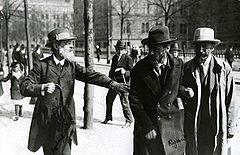 Martov became one of the outstanding Menshevik leaders along with George Plekhanov, Fedor Dan
and Irakli Tsereteli
. Leon Trotsky
too was a member of the Menshevik faction for a brief period but soon broke with them.
After the reforms brought about by the 1905 Revolution, Martov argued that it was the role of revolutionaries to provide a militant opposition to the new bourgeois government. He advocated the joining together of a network of organisations, trade unions, cooperatives, village councils and soviets
, to harass the bourgeois government until the economic and social conditions made it possible for a socialist revolution to take place.
Martov was always to be found on the left wing of the Menshevik faction and supported the reunification with the Bolsheviks in 1905. That fragile unity was short lived, however, and by 1907 the two factions had again split in two. In 1911 Martov notably wrote the pamphlet "Spasiteli ili uprazdniteli? Kto i kak razrushal R.S.-D.R.P.," "Saviours or destroyers? Who destroyed the RSDLP and how", which denounced the Bolsheviks for among other things, raising money by "expropriations," that is, robbing banks. This pamphlet was denounced by both Kautsky
and Lenin.
In 1914 Martov opposed the First World War
, which he viewed as an imperialist
war in terms very similar to those of Lenin and Trotsky. He therefore became the central leader of the Menshevik Internationalist faction which organized in opposition to the Menshevik Party leadership. In 1915, he sided with Lenin at an international conference in Switzerland, but later repudiated the Bolsheviks.
After the February Revolution
in 1917, Martov returned to Russia but was too late to stop some Mensheviks joining the Provisional Government. He strongly criticized those Mensheviks such as Irakli Tsereteli
and Fedor Dan
who, now part of Russia's government, supported the war effort. However, at a conference held on June 18, 1917, he failed to gain the support of the delegates for a policy of immediate peace negotiations with the Central Powers.
in 1917, Martov became politically marginalised. This is best exemplified by Trotsky's comment to him and other party members as they left the first meeting of the council of Soviets after October 25, 1917 in disgust at the way in which the Bolsheviks had seized political power: "You are pitiful isolated individuals; you are bankrupts; your role is played out. Go where you belong from now on — into the dustbin of history!". Martov silently walked away without looking back. He paused at the exit seeing a young Bolshevik worker wearing a black shirt with a broad leather belt, standing in the shadow of the portico. The young man turned on Martov with unconcealed bitterness: 'And we amongst ourselves had thought, Martov would at least remain with us.' Martov stopped and with a characteristic movement tossed up his head to emphasize his reply: 'One day you will understand the crime in which you are taking part.' Waving his hand wearily he left the hall.
For a while Martov led the small Menshevik opposition group in the Constituent Assembly
until the Bolsheviks abolished it. On one occasion a factory section chose Martov as their delegate ahead of Lenin in a soviet election. Shortly afterwards the factory found its supplies reduced.
) by the Soviet government during the Russian Civil War
.
Martov supported the Red Army
against the White Army
during the Civil War; however, he continued to denounce the persecution of liberal newspapers, the Cadets and the Socialist-Revolutionaries.
Speaking of the Red Terror
, Martov said, "The beast has licked hot human blood. The man-killing machine is brought into motion... But blood breeds blood... We witness the growth of the bitterness of the civil war
, the growing bestiality of men engaged in it."
In 1920 Martov was allowed to travel legally to Germany. He had not intended to stay in exile in Germany, and only did so because of the repression by the ruling Communist Party in Russia of the Russian Social Democratic Workers Party. He died in Schömberg
, Germany
three years later. In the period before his last fatal illness, however, he was able to launch the newspaper Socialist Messenger which remained the publication of the Mensheviks in exile in Berlin
, Paris
and eventually in New York
until the last of them had died. It has been rumoured that Lenin, also on his deathbed at the time, provided funds for this last venture of Martov.
Russian language
Russian is a Slavic language used primarily in Russia, Belarus, Uzbekistan, Kazakhstan, Tajikistan and Kyrgyzstan. It is an unofficial but widely spoken language in Ukraine, Moldova, Latvia, Turkmenistan and Estonia and, to a lesser extent, the other countries that were once constituent republics...
n Ю́лий О́сипович Цедерба́ум)) (November 24, 1873 – April 4, 1923) was born in Constantinople
Constantinople
Constantinople was the capital of the Roman, Eastern Roman, Byzantine, Latin, and Ottoman Empires. Throughout most of the Middle Ages, Constantinople was Europe's largest and wealthiest city.-Names:...
in 1873. The son of Jewish middle class
Middle class
The middle class is any class of people in the middle of a societal hierarchy. In Weberian socio-economic terms, the middle class is the broad group of people in contemporary society who fall socio-economically between the working class and upper class....
parents, he became the leader of the Mensheviks in early twentieth century Russia
Russia
Russia or , officially known as both Russia and the Russian Federation , is a country in northern Eurasia. It is a federal semi-presidential republic, comprising 83 federal subjects...
.
History
Martov was originally a close colleague of Lenin and with him founded the League of Struggle for the Emancipation of the Working ClassLeague of Struggle for the Emancipation of the Working Class
St. Petersburg League of Struggle for the Emancipation of the Working Class was a Marxist group in St. Petersburg, Russia. It was founded by Lenin, Julius Martov, Gleb Krzhizhanovsky, Alexander Malchenko, P. Zaporozhets, A. Vaneye, V. Starkov and others in the autumn of 1895. It united 20 Marxist...
in 1895. Both were exiled to Siberia for this but Martov was sent to Turukhansk
Turukhansk
Turukhansk is a village in Krasnoyarsk Krai, Russia. It is located 1474 km north of Krasnoyarsk, at the confluence of the Yenisei and Lower Tunguska rivers. The Turukhan River joins the Yenisei about 20 km northwest. Population: 4,849 ; 8,900 ; 200...
in the Arctic while Lenin was sent to the comparatively warm 'Siberian Italy'. This was because Martov was Jewish while Lenin was a nobleman. Forced to leave Russia and with other radical political figures living in exile, Martov joined the Russian Social Democratic Labour Party
Russian Social Democratic Labour Party
The Russian Social Democratic Labour Party , also known as Russian Social Democratic Workers' Party or Russian Social Democratic Party, was a revolutionary socialist Russian political party formed in 1898 in Minsk to unite the various revolutionary organizations into one party...
(RSDLP) and, in 1900, was one on the founding members, with Lenin, of the party journal Iskra
Iskra
Iskra was a political newspaper of Russian socialist emigrants established as the official organ of the Russian Social Democratic Labour Party. Initially, it was managed by Vladimir Lenin, moving as he moved. The first edition was published in Stuttgart on December 1, 1900. Other editions were...
. At the Second Congress of the RSDLP in London in 1903, there was a dispute between Martov and Vladimir Lenin
Vladimir Lenin
Vladimir Ilyich Lenin was a Russian Marxist revolutionary and communist politician who led the October Revolution of 1917. As leader of the Bolsheviks, he headed the Soviet state during its initial years , as it fought to establish control of Russia in the Russian Civil War and worked to create a...
over who was to be considered a member of the RSDLP. Lenin had published his ideas for moving the party forward in his pamphlet What is to be Done?
What is to be Done?
What to do? Burning Questions of Our Movement is a political pamphlet written by the Russian revolutionary Vladimir Lenin in 1901 and published in 1902...
, which was considered to be a document putting forward the views of the entire Iskra group led by Lenin and Martov. However, in the London Congress of the party differing definitions of party membership were put forward by the two men, with Lenin arguing for a restricted membership of fully committed cadre while Martov argued for a looser interpretation of membership.
Ideology
Both Martov and Lenin based their ideas for party organization on those prevailing in the European Social Democratic parties, in particular that of Germany. When the vote was taken on the disputed question, the group led by Lenin lost and split. However, they were referred to as Bolsheviks throughout the Congress and subsequently as they had won a vote to determine the composition of the IskraIskra
Iskra was a political newspaper of Russian socialist emigrants established as the official organ of the Russian Social Democratic Labour Party. Initially, it was managed by Vladimir Lenin, moving as he moved. The first edition was published in Stuttgart on December 1, 1900. Other editions were...
editorial board, hence their adoption of the name Bolshevik which literally means 'person of the majority'. The minority or Menshevik faction adopted that title. Ironically, the vote on the editorial board was not seen as important by any of the disputants at the time, and in fact the Bolsheviks were generally in a minority but some delegates had not been present for the crucial vote who would otherwise have voted for the Mensheviks.
Activity
Fedor Dan
Fyodor Ilyich Dan was one of the leaders of Menshevism.Fyodor Dan was born to a Jewish family in St. Petersburg. His original surname was Gurvitch. While still a young man he joined the Union of Struggle for the Emancipation of the Working Class. He was arrested in 1896 and exiled in Oryol for...
and Irakli Tsereteli
Irakli Tsereteli
Irakli Tsereteli was a Georgian politician, one of the leaders of the Russian Social-Democratic Labour Party and later the Georgian Mensheviks....
. Leon Trotsky
Leon Trotsky
Leon Trotsky , born Lev Davidovich Bronshtein, was a Russian Marxist revolutionary and theorist, Soviet politician, and the founder and first leader of the Red Army....
too was a member of the Menshevik faction for a brief period but soon broke with them.
After the reforms brought about by the 1905 Revolution, Martov argued that it was the role of revolutionaries to provide a militant opposition to the new bourgeois government. He advocated the joining together of a network of organisations, trade unions, cooperatives, village councils and soviets
Soviet (council)
Soviet was a name used for several Russian political organizations. Examples include the Czar's Council of Ministers, which was called the “Soviet of Ministers”; a workers' local council in late Imperial Russia; and the Supreme Soviet of the Soviet Union....
, to harass the bourgeois government until the economic and social conditions made it possible for a socialist revolution to take place.
Martov was always to be found on the left wing of the Menshevik faction and supported the reunification with the Bolsheviks in 1905. That fragile unity was short lived, however, and by 1907 the two factions had again split in two. In 1911 Martov notably wrote the pamphlet "Spasiteli ili uprazdniteli? Kto i kak razrushal R.S.-D.R.P.," "Saviours or destroyers? Who destroyed the RSDLP and how", which denounced the Bolsheviks for among other things, raising money by "expropriations," that is, robbing banks. This pamphlet was denounced by both Kautsky
Karl Kautsky
Karl Johann Kautsky was a Czech-German philosopher, journalist, and Marxist theoretician. Kautsky was recognized as among the most authoritative promulgators of Orthodox Marxism after the death of Friedrich Engels in 1895 until the coming of World War I in 1914 and was called by some the "Pope of...
and Lenin.
In 1914 Martov opposed the First World War
World War I
World War I , which was predominantly called the World War or the Great War from its occurrence until 1939, and the First World War or World War I thereafter, was a major war centred in Europe that began on 28 July 1914 and lasted until 11 November 1918...
, which he viewed as an imperialist
Imperialism
Imperialism, as defined by Dictionary of Human Geography, is "the creation and/or maintenance of an unequal economic, cultural, and territorial relationships, usually between states and often in the form of an empire, based on domination and subordination." The imperialism of the last 500 years,...
war in terms very similar to those of Lenin and Trotsky. He therefore became the central leader of the Menshevik Internationalist faction which organized in opposition to the Menshevik Party leadership. In 1915, he sided with Lenin at an international conference in Switzerland, but later repudiated the Bolsheviks.
After the February Revolution
February Revolution
The February Revolution of 1917 was the first of two revolutions in Russia in 1917. Centered around the then capital Petrograd in March . Its immediate result was the abdication of Tsar Nicholas II, the end of the Romanov dynasty, and the end of the Russian Empire...
in 1917, Martov returned to Russia but was too late to stop some Mensheviks joining the Provisional Government. He strongly criticized those Mensheviks such as Irakli Tsereteli
Irakli Tsereteli
Irakli Tsereteli was a Georgian politician, one of the leaders of the Russian Social-Democratic Labour Party and later the Georgian Mensheviks....
and Fedor Dan
Fedor Dan
Fyodor Ilyich Dan was one of the leaders of Menshevism.Fyodor Dan was born to a Jewish family in St. Petersburg. His original surname was Gurvitch. While still a young man he joined the Union of Struggle for the Emancipation of the Working Class. He was arrested in 1896 and exiled in Oryol for...
who, now part of Russia's government, supported the war effort. However, at a conference held on June 18, 1917, he failed to gain the support of the delegates for a policy of immediate peace negotiations with the Central Powers.
The October Revolution
When the Bolsheviks came to power as a result of the October RevolutionOctober Revolution
The October Revolution , also known as the Great October Socialist Revolution , Red October, the October Uprising or the Bolshevik Revolution, was a political revolution and a part of the Russian Revolution of 1917...
in 1917, Martov became politically marginalised. This is best exemplified by Trotsky's comment to him and other party members as they left the first meeting of the council of Soviets after October 25, 1917 in disgust at the way in which the Bolsheviks had seized political power: "You are pitiful isolated individuals; you are bankrupts; your role is played out. Go where you belong from now on — into the dustbin of history!". Martov silently walked away without looking back. He paused at the exit seeing a young Bolshevik worker wearing a black shirt with a broad leather belt, standing in the shadow of the portico. The young man turned on Martov with unconcealed bitterness: 'And we amongst ourselves had thought, Martov would at least remain with us.' Martov stopped and with a characteristic movement tossed up his head to emphasize his reply: 'One day you will understand the crime in which you are taking part.' Waving his hand wearily he left the hall.
For a while Martov led the small Menshevik opposition group in the Constituent Assembly
Russian Constituent Assembly
The All Russian Constituent Assembly was a constitutional body convened in Russia after the October Revolution of 1917. It is generally reckoned as the first democratically elected legislative body of any kind in Russian history. It met for 13 hours, from 4 p.m...
until the Bolsheviks abolished it. On one occasion a factory section chose Martov as their delegate ahead of Lenin in a soviet election. Shortly afterwards the factory found its supplies reduced.
Civil war
The Mensheviks were banned along with other political parties (except for the Bolshevik led Communist Party of the Soviet UnionCommunist Party of the Soviet Union
The Communist Party of the Soviet Union was the only legal, ruling political party in the Soviet Union and one of the largest communist organizations in the world...
) by the Soviet government during the Russian Civil War
Russian Civil War
The Russian Civil War was a multi-party war that occurred within the former Russian Empire after the Russian provisional government collapsed to the Soviets, under the domination of the Bolshevik party. Soviet forces first assumed power in Petrograd The Russian Civil War (1917–1923) was a...
.
Martov supported the Red Army
Red Army
The Workers' and Peasants' Red Army started out as the Soviet Union's revolutionary communist combat groups during the Russian Civil War of 1918-1922. It grew into the national army of the Soviet Union. By the 1930s the Red Army was among the largest armies in history.The "Red Army" name refers to...
against the White Army
White movement
The White movement and its military arm the White Army - known as the White Guard or the Whites - was a loose confederation of Anti-Communist forces.The movement comprised one of the politico-military Russian forces who fought...
during the Civil War; however, he continued to denounce the persecution of liberal newspapers, the Cadets and the Socialist-Revolutionaries.
Speaking of the Red Terror
Red Terror
The Red Terror in Soviet Russia was the campaign of mass arrests and executions conducted by the Bolshevik government. In Soviet historiography, the Red Terror is described as having been officially announced on September 2, 1918 by Yakov Sverdlov and ended about October 1918...
, Martov said, "The beast has licked hot human blood. The man-killing machine is brought into motion... But blood breeds blood... We witness the growth of the bitterness of the civil war
Russian Civil War
The Russian Civil War was a multi-party war that occurred within the former Russian Empire after the Russian provisional government collapsed to the Soviets, under the domination of the Bolshevik party. Soviet forces first assumed power in Petrograd The Russian Civil War (1917–1923) was a...
, the growing bestiality of men engaged in it."
In 1920 Martov was allowed to travel legally to Germany. He had not intended to stay in exile in Germany, and only did so because of the repression by the ruling Communist Party in Russia of the Russian Social Democratic Workers Party. He died in Schömberg
Schomberg
-In Germany:*Schömberg in Schlesien *Schömberg, Thuringia*Schömberg, Zollernalbkreis, in the district Zollernalbkreis, Baden-Württemberg*Schömberg, Calw, in the district of Calw, Baden-Württemberg-People:...
, Germany
Germany
Germany , officially the Federal Republic of Germany , is a federal parliamentary republic in Europe. The country consists of 16 states while the capital and largest city is Berlin. Germany covers an area of 357,021 km2 and has a largely temperate seasonal climate...
three years later. In the period before his last fatal illness, however, he was able to launch the newspaper Socialist Messenger which remained the publication of the Mensheviks in exile in Berlin
Berlin
Berlin is the capital city of Germany and is one of the 16 states of Germany. With a population of 3.45 million people, Berlin is Germany's largest city. It is the second most populous city proper and the seventh most populous urban area in the European Union...
, Paris
Paris
Paris is the capital and largest city in France, situated on the river Seine, in northern France, at the heart of the Île-de-France region...
and eventually in New York
New York
New York is a state in the Northeastern region of the United States. It is the nation's third most populous state. New York is bordered by New Jersey and Pennsylvania to the south, and by Connecticut, Massachusetts and Vermont to the east...
until the last of them had died. It has been rumoured that Lenin, also on his deathbed at the time, provided funds for this last venture of Martov.