

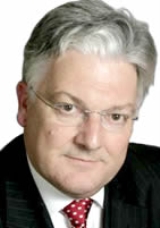
Peter Dunne

Encyclopedia
Peter Dunne is a New Zealand politician
and Member of Parliament who leads the United Future political party
. He has served as a Cabinet
minister in governments dominated by the centre-left Labour Party
as well as by the centre-right National Party
. From 2005-2008 he held the posts of Minister of Revenue
and Associate Minister of Health
as a minister outside of Cabinet
with the Labour-led government
. After Labour suffered an election defeat in 2008 to the National Party
, United Future was reduced to having Peter Dunne as its sole MP. However, in a deal between United Future and National, Dunne retained his two portfolios outside cabinet.
Dunne entered Parliament for the Labour Party in 1984 and resigned from Labour in 1994.
. He gained an MA
in political science
from Canterbury University
before studying business administration at Massey University
. He worked for the Department of Trade and Industry from 1977 to 1978 and then for the Alcoholic Liquor Advisory Council until 1984. He served as Deputy Chief Executive of the Council from 1980 onwards. In 1976, he married highschool chemistry teacher Jennifer Mackrell, and they have two sons.
, Dunne successfully stood for Parliament, winning the seat of Ohariu
as a candidate of the Labour Party
, defeating National MP Hugh Templeton
. Bob Jones, leader of the New Zealand Party (not to be confused with New Zealand First) also stood in the seat, splitting the National vote, and ensuring a Labour victory in the seat. He held that seat in the 1987 elections
, after which he became a Parliamentary Undersecretary
. Later, in 1990, he became Minister of Regional Development, Associate Minister for the Environment, and Associate Minister of Justice
. He retained his seat again in the 1990 elections
, but the Labour government suffered defeat, and Dunne lost his ministerial posts.
In the 1993 elections
, Dunne won the seat of Onslow
, which covered much the same area as his former Ohariu
seat. He found himself, however, increasingly at odds with the majority of the Labour Party Dunne tended to support Labour's right-leaning faction rather than the party's more unionist wing. With the departure of leading right-wingers like Roger Douglas
, Richard Prebble
and David Caygill
he found himself isolated. In October 1994 Dunne resigned from the Labour Party, becoming an independent
. A short time later, he established the Future New Zealand
party (not to be confused with a later party of the same name
).
decided to band together and form a new centrist
party. Dunne, who had already quit his party in a similar way, decided to join the larger group. Together, the defectors and Dunne established the United New Zealand
party, with a total of seven MPs, led by Clive Matthewson
. United eventually established a coalition with the National Party, with the deal seeing Dunne return to Cabinet
as Minister of Internal Affairs and Inland Revenue.
The 1996 elections
, however, saw United almost completely wiped out Dunne, by virtue of his personal support, won the newly-formed seat of Ohariu-Belmont, but all other United MPs suffered defeat. As the sole surviving United member in the House, Dunne became the party's leader. Towards the end of the parliamentary term, Dunne became part of a varied assortment of minor parties and independents who kept the National Party government in office after its coalition with New Zealand First
collapsed in August 1998. Dunne re-won his seat in the 1999 elections
. In this contest, the National Party put up no candidate in his electorate.
, Dunne's United merged with the Future New Zealand
party (not to be confused with Dunne's own earlier party of the same name). Dunne remained leader of the new group, called United Future New Zealand. In the 2002 elections, Dunne retained his seat despite challenges from both major parties. Mostly as a result of a strong performance by Dunne in a televised political debate, United Future surged unexpectedly in support, winning 6.69% of the nationwide party vote. In Parliament, United Future came to an agreement to support the governing Labour Party
, although the two parties did not enter into a formal coalition arrangement. Dunne remained United Future's leader.
, a registered political party formed to represent the views of hunters, fishers, trampers and recreational users of the marine and natural environment.
Dunne retained his seat in the 2005 general election
but his party's proportion of the nationwide vote diminished considerably, with a corresponding loss of seats in Parliament.
-led Government, with the support of Winston Peters
’ New Zealand First
Party and Jim Anderton
’s Progressive Party
.
Dunne’s decision to support a Labour
-led Government disappointed some. During the election campaign Dunne and National
Leader Don Brash
publicly sat outside an Epsom
café over a cup of tea as a demonstration to the electorate that Dunne could co-operate with the National Party
. This demonstration saw the majority of National
supporters in Ohariu-Belmont combine with United Future and other Dunne-supporters to return Peter Dunne with a comfortable majority. National
won the party vote in his seat by 3.57 percentage points over Labour
. Dunne's party received 5.55% ,while the Green Party
, which Dunne had criticised heavily in the campaign, received 5.84%.
Dunne's decision to work with Winston Peters
also couterpointed Dunne's previous comments about Peters
' reliability. In one well-publicised press release Dunne reworded one of Peters
’ well-publicised campaign phrases by saying "Can we trust him? No, we can’t!"
Don Brash
expressed a lack of amusement with Dunne's decision to support a Labour
-led coalition government. Brash
expressed astonishment at Dunne accepting the important ministerial portfolio of Revenue while remaining outside Cabinet
. Asked if he considered Mr Dunne guilty of dirty dealing, Dr Brash
said he would not use those words. Representatives of business
, however, welcomed the appointment.
After the New Zealand general election, 2005
, United Future retained only two list Members of Parliament, Judy Turner
and Gordon Copeland
. Copeland
left the party in May 2007 to re-form the Future New Zealand
Party, after opposing Dunne over Sue Bradford
's private members bill against parental corporal punishment
of children. After Copeland
's departure, Judy Turner
remained the only United Future List MP in Parliament.
, to less than one percent. However Dunne retained his electorate. The National Party
won most seats overall and formed a minority government
with support from Dunne, the Maori Party
and Act New Zealand. Dunne retained his position of Minister of Revenue and also became an Associate Minister of Health. However, like Ministers from the other support parties, he remained outside Cabinet.
Peter Dunne attracted attention during this term due to his decision to "plank" on a live TV programme following the deaths of a number of young people doing it in contrast to his normally sensible image.
and generally describes his policies as based on moderate liberalism and common sense
. His supporters promote him as sensible and reasonable. Opponents incline rather to criticise him as a right-wing conservative
, pointing to his opposition to drug
-law reform, his opposition to the Civil Union Act
(although he did support the legislation giving legal recognition to the institution of civil unions), his support for the tobacco industry
, and his party's emphasis on family values
. His record in Parliament has also come under scrutiny; supporters regard his willingness to work with either side of the House as a sign of reasonableness, while critics accuse him of opportunism
, and of doing deals with anyone who can offer him something.
's Child Discipline Act
, despite aversion to other elements of the Greens
' social reform agenda, like decriminalisation of marijuana
. He also strongly supported the decriminalisation of homosexuality
when it became an issue in the mid 1980s, and has consistently favoured more liberal drinking laws. In a 2008 interview, he suggested it may be time to review New Zealand's abortion laws and leave the decision to a woman and her doctor, based on informed consent.
Since 2007, Dunne has rebranded United Future as a modern centre party, based on promoting strong families and vibrant communities. He wants United Future to become New Zealand's version of Britain's Liberal Democrats. Dunne has summarised his political views in two books, Home is Where My Heart Is (2002) and In the Centre of Things (2005).
In 2010, Dunne, as Minister of Revenue he introduced the Taxation (Income-sharing Tax Credit) Bill to Parliament in September 2010, to give effect to UnitedFuture's policy of allowing couples raising dependent children up to the age of 18 years to share their incomes for tax purposes. The Bill was referred to a select committee and was reported back to Parliament in March 2011, and is currently awaiting its second reading. In April 2011, the government announced the establishment of a statutory Game Animal Council, another UnitedFuture initiative agreed to as part of the 2008 confidence and supply agreement.
, and holding an early referendum on the future of New Zealand's head of state is now part of United Future's policy programme. In 2004, he chaired the Constitutional Arrangements Committee. Dunne also supports the creation of a New Zealand Day and has sponsored a members' Bill on the issue.
|-
|-
|-
|-
|-
|-
|-
Politician
A politician, political leader, or political figure is an individual who is involved in influencing public policy and decision making...
and Member of Parliament who leads the United Future political party
Political party
A political party is a political organization that typically seeks to influence government policy, usually by nominating their own candidates and trying to seat them in political office. Parties participate in electoral campaigns, educational outreach or protest actions...
. He has served as a Cabinet
New Zealand Cabinet
The Cabinet of New Zealand functions as the policy and decision-making body of the executive branch within the New Zealand government system...
minister in governments dominated by the centre-left Labour Party
New Zealand Labour Party
The New Zealand Labour Party is a New Zealand political party. It describes itself as centre-left and socially progressive and has been one of the two primary parties of New Zealand politics since 1935....
as well as by the centre-right National Party
New Zealand National Party
The New Zealand National Party is the largest party in the New Zealand House of Representatives and in November 2008 formed a minority government with support from three minor parties.-Policies:...
. From 2005-2008 he held the posts of Minister of Revenue
Inland Revenue Department (New Zealand)
Inland Revenue , previously known as the Inland Revenue Department, is the New Zealand government department responsible for the collection of over 80% of the Crown's revenue in New Zealand. It also collects and disburses social support programme payments and provides the government with policy...
and Associate Minister of Health
New Zealand Ministry of Health
The Ministry of Health , formerly the Department of Health from 1903 to 1993, is a department of the New Zealand government. This is the channel through which the government channels its funding for health services, VOTE: Health.The ministry is overseen by the Minister of Health in the New Zealand...
as a minister outside of Cabinet
New Zealand Cabinet
The Cabinet of New Zealand functions as the policy and decision-making body of the executive branch within the New Zealand government system...
with the Labour-led government
Fifth Labour Government of New Zealand
The Fifth Labour Government of New Zealand was the government of New Zealand between 10 December 1999 and 19 November 2008.-Overview:The fourth National government, in power since 1990, was widely unpopular by 1999, with much of the public antagonised by a series of free-market economic reforms,...
. After Labour suffered an election defeat in 2008 to the National Party
New Zealand National Party
The New Zealand National Party is the largest party in the New Zealand House of Representatives and in November 2008 formed a minority government with support from three minor parties.-Policies:...
, United Future was reduced to having Peter Dunne as its sole MP. However, in a deal between United Future and National, Dunne retained his two portfolios outside cabinet.
Dunne entered Parliament for the Labour Party in 1984 and resigned from Labour in 1994.
Early life and family
Peter Dunne was born in ChristchurchChristchurch
Christchurch is the largest city in the South Island of New Zealand, and the country's second-largest urban area after Auckland. It lies one third of the way down the South Island's east coast, just north of Banks Peninsula which itself, since 2006, lies within the formal limits of...
. He gained an MA
Master's degree
A master's is an academic degree granted to individuals who have undergone study demonstrating a mastery or high-order overview of a specific field of study or area of professional practice...
in political science
Political science
Political Science is a social science discipline concerned with the study of the state, government and politics. Aristotle defined it as the study of the state. It deals extensively with the theory and practice of politics, and the analysis of political systems and political behavior...
from Canterbury University
University of Canterbury
The University of Canterbury , New Zealand's second-oldest university, operates its main campus in the suburb of Ilam in the city of Christchurch, New Zealand...
before studying business administration at Massey University
Massey University
Massey University is one of New Zealand's largest universities with approximately 36,000 students, 20,000 of whom are extramural students.The University has campuses in Palmerston North , Wellington and Auckland . Massey offers most of its degrees extramurally within New Zealand and internationally...
. He worked for the Department of Trade and Industry from 1977 to 1978 and then for the Alcoholic Liquor Advisory Council until 1984. He served as Deputy Chief Executive of the Council from 1980 onwards. In 1976, he married highschool chemistry teacher Jennifer Mackrell, and they have two sons.
Labour MP
In the 1984 electionsNew Zealand general election, 1984
The 1984 New Zealand general election was a nationwide vote to determine the shape of the 41st New Zealand Parliament. It marked the beginning of the Fourth Labour Government, with David Lange's Labour Party defeating long-serving Prime Minister Robert Muldoon of the National Party. It was also the...
, Dunne successfully stood for Parliament, winning the seat of Ohariu
Ohariu
Ōhariu is a New Zealand Parliamentary electorate returning one Member of Parliament to the New Zealand House of Representatives. It was contested for the first time at the 2008 election. It is the successor to Ohariu-Belmont, first contested at the first Mixed Member Proportional election in 1996...
as a candidate of the Labour Party
New Zealand Labour Party
The New Zealand Labour Party is a New Zealand political party. It describes itself as centre-left and socially progressive and has been one of the two primary parties of New Zealand politics since 1935....
, defeating National MP Hugh Templeton
Hugh Templeton
Hugh Campbell Templeton QSO AO is a former New Zealand diplomat, politician and member of parliament for the National Party.-Early life and family:Templeton was born in Southland...
. Bob Jones, leader of the New Zealand Party (not to be confused with New Zealand First) also stood in the seat, splitting the National vote, and ensuring a Labour victory in the seat. He held that seat in the 1987 elections
New Zealand general election, 1987
The 1987 New Zealand general election was a nationwide vote to determine the shape of the 43rd sitting of the New Zealand Parliament. The governing New Zealand Labour Party, led by Prime Minister David Lange, was re-elected for a second term, although the Opposition National Party made gains...
, after which he became a Parliamentary Undersecretary
Parliamentary Secretary
A Parliamentary Secretary is a member of a Parliament in the Westminster system who assists a more senior minister with his or her duties.In the parliamentary systems of several Commonwealth countries, such as the United Kingdom, Canada and Australia, it is customary for the prime minister to...
. Later, in 1990, he became Minister of Regional Development, Associate Minister for the Environment, and Associate Minister of Justice
Minister of Justice (New Zealand)
The Minister of Justice is a minister in the government of New Zealand. The minister has responsibility for the formulation of justice policy and for the administration of law courts....
. He retained his seat again in the 1990 elections
New Zealand general election, 1990
The 1990 New Zealand general election was held on 27 October to determine the composition of the 43rd New Zealand parliament. The governing Labour Party was defeated, ending its controversial two terms in office...
, but the Labour government suffered defeat, and Dunne lost his ministerial posts.
In the 1993 elections
New Zealand general election, 1993
The 1993 New Zealand general election was held on 6 November 1993 to determine the composition of the 44th New Zealand Parliament. It saw the governing National Party, led by Jim Bolger, win a second term in office, despite a major swing back towards the Labour Party. The new Alliance and New...
, Dunne won the seat of Onslow
Onslow (New Zealand electorate)
Onslow was a New Zealand Parliamentary electorate, for 1946 to 1963, and then from 1993 to 1996.-Population centres:The electorate covered the northern suburbs of the city of Wellington, ie Ngaio, Khandallah and Johnsonville...
, which covered much the same area as his former Ohariu
Ohariu
Ōhariu is a New Zealand Parliamentary electorate returning one Member of Parliament to the New Zealand House of Representatives. It was contested for the first time at the 2008 election. It is the successor to Ohariu-Belmont, first contested at the first Mixed Member Proportional election in 1996...
seat. He found himself, however, increasingly at odds with the majority of the Labour Party Dunne tended to support Labour's right-leaning faction rather than the party's more unionist wing. With the departure of leading right-wingers like Roger Douglas
Roger Douglas
Sir Roger Owen Douglas , is a New Zealand politician who formerly served as a senior New Zealand Labour Party Cabinet minister. He became arguably best-known for his prominent role in the radical economic restructuring undertaken by the Fourth Labour Government during the 1980s...
, Richard Prebble
Richard Prebble
Richard William Prebble CBE, born 7 February 1948, was for many years a member of the New Zealand Parliament. Initially a member of the Labour Party, he joined the newly formed ACT New Zealand party under Roger Douglas in 1996.-Early and personal life:...
and David Caygill
David Caygill
David Caygill, CBE is a former New Zealand politician. After being New Zealand's youngest city councillor at 22 , he was an MP from 1978 to 1996, representing the Labour Party...
he found himself isolated. In October 1994 Dunne resigned from the Labour Party, becoming an independent
Independent (politician)
In politics, an independent or non-party politician is an individual not affiliated to any political party. Independents may hold a centrist viewpoint between those of major political parties, a viewpoint more extreme than any major party, or they may have a viewpoint based on issues that they do...
. A short time later, he established the Future New Zealand
Future New Zealand (Dunne)
This party should not be confused with the better-known Future New Zealand, a continuation of the Christian Democrats.Future New Zealand was the name chosen by Peter Dunne for the party he founded after leaving the Labour Party. After spending several months as an independent, Dunne formed Future...
party (not to be confused with a later party of the same name
Future New Zealand
The Kiwi Party is a New Zealand political party formed in 2007. Briefly known as Future New Zealand, it is a breakaway from the United Future New Zealand party and seeks to carry on the tradition of Future New Zealand. The party was formed when MP Gordon Copeland left United Future after a dispute...
).
United New Zealand Party
In 1995, however, a group of MPs from both Labour and NationalNew Zealand National Party
The New Zealand National Party is the largest party in the New Zealand House of Representatives and in November 2008 formed a minority government with support from three minor parties.-Policies:...
decided to band together and form a new centrist
Centrism
In politics, centrism is the ideal or the practice of promoting policies that lie different from the standard political left and political right. Most commonly, this is visualized as part of the one-dimensional political spectrum of left-right politics, with centrism landing in the middle between...
party. Dunne, who had already quit his party in a similar way, decided to join the larger group. Together, the defectors and Dunne established the United New Zealand
United New Zealand
United New Zealand was a centrist political party in New Zealand founded in 1995. It merged with the Christian-based Future New Zealand party to form the United Future New Zealand party in 2000.-History:...
party, with a total of seven MPs, led by Clive Matthewson
Clive Matthewson
Clive Denby Matthewson MNZM , is a former New Zealand politician.Matthewson was originally a member of the Labour Party, representing the Dunedin West seat. He left Labour in 1995 to jointly establish the United New Zealand party with six other sitting MPs...
. United eventually established a coalition with the National Party, with the deal seeing Dunne return to Cabinet
New Zealand Cabinet
The Cabinet of New Zealand functions as the policy and decision-making body of the executive branch within the New Zealand government system...
as Minister of Internal Affairs and Inland Revenue.
The 1996 elections
New Zealand general election, 1996
The 1996 New Zealand general election was held on 12 October 1996 to determine the composition of the 45th New Zealand Parliament. It was notable for being the first election to be held under the new Mixed Member Proportional electoral system, and produced a parliament considerably more diverse...
, however, saw United almost completely wiped out Dunne, by virtue of his personal support, won the newly-formed seat of Ohariu-Belmont, but all other United MPs suffered defeat. As the sole surviving United member in the House, Dunne became the party's leader. Towards the end of the parliamentary term, Dunne became part of a varied assortment of minor parties and independents who kept the National Party government in office after its coalition with New Zealand First
New Zealand First
New Zealand First is a political party in New Zealand that was founded in 1993, following party founder Winston Peters' resignation from the National Party in 1992...
collapsed in August 1998. Dunne re-won his seat in the 1999 elections
New Zealand general election, 1999
The 1999 New Zealand general election was held on 27 November 1999 to determine the composition of the 46th New Zealand Parliament. The governing National Party, led by Prime Minister Jenny Shipley, was defeated, being replaced by a coalition of Helen Clark's Labour Party and the smaller Alliance...
. In this contest, the National Party put up no candidate in his electorate.
United Future New Zealand Party
Shortly before the 2002 electionsNew Zealand general election, 2002
The 2002 New Zealand general election was held on 27 July 2002 to determine the composition of the 47th New Zealand Parliament. It saw the reelection of Helen Clark's Labour Party government, as well as the worst-ever performance by the opposition National Party.Arguably the most controversial...
, Dunne's United merged with the Future New Zealand
Future New Zealand
The Kiwi Party is a New Zealand political party formed in 2007. Briefly known as Future New Zealand, it is a breakaway from the United Future New Zealand party and seeks to carry on the tradition of Future New Zealand. The party was formed when MP Gordon Copeland left United Future after a dispute...
party (not to be confused with Dunne's own earlier party of the same name). Dunne remained leader of the new group, called United Future New Zealand. In the 2002 elections, Dunne retained his seat despite challenges from both major parties. Mostly as a result of a strong performance by Dunne in a televised political debate, United Future surged unexpectedly in support, winning 6.69% of the nationwide party vote. In Parliament, United Future came to an agreement to support the governing Labour Party
New Zealand Labour Party
The New Zealand Labour Party is a New Zealand political party. It describes itself as centre-left and socially progressive and has been one of the two primary parties of New Zealand politics since 1935....
, although the two parties did not enter into a formal coalition arrangement. Dunne remained United Future's leader.
United Future New Zealand working with Outdoor Recreation
United Future, like other minor political parties working in coalition, suffered in the polls. The United Future entered an agreement to work formally with the Outdoor Recreation PartyOutdoor Recreation New Zealand
thumb|Current Outdoor Recreation NZ logoOutdoor Recreation New Zealand is a small political party in New Zealand. It is primarily based around the hunting and fishing lobbies, but also includes other people who participate in other outdoor sports...
, a registered political party formed to represent the views of hunters, fishers, trampers and recreational users of the marine and natural environment.
Dunne retained his seat in the 2005 general election
New Zealand general election, 2005
The 2005 New Zealand general election held on 17 September 2005 determined the composition of the 48th New Zealand Parliament. No party won a majority in the unicameral House of Representatives, but the Labour Party of Prime Minister Helen Clark secured two more seats than nearest rival, the...
but his party's proportion of the nationwide vote diminished considerably, with a corresponding loss of seats in Parliament.
Fifth Labour Government
On 17 October 2005 Dunne gave his support to a new LabourNew Zealand Labour Party
The New Zealand Labour Party is a New Zealand political party. It describes itself as centre-left and socially progressive and has been one of the two primary parties of New Zealand politics since 1935....
-led Government, with the support of Winston Peters
Winston Peters
Winston Raymond Peters is a New Zealand politician and leader of New Zealand First, a political party he founded in 1993. Peters has had a turbulent political career since entering Parliament in 1978. He served as Minister of Maori Affairs in the Bolger National Party Government before being...
’ New Zealand First
New Zealand First
New Zealand First is a political party in New Zealand that was founded in 1993, following party founder Winston Peters' resignation from the National Party in 1992...
Party and Jim Anderton
Jim Anderton
James Patrick Anderton, usually known as Jim Anderton , is the leader of the Progressive Party, a New Zealand political party. He has served in Parliament since 1984. He served as Deputy Prime Minister from 1999 to 2002 and is currently also the sitting Father of the House, the longest...
’s Progressive Party
New Zealand Progressive Party
Jim Anderton's Progressive Party , is a New Zealand political party generally somewhat to the left of its ally, the Labour Party....
.
Dunne’s decision to support a Labour
New Zealand Labour Party
The New Zealand Labour Party is a New Zealand political party. It describes itself as centre-left and socially progressive and has been one of the two primary parties of New Zealand politics since 1935....
-led Government disappointed some. During the election campaign Dunne and National
New Zealand National Party
The New Zealand National Party is the largest party in the New Zealand House of Representatives and in November 2008 formed a minority government with support from three minor parties.-Policies:...
Leader Don Brash
Don Brash
Donald "Don" Thomas Brash , a New Zealand politician, was Leader of the Opposition, parliamentary leader of the National Party from 28 October 2003 to 27 November 2006 and the leader of the ACT Party for 28th April 2011 - 26 November 2011...
publicly sat outside an Epsom
Epsom, New Zealand
Epsom is a suburb of Auckland, New Zealand. It is located in the centre of the Auckland isthmus between Mount Eden and One Tree Hill, south of Newmarket, and five km south of the city centre.-Notable features:...
café over a cup of tea as a demonstration to the electorate that Dunne could co-operate with the National Party
New Zealand National Party
The New Zealand National Party is the largest party in the New Zealand House of Representatives and in November 2008 formed a minority government with support from three minor parties.-Policies:...
. This demonstration saw the majority of National
New Zealand National Party
The New Zealand National Party is the largest party in the New Zealand House of Representatives and in November 2008 formed a minority government with support from three minor parties.-Policies:...
supporters in Ohariu-Belmont combine with United Future and other Dunne-supporters to return Peter Dunne with a comfortable majority. National
New Zealand National Party
The New Zealand National Party is the largest party in the New Zealand House of Representatives and in November 2008 formed a minority government with support from three minor parties.-Policies:...
won the party vote in his seat by 3.57 percentage points over Labour
New Zealand Labour Party
The New Zealand Labour Party is a New Zealand political party. It describes itself as centre-left and socially progressive and has been one of the two primary parties of New Zealand politics since 1935....
. Dunne's party received 5.55% ,while the Green Party
Green Party of Aotearoa New Zealand
The Green Party of Aotearoa New Zealand is a political party that has seats in the New Zealand parliament. It focuses firstly on environmentalism, arguing that all other aspects of humanity will cease to be of concern if there is no environment to sustain it...
, which Dunne had criticised heavily in the campaign, received 5.84%.
Dunne's decision to work with Winston Peters
Winston Peters
Winston Raymond Peters is a New Zealand politician and leader of New Zealand First, a political party he founded in 1993. Peters has had a turbulent political career since entering Parliament in 1978. He served as Minister of Maori Affairs in the Bolger National Party Government before being...
also couterpointed Dunne's previous comments about Peters
Winston Peters
Winston Raymond Peters is a New Zealand politician and leader of New Zealand First, a political party he founded in 1993. Peters has had a turbulent political career since entering Parliament in 1978. He served as Minister of Maori Affairs in the Bolger National Party Government before being...
' reliability. In one well-publicised press release Dunne reworded one of Peters
Winston Peters
Winston Raymond Peters is a New Zealand politician and leader of New Zealand First, a political party he founded in 1993. Peters has had a turbulent political career since entering Parliament in 1978. He served as Minister of Maori Affairs in the Bolger National Party Government before being...
’ well-publicised campaign phrases by saying "Can we trust him? No, we can’t!"
Don Brash
Don Brash
Donald "Don" Thomas Brash , a New Zealand politician, was Leader of the Opposition, parliamentary leader of the National Party from 28 October 2003 to 27 November 2006 and the leader of the ACT Party for 28th April 2011 - 26 November 2011...
expressed a lack of amusement with Dunne's decision to support a Labour
New Zealand Labour Party
The New Zealand Labour Party is a New Zealand political party. It describes itself as centre-left and socially progressive and has been one of the two primary parties of New Zealand politics since 1935....
-led coalition government. Brash
Don Brash
Donald "Don" Thomas Brash , a New Zealand politician, was Leader of the Opposition, parliamentary leader of the National Party from 28 October 2003 to 27 November 2006 and the leader of the ACT Party for 28th April 2011 - 26 November 2011...
expressed astonishment at Dunne accepting the important ministerial portfolio of Revenue while remaining outside Cabinet
New Zealand Cabinet
The Cabinet of New Zealand functions as the policy and decision-making body of the executive branch within the New Zealand government system...
. Asked if he considered Mr Dunne guilty of dirty dealing, Dr Brash
Don Brash
Donald "Don" Thomas Brash , a New Zealand politician, was Leader of the Opposition, parliamentary leader of the National Party from 28 October 2003 to 27 November 2006 and the leader of the ACT Party for 28th April 2011 - 26 November 2011...
said he would not use those words. Representatives of business
Business
A business is an organization engaged in the trade of goods, services, or both to consumers. Businesses are predominant in capitalist economies, where most of them are privately owned and administered to earn profit to increase the wealth of their owners. Businesses may also be not-for-profit...
, however, welcomed the appointment.
After the New Zealand general election, 2005
New Zealand general election, 2005
The 2005 New Zealand general election held on 17 September 2005 determined the composition of the 48th New Zealand Parliament. No party won a majority in the unicameral House of Representatives, but the Labour Party of Prime Minister Helen Clark secured two more seats than nearest rival, the...
, United Future retained only two list Members of Parliament, Judy Turner
Judy Turner
Judy Turner is a New Zealand politician who is the deputy leader of United Future New Zealand. She was a member of the New Zealand House of Representatives from 2002 to 2008 as a list MP.-Member of Parliament:...
and Gordon Copeland
Gordon Copeland
Gordon Copeland is a New Zealand politician who was a Member of Parliament from 2002 to 2008. He was a list MP for the United Future New Zealand party from 2002 until he resigned from the party in 2007. He is now Party President of The Kiwi Party, which he co-founded with another former United...
. Copeland
Gordon Copeland
Gordon Copeland is a New Zealand politician who was a Member of Parliament from 2002 to 2008. He was a list MP for the United Future New Zealand party from 2002 until he resigned from the party in 2007. He is now Party President of The Kiwi Party, which he co-founded with another former United...
left the party in May 2007 to re-form the Future New Zealand
Future New Zealand
The Kiwi Party is a New Zealand political party formed in 2007. Briefly known as Future New Zealand, it is a breakaway from the United Future New Zealand party and seeks to carry on the tradition of Future New Zealand. The party was formed when MP Gordon Copeland left United Future after a dispute...
Party, after opposing Dunne over Sue Bradford
Sue Bradford
Sue Bradford is a New Zealand politician who served as a list Member of Parliament representing the Green Party from 1999 to 2009.- Early life :...
's private members bill against parental corporal punishment
Corporal punishment
Corporal punishment is a form of physical punishment that involves the deliberate infliction of pain as retribution for an offence, or for the purpose of disciplining or reforming a wrongdoer, or to deter attitudes or behaviour deemed unacceptable...
of children. After Copeland
Gordon Copeland
Gordon Copeland is a New Zealand politician who was a Member of Parliament from 2002 to 2008. He was a list MP for the United Future New Zealand party from 2002 until he resigned from the party in 2007. He is now Party President of The Kiwi Party, which he co-founded with another former United...
's departure, Judy Turner
Judy Turner
Judy Turner is a New Zealand politician who is the deputy leader of United Future New Zealand. She was a member of the New Zealand House of Representatives from 2002 to 2008 as a list MP.-Member of Parliament:...
remained the only United Future List MP in Parliament.
Fifth National Government
United Future's share of the party vote declined further in the 2008 electionNew Zealand general election, 2008
The 2008 New Zealand general election was held on 8 November 2008 to determine the composition of the 49th New Zealand parliament. The conservative National Party, headed by its Parliamentary leader John Key, won a plurality of votes and seats, ending 9 years of government dominated by the social...
, to less than one percent. However Dunne retained his electorate. The National Party
New Zealand National Party
The New Zealand National Party is the largest party in the New Zealand House of Representatives and in November 2008 formed a minority government with support from three minor parties.-Policies:...
won most seats overall and formed a minority government
Minority government
A minority government or a minority cabinet is a cabinet of a parliamentary system formed when a political party or coalition of parties does not have a majority of overall seats in the parliament but is sworn into government to break a Hung Parliament election result. It is also known as a...
with support from Dunne, the Maori Party
Maori Party
The Māori Party, a political party in New Zealand, was formed on 7 July 2004. The Party is guided by eight constitutional "kaupapa", or Party objectives. Tariana Turia formed the Māori Party after resigning from the Labour Party where she had been a Cabinet Minister in the Fifth Labour-led...
and Act New Zealand. Dunne retained his position of Minister of Revenue and also became an Associate Minister of Health. However, like Ministers from the other support parties, he remained outside Cabinet.
Peter Dunne attracted attention during this term due to his decision to "plank" on a live TV programme following the deaths of a number of young people doing it in contrast to his normally sensible image.
Political philosophy
Dunne sees himself as a centristCentrism
In politics, centrism is the ideal or the practice of promoting policies that lie different from the standard political left and political right. Most commonly, this is visualized as part of the one-dimensional political spectrum of left-right politics, with centrism landing in the middle between...
and generally describes his policies as based on moderate liberalism and common sense
Common sense
Common sense is defined by Merriam-Webster as, "sound and prudent judgment based on a simple perception of the situation or facts." Thus, "common sense" equates to the knowledge and experience which most people already have, or which the person using the term believes that they do or should have...
. His supporters promote him as sensible and reasonable. Opponents incline rather to criticise him as a right-wing conservative
Conservatism
Conservatism is a political and social philosophy that promotes the maintenance of traditional institutions and supports, at the most, minimal and gradual change in society. Some conservatives seek to preserve things as they are, emphasizing stability and continuity, while others oppose modernism...
, pointing to his opposition to drug
Recreational drug use
Recreational drug use is the use of a drug, usually psychoactive, with the intention of creating or enhancing recreational experience. Such use is controversial, however, often being considered to be also drug abuse, and it is often illegal...
-law reform, his opposition to the Civil Union Act
Civil unions in New Zealand
Civil union has been legal in New Zealand since 26 April 2005. The Civil Union Act to establish the institution of civil union for same-sex and opposite-sex couples was passed by the Parliament on 9 December 2004. The Act has been described as very similar to the Marriage Act with references to...
(although he did support the legislation giving legal recognition to the institution of civil unions), his support for the tobacco industry
Tobacco industry
The tobacco industry comprises those persons and companies engaged in the growth, preparation for sale, shipment, advertisement, and distribution of tobacco and tobacco-related products. It is a global industry; tobacco can grow in any warm, moist environment, which means it can be farmed on all...
, and his party's emphasis on family values
Family values
Family values are political and social beliefs that hold the nuclear family to be the essential ethical and moral unit of society. Familialism is the ideology that promotes the family and its values as an institution....
. His record in Parliament has also come under scrutiny; supporters regard his willingness to work with either side of the House as a sign of reasonableness, while critics accuse him of opportunism
Opportunism
-General definition:Opportunism is the conscious policy and practice of taking selfish advantage of circumstances, with little regard for principles. Opportunist actions are expedient actions guided primarily by self-interested motives. The term can be applied to individuals, groups,...
, and of doing deals with anyone who can offer him something.
Social views
Against this, however, Dunne consistently supported Sue BradfordSue Bradford
Sue Bradford is a New Zealand politician who served as a list Member of Parliament representing the Green Party from 1999 to 2009.- Early life :...
's Child Discipline Act
Child Discipline Act
The Crimes Amendment Act 2007 is an amendment to the New Zealand's Crimes Act 1961 which removed the legal defence of "reasonable force" for parents prosecuted for assault on their children...
, despite aversion to other elements of the Greens
Green Party of Aotearoa New Zealand
The Green Party of Aotearoa New Zealand is a political party that has seats in the New Zealand parliament. It focuses firstly on environmentalism, arguing that all other aspects of humanity will cease to be of concern if there is no environment to sustain it...
' social reform agenda, like decriminalisation of marijuana
Cannabis (drug)
Cannabis, also known as marijuana among many other names, refers to any number of preparations of the Cannabis plant intended for use as a psychoactive drug or for medicinal purposes. The English term marijuana comes from the Mexican Spanish word marihuana...
. He also strongly supported the decriminalisation of homosexuality
Homosexuality
Homosexuality is romantic or sexual attraction or behavior between members of the same sex or gender. As a sexual orientation, homosexuality refers to "an enduring pattern of or disposition to experience sexual, affectional, or romantic attractions" primarily or exclusively to people of the same...
when it became an issue in the mid 1980s, and has consistently favoured more liberal drinking laws. In a 2008 interview, he suggested it may be time to review New Zealand's abortion laws and leave the decision to a woman and her doctor, based on informed consent.
Since 2007, Dunne has rebranded United Future as a modern centre party, based on promoting strong families and vibrant communities. He wants United Future to become New Zealand's version of Britain's Liberal Democrats. Dunne has summarised his political views in two books, Home is Where My Heart Is (2002) and In the Centre of Things (2005).
In 2010, Dunne, as Minister of Revenue he introduced the Taxation (Income-sharing Tax Credit) Bill to Parliament in September 2010, to give effect to UnitedFuture's policy of allowing couples raising dependent children up to the age of 18 years to share their incomes for tax purposes. The Bill was referred to a select committee and was reported back to Parliament in March 2011, and is currently awaiting its second reading. In April 2011, the government announced the establishment of a statutory Game Animal Council, another UnitedFuture initiative agreed to as part of the 2008 confidence and supply agreement.
Republicanism
Dunne strongly supports New Zealand becoming a republicRepublicanism in New Zealand
Republicanism in New Zealand is a theoretical political concept, the implementation of which would result in changing New Zealand's current constitutional monarchy to that of a republic...
, and holding an early referendum on the future of New Zealand's head of state is now part of United Future's policy programme. In 2004, he chaired the Constitutional Arrangements Committee. Dunne also supports the creation of a New Zealand Day and has sponsored a members' Bill on the issue.
External links
- Profile at United Future party
|-
|-
|-
|-
|-
|-
|-