


New Zealand National Party

Encyclopedia
The New Zealand National Party (Māori
: Rōpū Nāhinara, "National" or "the Nats") is the largest party in the New Zealand House of Representatives
and in November 2008 formed a minority government
with support from three minor parties.
The National Party advocates policies of reducing tax
es, reducing social welfare payments, promoting free trade
, restoring or maintaining New Zealand's traditional (Western) defence and security alliances and promoting one standard of citizenship for all New Zealanders ("One law for all"). The party's policy-documents contain commitment
s to doubling New Zealand's economic growth, to giving welfare payments only to "those in genuine need" and to "speedy, full and final settlements to historic Waitangi Treaty
claims".
National's 2008 tax package plan set out a three-year programme of personal tax cuts.
The National Party wants to retain skilled New Zealand workers and attract overseas New Zealanders back to New Zealand. The National Party wants to better match skills of immigrants and make immigration services world class in efficiency and effectiveness, restoring confidence in their integrity.
, the Party narrowly won more votes than the New Zealand Labour Party
in Auckland
, New Zealand's largest city, and in the northern cities of Hamilton
and Tauranga
while winning almost all of the rural and provincial electoral seats. Meanwhile, the rival Labour Party won considerably more votes in the urban electorate seats of Christchurch
and Dunedin
.
, a review of the party organisation resulted in decisions to weaken the regional structure and to implement a more centralised structure in order to make the structure more 'appropriate' for the new mixed member proportional electoral system. The Party President ( Peter Goodfellow) heads the administration outside of National's current sitting MPs
.
Historically, the Party's youth wing, the Young Nationals
, commonly known as the "Young Nats", has provided much political impetus as a ginger group
: it gained a historical reputation as "the" social organisation in rural New Zealand and in some urban circles.
Two other ideology specific groups exist in National. The Bluegreens are a group within National who help formulate Environmental policy. Many members of Caucus hold membership with the Bluegreens. The Blue Liberals are a National Group dedicated to promoting more liberal market and economic related policies.
until 1927, except for a short period between 1925 and 1927 when it used the name "National Party") and the Reform Party
. The United Party gained its main support from the cities, and drew upon business
es for money and upon middle class
electors for votes, while the Reform Party had a rural
base and received substantial support from farmer
s, who then formed a substantial proportion of the population.
Historically, the Liberal and Reform parties had competed against each other, but from 1931 until 1935 a coalition between the United and Reform parties held power in New Zealand. The coalition went into the 1935 election
under the title of the "National Political Federation", a name adopted to indicate that the grouping intended to represent New Zealanders from all backgrounds (in contrast to the previous situation, where United served city-dwellers and Reform served farmers). However, because of the effects of the Great Depression
and a perception that the existing coalition government had handled the situation poorly, the National Political Federation lost heavily in 1935 to the Labour Party
, the rise of which had originally prompted the alliance.
A new party, called the New Zealand National Party, formed at a meeting held in Wellington on 13 and 14 May 1936. Erstwhile members of the United and Reform parties made up the bulk of the new party. George Forbes
, Prime Minister from 1930 until 1935 and United Party Leader, opened the conference; he served as Leader of the Opposition from May until November, when the Reform MP Adam Hamilton
was elected the first leader. Hamilton led the Party into its first election in 1938. He got the top job primarily due to a compromise between George Forbes
(former leader of United) and Gordon Coates
(former leader of Reform), neither of whom wished to serve under the other. Hamilton, however, failed to counter Labour's popular Prime Minister
, Michael Joseph Savage
effectively. This, along with perceptions that he remained too much under the control of Coates and that he lacked real support from his party colleagues, saw Hamilton fail to prevent Labour's re-election in 1938
.
In 1940 Sidney Holland
replaced Hamilton. William Polson
"acted effectively as Holland's deputy" (Gustafson).
The 1943 election
saw Labour's majority reduced, but it remained in power
. In the 1946 elections
, National also failed to unseat Labour. However, in the 1949 elections
, thirteen years after the party's foundation, National finally won power, and Holland became Prime Minister.
set up by the previous Labour Government; though National gained, and has largely kept (with the exception of the Muldoon government), a reputation for showing more favour to farmers and to business
than did the Labour Party.
In 1951 the Waterfront Dispute
broke out, lasting 151 days. The National government stepped into the conflict, acting in opposition to the maritime union
s. Holland also used this opportunity to call the 1951 snap election
. Campaigning on an anti-Communist
platform and exploiting the Labour Opposition's apparent indecisiveness, National returned with an increased majority, gaining 54 parliamentary seats out of 80.
In the 1954 elections
, National again won, though losing some of its seats, and Holland became Prime Minister for a third term. Towards the end of his third term, however, Holland became increasingly ill, and stepped down from the leadership shortly before the general election in 1957. Keith Holyoake
, the party's long-standing deputy leader, took Holland's place. Holyoake, however, had insufficient time to establish himself in the public mind as Prime Minister, and lost in the election later that year
to Labour, then led by Walter Nash
.
, known since as the "Black Budget", as miserly and puritanical. After only one term in office, Labour suffered defeat at the hands of Holyoake and the National Party in the elections of 1960
.
Holyoake's government lasted twelve years, the Party gaining re-election three times (in 1963
, 1966
, and 1969
). However, this period also saw the rise of Social Credit
, which broke the National/Labour duopoly in parliament, winning former National seats from 1966. Holyoake retired from the Prime Ministership and from the Party leadership at the beginning of 1972, and his deputy, Jack Marshall
, replaced him.
Marshall suffered the same fate as Holyoake. Having succeeded an experienced leader in an election-year, he failed to establish himself in time. Marshall had an added disadvantage; he had to compete against the much more popular and charismatic Norman Kirk
, then leader of the Labour Party, and lost the ensuing election
. Unpopular policies, including initiating clear felling of parts of the Warawara kauri forest, also needlessly alienated voters.{Adams 1980}
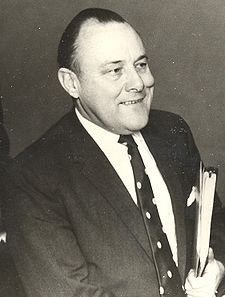 Within two years the Party removed Marshall as its parliamentary leader and replaced him with Robert Muldoon
, who had previously served as Minister of Finance
. An intense contest between Kirk and Muldoon followed. Kirk became ill and died in office (1974); his successor, Bill Rowling, proved no match for Muldoon, and in the 1975 elections
, National under Muldoon returned comfortably to power.
The Muldoon administration, which favoured interventionist
economic policies, arouses mixed opinions amongst the free-market
adherents of the modern National. Bill Birch
's "Think Big
" initiatives, designed to invest public money in energy self-sufficiency, stand in contrast to the Party's views. Muldoon's autocratic leadership style became increasingly unpopular with both the public and the Party, and together with disgruntlement over economic policy led to an attempted leadership change in 1980. Led by ministers Derek Quigley
, Jim McLay
, and Jim Bolger, the challenge (dubbed the "colonels' coup") against Muldoon aimed to replace him with Brian Talboys
, his deputy. However, the plan collapsed as the result of Talboys' unwillingness, and Muldoon kept his position.
 Under Muldoon, National won three consecutive general elections in 1975,1978
and 1981
. However, public dissatisfaction grew, and Muldoon's controlling and belligerent style of leadership
became less and less appealing. In both the 1978 and 1981 elections, National gained fewer votes than the Labour opposition, but could command a small majority in Parliament because of the then-used First Past the Post electoral system.
Dissent within the National Party continued to grow, however. Rebel National MPs Marilyn Waring
and Mike Minogue
caused particular concern to the leadership, threatening National's thin majority in parliament. When, in 1984, Marilyn Waring refused to support Muldoon's policies on visits by nuclear-powered and nuclear-armed ships, Muldoon called a snap election
. Muldoon made the television announcement of this election while visibly inebriated
, and some believe that he later regretted the decision to "go to the country". National lost the election to Labour under David Lange
.
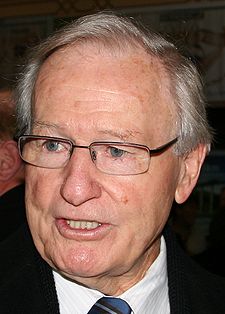
Shortly after this loss, the Party removed Muldoon from the leadership. Jim McLay
, who had replaced Brian Talboys as deputy leader shortly before the election, became the new leader. McLay, an urban liberal with right wing views on economics, however, failed to restore the party's fortunes. In 1986 Jim Bolger
took over the leadership with the support of centrists within the party.
In the 1990 elections
National defeated Labour in an electoral landslide and formed a new government under Jim Bolger
. However, the Party lost some support from Muldoon era policy based conservatives when it continued the economic reforms which had ultimately led to the defeat of the previous Labour government — these policies, started by Labour Party Finance Minister Roger Douglas
and popularly known as Rogernomics
, centred on the privatization
of state assets and on the removal of tariffs and subsidies
. These policies alienated traditional Labour supporters, who saw them as a betrayal of the party's social service based character, but did not appear to appease the membership base of the non-parliamentary National party either, which still had a significant supporter base for the statist intervention style policies of the Muldoon Government.
Many more conservative and centrist National supporters preferred Muldoon's more authoritarian and interventionist policies over the free-market liberalism promoted by Douglas. However, the new National Party Finance Minister, Ruth Richardson
, strongly supported Rogernomics, believing that Douglas had not gone far enough. (See Ruthanasia
.) Her policies encouraged two National MPs to leave the National Party and form the New Zealand Liberal Party (1992)
. Richardson's views also met with considerable opposition within the National Party Parliamentary Caucus and for a time caused damage to the party's membership base.
Nevertheless, National was able to secure its position due partly to a strongly recovering economy. At the same time as the 1993 election
, however, a referendum took place which established the MMP electoral system for future use in New Zealand general elections. This would have a significant impact on New Zealand politics. Some National Party MPs defected to a new grouping, United New Zealand
in mid-1995. And as a result of the new electoral mechanics, the New Zealand First
Party, led by former National MP and former Cabinet minister Winston Peters
, held the balance of power after the 1996 elections
. After a prolonged period of negotiation, in which New Zealand First played National and Labour off against each other (both parties negotiated complete coalition agreements), New Zealand First entered into a coalition with National.
Under the coalition agreement, Peters became Deputy Prime Minister
and had the post of Treasurer
especially created by the Crown for him. New Zealand First extracted a number of other concessions from National in exchange for its support. The influence of New Zealand First angered many National MPs, particularly Jenny Shipley
.
 When, in 1997, Shipley toppled Bolger
to become National's new leader, relations between National and its coalition partner deteriorated. After Shipley sacked Peters from Cabinet
in 1998, the New Zealand First party split into two groups and half the MPs followed Peters out of the coalition but the remainder broke away, establishing themselves as independents or as members of new parties of which none survived the 1999 election. From the latter group National gained enough support to continue in government with additional confidence support of Alamein Kopu
a defect Alliance List MP. The visibly damaged National Government managed to survive the parliamentary term, but lost the election
to Labour's Helen Clark
and the Alliance
's Jim Anderton
, who formed a coalition government.
 Shipley continued to lead the National Party until 2001, when Bill English
replaced her. English, however, proved unable to gain traction against Clark, and National suffered its worst-ever electoral defeat in the 2002 elections
, gaining only 27 of 120 seats. Many hoped that English would succeed in rebuilding the party, given time, but a year later polling showed the party performing only slightly better than in the election. In October 2003 English gave way as leader to Don Brash
, a former governor of the Reserve Bank
who had joined the National Parliamentary caucus in the 2002 election.
Under Dr Brash, the National Party's overall popularity with voters improved markedly. Mostly, however, the party achieved this by "reclaiming" support from electors who voted for other centre-right parties in 2002. National's campaigning on race relations, amid claims of preferential treatment of Māori, and amid their opposition to Labour Party policy during the foreshore-and-seabed controversy
, generated considerable publicity and much controversy. Strong campaigning on a tax-cuts theme in the lead-up to the 2005 elections
, together with a consolidation of centre-right support, may have contributed to the National Party's winning 48 out of 121 seats in Parliament. National, however, remained the second-largest party in Parliament (marginally behind Labour, which gained 50 seats), and had fewer options for forming a coalition government. With the formation of a new Labour-dominated Government, National remained the major Opposition party.
 After the 2005 election defeat Don Brash's leadership of National came under scrutiny from the media, and political watchers speculated on the prospect of a leadership-challenge before the next general election due in 2008
. Don Brash resigned on 23 November 2006, immediately before the release of Nicky Hager
's book The Hollow Men
, which contained damaging revelations obtained from private emails. John Key
became the leader of the National caucus on 27 November 2006. Key fostered a more "centrist" image, discussing issues such as child poverty
.
. The Labour Party, which had spent three terms in power, conceded the election and on 19 November the Governor-General swore in a new government: a centre-right coalition of the National Party, the ACT Party, led by Rodney Hide
, which won 5 seats, the Maori Party
, and the United Future Party.
After the election John Key
entered into talks with the Maori Party
even though he and his existing coalition partners commanded a majority. the National Government consists of National (58 seats), Act (5), the Maori Party
(5) and United Future's Peter Dunne. the National Government has 69 seats in a 122-seat Parliament. In Key's first cabinet he gave the Act Party's Rodney Hide and Heather Roy
seats outside cabinet and the Maori Party's Tariana Turia
and Pita Sharples
the same. Peter Dunne also received back the ministerial post outside cabinet which he had held within the immediately preceding Labour Government.
Short biographies of all Presidents up to Sue Wood appear in Barry Gustafson's The First Fifty Years.
Maori language
Māori or te reo Māori , commonly te reo , is the language of the indigenous population of New Zealand, the Māori. It has the status of an official language in New Zealand...
: Rōpū Nāhinara, "National" or "the Nats") is the largest party in the New Zealand House of Representatives
New Zealand House of Representatives
The New Zealand House of Representatives is the sole chamber of the legislature of New Zealand. The House and the Queen of New Zealand form the New Zealand Parliament....
and in November 2008 formed a minority government
Minority government
A minority government or a minority cabinet is a cabinet of a parliamentary system formed when a political party or coalition of parties does not have a majority of overall seats in the parliament but is sworn into government to break a Hung Parliament election result. It is also known as a...
with support from three minor parties.
Policies
According to the party's website, "The National Party seeks a safe, prosperous and successful New Zealand that creates opportunities for all New Zealanders to reach their personal goals and dreams".The National Party advocates policies of reducing tax
Tax
To tax is to impose a financial charge or other levy upon a taxpayer by a state or the functional equivalent of a state such that failure to pay is punishable by law. Taxes are also imposed by many subnational entities...
es, reducing social welfare payments, promoting free trade
Free trade
Under a free trade policy, prices emerge from supply and demand, and are the sole determinant of resource allocation. 'Free' trade differs from other forms of trade policy where the allocation of goods and services among trading countries are determined by price strategies that may differ from...
, restoring or maintaining New Zealand's traditional (Western) defence and security alliances and promoting one standard of citizenship for all New Zealanders ("One law for all"). The party's policy-documents contain commitment
Election promise
An election promise is a promise made to the public by a politician who is trying to win an election. They have long been a central element of elections and remain so today...
s to doubling New Zealand's economic growth, to giving welfare payments only to "those in genuine need" and to "speedy, full and final settlements to historic Waitangi Treaty
Treaty of Waitangi
The Treaty of Waitangi is a treaty first signed on 6 February 1840 by representatives of the British Crown and various Māori chiefs from the North Island of New Zealand....
claims".
National's 2008 tax package plan set out a three-year programme of personal tax cuts.
The National Party wants to retain skilled New Zealand workers and attract overseas New Zealanders back to New Zealand. The National Party wants to better match skills of immigrants and make immigration services world class in efficiency and effectiveness, restoring confidence in their integrity.
Support
Starting historically as a movement balanced between urban and rural interests, National appeals consistently to country and upper middle class voters. At the 2005 electionNew Zealand general election, 2005
The 2005 New Zealand general election held on 17 September 2005 determined the composition of the 48th New Zealand Parliament. No party won a majority in the unicameral House of Representatives, but the Labour Party of Prime Minister Helen Clark secured two more seats than nearest rival, the...
, the Party narrowly won more votes than the New Zealand Labour Party
New Zealand Labour Party
The New Zealand Labour Party is a New Zealand political party. It describes itself as centre-left and socially progressive and has been one of the two primary parties of New Zealand politics since 1935....
in Auckland
Auckland
The Auckland metropolitan area , in the North Island of New Zealand, is the largest and most populous urban area in the country with residents, percent of the country's population. Auckland also has the largest Polynesian population of any city in the world...
, New Zealand's largest city, and in the northern cities of Hamilton
Hamilton, New Zealand
Hamilton is the centre of New Zealand's fourth largest urban area, and Hamilton City is the country's fourth largest territorial authority. Hamilton is in the Waikato Region of the North Island, approximately south of Auckland...
and Tauranga
Tauranga
Tauranga is the most populous city in the Bay of Plenty region, in the North Island of New Zealand.It was settled by Europeans in the early 19th century and was constituted as a city in 1963...
while winning almost all of the rural and provincial electoral seats. Meanwhile, the rival Labour Party won considerably more votes in the urban electorate seats of Christchurch
Christchurch
Christchurch is the largest city in the South Island of New Zealand, and the country's second-largest urban area after Auckland. It lies one third of the way down the South Island's east coast, just north of Banks Peninsula which itself, since 2006, lies within the formal limits of...
and Dunedin
Dunedin
Dunedin is the second-largest city in the South Island of New Zealand, and the principal city of the Otago Region. It is considered to be one of the four main urban centres of New Zealand for historic, cultural, and geographic reasons. Dunedin was the largest city by territorial land area until...
.
Organisation
National features both regional and electorate-level organisational structures. National traditionally had a strongly decentralised organisation, designed to allow electorates and the five regions to appeal to the unique voter base in their area. However, in light of the 2002 election resultNew Zealand general election, 2002
The 2002 New Zealand general election was held on 27 July 2002 to determine the composition of the 47th New Zealand Parliament. It saw the reelection of Helen Clark's Labour Party government, as well as the worst-ever performance by the opposition National Party.Arguably the most controversial...
, a review of the party organisation resulted in decisions to weaken the regional structure and to implement a more centralised structure in order to make the structure more 'appropriate' for the new mixed member proportional electoral system. The Party President ( Peter Goodfellow) heads the administration outside of National's current sitting MPs
Caucus
A caucus is a meeting of supporters or members of a political party or movement, especially in the United States and Canada. As the use of the term has been expanded the exact definition has come to vary among political cultures.-Origin of the term:...
.
Historically, the Party's youth wing, the Young Nationals
New Zealand Young Nationals
The New Zealand Young Nationals are the youth wing of the New Zealand National Party a centre-right political party in New Zealand. It is a member of the International Young Democrat Union.-History:...
, commonly known as the "Young Nats", has provided much political impetus as a ginger group
Ginger group
A ginger group is a formal or informal group within, for example, a political party seeking to inspire the rest with its own enthusiasm and activity....
: it gained a historical reputation as "the" social organisation in rural New Zealand and in some urban circles.
Two other ideology specific groups exist in National. The Bluegreens are a group within National who help formulate Environmental policy. Many members of Caucus hold membership with the Bluegreens. The Blue Liberals are a National Group dedicated to promoting more liberal market and economic related policies.
Formation
The National Party officially formed in May 1936, but its roots go considerably further back. The party came about as the result of a merger between the United Party (known as the Liberal PartyNew Zealand Liberal Party
The New Zealand Liberal Party is generally regarded as having been the first real political party in New Zealand. It governed from 1891 until 1912. Out of office, the Liberals gradually found themselves pressed between the conservative Reform Party and the growing Labour Party...
until 1927, except for a short period between 1925 and 1927 when it used the name "National Party") and the Reform Party
New Zealand Reform Party
The Reform Party, formally the New Zealand Political Reform League, was New Zealand's second major political party, having been founded as a conservative response to the original Liberal Party...
. The United Party gained its main support from the cities, and drew upon business
Business
A business is an organization engaged in the trade of goods, services, or both to consumers. Businesses are predominant in capitalist economies, where most of them are privately owned and administered to earn profit to increase the wealth of their owners. Businesses may also be not-for-profit...
es for money and upon middle class
Middle class
The middle class is any class of people in the middle of a societal hierarchy. In Weberian socio-economic terms, the middle class is the broad group of people in contemporary society who fall socio-economically between the working class and upper class....
electors for votes, while the Reform Party had a rural
Rural
Rural areas or the country or countryside are areas that are not urbanized, though when large areas are described, country towns and smaller cities will be included. They have a low population density, and typically much of the land is devoted to agriculture...
base and received substantial support from farmer
Farmer
A farmer is a person engaged in agriculture, who raises living organisms for food or raw materials, generally including livestock husbandry and growing crops, such as produce and grain...
s, who then formed a substantial proportion of the population.
Historically, the Liberal and Reform parties had competed against each other, but from 1931 until 1935 a coalition between the United and Reform parties held power in New Zealand. The coalition went into the 1935 election
New Zealand general election, 1935
The 1935 New Zealand general election was a nationwide vote to determine the shape of the New Zealand Parliament's 25th term. It resulted in the Labour Party's first electoral victory, with Michael Joseph Savage becoming the first Labour Prime Minister...
under the title of the "National Political Federation", a name adopted to indicate that the grouping intended to represent New Zealanders from all backgrounds (in contrast to the previous situation, where United served city-dwellers and Reform served farmers). However, because of the effects of the Great Depression
Great Depression
The Great Depression was a severe worldwide economic depression in the decade preceding World War II. The timing of the Great Depression varied across nations, but in most countries it started in about 1929 and lasted until the late 1930s or early 1940s...
and a perception that the existing coalition government had handled the situation poorly, the National Political Federation lost heavily in 1935 to the Labour Party
New Zealand Labour Party
The New Zealand Labour Party is a New Zealand political party. It describes itself as centre-left and socially progressive and has been one of the two primary parties of New Zealand politics since 1935....
, the rise of which had originally prompted the alliance.
A new party, called the New Zealand National Party, formed at a meeting held in Wellington on 13 and 14 May 1936. Erstwhile members of the United and Reform parties made up the bulk of the new party. George Forbes
George William Forbes
George William Forbes served as the 22nd Prime Minister of New Zealand from 1930 to 1935. Few expected him to become Prime Minister when he did, and some believed him unsuitable, but he nevertheless remained in that office for five years...
, Prime Minister from 1930 until 1935 and United Party Leader, opened the conference; he served as Leader of the Opposition from May until November, when the Reform MP Adam Hamilton
Adam Hamilton
Adam Hamilton was a New Zealand politician. He was the first leader of the National Party during its early years in Opposition.-Early life:...
was elected the first leader. Hamilton led the Party into its first election in 1938. He got the top job primarily due to a compromise between George Forbes
George William Forbes
George William Forbes served as the 22nd Prime Minister of New Zealand from 1930 to 1935. Few expected him to become Prime Minister when he did, and some believed him unsuitable, but he nevertheless remained in that office for five years...
(former leader of United) and Gordon Coates
Gordon Coates
Joseph Gordon Coates, MC and bar served as the 21st Prime Minister of New Zealand from 1925 to 1928.- Early life :Born on the Hukatere Peninsula in Kaipara Harbour where his family ran a farm, Coates took on significant responsibility at a relatively early age because his father suffered from...
(former leader of Reform), neither of whom wished to serve under the other. Hamilton, however, failed to counter Labour's popular Prime Minister
Prime Minister of New Zealand
The Prime Minister of New Zealand is New Zealand's head of government consequent on being the leader of the party or coalition with majority support in the Parliament of New Zealand...
, Michael Joseph Savage
Michael Joseph Savage
Michael Joseph Savage was the first Labour Prime Minister of New Zealand.- Early life :Born in Tatong, Victoria, Australia, Savage first became involved in politics while working in that state. He emigrated to New Zealand in 1907. There he worked in a variety of jobs, as a miner, flax-cutter and...
effectively. This, along with perceptions that he remained too much under the control of Coates and that he lacked real support from his party colleagues, saw Hamilton fail to prevent Labour's re-election in 1938
New Zealand general election, 1938
The 1938 New Zealand general election was a nationwide vote to determine the shape of the New Zealand Parliament's 26th term. It resulted in the governing Labour Party being re-elected, although the newly-founded National Party gained a certain amount of ground.-Background:The Labour Party had won...
.
In 1940 Sidney Holland
Sidney Holland
Sir Sidney George Holland, GCMG, CH was the 25th Prime Minister of New Zealand from 13 December 1949 to 20 September 1957.-Early life:...
replaced Hamilton. William Polson
William Polson
Sir William John Polson, KCMG was a New Zealand politician, first as an Independent and then in the National Party. He joined the National Party on its formation in 1936, and "later acted effectively as Holland's deputy" ....
"acted effectively as Holland's deputy" (Gustafson).
The 1943 election
New Zealand general election, 1943
The 1943 New Zealand general election was a nationwide vote to determine the shape of the New Zealand Parliament's 27th term. With the onset of World War II, elections were initially postponed, but it was eventually decided to hold a general election in September 1943, around two years after it...
saw Labour's majority reduced, but it remained in power
Power (sociology)
Power is a measurement of an entity's ability to control its environment, including the behavior of other entities. The term authority is often used for power perceived as legitimate by the social structure. Power can be seen as evil or unjust, but the exercise of power is accepted as endemic to...
. In the 1946 elections
New Zealand general election, 1946
The 1946 New Zealand general election was a nationwide vote to determine the shape of the New Zealand Parliament's 28th term. It saw the governing Labour Party re-elected, but by a substantially narrower margin than in the three previous elections...
, National also failed to unseat Labour. However, in the 1949 elections
New Zealand general election, 1949
The 1949 New Zealand general election was a nationwide vote to determine the shape of the New Zealand Parliament's 29th term. It saw the governing Labour Party defeated by the opposition National Party...
, thirteen years after the party's foundation, National finally won power, and Holland became Prime Minister.
The First National Government
In 1949 National had campaigned on "the private ownership of production, distribution and exchange". Once in power the new Holland Government proved decidedly administratively conservative, retaining, for instance, the welfare stateWelfare state
A welfare state is a "concept of government in which the state plays a key role in the protection and promotion of the economic and social well-being of its citizens. It is based on the principles of equality of opportunity, equitable distribution of wealth, and public responsibility for those...
set up by the previous Labour Government; though National gained, and has largely kept (with the exception of the Muldoon government), a reputation for showing more favour to farmers and to business
Business
A business is an organization engaged in the trade of goods, services, or both to consumers. Businesses are predominant in capitalist economies, where most of them are privately owned and administered to earn profit to increase the wealth of their owners. Businesses may also be not-for-profit...
than did the Labour Party.
In 1951 the Waterfront Dispute
1951 New Zealand waterfront dispute
The 1951 New Zealand waterfront dispute was the largest and most widespread industrial dispute in New Zealand history. During the time, up to twenty thousand workers went on strike in support of waterfront workers protesting financial hardships and working conditions. Thousands more refused to...
broke out, lasting 151 days. The National government stepped into the conflict, acting in opposition to the maritime union
Trade union
A trade union, trades union or labor union is an organization of workers that have banded together to achieve common goals such as better working conditions. The trade union, through its leadership, bargains with the employer on behalf of union members and negotiates labour contracts with...
s. Holland also used this opportunity to call the 1951 snap election
New Zealand general election, 1951
The 1951 New Zealand general election was a nationwide vote to determine the shape of the New Zealand Parliament's 30th term. It saw the governing National Party remain in office, increasing its lead over the opposition Labour Party.-Background:...
. Campaigning on an anti-Communist
Anti-communism
Anti-communism is opposition to communism. Organized anti-communism developed in reaction to the rise of communism, especially after the 1917 October Revolution in Russia and the beginning of the Cold War in 1947.-Objections to communist theory:...
platform and exploiting the Labour Opposition's apparent indecisiveness, National returned with an increased majority, gaining 54 parliamentary seats out of 80.
In the 1954 elections
New Zealand general election, 1954
The 1954 New Zealand general election was a nationwide vote to determine the shape of the New Zealand Parliament's 31st term. It saw the governing National Party remain in office, but with a slightly reduced majority...
, National again won, though losing some of its seats, and Holland became Prime Minister for a third term. Towards the end of his third term, however, Holland became increasingly ill, and stepped down from the leadership shortly before the general election in 1957. Keith Holyoake
Keith Holyoake
Sir Keith Jacka Holyoake, KG, GCMG, CH, QSO, KStJ was a New Zealand politician. The only person to have been both Prime Minister and Governor-General of New Zealand, Holyoake was National Party Prime Minister from 20 September 1957 to 12 December 1957, then again from 12 December 1960 to 7...
, the party's long-standing deputy leader, took Holland's place. Holyoake, however, had insufficient time to establish himself in the public mind as Prime Minister, and lost in the election later that year
New Zealand general election, 1957
The 1957 New Zealand general election was a nationwide vote to determine the shape of the New Zealand Parliament's 32nd term. It saw the governing National Party narrowly defeated by the Labour Party...
to Labour, then led by Walter Nash
Walter Nash
Sir Walter Nash, GCMG, CH served as the 27th Prime Minister of New Zealand in the Second Labour Government from 1957 to 1960, and was also highly influential in his role as Minister of Finance...
.
Second National Government
Nash's government became very unpopular. Labour quickly acquired a reputation for poor economic management, and much of the public saw its 1958 BudgetBlack Budget (New Zealand)
In New Zealand, the term Black Budget refers to the government budget of 26 June 1958 in which Finance Minister Arnold Nordmeyer increased taxes on beer, tobacco, cars and petrol.The second Labour government took office in 1957, the 32nd Parliament...
, known since as the "Black Budget", as miserly and puritanical. After only one term in office, Labour suffered defeat at the hands of Holyoake and the National Party in the elections of 1960
New Zealand general election, 1960
The 1960 New Zealand general election was a nationwide vote to determine the shape of the New Zealand Parliament's 33rd term. It saw the governing Labour Party defeated by the National Party, putting an end to the short second Labour government.-Background:...
.
Holyoake's government lasted twelve years, the Party gaining re-election three times (in 1963
New Zealand general election, 1963
The 1963 New Zealand general election was a nationwide vote to determine the shape of the New Zealand Parliament's 34th term. The results were almost identical to those for the previous election, and the governing National Party remained in office....
, 1966
New Zealand general election, 1966
The 1966 New Zealand general election was a nationwide vote to determine the shape of the New Zealand Parliament's 35th term. It saw the governing National Party win a third consecutive term in office...
, and 1969
New Zealand general election, 1969
The 1969 New Zealand general election was a nationwide vote to determine the shape of the New Zealand Parliament's 36th term. It saw the governing National Party win a fourth consecutive term, under Prime Minister Keith Holyoake.-The Election:...
). However, this period also saw the rise of Social Credit
Social Credit Party (New Zealand)
The New Zealand Social Credit Party was a political party which served as the country's "third party" from the 1950s through into the 1980s. The party held a number of seats in the New Zealand Parliament, although never more than two at a time...
, which broke the National/Labour duopoly in parliament, winning former National seats from 1966. Holyoake retired from the Prime Ministership and from the Party leadership at the beginning of 1972, and his deputy, Jack Marshall
Jack Marshall
Sir John Ross Marshall, GBE, CH, , generally known as Jack Marshall, was a New Zealand politician. After spending twelve years as Deputy Prime Minister, he served as the 28th Prime Minister for most of 1972....
, replaced him.
Marshall suffered the same fate as Holyoake. Having succeeded an experienced leader in an election-year, he failed to establish himself in time. Marshall had an added disadvantage; he had to compete against the much more popular and charismatic Norman Kirk
Norman Kirk
Norman Eric Kirk was the 29th Prime Minister of New Zealand from 1972 until his sudden death in 1974. He led the Parliamentary wing of the New Zealand Labour Party from 1965 to 1974. He was the fourth Labour Prime Minister of New Zealand, but the first to be born in New Zealand...
, then leader of the Labour Party, and lost the ensuing election
New Zealand general election, 1972
The New Zealand general election of 1972 was held to elect MPs to the 37th session of the New Zealand Parliament. The Labour Party, led by Norman Kirk, defeated the governing National Party.-Background:...
. Unpopular policies, including initiating clear felling of parts of the Warawara kauri forest, also needlessly alienated voters.{Adams 1980}
Third National Government
Robert Muldoon
Sir Robert David "Rob" Muldoon, GCMG, CH served as the 31st Prime Minister of New Zealand from 1975 to 1984, as leader of the governing National Party. Muldoon had been a prominent member of the National party and MP for the Tamaki electorate for some years prior to becoming leader of the party...
, who had previously served as Minister of Finance
Minister of Finance (New Zealand)
The Minister of Finance is a senior figure within the government of New Zealand. The position is often considered to be the most important Cabinet role after that of the Prime Minister....
. An intense contest between Kirk and Muldoon followed. Kirk became ill and died in office (1974); his successor, Bill Rowling, proved no match for Muldoon, and in the 1975 elections
New Zealand general election, 1975
The 1975 New Zealand general election was held to elect MPs to the 38th session of the New Zealand Parliament. It was the first election in New Zealand where 18-20 year olds and all permanent residents of New Zealand were eligible to vote, although only citizens were able to be...
, National under Muldoon returned comfortably to power.
The Muldoon administration, which favoured interventionist
Economic interventionism
Economic interventionism is an action taken by a government in a market economy or market-oriented mixed economy, beyond the basic regulation of fraud and enforcement of contracts, in an effort to affect its own economy...
economic policies, arouses mixed opinions amongst the free-market
Free market
A free market is a competitive market where prices are determined by supply and demand. However, the term is also commonly used for markets in which economic intervention and regulation by the state is limited to tax collection, and enforcement of private ownership and contracts...
adherents of the modern National. Bill Birch
Bill Birch
Sir William Francis Birch, GNZM , usually known as Bill Birch, is a former New Zealand politician. He served as Minister of Finance for several years in the fourth National government.-Early life:...
's "Think Big
Think Big
The New Zealand Prime Minister Robert Muldoon and his New Zealand National Party government in the early 1980s sponsored Think Big as an interventionist state economic strategy. The Think Big schemes saw the government borrow heavily overseas, running up a large external deficit, and using the...
" initiatives, designed to invest public money in energy self-sufficiency, stand in contrast to the Party's views. Muldoon's autocratic leadership style became increasingly unpopular with both the public and the Party, and together with disgruntlement over economic policy led to an attempted leadership change in 1980. Led by ministers Derek Quigley
Derek Quigley
Derek Francis Quigley, QSO is a former New Zealand politician. He was a prominent member of the National Party during the late 1970s and early 1980s, and was known for his support of free market economics and trade liberalization...
, Jim McLay
Jim McLay
James Kenneth McLay, CNZM, QSO , generally known as Jim McLay, is a former New Zealand politician. He was Deputy Prime Minister, leader of the National Party and Leader of the Opposition for a short time. McLay is currently New Zealand's Permanent Representative to the United Nations.-Early...
, and Jim Bolger, the challenge (dubbed the "colonels' coup") against Muldoon aimed to replace him with Brian Talboys
Brian Talboys
Sir Brian Edward Talboys, CH, KCB, AC, is a former New Zealand politician. He served as Deputy Prime Minister for the first two terms of Robert Muldoon's premiership. If the abortive "Colonels' Coup" against Muldoon had been successful, Talboys would have become Prime Minister himself.-Early...
, his deputy. However, the plan collapsed as the result of Talboys' unwillingness, and Muldoon kept his position.
New Zealand general election, 1978
The 1978 New Zealand general election was a nationwide vote to elect the 39th New Zealand Parliament. It saw the governing National Party, led by Robert Muldoon, retain office, although the opposition Labour Party managed to win the largest share of the vote...
and 1981
New Zealand general election, 1981
The 1981 New Zealand general election was a nationwide vote to determine the shape of the 40th New Zealand Parliament. It saw the governing National Party, led by Robert Muldoon, win a third term in office, although the opposition Labour Party, led by Bill Rowling, actually won the largest share of...
. However, public dissatisfaction grew, and Muldoon's controlling and belligerent style of leadership
Leadership
Leadership has been described as the “process of social influence in which one person can enlist the aid and support of others in the accomplishment of a common task". Other in-depth definitions of leadership have also emerged.-Theories:...
became less and less appealing. In both the 1978 and 1981 elections, National gained fewer votes than the Labour opposition, but could command a small majority in Parliament because of the then-used First Past the Post electoral system.
Dissent within the National Party continued to grow, however. Rebel National MPs Marilyn Waring
Marilyn Waring
Marilyn Waring, CNZM, D.Phil., D.Litt. is a New Zealand feminist, a politician, an activist for female human rights and environmental issues, an author and an academic, known for her contributions to feminist economics....
and Mike Minogue
Mike Minogue
Michael John "Mike" Minogue was a National Party politician, lawyer and mayor.He was Mayor of Hamilton, New Zealand between 1968 and 1976, when he resigned to become a Member of Parliament...
caused particular concern to the leadership, threatening National's thin majority in parliament. When, in 1984, Marilyn Waring refused to support Muldoon's policies on visits by nuclear-powered and nuclear-armed ships, Muldoon called a snap election
New Zealand general election, 1984
The 1984 New Zealand general election was a nationwide vote to determine the shape of the 41st New Zealand Parliament. It marked the beginning of the Fourth Labour Government, with David Lange's Labour Party defeating long-serving Prime Minister Robert Muldoon of the National Party. It was also the...
. Muldoon made the television announcement of this election while visibly inebriated
Drunkenness
Alcohol intoxication is a physiological state that occurs when a person has a high level of ethanol in his or her blood....
, and some believe that he later regretted the decision to "go to the country". National lost the election to Labour under David Lange
David Lange
David Russell Lange, ONZ, CH , served as the 32nd Prime Minister of New Zealand from 1984 to 1989. He headed New Zealand's fourth Labour Government, one of the most reforming administrations in his country's history, but one which did not always conform to traditional expectations of a...
.
Fourth National Government
Shortly after this loss, the Party removed Muldoon from the leadership. Jim McLay
Jim McLay
James Kenneth McLay, CNZM, QSO , generally known as Jim McLay, is a former New Zealand politician. He was Deputy Prime Minister, leader of the National Party and Leader of the Opposition for a short time. McLay is currently New Zealand's Permanent Representative to the United Nations.-Early...
, who had replaced Brian Talboys as deputy leader shortly before the election, became the new leader. McLay, an urban liberal with right wing views on economics, however, failed to restore the party's fortunes. In 1986 Jim Bolger
Jim Bolger
James Brendan "Jim" Bolger, ONZ was the 35th Prime Minister of New Zealand from 1990 to 1997. Bolger was elected on the promise of delivering a "Decent Society" following the previous Labour government's economic reforms, known as Rogernomics...
took over the leadership with the support of centrists within the party.
In the 1990 elections
New Zealand general election, 1990
The 1990 New Zealand general election was held on 27 October to determine the composition of the 43rd New Zealand parliament. The governing Labour Party was defeated, ending its controversial two terms in office...
National defeated Labour in an electoral landslide and formed a new government under Jim Bolger
Jim Bolger
James Brendan "Jim" Bolger, ONZ was the 35th Prime Minister of New Zealand from 1990 to 1997. Bolger was elected on the promise of delivering a "Decent Society" following the previous Labour government's economic reforms, known as Rogernomics...
. However, the Party lost some support from Muldoon era policy based conservatives when it continued the economic reforms which had ultimately led to the defeat of the previous Labour government — these policies, started by Labour Party Finance Minister Roger Douglas
Roger Douglas
Sir Roger Owen Douglas , is a New Zealand politician who formerly served as a senior New Zealand Labour Party Cabinet minister. He became arguably best-known for his prominent role in the radical economic restructuring undertaken by the Fourth Labour Government during the 1980s...
and popularly known as Rogernomics
Rogernomics
The term Rogernomics, a portmanteau of "Roger" and "economics", was coined by journalists at the New Zealand Listener by analogy with Reaganomics to describe the economic policies followed by Roger Douglas after his appointment in 1984 as Minister of Finance in the Fourth Labour Government...
, centred on the privatization
Privatization
Privatization is the incidence or process of transferring ownership of a business, enterprise, agency or public service from the public sector to the private sector or to private non-profit organizations...
of state assets and on the removal of tariffs and subsidies
Subsidy
A subsidy is an assistance paid to a business or economic sector. Most subsidies are made by the government to producers or distributors in an industry to prevent the decline of that industry or an increase in the prices of its products or simply to encourage it to hire more labor A subsidy (also...
. These policies alienated traditional Labour supporters, who saw them as a betrayal of the party's social service based character, but did not appear to appease the membership base of the non-parliamentary National party either, which still had a significant supporter base for the statist intervention style policies of the Muldoon Government.
Many more conservative and centrist National supporters preferred Muldoon's more authoritarian and interventionist policies over the free-market liberalism promoted by Douglas. However, the new National Party Finance Minister, Ruth Richardson
Ruth Richardson
Ruth Richardson served as New Zealand's Minister of Finance from 1990 to 1993, and is known for her strong pursuit of free-market economic reforms .-Early life:...
, strongly supported Rogernomics, believing that Douglas had not gone far enough. (See Ruthanasia
Ruthanasia
Ruthanasia, a portmanteau of "Ruth" and "euthanasia", is the pejorative name given to the period of free-market economic reform conducted during the first term of the fourth National government in New Zealand, from 1990 to 1993...
.) Her policies encouraged two National MPs to leave the National Party and form the New Zealand Liberal Party (1992)
New Zealand Liberal Party (1992)
The New Zealand Liberal Party founded in 1992 was a splinter group of the National Party....
. Richardson's views also met with considerable opposition within the National Party Parliamentary Caucus and for a time caused damage to the party's membership base.
Nevertheless, National was able to secure its position due partly to a strongly recovering economy. At the same time as the 1993 election
New Zealand general election, 1993
The 1993 New Zealand general election was held on 6 November 1993 to determine the composition of the 44th New Zealand Parliament. It saw the governing National Party, led by Jim Bolger, win a second term in office, despite a major swing back towards the Labour Party. The new Alliance and New...
, however, a referendum took place which established the MMP electoral system for future use in New Zealand general elections. This would have a significant impact on New Zealand politics. Some National Party MPs defected to a new grouping, United New Zealand
United New Zealand
United New Zealand was a centrist political party in New Zealand founded in 1995. It merged with the Christian-based Future New Zealand party to form the United Future New Zealand party in 2000.-History:...
in mid-1995. And as a result of the new electoral mechanics, the New Zealand First
New Zealand First
New Zealand First is a political party in New Zealand that was founded in 1993, following party founder Winston Peters' resignation from the National Party in 1992...
Party, led by former National MP and former Cabinet minister Winston Peters
Winston Peters
Winston Raymond Peters is a New Zealand politician and leader of New Zealand First, a political party he founded in 1993. Peters has had a turbulent political career since entering Parliament in 1978. He served as Minister of Maori Affairs in the Bolger National Party Government before being...
, held the balance of power after the 1996 elections
New Zealand general election, 1996
The 1996 New Zealand general election was held on 12 October 1996 to determine the composition of the 45th New Zealand Parliament. It was notable for being the first election to be held under the new Mixed Member Proportional electoral system, and produced a parliament considerably more diverse...
. After a prolonged period of negotiation, in which New Zealand First played National and Labour off against each other (both parties negotiated complete coalition agreements), New Zealand First entered into a coalition with National.
Under the coalition agreement, Peters became Deputy Prime Minister
Deputy Prime Minister of New Zealand
The Deputy Prime Minister of New Zealand is second most senior officer in the Government of New Zealand, although this seniority does not necessarily translate into power....
and had the post of Treasurer
Treasurer
A treasurer is the person responsible for running the treasury of an organization. The adjective for a treasurer is normally "tresorial". The adjective "treasurial" normally means pertaining to a treasury, rather than the treasurer.-Government:...
especially created by the Crown for him. New Zealand First extracted a number of other concessions from National in exchange for its support. The influence of New Zealand First angered many National MPs, particularly Jenny Shipley
Jenny Shipley
Dame Jenny Shipley, DNZM , served as the 36th Prime Minister of New Zealand from December 1997 to December 1999, the first woman to hold this office and the first, and to date only, woman to serve as parliamentary leader of the National Party of New Zealand.-Early life:Shipley was born as Jennifer...
.
Jim Bolger
James Brendan "Jim" Bolger, ONZ was the 35th Prime Minister of New Zealand from 1990 to 1997. Bolger was elected on the promise of delivering a "Decent Society" following the previous Labour government's economic reforms, known as Rogernomics...
to become National's new leader, relations between National and its coalition partner deteriorated. After Shipley sacked Peters from Cabinet
Cabinet (government)
A Cabinet is a body of high ranking government officials, typically representing the executive branch. It can also sometimes be referred to as the Council of Ministers, an Executive Council, or an Executive Committee.- Overview :...
in 1998, the New Zealand First party split into two groups and half the MPs followed Peters out of the coalition but the remainder broke away, establishing themselves as independents or as members of new parties of which none survived the 1999 election. From the latter group National gained enough support to continue in government with additional confidence support of Alamein Kopu
Alamein Kopu
- Birth and early life :Kopu was raised in Opotiki. Her family was not wealthy, and Kopu characterises her youth as containing "much hardship". In 1978, her family moved to Sydney, Australia. In Australia, Kopu became involved with community programs aimed at drug users and prostitutes, something...
a defect Alliance List MP. The visibly damaged National Government managed to survive the parliamentary term, but lost the election
New Zealand general election, 1999
The 1999 New Zealand general election was held on 27 November 1999 to determine the composition of the 46th New Zealand Parliament. The governing National Party, led by Prime Minister Jenny Shipley, was defeated, being replaced by a coalition of Helen Clark's Labour Party and the smaller Alliance...
to Labour's Helen Clark
Helen Clark
Helen Elizabeth Clark, ONZ is a New Zealand political figure who was the 37th Prime Minister of New Zealand for three consecutive terms from 1999 to 2008...
and the Alliance
Alliance (New Zealand political party)
The Alliance is a left-wing political party in New Zealand. It was formed in 1991, and was influential in the 1990s, but has since declined and has no representation in parliament. It suffered a major setback after Jim Anderton, the party's leader, left the party in 2002, taking several of the...
's Jim Anderton
Jim Anderton
James Patrick Anderton, usually known as Jim Anderton , is the leader of the Progressive Party, a New Zealand political party. He has served in Parliament since 1984. He served as Deputy Prime Minister from 1999 to 2002 and is currently also the sitting Father of the House, the longest...
, who formed a coalition government.
Opposition (1999-2008)
Bill English
Simon William "Bill" English is the Deputy Prime Minister, Minister of Finance and Minister of Infrastructure of New Zealand.English entered parliament in 1990 as a National party MP representing the Wallace electorate...
replaced her. English, however, proved unable to gain traction against Clark, and National suffered its worst-ever electoral defeat in the 2002 elections
New Zealand general election, 2002
The 2002 New Zealand general election was held on 27 July 2002 to determine the composition of the 47th New Zealand Parliament. It saw the reelection of Helen Clark's Labour Party government, as well as the worst-ever performance by the opposition National Party.Arguably the most controversial...
, gaining only 27 of 120 seats. Many hoped that English would succeed in rebuilding the party, given time, but a year later polling showed the party performing only slightly better than in the election. In October 2003 English gave way as leader to Don Brash
Don Brash
Donald "Don" Thomas Brash , a New Zealand politician, was Leader of the Opposition, parliamentary leader of the National Party from 28 October 2003 to 27 November 2006 and the leader of the ACT Party for 28th April 2011 - 26 November 2011...
, a former governor of the Reserve Bank
Reserve Bank of New Zealand
The Reserve Bank of New Zealand is the central bank of New Zealand and is constituted under the Reserve Bank of New Zealand Act 1989. The Governor of the Reserve Bank is responsible for New Zealand's currency and operating monetary policy. The Bank's current Governor is Dr. Alan Bollard...
who had joined the National Parliamentary caucus in the 2002 election.
Under Dr Brash, the National Party's overall popularity with voters improved markedly. Mostly, however, the party achieved this by "reclaiming" support from electors who voted for other centre-right parties in 2002. National's campaigning on race relations, amid claims of preferential treatment of Māori, and amid their opposition to Labour Party policy during the foreshore-and-seabed controversy
New Zealand foreshore and seabed controversy
The New Zealand foreshore and seabed controversy is a debate in the politics of New Zealand. It concerns the ownership of the country's foreshore and seabed, with many Māori groups claiming that Māori have a rightful claim to title. These claims are based around historical possession and the Treaty...
, generated considerable publicity and much controversy. Strong campaigning on a tax-cuts theme in the lead-up to the 2005 elections
New Zealand general election, 2005
The 2005 New Zealand general election held on 17 September 2005 determined the composition of the 48th New Zealand Parliament. No party won a majority in the unicameral House of Representatives, but the Labour Party of Prime Minister Helen Clark secured two more seats than nearest rival, the...
, together with a consolidation of centre-right support, may have contributed to the National Party's winning 48 out of 121 seats in Parliament. National, however, remained the second-largest party in Parliament (marginally behind Labour, which gained 50 seats), and had fewer options for forming a coalition government. With the formation of a new Labour-dominated Government, National remained the major Opposition party.
New Zealand general election, 2008
The 2008 New Zealand general election was held on 8 November 2008 to determine the composition of the 49th New Zealand parliament. The conservative National Party, headed by its Parliamentary leader John Key, won a plurality of votes and seats, ending 9 years of government dominated by the social...
. Don Brash resigned on 23 November 2006, immediately before the release of Nicky Hager
Nicky Hager
Nicky Hager is an author and investigative journalist born in Levin, New Zealand and now resides in Wellington. He generally writes about issues involving intelligence networks, environmental issues and politics. He has degrees in physics and philosophy...
's book The Hollow Men
The Hollow Men (book)
The Hollow Men is a 2006 book written by Nicky Hager about the election strategies used by the New Zealand National Party during New Zealand's 2005 parliamentary election...
, which contained damaging revelations obtained from private emails. John Key
John Key
John Phillip Key is the 38th Prime Minister of New Zealand, in office since 2008. He has led the New Zealand National Party since 2006....
became the leader of the National caucus on 27 November 2006. Key fostered a more "centrist" image, discussing issues such as child poverty
Child poverty
Child poverty refers to the phenomenon of children living in poverty. This applies to children that come from poor families or orphans being raised with limited, or in some cases absent, state resources. Children that fail to meet the minimum acceptable standard of life for the nation where that...
.
Fifth National Government
On 8 November 2008 the National Party, led by John Key, won 58 seats in the general electionNew Zealand general election, 2008
The 2008 New Zealand general election was held on 8 November 2008 to determine the composition of the 49th New Zealand parliament. The conservative National Party, headed by its Parliamentary leader John Key, won a plurality of votes and seats, ending 9 years of government dominated by the social...
. The Labour Party, which had spent three terms in power, conceded the election and on 19 November the Governor-General swore in a new government: a centre-right coalition of the National Party, the ACT Party, led by Rodney Hide
Rodney Hide
Rodney Hide is a New Zealand politician who was leader of the political party ACT New Zealand from 2004 to 2011. From 2005 to 2011 he represented the electorate of Epsom as its Member of Parliament. Rodney Hide was Minister of Local Government, Associate Minister of Commerce and Minister of...
, which won 5 seats, the Maori Party
Maori Party
The Māori Party, a political party in New Zealand, was formed on 7 July 2004. The Party is guided by eight constitutional "kaupapa", or Party objectives. Tariana Turia formed the Māori Party after resigning from the Labour Party where she had been a Cabinet Minister in the Fifth Labour-led...
, and the United Future Party.
After the election John Key
John Key
John Phillip Key is the 38th Prime Minister of New Zealand, in office since 2008. He has led the New Zealand National Party since 2006....
entered into talks with the Maori Party
Maori Party
The Māori Party, a political party in New Zealand, was formed on 7 July 2004. The Party is guided by eight constitutional "kaupapa", or Party objectives. Tariana Turia formed the Māori Party after resigning from the Labour Party where she had been a Cabinet Minister in the Fifth Labour-led...
even though he and his existing coalition partners commanded a majority. the National Government consists of National (58 seats), Act (5), the Maori Party
Maori Party
The Māori Party, a political party in New Zealand, was formed on 7 July 2004. The Party is guided by eight constitutional "kaupapa", or Party objectives. Tariana Turia formed the Māori Party after resigning from the Labour Party where she had been a Cabinet Minister in the Fifth Labour-led...
(5) and United Future's Peter Dunne. the National Government has 69 seats in a 122-seat Parliament. In Key's first cabinet he gave the Act Party's Rodney Hide and Heather Roy
Heather Roy
Heather Roy , is a New Zealand politician and has served as an ACT Member of Parliament since 2002. From 2006 until 17 August 2010, Roy was ACT's Deputy Leader...
seats outside cabinet and the Maori Party's Tariana Turia
Tariana Turia
Tariana Turia is a New Zealand politician. She gained considerable prominence during the foreshore and seabed controversy, and eventually broke with her party as a result...
and Pita Sharples
Pita Sharples
Pita Russell Sharples, CBE, , a Māori academic and politician, currently co-leads the Māori Party. He currently is the member for Tamaki Makaurau in New Zealand's Parliament.-Early life:...
the same. Peter Dunne also received back the ministerial post outside cabinet which he had held within the immediately preceding Labour Government.
Parliamentary leaders
| Order | Leader | Term | Leader of the Opposition | Prime Minister |
|---|---|---|---|---|
| 1 | Adam Hamilton Adam Hamilton Adam Hamilton was a New Zealand politician. He was the first leader of the National Party during its early years in Opposition.-Early life:... |
1936–1940 | 1936–1940 | |
| 2 | Sidney Holland Sidney Holland Sir Sidney George Holland, GCMG, CH was the 25th Prime Minister of New Zealand from 13 December 1949 to 20 September 1957.-Early life:... |
1940–1957 | 1940–1949 | 1949–1957 |
| 3 | Keith Holyoake Keith Holyoake Sir Keith Jacka Holyoake, KG, GCMG, CH, QSO, KStJ was a New Zealand politician. The only person to have been both Prime Minister and Governor-General of New Zealand, Holyoake was National Party Prime Minister from 20 September 1957 to 12 December 1957, then again from 12 December 1960 to 7... |
1957–1972 | 1957–1960 | 1957 1960–1972 |
| 4 | Jack Marshall Jack Marshall Sir John Ross Marshall, GBE, CH, , generally known as Jack Marshall, was a New Zealand politician. After spending twelve years as Deputy Prime Minister, he served as the 28th Prime Minister for most of 1972.... |
1972–1974 | 1972–1974 | 1972 |
| 5 | Robert Muldoon Robert Muldoon Sir Robert David "Rob" Muldoon, GCMG, CH served as the 31st Prime Minister of New Zealand from 1975 to 1984, as leader of the governing National Party. Muldoon had been a prominent member of the National party and MP for the Tamaki electorate for some years prior to becoming leader of the party... |
1974–1984 | 1974–1975 1984 |
1975–1984 |
| 6 | Jim McLay Jim McLay James Kenneth McLay, CNZM, QSO , generally known as Jim McLay, is a former New Zealand politician. He was Deputy Prime Minister, leader of the National Party and Leader of the Opposition for a short time. McLay is currently New Zealand's Permanent Representative to the United Nations.-Early... |
1984–1986 | 1984–1986 | |
| 7 | Jim Bolger | 1986–1997 | 1986–1990 | 1990–1997 |
| 8 | Jenny Shipley Jenny Shipley Dame Jenny Shipley, DNZM , served as the 36th Prime Minister of New Zealand from December 1997 to December 1999, the first woman to hold this office and the first, and to date only, woman to serve as parliamentary leader of the National Party of New Zealand.-Early life:Shipley was born as Jennifer... |
1997–2001 | 1999–2001 | 1997–1999 |
| 9 | Bill English Bill English Simon William "Bill" English is the Deputy Prime Minister, Minister of Finance and Minister of Infrastructure of New Zealand.English entered parliament in 1990 as a National party MP representing the Wallace electorate... |
2001–2003 | 2001–2003 | |
| 10 | Don Brash Don Brash Donald "Don" Thomas Brash , a New Zealand politician, was Leader of the Opposition, parliamentary leader of the National Party from 28 October 2003 to 27 November 2006 and the leader of the ACT Party for 28th April 2011 - 26 November 2011... |
2003–2006 | 2003–2006 | |
| 11 | John Key John Key John Phillip Key is the 38th Prime Minister of New Zealand, in office since 2008. He has led the New Zealand National Party since 2006.... |
2006 – Present | 2006–2008 | 2008 – Present |
Party Presidents
| Name | Term |
|---|---|
| Sir George Wilson | 1936 |
| Colonel Claude H. Weston | 1936–1940 |
| Alex Gordon | 1940–1944 |
| Sir Wilfred Sim | 1944–1951 |
| Sir Alex McKenzie | 1951–1962 |
| John S. Meadowcroft | 1962–1966 |
| Edward Durning (Ned) Holt | 1966–1973 |
| Sir George Chapman | 1973–1982 |
| Sue Wood Sue Wood Suzanne Mary Wood, born in Onehunga in 1948, was the president of the National Party from 1982 to 1986, the first woman to hold the post. She had been a teacher, journalist and swimming coach.... |
1982–1986 |
| Neville Young | 1986–1989 |
| John Collinge John Collinge John Gregory Collinge is a former president of the New Zealand National Party and High Commissioner to the United Kingdom.-Early life:Collinge was born in the Hastings suburb of Mahora in 1939... |
1989–1994 |
| Lindsay Tisch Lindsay Tisch William Lindsay Tisch, known as Lindsay Tisch, JP, is a New Zealand politician, and member of the National Party.-Member of Parliament:... |
1994 |
| Geoff Thompson Geoffrey Thompson Geoffrey "Geoff" William Fleetwood Thompson, CNZM was the former New Zealand Member of Parliament for Horowhenua, in the North Island.-Member of Parliament:... |
1994–1998 |
| John Slater | 1998–2001 |
| Michelle Boag | 2001–2002 |
| Judy Kirk | 2002–2009 |
| Peter Goodfellow | 2009 – present |
Short biographies of all Presidents up to Sue Wood appear in Barry Gustafson's The First Fifty Years.
See also
- Political parties in New ZealandPolitical parties in New ZealandNew Zealand national politics feature a pervasive party system. Usually, all members of Parliament's unicameral House of Representatives belong to a political party. Independent MPs occur relatively rarely...
- Governments of New ZealandGovernments of New ZealandThe Government of New Zealand , formally Her Majesty's Government in New Zealand, is based on the Westminster system of responsible government...
- National Party's Caucus and National MPs' responsibilities