Home      Discussion      Topics      Dictionary      Almanac
Signup       Login
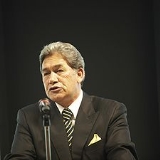
Winston Peters

Winston Peters

Overview
Winston Raymond Peters is a New Zealand
New Zealand
New Zealand is an island country in the south-western Pacific Ocean comprising two main landmasses and numerous smaller islands. The country is situated some east of Australia across the Tasman Sea, and roughly south of the Pacific island nations of New Caledonia, Fiji, and Tonga...

 politician and leader of New Zealand First
New Zealand First
New Zealand First is a political party in New Zealand that was founded in 1993, following party founder Winston Peters' resignation from the National Party in 1992...

, a political party
Political party
A political party is a political organization that typically seeks to influence government policy, usually by nominating their own candidates and trying to seat them in political office. Parties participate in electoral campaigns, educational outreach or protest actions...

 he founded in 1993. Peters has had a turbulent political career since entering Parliament
Parliament of New Zealand
The Parliament of New Zealand consists of the Queen of New Zealand and the New Zealand House of Representatives and, until 1951, the New Zealand Legislative Council. The House of Representatives is often referred to as "Parliament".The House of Representatives usually consists of 120 Members of...

 in 1978. He served as Minister of Maori Affairs
Minister of Maori Affairs
The Minister of Māori Affairs is the minister of the New Zealand government with broad responsibility for government policy towards Māori, the first inhabitants of New Zealand. The current Minister of Māori Affairs is Dr. Pita Sharples.-Role:...

 in the Bolger
Jim Bolger
James Brendan "Jim" Bolger, ONZ was the 35th Prime Minister of New Zealand from 1990 to 1997. Bolger was elected on the promise of delivering a "Decent Society" following the previous Labour government's economic reforms, known as Rogernomics...

 National Party Government
Fourth National Government of New Zealand
The Fourth National Government of New Zealand was the government of New Zealand from 2 November 1990 to 27 November 1999. Following in the footsteps of the previous Labour government, the fourth National government embarked on an extensive programme of spending cuts...

 before being sacked in 1991 and losing party endorsement for his Tauranga seat
Tauranga (New Zealand electorate)
Tauranga is a New Zealand Parliamentary electorate, returning one Member of Parliament to the New Zealand House of Representatives. The current MP for Tauranga is Simon Bridges of the National Party, who won the seat in the 2008 New Zealand general election, after the previous MP, Bob Clarkson of...

. He returned to Parliament as an independent, then formed his own party, New Zealand First. In Opposition, Peters became an outspoken critic of New Zealand immigration policies. As leader of New Zealand First, he held the balance of power following the 1996 election, enabling the National Party to form a coalition government and securing for himself the positions of Deputy Prime Minister and Treasurer. However, the coalition dissolved in 1998 following the replacement of Bolger by Jenny Shipley

Jenny Shipley
Dame Jenny Shipley, DNZM , served as the 36th Prime Minister of New Zealand from December 1997 to December 1999, the first woman to hold this office and the first, and to date only, woman to serve as parliamentary leader of the National Party of New Zealand.-Early life:Shipley was born as Jennifer...

 as Prime Minister.
Discussion
Ask a question about 'Winston Peters'
Start a new discussion about 'Winston Peters'
Answer questions from other users
Full Discussion Forum
 
Recent Discussions
Quotations

We have now reached the point where you can wander down Queen Street in Auckland and wonder if you are still in New Zealand or some other country.

2005 speech on immigration policy, entitled "Securing Our Borders and Protecting Our Identity."'

We are being colonised without New Zealanders having some say in the numbers of people coming in and where they are coming from. This is a deliberate policy of ethnic engineering and re-population.

2005 speech on immigration policy, entitled "Securing Our Borders and Protecting Our Identity."

I'm putting it to you and to all of my critics, if you can find any Asian leader in any Asian country of whatever political persuasion who doesn't subscribe to the immigration views of New Zealand First, then name that person now. None of you can, all the way to Turkey.

Interview with the 7:30 Report|7:30 Report, ABC TV, Australia.
Encyclopedia
Winston Raymond Peters is a New Zealand
New Zealand
New Zealand is an island country in the south-western Pacific Ocean comprising two main landmasses and numerous smaller islands. The country is situated some east of Australia across the Tasman Sea, and roughly south of the Pacific island nations of New Caledonia, Fiji, and Tonga...

 politician and leader of New Zealand First
New Zealand First
New Zealand First is a political party in New Zealand that was founded in 1993, following party founder Winston Peters' resignation from the National Party in 1992...

, a political party
Political party
A political party is a political organization that typically seeks to influence government policy, usually by nominating their own candidates and trying to seat them in political office. Parties participate in electoral campaigns, educational outreach or protest actions...

 he founded in 1993. Peters has had a turbulent political career since entering Parliament
Parliament of New Zealand
The Parliament of New Zealand consists of the Queen of New Zealand and the New Zealand House of Representatives and, until 1951, the New Zealand Legislative Council. The House of Representatives is often referred to as "Parliament".The House of Representatives usually consists of 120 Members of...

 in 1978. He served as Minister of Maori Affairs
Minister of Maori Affairs
The Minister of Māori Affairs is the minister of the New Zealand government with broad responsibility for government policy towards Māori, the first inhabitants of New Zealand. The current Minister of Māori Affairs is Dr. Pita Sharples.-Role:...

 in the Bolger
Jim Bolger
James Brendan "Jim" Bolger, ONZ was the 35th Prime Minister of New Zealand from 1990 to 1997. Bolger was elected on the promise of delivering a "Decent Society" following the previous Labour government's economic reforms, known as Rogernomics...

 National Party Government
Fourth National Government of New Zealand
The Fourth National Government of New Zealand was the government of New Zealand from 2 November 1990 to 27 November 1999. Following in the footsteps of the previous Labour government, the fourth National government embarked on an extensive programme of spending cuts...

 before being sacked in 1991 and losing party endorsement for his Tauranga seat
Tauranga (New Zealand electorate)
Tauranga is a New Zealand Parliamentary electorate, returning one Member of Parliament to the New Zealand House of Representatives. The current MP for Tauranga is Simon Bridges of the National Party, who won the seat in the 2008 New Zealand general election, after the previous MP, Bob Clarkson of...

. He returned to Parliament as an independent, then formed his own party, New Zealand First. In Opposition, Peters became an outspoken critic of New Zealand immigration policies. As leader of New Zealand First, he held the balance of power following the 1996 election, enabling the National Party to form a coalition government and securing for himself the positions of Deputy Prime Minister and Treasurer. However, the coalition dissolved in 1998 following the replacement of Bolger by Jenny Shipley
Jenny Shipley
Dame Jenny Shipley, DNZM , served as the 36th Prime Minister of New Zealand from December 1997 to December 1999, the first woman to hold this office and the first, and to date only, woman to serve as parliamentary leader of the National Party of New Zealand.-Early life:Shipley was born as Jennifer...

 as Prime Minister.

Following the dissolution of the coalition, New Zealand First split between supporters of Shipley's government and opponents. Support for the party collapsed at the 1999 election. He was defeated in his Tauranga seat in 2005, but remained in Parliament as a list MP and was given the Foreign Affairs, Senior Citizens and Racing portfolios in the Labour government. On 29 August 2008, he stood down as Foreign Affairs
Minister of Foreign Affairs (New Zealand)
The Minister of Foreign Affairs is a major ministerial portfolio in the government of New Zealand.The current Minister of Foreign Affairs is Murray McCully, who was National Party Spokeperson of Foreign Affairs and Shadow Minister of Foreign Affairs. There are also Associate Minister roles...

 and Racing Minister pending a police investigation into accusations that he failed to declare a series of political donations received by his party. On 23 September 2008, Peters was censured by the Parliament for "knowingly providing false or misleading information on a return of pecuniary interests" over a $100,000 donation made in 2005.

In the 2008 general election
New Zealand general election, 2008
The 2008 New Zealand general election was held on 8 November 2008 to determine the composition of the 49th New Zealand parliament. The conservative National Party, headed by its Parliamentary leader John Key, won a plurality of votes and seats, ending 9 years of government dominated by the social...

, New Zealand First failed to reach the five percent threshold and Peters did not regain his seat. As a result, neither Peters or New Zealand First were returned to Parliament. However, in the 2011 General Election
New Zealand general election, 2011
The 2011 New Zealand general election on Saturday 26 November 2011 determined the membership of the 50th New Zealand Parliament.One hundred and twenty-one MPs were elected to the New Zealand House of Representatives, 70 from single-member electorates, including one overhang seat, and 51 from party...

 New Zealand First experienced a resurgence in support, winning 6.8 percent of the party vote to secure eight seats in Parliament.

Early life


Peters was born in the Northland city of Whangarei, New Zealand
Whangarei
Whangarei, pronounced , is the northernmost city in New Zealand and the regional capital of Northland Region. Although commonly classified as a city, it is officially part of the Whangarei District, administered by the Whangarei District Council a local body created in 1989 to administer both the...

. He is of mixed ethnicity
Ethnic group
An ethnic group is a group of people whose members identify with each other, through a common heritage, often consisting of a common language, a common culture and/or an ideology that stresses common ancestry or endogamy...

, his father being Māori and his mother being of Scottish
Scotland
Scotland is a country that is part of the United Kingdom. Occupying the northern third of the island of Great Britain, it shares a border with England to the south and is bounded by the North Sea to the east, the Atlantic Ocean to the north and west, and the North Channel and Irish Sea to the...

 descent. His iwi
Iwi
In New Zealand society, iwi form the largest everyday social units in Māori culture. The word iwi means "'peoples' or 'nations'. In "the work of European writers which treat iwi and hapū as parts of a hierarchical structure", it has been used to mean "tribe" , or confederation of tribes,...

 affiliation is Ngāti Wai
Ngati Wai
Ngāti Wai is a Māori iwi of the east coast of the Northland Region of New Zealand. Its historical area stretched from Cape Brett in the north to Takatu Point on Tawharanui Peninsula in the south and out to Great Barrier Island, the Poor Knights Islands and other offshore islands.Descendants of...

 and his clan is McInnes. Two of his brothers, Ian
Ian Peters
Ian Peters was a New Zealand politician of the National Party.He represented the Tongariro electorate in Parliament from 1990 to 1993, when he was defeated by Mark Burton...

 and Jim, have also been MPs, and another brother Ron has also stood as a New Zealand First candidate.

After attending Whangarei Boys' High School and Dargaville High School Peters studied history, politics and law at the University of Auckland
University of Auckland
The University of Auckland is a university located in Auckland, New Zealand. It is the largest university in the country and the highest ranked in the 2011 QS World University Rankings, having been ranked worldwide...

 and graduated BA
Bachelor of Arts
A Bachelor of Arts , from the Latin artium baccalaureus, is a bachelor's degree awarded for an undergraduate course or program in either the liberal arts, the sciences, or both...

 and LLB before working both as a teacher and a lawyer. He was a member of the University Rugby Club in Auckland and captain of the Auckland Māori Rugby team. He also played in the Prince of Wales Cup for the Māori All Blacks. One brother, Wayne, played rugby for Otago
Otago Rugby Football Union
The Otago Rugby Football Union is the official governing body of rugby union for the Otago Region of New Zealand. The union is based in the city of Dunedin, and its home ground is Forsyth Barr Stadium. The top representative team competes in the ITM Cup, New Zealand's top provincial...

 and North Auckland
Northland Rugby Union
The Northland Rugby Football Union is the governing body of rugby union in the Northland region of New Zealand.-History:Rugby was first played in Northland in the 1870s, and the first union was set up in the province in 1895, known as the Marsden Football Union. The Northland union was founded in...

 in the then National Provincial Championship and was in the Junior All Blacks
Junior All Blacks
The Junior All Blacks are a New Zealand rugby union team. The Junior All Blacks are not an age grade side, but the second national team behind the New Zealand national rugby union team....

 while another brother, Allan, represented Wanganui
Wanganui
Whanganui , also spelled Wanganui, is an urban area and district on the west coast of the North Island of New Zealand. It is part of the Manawatu-Wanganui region....

 in rugby.

National Party


Peters entered national politics in 1975, standing unsuccessfully for the National Party
New Zealand National Party
The New Zealand National Party is the largest party in the New Zealand House of Representatives and in November 2008 formed a minority government with support from three minor parties.-Policies:...

 in the electorate seat of Northern Maori
Northern Maori
Northern Maori was one of the four original New Zealand Parliamentary Māori electorates, from 1868 to 1996.-Population centres:The electorate includes the following population centres: Auckland, Whangarei.-Tribal Areas:...

. This followed a successful campaign by Peters and other members of his Ngati Wai iwi to retain their tribal land in the face of the Labour government's plan to create coastal land reserves for the public. The result was that virtually no ancestral land was taken by the government of the day in the Whangarei coastal areas, and the initiative helped inspire the 1975 Land March led by Whina Cooper
Whina Cooper
Dame Whina Cooper ONZ DBE , was born Hohewhina Te Wake, daughter of Heremia Te Wake of the Te Rarawa iwi, at Te Karaka, Hokianga,...

.

Peters successfully ran again in 1978 but only after winning in the High Court an electoral petition which overturned the election night result for the seat of Hunua
Hunua
The Hunua electorate existed three times for the New Zealand House of Representatives beginning in 1978, based at the south end of the Auckland urban area, and named for the Hunua Ranges. It covered different geographical areas over those periods...

 (an electorate in the Auckland area) against Malcolm Douglas
Malcolm Douglas
Malcolm Douglas was a New Zealand politician of the Labour Party.He represented the Hunua electorate from 25 November 1978 after the 1978 general election, until 24 May 1979, when he was unseated by a decision of the Electoral Court in favour of Winston Peters...

, the brother of Roger Douglas
Roger Douglas
Sir Roger Owen Douglas , is a New Zealand politician who formerly served as a senior New Zealand Labour Party Cabinet minister. He became arguably best-known for his prominent role in the radical economic restructuring undertaken by the Fourth Labour Government during the 1980s...

. He lost this seat in 1981, but in 1984 he successfully stood in the electorate of Tauranga
Tauranga (New Zealand electorate)
Tauranga is a New Zealand Parliamentary electorate, returning one Member of Parliament to the New Zealand House of Representatives. The current MP for Tauranga is Simon Bridges of the National Party, who won the seat in the 2008 New Zealand general election, after the previous MP, Bob Clarkson of...

.

He became the National Party's spokesperson on Māori Affairs, Consumer Affairs, and Transport. In 1987, he was elevated to National's Front Bench, acting as spokesperson for Māori Affairs, Employment, and Race Relations. After National won the 1990 election
New Zealand general election, 1990
The 1990 New Zealand general election was held on 27 October to determine the composition of the 43rd New Zealand parliament. The governing Labour Party was defeated, ending its controversial two terms in office...

, Peters became Minister of Māori Affairs
Minister of Maori Affairs
The Minister of Māori Affairs is the minister of the New Zealand government with broad responsibility for government policy towards Māori, the first inhabitants of New Zealand. The current Minister of Māori Affairs is Dr. Pita Sharples.-Role:...

 in the fourth National government
Fourth National Government of New Zealand
The Fourth National Government of New Zealand was the government of New Zealand from 2 November 1990 to 27 November 1999. Following in the footsteps of the previous Labour government, the fourth National government embarked on an extensive programme of spending cuts...

, led by Jim Bolger
Jim Bolger
James Brendan "Jim" Bolger, ONZ was the 35th Prime Minister of New Zealand from 1990 to 1997. Bolger was elected on the promise of delivering a "Decent Society" following the previous Labour government's economic reforms, known as Rogernomics...

.

Peters disagreed with the party leadership on a number of matters, and frequently spoke out against his party regarding them. This made him relatively popular with the public. However, his party colleagues distrusted him, and his publicity-seeking behaviour made him increasingly disliked within his own party. While National may have tolerated his difference of opinion, they were far less willing to accept public criticism from a Cabinet minister which they determined was undermining the party. In October 1991, Bolger sacked Peters from Cabinet.

Peters remained as a National backbencher
Backbencher
In Westminster parliamentary systems, a backbencher is a Member of Parliament or a legislator who does not hold governmental office and is not a Front Bench spokesperson in the Opposition...

, continuing to criticise the party. In late 1992, when the National Party was considering possible candidates for the elections in the following year, it was decided that Peters would not be allowed to seek renomination for Tauranga. Peters unsuccessfully challenged this decision in the High Court, and in early 1993, he chose to resign from the party and from Parliament. This prompted a by-election in Tauranga
Tauranga by-election 1993
The Tauranga by-election was a by-election in the New Zealand electorate of Tauranga, a city in New Zealand's North Island. It took place on 17 April 1993, and was precipitated by the resignation from parliament of sitting MP Winston Peters. Peters, who had been increasingly at odds with his...

 some months before the scheduled national elections. He stood as an independent and won easily.

New Zealand First


Shortly before the 1993 election
New Zealand general election, 1993
The 1993 New Zealand general election was held on 6 November 1993 to determine the composition of the 44th New Zealand Parliament. It saw the governing National Party, led by Jim Bolger, win a second term in office, despite a major swing back towards the Labour Party. The new Alliance and New...

, Peters established New Zealand First and retained his Tauranga seat. Another New Zealand First candidate, Tau Henare
Tau Henare
Tau Henare is a New Zealand Māori parliamentarian. He served as a Member of Parliament from 1993 to 1999 and returned to Parliament in 2005. He has been involved with four political parties: Mana Motuhake, New Zealand First, Mauri Pacific and the National Party - representing three in...

, unseated the Labour incumbent in Northern Maori, helping to convince people that New Zealand First was not simply Peters' personal vehicle.

In the 1996 elections
New Zealand general election, 1996
The 1996 New Zealand general election was held on 12 October 1996 to determine the composition of the 45th New Zealand Parliament. It was notable for being the first election to be held under the new Mixed Member Proportional electoral system, and produced a parliament considerably more diverse...

, the MMP electoral system delivered a huge windfall to New Zealand First. The party won 17 seats and swept all of the Māori electorates. More importantly, it held the balance of power in Parliament. Neither National nor Labour
New Zealand Labour Party
The New Zealand Labour Party is a New Zealand political party. It describes itself as centre-left and socially progressive and has been one of the two primary parties of New Zealand politics since 1935....

 had enough support to govern alone. Neither party could form a majority without the backing of New Zealand First, meaning Peters could effectively choose the next prime minister.

It was widely expected that he would throw his support to Labour and make Labour leader Helen Clark
Helen Clark
Helen Elizabeth Clark, ONZ is a New Zealand political figure who was the 37th Prime Minister of New Zealand for three consecutive terms from 1999 to 2008...

 New Zealand's first female prime minister. Peters had bitterly criticised his former National colleagues, and appeared to promise that he would not even consider a coalition with Bolger. However, after over a month of negotiations with both parties, Peters decided to enter into coalition with National. Michael Laws
Michael Laws
Michael Laws is a New Zealand politician, broadcaster and writer/columnist. He served two terms as a Member of the New Zealand Parliament, representing the National Party and New Zealand First . He was elected as Mayor of Wanganui in 2004, was re-elected in 2007 but announced his retirement from...

, the party's campaign manager, later claimed that Peters had already decided to join forces with National and used his negotiations with Labour simply to win more concessions from Bolger.

Whatever the case, Peters exacted a high price for allowing Bolger to stay on as prime minister. Peters became Deputy Prime Minister and Treasurer (senior to the Minister of Finance
Minister of Finance (New Zealand)
The Minister of Finance is a senior figure within the government of New Zealand. The position is often considered to be the most important Cabinet role after that of the Prime Minister....

), the latter post created especially for him. Initially, there were concerns about whether Peters would be able to work with Bolger, the National prime minister who had previously sacked him from Cabinet, but the two did not seem to have any major difficulties.

Later, however, tensions began to develop between Peters and the National Party, which only worsened after Jenny Shipley
Jenny Shipley
Dame Jenny Shipley, DNZM , served as the 36th Prime Minister of New Zealand from December 1997 to December 1999, the first woman to hold this office and the first, and to date only, woman to serve as parliamentary leader of the National Party of New Zealand.-Early life:Shipley was born as Jennifer...

 staged a party room coup and became prime minister. After a dispute over the privatisation of Wellington International Airport
Wellington International Airport
Wellington International Airport is an international airport located in the suburb of Rongotai in Wellington, the capital city of New Zealand. It is a secondary hub and focus city for Air New Zealand and its subsidiaries...

, Peters was sacked from Cabinet again on 14 August 1998. He immediately broke off the coalition and led New Zealand First back into opposition. However, several MPs, including deputy leader Henare, opted to stay in government and leave New Zealand First. It later came out that Henare had tried to oust Peters as leader, but failed. None of the MPs who opted to stay in government retained their seats in the next election.

New Zealand First was severely mauled in the 1999 elections
New Zealand general election, 1999
The 1999 New Zealand general election was held on 27 November 1999 to determine the composition of the 46th New Zealand Parliament. The governing National Party, led by Prime Minister Jenny Shipley, was defeated, being replaced by a coalition of Helen Clark's Labour Party and the smaller Alliance...

, which saw Labour oust National from power. The party suffered for the rash of party-switching. Additionally, there was a wide perception that Peters had led voters to believe a vote for New Zealand First would get rid of National, only to turn around and go into coalition with National. New Zealand First collapsed to 4.3 percent of the vote, and would have been shut out of Parliament had Peters not managed to hold onto Tauranga by 63 votes. This only allowed New Zealand First to win five seats. Under New Zealand's MMP rules, a party that falls below the 5 percent threshold can still qualify for MMP by winning one electorate seat. Still in opposition, he continued to promote his traditional policies, but also became more noticeably concerned about immigration policies.

In the 2002 election
New Zealand general election, 2002
The 2002 New Zealand general election was held on 27 July 2002 to determine the composition of the 47th New Zealand Parliament. It saw the reelection of Helen Clark's Labour Party government, as well as the worst-ever performance by the opposition National Party.Arguably the most controversial...

, Peters performed well once again, campaigning on three main issues: reducing immigration, increasing punishments for crime, and ending the "grievance industry" around Treaty of Waitangi
Treaty of Waitangi
The Treaty of Waitangi is a treaty first signed on 6 February 1840 by representatives of the British Crown and various Māori chiefs from the North Island of New Zealand....

 settlements. This message regained much support for both Peters and his party, especially from among the elderly who had in the past backed Winston Peters, and New Zealand First won 10 percent of the vote and 13 seats. Peters seemed to hope that Labour would choose to ally with New Zealand First in order to stay in power. However, Clark explicitly rejected this possibility, instead relying on support from elsewhere. This appeared to anger Peters considerably.

In a speech at Orewa in 2005, he criticised immigration from Asian countries as "imported criminal activity" and warned that New Zealanders were "being colonised without having any say in the numbers of people coming in and where they are from." He also accused the Labour Party of having an "ethnic engineering and re-population policy." In July 2005, Peters said New Zealand should err on the side of caution in admitting immigrants until they "affirm their commitment to New Zealanders' values and standards." On the same occasion, Peters claimed to know that Muslim extremists were regularly entering New Zealand, and accused Islam in New Zealand
Islam in New Zealand
Islam in New Zealand began with the arrival of Muslim Chinese gold prospectors in the 1870s. Small numbers of Muslim immigrants from India and eastern Europe settled from the early 1900s until the 1960s. Large-scale Muslim immigration began in the 1970s with the arrival of Fiji Indians, followed in...

 as "having two faces a moderate face and a militant underbelly". However, he refused to identify the person or the source.

2005 election


As the 2005 general election
New Zealand general election, 2005
The 2005 New Zealand general election held on 17 September 2005 determined the composition of the 48th New Zealand Parliament. No party won a majority in the unicameral House of Representatives, but the Labour Party of Prime Minister Helen Clark secured two more seats than nearest rival, the...

 approached, Peters did not indicate a preference for coalition with either of the major parties, declaring that he would not seek the "baubles of office". He promised to either give support in confidence and supply to the party with the most seats, or to abstain from no-confidence votes against it, and that he would not deal with any coalition that included the Greens
Green Party of Aotearoa New Zealand
The Green Party of Aotearoa New Zealand is a political party that has seats in the New Zealand parliament. It focuses firstly on environmentalism, arguing that all other aspects of humanity will cease to be of concern if there is no environment to sustain it...

. He pledged to keep post-election negotiations to under three weeks following criticism of the seven week marathon it took to broker a deal with National in 1996.

In the election, some of New Zealand First's traditional support moved to National. Peters himself narrowly lost his longstanding hold on Tauranga to National MP Bob Clarkson
Bob Clarkson
Bob Clarkson, CNZM was National Party MP for Tauranga in the 48th Parliament of New Zealand.-Biography:In 1958 Clarkson qualified as a fitter and turner in Gisborne. He then moved to the Waikato and worked on the Kaimai Tunnel...

, but New Zealand First did well enough to receive seven seats (down from 13 in 2002), allowing Peters to remain in Parliament as a list MP. Soon after the 2005 election Peters launched a legal challenge against Clarkson. The case alleged that Clarkson had spent more than the legal limit allowed for campaign budgets during elections in New Zealand. This legal bid ultimately failed, with a majority of the judges in the case declaring that Clarkson had not overspent.

In negotiations with Clark after the election, Peters secured the ministerial portfolios of Foreign Affairs and Racing in the Labour-led government, a move which apparently lay at odds with his earlier promise to refuse the "baubles of office". He was a member of the Executive Council
Executive Council of New Zealand
The Executive Council of New Zealand is the body which legally serves the functions of the Cabinet. It has a function similar to that served by the Privy Council in the United Kingdom...

, although he was outside cabinet. He was able to criticise the government in areas not related to his portfolios, which experts said was an unprecedented situation. Considering his previous comments relating to immigration, there were mixed reactions from overseas commentators. His selection for the Foreign Affairs portfolio created some measure of surprise within the country and beyond. National Party leader Don Brash
Don Brash
Donald "Don" Thomas Brash , a New Zealand politician, was Leader of the Opposition, parliamentary leader of the National Party from 28 October 2003 to 27 November 2006 and the leader of the ACT Party for 28th April 2011 - 26 November 2011...

 said the choice was "astonishing", because "the whole region distrusts Winston Peters - Australia, Asia [...]. I think putting him as minister of foreign affairs does huge damage for our international reputation." The Age
The Age
The Age is a daily broadsheet newspaper, which has been published in Melbourne, Australia since 1854. Owned and published by Fairfax Media, The Age primarily serves Victoria, but is also available for purchase in Tasmania, the Australian Capital Territory and border regions of South Australia and...

, in Australia, expressed surprise that the position had been given to an "outspoken, anti-migrant populist [and] nationalist".

Allegations concerning Peters' involvement with Simunovich Fisheries and former Member of Parliament Ross Meurant
Ross Meurant
Alan Ross Meurant is a New Zealand public figure who has at various times gained public attention as a police officer, a businessman, a politician, and a political lobbyist.- Police :...

, who was engaged as both adviser to Peters and in undefined business activities with Peter Simunovich (managing director of Simunovich Fisheries), culminated in a Parliamentary Select Committee enquiry into what became known as the 'scampi enquiry'. The enquiry cleared Peters, Simunovich and Meurant of any wrongdoing.

In October 2006, Peters affirmed that he would continue to serve as leader for the 2008 election.

2008 election


Peters tried to regain Tauranga in the 2008 election
New Zealand general election, 2008
The 2008 New Zealand general election was held on 8 November 2008 to determine the composition of the 49th New Zealand parliament. The conservative National Party, headed by its Parliamentary leader John Key, won a plurality of votes and seats, ending 9 years of government dominated by the social...

 and lost to National's Simon Bridges
Simon Bridges
Simon Bridges is a New Zealand politician and former District and High Court Crown prosecutor. Bridges is currently the representative for the electorate of Tauranga in the 49th New Zealand Parliament, as a member of the National Party.Bridges currently lives in Mount Maunganui with his wife,...

 by a margin of 11,742 votes, a much larger loss than in 2005. With New Zealand First gaining 4.07 percent of the vote and failing to reach the 5 percent threshold to enter Parliament without winning an electorate seat, Peters did not enter the 49th New Zealand Parliament. In his concession speech, Peters promised, "This is not the end", and alluded to the fact that while New Zealand First would not have any members in Parliament, it was still New Zealand's fourth largest political party, with 4.07 percent of the vote. Despite this, political commentators described the defeat as "the end of the road" for Peters.

Peters generally shunned the media spotlight following the election. In 2009, he caused a brief flurry of interest when it was revealed he was still using a ministerial car, some months after his election defeat. Later it was reported he had started writing a rugby column for a local magazine. He appeared on TV ONE's Q & A programme on 5 July 2009, confirming that he was still the leader of New Zealand First. He hinted at a political comeback and attacked the New Zealand government's review of the Foreshore and Seabed Act. In late 2010 and early 2011 Peters made a number of appearances on television and radio where he made it clear his and New Zealand First's intention to contest the 2011 election. As of 2011 Peters and New Zealand First still register in major political polls. New Zealand First's annual convention in July 2011 received widespread media coverage and somewhat restored the media's interest in Peters and the party.

Views and policies


Considerable debate has centred on how to classify the politics of Winston Peters. He is commonly described as nationalist
Nationalism
Nationalism is a political ideology that involves a strong identification of a group of individuals with a political entity defined in national terms, i.e. a nation. In the 'modernist' image of the nation, it is nationalism that creates national identity. There are various definitions for what...

 and populist
Populism
Populism can be defined as an ideology, political philosophy, or type of discourse. Generally, a common theme compares "the people" against "the elite", and urges social and political system changes. It can also be defined as a rhetorical style employed by members of various political or social...

. He says he distrusts the corporate world a fact sometimes used to label him as left-wing but exhibits strong conservatism
Conservatism
Conservatism is a political and social philosophy that promotes the maintenance of traditional institutions and supports, at the most, minimal and gradual change in society. Some conservatives seek to preserve things as they are, emphasizing stability and continuity, while others oppose modernism...

 in his social policy, a right-wing stance. Perhaps his most notable policy in recent years has been his campaign against immigration.

Peters has a generally confrontational and fraught relationship with the media, handling media questions with ill-concealed contempt. Peters attributes the hostility of the media to the alleged control by foreign-owned business over the New Zealand media.

Peters has campaigned in previous elections for compulsory superannuation schemes for all New Zealanders. He has cultivated support amongst the elderly in particular, and his support has been concentrated among New Zealanders over 60 years of age.

In 2007, Peters was bestowed with the chiefly Samoan title Vaovasamanaia, meaning "beautiful, handsome, awesome, delighted and joyful."

Funding controversies


Peters attracted media attention in 2008 over controversial payments for legal services and party donations.

In 2005, Peters received $100,000 to fund legal costs to challenge the election of Bob Clarkson to the Tauranga electorate. The money came from Owen Glenn
Owen Glenn
Owen G Glenn ONZM is an expatriate New Zealand businessman and philanthropist, who supports hundreds of humanitarian causes worldwide through his family charity.Owen Glenn did his secondary schooling at Mount Roskill Grammar School, in Auckland....

, a wealthy businessman and philanthropist based in Monaco. Under parliamentary rules anything that is deemed to be a gift to MPs that is over the value of $500 must be relinquished. Peters denied knowing about the source of the money but this was not corroborated by his lawyer Brian Henry
Brian Henry (New Zealand)
Brian Phillip Henry is a well-known New Zealand barrister and an industrialist heir of the Henry Family.He was born in the New Zealand milling town of Tokoroa, where his father Jack Henry was the Resident Director at New Zealand Forest Products Kinleith Mill.In 1973, he graduated with an LLB from...

. Glenn has contradicted this testimony.

The Vela family, prominent in the racing industry, had donated $150,000 to Peters over a four year period. The payments were made in sums of $10,000 in order to remain within rules governing political party funding.

The Dominion Post
The Dominion Post (Wellington)
The Dominion Post is a metropolitan broadsheet newspaper published in Wellington, New Zealand, owned by the Australian Fairfax group, owners of The Age, Melbourne, and The Sydney Morning Herald.- Foundation :...

published details from New Zealand First sources that before the 2005 election $25,000 had been donated to the party from Bob Jones
Bob Jones (New Zealand)
Sir Robert 'Bob' Jones is a property tycoon, author and former politician in New Zealand. Growing up in the City of Lower Hutt suburb of Naenae, he attended Naenae College and then Victoria University of Wellington...

 via the Spencer Trust. The Trust is administered by Wayne Peters, a brother of Winston Peters. Jones confirmed that he had paid the money to the Spencer Trust and was asked by Winston Peters to make the donation. Peters denies that he had asked Jones for a donation to the party. The donation was not declared to the Electoral Commission as required by law.

On 29 August 2008, Peters offered to stand down from his portfolios as Foreign Affairs and Racing Minister, pending an investigation by the Serious Fraud Office
Serious Fraud Office (NZ)
The New Zealand Serious Fraud Office is based upon the British model. The SFO works closely with the New Zealand Police in trying to prevent serious and complex fraud....

 as to whether the donations from Sir Robert Jones and the Vela brothers reached the New Zealand First party as intended. On 10 September 2008, Winston Peters gave evidence to the Privileges Committee of the New Zealand Parliament in an attempt to refute evidence given by Owen Glenn. The Privileges Committee returned a report on 22 September recommending that Peters be censured for "knowingly providing false or misleading information on a return of pecuniary interests". Parliament passed a motion censuring Peters the following day. All but three of the parties in Parliament (New Zealand First, Labour, and Progressives who abstained) supported the censure.

Peters was later cleared by the Serious Fraud Office with respect to political donations, however some matters were referred back to the Electoral Commission as it was determined that, while no fraud had taken place, some electoral law matters with regard to funding declarations were not complied with. The police subsequently decided that no offence had been committed.

Further reading

  • Hames, Martin. Winston First: The Unauthorised Account of Winston Peters' Career (Auckland: Random House, 1995).

External links


|- style="text-align: center;"

|-
|-
|-
|-