


Persian Gulf naming dispute

Encyclopedia
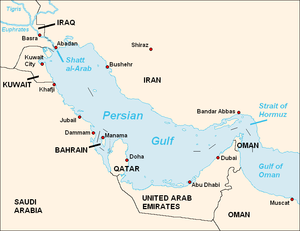
Persian Gulf
The Persian Gulf, in Southwest Asia, is an extension of the Indian Ocean located between Iran and the Arabian Peninsula.The Persian Gulf was the focus of the 1980–1988 Iran-Iraq War, in which each side attacked the other's oil tankers...
separating the Arabian Peninsula
Arabian Peninsula
The Arabian Peninsula is a land mass situated north-east of Africa. Also known as Arabia or the Arabian subcontinent, it is the world's largest peninsula and covers 3,237,500 km2...
from the Iranian plateau
Iranian plateau
The Iranian plateau, or Iranic plateau, is a geological formation in Southwest Asia. It is the part of the Eurasian Plate wedged between the Arabian and Indian plates, situated between the Zagros mountains to the west, the Caspian Sea and the Kopet Dag to the north, the Hormuz Strait and Persian...
, historically and internationally known as the Persian Gulf
Persian Gulf
The Persian Gulf, in Southwest Asia, is an extension of the Indian Ocean located between Iran and the Arabian Peninsula.The Persian Gulf was the focus of the 1980–1988 Iran-Iraq War, in which each side attacked the other's oil tankers...
after the land of Persia (Iran
Iran
Iran , officially the Islamic Republic of Iran , is a country in Southern and Western Asia. The name "Iran" has been in use natively since the Sassanian era and came into use internationally in 1935, before which the country was known to the Western world as Persia...
), has been disputed by some Arab countries since the 1960s. Rivalry between Persians
Persian people
The Persian people are part of the Iranian peoples who speak the modern Persian language and closely akin Iranian dialects and languages. The origin of the ethnic Iranian/Persian peoples are traced to the Ancient Iranian peoples, who were part of the ancient Indo-Iranians and themselves part of...
and Arab
Arab
Arab people, also known as Arabs , are a panethnicity primarily living in the Arab world, which is located in Western Asia and North Africa. They are identified as such on one or more of genealogical, linguistic, or cultural grounds, with tribal affiliations, and intra-tribal relationships playing...
s, however, along with the emergence of pan-Arabism
Pan-Arabism
Pan-Arabism is an ideology espousing the unification--or, sometimes, close cooperation and solidarity against perceived enemies of the Arabs--of the countries of the Arab world, from the Atlantic Ocean to the Arabian Sea. It is closely connected to Arab nationalism, which asserts that the Arabs...
and Arab nationalism
Arab nationalism
Arab nationalism is a nationalist ideology celebrating the glories of Arab civilization, the language and literature of the Arabs, calling for rejuvenation and political union in the Arab world...
, has seen the name Arabian Gulf become predominant in most Arab countries. Names beyond these two have also been applied to or proposed for this body of water.
Overview
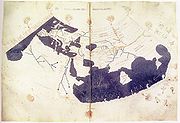
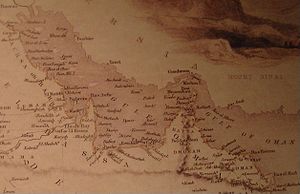
On almost all maps printed before 1960, and in most modern international treaties, documents and maps, this body of water is known by the name "Persian Gulf". This reflects traditional usage since the Greek geographers Strabo
Strabo
Strabo, also written Strabon was a Greek historian, geographer and philosopher.-Life:Strabo was born to an affluent family from Amaseia in Pontus , a city which he said was situated the approximate equivalent of 75 km from the Black Sea...
and Ptolemy
Ptolemy
Claudius Ptolemy , was a Roman citizen of Egypt who wrote in Greek. He was a mathematician, astronomer, geographer, astrologer, and poet of a single epigram in the Greek Anthology. He lived in Egypt under Roman rule, and is believed to have been born in the town of Ptolemais Hermiou in the...
, and the geopolitical realities of the time with a powerful Persian Empire (Iran
Iran
Iran , officially the Islamic Republic of Iran , is a country in Southern and Western Asia. The name "Iran" has been in use natively since the Sassanian era and came into use internationally in 1935, before which the country was known to the Western world as Persia...
) comprising the whole northern coastline and a scattering of local emirate
Emirate
An emirate is a political territory that is ruled by a dynastic Muslim monarch styled emir.-Etymology:Etymologically emirate or amirate is the quality, dignity, office or territorial competence of any emir ....
s on the Arabian coast. It was referred to as the Persian gulf in the Arabic Christian writer Agapius
Agapius the historian
Agapius son of Constantine was a 10th century Arabic Christian writer, best known for his lengthy Kitab al-'Unwan . He was the Melkite bishop of Manbij .He was contemporary with the annalist Eutychius , also a Melchite...
, writing in the 10th century.
Arab countries also used the term "Persian Gulf" until the 1960s, but with the rise of Arab nationalism
Arab nationalism
Arab nationalism is a nationalist ideology celebrating the glories of Arab civilization, the language and literature of the Arabs, calling for rejuvenation and political union in the Arab world...
during that decade, some Arab countries, including the ones bordering the Persian Gulf, adopted widespread use of the term "الخليج العربي" (al-Ḫalīj al-ʻArabiyy; Arab Gulf or Arabian Gulf) to refer to this waterway. This coupled with the decreasing influence of Iran on the political and economic priorities of the English-speaking Western World led to increasing acceptance, in regional politics and the mostly petroleum
Petroleum
Petroleum or crude oil is a naturally occurring, flammable liquid consisting of a complex mixture of hydrocarbons of various molecular weights and other liquid organic compounds, that are found in geologic formations beneath the Earth's surface. Petroleum is recovered mostly through oil drilling...
-related business, of the new alternative naming convention "Arabian Gulf" in Arab countries.
The term "Arabian Gulf" (Sinus Arabicus) was formerly used to refer to what is now known as the Red Sea
Red Sea
The Red Sea is a seawater inlet of the Indian Ocean, lying between Africa and Asia. The connection to the ocean is in the south through the Bab el Mandeb strait and the Gulf of Aden. In the north, there is the Sinai Peninsula, the Gulf of Aqaba, and the Gulf of Suez...
(as illustrated in the map examples with this article). This usage was adopted into European maps from, among others, Strabo and Ptolemy, who called the Red Sea Sinus Arabicus (Arabian Gulf). Both of these ancient geographers also used the name Sinus Persicus to refer to the body of water between the Arabian Peninsula and Iran. In the early Islamic era, Muslim geographers did the same, calling the body بحر فارس (Baḥr Fāris; Persian Sea) or "خليج فارس" (Ḫalīǧ Fāris; Persian Gulf). Later, most European maps from the early Modern Times onwards used similar terms (Sinus Persicus, Persischer Golf, Golfo di Persia and the like, in different languages) when referring to the Persian Gulf, possibly taking the name from the Islamic sources.
The capture of Baghdad
Baghdad
Baghdad is the capital of Iraq, as well as the coterminous Baghdad Governorate. The population of Baghdad in 2011 is approximately 7,216,040...
by the Ottoman Empire
Ottoman Empire
The Ottoman EmpireIt was usually referred to as the "Ottoman Empire", the "Turkish Empire", the "Ottoman Caliphate" or more commonly "Turkey" by its contemporaries...
in 1534 gave Turkey
Turkey
Turkey , known officially as the Republic of Turkey , is a Eurasian country located in Western Asia and in East Thrace in Southeastern Europe...
access to the Indian Ocean
Indian Ocean
The Indian Ocean is the third largest of the world's oceanic divisions, covering approximately 20% of the water on the Earth's surface. It is bounded on the north by the Indian Subcontinent and Arabian Peninsula ; on the west by eastern Africa; on the east by Indochina, the Sunda Islands, and...
via the port of Basra
Basra
Basra is the capital of Basra Governorate, in southern Iraq near Kuwait and Iran. It had an estimated population of two million as of 2009...
at the head of the gulf. This coincided with the early mapmaking efforts of Gerard Mercator, whose 1541 terrestrial globe attempts to give the most up-to-date information, naming the gulf Sinus Persicus, nunc Mare de Balsera ("Persian Gulf, now Sea of Basra"). However, on his world map of 1569, the name is changed to Mare di Mesendin (after the peninsula Ra's Musandam
Musandam
Musandam Governorate is a governorate of Oman.Geographically, the Musandam peninsula juts into the Strait of Hormuz, the narrow entry into the Persian Gulf, from the Arabian Peninsula. The Musandam peninsula is an exclave of Oman, separated from the rest of the country by the United Arab Emirates...
, in modern-day Oman
Oman
Oman , officially called the Sultanate of Oman , is an Arab state in southwest Asia on the southeast coast of the Arabian Peninsula. It is bordered by the United Arab Emirates to the northwest, Saudi Arabia to the west, and Yemen to the southwest. The coast is formed by the Arabian Sea on the...
), while his rival Abraham Ortelius
Abraham Ortelius
thumb|250px|Abraham Ortelius by [[Peter Paul Rubens]]Abraham Ortelius thumb|250px|Abraham Ortelius by [[Peter Paul Rubens]]Abraham Ortelius (Abraham Ortels) thumb|250px|Abraham Ortelius by [[Peter Paul Rubens]]Abraham Ortelius (Abraham Ortels) (April 14, 1527 – June 28,exile in England to take...
, for the world atlas of 1570, opted for Mare El Catif, olim Sinus Persicus (after the Arabian port of Al Qatif
Qatif
Qatif or Al-Qatif is a governorate and urban area located in Eastern Province, Saudi Arabia. It extends from Ras Tanura and Jubail in the north to Dammam in the south, and from the Persian Gulf in the east to King Fahd International Airport in the west...
), but labelled the entrance to the gulf- the present Strait of Hormuz
Strait of Hormuz
The Strait of Hormuz is a narrow, strategically important waterway between the Gulf of Oman in the southeast and the Persian Gulf. On the north coast is Iran and on the south coast is the United Arab Emirates and Musandam, an exclave of Oman....
- as Basora Fretum (Strait of Basra). Among all this confusion, the old name gradually reasserted itself in the 17th century, but Turkey still uses the name "Gulf of Basra" in Turkish today.
Following British attempts to control the seaway in the late 1830s, the Times Journal, published in London in 1840, referred to the Persian Gulf as the "Britain Sea," but this name was never used in any other context.
Proposed alternative names
The matter remains very contentious as the competing naming conventions are supported by certain governments in internal literature, but also in dealings with other states and international organizations. Some parties use terms like "The Gulf" or the "Arabo-Persian Gulf". After the Iranian RevolutionIranian Revolution
The Iranian Revolution refers to events involving the overthrow of Iran's monarchy under Shah Mohammad Reza Pahlavi and its replacement with an Islamic republic under Ayatollah Ruhollah Khomeini, the leader of the...
of 1979 some people in Islamic groups suggested the use of "Islamic Gulf." The originator of the term Islamic Gulf is not known, while some people suggest that prominent figures of the early years of the Islamic republic
Islamic republic
Islamic republic is the name given to several states in the Muslim world including the Islamic Republics of Pakistan, Iran, Afghanistan, and Mauritania. Pakistan adopted the title under the constitution of 1956. Mauritania adopted it on 28 November 1958. Iran adopted it after the 1979 Iranian...
including Ruhollah Khomeini
Ruhollah Khomeini
Grand Ayatollah Sayyed Ruhollah Musavi Khomeini was an Iranian religious leader and politician, and leader of the 1979 Iranian Revolution which saw the overthrow of Mohammad Reza Pahlavi, the Shah of Iran...
, Mehdi Bazargan
Mehdi Bazargan
Mehdi Bazargan was a prominent Iranian scholar, academic, long-time pro-democracy activist and head of Iran's interim government, making him Iran's first prime minister after the Iranian Revolution of 1979. He was the head of the first engineering department of Tehran University...
, and Sadegh Khalkhali may have supported the idea. The idea was quickly abandoned after Iran was invaded by its predominantly Arab and Muslim neighbor, Iraq
Iraq
Iraq ; officially the Republic of Iraq is a country in Western Asia spanning most of the northwestern end of the Zagros mountain range, the eastern part of the Syrian Desert and the northern part of the Arabian Desert....
.
Viewpoint of Iran
Iran only uses the term "Persian Gulf" and does not recognize the naming when it is referred to as "Arabian Gulf" or just the "Gulf". Iran does not consider the latter an impartial usage, and views it as an active contribution to abandonment of the historical name. Foreign airlines which do not use the term "Persian Gulf" are banned from Iran's airspace.National Persian Gulf Day
The National Persian Gulf Day is celebrated on April 30 in 2010, and is marked with various ceremonies all over IranIran
Iran , officially the Islamic Republic of Iran , is a country in Southern and Western Asia. The name "Iran" has been in use natively since the Sassanian era and came into use internationally in 1935, before which the country was known to the Western world as Persia...
, especially in the Persian Gulf
Persian Gulf
The Persian Gulf, in Southwest Asia, is an extension of the Indian Ocean located between Iran and the Arabian Peninsula.The Persian Gulf was the focus of the 1980–1988 Iran-Iraq War, in which each side attacked the other's oil tankers...
coastal cities.
The Islamic Republic of Iran designated April 30 as the "national day of Persian Gulf", since the date coincides with the anniversary of Shah Abbas
Abbas I of Persia
Shāh ‘Abbās the Great was Shah of Iran, and generally considered the greatest ruler of the Safavid dynasty. He was the third son of Shah Mohammad....
' successful military campaign against the Portuguese navy
Portuguese Navy
The Portuguese Navy is the naval branch of the Portuguese Armed Forces which, in cooperation and integrated with the other branches of the Portuguese military, is charged with the military defence of Portugal....
in the Persian Gulf, driving the Portuguese
Portugal
Portugal , officially the Portuguese Republic is a country situated in southwestern Europe on the Iberian Peninsula. Portugal is the westernmost country of Europe, and is bordered by the Atlantic Ocean to the West and South and by Spain to the North and East. The Atlantic archipelagos of the...
colonial forces out of the Strait of Hormuz
Strait of Hormuz
The Strait of Hormuz is a narrow, strategically important waterway between the Gulf of Oman in the southeast and the Persian Gulf. On the north coast is Iran and on the south coast is the United Arab Emirates and Musandam, an exclave of Oman....
in the Capture of Ormuz (1622)
Capture of Ormuz (1622)
In the 1622 Capture of Ormuz, a Anglo-Persian force combined to take over the Portuguese garrison at Hormuz Island, thus opening up Persian trade with England...
. The decision was taken by the High Council of Cultural Revolution, presided over by the former President Seyed Mohammad Khatami, the council mentioned the campaign launched recently by certain Arab states to re-name Persian Gulf as the drive behind the decision.
Post Company of the Islamic Republic of Iran, has issued a series of stamps commemorating the “the national day of Persian Gulf”.
The Secretariat
The United NationsUnited Nations
The United Nations is an international organization whose stated aims are facilitating cooperation in international law, international security, economic development, social progress, human rights, and achievement of world peace...
Secretariat
United Nations Secretariat
The United Nations Secretariat is one of the five principal organs of the United Nations and it is headed by the United Nations Secretary-General, assisted by a staff of international civil servants worldwide. It provides studies, information, and facilities needed by United Nations bodies for...
on many occasions has requested its staff to use only "Persian Gulf" as the standard geographical designation for that body of water. Most recently, the UN Secretariat has issued two editorial directives in 1994 and 1999 mentioning that only the term "Persian Gulf" should be used in UN documents.
Group of Experts on Geographical Names
The group of experts on Geographical Names was set up by the secretary-general of the United Nations in pursuance of economic and Social council resolution 715A(XXVII) on April 23, 1959 and has endorsed 'Persian Gulf' as the official name for this body of water.The group discussed the naming issue during its 23rd session, held in Vienna from March 28 to April 4, 2006. According to the report of the meeting, the Convenor "noted that countries could not be prohibited from using or creating exonyms."
The use of the name 'Arabian Gulf' was described to be 'faulty' by the Eighth United Nations Conference on the Standardization of Geographical Names, Berlin, 27 August September 2002.
International Hydrographic Organization
The International Hydrographic OrganizationInternational Hydrographic Organization
The International Hydrographic Organization is the inter-governmental organisation representing the hydrographic community. It enjoys observer status at the UN and is the recognised competent authority on hydrographic surveying and nautical charting...
, an international body for provision of hydrographic information for world-wide marine navigation and other purposes, uses the name "Gulf of Iran (Persian Gulf)" for this body of water. This is outlined in reference S-23 (Limits of Oceans and Seas), section 41.
United Kingdom
The United Kingdom government's Permanent Committee on Geographical Names for British Official UsePermanent Committee on Geographical Names for British Official Use
The Permanent Committee on Geographical Names is an independent inter-departmental body established in 1919. Its function is to establish standard names for places outside the UK, for the use of the British government....
(PCGN) has endorsed the term 'The Persian Gulf' as the correct term for the body of water.
United States
In the United StatesUnited States
The United States of America is a federal constitutional republic comprising fifty states and a federal district...
, Persian Gulf has been the label sanctioned for U.S. Government use since a decision by the State Department
United States Department of State
The United States Department of State , is the United States federal executive department responsible for international relations of the United States, equivalent to the foreign ministries of other countries...
's Board of Geographical Names
United States Board on Geographic Names
The United States Board on Geographic Names is a United States federal body whose purpose is to establish and maintain uniform usage of geographic names throughout the U.S. government.-Overview:...
in 1917: As recognized by the United States Board on Geographic names, the name of the body of water that lies between Iran and the Arab states of the Gulf Cooperation Council is the Persian Gulf. For political reasons, Arabs often refer to it as the Arab or Arabian Gulf. The NGA GEOnet Names Server (GNS), maintained by the National Geospatial-Intelligence Agency
National Geospatial-Intelligence Agency
The National Geospatial-Intelligence Agency is an agency of the federal government of the United States with the primary mission of collecting, analyzing and distributing geospatial intelligence in support of national security. NGA was formerly known as the National Imagery and Mapping Agency ...
, is the "official repository of standard spellings of all foreign place names" sanctioned by the Board of Geographical Names. The GNS lists "Persian Gulf" as the only "conventional" name, along with fourteen unofficial "variants" in different languages, such as "Gulf of Iran", "Gulf of Ajam", "Gulf of Basra", "Arabian Gulf", "Persian-Arabian Gulf", "Gulf of Fars", and "Farsi Gulf".
In recent years, due to increased cooperation with Arab states of the Persian Gulf
Persian Gulf States
Persian Gulf States can refer to:* Countries in the Middle East bordering the Persian Gulf and sometimes known as the Gulf States: Bahrain, Iran, Iraq, Kuwait, Oman, Qatar, Saudi Arabia, and the United Arab Emirates....
, various branches of the U.S. armed forces
United States armed forces
The United States Armed Forces are the military forces of the United States. They consist of the Army, Navy, Marine Corps, Air Force, and Coast Guard.The United States has a strong tradition of civilian control of the military...
have issued directives to their members to use the "Arabian Gulf" when operating in the area ("Persian Gulf" is still used in official publications and websites), partially to follow local conventions, or simply to follow local laws that ban the use of "Persian Gulf", e.g. in the United Arab Emirates
United Arab Emirates
The United Arab Emirates, abbreviated as the UAE, or shortened to "the Emirates", is a state situated in the southeast of the Arabian Peninsula in Western Asia on the Persian Gulf, bordering Oman, and Saudi Arabia, and sharing sea borders with Iraq, Kuwait, Bahrain, Qatar, and Iran.The UAE is a...
. Also for similar reasons, branches of American universities in the region have also dropped references to "Persian Gulf" in their teaching materials.
Australia
The Australian militaryAustralian Defence Force
The Australian Defence Force is the military organisation responsible for the defence of Australia. It consists of the Royal Australian Navy , Australian Army, Royal Australian Air Force and a number of 'tri-service' units...
refer to the area as 'The Gulf' (though to Australians in general, this name more commonly indicates the vicinity of the Gulf of Carpentaria
Gulf of Carpentaria
The Gulf of Carpentaria is a large, shallow sea enclosed on three sides by northern Australia and bounded on the north by the Arafura Sea...
). They refer to the northern part of this gulf as Northern Arabian Gulf (NAG) during operations.
Atlas and other media
National Geographic SocietyNational Geographic Society
The National Geographic Society , headquartered in Washington, D.C. in the United States, is one of the largest non-profit scientific and educational institutions in the world. Its interests include geography, archaeology and natural science, the promotion of environmental and historical...
uses the name Persian Gulf to refer to this body of water. In 2004, the society published a new edition of its National Geographic Atlas of the World using the term "Arabian Gulf" as an alternative name (in smaller type and in parentheses) for "Persian Gulf". This resulted in heavy protests by many Iran
Iran
Iran , officially the Islamic Republic of Iran , is a country in Southern and Western Asia. The name "Iran" has been in use natively since the Sassanian era and came into use internationally in 1935, before which the country was known to the Western world as Persia...
ians, especially the Internet user community, which led to the Iranian government acting on the issue and banning the distribution of the society's publications in Iran. On December 30, 2004, the society reversed its decision and published an Atlas Update, removing the parenthetical reference and adding a note: "Historically and most commonly known as the Persian Gulf, this body of water is referred to by some as the Arabian Gulf."
The 2000 Associated Press
Associated Press
The Associated Press is an American news agency. The AP is a cooperative owned by its contributing newspapers, radio and television stations in the United States, which both contribute stories to the AP and use material written by its staff journalists...
manual on usage elaborates: Persian Gulf is the “long-established name” and the best choice. “Some Arab nations call it the Arabian Gulf. Use Arabian Gulf only in direct quotations and explain in the text that the body of water is more commonly known as the Persian Gulf.”
In the year 2004, the Persian Gulf
Persian Gulf
The Persian Gulf, in Southwest Asia, is an extension of the Indian Ocean located between Iran and the Arabian Peninsula.The Persian Gulf was the focus of the 1980–1988 Iran-Iraq War, in which each side attacked the other's oil tankers...
naming dispute was the subject of a Google bomb
Google bomb
The terms Google bomb and Googlewashing refer to practices, such as creating large numbers of links, that cause a web page to have a high ranking for searches on unrelated or off topic keyword phrases, often for comical or satirical purposes...
by an Iran
Iran
Iran , officially the Islamic Republic of Iran , is a country in Southern and Western Asia. The name "Iran" has been in use natively since the Sassanian era and came into use internationally in 1935, before which the country was known to the Western world as Persia...
ian blog
Blog
A blog is a type of website or part of a website supposed to be updated with new content from time to time. Blogs are usually maintained by an individual with regular entries of commentary, descriptions of events, or other material such as graphics or video. Entries are commonly displayed in...
ger named Pendar Yousefi. This was the combined efforts of hundreds of bloggers, webmasters and Persian forums who pointed links with the word Arabian Gulf to a spoof error page found at this link.
Some atlases and media outlets have taken to referring to "The Gulf" without any adjectival qualification. This usage is followed by the BBC
BBC
The British Broadcasting Corporation is a British public service broadcaster. Its headquarters is at Broadcasting House in the City of Westminster, London. It is the largest broadcaster in the world, with about 23,000 staff...
and The Times Atlas of the World
Times Atlas of the World
The Times Atlas of the World, rebranded The Times Atlas of the World: Comprehensive Edition in its 11th edition and The Times Comprehensive Atlas of the World from its 12th edition, is a world atlas currently published by HarperCollins...
. Iran does not consider this an impartial usage and views it as an active contribution to abandonment of the historical name. In June 2006 Iran
Iran
Iran , officially the Islamic Republic of Iran , is a country in Southern and Western Asia. The name "Iran" has been in use natively since the Sassanian era and came into use internationally in 1935, before which the country was known to the Western world as Persia...
banned the sale of The Economist
The Economist
The Economist is an English-language weekly news and international affairs publication owned by The Economist Newspaper Ltd. and edited in offices in the City of Westminster, London, England. Continuous publication began under founder James Wilson in September 1843...
for the above reason, after a map in the magazine labeled the Persian Gulf
Persian Gulf
The Persian Gulf, in Southwest Asia, is an extension of the Indian Ocean located between Iran and the Arabian Peninsula.The Persian Gulf was the focus of the 1980–1988 Iran-Iraq War, in which each side attacked the other's oil tankers...
as 'The Gulf'. The Economist repeated this act in its February 18, 2010 article titled "Iraq, Iran and the politics of oil: Crude diplomacy". The Economist also used the name "Arabian Gulf" in the same article.
Islamic Solidarity Games
- A planned second Islamic Solidarity GamesIslamic Solidarity GamesThe Islamic Solidarity Games is a multinational, multi-sport event. The Games involve the elite athletes of the Organisation of the Islamic Conference...
in Iran, originally scheduled to take place in October 2009, and later re-scheduled for April 2010, was canceled when the Arab WorldArab worldThe Arab world refers to Arabic-speaking states, territories and populations in North Africa, Western Asia and elsewhere.The standard definition of the Arab world comprises the 22 states and territories of the Arab League stretching from the Atlantic Ocean in the west to the Arabian Sea in the...
and Iran could not agree over the use of the term 'Persian Gulf' in logos and medals for the Games.
Football
In football, the top tier of the Iranian football league systemIranian football league system
The Iranian football league system is a series of interconnected leagues for football clubs in Iran.-Structure:The current structure has been in place since 2001. The Iran Premier League is the highest level of club football in Iran. It is also called the Persian Gulf Cup. Below it is the Azadegan...
is named the Persian Gulf Cup to promote the Persian naming. The Iranian team
Iran national football team
The national football team of Iran represents Iran in international football competitions and is controlled by the Football Federation Islamic Republic of Iran...
does not take part in the Gulf Cup of Nations
Gulf Cup of Nations
The Gulf Cup of Nations , also known as Khaleeji followed by the edition of the games , is a football tournament currently held every two years rotating the host city every edition...
for national teams surrounding the waters due to its name.
See also
- Territorial disputes in the Persian GulfTerritorial disputes in the Persian GulfThis article deals with territorial disputes between states of in and around the Persian Gulf in Southwestern Asia. These states include Iran, Iraq, Kuwait, Saudi Arabia, Bahrain, Qatar, the United Arab Emirates , and Oman.-Background:...
- Sea of Japan naming disputeSea of Japan naming disputeThe international name for the body of water which is bordered by Japan, North Korea, Russia, and South Korea is disputed. The Japanese government supports the use of the name "Sea of Japan", while South Korea supports the name "East Sea", and North Korea supports the name "East Sea of Korea"...
- Macedonia naming disputeMacedonia naming disputeA diplomatic dispute over the use of the name Macedonia has been an ongoing issue in the bilateral relations between Greece and the Republic of Macedonia since the latter became independent from former Yugoslavia in 1991...
External links
- Historical, Geographical and Legal Validity of the name: PERSIAN GULF, Iranian delegation working paper for the 23rd Session of the United Nations Group of Experts on Geographical Names, April 2006
- Encyclopedia Iranica on the History of the Persian Gulf
- Factsheet on the Legal and Historical Usage of the "Persian Gulf" - ISG MIT
- A repository of Historical maps
- http://www.chnpress.com/article/?id=90§ion=2 cultural heritage
- Iran bans The Economist over map
- ISNA: "Goods labelled with "Arabian Gulf" banned in Iran."