


Territorial disputes in the Persian Gulf

Encyclopedia
Territorial dispute
A territorial dispute is a disagreement over the possession/control of land between two or more states or over the possession or control of land by a new state and occupying power after it has conquered the land from a former state no longer currently recognized by the new state.-Context and...
s between states
Sovereign state
A sovereign state, or simply, state, is a state with a defined territory on which it exercises internal and external sovereignty, a permanent population, a government, and the capacity to enter into relations with other sovereign states. It is also normally understood to be a state which is neither...
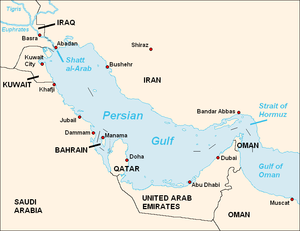
of in and around the Persian Gulf
Persian Gulf
The Persian Gulf, in Southwest Asia, is an extension of the Indian Ocean located between Iran and the Arabian Peninsula.The Persian Gulf was the focus of the 1980–1988 Iran-Iraq War, in which each side attacked the other's oil tankers...
in Southwestern Asia. These states include Iran
Iran
Iran , officially the Islamic Republic of Iran , is a country in Southern and Western Asia. The name "Iran" has been in use natively since the Sassanian era and came into use internationally in 1935, before which the country was known to the Western world as Persia...
, Iraq
Iraq
Iraq ; officially the Republic of Iraq is a country in Western Asia spanning most of the northwestern end of the Zagros mountain range, the eastern part of the Syrian Desert and the northern part of the Arabian Desert....
, Kuwait
Kuwait
The State of Kuwait is a sovereign Arab state situated in the north-east of the Arabian Peninsula in Western Asia. It is bordered by Saudi Arabia to the south at Khafji, and Iraq to the north at Basra. It lies on the north-western shore of the Persian Gulf. The name Kuwait is derived from the...
, Saudi Arabia
Saudi Arabia
The Kingdom of Saudi Arabia , commonly known in British English as Saudi Arabia and in Arabic as as-Sa‘ūdiyyah , is the largest state in Western Asia by land area, constituting the bulk of the Arabian Peninsula, and the second-largest in the Arab World...
, Bahrain
Bahrain
' , officially the Kingdom of Bahrain , is a small island state near the western shores of the Persian Gulf. It is ruled by the Al Khalifa royal family. The population in 2010 stood at 1,214,705, including 235,108 non-nationals. Formerly an emirate, Bahrain was declared a kingdom in 2002.Bahrain is...
, Qatar
Qatar
Qatar , also known as the State of Qatar or locally Dawlat Qaṭar, is a sovereign Arab state, located in the Middle East, occupying the small Qatar Peninsula on the northeasterly coast of the much larger Arabian Peninsula. Its sole land border is with Saudi Arabia to the south, with the rest of its...
, the United Arab Emirates
United Arab Emirates
The United Arab Emirates, abbreviated as the UAE, or shortened to "the Emirates", is a state situated in the southeast of the Arabian Peninsula in Western Asia on the Persian Gulf, bordering Oman, and Saudi Arabia, and sharing sea borders with Iraq, Kuwait, Bahrain, Qatar, and Iran.The UAE is a...
(UAE), and Oman
Oman
Oman , officially called the Sultanate of Oman , is an Arab state in southwest Asia on the southeast coast of the Arabian Peninsula. It is bordered by the United Arab Emirates to the northwest, Saudi Arabia to the west, and Yemen to the southwest. The coast is formed by the Arabian Sea on the...
.
Background
Tribes of Arabia
Tribes of Arabia refers to Arab clans hailing from the Arabian Peninsula.Much of the lineage provided before Ma'ad relies on biblical genealogy and therefore questions persist concerning the accuracy of this segment of Arab genealogy...
s felt loyalty to their tribe or shaykh and tended to roam across the Arabian desert according to the needs of their flocks. Official boundaries meant little, and the concept of allegiance to a distinct political unit was absent. Organized authority was confined to ports and oases
Oasis
In geography, an oasis or cienega is an isolated area of vegetation in a desert, typically surrounding a spring or similar water source...
. The delineation of borders began with the gradual encrochment of the Ottoman Empire on British interests in the Persian Gulf, leading to the Anglo-Turkish Conventions of 1913 and 1914. At the instigation of the British
British Empire
The British Empire comprised the dominions, colonies, protectorates, mandates and other territories ruled or administered by the United Kingdom. It originated with the overseas colonies and trading posts established by England in the late 16th and early 17th centuries. At its height, it was the...
, the boundaries of Kuwait, Iraq and the province of Al-Hasa were delineated at Uqair in 1922. The signing of the first oil
Petroleum
Petroleum or crude oil is a naturally occurring, flammable liquid consisting of a complex mixture of hydrocarbons of various molecular weights and other liquid organic compounds, that are found in geologic formations beneath the Earth's surface. Petroleum is recovered mostly through oil drilling...
concessions in the 1930s brought a fresh impetus to the process. Inland boundaries had never properly demarcated, leaving opportunities for contention, especially in areas of the most valuable oil deposits. Until 1971, British-led forces maintained peace and order in the Gulf, and British officials arbitrated local quarrels. After the withdrawal of these forces and officials, old territorial claims and suppressed tribal animosities rose to the surface. The concept of the modern state—introduced into the Persian Gulf region by the European powers—and the sudden importance of boundaries to define ownership of oil deposits kindled acute territorial disputes.
Iranian claims on Bahrain
Portuguese Empire
The Portuguese Empire , also known as the Portuguese Overseas Empire or the Portuguese Colonial Empire , was the first global empire in history...
and its subsequent occupation of the Bahrain archipelago. The Arab clan of the Al Khalifa, which has been the ruling family of Bahrain since the eighteenth century, has many times shown loyalty to Iran when disputes with British colonizers were brought up by raising the Iranian flag on official buildings during the last years of the 19th century. Iran in return reserved a seat in the Iranian parliament in early 1900s for its 14 province which was Bahrain. The last shah
Shah
Shāh is the title of the ruler of certain Southwest Asian and Central Asian countries, especially Persia , and derives from the Persian word shah, meaning "king".-History:...
of Iran, Mohammad Reza Pahlavi
Mohammad Reza Pahlavi
Mohammad Rezā Shāh Pahlavi, Shah of Iran, Shah of Persia , ruled Iran from 16 September 1941 until his overthrow by the Iranian Revolution on 11 February 1979...
, raised the Bahrain issue with the British when they withdrew from areas east of the Suez Canal
Suez Canal
The Suez Canal , also known by the nickname "The Highway to India", is an artificial sea-level waterway in Egypt, connecting the Mediterranean Sea and the Red Sea. Opened in November 1869 after 10 years of construction work, it allows water transportation between Europe and Asia without navigation...
, but he dropped his demand after a 1970 United Nations
United Nations
The United Nations is an international organization whose stated aims are facilitating cooperation in international law, international security, economic development, social progress, human rights, and achievement of world peace...
-backed and British executed questionnaire showed that Bahrainis overwhelmingly preferred independence to Iranian hegemony. However, it is important to note that Iran wanted a referendum sponsored by the UN in Bahrain so that the whole population would be able to vote on the future of the tiny Persian Gulf state, but the British refused and in turn suggested a method by which a British officer would give his report on the general inclinations of Bahrain's population after a general review. Since the majority of Bahrainis are Shiite, the British were not willing to put the future of Bahrain which is strategically important in the hands of the whole population. Due to this fact, the Bahrain issue was never really settled as some argue the UN sponsored report which was prepared by a British officer did not illustrate the true aspirations of the Bahrainis at the time and the role Britain played in this scenario had a major effect on the independence of the Persian Gulf state. In return for the withdrawal of its claim on Bahrain, the British agreed to fully leave the Greater and Lesser Tonbs to the Iranians, and have Abu Musa be administrated by Iran and U.A.E. mutually. The religious leaders of the Iranian Revolution
Iranian Revolution
The Iranian Revolution refers to events involving the overthrow of Iran's monarchy under Shah Mohammad Reza Pahlavi and its replacement with an Islamic republic under Ayatollah Ruhollah Khomeini, the leader of the...
revived the claim to Bahrain primarily on the grounds that the majority of Bahrainis were Shia Muslim
Muslim
A Muslim, also spelled Moslem, is an adherent of Islam, a monotheistic, Abrahamic religion based on the Quran, which Muslims consider the verbatim word of God as revealed to prophet Muhammad. "Muslim" is the Arabic term for "submitter" .Muslims believe that God is one and incomparable...
s. Iranian secular leaders subsequently renounced the claim in an attempt to establish better relations with Bahrain.
Iran and the United Arab Emirates
Abu Musa
Abu Musa is a 12-km² island in the eastern Persian Gulf, part of a six-island archipelago near the entrance to the Strait of Hormuz. The island is administered by Iran as part of the Iranian province of Hormozgan, but is also claimed by the United Arab Emirates .Abu Musa's inhabitants call it...
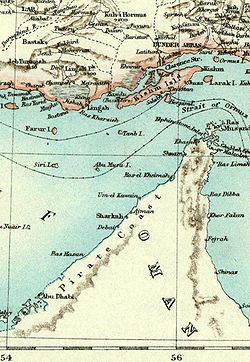
, Greater Tunb, and Lesser Tunb, located at the mouth of the Persian Gulf
Persian Gulf
The Persian Gulf, in Southwest Asia, is an extension of the Indian Ocean located between Iran and the Arabian Peninsula.The Persian Gulf was the focus of the 1980–1988 Iran-Iraq War, in which each side attacked the other's oil tankers...
between Iran and the UAE. The Iranians reasserted their historic claims to the islands, although the Iranians had been dislodged by the British in the late nineteenth century. Iran continued to hold the islands in 1993, and its action remained a source of contention with the UAE, which claimed authority by virtue of Britain's transfer of the islands to the emirates
Emirates of the United Arab Emirates
The United Arab Emirates is composed of 7 emirates :-References:...
of Sharjah and Ras al-Khaimah
Ras al-Khaimah
Ras al-Khaimah is one of the emirates of the United Arab Emirates , in the east of the Persian Gulf. It is in the northern part of the UAE bordering Oman's exclave. The capital city and home of most residents is also called Ras al-Khaimah. The city has a population of 263,217 as of 2008. The city...
. However, Britain had also agreed to give full authority to the Iranians in return for Iran's withdrawal of its claim on Bahrain. By late 1992, Sharjah and Iran had reached agreement with regard to Abu Musa, but Ras al-Khaimah had not reached a settlement with Iran concerning Greater Tunb and Lesser Tunb. The claim by U.A.E however is not recognized internationally as at the time Iran and Britain agreed on the fate of the three Islands, the U.A.E was just in the midst of being formed as a result of British withdrawal from the area and therefore could not lay claim on any territory as it was not yet an official state.
Bahrain and Qatar
Zubarah
Zubarah is a ruined and deserted town located in the northwestern coast of the Qatar peninsula about 105 km from the Qatari capital of Doha, part of Madinat ash Shamal municipality...
on the northwest coast of Qatar and to Hawar
Hawar
Hawar is the largest of the Hawar Islands of Bahrain. Its area of 40 square kilometres is nearly 80% of that of the Hawar Island group.In 2002, Bahrain applied to have the Hawar islands recognised as a World Heritage Site, due to their unique environment and habitat for endangered species...
and the adjacent islands
Hawar Islands
The Hawar Islands are a group of islands situated off the west coast of Qatar in the Gulf of Bahrain of the Persian Gulf.Despite their proximity to Qatar , the islands...
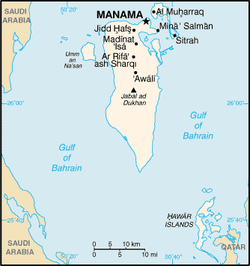
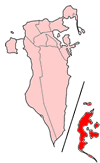
forty kilometers south of Zubarah, claims that stem from former tribal areas and dynastic struggles. The Al Khalifa had settled at Zubarah before driving the Iranians out of Bahrain in the eighteenth century. The Al Thani ruling family of Qatar vigorously dispute the Al Khalifa claim to the old settlement area now in Qatari hands as well as laying claim to the Bahraini-occupied Hawar and adjacent islands, a stone's throw from the mainland of Qatar but more than twenty kilometers from Bahrain. The simmering quarrel reignited in the spring of 1986 when Qatari helicopters removed and "kidnapped" workmen constructing a Bahraini coast guard station on Dibal Banks (Fasht ad Dibal), a reef
Reef
In nautical terminology, a reef is a rock, sandbar, or other feature lying beneath the surface of the water ....
off the coast of Qatar. Through Saudi Arabian mediation, the parties reached a fragile truce, whereby the Bahrainis agreed to remove their installations. However, in 1991 the dispute flared up again after Qatar instituted proceedings to let the International Court of Justice
International Court of Justice
The International Court of Justice is the primary judicial organ of the United Nations. It is based in the Peace Palace in The Hague, Netherlands...
(ICJ) in The Hague
The Hague
The Hague is the capital city of the province of South Holland in the Netherlands. With a population of 500,000 inhabitants , it is the third largest city of the Netherlands, after Amsterdam and Rotterdam...
, Netherlands
Netherlands
The Netherlands is a constituent country of the Kingdom of the Netherlands, located mainly in North-West Europe and with several islands in the Caribbean. Mainland Netherlands borders the North Sea to the north and west, Belgium to the south, and Germany to the east, and shares maritime borders...
, decide whether it had jurisdiction. The two countries exchanged complaints that their respective naval vessels had harassed the other's shipping in disputed waters. The territorial dispute was solved by the ICJ in a 2001 decision. Bahrain kept the Hawar Islands and Qit'at Jaradah but dropped claims to Janan Island and Zubarah, while Qatar retained significant maritime areas and their resources. The agreement has furthered the goal of definitively establishing the border with Saudi Arabia and Saudi-led mediation efforts continue.
Iraq and Kuwait
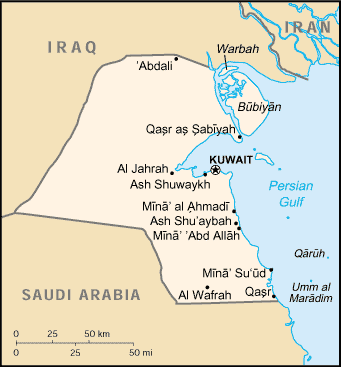
Saddam Hussein
Saddam Hussein Abd al-Majid al-Tikriti was the fifth President of Iraq, serving in this capacity from 16 July 1979 until 9 April 2003...
revived a long-standing Iraqi claim to the whole of Kuwait based on Ottoman Empire
Ottoman Empire
The Ottoman EmpireIt was usually referred to as the "Ottoman Empire", the "Turkish Empire", the "Ottoman Caliphate" or more commonly "Turkey" by its contemporaries...
boundaries. The Ottoman Empire exercised a tenuous sovereignty over Kuwait in the late nineteenth century, but the area passed under British protection in 1899. In 1932, Iraq informally confirmed its border with Kuwait, which had previously been demarcated by the British. In 1961, after Kuwait's independence and the withdrawal of British troops, Iraq reasserted its claim to the emirate based on the Ottomans' having attached it to Basra Province. British troops and aircraft were rushed back to Kuwait. A Saudi Arabian-led force of 3,000 from the League of Arab States (Arab League) that supported Kuwait against Iraqi pressure soon replaced them.
The boundary issue again arose when the Baath Party
Baath Party
The Arab Socialist Ba'ath Party was a political party mixing Arab nationalist and Arab socialist interests, opposed to Western imperialism, and calling for the renaissance or resurrection and unification of the Arab world into a single state. Ba'ath is also spelled Ba'th or Baath and means...
came to power in Iraq after a 1963 revolution. The new government officially recognized the independence of Kuwait and the boundaries Iraq had accepted in 1932. Iraq nevertheless reinstated its claims to Bubiyan
Bubiyan Island
Bubiyan Island is the largest island in the Kuwaiti coastal island chain situated in the north-western corner of the Persian Gulf, with an area of ....
and Warbah
Warbah Island
Warbah Island is an island belonging to Kuwait, located in the Persian Gulf, near the mouth of the Euphrates River. It is located roughly east of the Kuwaiti mainland, north of Bubiyan Island and south of the Iraqi mainland. It is roughly long and wide with a total area of...
islands in 1973, massing troops at the border. During the 1980-88 Iran–Iraq War, Iraq pressed for a long-term lease to the islands in order to improve its access to the gulf and its strategic position. Although Kuwait rebuffed Iraq, relations continued to be strained by boundary issues and inconclusive negotiations over the status of the islands.
In August 1991, Kuwait charged that a force of Iraqis, backed by gunboats, had attacked Bubiyan but had been repulsed and many of the invaders captured. UN investigators found that the Iraqis had come from fishing boats and had probably been scavenging for military supplies abandoned after the Persian Gulf War
Gulf War
The Persian Gulf War , commonly referred to as simply the Gulf War, was a war waged by a U.N.-authorized coalition force from 34 nations led by the United States, against Iraq in response to Iraq's invasion and annexation of Kuwait.The war is also known under other names, such as the First Gulf...
. Kuwait was suspected of having exaggerated the incident to underscore its need for international support against ongoing Iraqi hostility.
Al Buraimi
A particularly long and acrimonious disagreement involved claims over the Al Buraimi Oasis, disputed since the nineteenth century among tribes from Saudi Arabia, Abu DhabiAbu Dhabi (emirate)
Abu Dhabi, officially the Emirate of Abu Dhabi, , is one of seven emirates that constitute the United Arab Emirates . It is the capital of UAE and is the largest emirate by area , and second-largest by population , accounting for approximately 86% of the total land area of the UAE...
, and Oman. Although the tribes residing in the nine settlements of the oasis were from Oman and Abu Dhabi, followers of the Wahhabi religious movement
Wahhabism
Wahhabism is a religious movement or a branch of Islam. It was developed by an 18th century Muslim theologian from Najd, Saudi Arabia. Ibn Abdul Al-Wahhab advocated purging Islam of what he considered to be impurities and innovations...
that originated in what is now Saudi Arabia had periodically occupied and exacted tribute from the area. Oil prospecting began in the 1930s with British-backed the Iraq Petroleum Company creating subsidiary companies to explore and survey the area. In the late 1940s, Aramco survey parties began probing into Abu Dhabi territory with armed Saudi guards. Matters came to a head with a non-violent confrontation between Abu Dhabi and Saudi Arabia in 1949 known as the "Stobart incident", named after a British political officer of the time. In 1952, the Saudi Arabians sent a small constabulary force under Turki bin Abdullah Al Utayshan to occupy Hamasa, a village in the Buraimi Oasis. When arbitration efforts broke down in 1955, the British dispatched the Trucial Oman Scouts
Trucial Oman Scouts
The Trucial Oman Scouts was a paramilitary force raised by the British to serve in their Trucial States.-History:The Trucial Oman Scouts were established at Sharjah originally as the Trucial Oman Levies in 1951...
to expel the Saudi Arabian contingent. After the British withdrew from the Gulf, a settlement was reached between Zayed bin Sultan Al Nahyan of Abu Dhabi and King Faisal of Saudi Arabia. Under the Treaty of Jeddah of 1974, Saudi Arabia recognized claims of Abu Dhabi and Oman to the oasis. In return, Abu Dhabi agreed to grant Saudi Arabia a land corridor to the Gulf at Khawr al Udayd
Khawr al Udayd
Khawr al Udayd, also spelled Khor al Adaid, is an inlet of the Persian Gulf in the southeast of Qatar. It is known to local English speakers as the "Inland Sea".-External links:*...
and the oil from a disputed oil field. Some grazing and water rights remained in dispute. In March 1990 Saudi Arabia settled her borders with Oman in an agreement that also provided for shared grazing rights and use of water resources. The exact details of the boundary were not disclosed. More recently, a dispute over the Dolphin Gas Project
Dolphin Gas Project
The Dolphin Gas Project is the natural gas project of the United Arab Emirates, Qatar and Oman. It is the GCC's first cross-border refined gas transmission project and the largest energy-related venture ever undertaken in the region.-History:...
has renewed interest in the 1974 agreement.
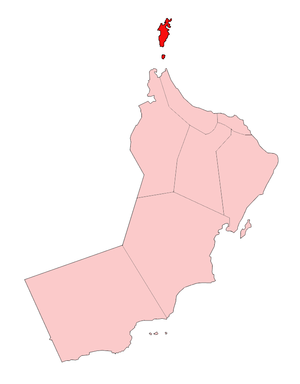
Musandam Peninsula
See also
- Iran-Arab relationsIran-Arab relationsWithin the Middle East historical conflicts have always coloured neighbouring Arab countries perceptions about Iran. At times peacefully coexisting, while at other times in bitter conflict...
- Middle EastMiddle EastThe Middle East is a region that encompasses Western Asia and Northern Africa. It is often used as a synonym for Near East, in opposition to Far East...
- Foreign relations of IranForeign relations of IranForeign relations of Iran refers to inter-governmental relationships between Iran and other countries. Following the 1979 Iranian Revolution, the newly-born Islamic Republic, under the leadership of Ayatollah Khomeini, dramatically reversed the pro-Western foreign policy of the last Shah of Iran,...
- Foreign relations of IraqForeign relations of IraqSince 1980, the foreign relations of Iraq were influenced by a number of controversial decisions by the Saddam Hussein administration. Hussein had good relations with the Soviet Union and a number of western countries such as France and Germany, who provided him with advanced weapons systems...
- Foreign relations of Saudi ArabiaForeign relations of Saudi ArabiaSaudi Arabia is a non-aligned state whose foreign policy objectives are to maintain its security and its paramount position on the Arabian Peninsula, defend general Arab and Islamic interests, promote solidarity among Islamic governments, and maintain cooperative relations with other oil-producing...
- Foreign relations of BahrainForeign relations of BahrainBahrain plays a modest, moderating role in regional politics and adheres to the views of the Arab League on Middle East peace and Palestinian rights. Since achieving independence in 1971, Bahrain has maintained friendly relations with most of its neighbours and with the world community...
- Foreign relations of QatarForeign relations of QatarQatar achieved full independence on 3 September 1971 in an atmosphere of cooperation with the United Kingdom, the United States of America and friendship with neighbouring states. Most Arab states were also among the first countries to recognise Qatar, and the state promptly gained admittance to...
- Foreign relations of the United Arab EmiratesForeign relations of the United Arab EmiratesSince the establishment of the United Arab Emirates in 2 December 1971, UAE adopted a balanced foreign policy based on adoption of dialogue, respect of international conventions, commitment to the United Nations Charter and non-interference of other country's internal affairs, and the settlement of...
- Foreign relations of OmanForeign relations of OmanWhen Sultan Qaboos bin Said Al Said assumed power in 1970, Oman had limited contacts with the outside world, including neighbouring Arab states. A special treaty relationship permitted the United Kingdom close involvement in Oman's civil and military affairs...