

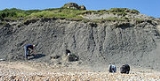
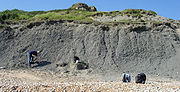
Oxford Clay

Encyclopedia
Jurassic
The Jurassic is a geologic period and system that extends from about Mya to Mya, that is, from the end of the Triassic to the beginning of the Cretaceous. The Jurassic constitutes the middle period of the Mesozoic era, also known as the age of reptiles. The start of the period is marked by...
marine sedimentary rock
Sedimentary rock
Sedimentary rock are types of rock that are formed by the deposition of material at the Earth's surface and within bodies of water. Sedimentation is the collective name for processes that cause mineral and/or organic particles to settle and accumulate or minerals to precipitate from a solution....
formation underlying much of southeast England
England
England is a country that is part of the United Kingdom. It shares land borders with Scotland to the north and Wales to the west; the Irish Sea is to the north west, the Celtic Sea to the south west, with the North Sea to the east and the English Channel to the south separating it from continental...
, from as far west as Dorset
Dorset
Dorset , is a county in South West England on the English Channel coast. The county town is Dorchester which is situated in the south. The Hampshire towns of Bournemouth and Christchurch joined the county with the reorganisation of local government in 1974...
and as far north as Yorkshire
Yorkshire
Yorkshire is a historic county of northern England and the largest in the United Kingdom. Because of its great size in comparison to other English counties, functions have been increasingly undertaken over time by its subdivisions, which have also been subject to periodic reform...
. The Oxford Clay is of middle Callovian
Callovian
In the geologic timescale, the Callovian is an age or stage in the Middle Jurassic, lasting between 164.7 ± 4.0 Ma and 161.2 ± 4.0 Ma. It is the last stage of the Middle Jurassic, following the Bathonian and preceding the Oxfordian....
to lower Oxfordian
Oxfordian stage
The Oxfordian is, in the ICS' geologic timescale, the earliest age of the Late Jurassic epoch, or the lowest stage of the Upper Jurassic series. It spans the time between 161.2 ± 4 Ma and 155.7 ± 4 Ma...
age and comprises 2 main facies. The lower facies comprises the Peterborough Member, a fossiliferous organic-rich mudstone. This facies and its rocks are commonly known as lower Oxford Clay. The upper facies comprises the middle Oxford Clay, the Stewartby Member, and the upper Oxford Clay, the Weymouth Member. The upper facies is a fossil poor assemblage of calcareous mudstone
Mudstone
Mudstone is a fine grained sedimentary rock whose original constituents were clays or muds. Grain size is up to 0.0625 mm with individual grains too small to be distinguished without a microscope. With increased pressure over time the platey clay minerals may become aligned, with the...
s.
Oxford Clay appears at the surface around Oxford
Oxford
The city of Oxford is the county town of Oxfordshire, England. The city, made prominent by its medieval university, has a population of just under 165,000, with 153,900 living within the district boundary. It lies about 50 miles north-west of London. The rivers Cherwell and Thames run through...
, Peterborough
Peterborough
Peterborough is a cathedral city and unitary authority area in the East of England, with an estimated population of in June 2007. For ceremonial purposes it is in the county of Cambridgeshire. Situated north of London, the city stands on the River Nene which flows into the North Sea...
and Weymouth and is exposed in many quarries around these areas. The top of the Lower Oxford Clay shows a lithological change, where fissile shale changes to grey mudstone. The Middle and Upper Oxford Clays differ slightly, as they are separated by an argillaceous limestone in the South Midlands.
The Callovo-Oxfordian Clay also occurs in the Paris basin
Paris Basin
Paris Basin may refer to:*As a hydrological basin, it is largely the basin of the River Seine* Paris Basin , the geological basin...
(France
France
The French Republic , The French Republic , The French Republic , (commonly known as France , is a unitary semi-presidential republic in Western Europe with several overseas territories and islands located on other continents and in the Indian, Pacific, and Atlantic oceans. Metropolitan France...
) and it is a potential host formation to dispose high-level radioactive waste in France.
Palaeontology
The Oxford Clay is well known for its rich fossilFossil
Fossils are the preserved remains or traces of animals , plants, and other organisms from the remote past...
record of fish
Fish
Fish are a paraphyletic group of organisms that consist of all gill-bearing aquatic vertebrate animals that lack limbs with digits. Included in this definition are the living hagfish, lampreys, and cartilaginous and bony fish, as well as various extinct related groups...
and invertebrates. Many of the fossils are well preserved, occasionally some are found exceptionally well preserved. Animals which lived in the Oxford Clay Sea include plesiosaurs, marine crocodiles
Metriorhynchidae
Metriorhynchidae is an extinct family of metriorhynchoid crocodyliforms from the Middle Jurassic to the Early Cretaceous period of Europe, North America and South America. Metriorhynchids are fully aquatic crocodyliforms. Their forelimbs were small and paddle-like, and unlike living crocodilians,...
, ichthyosaurs, cephalopods (such as belemnites), bivalves (such as Gryphaea
Gryphaea
Gryphaea, common name Devil's toenails, is a genus of extinct oysters, marine bivalve mollusks in the family Gryphaeidae.These fossils range from the Jurassic to the Cretaceous periods. They are particularly common in many parts of Britain....
), and a variety of gastropods. Dinosaur eggs are stratigraphically present in the Lower Oxford Clay. Geographically, they are located in Cambridgeshire, England.
Ornithischians
Indeterminate euornithopod remains stratigraphically present in the Lower Oxford Clay and geographically located in Cambridgeshire, England.| Ornithischians of the Oxford Clay | ||||||
|---|---|---|---|---|---|---|
| Genus | Species | Location | Stratigraphic position | Material | Notes | Images |
Callovosaurus Callovosaurus Callovosaurus is a genus of iguanodontian dinosaur known from most of a left thigh bone discovered in Middle Jurassic-age rocks of England. At times, it has been considered dubious or a valid genus of basal iguanodontian, perhaps a dryosaurid.-History and description:Callovosaurus is based on... |
||||||
Camptosaurus Camptosaurus Camptosaurus is a genus of plant-eating, beaked ornithischian dinosaurs of the Late Jurassic period of western North America. The name means 'flexible lizard', .... |
C. leedsi |
|
Lower |
"Femur." |
||
Lexovisaurus Lexovisaurus Lexovisaurus was one of the first dinosaurs from mid-to-Late Jurassic Europe, 164.7 mya to be discovered. It was a stegosaur. Its fossils have been found in France and northern England.... |
L. durobivensis |
|
Lower |
|||
Indeterminate |
|
|||||
|
Loricatosaurus Loricatosaurus Loricatosaurus is a genus of stegosaurid dinosaur from Callovian-age rocks of England and France... |
L. priscus |
|
Lower |
|||
Omosaurus |
O. leedsi |
|
Lower |
|||
Sarcolestes Sarcolestes Sarcolestes is a genus of early ankylosaurian dinosaur from Middle Jurassic England, Callovian, around 163 million years ago. The type species, Sarcolestes leedsi, was described by Richard Lydekker in 1893, but is based on very fragmentary material, holotype BMNH R2682, consisting of a single left... |
S. leedsi |
|
Lower |
"Partial mandible." |
||
Saurischians
| Saurischians of the Oxford Clay | ||||||
|---|---|---|---|---|---|---|
| Genus | Species | Location | Stratigraphic position | Material | Notes | Images |
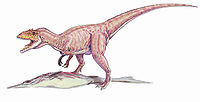
Cetiosauriscus Cetiosauriscus Cetiosauriscus is a genus of sauropod dinosaur. It was perhaps a diplodocid, a close relative of Diplodocus, and lived in the Callovian of England Cetiosauriscus (meaning "whale-lizard-like" i.e. "Cetiosaurus-like") is a genus of sauropod dinosaur. It was perhaps a diplodocid, a close relative of... |
C. stewarti |
|
Lower |
"Rear half of a skeleton." |
 |
|
Cetiosaurus Cetiosaurus Cetiosaurus meaning 'whale lizard', from the Greek cetus/κητος meaning 'sea monster' and saurus/σαυρος meaning 'lizard', was a sauropod dinosaur from the Mid to Late Jurassic Period in what are now Europe and Africa. It is estimated to have been about long and to have weighed roughly... |
Indeterminate |
|
Later found to be indeterminate sauropod remains. |
|||
Eustreptospondylus Eustreptospondylus Eustreptospondylus is a genus of megalosaurid dinosaur, from the Callovian stage of the Middle Jurassic period in southern England, at a time when Europe was a series of scattered islands Eustreptospondylus ("well-curved vertebra", in reference to the arrangement of the spine in the original... |
E. oxoniensis |
|
Middle |
Disarticulated skull and skeleton, with some referred limb elements. |
||
Megalosaurus Megalosaurus Megalosaurus is a genus of large meat-eating theropod dinosaurs of the Middle Jurassic period of Europe... |
Indeterminate |
|
Middle |
Oxford Clay remains attributed to Megalosaurus were actually indeterminate theropod remains. |
||
Ornithopsis Ornithopsis Ornithopsis was a medium-sized Early Cretaceous sauropod dinosaur, from England. It has been considered a synonym of the wastebasket taxon Pelorosaurus, but recent research suggests that this is not as clear-cut as supposed... |
O. leedsi |
|
Lower |
Later found to be indeterminate sauropod remains. |
||
Uses
Oxford Clay has a porous consistency and is soft and is often used in the making of roads. It is also the source of the Fletton stock brickFletton
Fletton is a residential area and electoral ward of the city of Peterborough, Cambridgeshire in the United Kingdom. For parliamentary purposes it falls within North West Cambridgeshire constituency...
of which much of London
London
London is the capital city of :England and the :United Kingdom, the largest metropolitan area in the United Kingdom, and the largest urban zone in the European Union by most measures. Located on the River Thames, London has been a major settlement for two millennia, its history going back to its...
is built. For brick making, the Oxford Clay has the advantage of containing carbon which provides part of the fuel required in firing it so reducing the requirement for an external fuel source.
See also
- ClayClayClay is a general term including many combinations of one or more clay minerals with traces of metal oxides and organic matter. Geologic clay deposits are mostly composed of phyllosilicate minerals containing variable amounts of water trapped in the mineral structure.- Formation :Clay minerals...
- London ClayLondon ClayThe London Clay Formation is a marine geological formation of Ypresian age which crops out in the southeast of England. The London Clay is well known for the fossils it contains. The fossils from the Lower Eocene indicate a moderately warm climate, the flora being tropical or subtropical...
- Weald ClayWeald ClayWeald Clay is a Lower Cretaceous sedimentary rock underlying areas of South East England. It is part of the Wealden Group of rocks. The clay is named after the Weald, an area of Sussex. It varies from orange and grey in colour and is used in brickmaking....
- Cheltenham Clay
- List of fossil sites (with link directory)
- List of dinosaur-bearing rock formations