


Origo Gentis Langobardorum

Encyclopedia
Founding myth
A national myth is an inspiring narrative or anecdote about a nation's past. Such myths often serve as an important national symbol and affirm a set of national values. A national myth may sometimes take the form of a national epic...
of the Lombard people
Lombards
The Lombards , also referred to as Longobards, were a Germanic tribe of Scandinavian origin, who from 568 to 774 ruled a Kingdom in Italy...
. The first part visions the origin and naming of the Lombards, and the following text more resembles a king-list, up until the rule of Perctarit
Perctarit
Perctarit was king of the Lombards from 661 to 662 the first time and later from 671 to 688. He was the son and successor of Aripert I. He shared power with his brother Godepert. He was a Catholic, Godepert an Arian. He ruled from Milan, Godepert from Pavia...
(672–688), which helps date the original writing of the text.
Manuscripts
The account has been preserved in three codices, mostly containing legalistic writings compiled in the reign of RothariRothari
Rothari , of the house of Arodus, was king of the Lombards from 636 to 652; previously he had been duke of Brescia. He succeeded Arioald, who was an Arian like himself, and was one of the most energetic of Lombard kings...
and known as Edictum Rothari
Edictum Rothari
The Edictum Rothari was the first written compilation of Lombard law, codified and promulgated 22 November 643 by King Rothari. The custom of the Lombards, according to Paul the Deacon, the Lombard historian, had been held in memory before this...
or Leges Langobardorum. As such, Origo Gentis Langobardorum is preserved in three manuscripts, Modena, Biblioteca Capitolare 0.I.2 (9th century), Cava de’ Tirreni, Archivio della Badia 4, (early 9th century) and Madrid, Biblioteca Nacional 413 (early 11th century).
Reception
Origo Gentis Langobardorum is also the textual source of the Lombard theonym godan (WōdanazWodanaz
or is the reconstructed Proto-Germanic name of a god of Germanic paganism, known as in Norse mythology, in Old English, or in Old High German and in Lombardic...
).
The Origo is summarized somewhat faithfully in the Historia Langobardorum by Paulus Diaconus. For the legend of origin Paulus Diaconus make a separate text paragraph for respectively the conflict with the Vandals and the consulting with Frea and Godan, and he precede the description of Frea and Godan with "loco antiquitas ridiculam fabulam" . Whereas the Origo is only extant in three copies, there are hundreds of medieval copies of the Historia.
Contents
Following is a free translation;Origin

Scandza
Scandza was the name given to Scandinavia by the Roman historian Jordanes in his work Getica, written while in Constantinople around AD 551. He described the area to set the stage for his treatment of the Goths' migration from southern Sweden to Gothiscandza...
, the home of the Winnili. Their ruler was a woman called Gambara, with her sons Ybor and Agio. The leaders of the Vandals
Vandals
The Vandals were an East Germanic tribe that entered the late Roman Empire during the 5th century. The Vandals under king Genseric entered Africa in 429 and by 439 established a kingdom which included the Roman Africa province, besides the islands of Sicily, Corsica, Sardinia and the Balearics....
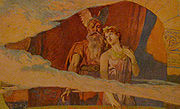
, Ambri and Assi, asked them to pay them tribute, but they refused, saying they would fight them. Ambri and Assi then went to Godan, and asked him for victory over the Winnili. Godan replied that he would give the victory to whomever he saw first at sunrise. At the same time, Gambara and her sons asked Frea
Frigg
Frigg is a major goddess in Norse paganism, a subset of Germanic paganism. She is said to be the wife of Odin, and is the "foremost among the goddesses" and the queen of Asgard. Frigg appears primarily in Norse mythological stories as a wife and a mother. She is also described as having the power...
, Godan's wife, for victory. Frea advised that the women of the Winnili should tie their hair in front of their faces like beards and join their men for battle. At sunrise, Frea turned her husband's bed so that at he was facing east, and woke him. Godan saw the women of the Winnili, their hair tied in front of their faces, and asked "who are these longbeards?", and Frea replied, since you named them, give them victory, and he did. From this day, the Winnili were called Langobardi, "longbeards".
Migration
After this, the Lombards migrated, and they came to Golaida (perhaps at the Oder
Oder
The Oder is a river in Central Europe. It rises in the Czech Republic and flows through western Poland, later forming of the border between Poland and Germany, part of the Oder-Neisse line...
), and later they ruled Aldonus and Anthaib (unclear, perhaps in Bavaria
Bavaria
Bavaria, formally the Free State of Bavaria is a state of Germany, located in the southeast of Germany. With an area of , it is the largest state by area, forming almost 20% of the total land area of Germany...
) and Bainaib (also Banthaib; perhaps in Bohemia
Bohemia
Bohemia is a historical region in central Europe, occupying the western two-thirds of the traditional Czech Lands. It is located in the contemporary Czech Republic with its capital in Prague...
) and Burgundaib (perhaps territory of the Burgundians
Burgundians
The Burgundians were an East Germanic tribe which may have emigrated from mainland Scandinavia to the island of Bornholm, whose old form in Old Norse still was Burgundarholmr , and from there to mainland Europe...
, at the Middle Rhine ), and they chose as their king Agilmund, son of Agion, from the line of Gugingus, and later they were ruled by Laiamicho of the same dynasty, and after him Lethuc, who ruled for some 40 years. He was succeeded by his son, Aldihoc, and after him, Godehoc ruled.
The Danubian lands
Audochari
Odoacer
Flavius Odoacer , also known as Flavius Odovacer, was the first King of Italy. His reign is commonly seen as marking the end of the Western Roman Empire. Though the real power in Italy was in his hands, he represented himself as the client of Julius Nepos and, after Nepos' death in 480, of the...
came from Ravenna
Ravenna
Ravenna is the capital city of the Province of Ravenna in the Emilia-Romagna region of Italy and the second largest comune in Italy by land area, although, at , it is little more than half the size of the largest comune, Rome...
with the Alans
Alans
The Alans, or the Alani, occasionally termed Alauni or Halani, were a group of Sarmatian tribes, nomadic pastoralists of the 1st millennium AD who spoke an Eastern Iranian language which derived from Scytho-Sarmatian and which in turn evolved into modern Ossetian.-Name:The various forms of Alan —...
,
487, Audochari fight the Rugi and came to Rugilanda (Lower Austria
Lower Austria
Lower Austria is the northeasternmost state of the nine states in Austria. The capital of Lower Austria since 1986 is Sankt Pölten, the most recently designated capital town in Austria. The capital of Lower Austria had formerly been Vienna, even though Vienna is not officially part of Lower Austria...
, north of the Danube
Danube
The Danube is a river in the Central Europe and the Europe's second longest river after the Volga. It is classified as an international waterway....
) to fight the Rugi, and he killed Theuvanue their king, and returned to Italy with many captives. The Lombards consequently left their land and lived in Rugilanda for some years.
Gudehoc was succeeded by his son, Claffo, and he by his son, Tato
Tato
Tato an early 6th century and was a king of the Lombards. He was the son of Claffo and a king of the Lething Dynasty.According to Procopius the Lombards were subject to the Heruli at this time and paid tribute. In 508 he fought with king Rodolph of the Heruli who was slain. It was a devastating...
. The Lombards tarried at Feld for three years, where Tato fought and killed Rodolfo, king of the Heruli
Heruli
The Heruli were an East Germanic tribe who are famous for their naval exploits. Migrating from Northern Europe to the Black Sea in the third century They were part of the...
.
Wacho
Wacho
Wacho was king of the Lombards before they entered Italy from an unknown date until his death in 539. His father was Unichis. Wacho usurped the throne by assassinating his uncle, King Tato . Tato's son Ildchis fought with him and fled to the Gepids where he died...
son of Unichus killed Tato, and Ildichus, Tato's son fought Wacho, but he had to flee to the Gepids, where he died. Wacho had three wives, the first Raicunda, daughter of Fisud, king of the Turingi
Thuringii
The Thuringii or Toringi were a Germanic tribe which appeared late during the Völkerwanderung in the Harz Mountains of central Germania around 280, in a region which still bears their name to this day — Thuringia. They evidently filled a void left when the previous inhabitants — the...
, the second Austrigusa, a daughter of the Gippidi, who had two daughters, Wisigarda, who married Theudipert, king of the Franks
Franks
The Franks were a confederation of Germanic tribes first attested in the third century AD as living north and east of the Lower Rhine River. From the third to fifth centuries some Franks raided Roman territory while other Franks joined the Roman troops in Gaul. Only the Salian Franks formed a...
, and Walderada
Waldrada
Waldrada , widow of Theudebald, King of Austrasia , repudiated mistress of Chlothar I, King of the Franks , was the daughter of Wacho, King of the Lombards and his second wife called Austrigusa or Ostrogotha, a Gepid...
, who married Suscald, another king of the Franks, who didn't like her and gave her to Garipald, and the third Silinga, daughter of the king of the Heruli, who had a son named Waltari, who succeeded Wacho and ruled for seven years. Farigaidus was the last of the line of Lethuc.
After Waltari ruled Auduin, who led the Lombards to Pannonia
Pannonia
Pannonia was an ancient province of the Roman Empire bounded north and east by the Danube, coterminous westward with Noricum and upper Italy, and southward with Dalmatia and upper Moesia....
. Albuin, son of Auduin and his wife Rodelenda ruled after him. Albuin fought and killed Cunimund, king of the Gippidi. Albuin took to wife Cunimund's daughter, Rosemunda, and after she died Flutsuinda, daughter of Flothario, king of the Franks. She had a daughter called Albsuinda.
Italy
After the Lombards had lived in Pannonia for 42 years, Albuin led them into Italy, in the month of April, and two years later, Albuin was lord of Italy.
565, Albuin becomes lord of Italy He ruled for three years, before he was killed by Hilmichis and his wife Rosemunda, in the palace in Verona
Verona
Verona ; German Bern, Dietrichsbern or Welschbern) is a city in the Veneto, northern Italy, with approx. 265,000 inhabitants and one of the seven chef-lieus of the region. It is the second largest city municipality in the region and the third of North-Eastern Italy. The metropolitan area of Verona...
. The Lombards however didn't suffer Hilmichis to rule them, so Rosamunda called the prefect Longinus that he should capture Ravenna, and Hilmichis and Rosamunda escaped with Albsuinda, daughter of king Albuin, and the whole treasury of Ravenna. Longinus then tried to persuade Rosamunda to kill Hilmichis, so she might marry him, and she followed his advice and poisoned him, but as Hilmichis drank the poison, he realized what was happening, and he asked Rosamunda to drink with him, and they died together. Thus, Longinus was left with all the treasures of the Lombards, and with Albsuinda, the king's daughter, whom he carried away to the Emperor at Constantinople
Constantinople
Constantinople was the capital of the Roman, Eastern Roman, Byzantine, Latin, and Ottoman Empires. Throughout most of the Middle Ages, Constantinople was Europe's largest and wealthiest city.-Names:...
.
After Albuin, Cleph
Cleph
Cleph was king of the Lombards from 572 or 573 to 574 or 575.He succeeded Alboin, to whom he was not related by blood. He was a violent and terrifying figure to the Romans and Byzantines struggling to maintain control of the peninsula...
572-574, Cleph was king for two years. Then there followed an interregnum of twelve years, during which the Lombards were ruled by dukes. After this, Autarinus
Authari
Authari also known as Agilolf, was king of the Lombards from 584 to his death. After his father, Cleph, died in 574, the Lombardic nobility refused to appoint a successor, resulting in ten years interregnum known as the Rule of the Dukes.In 574 and 575 the Lombards made the blunder of invading...
,
584-590, Autarinus son of Claffo was king for seven years. He married Theudelenda, daughter of Garipald, and also Walderade of Bavaria
Bavaria
Bavaria, formally the Free State of Bavaria is a state of Germany, located in the southeast of Germany. With an area of , it is the largest state by area, forming almost 20% of the total land area of Germany...
. With Theudelenda came Gundoald her brother, and Autarinus made him duke of Asti
Asti
Asti is a city and comune of about 75,000 inhabitants located in the Piedmont region of northwestern Italy, about 55 kilometres east of Turin in the plain of the Tanaro River...
.
Acquo
Agilulf
Agilulf called the Thuringian, was a duke of Turin and king of the Lombards from 591 until his death.-Biography:A relative of his predecessor Authari, he was selected king on the advice of the Christian queen and widow of Authari, Theodelinda, whom he then married...
, duke of the Turingi came from the Thaurini, and married queen Theudelenda, becoming king of the Lombards. He killed his enemies, Zangrolf of Verona, Mimulf of the Island of Saint Julian, Gaidulf of Bergamo
Bergamo
Bergamo is a town and comune in Lombardy, Italy, about 40 km northeast of Milan. The comune is home to over 120,000 inhabitants. It is served by the Orio al Serio Airport, which also serves the Province of Bergamo, and to a lesser extent the metropolitan area of Milan...
, and others. With Theudelenda, he had a daughter called Gunperga, and he ruled for six years.
After him ruled Aroal
Arioald
Arioald was the Lombard king of Italy from 626 to 636. Duke of Turin, he married the princess Gundeberga, daughter of King Agilulf and his queen Theodelinda. He was, unlike his father-in-law, an Arian who did not accept Catholicism....
,
c. 624-636, Aroal for twelve years, and after him Rothari
Rothari
Rothari , of the house of Arodus, was king of the Lombards from 636 to 652; previously he had been duke of Brescia. He succeeded Arioald, who was an Arian like himself, and was one of the most energetic of Lombard kings...
636-652, Rothari of the Arodus family, and he broke the a city and fortress of the Romans, and he fought at the Scutella river, killing 8,000 Romans. Rothari ruled for 17 years, and after him Aripert
Aripert I
Aripert I was king of the Lombards in Italy. He was the son of Gundoald, duke of Asti, who had crossed the Alps from Bavaria with his sister Theodelinda. As a relative of the Bavarian ducal house, his was called the Bavarian Dynasty.He was the first Roman Catholic king of the Lombards, elected...
653- 661, Aripert for nine years, and after him Grimoald
Grimoald I of Benevento
Grimoald I was duke of Benevento and king of the Lombards .Born probably before 610 to Duke Gisulf II of Friuli and the Bavarian princess Ramhilde, daughter of Duke Garibald I of Bavaria, he succeeded his brother Radoald as duke of Benevento...
, for nine years. During his reign, Constantine came from Constantinople on a campaign, and went back to Sicily where he was killed by his own people. After Grimoald, Berthari
Perctarit
Perctarit was king of the Lombards from 661 to 662 the first time and later from 671 to 688. He was the son and successor of Aripert I. He shared power with his brother Godepert. He was a Catholic, Godepert an Arian. He ruled from Milan, Godepert from Pavia...
was king.
Chronology
There are no dates in Origo Gentis Langobardorum, but the following gives the chronology :Editions
- Caudio Azzara/Stefano Gasparri, Le leggi dei Longobardi, Storia memoria e diritto di un popolo germanico, Milano 1992, 2-7
- Annalisa Bracciotti, Biblioteca di cultura romanobarbarica 2, Roma 1998, 105-119.
External links
Portals for primary sources- English translation