

Odd-toed ungulate

Encyclopedia
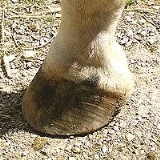
An odd-toed ungulate is a mammal
with hooves
that feature an odd number of toe
s. Odd-toed ungulates comprise the order
Perissodactyla (Greek
: περισσός, perissós, "uneven", and δάκτυλος, dáktylos, "finger/toe"). The middle toe on each hoof is usually larger than its neighbours. Odd-toed ungulates are relatively large grazers and, unlike the ruminant
even-toed ungulates (artiodactyls)
, they have relatively simple stomach
s because they are hindgut fermenters, digesting plant cellulose
in their intestine
s rather than in one or more stomachs. Odd-toed ungulates include the horse
, tapir
s, and rhinoceros
es.
s are known prior to the early Eocene
, the odd-toed ungulates probably arose in what is now Asia
during the late Paleocene
, less than 10 million years after the Cretaceous-Tertiary extinction event
. By the start of the Eocene
(55 million years ago) they had diversified and spread out to occupy several continents. Horse
s and tapir
s both evolved in North America; rhinoceroses appear to have developed in Asia
from tapir-like animals and then recolonised the Americas during the middle Eocene (about 45 million years ago). There were approximately 15 families, of which only three survive (McKenna and Bell, 1997; Hooker, 2005). These families were very diverse in form and size; they included the enormous brontotheres
and the bizarre chalicothere
s. The largest perissodactyl, an Asian rhinoceros called Paraceratherium
, reached 12 short tons (10.9 t), more than twice the weight of an elephant
.
Perissodactyls were the dominant group of large terrestrial browsers right through the Oligocene
. However, the rise of grasses in the Miocene
(about 20 million years ago) saw a major change: the even-toed ungulate
s with their more complex stomachs were better able to adapt to a coarse, low-nutrition diet, and soon rose to prominence. Nevertheless, many odd-toed species survived and prospered until the late Pleistocene
(about 10,000 years ago) when they faced the pressure of human hunting and habitat change.
The three surviving families of odd-toed ungulate are classified as follows.
It was long thought, based on morphology
, that odd-toed ungulates form a clade
with even-toed ungulates. Recent phylogenetic studies have lacked full confidence in this conclusion however; some studies link Perissodactyla with Ferae
into a proposed clade Zooamata
while the Pegasoferae
proposal goes further, suggesting that Chiroptera (bats) are more closely related to odd-toed ungulates than even-toed ones. The most recent study, by Zhou et al. (2011), finds better (but not full) support for the traditional view, uniting Perissodactyla with Cetartiodactyla
into a clade of "true ungulates," Euungulata
.
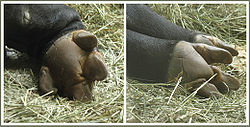 The living perissodactyls are a diverse group. At one extreme are the lithe and graceful horses; on another, the huge, tank-like rhinoceroses; and in the middle, the vaguely pig-like tapirs. All extant perissodactyls are large, from the 180-kg Mountain Tapir
to the 2,300-kg White Rhinoceros
.
Extinct perissodactyls possessed a far more diverse range of forms, too, including the tiny, vaguely tapir-like paleothere
s, the monstrous brontotheres, the knuckle-walking
chalicothere
s, and the gigantic rhinoceros Indricotherium, which dwarfed even elephants.
However, all perissodactyls, extinct and extant, have a mesaxonic foot structure. In other words, the symmetry of the foot passes through the third digit. This means that this digit holds the animal's weight. In equines, the mesaxonic foot has been modified so that the non-weight bearing
digits have atrophied away, while the third toe has enlarged, so that modern equines have only one toe. Also, all perissodactyls are hindgut fermenters. Hindgut fermenters, in contrast to the ruminants, store digested food which has left the stomach in a pouch-like extension of the large intestine called the caecum (literally "cave"), where the food is digested by bacteria.
.
Huge fossil beds made of the bones of hundreds or thousands of individuals suggest that many of the larger brontothere species were social animals at least some of the time. Some prehistoric rhinoceroses, such as Diceratherium
, were also social animals which organized themselves into herds. However, modern-day rhinoceroses are solitary animals which maintain territories, often attacking members of their own species when their space has been invaded. Tapirs, too, are solitary animals, though they are shy, retiring creatures which do not defend or maintain territories.
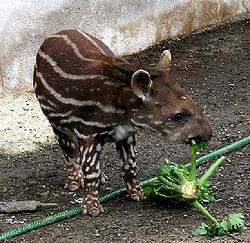 As with the males of many other animal groups, male perissodactyls often spar with each other for the privilege to mate with receptive females. A male which has found a female will attempt to taste her urine to see if she is in estrus. The female may also signal that she is in estrus, such as the whistling of cow Indian rhinoceros
es and tapirs.
Perissodactyls tend to have one foal or calf at a time. Very rarely, the female may have twins. Gestation is very long, from about 11 months in horses to 16 months for rhinoceroses. The calf or foal is capable of standing within moments of birth, but is very dependent on its mother. The young stays with its mother even after weaned, usually until it is chased off by the mother upon the birth of a new foal or calf. At this time, in horses, the foal will enter into the herd proper, later, young stallions are often chased off and join bachelor herds. With rhinos and tapirs, the newly weaned calf wanders away to search for new feeding grounds.
. Horses were domesticated 1000 years later. The zebroid
, that is, a zebra hybrid, began appearing in zoos and menageries during the 19th century. During the 16th century, the Spaniards brought horses with them, and inadvertently reintroduced horses back into North America. While no rhinoceros has been domesticated, they have been captured for zoos and menageries since ancient times.
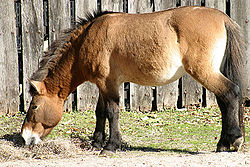 The odd-toed ungulates have been among the most important herbivorous mammals, at times they have been the dominant herbivores in many ecosystems. However, over the course of millions of years, many species went extinct due to climatic change, newer, coarser-leaved plants, predators, disease, and competition from other herbivores, particularly the artiodactyls. The Chalicotheriidae was the most recent family of perissodactyl to become entirely extinct. The perissodactyls' decline continues even today. Most species are listed as threatened species
, and although no species are confirmed to be extinct, some subspecies
have gone extinct. The quagga
was hunted for its meat, the tarpan were hunted for sport, and a subspecies of Black Rhinoceros
was hunted for its horn (as with all other African rhinoceros species).
Perissodactyls tend to do well in captivity, and there are many breeding programs in place to help replenish wild populations. The Przewalski's horse
has been recently released back to the wild. Some of the captive breeding programs for some equids are unusual, in that breeders have been carefully selecting specimens to recreate various recently extinct equids, such as the Tarpan
and Quagga. Most wild rhinoceroses are monitored, and some have their horns trimmed off to discourage horn-poachers. Even so, if conservations do not improve, it may very well be that the only living perissodactyls left will be the domesticated horse and donkey.
Two recently extinct equids
Mammal
Mammals are members of a class of air-breathing vertebrate animals characterised by the possession of endothermy, hair, three middle ear bones, and mammary glands functional in mothers with young...
with hooves
Hoof
A hoof , plural hooves or hoofs , is the tip of a toe of an ungulate mammal, strengthened by a thick horny covering. The hoof consists of a hard or rubbery sole, and a hard wall formed by a thick nail rolled around the tip of the toe. The weight of the animal is normally borne by both the sole...
that feature an odd number of toe
Toe
Toes are the digits of the foot of a tetrapod. Animal species such as cats that walk on their toes are described as being digitigrade. Humans, and other animals that walk on the soles of their feet, are described as being plantigrade; unguligrade animals are those that walk on hooves at the tips of...
s. Odd-toed ungulates comprise the order
Order (biology)
In scientific classification used in biology, the order is# a taxonomic rank used in the classification of organisms. Other well-known ranks are life, domain, kingdom, phylum, class, family, genus, and species, with order fitting in between class and family...
Perissodactyla (Greek
Greek language
Greek is an independent branch of the Indo-European family of languages. Native to the southern Balkans, it has the longest documented history of any Indo-European language, spanning 34 centuries of written records. Its writing system has been the Greek alphabet for the majority of its history;...
: περισσός, perissós, "uneven", and δάκτυλος, dáktylos, "finger/toe"). The middle toe on each hoof is usually larger than its neighbours. Odd-toed ungulates are relatively large grazers and, unlike the ruminant
Ruminant
A ruminant is a mammal of the order Artiodactyla that digests plant-based food by initially softening it within the animal's first compartment of the stomach, principally through bacterial actions, then regurgitating the semi-digested mass, now known as cud, and chewing it again...
even-toed ungulates (artiodactyls)
Even-toed ungulate
The even-toed ungulates are ungulates whose weight is borne about equally by the third and fourth toes, rather than mostly or entirely by the third as in odd-toed ungulates such as horses....
, they have relatively simple stomach
Stomach
The stomach is a muscular, hollow, dilated part of the alimentary canal which functions as an important organ of the digestive tract in some animals, including vertebrates, echinoderms, insects , and molluscs. It is involved in the second phase of digestion, following mastication .The stomach is...
s because they are hindgut fermenters, digesting plant cellulose
Cellulose
Cellulose is an organic compound with the formula , a polysaccharide consisting of a linear chain of several hundred to over ten thousand β linked D-glucose units....
in their intestine
Intestine
In human anatomy, the intestine is the segment of the alimentary canal extending from the pyloric sphincter of the stomach to the anus and, in humans and other mammals, consists of two segments, the small intestine and the large intestine...
s rather than in one or more stomachs. Odd-toed ungulates include the horse
Horse
The horse is one of two extant subspecies of Equus ferus, or the wild horse. It is a single-hooved mammal belonging to the taxonomic family Equidae. The horse has evolved over the past 45 to 55 million years from a small multi-toed creature into the large, single-toed animal of today...
, tapir
Tapir
A Tapir is a large browsing mammal, similar in shape to a pig, with a short, prehensile snout. Tapirs inhabit jungle and forest regions of South America, Central America, and Southeast Asia. There are four species of Tapirs: the Brazilian Tapir, the Malayan Tapir, Baird's Tapir and the Mountain...
s, and rhinoceros
Rhinoceros
Rhinoceros , also known as rhino, is a group of five extant species of odd-toed ungulates in the family Rhinocerotidae. Two of these species are native to Africa and three to southern Asia....
es.
Evolution
Although no certain fossilFossil
Fossils are the preserved remains or traces of animals , plants, and other organisms from the remote past...
s are known prior to the early Eocene
Eocene
The Eocene Epoch, lasting from about 56 to 34 million years ago , is a major division of the geologic timescale and the second epoch of the Paleogene Period in the Cenozoic Era. The Eocene spans the time from the end of the Palaeocene Epoch to the beginning of the Oligocene Epoch. The start of the...
, the odd-toed ungulates probably arose in what is now Asia
Asia
Asia is the world's largest and most populous continent, located primarily in the eastern and northern hemispheres. It covers 8.7% of the Earth's total surface area and with approximately 3.879 billion people, it hosts 60% of the world's current human population...
during the late Paleocene
Paleocene
The Paleocene or Palaeocene, the "early recent", is a geologic epoch that lasted from about . It is the first epoch of the Palaeogene Period in the modern Cenozoic Era...
, less than 10 million years after the Cretaceous-Tertiary extinction event
Cretaceous-Tertiary extinction event
The Cretaceous–Paleogene extinction event, formerly named and still commonly referred to as the Cretaceous-Tertiary extinction event, occurred approximately 65.5 million years ago at the end of the Maastrichtian age of the Cretaceous period. It was a large-scale mass extinction of animal and plant...
. By the start of the Eocene
Eocene
The Eocene Epoch, lasting from about 56 to 34 million years ago , is a major division of the geologic timescale and the second epoch of the Paleogene Period in the Cenozoic Era. The Eocene spans the time from the end of the Palaeocene Epoch to the beginning of the Oligocene Epoch. The start of the...
(55 million years ago) they had diversified and spread out to occupy several continents. Horse
Horse
The horse is one of two extant subspecies of Equus ferus, or the wild horse. It is a single-hooved mammal belonging to the taxonomic family Equidae. The horse has evolved over the past 45 to 55 million years from a small multi-toed creature into the large, single-toed animal of today...
s and tapir
Tapir
A Tapir is a large browsing mammal, similar in shape to a pig, with a short, prehensile snout. Tapirs inhabit jungle and forest regions of South America, Central America, and Southeast Asia. There are four species of Tapirs: the Brazilian Tapir, the Malayan Tapir, Baird's Tapir and the Mountain...
s both evolved in North America; rhinoceroses appear to have developed in Asia
Asia
Asia is the world's largest and most populous continent, located primarily in the eastern and northern hemispheres. It covers 8.7% of the Earth's total surface area and with approximately 3.879 billion people, it hosts 60% of the world's current human population...
from tapir-like animals and then recolonised the Americas during the middle Eocene (about 45 million years ago). There were approximately 15 families, of which only three survive (McKenna and Bell, 1997; Hooker, 2005). These families were very diverse in form and size; they included the enormous brontotheres
Brontotheriidae
Brontotheriidae, also called Titanotheriidae, is a family of extinct mammals belonging to the order Perissodactyla, the order that includes horses, rhinoceroses, and tapirs. Superficially they looked rather like rhinos, although they were not true rhinos and are probably most closely related to...
and the bizarre chalicothere
Chalicothere
Chalicotheres were a group of herbivorous, odd-toed ungulate mammals spread throughout North America, Europe, Asia, and Africa during the Early Eocene to Early Pleistocene subepochs living from 55.8 mya—781,000 years ago, existing for approximately .They evolved around 40 million years ago from...
s. The largest perissodactyl, an Asian rhinoceros called Paraceratherium
Paraceratherium
Paraceratherium, also commonly known as Indricotherium or Baluchitherium , is an extinct genus of gigantic hornless rhinoceros-like mammals of the family Hyracodontidae, endemic to Eurasia and Asia during the Eocene to Oligocene 37.2—23.030 Mya, existing for approximately...
, reached 12 short tons (10.9 t), more than twice the weight of an elephant
Elephant
Elephants are large land mammals in two extant genera of the family Elephantidae: Elephas and Loxodonta, with the third genus Mammuthus extinct...
.
Perissodactyls were the dominant group of large terrestrial browsers right through the Oligocene
Oligocene
The Oligocene is a geologic epoch of the Paleogene Period and extends from about 34 million to 23 million years before the present . As with other older geologic periods, the rock beds that define the period are well identified but the exact dates of the start and end of the period are slightly...
. However, the rise of grasses in the Miocene
Miocene
The Miocene is a geological epoch of the Neogene Period and extends from about . The Miocene was named by Sir Charles Lyell. Its name comes from the Greek words and and means "less recent" because it has 18% fewer modern sea invertebrates than the Pliocene. The Miocene follows the Oligocene...
(about 20 million years ago) saw a major change: the even-toed ungulate
Even-toed ungulate
The even-toed ungulates are ungulates whose weight is borne about equally by the third and fourth toes, rather than mostly or entirely by the third as in odd-toed ungulates such as horses....
s with their more complex stomachs were better able to adapt to a coarse, low-nutrition diet, and soon rose to prominence. Nevertheless, many odd-toed species survived and prospered until the late Pleistocene
Pleistocene
The Pleistocene is the epoch from 2,588,000 to 11,700 years BP that spans the world's recent period of repeated glaciations. The name pleistocene is derived from the Greek and ....
(about 10,000 years ago) when they faced the pressure of human hunting and habitat change.
Taxonomy
The members of the order fall into two suborders:- Hippomorpha are odd-toed ungulates that are, today, fast runners with long legs and have only one toe. The only extant familyFamily (biology)In biological classification, family is* a taxonomic rank. Other well-known ranks are life, domain, kingdom, phylum, class, order, genus, and species, with family fitting between order and genus. As for the other well-known ranks, there is the option of an immediately lower rank, indicated by the...
of this suborder is EquidaeEquidaeEquidae is the taxonomic family of horses and related animals, including the extant horses, donkeys, and zebras, and many other species known only from fossils. All extant species are in the genus Equus...
(whose sole surviving genusGenusIn biology, a genus is a low-level taxonomic rank used in the biological classification of living and fossil organisms, which is an example of definition by genus and differentia...
is Equus), comprising the horseHorseThe horse is one of two extant subspecies of Equus ferus, or the wild horse. It is a single-hooved mammal belonging to the taxonomic family Equidae. The horse has evolved over the past 45 to 55 million years from a small multi-toed creature into the large, single-toed animal of today...
, zebraZebraZebras are several species of African equids united by their distinctive black and white stripes. Their stripes come in different patterns unique to each individual. They are generally social animals that live in small harems to large herds...
, donkeyDonkeyThe donkey or ass, Equus africanus asinus, is a domesticated member of the Equidae or horse family. The wild ancestor of the donkey is the African Wild Ass, E...
, onagerOnagerThe Onager is a large member of the genus Equus of the family Equidae native to the deserts of Syria, Iran, Pakistan, India, Israel and Tibet...
, and allied species. The extinct, rhinoceros-like brontotheres are also included in this suborder. Both families probably descended from palaeotheres. - Ceratomorpha have several functional toes; they are heavier than and move more slowly than the Hippomorpha. This suborder has two extant families: TapirTapirA Tapir is a large browsing mammal, similar in shape to a pig, with a short, prehensile snout. Tapirs inhabit jungle and forest regions of South America, Central America, and Southeast Asia. There are four species of Tapirs: the Brazilian Tapir, the Malayan Tapir, Baird's Tapir and the Mountain...
idae (tapirs) and RhinocerotidaeRhinocerosRhinoceros , also known as rhino, is a group of five extant species of odd-toed ungulates in the family Rhinocerotidae. Two of these species are native to Africa and three to southern Asia....
(rhinoceroses). The extinct chalicothereChalicothereChalicotheres were a group of herbivorous, odd-toed ungulate mammals spread throughout North America, Europe, Asia, and Africa during the Early Eocene to Early Pleistocene subepochs living from 55.8 mya—781,000 years ago, existing for approximately .They evolved around 40 million years ago from...
s may belong to this suborder as well.
The three surviving families of odd-toed ungulate are classified as follows.
- ORDER PERISSODACTYLA
- Suborder Hippomorpha
- Family EquidaeEquidaeEquidae is the taxonomic family of horses and related animals, including the extant horses, donkeys, and zebras, and many other species known only from fossils. All extant species are in the genus Equus...
: horses and allies, seven species in one genus- Wild horseWild HorseThe wild horse is a species of the genus Equus, which includes as subspecies the domesticated horse as well as the undomesticated Tarpan and Przewalski's Horse. The Tarpan became extinct in the 19th century, and Przewalski's Horse was saved from the brink of extinction and reintroduced...
, Equus ferus- Przewalski's HorsePrzewalski's HorsePrzewalski's Horse or Dzungarian Horse, is a rare and endangered subspecies of wild horse native to the steppes of central Asia, specifically China and Mongolia.At one time extinct in the wild, it has been reintroduced to its native habitat in Mongolia at the Khustain Nuruu...
, Equus ferus przewalskii - Domestic horseHorseThe horse is one of two extant subspecies of Equus ferus, or the wild horse. It is a single-hooved mammal belonging to the taxonomic family Equidae. The horse has evolved over the past 45 to 55 million years from a small multi-toed creature into the large, single-toed animal of today...
, Equus ferus caballus
- Przewalski's Horse
- African Wild AssAfrican Wild AssThe African Wild Ass is a wild member of the horse family, Equidae. This species is believed to be the ancestor of the domestic donkey which is usually placed within the same species. They live in the deserts and other arid areas of northeastern Africa, in Eritrea, Ethiopia and Somalia; it...
Equus africanus- Domesticated Ass (Donkey)DonkeyThe donkey or ass, Equus africanus asinus, is a domesticated member of the Equidae or horse family. The wild ancestor of the donkey is the African Wild Ass, E...
Equus africanus asinus
- Domesticated Ass (Donkey)
- OnagerOnagerThe Onager is a large member of the genus Equus of the family Equidae native to the deserts of Syria, Iran, Pakistan, India, Israel and Tibet...
or Asiatic Ass, Equus hemionus - KiangKiangThe kiang is the largest of the wild asses. It is native to the Tibetan Plateau, where it inhabits montane and alpine grasslands. Its current range is restricted to Ladakh in Jammu and Kashmir, plains of the Tibetan plateau and northern Nepal along the Tibetan border...
or Tibetan Wild Ass, Equus kiang - Plains ZebraPlains ZebraThe plains zebra , also known as the common zebra or Burchell's zebra, is the most common and geographically widespread species of zebra. It ranges from the south of Ethiopia through East Africa to as far south as Angola and eastern South Africa...
, Equus quagga - Mountain ZebraMountain ZebraThe Mountain Zebra, Equus zebra, is a threatened species of equid native to south-western Angola, Namibia and South Africa. It has two subspecies, the Cape Mountain Zebra and Hartmann's Mountain Zebra , though it has been suggested these should be considered separate species.-Taxonomy:In 2004,...
, Equus zebra- Cape Mountain ZebraCape Mountain ZebraCape mountain zebra, Equus zebra zebra, is a subspecies of the Mountain zebra found in the Western and Eastern Cape in South Africa. They mainly eat grass but if little food is left they will eat bushes...
, Equus zebra zebra - Hartmann's Mountain ZebraHartmann's Mountain ZebraHartmann's mountain zebra, Equus zebra hartmannae, is a subspecies of the mountain zebra found in far south-western Angola and western Namibia.Hartmann's mountain zebras prefer to live in small groups of 7-12 individuals...
, Equus zebra hartmannae
- Cape Mountain Zebra
- Grevy's ZebraGrevy's ZebraThe Grévy's zebra , also known as the Imperial zebra, is the largest extant wild equid and one of three species of zebra, the other two being the plains zebra and the mountain zebra. Named after Jules Grévy, it is the sole extant member of the subgenus Dolichohippus. The Grévy's zebra is found in...
, Equus grevyi
- Wild horse
- Family Equidae
- Suborder Ceratomorpha
- Family Tapiridae: tapirs, four species in one genus
- Brazilian TapirBrazilian TapirThe South American Tapir , or Brazilian Tapir or Lowland Tapir or Anta, is one of four species in the tapir family, along with the Mountain Tapir, the Malayan Tapir, and Baird's Tapir...
, Tapirus terrestris - Mountain TapirMountain TapirThe Mountain Tapir or Woolly Tapir is the smallest of the four species of tapir and is the only one to live outside of tropical rainforests in the wild...
, Tapirus pinchaque - Baird's TapirBaird's TapirBaird’s Tapir is a species of tapir that is native to Central America and northern South America. It is one of three Latin American species of tapir.-Names:...
, Tapirus bairdii - Malayan TapirMalayan TapirThe Malayan Tapir , also called the Asian Tapir, is the largest of the four species of tapir and the only one native to Asia. The scientific name refers to the East Indies, the species' natural habitat...
, Tapirus indicus
- Brazilian Tapir
- Family Rhinocerotidae: rhinoceroses, five species in four genera
- Black RhinocerosBlack RhinocerosThe Black Rhinoceros or Hook-lipped Rhinoceros , is a species of rhinoceros, native to the eastern and central areas of Africa including Kenya, Tanzania, Cameroon, South Africa, Namibia, Zimbabwe, and Angola...
, Diceros bicornis - White RhinocerosWhite RhinocerosThe White Rhinoceros or Square-lipped rhinoceros is one of the five species of rhinoceros that still exist. It has a wide mouth used for grazing and is the most social of all rhino species...
, Ceratotherium simum - Indian RhinocerosIndian RhinocerosThe Indian Rhinoceros is also called Greater One-horned Rhinoceros and Asian One-horned Rhinoceros and belongs to the Rhinocerotidae family...
, Rhinoceros unicornis - Javan RhinocerosJavan RhinocerosThe Javan Rhinoceros or Lesser One-horned Rhinoceros is a member of the family Rhinocerotidae and one of five extant rhinoceroses...
, Rhinoceros sondaicus - Sumatran RhinocerosSumatran RhinocerosThe Sumatran Rhinoceros is a member of the family Rhinocerotidae and one of five extant rhinoceroses. It is the only extant species of the genus Dicerorhinus. It is the smallest rhinoceros, although is still a large mammal. This rhino stands high at the shoulder, with a head-and-body length of ...
, Dicerorhinus sumatrensis
- Black Rhinoceros
- Family Tapiridae: tapirs, four species in one genus
- Suborder Hippomorpha
It was long thought, based on morphology
Morphology (biology)
In biology, morphology is a branch of bioscience dealing with the study of the form and structure of organisms and their specific structural features....
, that odd-toed ungulates form a clade
Clade
A clade is a group consisting of a species and all its descendants. In the terms of biological systematics, a clade is a single "branch" on the "tree of life". The idea that such a "natural group" of organisms should be grouped together and given a taxonomic name is central to biological...
with even-toed ungulates. Recent phylogenetic studies have lacked full confidence in this conclusion however; some studies link Perissodactyla with Ferae
Ferae
Ferae is a clade of mammals, consisting of the orders Carnivora and Pholidota . Pangolins do not look much like carnivorans , and were thought to be the closest relatives of Xenarthra...
into a proposed clade Zooamata
Zooamata
Zooamata is a proposed clade of mammals consisting of Ferae and Perissodactyla . Together with Cetartiodactyla and chiroptera it forms Scrotifera , and is part of Laurasiatheria...
while the Pegasoferae
Pegasoferae
Pegasoferae is a proposed clade of mammals based on genomic research in molecular systematics by Nishihara, Hasegawa and Okada .To the surprise of the authors, their data led them to propose a clade that includes bats , carnivores such as cats and dogs , horses and other odd-toed ungulates and...
proposal goes further, suggesting that Chiroptera (bats) are more closely related to odd-toed ungulates than even-toed ones. The most recent study, by Zhou et al. (2011), finds better (but not full) support for the traditional view, uniting Perissodactyla with Cetartiodactyla
Cetartiodactyla
Cetartiodactyla is the clade in which whales and even-toed ungulates have currently been placed. The term was coined by merging the name for the two orders, Cetacea and Artiodactyla, into a single word. The term Cetartiodactyla reflects the idea that whales evolved within the artiodactyls...
into a clade of "true ungulates," Euungulata
Euungulata
Euungulata is a proposed clade of mammals within Laurasiatheria, consisting of the following orders and their common ancestors:* Perissodactyla* Cetacea* ArtiodactylaIt is based on evidence from molecular phylogenetics...
.
Characteristics
Mountain Tapir
The Mountain Tapir or Woolly Tapir is the smallest of the four species of tapir and is the only one to live outside of tropical rainforests in the wild...
to the 2,300-kg White Rhinoceros
White Rhinoceros
The White Rhinoceros or Square-lipped rhinoceros is one of the five species of rhinoceros that still exist. It has a wide mouth used for grazing and is the most social of all rhino species...
.
Extinct perissodactyls possessed a far more diverse range of forms, too, including the tiny, vaguely tapir-like paleothere
Palaeotheriidae
Palaeotheres are an extinct group of herbivorous mammals related to tapirs and rhinoceros, and probably ancestral to horses. They ranged across Europe and Asia during the Eocene through Oligocene 55—28 Ma, existing for approximately ....
s, the monstrous brontotheres, the knuckle-walking
Knuckle-walking
Knuckle-walking is a form of quadrupedal walking in which the forelimbs hold the fingers in a partially flexed posture that allows body weight to press down on the ground through the knuckles....
chalicothere
Chalicothere
Chalicotheres were a group of herbivorous, odd-toed ungulate mammals spread throughout North America, Europe, Asia, and Africa during the Early Eocene to Early Pleistocene subepochs living from 55.8 mya—781,000 years ago, existing for approximately .They evolved around 40 million years ago from...
s, and the gigantic rhinoceros Indricotherium, which dwarfed even elephants.
However, all perissodactyls, extinct and extant, have a mesaxonic foot structure. In other words, the symmetry of the foot passes through the third digit. This means that this digit holds the animal's weight. In equines, the mesaxonic foot has been modified so that the non-weight bearing
Weight bearing
In orthopedics, weight-bearing is the amount of weight a patient puts on the leg on which surgery has been performed. In general, it is described as a percentage of the body weight, because each leg of a healthy person carries the full body weight when walking, in an alternating fashion.After...
digits have atrophied away, while the third toe has enlarged, so that modern equines have only one toe. Also, all perissodactyls are hindgut fermenters. Hindgut fermenters, in contrast to the ruminants, store digested food which has left the stomach in a pouch-like extension of the large intestine called the caecum (literally "cave"), where the food is digested by bacteria.
Social structures
Today, the equines are the only social perissodactyls still extant. Horses organize themselves into small bands with a dominant mare at the top of the pecking order, as well as a resident stallion. Several bands will share a common territory, with some members of one band joining another band, every so often. These bands, in turn, form a herdHorse behavior
Horse behavior is best understood from the perspective that horses are prey animals with a well-developed fight-or-flight instinct. Their first response to a threat is to flee, although they are known to stand their ground and defend themselves or their offspring in cases where flight is...
.
Huge fossil beds made of the bones of hundreds or thousands of individuals suggest that many of the larger brontothere species were social animals at least some of the time. Some prehistoric rhinoceroses, such as Diceratherium
Diceratherium
Diceratherium is an extinct genus of rhinoceros endemic to North America, Europe, and Asia during the Oligocene through Miocene living from 33.9—11.6 mya, existing for approximately .-Taxonomy:...
, were also social animals which organized themselves into herds. However, modern-day rhinoceroses are solitary animals which maintain territories, often attacking members of their own species when their space has been invaded. Tapirs, too, are solitary animals, though they are shy, retiring creatures which do not defend or maintain territories.
Mating and reproduction
Indian Rhinoceros
The Indian Rhinoceros is also called Greater One-horned Rhinoceros and Asian One-horned Rhinoceros and belongs to the Rhinocerotidae family...
es and tapirs.
Perissodactyls tend to have one foal or calf at a time. Very rarely, the female may have twins. Gestation is very long, from about 11 months in horses to 16 months for rhinoceroses. The calf or foal is capable of standing within moments of birth, but is very dependent on its mother. The young stays with its mother even after weaned, usually until it is chased off by the mother upon the birth of a new foal or calf. At this time, in horses, the foal will enter into the herd proper, later, young stallions are often chased off and join bachelor herds. With rhinos and tapirs, the newly weaned calf wanders away to search for new feeding grounds.
Domestication
Humans have a historically long interaction with perissodactyls. The wild ass was the first equid to be domesticated, around 5000 BC in EgyptEgypt
Egypt , officially the Arab Republic of Egypt, Arabic: , is a country mainly in North Africa, with the Sinai Peninsula forming a land bridge in Southwest Asia. Egypt is thus a transcontinental country, and a major power in Africa, the Mediterranean Basin, the Middle East and the Muslim world...
. Horses were domesticated 1000 years later. The zebroid
Zebroid
A zebroid is the offspring of any cross between a zebra and any other equine: essentially, a zebra hybrid. In most cases, the sire is a zebra stallion. Offspring of a donkey sire and zebra dam, called a zebra hinny, or donkra, do exist but are rare. Zebroids have been bred since the 19th century...
, that is, a zebra hybrid, began appearing in zoos and menageries during the 19th century. During the 16th century, the Spaniards brought horses with them, and inadvertently reintroduced horses back into North America. While no rhinoceros has been domesticated, they have been captured for zoos and menageries since ancient times.
Conservation
Threatened species
Threatened species are any speciesg animals, plants, fungi, etc.) which are vulnerable to endangerment in the near future.The World Conservation Union is the foremost authority on threatened species, and treats threatened species not as a single category, but as a group of three categories,...
, and although no species are confirmed to be extinct, some subspecies
Subspecies
Subspecies in biological classification, is either a taxonomic rank subordinate to species, ora taxonomic unit in that rank . A subspecies cannot be recognized in isolation: a species will either be recognized as having no subspecies at all or two or more, never just one...
have gone extinct. The quagga
Quagga
The quagga is an extinct subspecies of the plains zebra, which was once found in great numbers in South Africa's Cape Province and the southern part of the Orange Free State. It was distinguished from other zebras by having the usual vivid marks on the front part of the body only...
was hunted for its meat, the tarpan were hunted for sport, and a subspecies of Black Rhinoceros
Black Rhinoceros
The Black Rhinoceros or Hook-lipped Rhinoceros , is a species of rhinoceros, native to the eastern and central areas of Africa including Kenya, Tanzania, Cameroon, South Africa, Namibia, Zimbabwe, and Angola...
was hunted for its horn (as with all other African rhinoceros species).
Perissodactyls tend to do well in captivity, and there are many breeding programs in place to help replenish wild populations. The Przewalski's horse
Przewalski's Horse
Przewalski's Horse or Dzungarian Horse, is a rare and endangered subspecies of wild horse native to the steppes of central Asia, specifically China and Mongolia.At one time extinct in the wild, it has been reintroduced to its native habitat in Mongolia at the Khustain Nuruu...
has been recently released back to the wild. Some of the captive breeding programs for some equids are unusual, in that breeders have been carefully selecting specimens to recreate various recently extinct equids, such as the Tarpan
Tarpan
Tarpan is an extinct subspecies of wild horse. The last individual of this subspecies died in captivity in Russia in 1909....
and Quagga. Most wild rhinoceroses are monitored, and some have their horns trimmed off to discourage horn-poachers. Even so, if conservations do not improve, it may very well be that the only living perissodactyls left will be the domesticated horse and donkey.
Two recently extinct equids