
Home      Discussion      Topics      Dictionary      Almanac
Signup       Login
Paraceratherium

Paraceratherium

Overview
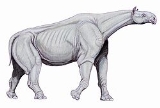
Paraceratherium, also commonly known as Indricotherium or Baluchitherium (see taxonomic discussion below), is an extinct
Extinction
In biology and ecology, extinction is the end of an organism or of a group of organisms , normally a species. The moment of extinction is generally considered to be the death of the last individual of the species, although the capacity to breed and recover may have been lost before this point...

 genus
Genus
In biology, a genus is a low-level taxonomic rank used in the biological classification of living and fossil organisms, which is an example of definition by genus and differentia...

 of gigantic hornless rhinoceros
Rhinoceros
Rhinoceros , also known as rhino, is a group of five extant species of odd-toed ungulates in the family Rhinocerotidae. Two of these species are native to Africa and three to southern Asia....

-like mammals of the family Hyracodontidae
Hyracodontidae
Hyracodontidae is an extinct family of rhinoceroses endemic to North America, Europe, and Asia during the Eocene through early Miocene living from 55.8—20 mya, existing for approximately .They are typified as having long limbs and having no horns...

, endemic to Eurasia and Asia during the Eocene
Eocene
The Eocene Epoch, lasting from about 56 to 34 million years ago , is a major division of the geologic timescale and the second epoch of the Paleogene Period in the Cenozoic Era. The Eocene spans the time from the end of the Palaeocene Epoch to the beginning of the Oligocene Epoch. The start of the...

 to Oligocene
Oligocene
The Oligocene is a geologic epoch of the Paleogene Period and extends from about 34 million to 23 million years before the present . As with other older geologic periods, the rock beds that define the period are well identified but the exact dates of the start and end of the period are slightly...

 37.2—23.030 Mya, existing for approximately . It was first discovered in the Baluchistan province of Pakistan
Pakistan
Pakistan , officially the Islamic Republic of Pakistan is a sovereign state in South Asia. It has a coastline along the Arabian Sea and the Gulf of Oman in the south and is bordered by Afghanistan and Iran in the west, India in the east and China in the far northeast. In the north, Tajikistan...

, hence the name, by Sir Clive Forster Cooper.
Discussion
Ask a question about 'Paraceratherium'
Start a new discussion about 'Paraceratherium'
Answer questions from other users
Full Discussion Forum
 
Unanswered Questions
Recent Discussions
Encyclopedia
Paraceratherium, also commonly known as Indricotherium or Baluchitherium (see taxonomic discussion below), is an extinct
Extinction
In biology and ecology, extinction is the end of an organism or of a group of organisms , normally a species. The moment of extinction is generally considered to be the death of the last individual of the species, although the capacity to breed and recover may have been lost before this point...

 genus
Genus
In biology, a genus is a low-level taxonomic rank used in the biological classification of living and fossil organisms, which is an example of definition by genus and differentia...

 of gigantic hornless rhinoceros
Rhinoceros
Rhinoceros , also known as rhino, is a group of five extant species of odd-toed ungulates in the family Rhinocerotidae. Two of these species are native to Africa and three to southern Asia....

-like mammals of the family Hyracodontidae
Hyracodontidae
Hyracodontidae is an extinct family of rhinoceroses endemic to North America, Europe, and Asia during the Eocene through early Miocene living from 55.8—20 mya, existing for approximately .They are typified as having long limbs and having no horns...

, endemic to Eurasia and Asia during the Eocene
Eocene
The Eocene Epoch, lasting from about 56 to 34 million years ago , is a major division of the geologic timescale and the second epoch of the Paleogene Period in the Cenozoic Era. The Eocene spans the time from the end of the Palaeocene Epoch to the beginning of the Oligocene Epoch. The start of the...

 to Oligocene
Oligocene
The Oligocene is a geologic epoch of the Paleogene Period and extends from about 34 million to 23 million years before the present . As with other older geologic periods, the rock beds that define the period are well identified but the exact dates of the start and end of the period are slightly...

 37.2—23.030 Mya, existing for approximately . It was first discovered in the Baluchistan province of Pakistan
Pakistan
Pakistan , officially the Islamic Republic of Pakistan is a sovereign state in South Asia. It has a coastline along the Arabian Sea and the Gulf of Oman in the south and is bordered by Afghanistan and Iran in the west, India in the east and China in the far northeast. In the north, Tajikistan...

, hence the name, by Sir Clive Forster Cooper.

Background


Paraceratherium is the largest land mammal known, larger than the largest species of mammoth
Mammoth
A mammoth is any species of the extinct genus Mammuthus. These proboscideans are members of Elephantidae, the family of elephants and mammoths, and close relatives of modern elephants. They were often equipped with long curved tusks and, in northern species, a covering of long hair...

s (Mammuthus sungari
Mammuthus sungari
Mammuthus sungari, sometimes called the Songhua River Mammoth, evolved from smaller Siberian mammoths and occurred in Northern China during the middle Pleistocene...

, which may have approached it in size and weight). It is also known as the "giraffe rhinoceros". Adult Paraceratherium are estimated to have been 5.5 metres (18 ft) tall at the shoulder, 9 metres (29.5 ft) in length from nose to rump, a maximum raised head height of about 8 metres (26.2 ft), and a skull length of 1.5 metres (4.9 ft). Weight estimates vary greatly, but most realistic and reliable weight estimates are about 20 tonnes. This puts it in the weight range of some medium-sized sauropod dinosaur
Dinosaur
Dinosaurs are a diverse group of animals of the clade and superorder Dinosauria. They were the dominant terrestrial vertebrates for over 160 million years, from the late Triassic period until the end of the Cretaceous , when the Cretaceous–Paleogene extinction event led to the extinction of...

s.

It was a herbivore that stripped leaves from trees with its down-pointing, tusk-like upper teeth that occluded forward-pointing lower teeth. It had a long, low, hornless skull and vaulted frontal and nasal bones. Its front teeth were reduced to a single pair of incisors in either jaw, but they were conical and so large that they looked like small tusks. The upper incisors pointed straight downwards, while the lower ones jutted outwards. The upper lip was evidently extremely mobile. The neck was very long, the trunk robust, and the limbs long and thick, column-like.

Its type of dentition
Dentition
Dentition pertains to the development of teeth and their arrangement in the mouth. In particular, the characteristic arrangement, kind, and number of teeth in a given species at a given age...

, its mobile upper lip and its long legs and neck indicate that it was a browser that lived on the leaves and twigs of trees and large shrubs.

Taxonomy


While more distinct at the species
Species
In biology, a species is one of the basic units of biological classification and a taxonomic rank. A species is often defined as a group of organisms capable of interbreeding and producing fertile offspring. While in many cases this definition is adequate, more precise or differing measures are...

 level, there is uncertainty and disagreement with regard to the genus
Genus
In biology, a genus is a low-level taxonomic rank used in the biological classification of living and fossil organisms, which is an example of definition by genus and differentia...

 level of taxonomy.

Paraceratherium was first described by Forster Cooper in 1911.
The genus Baluchitherium was first described by Forster Cooper in 1913.
The genus Indricotherium was first described by Borissiak in 1915.

Baluchitherium is now widely regarded as a synonym of (i.e. the same as) either Paraceratherium or Indricotherium.

However, there has been disagreement over whether Indricotherium is a distinct genus from Paraceratherium. Lucas and Sobus in their 1989 review of the subfamily Indricotheriinae
Indricotheriinae
Indricotheriinae is a subfamily of Hyracodontidae, a group of long-limbed, hornless rhinoceroses that evolved in the Eocene epoch and continued through to the early Miocene. The earlier hyracodontid species, such as Hyracodon were modest-sized, fast-running, lightly built animals with little...

 (see reference below), argue for synonymy, and consider that the differences between the two are of species level at most, and may even be the result of sexual dimorphism in a single species, with the larger more robust Indricotherium with larger incisors being probably the male, and the more gracile Paraceratherium the female. Others, however, have expressed doubts about this (concerning the interpretation of the shape of the skull). Even if these two do turn out to be distinct genera, they would still be similar in size and appearance.

If they are considered the same genus, then Indricotherium would become a junior synonym of Paraceratherium, because, according to the priority principle of scientific classification, the first publication, and hence the oldest valid name, takes priority and the name Paraceratherium predates the other.

Here Lucas and Sobus are followed. They consider Indricotherium, Baluchitherium, Thaumastotherium Forster Cooper, 1913a, Aralotherium Borissiak, 1939, and Dzungariotherium Xu and Wang, 1973 all as junior synonyms of Paraceratherium.
Lucas and Sobus recognise four valid species of Paraceratherium. One more (P. zhajremensis) has been tentatively added. The Paraceratherium species are:
Paraceratherium bugtiense (Pilgrim, 1908) from the Oligocene of Pakistan is the type species of Paraceratherium. Baluchitherium osborni Forster Cooper, 1913a is a junior synonym. It was first found in the Chitarwata Formation
Chitarwata Formation
The Chitarwata Formation is a geological formation in western Pakistan, made up of Oligocene and early Miocene terrestrial facies. It is dominated by coastal paleoenvironments ....

 of the Bugti Hills
Bugti Hills
Bugti Hills are a range of hills in eastern Balochistan, Pakistan. It includes the tribal tract called Bugti country.30 million years ago the Haplorrhinies: Bugtipithecus inexpectans, Phileosimias kamali and Phileosimias brahuiorum, similar to today's lemurs, lived in rainforests on the Bugti...

, Balochistan
Balochistan (region)
Balochistan or Baluchistan is an arid, mountainous region in the Iranian plateau in Southwest Asia; it includes part of southeastern Iran, western Pakistan, and southwestern Afghanistan. The area is named after the numerous Baloch tribes, Iranian peoples who moved into the area from the west...

, after which it was originally named. New specimens of P. bugtiense were unearthed in the last decade by a French-Pakistani team (Antoine et al., 2004; Métais et al., 2009).

Paraceratherium transouralicum (Pavlova, 1922). Also known as Indricotherium transouralicum, this is the best known and most widespread species, known from the middle and late Oligocene of Kazakhstan
Kazakhstan
Kazakhstan , officially the Republic of Kazakhstan, is a transcontinental country in Central Asia and Eastern Europe. Ranked as the ninth largest country in the world, it is also the world's largest landlocked country; its territory of is greater than Western Europe...

, Mongolia
Mongolia
Mongolia is a landlocked country in East and Central Asia. It is bordered by Russia to the north and China to the south, east and west. Although Mongolia does not share a border with Kazakhstan, its western-most point is only from Kazakhstan's eastern tip. Ulan Bator, the capital and largest...

, and Nei Monggol in northern China. Lucas and Sobus list the following species as synonyms: Baluchitherium grangeri Osborn, 1923, Indricotherium asiaticum Borissiak, 1923, Indricotherium minus Borissiak, 1923.

Paraceratherium orgosensis (Chiu, 1973) is the largest species, the teeth being at least a quarter again as big as P. transouralicum (see Lucas and Sobus p. 363/fig.19.2). It is known from the middle and late Oligocene of Xinjiang
Xinjiang
Xinjiang is an autonomous region of the People's Republic of China. It is the largest Chinese administrative division and spans over 1.6 million km2...

, northwest China.
The three synonyms are Dzungariotherium orgosensis Chiu, 1973 and (each of the following named after a separate skull) Dzungariotherium turfanensis Xu & Wang, 1978 and Paraceratherium lipidus Xu & Wang, 1978. While there is some variation in details of the proportions of the skull (perhaps due to sexual dimorphism
Sexual dimorphism
Sexual dimorphism is a phenotypic difference between males and females of the same species. Examples of such differences include differences in morphology, ornamentation, and behavior.-Examples:-Ornamentation / coloration:...

), all occur in a close geographical region and have distinct first and second upper molar crochet
Crochet
Crochet is a process of creating fabric from yarn, thread, or other material strands using a crochet hook. The word is derived from the French word "crochet", meaning hook. Hooks can be made of materials such as metals, woods or plastic and are commercially manufactured as well as produced by...

s.

Paraceratherium prohorovi (Borissiak, 1939) from the late Oligocene or early Miocene of eastern Kazakhstan.

Paraceratherium zhajremensis (Osborn, 1923) from the Middle and late Oligocene of India.

Other remains referable to Paraceratherium or related taxa were found in Southeastern Europe and Asia Minor, notably in Turkey (Antoine et al., 2008).

Paraceratherium means "near horn animal" in old Greek, indicating the fact that is was hornless, but related to the rhinoceros
Rhinoceros
Rhinoceros , also known as rhino, is a group of five extant species of odd-toed ungulates in the family Rhinocerotidae. Two of these species are native to Africa and three to southern Asia....

es.

Indricotherium is named after a mythical Russian beast called the Indrik-Beast
Indrik
In Russian folklore, the Indrik-Beast is a fabulous beast, the king of all animals, who lives on a mountain known as "The Holy Mountain" where no other foot may tread. When it stirs, the Earth trembles...

, considered the most powerful creature and the father of the animals.

Baluchitherium means "beast of Baluchistan", as it was first discovered in Baluchistan, in eastern Iran.

In popular culture


Paraceratherium was main focus in the third episode
Episode
An episode is a part of a dramatic work such as a serial television or radio program. An episode is a part of a sequence of a body of work, akin to a chapter of a book. The term sometimes applies to works based on other forms of mass media as well, as in Star Wars...

 of the popular BBC documentary
Documentary
A documentary is a creative work of non-fiction, including:* Documentary film, including television* Radio documentary* Documentary photographyRelated terms include:...

 Walking with Beasts
Walking with Beasts
Walking with Beasts is a 2001 six-part television documentary miniseries, produced by the BBC in the United Kingdom, narrated by Kenneth Branagh. In North America it has been retitled Walking with Prehistoric Beasts, and the original Discovery Channel broadcast was narrated by Stockard Channing...

. In the programme the narrator
Narrator
A narrator is, within any story , the fictional or non-fictional, personal or impersonal entity who tells the story to the audience. When the narrator is also a character within the story, he or she is sometimes known as the viewpoint character. The narrator is one of three entities responsible for...

 always calls the creature an Indricothere, not a specific genus
Genus
In biology, a genus is a low-level taxonomic rank used in the biological classification of living and fossil organisms, which is an example of definition by genus and differentia...

. Although in the accompanying book's information box about the animal, it states that the Indricothere is called Paraceratherium.

The creature is featured in Ratha's Courage
Ratha's Courage
Ratha’s Courage is a novel by Clare Bell. It was published in 2008 by Imaginator Press.This novel is the final one in the Ratha series, also re-titled as The Book of the Named.-Plot summary:...

, the fifth book of the Clan Ground series by Clare Bell.

The creature's name is also given to the title of an instrumental track from Van Halen's album, Balance.

External links