


Kiang

Encyclopedia
The kiang is the largest of the wild ass
es. It is native to the Tibetan Plateau
, where it inhabits montane and alpine grasslands
. Its current range is restricted to Ladakh
in Jammu and Kashmir
, plains of the Tibetan plateau
and northern Nepal
along the Tibet
an border. Other common name
s for this species include Tibetan wild ass, khyang, and gorkhar.
(Equus hemionus), and in some classifications it is considered a subspecies, E. hemionus kiang. Molecular studies, however, indicate that it is a distinct species. An even closer relative, however, may be the extinct Equus conversidens
of Pleistocene America, to which it bears a number of striking similarities; however, such a relationship would require kiangs to have crossed Beringia during the Ice Age, for which there is little evidence. Kiang can crossbreed with onagers, horse
s, donkey
s, and Burchell's zebra
s in captivity, although, like mule
s, the resulting offspring are sterile. Kiangs have never been domesticated.
es, with an average shoulder height of . They range from 132 to 142 cm (52 to 55.9 ) high at the shoulder, with a body 182 to 214 cm (71.7 to 84.3 ) long, and a 32 to 45 cm (12.6 to 17.7 ) tail. Kiangs have only slight sexual dimorphism
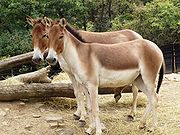
, with the males weighing from 350 to 400 kg (771.6 to 881.8 ), while females weigh 250 to 300 kg (551.2 to 661.4 ). They have a large head, with a blunt muzzle and a convex nose. The mane is upright and relatively short. The coat is a rich chestnut colour, darker brown in winter and a sleek reddish brown in late summer, when the animal molts its woolly fur. The summer coat is 1.5 centimeters long and the winter coat is double that length. The legs, underparts, end of the muzzle, and the inside of the ears are all white. A broad, dark chocolate-coloured dorsal stripe extends from the mane to the end of the tail, which ends in a tuft of blackish brown hairs.
, between the Himalayas in the south and the Kunlun Mountains
in the north. This restricts them almost entirely to China, but small number are found across the borders in the Ladakh
and Sikkim
regions of India
, and along the northern frontier of Nepal
.
Three subspecies of kiang are currently recognised:
The eastern kiang is the largest subspecies; the southern kiang is the smallest. The western kiang is slightly smaller than the eastern and also has a darker coat. However, there is no genetic information confirming the validity of the three subspecies, which may simply represent a cline
, with gradual variation between the three forms.
Kiangs inhabit alpine meadows and steppe
country between 2700 and 5300 m (8,858.3 and 17,388.5 ) elevation. They prefer relatively flat plateaus, wide valleys, and low hills, dominated by grasses, sedges, and smaller amounts of other low-lying vegetation. This open terrain, in addition to supplying them with suitable forage absent in the more arid regions of central Asia, may make it easier for them to detect, and flee from, predators.
s, feeding on grasses and sedges, especially Stipa
, but also including other local plants such as bog sedges
, Carex
, and meadow grass
. When there is little grass available, such as during winter or in the more arid margins of their native habitat, they have been observed eating shrubs, herbs, and even Oxytropis
roots, dug from the ground. Although they do sometimes drink from waterholes, such sources of water are rare on the Tibetan plateau, and it is likely they obtain most of their water from the plants they eat, or possibly from snow in winter.
The only real predator other than humans is the wolf. Kiangs defend themselves by forming a circle and, with heads down kick out violently. As a result wolves usually attack single animals who have strayed from the group.
Kiangs sometimes gather together in large herds, which may number several hundred individuals. However, these herds are not permanent groupings, but temporary aggregations, consisting either of young males only, or of mothers and their foals. Older males are typically solitary, defending a territory of about 0.5 to 5 km² (0.193051079296268 to 1.9 ) from rivals, and dominating any local groups of females. Territorial males sometimes become aggressive towards intruders, kicking and biting at them, but more commonly chase them away after a threat display that involves flattening the ears and braying.
has been variously reported as anything from seven to twelve months, and results in the birth of a single foal. Females are able to breed again almost immediately after birth, although births every other year are more common. Foals weigh up to 35 kilograms (77.2 lb) at birth, and are able to walk within a few hours. The age of sexual maturity is unknown, although probably around three or four years, as it is in the closely related onager. Kiang live for up to twenty years in the wild.
, a Japanese monk who traveled in Tibet from July, 1900 to June 1902, reported:
 Thubten Jigme Norbu, the elder brother of Tenzin Gyatso the 14th Dalai Lama
, reporting on his trip from Kumbum Monastery
in Amdo
to Lhasa in 1950, said that:
Kiang is also a name used by many people of the Malay region, the name originates from "Kyang" as pictured above. In 1823 Sir Kiambang Walsur visited the region and found the kiang's breath to smell sweet like lychee
berries. The Malaysian name "Kiang" can be used as an insult or as a seduction.
Wild ass
Wild ass can refer to:*African Wild Ass*Kiang *Onager *Yukon Wild Horse is sometimes called the Yukon Wild Ass....
es. It is native to the Tibetan Plateau
Tibetan Plateau
The Tibetan Plateau , also known as the Qinghai–Tibetan Plateau is a vast, elevated plateau in Central Asia covering most of the Tibet Autonomous Region and Qinghai, in addition to smaller portions of western Sichuan, southwestern Gansu, and northern Yunnan in Western China and Ladakh in...
, where it inhabits montane and alpine grasslands
Montane grasslands and shrublands
Montane grasslands and shrublands is a biome defined by the World Wildlife Fund. The biome includes high altitude grasslands and shrublands around the world....
. Its current range is restricted to Ladakh
Ladakh
Ladakh is a region of Jammu and Kashmir, the northernmost state of the Republic of India. It lies between the Kunlun mountain range in the north and the main Great Himalayas to the south, inhabited by people of Indo-Aryan and Tibetan descent...
in Jammu and Kashmir
Jammu and Kashmir
Jammu and Kashmir is the northernmost state of India. It is situated mostly in the Himalayan mountains. Jammu and Kashmir shares a border with the states of Himachal Pradesh and Punjab to the south and internationally with the People's Republic of China to the north and east and the...
, plains of the Tibetan plateau
Tibetan Plateau
The Tibetan Plateau , also known as the Qinghai–Tibetan Plateau is a vast, elevated plateau in Central Asia covering most of the Tibet Autonomous Region and Qinghai, in addition to smaller portions of western Sichuan, southwestern Gansu, and northern Yunnan in Western China and Ladakh in...
and northern Nepal
Nepal
Nepal , officially the Federal Democratic Republic of Nepal, is a landlocked sovereign state located in South Asia. It is located in the Himalayas and bordered to the north by the People's Republic of China, and to the south, east, and west by the Republic of India...
along the Tibet
Tibet
Tibet is a plateau region in Asia, north-east of the Himalayas. It is the traditional homeland of the Tibetan people as well as some other ethnic groups such as Monpas, Qiang, and Lhobas, and is now also inhabited by considerable numbers of Han and Hui people...
an border. Other common name
Common name
A common name of a taxon or organism is a name in general use within a community; it is often contrasted with the scientific name for the same organism...
s for this species include Tibetan wild ass, khyang, and gorkhar.
Taxonomy
The kiang is closely related to the onagerOnager
The Onager is a large member of the genus Equus of the family Equidae native to the deserts of Syria, Iran, Pakistan, India, Israel and Tibet...
(Equus hemionus), and in some classifications it is considered a subspecies, E. hemionus kiang. Molecular studies, however, indicate that it is a distinct species. An even closer relative, however, may be the extinct Equus conversidens
Equus conversidens
Equus conversidens Owen 1869, or the Mexican Horse, was a Pleistocene species of horse, now extinct, that inhabited North America.Fossils found in Mexico, Texas, Arizona, New Mexico, Oklahoma, Kansas and Florida have been identified as Equus conversidens...
of Pleistocene America, to which it bears a number of striking similarities; however, such a relationship would require kiangs to have crossed Beringia during the Ice Age, for which there is little evidence. Kiang can crossbreed with onagers, horse
Horse
The horse is one of two extant subspecies of Equus ferus, or the wild horse. It is a single-hooved mammal belonging to the taxonomic family Equidae. The horse has evolved over the past 45 to 55 million years from a small multi-toed creature into the large, single-toed animal of today...
s, donkey
Donkey
The donkey or ass, Equus africanus asinus, is a domesticated member of the Equidae or horse family. The wild ancestor of the donkey is the African Wild Ass, E...
s, and Burchell's zebra
Burchell's Zebra
Burchell's Zebra is a southern subspecies of the Plains Zebra.-Range:Formerly Burchell's zebra ranged north of the Vaal/Orange river system, extending northwest via southern Botswana to Etosha and the Kaokoveld, southeast to Swaziland and Kwazulu-Natal...
s in captivity, although, like mule
Mule
A mule is the offspring of a male donkey and a female horse. Horses and donkeys are different species, with different numbers of chromosomes. Of the two F1 hybrids between these two species, a mule is easier to obtain than a hinny...
s, the resulting offspring are sterile. Kiangs have never been domesticated.
Characteristics
The kiang is the largest of the wild assWild ass
Wild ass can refer to:*African Wild Ass*Kiang *Onager *Yukon Wild Horse is sometimes called the Yukon Wild Ass....
es, with an average shoulder height of . They range from 132 to 142 cm (52 to 55.9 ) high at the shoulder, with a body 182 to 214 cm (71.7 to 84.3 ) long, and a 32 to 45 cm (12.6 to 17.7 ) tail. Kiangs have only slight sexual dimorphism
Sexual dimorphism
Sexual dimorphism is a phenotypic difference between males and females of the same species. Examples of such differences include differences in morphology, ornamentation, and behavior.-Examples:-Ornamentation / coloration:...
, with the males weighing from 350 to 400 kg (771.6 to 881.8 ), while females weigh 250 to 300 kg (551.2 to 661.4 ). They have a large head, with a blunt muzzle and a convex nose. The mane is upright and relatively short. The coat is a rich chestnut colour, darker brown in winter and a sleek reddish brown in late summer, when the animal molts its woolly fur. The summer coat is 1.5 centimeters long and the winter coat is double that length. The legs, underparts, end of the muzzle, and the inside of the ears are all white. A broad, dark chocolate-coloured dorsal stripe extends from the mane to the end of the tail, which ends in a tuft of blackish brown hairs.
Distribution and habitat
Kiangs are found on the Tibetan plateauTibetan Plateau
The Tibetan Plateau , also known as the Qinghai–Tibetan Plateau is a vast, elevated plateau in Central Asia covering most of the Tibet Autonomous Region and Qinghai, in addition to smaller portions of western Sichuan, southwestern Gansu, and northern Yunnan in Western China and Ladakh in...
, between the Himalayas in the south and the Kunlun Mountains
Kunlun Mountains
The Kunlun Mountains are one of the longest mountain chains in Asia, extending more than 3,000 km. In the broadest sense, it forms the northern edge of the Tibetan Plateau south of the Tarim Basin and the Gansu Corridor and continues east south of the Wei River to end at the North China Plain.The...
in the north. This restricts them almost entirely to China, but small number are found across the borders in the Ladakh
Ladakh
Ladakh is a region of Jammu and Kashmir, the northernmost state of the Republic of India. It lies between the Kunlun mountain range in the north and the main Great Himalayas to the south, inhabited by people of Indo-Aryan and Tibetan descent...
and Sikkim
Sikkim
Sikkim is a landlocked Indian state nestled in the Himalayan mountains...
regions of India
India
India , officially the Republic of India , is a country in South Asia. It is the seventh-largest country by geographical area, the second-most populous country with over 1.2 billion people, and the most populous democracy in the world...
, and along the northern frontier of Nepal
Nepal
Nepal , officially the Federal Democratic Republic of Nepal, is a landlocked sovereign state located in South Asia. It is located in the Himalayas and bordered to the north by the People's Republic of China, and to the south, east, and west by the Republic of India...
.
Three subspecies of kiang are currently recognised:
- Equus kiang kiang — Western Kiang (TibetTibetTibet is a plateau region in Asia, north-east of the Himalayas. It is the traditional homeland of the Tibetan people as well as some other ethnic groups such as Monpas, Qiang, and Lhobas, and is now also inhabited by considerable numbers of Han and Hui people...
, Ladakh, southwestern XinjiangXinjiangXinjiang is an autonomous region of the People's Republic of China. It is the largest Chinese administrative division and spans over 1.6 million km2...
) - Equus kiang holdereri — Eastern Kiang (QinghaiQinghaiQinghai ; Oirat Mongolian: ; ; Salar:) is a province of the People's Republic of China, named after Qinghai Lake...
, southeastern Xinjiang) - Equus kiang polyodon — Southern Kiang (southern Tibet, Nepalese border)
The eastern kiang is the largest subspecies; the southern kiang is the smallest. The western kiang is slightly smaller than the eastern and also has a darker coat. However, there is no genetic information confirming the validity of the three subspecies, which may simply represent a cline
Cline
Cline, as spelled, is an Irish surname with historical roots in County Roscommon.People bearing the name include:* Catherine Ann Cline , American historian and author* Edward Cline , American screenwriter and director...
, with gradual variation between the three forms.
Kiangs inhabit alpine meadows and steppe
Steppe
In physical geography, steppe is an ecoregion, in the montane grasslands and shrublands and temperate grasslands, savannas, and shrublands biomes, characterized by grassland plains without trees apart from those near rivers and lakes...
country between 2700 and 5300 m (8,858.3 and 17,388.5 ) elevation. They prefer relatively flat plateaus, wide valleys, and low hills, dominated by grasses, sedges, and smaller amounts of other low-lying vegetation. This open terrain, in addition to supplying them with suitable forage absent in the more arid regions of central Asia, may make it easier for them to detect, and flee from, predators.
Behavior
Like all equids, kiangs are herbivoreHerbivore
Herbivores are organisms that are anatomically and physiologically adapted to eat plant-based foods. Herbivory is a form of consumption in which an organism principally eats autotrophs such as plants, algae and photosynthesizing bacteria. More generally, organisms that feed on autotrophs in...
s, feeding on grasses and sedges, especially Stipa
Stipa
This article is about a type of grass.For Speech Transmission Index for Public Address Systems, see Speech transmission index.For the Italian aircraft designer, see Luigi Stipa...
, but also including other local plants such as bog sedges
Kobresia
Kobresia is a genus of plants in the sedge family. They are sometimes called bog sedges. These perennial sedges are quite similar to Carex species in appearance...
, Carex
Carex
Carex is a genus of plants in the family Cyperaceae, commonly known as sedges. Other members of the Cyperaceae family are also called sedges, however those of genus Carex may be called "true" sedges, and it is the most species-rich genus in the family. The study of Carex is known as...
, and meadow grass
Poa
Poa is a genus of about 500 species of grasses, native to the temperate regions of both hemispheres. Common names include meadow-grass , bluegrass , tussock , and speargrass. "Poa" is Greek for fodder...
. When there is little grass available, such as during winter or in the more arid margins of their native habitat, they have been observed eating shrubs, herbs, and even Oxytropis
Oxytropis
Oxytropis is a genus of plants in the legume family. It is one of two genera of plants known as locoweeds, and are notorious for being toxic to grazing animals. The other locoweed genus is the closely related Astragalus. There are about 300 species native to Eurasia and North America. Several...
roots, dug from the ground. Although they do sometimes drink from waterholes, such sources of water are rare on the Tibetan plateau, and it is likely they obtain most of their water from the plants they eat, or possibly from snow in winter.
The only real predator other than humans is the wolf. Kiangs defend themselves by forming a circle and, with heads down kick out violently. As a result wolves usually attack single animals who have strayed from the group.
Kiangs sometimes gather together in large herds, which may number several hundred individuals. However, these herds are not permanent groupings, but temporary aggregations, consisting either of young males only, or of mothers and their foals. Older males are typically solitary, defending a territory of about 0.5 to 5 km² (0.193051079296268 to 1.9 ) from rivals, and dominating any local groups of females. Territorial males sometimes become aggressive towards intruders, kicking and biting at them, but more commonly chase them away after a threat display that involves flattening the ears and braying.
Reproduction
Kiangs mate between late July and late August, when older males tend reproductive females by trotting around them, and then chasing them prior to mating. The length of gestationGestation
Gestation is the carrying of an embryo or fetus inside a female viviparous animal. Mammals during pregnancy can have one or more gestations at the same time ....
has been variously reported as anything from seven to twelve months, and results in the birth of a single foal. Females are able to breed again almost immediately after birth, although births every other year are more common. Foals weigh up to 35 kilograms (77.2 lb) at birth, and are able to walk within a few hours. The age of sexual maturity is unknown, although probably around three or four years, as it is in the closely related onager. Kiang live for up to twenty years in the wild.
Travellers' accounts
Ekai KawaguchiEkai Kawaguchi
was a Japanese Buddhist monk, famed for his four journeys to Nepal , and two to Tibet , being the first recorded Japanese citizen to travel in either country.Until March, 1891, he had been the Rector of the Zen in Tokyo (February 26, 1866 – February 24, 1945) was a Japanese Buddhist monk,...
, a Japanese monk who traveled in Tibet from July, 1900 to June 1902, reported:
- "As I have already said, khyang is the name given by the Tibetans to the wild horse of their northern steppeSteppeIn physical geography, steppe is an ecoregion, in the montane grasslands and shrublands and temperate grasslands, savannas, and shrublands biomes, characterized by grassland plains without trees apart from those near rivers and lakes...
s. More accurately it is a species of ass, quite as large in size as a large Japanese horse. In color it is reddish brown, with black hair on the ridge of the back and black mane and with the belly white. To all appearance it is an ordinary horse, except for its tufted tail. It is a powerful animal, and it is extraordinarily fleet. It is never seen singly, but always in twos or threes, if not in a herd of sixty or seventy. Its scientific name is Equus hemionis, but is for the most part called by its Tibetan name, which is usually spelled khyang in English. It has a curious habit of turning round and round, when it comes within seeing distance of a man. Even a mile and a quarter away, it will commence this turning round at every short stage of its approach, and after each turn it will stop for a while, to look at the man over its own back, like a fox. Ultimately it comes up quite close. When quite near it will look scared, and at the slightest thing will wheel round and dash away, but only to stop and look back. When one thinks it has run far away, it will be found that it has circled back quite near, to take, as it were, a silent survey of the stranger from behind. Altogether it is an animal of very queer habits."
Dalai Lama
The Dalai Lama is a high lama in the Gelug or "Yellow Hat" branch of Tibetan Buddhism. The name is a combination of the Mongolian word далай meaning "Ocean" and the Tibetan word bla-ma meaning "teacher"...
, reporting on his trip from Kumbum Monastery
Kumbum Monastery
Kumbum Monastery is a Buddhist monastery in Qinghai province, China. Kumbum was founded in 1583 in a narrow valley close to the village of Lusar in the Tibetan cultural region of Amdo. Its superior monastery is Drepung, immediately to the west of Lhasa...
in Amdo
Amdo
Amdo is one of the three traditional regions of Tibet, the other two being Ü-Tsang and Kham; it is also the birth place of the 14th Dalai Lama. Amdo encompasses a large area from the Machu River to the Drichu river . While culturally and ethnically a Tibetan area, Amdo has been administered by a...
to Lhasa in 1950, said that:
- "The kyangs or wild asses, live together in smaller groups, each headed by a stallion, lording it over anything from ten to fifty mares. I was struck by the noble appearance of these beasts; and, in particular, by the beautiful line of head and neck. Their coat is light brown on the back and whitish below the belly, and their long thin tails are almost black; the whole representing excellent camouflage against their natural background. They look wonderfully elegant and graceful when you see them darting across the steppes like arrows, heads stretched out and tails streaming away behind them in the wind. Their rutting season is in the autumn, and then the stallions are at their most aggressive as they jealously guard their harems. The fiercest and most merciless battles take place at this time of the year between the stallion installed and interlopers from other herds. When the battle is over the victor, himself bloody and bruised from savage bites and kicks, leads off the mares in a wild gallop over the steppe.
- We would often see kyangs by the thousand spread over the hillsides and looking inquisitively at our caravan; sometimes they would even surround us, though keeping at some distance."
Kiang is also a name used by many people of the Malay region, the name originates from "Kyang" as pictured above. In 1823 Sir Kiambang Walsur visited the region and found the kiang's breath to smell sweet like lychee
Lychee
The lychee is the sole member of the genus Litchi in the soapberry family, Sapindaceae. It is a tropical and subtropical fruit tree native to Southern China and Southeast Asia, and now cultivated in many parts of the world...
berries. The Malaysian name "Kiang" can be used as an insult or as a seduction.