

Ocellus

Encyclopedia
A simple eye refers to a type of eye
design or optical arrangement that contains a single lens which detect light. A "simple eye" is so-called in distinction from a multi-lensed "compound eye", and is not necessarily at all simple in the usual sense of the word. The eyes of humans
and large animals, and camera lenses are classed as "simple" because in both cases a single lens collects and focuses light onto the retina
or film
. Many insect
s have compound eyes consisting of multiple lenses (up to tens of thousands), each focusing light onto a small number of retinula cells.
The structure of an animal's eye is determined by the environment in which it lives, and the behavioural tasks it must fulfill in order to survive. Arthropod
s differ widely in the habitats in which they live, as well as their visual requirements for finding food or conspecifics, and avoiding predators. Consequently, an enormous variety of eye designs are found in arthropods: nature has repeatedly developed novel solutions to overcome visual problems or limitations (for a review of arthropod visual systems see Warrant, 2006).
and lens
. The apparent eye color in these animals is therefore red or black.
Many snail
s and slug
s (gastropod mollusks) also have ocelli, either at the tip of the tentacles or at the base of the tentacles. However some other gastropods, such as the Strombidae
, have much more sophisticated eyes.
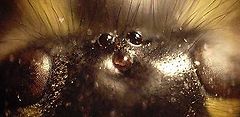 Spiders do not have compound eyes but instead have several pairs of simple eyes with each pair adapted for a specific task or tasks. There are principal and secondary eyes in spiders having four or more pairs of eyes. Only the principal eyes have a retina that can be moved. The secondary eyes have a reflector at the back of the eyes. The light-sensitive part of the receptor cells is next to this so they get direct and reflected light. In hunting or jumping spiders for example, a forward-facing pair possesses the best resolution (and even telescopic components) in order to see the (often small) prey at a large distance. Night-hunting spiders' eyes are very sensitive in low light levels with a large aperture, f/
0.58.
(eye), and literally means "little eye". Two distinct ocellus types exist: dorsal
ocelli (or simply "ocelli"), found in most insects, and lateral ocelli (or stemmata), which are found in the larvae of some insect orders. They are structurally and functionally very different. Simple eyes of other animals, e.g. cnidaria
ns may also be referred to as 'ocelli', but again the structure and anatomy of these eyes is quite distinct from those of the dorsal ocelli of insects.
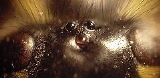
Dorsal ocelli are light-sensitive organs found on the dorsal (top-most) surface or frontal surface of the head of many insects (e.g. Hymenoptera
(bee
s, ant
s, wasp
s, sawflies
), Diptera
(flies), Odonata
(dragonflies
, damselflies
) and Orthoptera
(grasshopper
s, locust
s)). The ocelli co-exist with the compound eyes, thus most insects possess two anatomically separate and functionally different visual pathways.
The number, form, and function of the dorsal ocelli varies markedly throughout insect orders. They tend to be larger and more strongly expressed in flying insects (particularly bees, wasps, dragonflies and locusts), where they are typically found as a triplet. Two lateral ocelli are directed to the left and right of the head respectively, while a central (median) ocellus is directed frontally. In some terrestrial insects (e.g. some ants and cockroaches), only two lateral ocelli are present: the median ocellus is absent. Note that the unfortunately labelled "lateral ocelli" here refers to the sideways-facing position of the ocelli, which are of the dorsal type. They should not be confused with the lateral ocelli of some insect larvae (see stemmata).
A dorsal ocellus consists of a lens element (cornea
) and a layer of photoreceptors (rod cells). As noted above, ocelli vary widely among insect orders. The ocellar lens may be strongly curved (e.g. bees, locusts, dragonflies) or flat (e.g. cockroaches). The photoreceptor layer may (e.g. locusts) or may not (e.g. blowflies, dragonflies) be separated from the lens by a clear zone (vitreous humour
). The number of photoreceptors also varies widely, but may number in the hundreds or thousands for well developed ocelli.
Two somewhat unusual features of the ocelli are particularly notable and generally well conserved between insect orders.
These two factors have led to the conclusion that the dorsal ocelli are incapable of perceiving form, and are thus solely suitable for light metering functions. Given the large aperture and low f-number
of the lens, as well as high convergence ratios and synaptic gains, the ocelli are generally considered to be far more sensitive to light than the compound eyes. Additionally, given the relatively simple neural arrangement of the eye (small number of synapses between detector and effector) as well as the extremely large diameter of some ocellar interneurons (often the largest diameter neurons in the animal's nervous system) the ocelli are typically considered to be "faster" than the compound eyes.
One common theory of ocellar function in flying insects holds that they are used to assist in maintaining flight stability. Given their underfocused nature, wide fields of view, and high light collecting ability, the ocelli are superbly adapted for measuring changes in the perceived brightness of the external world as an insect rolls or pitches around its body axis during flight. Corrective flight responses to light have been demonstrated in locusts and dragonflies in tethered flight. Other theories of ocellar function have ranged from roles as light adaptors or global excitatory organs, polarization sensors, and circadian entrainers.
Recent studies have shown that the ocelli of some insects (most notably the dragonfly, but also some wasps) are capable of form vision as the ocellar lens forms an image within, or close to the photoreceptor layer. In dragonflies it has been demonstrated that the receptive fields of both the photoreceptors and the second-order neurons can be quite restricted. Further research has demonstrated that these eyes not only resolve spatial details of the world, they also perceive motion. Second-order neurons in the dragonfly median ocellus respond more strongly to upwards moving bars and gratings than to downwards moving bars and gratings. However this effect is only present when ultraviolet
light is used in the stimulus; when ultraviolet light is absent, no directional response is observed. Dragonfly ocelli are especially highly developed and specialised visual organs, which may support the exceptional acrobatic abilities of these animals.
Research on the ocelli is of high interest to designers of small unmanned aerial vehicles. Designers of these craft face many of the same challenges that insects face in maintaining stability in a three-dimensional world. Engineers are increasingly taking inspiration from insects in order to overcome these challenges.
s, springtail
s, silverfish
, and Strepsiptera
). They have a similar form to ommatidia, the constituent elements of compound eyes: thus they may not be considered as simple eyes. Behind each lens lies a single cluster of photoreceptor cells, termed a retinula. Their lens is biconvex, and their body contains a vitreous or crystalline core. They may represent simplified compound eyes, reflected by their lateral position on the head. They are possessed by myriapods and some insect larvae.
is allelic to ocelliless, a mutation that stops ocelli being produced. In Drosophila, the rhodopsin Rh2 is only expressed in simple eyes.
Whilst (in Drosophila at least) the genes eyeless and dachshund
are both expressed in the compound eye but not the simple eye, there are no reported developmental genes uniquely expressed in the simple eye.
Egfr (Epidermal growth factor receptor) promotes the expression of orthodenticle (and possibly Eyes absent ('Eya')) and as such is essential for simple eye formation.
Eye
Eyes are organs that detect light and convert it into electro-chemical impulses in neurons. The simplest photoreceptors in conscious vision connect light to movement...
design or optical arrangement that contains a single lens which detect light. A "simple eye" is so-called in distinction from a multi-lensed "compound eye", and is not necessarily at all simple in the usual sense of the word. The eyes of humans
Human eye
The human eye is an organ which reacts to light for several purposes. As a conscious sense organ, the eye allows vision. Rod and cone cells in the retina allow conscious light perception and vision including color differentiation and the perception of depth...
and large animals, and camera lenses are classed as "simple" because in both cases a single lens collects and focuses light onto the retina
Retina
The vertebrate retina is a light-sensitive tissue lining the inner surface of the eye. The optics of the eye create an image of the visual world on the retina, which serves much the same function as the film in a camera. Light striking the retina initiates a cascade of chemical and electrical...
or film
Film
A film, also called a movie or motion picture, is a series of still or moving images. It is produced by recording photographic images with cameras, or by creating images using animation techniques or visual effects...
. Many insect
Insect
Insects are a class of living creatures within the arthropods that have a chitinous exoskeleton, a three-part body , three pairs of jointed legs, compound eyes, and two antennae...
s have compound eyes consisting of multiple lenses (up to tens of thousands), each focusing light onto a small number of retinula cells.
The structure of an animal's eye is determined by the environment in which it lives, and the behavioural tasks it must fulfill in order to survive. Arthropod
Arthropod
An arthropod is an invertebrate animal having an exoskeleton , a segmented body, and jointed appendages. Arthropods are members of the phylum Arthropoda , and include the insects, arachnids, crustaceans, and others...
s differ widely in the habitats in which they live, as well as their visual requirements for finding food or conspecifics, and avoiding predators. Consequently, an enormous variety of eye designs are found in arthropods: nature has repeatedly developed novel solutions to overcome visual problems or limitations (for a review of arthropod visual systems see Warrant, 2006).
Ocelli or eye spots
Jellyfish, sea stars, and flatworms bear the simplest eyes, pigment spot ocelli, which have pigment distributed randomly and which have no additional structures such as a corneaCornea
The cornea is the transparent front part of the eye that covers the iris, pupil, and anterior chamber. Together with the lens, the cornea refracts light, with the cornea accounting for approximately two-thirds of the eye's total optical power. In humans, the refractive power of the cornea is...
and lens
Lens (anatomy)
The crystalline lens is a transparent, biconvex structure in the eye that, along with the cornea, helps to refract light to be focused on the retina. The lens, by changing shape, functions to change the focal distance of the eye so that it can focus on objects at various distances, thus allowing a...
. The apparent eye color in these animals is therefore red or black.
Many snail
Snail
Snail is a common name applied to most of the members of the molluscan class Gastropoda that have coiled shells in the adult stage. When the word is used in its most general sense, it includes sea snails, land snails and freshwater snails. The word snail without any qualifier is however more often...
s and slug
Slug
Slug is a common name that is normally applied to any gastropod mollusc that lacks a shell, has a very reduced shell, or has a small internal shell...
s (gastropod mollusks) also have ocelli, either at the tip of the tentacles or at the base of the tentacles. However some other gastropods, such as the Strombidae
Strombidae
Strombidae, commonly known as the true conchs, is a taxonomic family of medium-sized to very large sea snails, marine gastropod mollusks in the superfamily Stromboidea....
, have much more sophisticated eyes.
Spider eyes
F-number
In optics, the f-number of an optical system expresses the diameter of the entrance pupil in terms of the focal length of the lens; in simpler terms, the f-number is the focal length divided by the "effective" aperture diameter...
0.58.
Dorsal ocelli
The term "ocelli" (singular ocellus) is derived from the LatinLatin
Latin is an Italic language originally spoken in Latium and Ancient Rome. It, along with most European languages, is a descendant of the ancient Proto-Indo-European language. Although it is considered a dead language, a number of scholars and members of the Christian clergy speak it fluently, and...
(eye), and literally means "little eye". Two distinct ocellus types exist: dorsal
Dorsum (biology)
In anatomy, the dorsum is the upper side of animals that typically run, fly, or swim in a horizontal position, and the back side of animals that walk upright. In vertebrates the dorsum contains the backbone. The term dorsal refers to anatomical structures that are either situated toward or grow...
ocelli (or simply "ocelli"), found in most insects, and lateral ocelli (or stemmata), which are found in the larvae of some insect orders. They are structurally and functionally very different. Simple eyes of other animals, e.g. cnidaria
Cnidaria
Cnidaria is a phylum containing over 9,000 species of animals found exclusively in aquatic and mostly marine environments. Their distinguishing feature is cnidocytes, specialized cells that they use mainly for capturing prey. Their bodies consist of mesoglea, a non-living jelly-like substance,...
ns may also be referred to as 'ocelli', but again the structure and anatomy of these eyes is quite distinct from those of the dorsal ocelli of insects.
Dorsal ocelli are light-sensitive organs found on the dorsal (top-most) surface or frontal surface of the head of many insects (e.g. Hymenoptera
Hymenoptera
Hymenoptera is one of the largest orders of insects, comprising the sawflies, wasps, bees and ants. There are over 130,000 recognized species, with many more remaining to be described. The name refers to the heavy wings of the insects, and is derived from the Ancient Greek ὑμήν : membrane and...
(bee
Bee
Bees are flying insects closely related to wasps and ants, and are known for their role in pollination and for producing honey and beeswax. Bees are a monophyletic lineage within the superfamily Apoidea, presently classified by the unranked taxon name Anthophila...
s, ant
Ant
Ants are social insects of the family Formicidae and, along with the related wasps and bees, belong to the order Hymenoptera. Ants evolved from wasp-like ancestors in the mid-Cretaceous period between 110 and 130 million years ago and diversified after the rise of flowering plants. More than...
s, wasp
Wasp
The term wasp is typically defined as any insect of the order Hymenoptera and suborder Apocrita that is neither a bee nor an ant. Almost every pest insect species has at least one wasp species that preys upon it or parasitizes it, making wasps critically important in natural control of their...
s, sawflies
Sawfly
Sawfly is the common name for insects belonging to suborder Symphyta of the order Hymenoptera. Sawflies are distinguishable from most other Hymenoptera by the broad connection between the abdomen and the thorax, and by their caterpillar-like larvae...
), Diptera
Diptera
Diptera , or true flies, is the order of insects possessing only a single pair of wings on the mesothorax; the metathorax bears a pair of drumstick like structures called the halteres, the remnants of the hind wings. It is a large order, containing an estimated 240,000 species, although under half...
(flies), Odonata
Odonata
Odonata is an order of insects, encompassing dragonflies and damselflies . The word dragonfly is also sometimes used to refer to all Odonata, but the back-formation odonate is a more correct English name for the group as a whole...
(dragonflies
Dragonfly
A dragonfly is a winged insect belonging to the order Odonata, the suborder Epiprocta or, in the strict sense, the infraorder Anisoptera . It is characterized by large multifaceted eyes, two pairs of strong transparent wings, and an elongated body...
, damselflies
Damselfly
Damselflies are insects in the order Odonata. Damselflies are similar to dragonflies, but the adults can be distinguished by the fact that the wings of most damselflies are held along, and parallel to, the body when at rest...
) and Orthoptera
Orthoptera
Orthoptera is an order of insects with paurometabolous or incomplete metamorphosis, including the grasshoppers, crickets and locusts.Many insects in this order produce sound by rubbing their wings against each other or their legs, the wings or legs containing rows of corrugated bumps...
(grasshopper
Grasshopper
The grasshopper is an insect of the suborder Caelifera in the order Orthoptera. To distinguish it from bush crickets or katydids, it is sometimes referred to as the short-horned grasshopper...
s, locust
Locust
Locusts are the swarming phase of short-horned grasshoppers of the family Acrididae. These are species that can breed rapidly under suitable conditions and subsequently become gregarious and migratory...
s)). The ocelli co-exist with the compound eyes, thus most insects possess two anatomically separate and functionally different visual pathways.
The number, form, and function of the dorsal ocelli varies markedly throughout insect orders. They tend to be larger and more strongly expressed in flying insects (particularly bees, wasps, dragonflies and locusts), where they are typically found as a triplet. Two lateral ocelli are directed to the left and right of the head respectively, while a central (median) ocellus is directed frontally. In some terrestrial insects (e.g. some ants and cockroaches), only two lateral ocelli are present: the median ocellus is absent. Note that the unfortunately labelled "lateral ocelli" here refers to the sideways-facing position of the ocelli, which are of the dorsal type. They should not be confused with the lateral ocelli of some insect larvae (see stemmata).
A dorsal ocellus consists of a lens element (cornea
Cornea
The cornea is the transparent front part of the eye that covers the iris, pupil, and anterior chamber. Together with the lens, the cornea refracts light, with the cornea accounting for approximately two-thirds of the eye's total optical power. In humans, the refractive power of the cornea is...
) and a layer of photoreceptors (rod cells). As noted above, ocelli vary widely among insect orders. The ocellar lens may be strongly curved (e.g. bees, locusts, dragonflies) or flat (e.g. cockroaches). The photoreceptor layer may (e.g. locusts) or may not (e.g. blowflies, dragonflies) be separated from the lens by a clear zone (vitreous humour
Vitreous humour
The vitreous humour or vitreous humor is the clear gel that fills the space between the lens and the retina of the eyeball of humans and other vertebrates...
). The number of photoreceptors also varies widely, but may number in the hundreds or thousands for well developed ocelli.
Two somewhat unusual features of the ocelli are particularly notable and generally well conserved between insect orders.
- The refractive power of the lens is not typically sufficient to form an image on the photoreceptor layer.
- Dorsal ocelli ubiquitously have massive convergence ratios from first-order (photoreceptor) to second-order neurons.
These two factors have led to the conclusion that the dorsal ocelli are incapable of perceiving form, and are thus solely suitable for light metering functions. Given the large aperture and low f-number
F-number
In optics, the f-number of an optical system expresses the diameter of the entrance pupil in terms of the focal length of the lens; in simpler terms, the f-number is the focal length divided by the "effective" aperture diameter...
of the lens, as well as high convergence ratios and synaptic gains, the ocelli are generally considered to be far more sensitive to light than the compound eyes. Additionally, given the relatively simple neural arrangement of the eye (small number of synapses between detector and effector) as well as the extremely large diameter of some ocellar interneurons (often the largest diameter neurons in the animal's nervous system) the ocelli are typically considered to be "faster" than the compound eyes.
One common theory of ocellar function in flying insects holds that they are used to assist in maintaining flight stability. Given their underfocused nature, wide fields of view, and high light collecting ability, the ocelli are superbly adapted for measuring changes in the perceived brightness of the external world as an insect rolls or pitches around its body axis during flight. Corrective flight responses to light have been demonstrated in locusts and dragonflies in tethered flight. Other theories of ocellar function have ranged from roles as light adaptors or global excitatory organs, polarization sensors, and circadian entrainers.
Recent studies have shown that the ocelli of some insects (most notably the dragonfly, but also some wasps) are capable of form vision as the ocellar lens forms an image within, or close to the photoreceptor layer. In dragonflies it has been demonstrated that the receptive fields of both the photoreceptors and the second-order neurons can be quite restricted. Further research has demonstrated that these eyes not only resolve spatial details of the world, they also perceive motion. Second-order neurons in the dragonfly median ocellus respond more strongly to upwards moving bars and gratings than to downwards moving bars and gratings. However this effect is only present when ultraviolet
Ultraviolet
Ultraviolet light is electromagnetic radiation with a wavelength shorter than that of visible light, but longer than X-rays, in the range 10 nm to 400 nm, and energies from 3 eV to 124 eV...
light is used in the stimulus; when ultraviolet light is absent, no directional response is observed. Dragonfly ocelli are especially highly developed and specialised visual organs, which may support the exceptional acrobatic abilities of these animals.
Research on the ocelli is of high interest to designers of small unmanned aerial vehicles. Designers of these craft face many of the same challenges that insects face in maintaining stability in a three-dimensional world. Engineers are increasingly taking inspiration from insects in order to overcome these challenges.
Stemmata
Stemmata (singular stemma, also referred to as lateral ocelli) are the only eyes of the larvae of several orders of insects (fleaFlea
Flea is the common name for insects of the order Siphonaptera which are wingless insects with mouthparts adapted for piercing skin and sucking blood...
s, springtail
Springtail
Springtails form the largest of the three lineages of modern hexapods that are no longer considered insects...
s, silverfish
Silverfish
Lepisma saccharina, frequently called silverfish, fishmoths, carpet sharks or paramites, are small, wingless insects in the order Thysanura...
, and Strepsiptera
Strepsiptera
The Strepsiptera are an order of insects with ten families making up about 600 species...
). They have a similar form to ommatidia, the constituent elements of compound eyes: thus they may not be considered as simple eyes. Behind each lens lies a single cluster of photoreceptor cells, termed a retinula. Their lens is biconvex, and their body contains a vitreous or crystalline core. They may represent simplified compound eyes, reflected by their lateral position on the head. They are possessed by myriapods and some insect larvae.
Genetic controls
A number of genetic pathways are responsible for the occurrence and positioning of the ocelli. The gene orthodenticleOrthodenticle
Orthodenticle is a homeobox gene involved in head development. It produces a homeodomain protein which controls the development of cells in the developing head of embryos...
is allelic to ocelliless, a mutation that stops ocelli being produced. In Drosophila, the rhodopsin Rh2 is only expressed in simple eyes.
Whilst (in Drosophila at least) the genes eyeless and dachshund
Dachshund (gene)
dachshund is a gene involved in the development of the arthropod compound eye which also plays a role in leg development....
are both expressed in the compound eye but not the simple eye, there are no reported developmental genes uniquely expressed in the simple eye.
Egfr (Epidermal growth factor receptor) promotes the expression of orthodenticle (and possibly Eyes absent ('Eya')) and as such is essential for simple eye formation.
Further reading
External links
- John R. Meyer, Photoreceptors