
All Topics  
Vitreous humour


   Email Print
   Bookmark   Link


Vitreous humour


The vitreous humour (British spelling
American and British English spelling differences

American and British English spelling differences are one aspect of American and British English differences.The spelling systems of Commonwealth of Nations countries, for the most part, closely resemble the British system....
) or vitreous humor (US spelling
American and British English spelling differences

American and British English spelling differences are one aspect of American and British English differences.The spelling systems of Commonwealth of Nations countries, for the most part, closely resemble the British system....
) is the clear gel
Gel

A gel is a solid, gelatin material that can have properties ranging from soft and weak to hard and tough. Gels are defined as a substantially dilute crosslinked system, which exhibits no flow when in the steady-state....
 that fills the space between the lens and the retina
Retina

The vertebrate retina is a light sensitive tissue lining the inner surface of the eye. The optics of the eye create an image of the visual world on the retina, which serves much the same function as the film in a camera....
 of the eyeball of humans and other vertebrates
Vertebrate

Vertebrates are members of the subphylum Vertebrata, chordates with Vertebras or Vertebral columns. The grouping sometimes includes the hagfish, which have no vertebrae, but are genetically quite closely related to lampreys, which do have vertebrae....
. It is often referred to as the vitreous body or simply "the vitreous".

Composition, properties and function
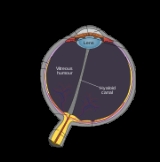
The vitreous is the transparent, colourless, gelatinous mass that fills the space between the lens of the eye and the retina lining the back of the eye.


Discussion
Ask a question about 'Vitreous humour'
Start a new discussion about 'Vitreous humour'
Answer questions from other users
Full Discussion Forum


Recent Posts


Encyclopedia


The vitreous humour (British spelling
American and British English spelling differences

American and British English spelling differences are one aspect of American and British English differences.The spelling systems of Commonwealth of Nations countries, for the most part, closely resemble the British system....
) or vitreous humor (US spelling
American and British English spelling differences

American and British English spelling differences are one aspect of American and British English differences.The spelling systems of Commonwealth of Nations countries, for the most part, closely resemble the British system....
) is the clear gel
Gel

A gel is a solid, gelatin material that can have properties ranging from soft and weak to hard and tough. Gels are defined as a substantially dilute crosslinked system, which exhibits no flow when in the steady-state....
 that fills the space between the lens and the retina
Retina

The vertebrate retina is a light sensitive tissue lining the inner surface of the eye. The optics of the eye create an image of the visual world on the retina, which serves much the same function as the film in a camera....
 of the eyeball of humans and other vertebrates
Vertebrate

Vertebrates are members of the subphylum Vertebrata, chordates with Vertebras or Vertebral columns. The grouping sometimes includes the hagfish, which have no vertebrae, but are genetically quite closely related to lampreys, which do have vertebrae....
. It is often referred to as the vitreous body or simply "the vitreous".

Composition, properties and function


The vitreous is the transparent, colourless, gelatinous mass that fills the space between the lens of the eye and the retina lining the back of the eye. It is produced by certain retinal cells. It contains very few cells (mostly phagocytes which remove unwanted cellular debris in the visual field
Visual field

The term 'visual field' is sometimes used as a synonym to field of view, though they do not designate the same thing. The visual field is the "spatial array of visual sensations available to observation in introspection psychological experiments" , while field of view "refers to the physical objects and light sources in the external world...
, as well as the hyalocytes of Balazs, which reprocess the hyaluronic acid), no blood vessels, and 99% of its volume is water with salts, sugars, vitrosin, and a network of collagen
Collagen

Collagen is the main protein of connective tissue in animals and the most abundant protein in mammals, making up about 25% to 35% of the whole-body protein content....
 type II fibers with the mucopolysaccharide hyaluronic acid accounting for the rest. The water content of the vitreous (98%) is greater than that of the lens (75%). However, the vitreous has a viscosity
Viscosity

Viscosity is a measure of the Drag of a fluid which is being deformed by either shear stress or extensional stress. In everyday terms , viscosity is "thickness"....
 two to four times that of pure water, giving it a gelatinous consistency. It also has a refractive index
Refractive index

The refractive index of a medium is a measure for how much the speed of light is reduced inside the medium. For example, typical soda-lime glass has a refractive index of 1.5, which means that in glass, light travels at times the speed of light in a vacuum....
 of 1.336.

Although the vitreous is in contact with the retina
Retina

The vertebrate retina is a light sensitive tissue lining the inner surface of the eye. The optics of the eye create an image of the visual world on the retina, which serves much the same function as the film in a camera....
 and helps to keep it in place by pressing it against the choroid
Choroid

The choroid, also known as the choroidea or choroid coat, is the Blood vessel layer of the eye lying between the retina and the sclera....
, it does not adhere to the retina, except in three places: around the anterior border of the retina; in the macula
Macula

The macula or macula lutea is an oval-shaped highly pigmented yellow spot near the center of the retina of the human eye. It has a diameter of around 5 mm and is often histologically defined as having two or more layers of ganglion cells....
, the tiny spot in the retina which gives us our "detail" and central vision; and at the optic nerve disc (where the retina sends about 1.2 million nerve fibres (axons) to the brain).

Unlike the fluid in the frontal parts of the eye (aqueous humour
Aqueous humour

The aqueous humor is a thick watery substance that is between the lens and the cornea....
) which is continuously replenished, the gel in the vitreous chamber is stagnant. Therefore, if blood, cells or other byproducts of inflammation get into the vitreous, they will remain there unless removed surgically (see floaters). If the vitreous pulls away from the retina, it is known as a vitreous detachment. As we age, the vitreous often liquefies and may collapse. This is more likely to occur, and occurs much earlier, in eyes that are nearsighted (myopia). It can also occur after injuries to the eye or inflammation in the eye (uveitis
Uveitis

Uveitis specifically refers to inflammation of the middle layer of the eye, termed the "uvea" but in common usage may refer to any inflammatory process involving the interior of the eye, with inflammation specifically of the uvea termed iridocyclitis....
).

Pathology


The collagen
Collagen

Collagen is the main protein of connective tissue in animals and the most abundant protein in mammals, making up about 25% to 35% of the whole-body protein content....
 fibres of the vitreous are held apart by electrical charges. With ageing, these charges tend to reduce, and the fibres may clump together. Similarly, the gel may liquefy, a condition known as syneresis, allowing cells and other organic clusters to float freely within the vitreous humour. These allow floaters which are perceived in the visual field as spots or fibrous strands. Floaters are generally harmless, but the sudden onset of recurring floaters may signify a posterior vitreous detachment
Posterior vitreous detachment

A posterior vitreous detachment is a condition of the eye in which the vitreous humour separates from the retina....
 (PVD) or other diseases of the eye.

Clinical significance


The metabolic exchange and equilibration between systemic circulation
Systemic circulation

Systemic circulation is the portion of the cardiovascular system which carries oxygenated blood away from the heart, to the body, and returns deoxygenated blood back to the heart....
 and vitreous humour is so slow that vitreous humour is sometimes the fluid of choice for postmortem analysis of glucose
Glucose

Glucose , a monosaccharide also known as grape sugar, blood sugar, or corn sugar, is a very important carbohydrate in biology....
 levels or substances which would be more rapidly diffused, degraded, excreted, or metabolized from the general circulation.

External links