
Home      Discussion      Topics      Dictionary      Almanac
Signup       Login
Dragonfly

Dragonfly

Overview

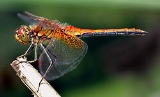
A dragonfly is a type of insect
Insect
Insects are arthropods, having a hard exoskeleton, a three-part body , three pairs of jointed legs, compound eyes, and two antennae. They are the most diverse group of animals on the planet and include more than a million species that are already described. Insects represent more than half of all...

 belonging to the order Odonata
Odonata
Odonata is an order of insects, encompassing dragonflies and damselflies . The word dragonfly is also sometimes used to refer to all Odonata...

, the suborder Epiprocta
Epiprocta
The Epiprocta Lohmann, 1996 is one of the two extant suborders of the Odonata . It is a relatively recently-proposed suborder, having been created to accommodate the inclusion of the Anisozygoptera...

 or, in the strict sense, the infraorder Anisoptera. It is characterized by large multifaceted eyes, two pairs of strong transparent wings
Insect wing
Insect wings are outgrowths of the insect exoskeleton that enable insects to fly. They are found on the second and third thoracic segments , and the two pairs are often referred to as the forewings and hindwings, respectively, though a few insects lack hindwings, even rudiments...

, and an elongated body. Dragonflies are similar to damselflies, but the adults can be differentiated by the fact that the wings of most dragonflies are held away from, and perpendicular to, the body when at rest.
Discussion
Ask a question about 'Dragonfly'
Start a new discussion about 'Dragonfly'
Answer questions from other users
Full Discussion Forum
 
Unanswered Questions
Recent Discussions
Encyclopedia

A dragonfly is a type of insect
Insect
Insects are arthropods, having a hard exoskeleton, a three-part body , three pairs of jointed legs, compound eyes, and two antennae. They are the most diverse group of animals on the planet and include more than a million species that are already described. Insects represent more than half of all...

 belonging to the order Odonata
Odonata
Odonata is an order of insects, encompassing dragonflies and damselflies . The word dragonfly is also sometimes used to refer to all Odonata...

, the suborder Epiprocta
Epiprocta
The Epiprocta Lohmann, 1996 is one of the two extant suborders of the Odonata . It is a relatively recently-proposed suborder, having been created to accommodate the inclusion of the Anisozygoptera...

 or, in the strict sense, the infraorder Anisoptera. It is characterized by large multifaceted eyes, two pairs of strong transparent wings
Insect wing
Insect wings are outgrowths of the insect exoskeleton that enable insects to fly. They are found on the second and third thoracic segments , and the two pairs are often referred to as the forewings and hindwings, respectively, though a few insects lack hindwings, even rudiments...

, and an elongated body. Dragonflies are similar to damselflies, but the adults can be differentiated by the fact that the wings of most dragonflies are held away from, and perpendicular to, the body when at rest. Even though dragonflies possess 6 legs like any other insect, they are not capable of walking.

Dragonflies are valuable predators
Predation
In ecology, predation describes a biological interaction where a predator feeds on its prey, . Predators may or may not kill their prey prior to feeding on them, but the act of predation always results in the death of the prey...

 that eat mosquito
Mosquito
Mosquito is a common insect in the family Culicidae...

es, and other small insects like flies
Fly
True flies are insects of the order Diptera , possessing a single pair of wings on the mesothorax and a pair of halteres, derived from the hind wings, on the metathorax....

, bee
Bee
Bees are flying insects closely related to wasps and ants, and are known for their role in pollination and for producing honey and beeswax. Bees are a monophyletic lineage within the superfamily Apoidea, presently classified by the unranked taxon name Anthophila...

s, ant
Ant
Ants are social insects of the family Formicidae , and along with the related wasps and bees, they belong to the order Hymenoptera. Ants evolved from wasp-like ancestors in the mid-Cretaceous period between 110 and 130 million years ago and diversified after the rise of flowering plants...

s, and butterflies
Butterfly
A butterfly is an insect of the order Lepidoptera. Like all Lepidoptera, butterflies are notable for their unusual life cycle with a larval caterpillar stage, an inactive pupal stage, and a spectacular metamorphosis into a familiar and colourful winged adult form. Most species are day-flying so...

. They are usually found around lakes, ponds, streams and wetland
Wetland
A wetland is an area of land whose soil is saturated with moisture either permanently or seasonally. Such areas may also be covered partially or completely by shallow pools of water. Wetlands include swamps, marshes, and bogs, among others. The water found in wetlands can be saltwater, freshwater,...

s because their larva
Larva
A larva is a young form of animal with indirect development, going through or undergoing metamorphosis ....

e, known as "nymphs
Nymph (biology)
In biology, a nymph is the immature form of some invertebrates, particularly insects, which undergoes in gradual metamorphosis before reaching its adult stage. Unlike a typical larva, a nymph's overall form already resembles that of the adult. In addition, while a nymph moults it never enters a...

", are aquatic.

Life cycle


Female dragonfly lay eggs
Egg (biology)
In most birds and reptiles, an egg is the zygote, resulting from fertilization of the ovum. To enable incubation the egg is usually kept within a favourable temperature range as it nourishes and protects the growing embryo. When the embryo is adequately developed it breaks out of the egg in the...

 in or near water, often on floating or emergent plants. When laying eggs, some species will submerge themselves completely in order to lay their eggs on a good surface. The eggs then hatch into nymphs. Most of a dragonfly's life is spent in the naiad (that is, nymph) form, beneath the water's surface, using extendable jaws
Insect mouthparts
Insects exhibit a range of mouthparts, adapted to particular modes of feeding. The earliest insects had chewing mouthparts...

 to catch other invertebrates
Invertebrate
An invertebrate is an animal without a vertebral column. The group includes 95% of all animal species — all animals except those in the Chordate subphylum Vertebrata ....

 or even vertebrates
Vertebrate
Vertebrates are members of the subphylum Vertebrata, chordates with backbones or spinal columns. About 58,000 species of vertebrates have been described. Vertebrata is the largest subphylum of chordates, and contains many familiar groups of large land animals. Vertebrates comprise cyclostomes, bony...

 such as tadpoles and fish. They breathe through gills in their rectum
Rectum
The rectum is the final straight portion of the large intestine in some mammals, and the gut in others, terminating in the anus. The human rectum is about 12 cm long...

, and can rapidly propel themselves by suddenly expelling water through the anus. In flight the adult dragonfly can propel itself in six directions; upward, downward, forward, back, and side to side. Some nymphs even hunt on land, an aptitude which could easily have been more common in ancient times when terrestrial predators were clumsier.

The larval stage of large dragonflies may last as long as five years. In smaller species, this stage may last between two months and three years. When the larva is ready to metamorphose into an adult, it climbs up a reed
Reed (plant)
Reed is a generic botanical term used to describe numerous tall, grass-like plants of wet places, which are the namesake vegetation of reed beds...

 or other emergent plant. Exposure to air causes the larva to begin breathing. The skin splits at a weak spot behind the head and the adult dragonfly crawls out of its old larval skin, pumps up its wings, and flies off to feed on midges and flies. The adult stage of larger species of dragonfly can last as long as five or six months.

Classification (Anisozygoptera)


Formerly, the Anisoptera were given suborder rank beside the "ancient dragonflies" (Anisozygoptera) which were believed to contain the two living species of the genus Epiophlebia and numerous fossil ones. More recently it turned out that the "anisozygopterans" form a paraphyletic
Paraphyly
In phylogenetics, a group of organisms is said to be paraphyletic if the group contains its most recent common ancestor but does not contain all the descendants of that ancestor.- Relation to monophyletic groups :...

 assemblage of morphologically
Morphology (biology)
In biology morphology is the form, structure and configuration of an organism.This includes aspects of the outward appearance as well as the form and structure of the internal parts like bones and organs...

 primitive relatives of the Anisoptera. Thus, the Anisoptera (true dragonflies) are reduced to an infraorder in the new suborder Epiprocta (dragonflies in general). The artificial grouping Anisozygoptera is disbanded, its members being largely recognized as extinct offshoots at various stages of dragonfly evolution
Evolution
In biology, evolution is change in the genetic material of a population of organisms from one generation to the next. Though changes produced in any one generation are normally small, differences accumulate with each generation and can, over time, cause substantial changes in the population, a...

. The two living species formerly placed there — the Asian relict dragonflies — form the infraorder Epiophlebioptera alongside the Anisoptera.

Dragonflies and damselflies


Damselflies
Damselfly
The Damselfly is an insect in the order Odonata. Damselflies are similar to dragonflies, but the adults can be differentiated by the fact that the wings of most damselflies are held along, and parallel to, the body when at rest...

 (suborder Zygoptera) are often confused with newly moulted dragonflies but once a dragonfly molts it is fully grown. There are other distinctions that set them apart: most damselflies hold their wings at rest together above the torso or held slightly open above (such as in the family Lestidae), whereas most dragonflies at rest hold their wings horizontally or occasionally slightly down and forward. Also, the back wing of the dragonfly broadens near the base, caudal to the connecting point at the body, while the back wing of the damselfly is similar to the front wing. The eyes on a damselfly are apart; in most dragonflies the eyes touch. Notable exceptions are the Petaluridae (Petaltails) and the Gomphidae (Clubtails).

Northern Hemisphere


  • Emperor
    Emperor (dragonfly)
    The Emperor Dragonfly, Anax imperator, is a large and powerful species of European hawker dragonfly of the family Aeshnidae, averaging in length.-Identification:...

    , Anax imperator
  • Keeled Skimmer
    Keeled Skimmer
    The Keeled Skimmer, Orthetrum coerulescens, is a species of European dragonfly.This species resembles the Black-tailed Skimmer but is slimmer and the male has no black tip. Females and immature males lack the black abdominal pattern...

    , Orthetrum coerulescens
  • Black-tailed Skimmer
    Black-tailed Skimmer
    The Black-lined Skimmer, Orthetrum cancellatum, is a European dragonfly.The male has a blue abdomen with a black tip and transparent wings, and the female has a yellowish brown body with black zigzag marks along the abdomen and the transparent wings....

    , Orthetrum cancellatum
  • Common Whitetail
    Common Whitetail
    The Common Whitetail or Long-tailed Skimmer, Libellula lydia is a common dragonfly across much of North America, with a striking and unusual appearance. The male's chunky white body , combined with the brownish-black bands on its otherwise translucent wings, give it a checkered look...

    , Libellula lydia
  • Migrant Hawker
    Migrant Hawker
    The Migrant Hawker is with its length of 63 mm one of the smaller species of hawker dragonflies. The species prefers still or slow-flowing water and can tolerate brackish sites. The flight period is from July to the end of October...

    , Aeshna mixta
  • Azure Hawker
    Azure Hawker
    The Azure Hawker is one of the smaller species of hawker dragonflies, . The flight period is from late May to August...

    , Aeshna caerulea
  • Southern Hawker
    Southern Hawker
    The Southern Hawker , known as the Blue Darner in the Western Hemisphere, is a 70 mm long species of hawker dragonfly.It is large, with a long body...

    , Aeshna cyanea
  • Norfolk Hawker
    Norfolk Hawker
    The Norfolk Hawker , while common in Europe, is an extremely rare species of dragonfly in Great Britain. It has a yellow triangular mark on the second abdominal segment which gave rise to its scientific name. It also has green eyes and clear, untinted wings...

    , Aeshna isosceles
  • Common Hawker
    Common Hawker
    The Common Hawker or Sedge Darner is one of the larger species of hawker dragonflies. It is native to Eurasia and northern North America. The flight period is from June to early October.It is long with a brown body...

    , Aeshna juncea
  • Red-veined Darter
    Red-veined Darter
    The red-veined darter is a dragonfly of the genus Sympetrum. It is a common species in southern Europe and from the 1990s onwards has increasingly been found in northwest Europe, including Britain and Ireland...

    , Sympetrum fonscolombii
  • Common Darter
    Common Darter
    The Common Darter is a dragonfly of the family Libellulidae native to Eurasia. It is one of the most common dragonflies in Europe, occurring in a wide variety of water bodies, though with a preference for breeding in still water such as ponds and lakes...

    , Sympetrum striolatum
  • Vagrant Darter
    Vagrant Darter
    The Vagrant Darter, Sympetrum vulgatum, is a European dragonfly.The species takes it English name from its habit of occasionally appearing as a rare vagrant north of its normal range....

    , Sympetrum vulgatum
  • Yellow-winged Darter
    Yellow-winged Darter
    The yellow-winged darter, Sympetrum flaveolum, is a dragonfly found in Europe and mid and Northern China. Breeding is confined to stagnant water, usually in peat bogs. Although not resident in the United Kingdom it occasionally migrates there in some numbers. Such 'Invasion Years' occurred in 1906,...

    , Sympetrum flaveolum
  • Broad-bodied Chaser
    Broad-bodied Chaser
    The Broad-bodied Chaser, Libellula depressa, is a European dragonfly. The approximate wing-span of the broad-bodied chaser is 70 millimeters. It occurs in Europe except for the northern parts and in Asia eastwards to south-west Siberia...

    , Libellula depressa
  • Four-spotted Chaser
    Four-spotted Chaser
    The Four-spotted Chaser, known in North America as the Four-spotted Skimmer is a dragonfly of the family Libellulidae found frequently throughout Europe, Asia, and North America....

    , Libellula quadrimaculata
  • Scarce Chaser
    Scarce Chaser
    The scarce chaser is a species of dragonfly. The adult male has a bright blue abdomen with patches of black, while the adult female and juvenile male each have a bright orange abdomen. It is about 45 mm in length with an average wingspan of 74 mm. It is distributed throughout Europe...

    , Libellula fulva
  • Green Darner
    Green Darner
    The dragonfly species Anax junius is commonly called the green darner, after its resemblance to a darning-needle. Common throughout North America, it ranges south to Panama and occurs in the West Indies, Tahiti, and Asia from Japan to mainland China...

    , Anax junius
  • Downy Emerald
    Downy Emerald
    The downy emerald is a species of dragonfly. It is metallic green and bronze in color, and its thorax is coated with fine hairs, hence its name. Like most other emeralds, the downy emerald has bright shiny green eyes...

    , Cordulia aenea
  • Blue-eyed Darner
    Blue-eyed Darner
    The Blue-eyed Darner is a dragonfly of the family Aeshnidae.The Blue-eyed Darner is a common dragonfly of the western United States commonly sighted in the sagebrush steppe of the Snake River Plain, occurring east to the Midwest from central Canada and the Dakotas south to west Texas and Oklahoma...

    , Aeshna multicolor
  • Roseate Skimmer
    Roseate Skimmer
    The Roseate Skimmer is a common southern dragonfly. The male of the species has a rose pink and red/maroon colored abdomen. Females of the species have orange-brown abdomens with clear orangish veins and a brownish thorax with a light stripe down back...

    , Orthemis ferruginea
  • Widow Skimmer
    Widow Skimmer
    The Widow Skimmer is one of the group of dragonflies known as King Skimmers. The species occurs commonly across much of the United States except in the higher Rocky Mountains areas....

    , Libellula luctuosa
  • Great Pondhawk, Erythemis vesiculosa
  • Comet Darner, Anax longipes
  • Banded Pennant, Celithemis fasciata
  • Somatochlora margarita
    Somatochlora margarita
    Somatochlora margarita is a species of dragonfly in family Corduliidae. It is endemic to the United States. Its natural habitat is rivers.-Source:* Abbott, J.C. 2005. . Downloaded on 10 August 2007....

    , Somatochlora margarita

  • Southern Hemisphere


    • Glistening Demoiselle
      Phaon iridipennis
      Phaon iridipennis commonly known as the Glistening Demoiselle is a species of damselfly in family Calopterygidae. It is found in Angola, Benin, Botswana, Burkina Faso, Cameroon, Central African Republic, the Republic of the Congo, the Democratic Republic of the Congo, Ivory Coast, Equatorial...

       Phaon iridipennis
    • Dancing Jewel
      Platycypha caligata
      Platycypha caligata is a species of damselfly in family Chlorocyphidae. It is found in Angola, Botswana, Ethiopia, Guinea-Bissau, Kenya, Malawi, Mozambique, Namibia, Somalia, South Africa, Tanzania, Uganda, Zambia, Zimbabwe, possibly Burundi, and possibly the Republic of the Congo...

       Platycypha caligata
    • Mountain Malachite Chlorolestes fasciatus
    • Common Spreadwing
      Lestes plagiatus
      Lestes plagiatus is a species of damselfly in family Lestidae.It is found in Angola, Botswana, Kenya, Malawi, Mozambique, Nigeria, South Africa, Sudan, Tanzania, Uganda, Zambia, Zimbabwe, and possibly Burundi...

       Lestes plagiatus
    • Common Threadtail
      Elattoneura glauca
      Elattoneura glauca is a species of damselfly in the family Protoneuridae. It is found in Angola, Botswana, the Democratic Republic of the Congo, Equatorial Guinea, Ethiopia, Kenya, Malawi, Mozambique, Namibia, Somalia, South Africa, Tanzania, Uganda, Zambia, Zimbabwe, possibly Burkina Faso, and...

       Elattoneura glauca
    • Goldtail Allocnemis leucosticta
    • Swamp Bluet
      Africallagma glaucum
      Africallagma glaucum is a species of damselfly in family Coenagrionidae. It is found in Botswana, Gabon, Ghana, Kenya, Malawi, Mozambique, Namibia, Nigeria, Réunion, South Africa, Tanzania, Uganda, Zambia, Zimbabwe, and possibly Burundi...

       Africallagma glaucum
    • Pinhey's Whisp
      Agriocnemis pinheyi
      Agriocnemis pinheyi is a species of damselfly in family Coenagrionidae. It is found in Mozambique, South Africa, Tanzania, Zambia, Zimbabwe, and possibly Malawi. Its natural habitats are intermittent freshwater lakes, freshwater marshes, and freshwater springs.-References:* Clausnitzer, V. 2005. ....

       Agriocnemis pinheyi
    • Black-tailed Bluet
      Azuragrion nigridorsum
      Azuragrion nigridorsum is a species of damselfly in family Coenagrionidae. It is found in Angola, Botswana, Cameroon, Ethiopia, Kenya, Malawi, Mozambique, Namibia, Niger, South Africa, Sudan, Tanzania, Uganda, Zambia, and Zimbabwe...

       Azuragrion nigridorsum
    • Common Citril
      Ceriagrion glabrum
      Ceriagrion glabrum is a species of damselfly in family Coenagrionidae. It is found in Angola, Botswana, Burkina Faso, Burundi, Cameroon, Chad, the Republic of the Congo, the Democratic Republic of the Congo, Ivory Coast, Egypt, Equatorial Guinea, Ethiopia, Gabon, Gambia, Ghana, Guinea, Kenya,...

       Ceriagrion glabrum
    • Yellow-faced Sprite Pseudagrion citricola
    • Gambel's Sprite
      Pseudagrion gamblesi
      Pseudagrion gamblesi is a species of damselfly in family Coenagrionidae. It is found in Angola, Botswana, Ethiopia, Kenya, Malawi, South Africa, Tanzania, Uganda, Zambia, Zimbabwe, and possibly Burundi...

       Pseudagrion gamblesi
    • Hagen's Sprite
      Pseudagrion hageni
      Pseudagrion hageni is a species of damselfly in family Coenagrionidae. It is found in Angola, Kenya, Malawi, Mozambique, South Africa, Tanzania, Uganda, Zambia, Zimbabwe, possibly Burundi, and possibly the Republic of the Congo. Its natural habitats are subtropical or tropical moist lowland forests...

       Pseudagrion hageni
  • Hamon's Sprite
    Pseudagrion hamoni
    Pseudagrion hamoni is a species of damselfly in family Coenagrionidae. It is found in Algeria, Benin, Botswana, Burkina Faso, Cameroon, Central African Republic, Chad, the Republic of the Congo, Ivory Coast, Egypt, Gambia, Ghana, Guinea, Kenya, Libya, Malawi, Mali, Mauritania, Mozambique, Namibia,...

     Pseudagrion hamoni
  • Kersten's Sprite Psuedagrion kersteni
  • Masai Sprite
    Pseudagrion massaicum
    Pseudagrion massaicum is a species of damselfly in family Coenagrionidae. It is found in Angola, Botswana, Comoros, the Democratic Republic of the Congo, Ethiopia, Ghana, Kenya, Malawi, Namibia, Somalia, South Africa, Sudan, Tanzania, Uganda, Zambia, Zimbabwe, possibly Burundi, and possibly Guinea...

     Pseudagrion massaicum
  • Salisbury Sprite
    Pseudagrion salisburyense
    Pseudagrion salisburyense is a species of damselfly in the family Coenagrionidae. It is found in Angola, Botswana, Ethiopia, Kenya, Malawi, Mozambique, Namibia, Somalia, South Africa, Tanzania, Uganda, Zambia, Zimbabwe, and possibly Burundi...

     Pseudagrion salisburyense
  • Natal Sprite
    Pseudagrion spernatum
    Pseudagrion spernatum is a species of damselfly in the family Coenagrionidae. It is found in Angola, the Democratic Republic of the Congo, Ethiopia, Kenya, Malawi, Mozambique, South Africa, Tanzania, Uganda, Zambia, Zimbabwe, possibly Burundi, and possibly the Republic of the Congo...

     Pseudagrion spernatum
  • Orange Emperor
    Anax speratus
    Anax speratus is a species of dragonfly in family Aeshnidae. It is found in Angola, Botswana, the Democratic Republic of the Congo, Ethiopia, Ghana, Kenya, Malawi, Mozambique, Namibia, Nigeria, Sierra Leone, Somalia, South Africa, Sudan, Tanzania, Togo, Uganda, Zambia, Zimbabwe, and possibly Burundi...

     Anax speratus
  • Common Thorntail Ceratogomphus pictus
  • Yellowjack Notogomphus praetorius
  • Rock Hooktail
    Paragomphus cognatus
    Paragomphus cognatus is a species of dragonfly in family Gomphidae. It is found in Angola, Ivory Coast, Ethiopia, Kenya, Malawi, Mozambique, Namibia, Nigeria, Sierra Leone, South Africa, Tanzania, Uganda, Zambia, Zimbabwe, and possibly Burundi...

     Paragomphus cognatus
  • Acisoma
    Acisoma
    Acisoma is a genus of dragonfly in family Libellulidae. It contains the following species:* Acisoma panorpoides* Acisoma trifidum...

     Acisoma panorpoides and Acisoma trifidum
  • Banded Groundling
    Brachythemis leucosticta
    Brachythemis leucosticta is a species of dragonfly in family Libellulidae. It is found in Algeria, Angola, Botswana, Burkina Faso, Chad, the Democratic Republic of the Congo, Ivory Coast, Egypt, Ethiopia, Gambia, Ghana, Guinea, Guinea-Bissau, Kenya, Madagascar, Malawi, Mali, Mauritania, Morocco,...

     Brachythemis leucosticta
  • Broad Scarlet Crocothemis erythraea
  • Little Scarlet
    Crocothemis sanguinolenta
    Crocothemis sanguinolenta is a species of dragonfly in family Libellulidae. It is found in Angola, Botswana, Cameroon, Central African Republic, Chad, the Democratic Republic of the Congo, Ivory Coast, Egypt, Ethiopia, Ghana, Guinea, Kenya, Liberia, Madagascar, Malawi, Mali, Mozambique, Namibia,...

     Crocothemis sanguinolenta
  • Black Percher
    Diplacodes lefebvrii
    Diplacodes lefebvrii is a species of dragonfly in family Libellulidae. It is found in Algeria, Angola, Botswana, Burkina Faso, Cameroon, Chad, Ivory Coast, Egypt, Equatorial Guinea, Ethiopia, Gambia, Ghana, Guinea, Guinea-Bissau, Kenya, Liberia, Madagascar, Malawi, Mali, Mauritius, Morocco,...

     Diplacodes lefebvrii
  • Black-tailed Skimmer
    Black-tailed Skimmer
    The Black-lined Skimmer, Orthetrum cancellatum, is a European dragonfly.The male has a blue abdomen with a black tip and transparent wings, and the female has a yellowish brown body with black zigzag marks along the abdomen and the transparent wings....

     Nesciothemis farinosa
  • Two-striped Skimmer
    Orthetrum caffrum
    Orthetrum caffrum is a species of dragonfly in family Libellulidae. It is found in Angola, Cameroon, Chad, Ivory Coast, Ethiopia, Guinea, Kenya, Malawi, Mozambique, Namibia, Sierra Leone, South Africa, Sudan, Tanzania, Uganda, Zambia, Zimbabwe, possibly Burundi, and possibly Gambia...

     Orthetrum caffrum
  • Epaulet Skimmer
    Orthetrum chrysostigma
    Orthetrum chrysostigma is a species of dragonfly in family Libellulidae. It is found in Algeria, Angola, Benin, Botswana, Burkina Faso, Cameroon, Central African Republic, Chad, the Democratic Republic of the Congo, Ivory Coast, Egypt, Equatorial Guinea, Ethiopia, Gambia, Ghana, Guinea, Kenya,...

     Orthetrum chrysostigma
  • Julia Skimmer
    Orthetrum julia
    Orthetrum julia is a species of dragonfly in family Libellulidae. It is found in Angola, Benin, Burkina Faso, Cameroon, Central African Republic, the Republic of the Congo, the Democratic Republic of the Congo, Ivory Coast, Equatorial Guinea, Ethiopia, Gabon, Gambia, Ghana, Guinea, Kenya, Liberia,...

     Orthetrum julia
  • St. Lucia Widow
    Palpopleura portia
    Palpopleura portia is a species of dragonfly in family Libellulidae. It is found in Angola, Botswana, Burkina Faso, Central African Republic, the Democratic Republic of the Congo, Ivory Coast, Equatorial Guinea, Ethiopia, Gambia, Kenya, Madagascar, Malawi, Mozambique, Namibia, Nigeria, Senegal,...

     Palpopleura portia
  • Nomad Sympetrum fonscolombii
  • Red-veined Dropwing Trithemas arteriosa
  • Navy Dropwing
    Trithemis furva
    Trithemis furva is a species of dragonfly in family Libellulidae. It is found in Angola, Cameroon, Chad, Ivory Coast, Equatorial Guinea, Ethiopia, Guinea, Kenya, Liberia, Madagascar, Malawi, Mozambique, Namibia, Nigeria, Sierra Leone, Somalia, South Africa, Sudan, Tanzania, Uganda, Zambia,...

     Trithemis furva
  • Kirby's Dropwing
    Trithemis kirbyi
    Orange-winged Dropwing is a species of dragonfly in family Libellulidae. It is found in Algeria, Angola, Benin, Botswana, Burkina Faso, Chad, Comoros, the Democratic Republic of the Congo, Ivory Coast, Egypt, Ethiopia, Gambia, Ghana, Guinea, Kenya, Liberia, Madagascar, Malawi, Morocco, Mozambique,...

     Trithemis kirbyi
  • Jaunty Dropwing
    Trithemis stictica
    Trithemis stictica is a species of dragonfly in family Libellulidae. It is found in Angola, Botswana, Cameroon, the Democratic Republic of the Congo, Ivory Coast, Ethiopia, Ghana, Guinea, Kenya, Liberia, Madagascar, Malawi, Mozambique, Namibia, Nigeria, Sierra Leone, Somalia, South Africa, Sudan,...

     Trithemis stictica

  • Dragonflies in culture


    In Europe, dragonflies have often been seen as sinister. Some English vernacular names, such as "devil
    Devil
    The Devil is believed in certain religions and folklore to be a powerful, supernatural entity that is the personification of evil and the enemy of God and humankind. The Devil is commonly associated with heretics, infidels, and other unbelievers...

    's darning needle" and "ear cutter", link them with evil or injury. A Romania
    Romania
    Romania is a country located in Southeastern and Central Europe, North of the Balkan Peninsula, on the Lower Danube, within and outside the Carpathian arch, bordering on the Black Sea. Almost all of the Danube Delta is located within its territory...

    n folk tale
    Folklore
    Folklore is the body of expressive culture, including stories, music, dance, legends, oral history, proverbs, jokes, popular beliefs, customs, and so forth within a particular population comprising the traditions of that culture, subculture, or group. It is also the set of practices through which...

     says that the dragonfly was once a horse
    Horse
    The horse is a hoofed mammal, a subspecies of one of seven extant species of the family Equidae. The horse has evolved over the past 45 to 55 million years from a small multi-toed creature into the large, single-toed animal of today...

     possessed by the devil. Swedish
    Sweden
    Sweden , officially the Kingdom of Sweden , is a Nordic country on the Scandinavian Peninsula in Northern Europe...

     folklore holds that the devil uses dragonflies to weigh people's souls. Another Swedish legend holds that troll
    Troll
    A troll is a member of a race of fearsome creatures from Norse mythology.Originally more or less the Nordic equivalents of giants, although often smaller in size, the different depictions have come to range from the fiendish giants – similar to the ogres of England – to a devious, more human-like...

    s use the dragonflies as spindles
    Spindle (textiles)
    A spindle is a wooden spike weighted at one end with a circular whorl; it may have an optional hook at either end of the spike. It is used for spinning wool and other fibers into thread...

     when weaving their clothes (hence the Swedish word for dragonfly trollslända, lit. "troll's spindle") as well as sending them to poke out the eyes of their enemies. The Norwegian
    Norwegian language
    Norwegian is a North Germanic language spoken primarily in Norway, where it is an official language. Together with Swedish and Danish, Norwegian forms a continuum of more or less mutually intelligible local and regional variants ...

     name for dragonflies is "Øyenstikker", which literally means Eye Poker and in Portugal
    Portugal
    Portugal , officially the Portuguese Republic , is a country located in southwestern Europe on the Iberian Peninsula. Portugal is the westernmost country of mainland Europe and is bordered by the Atlantic Ocean to the west and south and by Spain to the north and east...

     they are sometimes called "Tira-olhos" (Eye snatcher). They are often associated with snake
    Snake
    Snakes are elongate legless carnivorous reptiles of the suborder Serpentes that can be distinguished from legless lizards by their lack of eyelids and external ears. Like all squamates, snakes are ectothermic amniote vertebrates covered in overlapping scales...

    s, as in the Welsh
    Welsh language
    Welsh is a member of the Brythonic branch of Celtic spoken natively in Wales, in England by some along the Welsh border and in the Welsh immigrant colony in the Chubut Valley in Argentine Patagonia....

     name gwas-y-neidr, "adder
    Adder
    Adder may refer to:Snakes:* Any venomous snake* Vipera berus, a.k.a. the common European adder, a venomous viper found in Europe and northern Asia...

    's servant". The Southern United States
    Southern United States
    The Southern United States—commonly referred to as the American South, Dixie, Down South, or simply the South—constitutes a large distinctive region in the southeastern and south-central United States...

     term "snake doctor" refers to a folk belief that dragonflies follow snakes around and stitch them back together if they are injured. The Lithuanian word "Laum žirgis" is a composite word meaning "the Lauma
    Lauma
    Latvian: Lauma, Lithuanian: Laumė is a woodland fae, and guardian spirit of orphans in Eastern Baltic mythology. Originally a sky spirit, her compassion for human suffering brought her to earth to share our fate.-In Latvian mythology:...

    's horse", while in Dutch, Aeshna mixta is called "Paardenbijter" or "horse biter". In some South American countries, dragonflies are also called matacaballo (horse killer), or caballito del diablo (devil's little horse), since they were perceived as harmful, some species being quite large for an insect.

    In East Asia and among Native Americans, dragonflies have a far better reputation, one that can also be said to have positively influenced modern day views about dragonflies in most countries, in the same vein as the insect's namesake, the dragon
    Dragon
    Dragons are legendary creatures, typically with serpentine or otherwise reptilian traits, that feature in the myths of worldwide cultures.The two most familiar interpretations of dragons are European dragons, derived from various European folk traditions, and the unrelated Oriental dragons, such as...

    , which has a positive image in the east, but initially had an association with evil in the west.

    For some Native American tribes they represent swiftness and activity, and for the Navajo
    Navajo people
    The Navajo or Diné of the Southwestern United States are the second largest Native American tribe of Northern America. In the 2000 U.S. census, 298,197 people claimed to be fully or partly of Navajo ancestry. The Navajo Nation constitutes an independent governmental body which manages the Navajo...

     they symbolize pure water. Dragonflies are a common motif in Zuni
    Zuni
    The Zuni or A:shiwi are a Native American tribe, one of the Pueblo peoples, most of whom live in the Pueblo of Zuni on the Zuni River, a tributary of the Little Colorado River, in western New Mexico, United States...

     pottery; stylized as a double-barred cross, they appear in Hopi
    Hopi
    The Hopi are American Indians people who primarily live on the 12,635 km² Hopi Reservation in northeastern Arizona. The Hopi Reservation is entirely surrounded by the much larger Navajo Reservation. The two nations used to share the Navajo-Hopi Joint Use Area...

     rock art and on Pueblo
    Pueblo people
    The Pueblo people are a Native American people in the Southwestern United States. Their traditional economy is based on agriculture and trade. When first encountered by the Spanish in the 16th century, they were living in villages that the Spanish called pueblos, meaning "villages"...

     necklaces. It is said in some Native American beliefs that dragonflies are a symbol of renewal after a time of great hardship.

    They also have traditional uses as medicine in Japan and China. In some parts of the world they are a food source, eaten either as adults or larvae; in Indonesia
    Indonesia
    The Republic of Indonesia is a country in Southeast Asia and Oceania. Indonesia comprises 17,508 islands. With an estimated population of around 237 million people, it is the world's fourth most populous country, with the world's largest population of Muslims.Indonesia is a republic, with an...

    , for example, they are caught on poles made sticky with birdlime
    Birdlime
    Birdlime is a viscid, adhesive substance used in trapping birds. It is spread on a branch or twig, upon which a bird may land and be caught. Its use is illegal in many countries....

    , then fried in oil as a delicacy.

    Vietnamese people
    Vietnamese people
    The Vietnamese people are an ethnic group originating from what is now northern Vietnam and southern China. They are the majority ethnic group of Vietnam, comprising 86% of the population as of the 1999 census, and are officially known as Kinh to distinguish them from other ethnic groups in Vietnam...

     have a traditional way to forecast rain
    Rain
    Rain is liquid precipitation, as opposed to other kinds of precipitation such as snow, hail and sleet. On Earth, it is the condensation of atmospheric water vapor into drops heavy enough to fall, often making it to the surface...

     by seeing dragonflies: "Chuồn chuồn bay thấp thì mưa, bay cao thì nắng, bay vừa thì râm" (Dragonflies fly at low level, it is rainy; dragonflies fly at high level, it is sunny; dragonflies fly at medium level, it is shadowy).

    In some parts of the world it is considered lucky to have a dragonfly land on you, even to the point of yielding seven years of good luck.

    In the United States dragonflies and damselflies
    Damselfly
    The Damselfly is an insect in the order Odonata. Damselflies are similar to dragonflies, but the adults can be differentiated by the fact that the wings of most damselflies are held along, and parallel to, the body when at rest...

     are sought out as a hobby similar to birding and butterflying, known as oding, from the dragonfly's Latin species name, odonata. Oding is especially popular in Texas, where 225 out of a total of 457 known species of odonates in the world have been observed. With care, dragonflies can be handled and released by Oders, like butterflies.

    Images of dragonflies were common in Art Nouveau
    Art Nouveau
    Art Nouveau is an international movement and style of art, architecture and applied art—especially the decorative arts—that peaked in popularity at the turn of the 20th century . The name 'Art nouveau' is French for 'new art'...

    , especially in jewelry designs and appear in posters by artists such as Maeve Harris
    Maeve Harris
    Maeve Harris is a Seattle-based American abstract painter noted for merging "nature and the abstract". Her paintings were featured prominently on episodes of the TV show Celebrity Apprentice. Her paintings have appeared in posters. She was represented by New Era in 2002 and exclusively by Grand...

    . They have also been used as a decorative motif on fabrics and home furnishings.

    Japan


    In Japan
    Japan
    is an island country in East Asia. Located in the Pacific Ocean, it lies to the east of the Sea of Japan, People's Republic of China, North Korea, South Korea and Russia, stretching from the Sea of Okhotsk in the north to the East China Sea and Taiwan in the south...

     dragonflies symbolize "martial success," due to similarity in the sound of the word "dragonfly" and "victory" in Japanese. As a seasonal symbol, the dragonfly is associated with late summer
    Summer
    Summer is one of the four temperate seasons, marked by the time of year with the longest days, and lies between spring and autumn. The seasons are popularly considered to start on different dates in different cultures based on astronomy and regional meteorology. When it is summer in the southern...

     and early autumn.

    More generally, in Japan dragonflies are symbols of courage, strength, and happiness, and they often appear in art and literature, especially haiku
    Haiku
    ' , plural haiku, is a form of Japanese poetry, consisting of 17 moras , in three metrical phrases of 5, 7, and 5 moras respectively. Haiku typically contain a kigo, or seasonal reference, and a kireji or verbal caesura...

    . In ancient mythology, Japan was known as Akitsushima, which means "Land of the Dragonflies". The love for dragonflies is reflected by the fact that there are traditional names for almost all of the 200 species of dragonflies found in and around Japan. Japanese children catch large dragonflies as a game, using a hair with a small pebble tied to each end, which they throw into the air. The dragonfly mistakes the pebbles for prey, gets tangled in the hair, and is dragged to the ground by the weight.

    Also, in Japan
    Japan
    is an island country in East Asia. Located in the Pacific Ocean, it lies to the east of the Sea of Japan, People's Republic of China, North Korea, South Korea and Russia, stretching from the Sea of Okhotsk in the north to the East China Sea and Taiwan in the south...

    , amongst the Three Great Spears of Japan is one which is called the Tonbogiri
    Tonbogiri
    The is one of three legendary Japanese spears created by the famed swordsmith Masazane, said to be wielded by the daimy%C5%8D Honda Tadakatsu. The spear derives its name from the myth that a dragonfly landed on its blade and was instantly cut in two...

    , which when translated is called 'The Dragon Fly Cutter'. The spear is an important part of Japan's imperial regalia - the spear itself was once wielded by the legendary Samurai
    Samurai
    is the term for the military nobility of pre-industrial Japan. According to translator William Scott Wilson: "In Chinese, the character 侍 was originally a verb meaning to wait upon or accompany a person in the upper ranks of society, and this is also true of the original term in Japanese, saburau...

    , Honda Tadakatsu
    Honda Tadakatsu
    ' , also called Honda Heihachirō , was a Japanese general of the late Sengoku through early Edo period, who served Tokugawa Ieyasu.- Biography :...

    . Its name is derived from the story that the blade is so sharp, a dragonfly once landed on it and was instantly cut in half.

    Other


    In drug references, several drugs have been synthesized that have molecule structures resembling Dragonflies. For instance Bromo-dragonfly
    Bromo-DragonFLY
    Bromo-DragonFLY, also known as ABDF, or "Placid" is a psychedelic hallucinogenic drug related to the phenethylamine family. Bromo-DragonFLY is considered an extremely potent hallucinogen, only slightly less potent than LSD with a normal dose in the region of 200 μg to 800 μg, and it has an...

     and 2C-B-FLY
    2C-B-FLY
    2C-B-FLY is a psychedelic phenethylamine of the 2C family. It was first synthesized by Aaron P. Monte, and is sometimes used as an entheogen.-Chemistry:...

    . The names reflect the dragonfly appearance.

    External links