
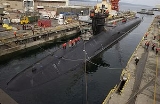
The Ohio class is a class of
nuclear-poweredNuclear power is the use of sustained nuclear fission to generate heat and electricity. Nuclear power plants provide about 6% of the world's energy and 13–14% of the world's electricity, with the U.S., France, and Japan together accounting for about 50% of nuclear generated electricity...
submarines used by the
United States NavyThe United States Navy is the naval warfare service branch of the United States Armed Forces and one of the seven uniformed services of the United States. The U.S. Navy is the largest in the world; its battle fleet tonnage is greater than that of the next 13 largest navies combined. The U.S...
. The United States has 18 Ohio-class submarines:
- 14 nuclear-powered SSBNs (fleet ballistic missile submarines (FBM)), each armed with up to 24 Trident II
UGM-133 Trident II, or Trident D5 is a submarine-launched ballistic missile, built by Lockheed Martin Space Systems in Sunnyvale, California, and deployed with the US Navy and Royal Navy. It was first deployed in 1990, and is still in service....
SLBMs; they are also known as "Trident" submarinesTrident submarine may refer to the following classes of submarine.*Ohio class submarine of the United States Navy, armed with Trident Ballistic Missiles or Cruise Missiles ....
, and provide the sea-based leg of the nuclear triadA nuclear triad refers to a nuclear arsenal which consists of three components, traditionally strategic bombers, ICBMs and SLBMs. The purpose of having a three-branched nuclear capability is to significantly reduce the possibility that an enemy could destroy all of a nation's nuclear forces in a...
of the United States strategic nuclear weapons arsenal
- 4 nuclear-powered SSGNs (cruise missile submarines), each capable of carrying 154 Tomahawk
The Tomahawk is a long-range, all-weather, subsonic cruise missile. Introduced by General Dynamics in the 1970s, it was designed as a medium- to long-range, low-altitude missile that could be launched from a surface platform. It has been improved several times and, by way of corporate divestitures...
cruise missiles with either conventional or nuclear warheads
The Ohio class is named after the lead submarine of this class, the formerly designated SSBN-726. The 14 Trident II SSBNs together carry approximately fifty percent of the total US strategic warhead inventory. The exact number varies in an unpredictable and classified manner, at or below a maximum set by various strategic arms limitation treaties. Although the missiles have no pre-set targets when the submarine goes on patrol, the platform, when required, is capable of rapid targeting using secure and constant at-sea
communications linksCommunication with submarines is difficult because radio waves do not travel well through thick electrical conductors like salt water.The obvious solution is to surface and raise an antenna above the water, then use ordinary radio transmissions. Early submarines had to frequently surface anyway for...
.
Ohio class submarines are the largest constructed for the U.S. Navy. Two classes of Russian submarines have larger total displacements: the Soviet-designed s have more than twice the total displacement, and the Russian Federation's s have roughly 25% greater total displacement, but are shorter by 3 foot (0.9144 m). Ohio class boats can carry more missiles and warheads than either.
Ohios were specifically designed for extended deterrence patrols. Each submarine is complemented by two crews, Blue and Gold (standard practice for US FBMs), with each crew typically serving 70-90 day patrols. To decrease the time in port for crew turnover and replenishment, three large logistics hatches are fitted to provide large diameter resupply and repair openings. These hatches allow rapid transfer of supply pallets, equipment replacement modules, and machinery components, significantly reducing the time required for replenishment and maintenance.
The class design allows the vessel to operate for over fifteen years between major overhauls. The boats are purported to be as quiet at their cruising speed of 20 kn (39.2 km/h; 24.4 mph) or more as previous subs were at 6 kn (11.8 km/h; 7.3 mph), although exact information remains classified.
Ohios were constructed from sections of hull, each four-deck section 42 ft (12.8 m) in diameter. The sections were produced at
Quonset PointQuonset Point, also known simply as Quonset, is a small peninsula in Narragansett Bay in the U.S. state of Rhode Island. It is contained entirely within the town of North Kingstown. "Quonset" is a Native American word likely meaning "small long place".Quonset Point was the location of Naval Air...
,
Rhode IslandThe state of Rhode Island and Providence Plantations, more commonly referred to as Rhode Island , is a state in the New England region of the United States. It is the smallest U.S. state by area...
, and assembled by
Electric BoatWhile a significant majority of water vessels are powered by diesel engines, with sail power and gasoline engines also remaining popular, boats powered by electricity have been used for over 120 years. Electric boats were very popular from the 1880s until the 1920s, when the internal combustion...
at Groton. Fire control for the
Mark 48The Mark 48 and its improved ADCAP variant are heavyweight submarine-launched torpedoes. They were designed to sink fast, deep-diving nuclear-powered submarines and high-performance surface ships.-History:...
torpedoThe modern torpedo is a self-propelled missile weapon with an explosive warhead, launched above or below the water surface, propelled underwater towards a target, and designed to detonate either on contact with it or in proximity to it.The term torpedo was originally employed for...
es is by Mark 118 Mod 2 system, while the Missile Fire Control (MFC) system is a Mark 98.
Except for , the Ohio class submarines are named after states in the United States.
History
The first eight Ohio class submarines were originally equipped with up to 24
Trident I (C4)The Trident missile is a submarine-launched ballistic missile equipped with multiple independently-targetable reentry vehicles . The Fleet Ballistic Missile is armed with nuclear warheads and is launched from nuclear-powered ballistic missile submarines . Trident missiles are carried by fourteen...
submarine-launched ballistic missileA submarine-launched ballistic missile is a ballistic missile capable of delivering a nuclear warhead that can be launched from submarines. Modern variants usually deliver multiple independently targetable reentry vehicles each of which carries a warhead and allows a single launched missile to...
s. Beginning with the ninth Trident submarine, , the remaining boats were equipped with the
Trident II (D5)The Trident missile is a submarine-launched ballistic missile equipped with multiple independently-targetable reentry vehicles . The Fleet Ballistic Missile is armed with nuclear warheads and is launched from nuclear-powered ballistic missile submarines . Trident missiles are carried by fourteen...
. The Trident II missile carries eight
multiple independently targetable reentry vehicleA multiple independently targetable reentry vehicle warhead is a collection of nuclear weapons carried on a single intercontinental ballistic missile or a submarine-launched ballistic missile . Using a MIRV warhead, a single launched missile can strike several targets, or fewer targets redundantly...
s (MIRVs), in sum delivering more deterrence than the Trident I and with much greater accuracy. Starting with in 2000, the Navy began converting the remaining C4-equipped submarines to D5 missiles; this was completed in mid-2008.
The first eight boats were homeported in
Bangor, WashingtonNaval Base Kitsap is a U.S. Navy base located on the Kitsap Peninsula in Washington state. It was created in 2004 by merging the former Naval Station Bremerton with Naval Submarine Base Bangor...
to replace the Polaris (A3) carrying submarines that were then being decommissioned. The remaining ten boats were originally homeported in
Kings Bay, GeorgiaNaval Submarine Base Kings Bay is a base of the United States Navy located adjacent to the town of St. Marys in Camden County, Georgia, in southeastern Georgia, and not far from Jacksonville, Florida. The Submarine Base is the U.S. Atlantic Fleet's home port for U.S. Navy Fleet ballistic missile...
, replacing the Atlantic-based Poseidon and Trident Backfit submarines. During the conversion of the first four hulls to SSGNs (see below), five boats, , , , and , were shifted from Kings Bay to Bangor. Further shifts are occurring as the United States' strategic needs change.
SSBN/SSGN conversions
After the end of the
Cold WarThe Cold War was the continuing state from roughly 1946 to 1991 of political conflict, military tension, proxy wars, and economic competition between the Communist World—primarily the Soviet Union and its satellite states and allies—and the powers of the Western world, primarily the United States...
, plans called for to be retired in 2002, followed by three of her sister ships. However, Ohio, , and instead were slated for modification, to remain in service carrying conventionally-armed guided missiles, and were designated
SSGNA cruise missile submarine is a submarine that can launch guided missiles. SSGN is the United States Navy hull classification symbol for a nuclear-powered cruise missile submarine. The SS denotes "Ship, Submersible" , the G denotes "guided missile," and the N denotes "nuclear powered"....
s.
Beginning in 2002 through 2010, 22 of the 24 88 inches (2.2 m) diameter Trident missile tubes were modified to contain large
vertical launch systemsA vertical launching system is a system for holding and firing missiles on surface ships and submarines used by many navies around the world. Each VLS system consists of a number of cells, which can hold one or more missiles ready for firing...
(VLS), one configuration of which may be a cluster of seven
Tomahawk cruise missilesThe Tomahawk is a long-range, all-weather, subsonic cruise missile. Introduced by General Dynamics in the 1970s, it was designed as a medium- to long-range, low-altitude missile that could be launched from a surface platform. It has been improved several times and, by way of corporate divestitures...
. In this configuration, the number of cruise missiles carried could be a maximum of 154, the equivalent of what is typically deployed in a surface battle group. Other payload possibilities include new generations of
supersonicSupersonic speed is a rate of travel of an object that exceeds the speed of sound . For objects traveling in dry air of a temperature of 20 °C this speed is approximately 343 m/s, 1,125 ft/s, 768 mph or 1,235 km/h. Speeds greater than five times the speed of sound are often...
and
hypersonicIn aerodynamics, a hypersonic speed is one that is highly supersonic. Since the 1970s, the term has generally been assumed to refer to speeds of Mach 5 and above...
cruise missiles, and Submarine Launched Intermediate Range Ballistic Missiles (SLIRBM), unmanned air vehicles (UAVs), the
ADM-160 MALDThe ADM-160 MALD is a decoy missile developed by the United States of America.-DARPA MALD program:The Miniature Air-Launched Decoy program was begun in 1995 by DARPA as an effort to develop a small, low cost decoy missile for use in the suppression of enemy defences...
, sensors for anti-submarine warfare or intelligence, surveillance and reconnaissance missions, counter-mine warfare payloads such as the
AN/BLQ-11 Long Term Mine Reconnaissance SystemThe AN/BLQ-11 autonomous Unmanned Undersea Vehicle is a torpedo tube-launched and tube-recovered underwater search and survey unmanned undersea vehicle capable of performing autonomous minefield reconnaissance as much as in advance of a host Los Angeles-, Seawolf-, or Virginia-class...
(LMRS), and the broaching universal buoyant launcher (BUBL) and stealthy affordable capsule system (SACS) specialized payload canisters.
The missile tubes also have room for stowage canisters that can extend the forward deployment time for special forces. The other two Trident tubes are converted to swimmer lockout chambers. For special operations, the
Advanced SEAL Delivery SystemAdvanced SEAL Delivery System was a midget submarine operated by the United States Navy and United States Special Operations Command that is designed to provide stealthy submerged transportation for special operations forces from the decks of nuclear submarines for primary use as an insertion...
and the
Dry Deck ShelterA Dry Deck Shelter is a removable module that can be attached to a submarine to allow divers easy exit and entrance while the boat is submerged...
can be mounted on the lockout chamber and the boat will be able to host up to 66 special operations sailors or Marines, such as Navy SEALs. Improved communications equipment installed during the upgrade allows the SSGNs to serve as a forward-deployed, clandestine Small Combatant Joint Command Center.
On 26 September 2002, the Navy awarded the Electric Boat company a $442.9 million contract to begin the first phase of the SSGN submarine conversion program. Those funds covered only the initial phase of conversion for the first two boats on the schedule. Advanced procurement was funded at $355 million in fiscal year 2002, $825 million in the FY 2003 budget and, through the five-year defense budget plan, at $936 million in FY 2004, $505 million in FY 2005, and $170 million in FY 2006. Thus, the total cost to refit the four boats is just under $700 million per vessel.
In November 2002, the USS Ohio entered drydock, beginning her 36-month
refueling and missile conversion overhaulIn the United States Navy, Refueling and Overhaul refers to a lengthy process or procedure performed on nuclear-powered Naval ships, which involves replacement of expended nuclear fuel with new fuel and a general maintenance fix-up, renovation, and often modernization of the entire ship...
. Electric Boat announced on 9 January 2006 that the conversion had been completed. The converted Ohio rejoined the fleet in February 2006, followed by the USS Florida in April 2006. The converted USS Michigan was delivered in November 2006. The converted Ohio went to sea for the first time in October 2007. The Georgia returned to the fleet in March 2008 at
Kings BayNaval Submarine Base Kings Bay is a base of the United States Navy located adjacent to the town of St. Marys in Camden County, Georgia, in southeastern Georgia, and not far from Jacksonville, Florida. The Submarine Base is the U.S. Atlantic Fleet's home port for U.S. Navy Fleet ballistic missile...
. These four SSGNs are expected to remain in service until about 2023-2026.
Replacement
The
Department of DefenseThe United States Department of Defense is the U.S...
anticipates a continued need for a
sea-based strategic nuclear forceA nuclear triad refers to a nuclear arsenal which consists of three components, traditionally strategic bombers, ICBMs and SLBMs. The purpose of having a three-branched nuclear capability is to significantly reduce the possibility that an enemy could destroy all of a nation's nuclear forces in a...
.
The first of the current Ohio SSBNs are expected to be retired by 2029,
[ meaning that a platform must already be seaworthy by that time. A replacement may cost over $4 billion per unit compared to Ohios $2 billion.][ The Navy is exploring two options. The first is a variant of the nuclear attack submarines. The second is a dedicated SSBN, either with a new hull or based on an overhaul of the current Ohio. ]
With the cooperation of both Electric Boat and Newport News Shipbuilding, in 2007 the Navy had already begun a cost control study.[ Then in December 2008 the Navy awarded Electric Boat a contract for the missile compartment design of the Ohio class replacement, worth up to $592 million. Newport News is expected to receive close to 4% of that project. Though the Navy has yet to confirm an Ohio class replacement program, Defense Secretary]The Secretary of Defense is the head and chief executive officer of the Department of Defense of the United States of America. This position corresponds to what is generally known as a Defense Minister in other countries...
Robert M. Gates, as of April 2009, confirms that the Navy should begin such a program in 2010. The new vessel is scheduled to enter the design phase by 2014. It is anticipated that if a new hull design is used the program must be initiated by 2016 in order to meet the 2029 deadline.
Rep. Gene Taylor of Mississippi had threatened to block the project unless the Navy shares with the Congress an internal Analysis of AlternativesThis article refers to the Analysis of Alternatives military process, not the general business practice. The AoA is a cornerstone of Military Acquisition, and deliberately embodies the fair and competitive character of the United States business atmosphere...
.
Popular culture
As ballistic missile submarines, the Ohio class has occasionally been portrayed in fiction books and films.
is the setting for the film Crimson TideThe film has uncredited additional writing by Quentin Tarantino, much of it being the pop-culture reference-laden dialogue.The U.S. Navy objected to many of the elements in the script — particularly the aspect of mutiny on board a U.S. naval vessel — and as such, the film was produced...
.
- The sinking of the fictional USS Montana is the inciting incident in James Cameron
James Francis Cameron is a Canadian-American film director, film producer, screenwriter, editor, environmentalist and inventor...
's 1989 film The AbyssThe Abyss is a 1989 science fiction film written and directed by James Cameron. It stars Ed Harris, Mary Elizabeth Mastrantonio, and Michael Biehn. The original musical score was composed by Alan Silvestri...
.
- In Tom Clancy's novels, these missile submarines play important roles. For example, the fictional Akula-class submarine Admiral Lunin attacks the near the end of The Sum of All Fears
The Sum of All Fears is the best-selling thriller novel by Dan Fogelman and Tom Clancy, and part of the Jack Ryan series. It was the fourth book of the series to be turned into a film. An interesting historical note is that this book was released just days before the Moscow uprising in 1991, which...
. Also, in Debt of HonorDebt of Honor is a novel by Tom Clancy. It is a continuation of the series featuring his character Jack Ryan. In this installment, Ryan has become the National Security Advisor when the Japanese government goes to war with the United States...
, five Ohios of the U.S. Pacific fleet (specifically those named after battleships sunk in the Pearl Harbor attack) are used as attack submarines due to their availability from nuclear disarmament. One is also deployed as an Army special operations support platform.
See also
- Yankee Notch – 1983 conversion of former Soviet SSBN class to take up to 40 missiles similar to Tomahawks
- Intercontinental ballistic missile
An intercontinental ballistic missile is a ballistic missile with a long range typically designed for nuclear weapons delivery...
- Submarine-launched ballistic missile
A submarine-launched ballistic missile is a ballistic missile capable of delivering a nuclear warhead that can be launched from submarines. Modern variants usually deliver multiple independently targetable reentry vehicles each of which carries a warhead and allows a single launched missile to...
- Nuclear warfare
Nuclear warfare, or atomic warfare, is a military conflict or political strategy in which nuclear weaponry is detonated on an opponent. Compared to conventional warfare, nuclear warfare can be vastly more destructive in range and extent of damage...
- Nuclear strategy
Nuclear strategy involves the development of doctrines and strategies for the production and use of nuclear weapons.As a sub-branch of military strategy, nuclear strategy attempts to match nuclear weapons as means to political ends...