
All Topics  
Battle of Dunkirk


   Email Print
   Bookmark   Link


Battle of Dunkirk


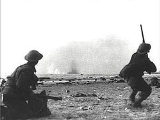
The Battle of Dunkirk was the defense and evacuation of the British and Allied forces that had been separated from the main body of the French defenses by the German advance.

After the seven months of the Phoney War, the Battle of FranceBattle of France

In World War II, the Battle of France, also known as the Fall of France, was the German and Italian invasion of France...
 began in earnest on 10 May 1940. To the east, the German Army Group BArmy Group B

Army Group B was the name of three different German Army Groups that saw action during World War II....
 invaded and subdued the NetherlandsNetherlands

The Netherlands is the European part of the Kingdom of the Netherlands , which is formed by the Netherlands, the Neth...
 and advanced westwards through BelgiumBelgium

The Kingdom of Belgium is a country in northwest Europe bordered by the Netherlands, Germany, Luxembourg and France and is...
. On the 14 May, Army Group AArmy Group A

Army Group A was the name of a German Army Group during World War II....
 burst through the ArdennesArdennes

The Ardennes is a region of extensive forests and rolling hill country, primarily in Belgium and Luxembourg, but stretching ...
 region and advanced rapidly to the west toward Sedan, then turned northwards to the English ChannelEnglish Channel

The English Channel is the part of the Atlantic Ocean that separates the island of Great Britain from northern France and j...
, in what GeneralfeldmarschallGeneralfeldmarschall

Generalfeldmarschall was a rank in the armies of several German states, the Holy Roman Empire, and the Austrian Empire....
 Erich von MansteinErich von Manstein Overview

Erich von Manstein was a lifelong professional soldier who rose to become one of the most prominent commanders of Nazi Germa...
 called the "sickle cut" (known as the Manstein PlanManstein Plan

The Manstein Plan was the primary war plan of the German Army during the Battle of France in 1940....
).

A series of Allied counter-attacks, including the Battle of ArrasBattle of Arras (1940)

The Battle of Arras, was an Allied counter-attack against the German blitzkrieg through France during World War II in 1940....
, failed to sever the German spearhead, which reached the coast on 20 May, separating the British Expeditionary ForceBritish Expeditionary Force

The British Expeditionary Force was the British army sent to France and Belgium in World War I and British Forces in Europe ...
 near ArmentièresArmentières

Armenti?res is a commune in the Nord Nord department in the Nord-Pas-de-Calais region in northern France....
, the French First Army, and the Belgian army further to the north from the majority of French troops south of the German penetration. After reaching the Channel, the Germans swung north along the coast, threatening to capture the ports and trap the British and French forces before they could evacuate to Britain.

The battle

On 24 May, Hitler visited General Gerd von RundstedtGerd von Rundstedt

Karl Rudolf Gerd von Rundstedt was a field marshal of the German Army during World War II....
's headquarters at CharlevilleCharleville-Mézières

Charleville-M?zi?res is a commune in northern France, capital of the Ardennes Ardennes department in the Champagne-Ardenne r...
. Von Rundstedt advised him that the infantry should attack the British forces at Arras, where they had shown themselves capable of significant action, while Kleist's armour held the line West and South of Dunkirk in order to pounce on the Allied Forces retreating before Army Group B.
This order allowed the Germans to consolidate their gains and prepare for a southward advance against the remaining French forces. In addition, the terrain around Dunkirk was considered unsuitable for armour, so the destruction of the Allied forces was initially assigned to the LuftwaffeLuftwaffe

The Deutsche Luftwaffe or Luftwaffe is the commonly used term for the German air force....
 and the German infantry organised in Army Group BArmy Group B

Army Group B was the name of three different German Army Groups that saw action during World War II....
.
The true reason for Hitler's decision to halt the German armour is a matter of debate. The most popular theory is that Von Rundstedt and Hitler agreed to conserve the armour for future operations further South - namely for Operation Fall Rot.

On 25 May 1940, General Lord GortJohn Vereker, 6th Viscount Gort

Field Marshal John Standish Surtees Prendergast Vereker, 6th Viscount Gort, VC, GCB, CBE, DSO and two Bars, MVO, MC was a Br...
, the commander of the BEF, decided to evacuate British forces. From 25 May to 28 May, British troops retreated about 30 miles northwest into a pocketPockets of resistance

Pockets of resistance is a term made popular by the media, referring to widespread but separated resistance in Post occupied...
 along the France-Belgian border extending from DunkirkDunkirk

Dunkirk is a harbor city and a commune in the northernmost part of France, in the dpartement of Nord, 10 km from the Bel...
 on the coast to the Belgian town of PoperingePoperinge

Poperinge is a municipality located in the province of West Flanders, Flemish Region, Belgium....
. The Belgians surrendered on 28 May, followed the next day by elements of the French 1st Army trapped outside the Dunkirk Pocket.

Starting on 27 May, the evacuation of Dunkirk began. The German Panzer DivisionPanzer Division

Panzer Division is the German term for armored division....
s were ordered to resume their advance on the same day, but improved defenses halted their initial offensive, although the remaining Allied forces were compressed into a five km wide coastal strip from De PanneDe Panne

De Panne is a municipality located in the Belgian province of West Flanders....
 through Bray-DunesBray-Dunes

Bray-Dunes is a village and commune of the Nord dpartement, in Flanders, France, at the Belgian border....
 to Dunkirk by 31 May.

A total of five nations took part in the evacuation from Dunkirk — Britain, France, Belgium, Netherlands and Poland.

The defense of the perimeter led to the loss or capture of a number of British Army units such as the 2nd Battalion of the Royal Norfolk RegimentRoyal Norfolk Regiment

The Royal Norfolk Regiment, originally formed as the Norfolk Regiment, was a regiment of the British Army....
 who were involved in the Le Paradis massacreLe Paradis massacre

The Le Paradis massacre was an atrocity against soldiers hors de combat during the Battle of France of World War II, whe...
 on 26 May. More than 35,000 French soldiers were made prisoners. Nevertheless, in the nine days from 27 May to 4 June, 338,226 men left France, including 139,997 French and Belgian troops, together with a small number of Dutch troops.

Number of men rescued (in chronological order):
  • 27 May (7669 men)
  • 28 May (17,804 men)
  • 29 May (47,310 men)
  • 30–31 May (120,927 men)
  • 1 June (64,229 men)
  • 2–4 June (up to 54,000 men)


In accordance with military principle where priority is given to men over arms, the Allies left behind 2,000 guns, 60,000 trucks, 76,000 tons of ammunition and 600,000 tons of fuel supplies.

  • 10,252 German soldiers lost
  • 42,000 wounded
  • 8,467 missing
  • 1,212,000 Dutch, Belgian, French and British prisoners taken
  • 30,000 British died
  • 34,000 British captured
  • 338,226 men saved in the evacuation


The Germans gained:
  • 1,200 field guns
  • 1,250 anti-aircraft guns
  • 11,000 machine guns
  • 25,000 vehicles

Aftermath

The successful evacuation of 338,000 Allied troops from Dunkirk ended the first phase in the Battle of FranceBattle of France

In World War II, the Battle of France, also known as the Fall of France, was the German and Italian invasion of France...
. It provided a great boost to British morale, but left the remaining French to stand alone against a renewed German assault southwards. The British 51st (Highland) division was left behind by the British to cover the allied retreat. The division was made up of the Black WatchBlack Watch

The Black Watch, 3rd Battalion, Royal Regiment of Scotland is an infantry battalion of the Royal Regiment of Scotland....
, Argyll and Sutherland HighlandersArgyll and Sutherland Highlanders

The Argyll and Sutherland Highlanders was an infantry regiment of the British Army, part of the Scottish Division....
, Gordon Highlanders, Seaforth HighlandersSeaforth Highlanders

The Seaforth Highlanders was a historic regiment of the British Army associated with large areas of the northern Highlands o...
 and Queen's Own Cameron HighlandersQueen's Own Cameron Highlanders

The Queen's Own Cameron Highlanders was a regiment of the British Army....
. Many were captured or killed. German troops entered Paris on 14 June and accepted the surrender of France on 22 June.

A marble memorial was established at Dunkirk (Dunkerque), it translates in English as: "To the glorious memory of the pilots, mariners, and soldiers of the French and Allied armies who sacrificed themselves in the Battle of Dunkirk May June 1940"

The loss of so much materielMateriel

Materiel is a term used in English to refer to the equipment and supplies in military and commercial supply chain management...
 on the beaches meant that the British Army needed months to re-supply properly and some planned introductions of new equipment were halted while industrial resources concentrated on making good the losses. Troops falling back from Dunkirk were told by their officers to burn or otherwise disable their trucks (so as not to let them benefit the advancing German forces). The shortage of army vehicles after Dunkirk was so severe that the Royal Army Service Corps (RASC) was reduced to retrieving and refurbishing numbers of obsolete bus and coach models from UK scrapyards to press them into use as troop transports. Some of these antique 1930s workhorses (some with only rear-wheel braking, which made them illegal for use on British roads) were still in use as late as the North African campaign some two years later.

The Dunkirk Spirit

The successful evacuation of Dunkirk in 1940, and particularly the role of the "Dunkirk little ships" was subsequently exploited very effectively in British propaganda. Many of the "little ships" were private vessels such as fishing boats and pleasure cruisers, but commercial vessels such as ferries also contributed to the force, including a number from as far away as the Isle of Man and Glasgow. These smaller vessels, guided by Naval craft across the channel from the Thames Estuary and from Dover, assisted in the official evacuation. Being able to reach much closer in the beachfront shallows than larger craft, the "little ships" acted as shuttles to and from the larger craft, lifting troops who were queuing in the water, many standing shoulder-deep in water for hours in the wait for a craft. For many decades after the war, the term "Dunkirk Spirit" stood for a popular belief in the solidarity of the British people in times of adversity.

In popular culture

The battle and the evacuation were re-enacted in the 20042004 in television

The year 2004 in television involved some significant events....
 BBC televisionBBC Television

BBC Television is a service of the British Broadcasting Corporation which began in 1932....
 docudrama DunkirkDunkirk (TV series) Overview

Dunkirk is a 2004 BBC television docudrama about the Battle of Dunkirk and the Dunkirk evacuation in World War II....
.

The evacuation from Dunkirk was featured in the novelAtonement (novel)

Atonement is a novel by British writer Ian McEwan....
 and its 2007 film adaptionAtonement (film)

Atonement is a 2007 film directed by Joe Wright....
 Atonement, which included a continuous four minute shot of the protagonist walking down the chaotic beach.

See also

  • Military history of the United Kingdom during World War IIMilitary history of the United Kingdom during World War II

    The United Kingdom declared war on Nazi Germany in 1939, after the German invasion of Poland....
  • BlitzkriegBlitzkrieg Summary

    Blitzkrieg is a popular name for an offensive operational-level military doctrine which involves an initial bombardmen...
  • Battle of FranceBattle of France

    In World War II, the Battle of France, also known as the Fall of France, was the German and Italian invasion of France...


Bibliography

  • Holmes, Richard, ed. "France, Fall of". The Oxford Companion to Military History. New York: Oxford University Press, 2001. ISBN 0-19-866209-2.
  • Hooton, E.R. Luftwaffe at War; Blitzkrieg in the West. London: Chevron/Ian Allen, 2007. ISBN 978-1-85780-272-6.
  • Keegan, John. The Second World War, New York: Viking Penguin, 1989. ISBN 0-670-82359-7.
  • Liddell Hart, B.H. History of the Second World War. New York: G.P. Putnam, 1970. ISBN 0-30680-912-5.
  • McEwan, Ian, Atonement, London: Jonathan Cape, 2001. ISBN 0-224062522.
  • McGlashan, Kenneth B, with Zupp, Owen P. Down to Earth: A Fighter Pilot Recounts His Experiences of Dunkirk, the Battle of Britain, Dieppe, D-Day and Beyond. London. Grub Street Publishing, 2007. ISBN 1-90494-384-5.
  • Murray, Williamson and Millett, Allan R. A War to Be Won: Fighting the Second World War. Cambridge, Mass.: Belknap Press, 2000. ISBN 0-674-00163-X.
  • Salmaggi, Cesare and Alfredo Pallavisini. 2194 Days of War An Illustrated Chronology of the Second World War. New York: Gallery Books, 1993. ISBN 0-8317-8885-2.
  • Taylor, A.J.P. and Mayer, S.L., eds. A History Of World War Two. London: Octopus Books, 1974. ISBN 0-70640-399-1.
  • Weinberg, Gerhard L. A World at Arms, New York: Cambridge University Press, 1994. ISBN 0-521-44317-2.
  • Wilmot, Chester. The Struggle for Europe. Old Saybrook, Connecticut: Konecky & Konecky, 1952. ISBN 1-56852-525-7.

External links