

Sexagenary cycle

Encyclopedia
The Chinese
sexagenary cycle , also known as the Stems-and-Branches , is a cycle of sixty terms used for recording days or years. It appears, as a means of recording days, in the first Chinese written texts, the Shang dynasty
oracle bones from the late second millennium BC. Its use to record years began around the middle of the 3rd century B.C. The cycle, and variations on it, have been an important part of historical calendrical systems in other, Chinese-influenced Asian states, notably those of Japan, Korea, Tibet and Vietnam. This traditional method of numbering days and years no longer has any significant role in modern Chinese time keeping or the official calendar. However, the sexagenary cycle continues to have a role in contemporary Chinese astrology
and fortune telling
.
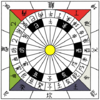
 Each term in the sexagenary cycle consists of two Chinese characters, the first representing a term from a cycle of ten known as the Heavenly Stems (天干; tiāngān) and the second from a cycle of twelve known as the Earthly Branches
(地支; dìzhī). The first term (jia-zi 甲子) combines the first heavenly stem (jia 甲) with the first earthly branch (zi 子). The second (yi-chou 乙丑) combines the second stem with the second branch. This continues, generating a total of 60 different terms (the least common multiple
of ten and twelve), after which the cycle repeats itself. This combination of two sub-cycles to generate a larger cycle and its use to record time have parallels in other calendrical systems, notably the Akan calendar
.
The sexagenary cycle is attested as a method of recording days from the earliest written records in China, records of divination on oracle bones, beginning ca. 1250 BC. Almost every oracle bone inscription includes a date in this format. This use of the cycle for days is attested throughout the Zhou dynasty
and remained common into the Han period
for all documentary purposes that required dates specified to the day.
Almost all the dates in the Spring and Autumn Annals
, a chronological list of events from 722 to 481 BC, use this system in combination with reign years and months (lunations
) to record dates. Eclipses recorded in the Annals demonstrate that continuity in the sexagenary day-count was unbroken from that period onwards. It is likely that this unbroken continuity went back still further to the first appearance of the sexagenary cycle during the Shang period.
The use of the sexagenary cycle for recording years is more recent. The earliest document showing this usage is a diagram among the silk manuscripts from Mawangdui tomb 3, sealed in 168 BC. An annotation marking the first
year of the reign of Qin Shi Huang
秦始皇 (246 BC) is applied to the diagram next to the position of the 60-cycle term (day 52 of 60, yi-mao 乙卯) corresponding that year. Use of the cycle to record years became widespread for administrative time-keeping during the Western Han Dynasty (202 BC- 8 AD). The count of years has continued uninterrupted ever since: the year 1984 began the present cycle (a jia-zi 甲子 year), and 2044 will begin another. Note that the new year
, when the sexagenary count increments, is not January 1st, but rather the lunar new year
of the traditional Chinese calendar. For example, the yi-chou 己丑 year (coinciding roughly with 2009) began on February 4th.
In Japan, according to Nihon shoki
, the calendar was transmitted to Japan in year 553. But it was not until the Suiko
era that the calendar was used for politics. The year 604, when the Japanese officially adopted the Chinese calendar, was the first year of the cycle.
The Japanese tradition of celebrating reflects the influence of the sexagenary cycle as a count of years.
The Tibetan calendar
also counts years using a 60-year cycle based on 12 animals and 5 elements, but while the first year of the Chinese cycle is always the year of the Wood Rat, the first year of the Tibetan cycle is the year of the Fire Hare (year #4 on the Chinese cycle).
* The names of several animals can be translated into English in several different ways. The Vietnamese Earthly Branches use Cat
instead of Rabbit.
 Year 2000 was the 17th year of the 78th sexagenary cycle, a gēng-chén year (庚辰年), a year of the Yang Metal Dragon. Therefore, year 2006 is the 23rd year of the 78th sexagenary cycle, a bǐng-xū year (丙戌年).
The cyclic designation of a year expressed in the AD/BC system can be found in the following way:
For a year over 3 AD, subtract 3, divide by 60 and take the remainder. (( Year - 3) mod 60 ). For example for 2011, subtract 3 to get 2008. When 2008 is divided by 60 the remainder is 28. So looking for No 28 in the table, 2011 is a 辛卯 year. However, if the remainder is 0, the year is a no. 60 癸亥 year. Equivalently, divide directly the year by 60, obtain a remainder from 0 to 59 and look in column AD (in the example, this leads to AD=31 and again to 辛卯)
For a BC year, add 3 to the (BC) year, divide by 60. Take the remainder and subtract it from 61 to get the cyclic number. However, if the remainder is 0, the cyclic number is 1. ( 61- ((Year+3) mod 60)). For example, for 246 BC, add 3 to 246 to get 249. When 249 is divided by 60, the remainder is 9. Subtract 9 from 61 and you get 52, which by the table is a 乙卯 year. Equivalently, divide directly the year by 60, obtain a remainder from 0 to 59 and look in column BC (in the example, this leads to BC=6 and again to 乙卯). For these computations year 246 BC cannot be treated as -246 AD due to the lack of a year 0 in the AD/BC system.
Note that the year involved is not necessarily a Jan 1- Dec. 31 year; it is the year accepted by the relevant community, and so can vary with the period, the place, or even the purpose.
One system follows the ordinary Chinese lunar calendar
and connects the names of the months directly to the central solar term
(Zhongqi 中氣). The (建)子月 is the month containing the winter solstice 冬至 Zhongqi . The (建)丑月 is the month of the following Zhongqi , which is 大寒, and the (建)寅月 is that of the 雨水 Zhongqi , etc. Intercalary months have the same branch as the preceding month.
In the other system (節月) the "month" lasts for the period of two solar terms (2 氣策). The 子月 is the period starting with 大雪, i.e. the solar term before the winter solstice. The 丑月 starts with 小寒, the term before 大寒, and the 寅月 starts with 立春, the term before 雨水, etc. Thus in the solar system a month starts anywhere from about 15 days before to 15 days after its lunar counterpart.
The branch names are not usual month names; the main use of the branches for months is astrological. However, the names are sometimes used to indicate historically which (lunar) month was the first month of the year in ancient times. For example, since the Han Period, the first month has been (建)寅月, but earlier the first month was (建)子月 (Chou Period) or (建)丑月 (traditionally during the Shang Period) as well.
For astrological purposes stems are also necessary, and the months are named using the sexegenary cycle following a five-year cycle starting in a 甲(1) or 己 (6) year. The first month of the 甲 or 己 year is a 丙寅 (3) month, the next one is a 丁卯 (4) month, etc., and the last month of the year is a 丁丑(14) month. The next year will start with a 戊寅 (15) month, etc. following the cycle. The 5th year will end with a 乙丑 (2) month, and the following month, the start of a 己 or 甲 year, will be a 丙寅 (3) month again. The beginning and end of the (solar) months in the table below are the approximate dates of current solar terms; they vary slightly from year to year depending on the leap days of the Gregorian calendar.
China
Chinese civilization may refer to:* China for more general discussion of the country.* Chinese culture* Greater China, the transnational community of ethnic Chinese.* History of China* Sinosphere, the area historically affected by Chinese culture...
sexagenary cycle , also known as the Stems-and-Branches , is a cycle of sixty terms used for recording days or years. It appears, as a means of recording days, in the first Chinese written texts, the Shang dynasty
Shang Dynasty
The Shang Dynasty or Yin Dynasty was, according to traditional sources, the second Chinese dynasty, after the Xia. They ruled in the northeastern regions of the area known as "China proper" in the Yellow River valley...
oracle bones from the late second millennium BC. Its use to record years began around the middle of the 3rd century B.C. The cycle, and variations on it, have been an important part of historical calendrical systems in other, Chinese-influenced Asian states, notably those of Japan, Korea, Tibet and Vietnam. This traditional method of numbering days and years no longer has any significant role in modern Chinese time keeping or the official calendar. However, the sexagenary cycle continues to have a role in contemporary Chinese astrology
Chinese astrology
Chinese astrology is based on the traditional astronomy and calendars. The development of Chinese astrology is tied to that of astronomy, which came to flourish during the Han Dynasty ....
and fortune telling
Chinese fortune telling
Chinese fortune telling, better known as Suan ming has utilized many varying divination techniques throughout the dynastic periods. There are many methods still in practice in China, Taiwan and Hong Kong today, and they remain in use due to their accuracy and popularity...
.
Overview
Earthly Branches
The Earthly Branches provide one Chinese system for reckoning time.This system was built from observations of the orbit of Jupiter. Chinese astronomers divided the celestial circle into 12 sections to follow the orbit of Suìxīng . Astronomers rounded the orbit of Suixing to 12 years...
(地支; dìzhī). The first term (jia-zi 甲子) combines the first heavenly stem (jia 甲) with the first earthly branch (zi 子). The second (yi-chou 乙丑) combines the second stem with the second branch. This continues, generating a total of 60 different terms (the least common multiple
Least common multiple
In arithmetic and number theory, the least common multiple of two integers a and b, usually denoted by LCM, is the smallest positive integer that is a multiple of both a and b...
of ten and twelve), after which the cycle repeats itself. This combination of two sub-cycles to generate a larger cycle and its use to record time have parallels in other calendrical systems, notably the Akan calendar
Akan calendar
The Akan calendar is based on what the Akan call 'forty days'; Adaduanan . Close examination of the cycle reveals 42 different days, with the 43rd being the same as the first.-Nanson:...
.
The sexagenary cycle is attested as a method of recording days from the earliest written records in China, records of divination on oracle bones, beginning ca. 1250 BC. Almost every oracle bone inscription includes a date in this format. This use of the cycle for days is attested throughout the Zhou dynasty
Zhou Dynasty
The Zhou Dynasty was a Chinese dynasty that followed the Shang Dynasty and preceded the Qin Dynasty. Although the Zhou Dynasty lasted longer than any other dynasty in Chinese history, the actual political and military control of China by the Ji family lasted only until 771 BC, a period known as...
and remained common into the Han period
Han Dynasty
The Han Dynasty was the second imperial dynasty of China, preceded by the Qin Dynasty and succeeded by the Three Kingdoms . It was founded by the rebel leader Liu Bang, known posthumously as Emperor Gaozu of Han. It was briefly interrupted by the Xin Dynasty of the former regent Wang Mang...
for all documentary purposes that required dates specified to the day.
Almost all the dates in the Spring and Autumn Annals
Spring and Autumn Annals
The Spring and Autumn Annals is the official chronicle of the State of Lu covering the period from 722 BCE to 481 BCE. It is the earliest surviving Chinese historical text to be arranged on annalistic principles. The text is extremely concise and, if all the commentaries are excluded, about 16,000...
, a chronological list of events from 722 to 481 BC, use this system in combination with reign years and months (lunations
Lunation
Lunation is the mean time for one lunar phase cycle . It is on average 29.530589 days, or 29 days 12 hours 44 minutes and 3 seconds...
) to record dates. Eclipses recorded in the Annals demonstrate that continuity in the sexagenary day-count was unbroken from that period onwards. It is likely that this unbroken continuity went back still further to the first appearance of the sexagenary cycle during the Shang period.
The use of the sexagenary cycle for recording years is more recent. The earliest document showing this usage is a diagram among the silk manuscripts from Mawangdui tomb 3, sealed in 168 BC. An annotation marking the first
year of the reign of Qin Shi Huang
Qin Shi Huang
Qin Shi Huang , personal name Ying Zheng , was king of the Chinese State of Qin from 246 BC to 221 BC during the Warring States Period. He became the first emperor of a unified China in 221 BC...
秦始皇 (246 BC) is applied to the diagram next to the position of the 60-cycle term (day 52 of 60, yi-mao 乙卯) corresponding that year. Use of the cycle to record years became widespread for administrative time-keeping during the Western Han Dynasty (202 BC- 8 AD). The count of years has continued uninterrupted ever since: the year 1984 began the present cycle (a jia-zi 甲子 year), and 2044 will begin another. Note that the new year
New Year
The New Year is the day that marks the time of the beginning of a new calendar year, and is the day on which the year count of the specific calendar used is incremented. For many cultures, the event is celebrated in some manner....
, when the sexagenary count increments, is not January 1st, but rather the lunar new year
Chinese New Year
Chinese New Year – often called Chinese Lunar New Year although it actually is lunisolar – is the most important of the traditional Chinese holidays. It is an all East and South-East-Asia celebration...
of the traditional Chinese calendar. For example, the yi-chou 己丑 year (coinciding roughly with 2009) began on February 4th.
In Japan, according to Nihon shoki
Nihon Shoki
The , sometimes translated as The Chronicles of Japan, is the second oldest book of classical Japanese history. It is more elaborate and detailed than the Kojiki, the oldest, and has proven to be an important tool for historians and archaeologists as it includes the most complete extant historical...
, the calendar was transmitted to Japan in year 553. But it was not until the Suiko
Empress Suiko
was the 33rd emperor of Japan, according to the traditional order of succession.Suiko's reign spanned the years from 593 until her death in 628....
era that the calendar was used for politics. The year 604, when the Japanese officially adopted the Chinese calendar, was the first year of the cycle.
The Japanese tradition of celebrating reflects the influence of the sexagenary cycle as a count of years.
The Tibetan calendar
Tibetan calendar
The Tibetan calendar is a lunisolar calendar, that is, the Tibetan year is composed of either 12 or 13 lunar months, each beginning and ending with a new moon. A thirteenth month is added every two or three years, so that an average Tibetan year is equal to the solar year.The Tibetan New Year...
also counts years using a 60-year cycle based on 12 animals and 5 elements, but while the first year of the Chinese cycle is always the year of the Wood Rat, the first year of the Tibetan cycle is the year of the Fire Hare (year #4 on the Chinese cycle).
Ten Heavenly Stems
| No. | Heavenly Stem |
Chinese name (Mandarin Standard Mandarin Standard Chinese or Modern Standard Chinese, also known as Mandarin or Putonghua, is the official language of the People's Republic of China and Republic of China , and is one of the four official languages of Singapore.... pron. in pinyin Pinyin Pinyin is the official system to transcribe Chinese characters into the Roman alphabet in China, Malaysia, Singapore and Taiwan. It is also often used to teach Mandarin Chinese and spell Chinese names in foreign publications and used as an input method to enter Chinese characters into... ) |
Japanese name |
Korean name |
Vietnamese name |
Yin yang | Wu xing | ||
|---|---|---|---|---|---|---|---|---|---|
| Onyomi | Kunyomi with corresponding kanji Kanji Kanji are the adopted logographic Chinese characters hanzi that are used in the modern Japanese writing system along with hiragana , katakana , Indo Arabic numerals, and the occasional use of the Latin alphabet... |
Romanized Revised Romanization of Korean The Revised Romanization of Korean is the official Korean language romanization system in South Korea proclaimed by Ministry of Culture, Sports and Tourism, replacing the older McCune–Reischauer system... |
Hangul Hangul Hangul,Pronounced or ; Korean: 한글 Hangeul/Han'gŭl or 조선글 Chosŏn'gŭl/Joseongeul the Korean alphabet, is the native alphabet of the Korean language. It is a separate script from Hanja, the logographic Chinese characters which are also sometimes used to write Korean... |
||||||
| 1 | jiǎ | kō | kinoe | gap | 갑 | giáp | yang | wood Wood (classical element) Tree , traditionally translated as Wood, is the growing of the matter, or the matter's growing stage. Tree is the first phase of Wu Xing. Tree is yang in character... |
|
| 2 | yǐ | otsu | kinoto | eul | 을 | ất | yin | ||
| 3 | bǐng | hei | hinoe | byeong | 병 | bính | yang | fire Fire (classical element) Fire has been an important part of all cultures and religions from pre-history to modern day and was vital to the development of civilization. It has been regarded in many different contexts throughout history, but especially as a metaphysical constant of the world.-Greek and Roman tradition:Fire... |
|
| 4 | dīng | tei | hinoto | jeong | 정 | đinh | yin | ||
| 5 | wù | bo | tsuchinoe | mu | 무 | mậu | yang | earth Earth (classical element) Earth, home and origin of humanity, has often been worshipped in its own right with its own unique spiritual tradition.-European tradition:Earth is one of the four classical elements in ancient Greek philosophy and science. It was commonly associated with qualities of heaviness, matter and the... |
|
| 6 | jǐ | ki | tsuchinoto | gi | 기 | kỷ | yin | ||
| 7 | gēng | kō | kanoe | gyeong | 경 | canh | yang | metal Metal (classical element) Metal , is the decline of the matter, or the matter's decline stage. Metal is the fourth phase of Wu Xing. Metal is yin in character, its motion is inwards and its energy is contracting. It is associated with the Autumn, the west, old age, the planet Venus, the color white, dry weather, and the... |
|
| 8 | xīn | shin | kanoto | shin | 신 | tân | yin | ||
| 9 | rén | jin | mizunoe | im | 임 | nhâm | yang | water Water (classical element) Water is one of the elements in ancient Greek philosophy, in the Asian Indian system Panchamahabhuta, and in the Chinese cosmological and physiological system Wu Xing... |
|
| 10 | guǐ | ki | mizunoto | gye | 계 | quý | yin |
Twelve Earthly Branches
| No. | Earthly Branch |
Chinese name (Mandarin Standard Mandarin Standard Chinese or Modern Standard Chinese, also known as Mandarin or Putonghua, is the official language of the People's Republic of China and Republic of China , and is one of the four official languages of Singapore.... pron. in pinyin Pinyin Pinyin is the official system to transcribe Chinese characters into the Roman alphabet in China, Malaysia, Singapore and Taiwan. It is also often used to teach Mandarin Chinese and spell Chinese names in foreign publications and used as an input method to enter Chinese characters into... ) |
Japanese name |
Korean name |
Vietnamese name |
Vietnamese zodiac |
Chinese zodiac |
Corresponding hours |
||
|---|---|---|---|---|---|---|---|---|---|---|
| Onyomi | Kunyomi | Romanized Revised Romanization of Korean The Revised Romanization of Korean is the official Korean language romanization system in South Korea proclaimed by Ministry of Culture, Sports and Tourism, replacing the older McCune–Reischauer system... |
Hangul Hangul Hangul,Pronounced or ; Korean: 한글 Hangeul/Han'gŭl or 조선글 Chosŏn'gŭl/Joseongeul the Korean alphabet, is the native alphabet of the Korean language. It is a separate script from Hanja, the logographic Chinese characters which are also sometimes used to write Korean... |
|||||||
| 1 | zǐ | shi | ne | ja | 자 | tý | Rat (chuột) | Rat Rat (zodiac) The Rat is one of the 12-year cycle of animals which appear in the Chinese zodiac related to the Chinese calendar, the Year of the Rat is associated with the earthly branch symbol 子... |
11 p.m. to 1 a.m. | |
| 2 | chǒu | chū | ushi | chuk | 축 | sửu | Ox (trâu) | Ox Ox (zodiac) The Ox is one of the 12-year cycle of animals which appear in the Chinese zodiac related to the Chinese calendar. The Year of the Ox is denoted by the earthly branch character 丑... |
1 to 3 a.m. | |
| 3 | yín | in | tora | in | 인 | dần | Tiger (hổ/cọp) | Tiger Tiger (zodiac) The Tiger , is one of the 12-year cycle of animals which appear in the Chinese zodiac related to the Chinese calendar. The Year of the Tiger is associated with the earthly branch symbol 寅.- Years and the Five Elements :... |
3 to 5 a.m. | |
| 4 | mǎo | bō | u | myo | 묘 | mẹo/mão | Rabbit (mèo) | Rabbit Rabbit (zodiac) The Chinese Year of the Rabbit is actually the Chinese Year of the Hare, as China has seven native species of hares and no native species of rabbits. The Chinese applied their word for hare to the first rabbits to be taken to China, and the word is now erroneously back-translated into English as... * |
5 to 7 a.m. | |
| 5 | chén | shin | tatsu | jin | 진 | thìn | Dragon (rồng) | Dragon Dragon (zodiac) The Dragon , is one of the 12-year cycle of animals which appear in the Chinese zodiac related to the Chinese calendar, and the only animal that is legendary... |
7 to 9 a.m. | |
| 6 | sì | shi | mi | sa | 사 | tỵ | Snake (rắn) | Snake Snake (zodiac) The Snake is one of the 12-year cycle of animals which appear in the Chinese zodiac related to the Chinese calendar. The Year of the Snake is associated with the earthly branch symbol 巳.-Years and the Five Elements:... |
9 to 11 a.m. | |
| 7 | wǔ | go | uma | o | 오 | ngọ | Horse (ngựa) | Horse Horse (zodiac) The Horse is the seventh of the 12 animals which appear in the Chinese zodiac related to the Chinese calendar. The Year of the Horse is associated with the earthly branch symbol 午.- Years and the Five Elements :... |
11 a.m. to 1 p.m. | |
| 8 | wèi | mi or bi | hitsuji | mi | 미 | mùi | Goat (dê) | Goat | 1 to 3 p.m. | |
| 9 | shēn | shin | saru | shin | 신 | thân | Monkey (khỉ) | Monkey Monkey (zodiac) The Monkey is the ninth of the 12-year cycle of animals which appear in the Chinese zodiac related to the Chinese calendar. The Year of the Monkey is associated with the earthly branch symbol 申.-Years and the five elements:... |
3 to 5 p.m. | |
| 10 | yǒu | yū | tori | yu | 유 | dậu | Rooster (gà) | Rooster Rooster (zodiac) The Rooster is one of the 12-year cycle of animals which appear in the Chinese zodiac related to the Chinese calendar. The Year of the Rooster is represented by the earthly branch character 酉.- Years and associated Five Elements :... |
5 to 7 p.m. | |
| 11 | xū | jutsu | inu | sul | 술 | tuất | Dog (chó) | Dog Dog (zodiac) The Dog is one of the 12-year cycle of animals which appear in the Chinese zodiac related to the Chinese calendar. The Year of the Dog is associated with the earthly branch symbol 戌... |
7 to 9 p.m. | |
| 12 | hài | gai | i | hae | 해 | hợi | Pig (heo) | Pig Pig (zodiac) The Pig , is the last of the 12 animals which appear in the Chinese zodiac. The Year of the Pig is associated with the earthly branch Hai .In Chinese culture, the pig is associated with fertility and virility... |
9 to 11 p.m. |
Cat
The cat , also known as the domestic cat or housecat to distinguish it from other felids and felines, is a small, usually furry, domesticated, carnivorous mammal that is valued by humans for its companionship and for its ability to hunt vermin and household pests...
instead of Rabbit.
Sexagenary Cycle
| No. | Stem-Branch | Chinese name | Korean name | Japanese name | Vietnamese name | Associations | AD | BC |
|---|---|---|---|---|---|---|---|---|
| 1 | 甲子 | jiǎ-zǐ | gapja 갑자 | kōshi(kasshi)/kinoe-ne | Giáp Tý | Yang Wood Rat | 4 | 57 |
| 2 | 乙丑 | yǐ-chǒu | eulchuk 을축 | itchū/kinoto-ushi | Ất Sửu | Yin Wood Ox | 5 | 56 |
| 3 | 丙寅 | bǐng-yín | byeongin 병인 | heiin/hinoe-tora | Bính Dần | Yang Fire Tiger | 6 | 55 |
| 4 | 丁卯 | dīng-mǎo | jeongmyo 정묘 | teibō/hinoto-u | Đinh Mão | Yin Fire Rabbit | 7 | 54 |
| 5 | 戊辰 | wù-chén | mujin 무진 | boshin/tsuchinoe-tatsu | Mậu Thìn | Yang Earth Dragon | 8 | 53 |
| 6 | 己巳 | jǐ-sì | gisa 기사 | kishi/tsuchinoto-mi | Kỷ Tỵ | Yin Earth Snake | 9 | 52 |
| 7 | 庚午 | gēng-wǔ | gyeongo 경오 | kōgo/kanoe-uma | Canh Ngọ | Yang Metal Horse | 10 | 51 |
| 8 | 辛未 | xīn-wèi | shinmi 신미 | shinbi/kanoto-hitsuji | Tân Mùi | Yin Metal Goat | 11 | 50 |
| 9 | 壬申 | rén-shēn | imshin 임신 | jinshin/mizunoe-saru | Nhâm Thân | Yang Water Monkey | 12 | 49 |
| 10 | 癸酉 | guǐ-yǒu | gyeyu 계유 | kiyū/mizunoto-tori | Quý Dậu | Yin Water Rooster | 13 | 48 |
| 11 | 甲戌 | jiǎ-xū | gapsul 갑술 | kōjutsu/kinoe-inu | Giáp Tuất | Yang Wood Dog | 14 | 47 |
| 12 | 乙亥 | yǐ-hài | eulhae 을해 | itsugai/kinoto-i | Ât Hợi | Yin Wood Pig | 15 | 46 |
| 13 | 丙子 | bǐng-zǐ | byeongja 병자 | heishi/hinoe-ne | Bính Tý | Yang Fire Rat | 16 | 45 |
| 14 | 丁丑 | dīng-chǒu | jeongchuk 정축 | teichū/hinoto-ushi | Đinh Sửu | Yin Fire Ox | 17 | 44 |
| 15 | 戊寅 | wù-yín | muin 무인 | boin/tsuchinoe-tora | Mậu Dần | Yang Earth Tiger | 18 | 43 |
| 16 | 己卯 | jǐ-mǎo | gimyo 기묘 | kibō/tsuchinoto-u | Kỷ Mão | Yin Earth Rabbit | 19 | 42 |
| 17 | 庚辰 | gēng-chén | gyeongjin 경진 | kōshin/kanoe-tatsu | Canh Thìn | Yang Metal Dragon | 20 | 41 |
| 18 | 辛巳 | xīn-sì | shinsa 신사 | shinshi/kanoto-mi | Tân Tỵ | Yin Metal Snake | 21 | 40 |
| 19 | 壬午 | rén-wǔ | imo 임오 | jingo/mizunoe-uma | Nhâm Ngọ | Yang Water Horse | 22 | 39 |
| 20 | 癸未 | guǐ-wèi | gyemi 계미 | kibi/mizunoto-hitsuji | Quý Mùi | Yin Water Goat | 23 | 38 |
| 21 | 甲申 | jiǎ-shēn | gapshin 갑신 | kōshin/kinoe-saru | Giáp Thân | Yang Wood Monkey | 24 | 37 |
| 22 | 乙酉 | yǐ-yǒu | eulyu 을유 | itsuyū/kinoto-tori | Ất Dậu | Yin Wood Rooster | 25 | 36 |
| 23 | 丙戌 | bǐng-xū | byeongsul 병술 | heijutsu/hinoe-inu | Bính Tuất | Yang Fire Dog | 26 | 35 |
| 24 | 丁亥 | dīng-hài | jeonghae 정해 | teigai/hinoto-i | Đinh Hợi | Yin Fire Pig | 27 | 34 |
| 25 | 戊子 | wù-zǐ | muja 무자 | boshi/tsuchinoe-ne | Mậu Tý | Yang Earth Rat | 28 | 33 |
| 26 | 己丑 | jǐ-chǒu | gichuk 기축 | kichū/tsuchinoto-ushi | Kỷ Sửu | Yin Earth Ox | 29 | 32 |
| 27 | 庚寅 | gēng-yín | gyeongin 경인 | kōin/kanoe-tora | Canh Dần | Yang Metal Tiger | 30 | 31 |
| 28 | 辛卯 | xīn-mǎo | shinmyo 신묘 | shinbō/kanoto-u | Tân Mão | Yin Metal Rabbit | 31 | 30 |
| 29 | 壬辰 | rén-chén | imjin 임진 | jinshin/mizunoe-tatsu | Nhâm Thìn | Yang Water Dragon | 32 | 29 |
| 30 | 癸巳 | guǐ-sì | gyesa 계사 | kishi/mizunoto-mi | Quý Tỵ | Yin Water Snake | 33 | 28 |
| 31 | 甲午 | jiǎ-wǔ | gapo 갑오 | kōgo/kinoe-uma | Giáo Ngọ | Yang Wood Horse | 34 | 27 |
| 32 | 乙未 | yǐ-wèi | eulmi 을미 | itsubi/kinoto-hitsuji | Ất Mùi | Yin Wood Goat | 35 | 26 |
| 33 | 丙申 | bǐng-shēn | byeongshin 병신 | heishin/hinoe-saru | Bính Thân | Yang Fire Monkey | 36 | 25 |
| 34 | 丁酉 | dīng-yǒu | jeongyu 정유 | teiyū/hinoto-tori | Đinh Dậu | Yin Fire Rooster | 37 | 24 |
| 35 | 戊戌 | wù-xū | musul 무술 | bojutsu/tsuchinoe-inu | Mậu Tuất | Yang Earth Dog | 38 | 23 |
| 36 | 己亥 | jǐ-hài | gihae 기해 | kigai/tsuchinoto-i | Kỷ Hợi | Yin Earth Pig | 39 | 22 |
| 37 | 庚子 | gēng-zǐ | gyeongja 경자 | kōshi/kanoe-ne | Canh Tý | Yang Metal Rat | 40 | 21 |
| 38 | 辛丑 | xīn-chǒu | shinchuk 신축 | shinchū/kanoto-ushi | Tân Sửu | Yin Metal Ox | 41 | 20 |
| 39 | 壬寅 | rén-yín | imin 임인 | jin'in/mizunoe-tora | Nhâm Dần | Yang Water Tiger | 42 | 19 |
| 40 | 癸卯 | guǐ-mǎo | gyemyo 계묘 | kibō/mizunoto-u | Quý Mão | Yin Water Rabbit | 43 | 18 |
| 41 | 甲辰 | jiǎ-chén | gapjin 갑진 | kōshin/kinoe-tatsu | Giáp Thìn | Yang Wood Dragon | 44 | 17 |
| 42 | 乙巳 | yǐ-sì | eulsa 을사 | itsushi/kinoto-mi | Ất Tỵ | Yin Wood Snake | 45 | 16 |
| 43 | 丙午 | bǐng-wǔ | byeongo 병오 | heigo/hinoe-uma | Bính Ngọ | Yang Fire Horse | 46 | 15 |
| 44 | 丁未 | dīng-wèi | jeongmi 정미 | teibi/hinoto-hitsuji | Đinh Mùi | Yin Fire Goat | 47 | 14 |
| 45 | 戊申 | wù-shēn | mushin 무신 | boshin/tsuchinoe-saru | Mậu Thân | Yang Earth Monkey | 48 | 13 |
| 46 | 己酉 | jǐ-yǒu | giyu 기유 | kiyū/tsuchinoto-tori | Kỷ Dậu | Yin Earth Rooster | 49 | 12 |
| 47 | 庚戌 | gēng-xū | gyeongsul 경술 | kōjutsu/kanoe-inu | Canh Tuất | Yang Metal Dog | 50 | 11 |
| 48 | 辛亥 | xīn-hài | shinhae 신해 | shingai/kanoto-i | Tân Hợi | Yin Metal Pig | 51 | 10 |
| 49 | 壬子 | rén-zǐ | imja 임자 | jinshi/mizunoe-ne | Nhâm Tý | Yang Water Rat | 52 | 9 |
| 50 | 癸丑 | guǐ-chǒu | gyechuk 계축 | kichū/mizunoto-ushi | Quý Sửu | Yin Water Ox | 53 | 8 |
| 51 | 甲寅 | jiǎ-yín | gapin 갑인 | kōin/kinoe-tora | Giáp Dần | Yang Wood Tiger | 54 | 7 |
| 52 | 乙卯 | yǐ-mǎo | eulmyo 을묘 | itsubō/kinoto-u | Ất Mão | Yin Wood Rabbit | 55 | 6 |
| 53 | 丙辰 | bǐng-chén | byeongjin 병진 | heishin/hinoe-tatsu | Bính Thìn | Yang Fire Dragon | 56 | 5 |
| 54 | 丁巳 | dīng-sì | jeongsa 정사 | teishi/hinoto-mi | Đinh Tỵ | Yin Fire Snake | 57 | 4 |
| 55 | 戊午 | wù-wǔ | muo 무오 | bogo/tsuchinoe-uma | Mậu Ngọ | Yang Earth Horse | 58 | 3 |
| 56 | 己未 | jǐ-wèi | gimi 기미 | kibi/tsuchinoto-hitsuji | Kỷ Mùi | Yin Earth Goat | 59 | 2 |
| 57 | 庚申 | gēng-shēn | gyeongshin 경신 | kōshin/kanoe-saru | Canh Thân | Yang Metal Monkey | 0 | 1 |
| 58 | 辛酉 | xīn-yǒu | shinyu 신유 | shin'yū/kanoto-tori | Tân Dậu | Yin Metal Rooster | 1 | 0 |
| 59 | 壬戌 | rén-xū | imsul 임술 | jinjutsu/mizunoe-inu | Nhâm Tuất | Yang Water Dog | 2 | 59 |
| 60 | 癸亥 | guǐ-hài | gyehae 계해 | kigai/mizunoto-i | Quý Hợi | Yin Water Pig | 3 | 58 |
Cyclic years and Western Years
The cycle repeats continually. Thus 237 BC, 4 AD, 1864, and 1984 were all 甲子 (1) years.The cyclic designation of a year expressed in the AD/BC system can be found in the following way:
For a year over 3 AD, subtract 3, divide by 60 and take the remainder. (( Year - 3) mod 60 ). For example for 2011, subtract 3 to get 2008. When 2008 is divided by 60 the remainder is 28. So looking for No 28 in the table, 2011 is a 辛卯 year. However, if the remainder is 0, the year is a no. 60 癸亥 year. Equivalently, divide directly the year by 60, obtain a remainder from 0 to 59 and look in column AD (in the example, this leads to AD=31 and again to 辛卯)
For a BC year, add 3 to the (BC) year, divide by 60. Take the remainder and subtract it from 61 to get the cyclic number. However, if the remainder is 0, the cyclic number is 1. ( 61- ((Year+3) mod 60)). For example, for 246 BC, add 3 to 246 to get 249. When 249 is divided by 60, the remainder is 9. Subtract 9 from 61 and you get 52, which by the table is a 乙卯 year. Equivalently, divide directly the year by 60, obtain a remainder from 0 to 59 and look in column BC (in the example, this leads to BC=6 and again to 乙卯). For these computations year 246 BC cannot be treated as -246 AD due to the lack of a year 0 in the AD/BC system.
Note that the year involved is not necessarily a Jan 1- Dec. 31 year; it is the year accepted by the relevant community, and so can vary with the period, the place, or even the purpose.
Months in Sexagenary Cycle
The branches are used marginally to indicate months. Despite there being twelve branches and twelve months in a year, the earliest use of branches to indicate a twelve-fold division of a year was in the 2nd century BC. They were coordinated with the orientations of the Great Dipper, ( 建子月, 建丑月,etc.) .There are two systems of these months, a lunar and a solar.One system follows the ordinary Chinese lunar calendar
Chinese calendar
The Chinese calendar is a lunisolar calendar, incorporating elements of a lunar calendar with those of a solar calendar. It is not exclusive to China, but followed by many other Asian cultures as well...
and connects the names of the months directly to the central solar term
Solar term
A solar term is any of 24 points in traditional East Asian lunisolar calendars that matches a particular astronomical event or signifies some natural phenomenon. The points are spaced 15° apart along the ecliptic and are used by lunisolar calendars to stay synchronized with the seasons. Solar terms...
(Zhongqi 中氣). The (建)子月 is the month containing the winter solstice 冬至 Zhongqi . The (建)丑月 is the month of the following Zhongqi , which is 大寒, and the (建)寅月 is that of the 雨水 Zhongqi , etc. Intercalary months have the same branch as the preceding month.
In the other system (節月) the "month" lasts for the period of two solar terms (2 氣策). The 子月 is the period starting with 大雪, i.e. the solar term before the winter solstice. The 丑月 starts with 小寒, the term before 大寒, and the 寅月 starts with 立春, the term before 雨水, etc. Thus in the solar system a month starts anywhere from about 15 days before to 15 days after its lunar counterpart.
The branch names are not usual month names; the main use of the branches for months is astrological. However, the names are sometimes used to indicate historically which (lunar) month was the first month of the year in ancient times. For example, since the Han Period, the first month has been (建)寅月, but earlier the first month was (建)子月 (Chou Period) or (建)丑月 (traditionally during the Shang Period) as well.
For astrological purposes stems are also necessary, and the months are named using the sexegenary cycle following a five-year cycle starting in a 甲(1) or 己 (6) year. The first month of the 甲 or 己 year is a 丙寅 (3) month, the next one is a 丁卯 (4) month, etc., and the last month of the year is a 丁丑(14) month. The next year will start with a 戊寅 (15) month, etc. following the cycle. The 5th year will end with a 乙丑 (2) month, and the following month, the start of a 己 or 甲 year, will be a 丙寅 (3) month again. The beginning and end of the (solar) months in the table below are the approximate dates of current solar terms; they vary slightly from year to year depending on the leap days of the Gregorian calendar.
| Earthly Branches of the certain months | Solar term | Zhongqi (the Middle solar term) | Starts at | Ends at | Names in year of Jia or Ji(甲/己年) | Names in year of Yi or Geng (乙/庚年) | Names in year of Bing or Xin (丙/辛年) | Names in Year of Ding or Ren (丁/壬年) | Names in Xu or Gui (戊/癸年) |
|---|---|---|---|---|---|---|---|---|---|
| Month of Yin (寅月) | Lichun Lichun The traditional East Asian calendars divide a year into 24 solar terms . Lìchūn or Risshun is the 1st solar term. It begins when the Sun reaches the celestial longitude of 315° and ends when it reaches the longitude of 330°. It more often refers in particular to the day when the Sun is exactly... - Jingzhe Jingzhe Jīngzhé or Keichitsu is the 3rd of 24 solar terms in the traditional East Asian calendars. It begins when the Sun reaches the celestial longitude of 345° and ends when it reaches the longitude of 360°. It more often refers in particular to the day when the Sun is exactly at the celestial... |
Yushui | February 4 | March 6 | Bingyin / 丙寅月 | Xuyin / 戊寅月 | Gengyin / 庚寅月 | Renyin / 壬寅月 | Jiayin / 甲寅月 |
Month of Mao (卯月) |
Jingzhe Jingzhe Jīngzhé or Keichitsu is the 3rd of 24 solar terms in the traditional East Asian calendars. It begins when the Sun reaches the celestial longitude of 345° and ends when it reaches the longitude of 360°. It more often refers in particular to the day when the Sun is exactly at the celestial... - Qingming Qingming Traditional East Asian lunisolar calendars divide a year into 24 solar terms . Qīngmíng or Chīngmíng or Seimei is the 5th solar term. It begins when the Sun reaches the celestial longitude of 15° and ends when it reaches the longitude of 30°... |
Chunfen Chunfen The traditional East Asian calendars divide a year into 24 solar terms . Chūnfēn or Shunbun is the 4th solar term. It begins when the Sun reaches the celestial longitude of 0° and ends when it reaches the longitude of 15°. It more often refers in particular to the day when the Sun is exactly at... |
March 6 | April 5 | Dingmao / 丁卯月 | Jimao / 己卯月 | Xinmao / 辛卯月 | Guimao / 癸卯月 | Yimao / 乙卯月 |
| Month of Chen (辰月) | Qingming Qingming Traditional East Asian lunisolar calendars divide a year into 24 solar terms . Qīngmíng or Chīngmíng or Seimei is the 5th solar term. It begins when the Sun reaches the celestial longitude of 15° and ends when it reaches the longitude of 30°... - Lixia Lixia The traditional East Asian calendars divide a year into 24 solar terms . Lìxià or Rikka is the 7th solar term. It begins when the Sun reaches the celestial longitude of 45° and ends when it reaches the longitude of 60°. It more often refers in particular to the day when the Sun is exactly at the... |
Guyu Guyu The traditional East Asian calendars divide a year into 24 solar terms . Gǔyù or more commonly pronounced as Gǔyǔ, or Kokuu is the 6th solar term. It begins when the Sun reaches the celestial longitude of 30° and ends when it reaches the longitude of 45°... |
April 5 | May 6 | Xuchen / 戊辰月 | Gengchen / 庚辰月 | Renchen / 壬辰月 | Jiachen / 甲辰月 | Bingchen / 丙辰月 |
| Month of Si (巳月) | Lixia Lixia The traditional East Asian calendars divide a year into 24 solar terms . Lìxià or Rikka is the 7th solar term. It begins when the Sun reaches the celestial longitude of 45° and ends when it reaches the longitude of 60°. It more often refers in particular to the day when the Sun is exactly at the... - Mangzhong Mangzhong The traditional East Asian calendars divide a year into 24 solar terms . Mángzhǒng or more commonly pronounced as Mángzhòng, or Bōshu is the 9th solar term. It begins when the Sun reaches the celestial longitude of 75° and ends when it reaches the longitude of 90°... |
Xiaoman Xiaoman The traditional East Asian calendars divide a year into 24 solar terms . Xiǎomǎn or Shōman is the 8th solar term. It begins when the Sun reaches the celestial longitude of 60° and ends when it reaches the longitude of 75°. It more often refers in particular to the day when the Sun is exactly at... |
May 6 | June 6 | Jisi / 己巳月 | Xinsi / 辛巳月 | Guisi / 癸巳月 | Yisi / 乙巳月 | Dingsi / 丁巳月 |
| Month of Wu (午月) | Mangzhong Mangzhong The traditional East Asian calendars divide a year into 24 solar terms . Mángzhǒng or more commonly pronounced as Mángzhòng, or Bōshu is the 9th solar term. It begins when the Sun reaches the celestial longitude of 75° and ends when it reaches the longitude of 90°... - Xiaoshu Xiaoshu The traditional East Asian calendars divide a year into 24 solar terms . Xiǎoshǔ or Shōsho is the 11th solar term. It begins when the Sun reaches the celestial longitude of 105° and ends when it reaches the longitude of 120°. It more often refers in particular to the day when the Sun is exactly... |
Xiazhi Xiazhi The traditional East Asian calendars divide a year into 24 solar terms .-The tenth:Xiàzhì or Geshi is the 10th solar term, and marks the summer solstice. It begins when the Sun reaches the celestial longitude of 90° and ends when it reaches the longitude of 105°... |
June 6 | July 7 | Gengwu / 庚午月 | Renwu / 壬午月 | Jiawu / 甲午月 | Bingwu / 丙午月 | Xuwu / 戊午月 |
| Month of Wei (未月) | Xiaoshu Xiaoshu The traditional East Asian calendars divide a year into 24 solar terms . Xiǎoshǔ or Shōsho is the 11th solar term. It begins when the Sun reaches the celestial longitude of 105° and ends when it reaches the longitude of 120°. It more often refers in particular to the day when the Sun is exactly... - Liqiu Liqiu The traditional East Asian calendars divide a year into 24 solar terms . Lìqiū or Risshū is the 13th solar term. It begins when the Sun reaches the celestial longitude of 135° and ends when it reaches the longitude of 150°. It more often refers in particular to the day when the Sun is exactly at... |
Dashu Dashu The traditional East Asian calendars divide a year into 24 solar terms . Dàshǔ or Taisho is the 12th solar term. It begins when the Sun reaches the celestial longitude of 120° and ends when it reaches the longitude of 135°. It more often refers in particular to the day when the Sun is exactly at... |
July 7 | August 8 | Xinwei / 辛未月 | Guiwei / 癸未月 | Yiwei / 乙未月 | Dingwei / 丁未月 | Jiwei / 己未月 |
| Month of Shen (申月) | Liqiu Liqiu The traditional East Asian calendars divide a year into 24 solar terms . Lìqiū or Risshū is the 13th solar term. It begins when the Sun reaches the celestial longitude of 135° and ends when it reaches the longitude of 150°. It more often refers in particular to the day when the Sun is exactly at... - Bailu Bailu The traditional East Asian calendars divide a year into 24 solar terms . Báilù or Hakuro is the 15th solar term. It begins when the Sun reaches the celestial longitude of 165° and ends when it reaches the longitude of 180°. It more often refers in particular to the day when the Sun is exactly at... |
Chushu Chushu The traditional East Asian calendars divide a year into 24 solar terms . Chǔshǔ or Shosho is the 14th solar term. It begins when the Sun reaches the celestial longitude of 150° and ends when it reaches the longitude of 165°. It more often refers in particular to the day when the Sun is exactly... |
August 8 | September 8 | Renshen / 壬申月 | Jiashen / 甲申月 | Bingshen / 丙申月 | Xushen / 戊申月 | Gengshen / 庚申月 |
| Month of You (酉月) | Bailu Bailu The traditional East Asian calendars divide a year into 24 solar terms . Báilù or Hakuro is the 15th solar term. It begins when the Sun reaches the celestial longitude of 165° and ends when it reaches the longitude of 180°. It more often refers in particular to the day when the Sun is exactly at... - Hanlu Hanlu The traditional East Asian calendars divide a year into 24 solar terms . Hánlù or Kanro is the 17th solar term. It begins when the Sun reaches the celestial longitude of 195° and ends when it reaches the longitude of 210°. It more often refers in particular to the day when the Sun is exactly at... |
Qiufen Qiufen The traditional East Asian calendars divide a year into 24 solar terms . Qiūfēn or Shūbun is the 16th solar term. It begins when the Sun reaches the celestial longitude of 180° and ends when it reaches the longitude of 195°. It more often refers in particular to the day when the Sun is exactly... |
September 8 | October 8 | Guiyou / 癸酉月 | Yiyou / 乙酉月 | Dingyou / 丁酉月 | Jiyou / 己酉月 | Xinyou / 辛酉月 |
| Month of Xu (戌月) | Hanlu Hanlu The traditional East Asian calendars divide a year into 24 solar terms . Hánlù or Kanro is the 17th solar term. It begins when the Sun reaches the celestial longitude of 195° and ends when it reaches the longitude of 210°. It more often refers in particular to the day when the Sun is exactly at... - Lidong Lidong The traditional East Asian calendars divide a year into 24 solar terms . Lìdōng or Rittō is the 19th solar term. It begins when the Sun reaches the celestial longitude of 225° and ends when it reaches the longitude of 240°. It more often refers in particular to the day when the Sun is exactly at... |
Shuangjiang | October 8 | November 7 | Jiaxu / 甲戌月 | Bingxu / 丙戌月 | Wuxu / 戊戌月 | Gengxu / 庚戌月 | Renxu / 壬戌月 |
| Month of Hai (亥月) | Lidong Lidong The traditional East Asian calendars divide a year into 24 solar terms . Lìdōng or Rittō is the 19th solar term. It begins when the Sun reaches the celestial longitude of 225° and ends when it reaches the longitude of 240°. It more often refers in particular to the day when the Sun is exactly at... - Daxue |
Xiaoxue Xiaoxue The traditional East Asian calendars divide a year into 24 solar terms . Xiǎoxuě or Shōsetsu is the 20th solar term. It begins when the Sun reaches the celestial longitude of 240° and ends when it reaches the longitude of 255°. It more often refers in particular to the day when the Sun is... |
November 7 | December 7 | Yihai / 乙亥月 | Dinghai / 丁亥月 | Jihai / 己亥月 | Xinhai / 辛亥月 | Guihai / 癸亥月 |
| Month of Zi (子月) | Daxue - Xiaohan Xiaohan The traditional East Asian calendars divide a year into 24 solar terms . Xiǎohán or Shōkan is the 23rd solar term. It begins when the Sun reaches the celestial longitude of 285° and ends when it reaches the longitude of 300°. It more often refers in particular to the day when the Sun is exactly... |
Dongzhi | December 7 | January 6 | Jiazi / 甲子月 | Bingzi / 丙子月 | Xuzi / 戊子月 | Gengzi / 庚子月 | Renzi / 壬子月 |
| Month of Chou (丑月) | Xiaohan Xiaohan The traditional East Asian calendars divide a year into 24 solar terms . Xiǎohán or Shōkan is the 23rd solar term. It begins when the Sun reaches the celestial longitude of 285° and ends when it reaches the longitude of 300°. It more often refers in particular to the day when the Sun is exactly... - Lichun Lichun The traditional East Asian calendars divide a year into 24 solar terms . Lìchūn or Risshun is the 1st solar term. It begins when the Sun reaches the celestial longitude of 315° and ends when it reaches the longitude of 330°. It more often refers in particular to the day when the Sun is exactly... |
Dahan | January 6 | February 4 | Yichou / 乙丑月 | Dingchou / 丁丑月 | Jichou / 己丑月 | Xinchou / 辛丑月 | Guichou / 癸丑月 |
See also
- Chinese calendarChinese calendarThe Chinese calendar is a lunisolar calendar, incorporating elements of a lunar calendar with those of a solar calendar. It is not exclusive to China, but followed by many other Asian cultures as well...
- Lunisolar calendarLunisolar calendarA lunisolar calendar is a calendar in many cultures whose date indicates both the moon phase and the time of the solar year. If the solar year is defined as a tropical year then a lunisolar calendar will give an indication of the season; if it is taken as a sidereal year then the calendar will...
- Tai SuiTai suiTai Sui refers to stars directly opposite to Jupiter. They influence the Chinese zodiac, and are also a theory in religious Taoism and Feng Shui....
- Xinhai RevolutionXinhai RevolutionThe Xinhai Revolution or Hsinhai Revolution, also known as Revolution of 1911 or the Chinese Revolution, was a revolution that overthrew China's last imperial dynasty, the Qing , and established the Republic of China...
, named after the "Yin Metal Pig" year 1911