


Emperor Nintoku

Encyclopedia
was the 16th emperor
of Japan
, according to the traditional order of succession.
No firm dates can be assigned to this emperor's life or reign, but he is conventionally considered to have reigned from 313–399.
According to Nihon Shoki
, he was the fourth son of Emperor Ōjin
and his mother was Nakatsuhime no Mikoto, a great-granddaughter of Emperor Keikō
. He was also the father of Emperors Richū
, Hanzei
, and Ingyō
.
Nintoku's contemporary title would not have been tennō, as most historians believe this title was not introduced until the reigns of Emperor Tenmu and Empress Jitō
. Rather, it was presumably Sumeramikoto or Amenoshita Shiroshimesu Ōkimi (治天下大王), meaning "the great king who rules all under heaven." Alternatively, Nintoku might have been referred to as (ヤマト大王/大君) or the "Great King of Yamato."
The achievements of Nintoku's reign which are noted in Nihon Shoki
include:
(磐之媛命), poet and daughter of Katsuragi no Sotsuhiko (葛城襲津彦)
Empress(second): Yatanohimemiko (八田皇女), daughter of Emperor Ōjin
Himuka no Kaminagahime (日向髪長媛), daughter of Morokata no Kimi Ushimoroi (諸県君牛諸井)
Uji no Wakiiratsume (宇遅之若郎女), daughter of Emperor Ōjin
Kurohime (黒日売), daughter of Kibi no Amabe no Atai (吉備海部直)
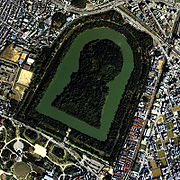 Daisen-Kofun
(the biggest tomb in Japan) in Sakai, Osaka
is considered to be his final resting place. The actual site of Nintoku's grave
is not known.
The Imperial tomb of Nintoku's consort, Iwa-no hime no Mikoto, is said to be located in Saki-cho, Nara City. Both kofun
-type Imperial tombs are characterized by a keyhole-shaped island located within a wide, water-filled moat.
Imperial tombs and mausolea are cultural properties; but they are guarded and administered by the Imperial Household Agency
(IHA
), which is the government department responsible for all matters relating to the emperor and his family. According to the IHA, the tombs are more than a mere repository for historical artifacts; they are sacred religious sites. IHA construes each of the Imperial grave sites as sanctuaries for the spirits of the ancestors of the Imperial House.
Nintoku is traditionally venerated at a memorial
Shinto
shrine
(misasagi) at Osaka
. The Imperial Household Agency
designates this location as his mausoleum
. It is formally named Mozu no Mimihara no naka no misasagi.
Emperor
An emperor is a monarch, usually the sovereign ruler of an empire or another type of imperial realm. Empress, the female equivalent, may indicate an emperor's wife or a woman who rules in her own right...
of Japan
Japan
Japan is an island nation in East Asia. Located in the Pacific Ocean, it lies to the east of the Sea of Japan, China, North Korea, South Korea and Russia, stretching from the Sea of Okhotsk in the north to the East China Sea and Taiwan in the south...
, according to the traditional order of succession.
No firm dates can be assigned to this emperor's life or reign, but he is conventionally considered to have reigned from 313–399.
Legendary narrative
Nintoku is considered to have ruled the country during the late-fourth century and early-fifth century, but there is a paucity of information about him. There is insufficient material available for further verification and study.According to Nihon Shoki
Nihon Shoki
The , sometimes translated as The Chronicles of Japan, is the second oldest book of classical Japanese history. It is more elaborate and detailed than the Kojiki, the oldest, and has proven to be an important tool for historians and archaeologists as it includes the most complete extant historical...
, he was the fourth son of Emperor Ōjin
Emperor Ojin
, also known as Homutawake or , was the 15th emperor of Japan, according to the traditional order of succession.No firm dates can be assigned to this emperor's life or reign, but he is conventionally considered to have reigned from 270 to 310....
and his mother was Nakatsuhime no Mikoto, a great-granddaughter of Emperor Keikō
Emperor Keiko
; also known as Ootarashihikooshirowake no Sumeramikoto, was the 12th emperor of Japan, according to the traditional order of succession.No firm dates can be assigned to this emperor's life or reign, but he is conventionally considered to have reigned from 71–130.-Legendary narrative:Keikō is...
. He was also the father of Emperors Richū
Emperor Richu
was the 17th emperor of Japan, according to the traditional order of succession.No firm dates can be assigned to this emperor's life or reign, but he is conventionally considered to have reigned from 400–405.-Legendary narrative :...
, Hanzei
Emperor Hanzei
, also known as Emperor Hanshō, was the 18th emperor of Japan, according to the traditional order of succession.No firm dates can be assigned to this emperor's life or reign, but he is conventionally considered to have reigned from 406 to 410....
, and Ingyō
Emperor Ingyo
was the 19th emperor of Japan, according to the traditional order of succession.No firm dates can be assigned to this emperor's life or reign, but he is conventionally considered to have reigned from 411–453.-Legendary narrative:...
.
Nintoku's contemporary title would not have been tennō, as most historians believe this title was not introduced until the reigns of Emperor Tenmu and Empress Jitō
Empress Jito
was the 41st emperor of Japan, according to the traditional order of succession.Jitō's reign spanned the years from 686 through 697.In the history of Japan, Jitō was the third of eight women to take on the role of empress regnant. The two female monarchs before Jitō were Suiko and Kōgyoku/Saimei...
. Rather, it was presumably Sumeramikoto or Amenoshita Shiroshimesu Ōkimi (治天下大王), meaning "the great king who rules all under heaven." Alternatively, Nintoku might have been referred to as (ヤマト大王/大君) or the "Great King of Yamato."
Events of Nintoku's life
Although the Nihon Shoki states that Nintoku ruled from 313–399, modern research suggests those dates are likely inaccurate.The achievements of Nintoku's reign which are noted in Nihon Shoki
Nihon Shoki
The , sometimes translated as The Chronicles of Japan, is the second oldest book of classical Japanese history. It is more elaborate and detailed than the Kojiki, the oldest, and has proven to be an important tool for historians and archaeologists as it includes the most complete extant historical...
include:
- constructed a thorn field bank called Namba no Horie to prevent a flood in Kawachi plains and for development. It is assumed that this was Japan's first large-scale engineering works undertaking.
- established a thorn field estate under the direct control of the Imperial Court (まむたのみやけ)
- constructed a Yokono bank (horizontal parcel, Ikuno-ku, Osaka-shi).
Consorts and Children
Empress(first): Princess IwaPrincess Iwa
, sometimes known as , was a poet and the Empress consort of Emperor Nintoku, who was the 16th emperor of Japan, according to the traditional order of succession. She was a descendant of Emperor Kōgen....
(磐之媛命), poet and daughter of Katsuragi no Sotsuhiko (葛城襲津彦)
- Prince Ooe no Izahowake (大兄去来穂別尊) Emperor RichūEmperor Richuwas the 17th emperor of Japan, according to the traditional order of succession.No firm dates can be assigned to this emperor's life or reign, but he is conventionally considered to have reigned from 400–405.-Legendary narrative :...
- Prince Suminoe no Nakatsu (住吉仲皇子)
- Prince Mizuhawake (瑞歯別尊) Emperor HanzeiEmperor Hanzei, also known as Emperor Hanshō, was the 18th emperor of Japan, according to the traditional order of succession.No firm dates can be assigned to this emperor's life or reign, but he is conventionally considered to have reigned from 406 to 410....
- Prince Oasatsuma wakugo no Sukune (雄朝津間稚子宿禰尊) Emperor IngyōEmperor Ingyowas the 19th emperor of Japan, according to the traditional order of succession.No firm dates can be assigned to this emperor's life or reign, but he is conventionally considered to have reigned from 411–453.-Legendary narrative:...
Empress(second): Yatanohimemiko (八田皇女), daughter of Emperor Ōjin
Emperor Ojin
, also known as Homutawake or , was the 15th emperor of Japan, according to the traditional order of succession.No firm dates can be assigned to this emperor's life or reign, but he is conventionally considered to have reigned from 270 to 310....
Himuka no Kaminagahime (日向髪長媛), daughter of Morokata no Kimi Ushimoroi (諸県君牛諸井)
- Prince Ookusaka (大草香皇子)
- Princess Kusaka no hatabihime no Himemiko (草香幡梭姫皇女)
Uji no Wakiiratsume (宇遅之若郎女), daughter of Emperor Ōjin
Emperor Ojin
, also known as Homutawake or , was the 15th emperor of Japan, according to the traditional order of succession.No firm dates can be assigned to this emperor's life or reign, but he is conventionally considered to have reigned from 270 to 310....
Kurohime (黒日売), daughter of Kibi no Amabe no Atai (吉備海部直)
Nintoku's tomb
Kofun
Kofun are megalithic tombs or tumuli in Japan, constructed between the early 3rd century and early 7th century. They gave their name to the Kofun period . Many of the Kofun have a distinctive keyhole-shaped mound , unique to ancient Japan...
(the biggest tomb in Japan) in Sakai, Osaka
Sakai, Osaka
is a city in Osaka Prefecture, Japan. It has been one of the largest and most important seaports of Japan since the Medieval era.Following the February 2005 annexation of the town of Mihara, from Minamikawachi District, the city has grown further and is now the fourteenth most populous city in...
is considered to be his final resting place. The actual site of Nintoku's grave
Grave (burial)
A grave is a location where a dead body is buried. Graves are usually located in special areas set aside for the purpose of burial, such as graveyards or cemeteries....
is not known.
The Imperial tomb of Nintoku's consort, Iwa-no hime no Mikoto, is said to be located in Saki-cho, Nara City. Both kofun
Kofun
Kofun are megalithic tombs or tumuli in Japan, constructed between the early 3rd century and early 7th century. They gave their name to the Kofun period . Many of the Kofun have a distinctive keyhole-shaped mound , unique to ancient Japan...
-type Imperial tombs are characterized by a keyhole-shaped island located within a wide, water-filled moat.
Imperial tombs and mausolea are cultural properties; but they are guarded and administered by the Imperial Household Agency
Imperial Household Agency
The is a government agency of Japan in charge of the state matters concerning Japan's imperial family and also keeping the Privy Seal and the State Seal...
(IHA
Imperial Household Agency
The is a government agency of Japan in charge of the state matters concerning Japan's imperial family and also keeping the Privy Seal and the State Seal...
), which is the government department responsible for all matters relating to the emperor and his family. According to the IHA, the tombs are more than a mere repository for historical artifacts; they are sacred religious sites. IHA construes each of the Imperial grave sites as sanctuaries for the spirits of the ancestors of the Imperial House.
Nintoku is traditionally venerated at a memorial
Memorial
A memorial is an object which serves as a focus for memory of something, usually a person or an event. Popular forms of memorials include landmark objects or art objects such as sculptures, statues or fountains, and even entire parks....
Shinto
Shinto
or Shintoism, also kami-no-michi, is the indigenous spirituality of Japan and the Japanese people. It is a set of practices, to be carried out diligently, to establish a connection between present day Japan and its ancient past. Shinto practices were first recorded and codified in the written...
shrine
Shrine
A shrine is a holy or sacred place, which is dedicated to a specific deity, ancestor, hero, martyr, saint, daemon or similar figure of awe and respect, at which they are venerated or worshipped. Shrines often contain idols, relics, or other such objects associated with the figure being venerated....
(misasagi) at Osaka
Osaka
is a city in the Kansai region of Japan's main island of Honshu, a designated city under the Local Autonomy Law, the capital city of Osaka Prefecture and also the biggest part of Keihanshin area, which is represented by three major cities of Japan, Kyoto, Osaka and Kobe...
. The Imperial Household Agency
Imperial Household Agency
The is a government agency of Japan in charge of the state matters concerning Japan's imperial family and also keeping the Privy Seal and the State Seal...
designates this location as his mausoleum
Mausoleum
A mausoleum is an external free-standing building constructed as a monument enclosing the interment space or burial chamber of a deceased person or persons. A monument without the interment is a cenotaph. A mausoleum may be considered a type of tomb or the tomb may be considered to be within the...
. It is formally named Mozu no Mimihara no naka no misasagi.
See also
- Emperor of JapanEmperor of JapanThe Emperor of Japan is, according to the 1947 Constitution of Japan, "the symbol of the state and of the unity of the people." He is a ceremonial figurehead under a form of constitutional monarchy and is head of the Japanese Imperial Family with functions as head of state. He is also the highest...
- List of Emperors of Japan
- Imperial cultImperial cultAn imperial cult is a form of state religion in which an emperor, or a dynasty of emperors , are worshipped as messiahs, demigods or deities. "Cult" here is used to mean "worship", not in the modern pejorative sense...
- Five kings of WaFive kings of WaThe five kings of Wa are kings of ancient Japan who sent envoys to China during the 5th century to strengthen the legitimacy of their claims to power by gaining the recognition of the Chinese emperor. Details about them are unknown...