


Narmer Palette

Encyclopedia
Egypt
Egypt , officially the Arab Republic of Egypt, Arabic: , is a country mainly in North Africa, with the Sinai Peninsula forming a land bridge in Southwest Asia. Egypt is thus a transcontinental country, and a major power in Africa, the Mediterranean Basin, the Middle East and the Muslim world...
ian archeological find, dating from about the 31st century BC, containing some of the earliest hieroglyph
Egyptian hieroglyphs
Egyptian hieroglyphs were a formal writing system used by the ancient Egyptians that combined logographic and alphabetic elements. Egyptians used cursive hieroglyphs for religious literature on papyrus and wood...
ic inscriptions ever found. It is thought by some to depict the unification of Upper
Upper Egypt
Upper Egypt is the strip of land, on both sides of the Nile valley, that extends from the cataract boundaries of modern-day Aswan north to the area between El-Ayait and Zawyet Dahshur . The northern section of Upper Egypt, between El-Ayait and Sohag is sometimes known as Middle Egypt...
and Lower Egypt
Lower Egypt
Lower Egypt is the northern-most section of Egypt. It refers to the fertile Nile Delta region, which stretches from the area between El-Aiyat and Zawyet Dahshur, south of modern-day Cairo, and the Mediterranean Sea....
under the king Narmer
Narmer
Narmer was an ancient Egyptian pharaoh of the Early Dynastic Period . He is thought to be the successor to the Protodynastic pharaohs Scorpion and/or Ka, and he is considered by some to be the unifier of Egypt and founder of the First Dynasty, and therefore the first pharaoh of unified Egypt.The...
. On one side, the king is depicted with the bulbed White crown of Upper (southern) Egypt, and the other side depicts the king wearing the level Red Crown of Lower (northern) Egypt. Along with the Scorpion Macehead
Scorpion Macehead
The Scorpion macehead refers to a decorated ancient Egyptian macehead found by British archeologists James E. Quibell and Frederick W. Green in what they called the main deposit in the temple of Horus at Hierakonpolis during the dig season of 1897/1898...
and the Narmer Macehead
Narmer Macehead
The Narmer macehead is an ancient Egyptian decorative stone mace head. It was found during a dig at Kom al Akhmar, the site of Hierakonpolis It is dated to the reign of king Narmer whose serekh is engraved on it...
s, also found together in the "Main Deposit
Main deposit (Nekhen)
The Main deposit was a foundation deposit of particular note in a temple in Nekhen. It was dug during the early Old Kingdom, and was excavated in 1894. The deposit is famous for having been the site where the Narmer Palette, Narmer Macehead, and Scorpion Macehead were discovered.The site was first...
" at Hierakonopolis, the Narmer Palette provides one of the earliest known depictions of an Egyptian king. The Palette shows many of the classic conventions of Egyptian art which must already have been formalized by the time of the Palette's creation. The Egyptologist Bob Brier
Bob Brier
Robert Brier , also known as Mr. Mummy, is an American Egyptologist specializing in paleopathology. A Senior Research Fellow at the C.W...
has referred to the Narmer Palette as "the first historical document in the world".
The Palette, which has survived five millennia in almost perfect condition, was discovered by British
United Kingdom
The United Kingdom of Great Britain and Northern IrelandIn the United Kingdom and Dependencies, other languages have been officially recognised as legitimate autochthonous languages under the European Charter for Regional or Minority Languages...
archeologists James E. Quibell
James E. Quibell
James Edward Quibell was a British Egyptologist, born in Newport, Shropshire.He was educated at Adams' Grammar School and Christ Church, Oxford...
and Frederick W. Green, in what they called the Main Deposit in the Temple of Horus at Hierakonpolis, during the dig season of 1897–1898. Also found at this dig were the Narmer Macehead and the Scorpion Macehead. The exact place and circumstances of these finds were not recorded very clearly by Quibell and Green. In fact, Green's report placed the Palette in a different layer one or two yards away from the deposit, which is considered to be more accurate on the basis of the original excavation notes. It has been suggested that these objects were royal donations made to the temple. Hierakonpolis was the ancient capital of Upper Egypt during the pre-dynastic Naqada III
Naqada III
Naqada III is the last phase of the Naqada culture of ancient Egyptian prehistory, dating approximately from 3200 to 3000 BC. It is the period during which the process of state formation, which had begun to take place in Naqada II, became highly visible, with named kings heading powerful...
phase of Egyptian history.
Palettes
Cosmetic palette
The cosmetic palettes of middle to late predynastic Egypt are archaeological artifacts, originally used to grind and apply ingredients for facial or body cosmetics. The decorative palettes of the late 4th millennium BCE appear to have lost this function and became commemorative, ornamental, and...
were typically used for grinding cosmetics, but this palette is too large and heavy (and elaborate) to have been created for personal use, and was likely a ritual or votive object, specifically made for donation to, or use in, a temple. One theory is that it was used to grind cosmetics to adorn the statues of the gods.
The Narmer Palette is part of the permanent collection of the Egyptian Museum
Egyptian Museum
The Museum of Egyptian Antiquities, known commonly as the Egyptian Museum, in Cairo, Egypt, is home to an extensive collection of ancient Egyptian antiquities. It has 120,000 items, with a representative amount on display, the remainder in storerooms....
in Cairo
Cairo
Cairo , is the capital of Egypt and the largest city in the Arab world and Africa, and the 16th largest metropolitan area in the world. Nicknamed "The City of a Thousand Minarets" for its preponderance of Islamic architecture, Cairo has long been a centre of the region's political and cultural life...
.
Description
The Narmer Palette is a 63 centimetres (2.1 ft), shield-shaped, ceremonial palette, carved from a single piece of flat, soft dark gray-green siltstoneSiltstone
Siltstone is a sedimentary rock which has a grain size in the silt range, finer than sandstone and coarser than claystones.- Description :As its name implies, it is primarily composed of silt sized particles, defined as grains 1/16 - 1/256 mm or 4 to 8 on the Krumbein phi scale...
. The stone has often been wrongly identified, in the past, as being slate
Slate
Slate is a fine-grained, foliated, homogeneous metamorphic rock derived from an original shale-type sedimentary rock composed of clay or volcanic ash through low-grade regional metamorphism. The result is a foliated rock in which the foliation may not correspond to the original sedimentary layering...
or schist
Schist
The schists constitute a group of medium-grade metamorphic rocks, chiefly notable for the preponderance of lamellar minerals such as micas, chlorite, talc, hornblende, graphite, and others. Quartz often occurs in drawn-out grains to such an extent that a particular form called quartz schist is...
. Slate is layered and prone to flaking, and schist is a metamorphic rock
Metamorphic rock
Metamorphic rock is the transformation of an existing rock type, the protolith, in a process called metamorphism, which means "change in form". The protolith is subjected to heat and pressure causing profound physical and/or chemical change...
containing large, randomly-distributed mineral grains. Both are unlike the finely-grained, hard, flake-resistant siltstone, whose source is from a well-attested quarry that has been used since pre-dynastic times at Wadi Hammamat
Wadi Hammamat
' is a dry river bed in Egypt's Eastern Desert, about halfway between Qusier and Qena. It was a major mining region and trade route east from the Nile Valley in ancient times, and three thousand years of rock carvings and graffiti make it a major scientific and tourist site today.-Trade...
. This material was used extensively during the pre-dynastic period
Predynastic Egypt
The Prehistory of Egypt spans the period of earliest human settlement to the beginning of the Early Dynastic Period of Egypt in ca. 3100 BC, starting with King Menes/Narmer....
for creating such palettes, and also was used as a source for Old Kingdom
Old Kingdom
Old Kingdom is the name given to the period in the 3rd millennium BC when Egypt attained its first continuous peak of civilization in complexity and achievement – the first of three so-called "Kingdom" periods, which mark the high points of civilization in the lower Nile Valley .The term itself was...
statuary. A statue of the 2nd dynasty pharaoh Khasekhemwy
Khasekhemwy
Khasekhemwy was the fifth and final king of the Second dynasty of Egypt. Little is known of Khasekhemwy, other than that he led several significant military campaigns and built several monuments, still extant, mentioning war against the Northerners...
, found in the same complex as the Narmer Palette at Hierakonopolis, also was made of this material.
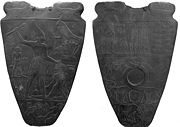
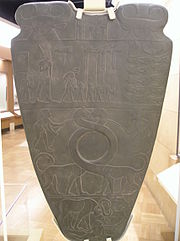
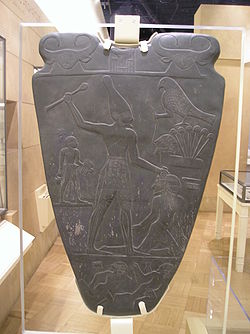
Both sides of the Palette are decorated, carved in raised relief. At the top of both sides of the Palette are the central serekh
Serekh
In Egyptian hieroglyphs, a serekh is a rectangular enclosure representing the niched or gated façade of a palace surmounted by the Horus falcon, indicating that the text enclosed is a royal name...
s bearing the rebus
Rebus
A rebus is an allusional device that uses pictures to represent words or parts of words. It was a favourite form of heraldic expression used in the Middle Ages to denote surnames, for example in its basic form 3 salmon fish to denote the name "Salmon"...
symbols n'r (catfish) and mr (chisel) inside, being the phonetic representation of Narmer's name. The serekh on each side are flanked by a pair of bovine heads with highly curved horns, thought to represent the cow goddess Bat, who was the patron deity of the seventh nome of Upper Egypt, and was also the deification of the cosmos and the Milky Way within Egyptian mythology during the pre-dynastic and Old Kingdom periods of Ancient Egyptian history.
Obverse side
Deshret
Deshret, from ancient Egyptian, was the formal name for the Red Crown of and for the desert Red Land on either side of Kemet, the fertile Nile river basin. The end has a curly wire on it, that represents the proboscis of a honey bee. Deshret or DSRT also represents the insect known as the honeybee...
of Lower Egypt, whose symbol was the papyrus. He holds a mace and a flail, two traditional symbols of kingship. To his right are the hieroglyphic symbols for his name, though not contained within a serekh
Serekh
In Egyptian hieroglyphs, a serekh is a rectangular enclosure representing the niched or gated façade of a palace surmounted by the Horus falcon, indicating that the text enclosed is a royal name...
. Behind him is his sandal bearer, whose name may be represented by the rosette
Rosette (design)
A rosette is a round, stylized flower design, used extensively in sculptural objects from antiquity. Appearing in Mesopotamia and used to decorate the funeral stele in Ancient Greece...
appearing adjacent to his head, and a second rectangular symbol that has no clear interpretation but which has been suggested may represent a town or citadel. Immediately in front of the pharaoh is a long-haired man, accompanied by a pair of hieroglyphs that have been interpreted as his name: Tshet (this assumes that these symbols had the same phonetic value used in later hieroglyphic writing). Before this man are four standard bearers, holding aloft an animal skin, a dog, and two falcons. At the far-right of this scene are ten decapitated corpses, with heads at their feet, possibly symbolizing the victims of Narmer's conquest. Above them are the symbols for a ship, a falcon, and a harpoon, which has been interpreted as representing the names of the towns that were conquered.
Below the procession, two men are holding ropes tied to the outstretched, intertwining necks of two serpopard
Serpopard
The serpopard is a term applied by some modern researchers to what is described as a mythical animal known from Ancient Egyptian depictions. This term is not used in any original texts, and is an interpretation made only recently. The image is featured specifically on decorated cosmetic palettes...
s confronting each other
Confronted-animals
Confronted animals, or confronted-animal as an adjective, where two animals face each other in a symmetrical pose, is an ancient bilateral motif in art and artifacts studied in archaeology and art history. The Anti-Confronted animals is the opposing motif...
, mythical felines with bodies of leopards (or more likely lionesses, given that there are no spots indicated) and snakelike necks. The circle formed by their exaggeratedly curving necks is the central part of the Palette, which is the area where the cosmetics would be ground. These animals have been considered an additional symbol for the unification of Egypt, but it is a unique image in Egyptian art and there is nothing to suggest that either animal represents an identifiable part of Egypt, although each had lioness war goddesses as protectors and the intertwined necks may represent the unification of the state. Similar images of such mythical animals are known from other contemporaneous cultures, and there are other examples of late-predynastic objects (including other palettes and knife handles) which borrow similar elements from Mesopotamia
Mesopotamia
Mesopotamia is a toponym for the area of the Tigris–Euphrates river system, largely corresponding to modern-day Iraq, northeastern Syria, southeastern Turkey and southwestern Iran.Widely considered to be the cradle of civilization, Bronze Age Mesopotamia included Sumer and the...
n iconography
Iconography
Iconography is the branch of art history which studies the identification, description, and the interpretation of the content of images. The word iconography literally means "image writing", and comes from the Greek "image" and "to write". A secondary meaning is the painting of icons in the...
.
At the bottom of the Palette, a bovine image is seen knocking down the walls of a city while trampling on a fallen foe. Because of the lowered head in the image, this is interpreted as a presentation of the king vanquishing his foes, "Bull of his Mother" being a common epithet given to Egyptian kings as the son of the patron cow goddess. This posture of a bovine has the meaning of "force" in later hieroglyphics.
Reverse side
Hathor
Hathor , is an Ancient Egyptian goddess who personified the principles of love, beauty, music, motherhood and joy. She was one of the most important and popular deities throughout the history of Ancient Egypt...
(who often appears in this view also). Some authors suggest that the images represent the vigor of the king as pair of bulls.
A large picture in the center of the Palette depicts Narmer wearing the White Crown of Upper Egypt whose symbol was the flowering lotus, and wielding a mace. To his left is a man bearing the king's sandals, again flanked by a rosette symbol. To the right of the king is a kneeling prisoner, who is about to be struck by the king. A pair of symbols appear next to his head, perhaps indicating his name, or indicating the region where he was from. Above the prisoner is a falcon, representing Horus
Horus
Horus is one of the oldest and most significant deities in the Ancient Egyptian religion, who was worshipped from at least the late Predynastic period through to Greco-Roman times. Different forms of Horus are recorded in history and these are treated as distinct gods by Egyptologists...
, perched above a set of papyrus flowers, the symbol of Lower Egypt. In his talons he holds a rope-like object which appears to be attached to the nose of a man's head that also emerges from the papyrus flowers, perhaps indicating that he is drawing life from the head. The papyrus has often been interpreted as referring to the marshes of the Nile Delta region in Lower Egypt, or that the battle happened in a marshy area, or even that each papyrus flower represents the number 1,000, indicating that 6,000 enemies were subdued in the battle.
Below the king's feet is a third section, depicting two naked, bearded men. They are either running, or are meant to be seen as sprawling dead upon the ground. Appearing to the left of the head of each man is a hieroglyphic sign, the first a walled town, the second a type of knot
Knot (hieroglyph)
The ancient Egyptian Knot hieroglyph, or girdle knot, Gardiner sign listed no. S24, portrays a reef knot. Besides its use as a hieroglyph, it has usage in statuary and reliefs; it is also an amulet, typically made of worked stone, or as jewellery elements.-Language usage:The knot hieroglyph is...
, likely indicating the name of a defeated town.
Scholarly debate on the Palette
The Palette has raised considerable scholarly debate over the years. In general the arguments fall into one of two camps: scholars who believe that the Palette is a record of actual events, and other academics who argue that it is an object designed to establish the mythology of united rule over Upper and Lower Egypt by the king.It had been thought that the Palette either depicted the unification of Lower Egypt
Lower Egypt
Lower Egypt is the northern-most section of Egypt. It refers to the fertile Nile Delta region, which stretches from the area between El-Aiyat and Zawyet Dahshur, south of modern-day Cairo, and the Mediterranean Sea....
by the king of Upper Egypt
Upper Egypt
Upper Egypt is the strip of land, on both sides of the Nile valley, that extends from the cataract boundaries of modern-day Aswan north to the area between El-Ayait and Zawyet Dahshur . The northern section of Upper Egypt, between El-Ayait and Sohag is sometimes known as Middle Egypt...
, or recorded a recent military success over the Libyans
Ancient Libya
The Latin name Libya referred to the region west of the Nile Valley, generally corresponding to modern Northwest Africa. Climate changes affected the locations of the settlements....
, or the last stronghold of a Lower Egyptian dynasty based in Buto
Buto
Buto , Butus , or Butosus, , now Tell al-Fara'in near the city of Desouk , was an ancient city located 95 km east of Alexandria in the Nile Delta of Egypt. The city stood on the Sebennytic arm of the Nile, near its mouth, and on the southern shore of the Butic Lake...
. More recently scholars such as Nicholas Millet
Nicholas Millet
Dr. Nicholas Byram Millet was an Egyptologist affiliated with the Royal Ontario Museum and the University of Toronto. An archaeologist, art historian, linguist, museum curator, administrator, and celebrated teacher, Millet was able to make great strides in the daunting task of translating the lost...
have argued that the Palette does not represent a historical event (such as the unification of Egypt), but instead represents the events of the year in which the object was dedicated to the temple. Whitney Davis has suggested that the iconography on this and other pre-dynastic palettes has more to do with establishing the king as a visual metaphor of the conquering hunter, caught in the moment of delivering a mortal blow to his enemies. John Baines
John Baines
John Baines is the incumbent Professor of Egyptology at the University of Oxford and a fellow of The Queen's College. He is the author of multiple scholarly articles and publications relating to ancient Egyptian civilization....
has suggested that the events portrayed are "tokens of royal achievement" from the past, and that "the chief purpose of the piece is not to record an event but to assert that the king dominates the ordered world in the name of the gods and has defeated internal, and especially external, forces of disorder.
Palette location-Egyptian Museum, Cairo
The Narmer Palette resides in the Egyptian MuseumEgyptian Museum
The Museum of Egyptian Antiquities, known commonly as the Egyptian Museum, in Cairo, Egypt, is home to an extensive collection of ancient Egyptian antiquities. It has 120,000 items, with a representative amount on display, the remainder in storerooms....
in Cairo
Cairo
Cairo , is the capital of Egypt and the largest city in the Arab world and Africa, and the 16th largest metropolitan area in the world. Nicknamed "The City of a Thousand Minarets" for its preponderance of Islamic architecture, Cairo has long been a centre of the region's political and cultural life...
, and is one of the initial exhibits which visitors have been able to see when entering the museum. It has the Journal d'Entrée number JE32169 and the Catalogue Général number CG14716.
In popular culture
The Narmer Palette is featured in the 2009 film WatchmenWatchmen (film)
Watchmen is a 2009 superhero film directed by Zack Snyder and starring Malin Åkerman, Billy Crudup, Matthew Goode, Jackie Earle Haley, Jeffrey Dean Morgan, and Patrick Wilson. It is an adaptation of the comic book of the same name by Alan Moore and Dave Gibbons...
, where a scaled-up version of it can be seen in the office of Adrian Veidt (Ozymandias). It is a fitting artifact for Veidt to have, considering he is a man who is strongly interested in Egypt and wishes to unite the world.
The Australian author Jackie French
Jackie French
Jacqueline Anne "Jackie" French is an award-winning Australian author. She writes mainly children's fiction and books on gardening....
used the palette, and recent research into Sumerian trade routes, to create her historical novel Pharaoh (2007). In it Narmer, as a youth, is inspired by Sumerian culture to unite the towns along the Nile.
The palette is featured in manga
Manga
Manga is the Japanese word for "comics" and consists of comics and print cartoons . In the West, the term "manga" has been appropriated to refer specifically to comics created in Japan, or by Japanese authors, in the Japanese language and conforming to the style developed in Japan in the late 19th...
artist Yukinobu Hoshino
Yukinobu Hoshino
is a Japanese manga artist. He was born in Kushiro, Hokkaidō and dropped out of Aichi Prefectural University of Fine Arts and Music mid-semester from the fine arts department. He made his debut in 1975 with Kotetsu no Queen and with Harukanaru Asa won the Tezuka prize for an outstanding manga. On...
's short story "The temple of El Alamein
El Alamein no Shinden
The Temple of El Alamein is a compilation of World War II short stories from the perspective of the German military personnel by Manga artist Yukinobu Hoshino and released in 1998. Taking place between 1940 and 1945, when the war was at its most violent peak, each story takes place in a different...
" in which a German tank
Tank
A tank is a tracked, armoured fighting vehicle designed for front-line combat which combines operational mobility, tactical offensive, and defensive capabilities...
crew discover a temple that contains proof that the ancient Egyptians used dinosaurs
Dinosaur
Dinosaurs are a diverse group of animals of the clade and superorder Dinosauria. They were the dominant terrestrial vertebrates for over 160 million years, from the late Triassic period until the end of the Cretaceous , when the Cretaceous–Paleogene extinction event led to the extinction of...
to build Pyramid
Pyramid
A pyramid is a structure whose outer surfaces are triangular and converge at a single point. The base of a pyramid can be trilateral, quadrilateral, or any polygon shape, meaning that a pyramid has at least three triangular surfaces...
s in the pre-dynastic era.
The Palette is also featured in The Kane Chronicles
The Kane Chronicles
The Kane Chronicles is a fictional trilogy by Rick Riordan about the adventures undertaken by Carter and Sadie Kane, the two main characters, in their quest to awaken the sun god,Ra.He is the god of all the gods or the supreme god. It is set in the modern United States, in the same sort of universe...
by Rick Riordan
Rick Riordan
Richard Russell "Rick" Riordan, Jr. is an American author best known for writing the Percy Jackson & the Olympians series. He also wrote the Tres Navarre mystery series for adults and helped to edit Demigods and Monsters, a collection of essays on the topic of his Percy Jackson series...
.
See also
- Libyan PaletteLibyan PaletteThe Libyan Palette is the surviving lower portion of a stone cosmetic palette bearing carved decoration and writing. It dates from the Naqada III or Protodynastic Period of Egypt...
(another well-known Predynastic Egyptian palette) - Warka VaseWarka VaseThe Warka Vase or the Uruk Vase is a carved alabaster stone vessel found in the temple complex of the Sumerian goddess Inanna in the ruins of the ancient city of Uruk, located in the modern Al Muthanna Governorate, in southern Iraq. Like the Narmer Palette from Egypt, it is one of the earliest...
(a comparable contemporary work of narrative relief sculpture from the SumerSumerSumer was a civilization and historical region in southern Mesopotamia, modern Iraq during the Chalcolithic and Early Bronze Age....
ian civilisation). - Kish tabletKish tabletThe Kish tablet is a limestone tablet found at Tell al-Uhaymir, Babil Governorate, Iraq - the site of the ancient Sumerian city of Kish. It is dated to ca. 3500 BC...
External links
- Narmer Palette - Archaeowiki.org
- High resolution photograph of the Narmer Palette
- Good images of Narmer Palette scroll down to the drawing of the Palette and take the link to the photographs published by Francesco Rafaele
- The Narmer Palette: The victorious king of the south
- Narmer Palette (weber.ucsd.edu)
- Narmer Palette (ancient-egypt.org)
- Corpus of Eygptian Late Predynastic Palettes Images of more than fifty such palettes with various motifs