
|
|
|
|
Humus
|
| |
|
| |
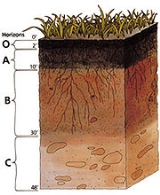
Humus (Origin: 1790–1800; < Latin: earth, ground) is degraded organic material in soil, which causes some soil layers to be dark brown or black.
In soil science, humus refers to any organic matter that has reached a point of stability, where it will break down no further and might, if conditions do not change, remain essentially as it is for centuries, if not millennia.
In agriculture, humus is sometimes also used to describe mature compost, or natural compost extracted from a forest or other spontaneous source for use to amend soil.

Discussion
Ask a question about 'Humus'
Start a new discussion about 'Humus'
Answer questions from other users
|
Encyclopedia
Humus (Origin: 1790–1800; < Latin: earth, ground) is degraded organic material in soil, which causes some soil layers to be dark brown or black.
In soil science, humus refers to any organic matter that has reached a point of stability, where it will break down no further and might, if conditions do not change, remain essentially as it is for centuries, if not millennia.
In agriculture, humus is sometimes also used to describe mature compost, or natural compost extracted from a forest or other spontaneous source for use to amend soil. It is also used to describe a topsoil horizon that contains organic matter (humus type, humus form, humus profile.)
Humification
The process of "humification" can occur naturally in soil, or in the production of compost. The importance of chemically stable humus is thought by some to be the fertility it provides to soils in both a physical and chemical sense, though some agricultural experts put a greater focus on other features of it, such as disease suppressiveness. Physically, it helps the soil retain moisture by increasing microporosity, and encourages the formation of good soil structure. Chemically, it has many active sites that bind to ions of plant nutrients, making them more available by ion exchange. Biologically, it allows soil organisms (microbes) to feed and reproduce. Humus is often described as the 'life-force' of the soil. Yet it is difficult to define humus in precise terms; it is a highly complex substance, the full nature of which is still not fully understood. Physically, humus can be differentiated from organic matter in that the latter is rough looking material, with coarse plant remains still visible, while once fully humified it becomes more uniform in appearance (a dark, spongy, jelly-like substance) and amorphous in structure, and may remain such for millennia or more. That is, it has no determinate shape, structure or character.
Plant remains (including those that have passed through an animal and are excreted as manure) contain organic compounds: sugars, starches, proteins, carbohydrates, lignins, waxes, resins and organic acids. The process of organic matter decay in the soil begins with the decomposition of sugars and starches from carbohydrates, which break down easily as saprotrophs initially invade the dead plant, while the remaining cellulose and lignin break down more slowly. Proteins decompose into amino acids at a rate depending on carbon to nitrogen ratios. Organic acids and sugars break down rapidly, while fats, waxes and resins remain relatively unchanged for longer periods of time. Lignin, which is slowly tranformed by white-rot fungi, is one of the main precursors of humus, together with by-products of microbial and faunal activity. The humus, that is the end product of this process, is thus a mixture of compounds and complex life chemicals of plant, animal, or microbial origin, which has many functions and benefits in the soil. Earthworm humus (vermicompost) is considered by some to be the best organic manure there is.
Humification of leaf litter and formation of clay-humus complexes
Compost that is readily capable of further decomposition is sometimes referred to as effective or active humus, though again scientists would say that if it is not stable, it's not humus at all. This kind of compost is principally derived from sugars, starches, and proteins, and consists of simple organic (fulvic) acids. It is an excellent source of plant nutrients, but of little value regarding long-term soil structure and tilth. Stable (or passive) humus consisting of humic acids and humins, on the other hand, are so highly insoluble (or tightly bound
to clay particles that they cannot be penetrated by microbes) that they are greatly resistant to further decomposition. Thus they add few readily available nutrients to the soil, but play an essential part in providing its physical structure. Some very stable humus complexes have survived for thousands of years. Stable humus tends to originate from woodier plant materials, eg, cellulose and lignins. Soil animals, which ingest then transform organic matter in their guts, are active agents of humification, in association with fungi and bacteria: most humus in the soil is included in animal feces of more or less dark color according to their content in organic matter.
Benefits of soil organic matter and humus
- The mineralization process that converts raw organic matter to the relatively stable substance that is humus feeds the soil population of micro-organisms and other creatures, thus maintaining high and healthy levels of soil life.
- The rate at which raw organic matter is converted into humus promotes (when fast) or limits (when slow) the coexistence of plants, animals and microbes in terrestrial ecosystems
- Effective and stable humus (see below) are further sources of nutrients to microbes, the former providing a readily available supply while the latter acts as a more long-term storage reservoir.
- Humification of dead plant material causes complex organic compounds to break down into simpler forms, which are then made available to growing plants for uptake through their root systems.
- Humus is a colloidal substance, and increases the soil's cation exchange capacity, hence its ability to store nutrients by chelation as can clay particles; thus while these nutrient cations are accessible to plants, they are held in the soil safe from leaching away by rain or irrigation.
- Humus can hold the equivalent of 80–90% of its weight in moisture, and therefore increases the soil's capacity to withstand drought conditions.
- The biochemical structure of humus enables it to moderate — or buffer — excessive acid or alkaline soil conditions.
- During the humification process, microbes secrete sticky gums; these contribute to the crumb structure of the soil by holding particles together, allowing greater aeration of the soil. Toxic substances such as heavy metals, as well as excess nutrients, can be chelated (that is, bound to the complex organic molecules of humus) and prevented from entering the wider ecosystem.
- The dark color of humus (usually black or dark brown) helps to warm up cold soils in the spring.
See also
|
| |
|
|