
Home      Discussion      Topics      Dictionary      Almanac
Signup       Login
Rubber mulch

Rubber mulch

Overview
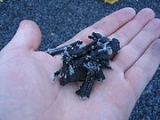
Rubber mulch is a type of mulch
Mulch
In agriculture and gardening, is a protective cover placed over the soil to retain moisture, reduce erosion, provide nutrients, and suppress weed growth and seed germination. Mulching in gardens and landscaping mimics the leaf cover that is found on forest floors....

 used in garden
Garden
A garden is a planned space, usually outdoors, set aside for the display, cultivation, and enjoyment of plants and other forms of nature. The garden can incorporate both natural and man-made materials. The most common form today is known as a residential garden, but the term garden has...

s and sustainable landscaping
Sustainable landscaping
Sustainable landscaping encompasses a variety of practices that have developed in response to environmental issues. These practices are used in every phase of landscaping, including design, construction, implementation and management of residential and commercial landscapes. Issues of...

 that is made from 100% recycled rubber.
Discussion
Ask a question about 'Rubber mulch'
Start a new discussion about 'Rubber mulch'
Answer questions from other users
Full Discussion Forum
 
Unanswered Questions
Encyclopedia
Rubber mulch is a type of mulch
Mulch
In agriculture and gardening, is a protective cover placed over the soil to retain moisture, reduce erosion, provide nutrients, and suppress weed growth and seed germination. Mulching in gardens and landscaping mimics the leaf cover that is found on forest floors....

 used in garden
Garden
A garden is a planned space, usually outdoors, set aside for the display, cultivation, and enjoyment of plants and other forms of nature. The garden can incorporate both natural and man-made materials. The most common form today is known as a residential garden, but the term garden has...

s and sustainable landscaping
Sustainable landscaping
Sustainable landscaping encompasses a variety of practices that have developed in response to environmental issues. These practices are used in every phase of landscaping, including design, construction, implementation and management of residential and commercial landscapes. Issues of...

 that is made from 100% recycled rubber.

Composition


Rubber mulch generally consists of either waste tire
Tire
A tire or tyre is a ring-shaped covering that fits around a wheel rim to protect it and enable better vehicle performance by providing a flexible cushion that absorbs shock while keeping the wheel in close contact with the ground...

 buffings or nuggets of rubber
Rubber
Natural rubber, also called India rubber or caoutchouc, is an elastomer that was originally derived from latex, a milky colloid produced by some plants. The plants would be ‘tapped’, that is, an incision made into the bark of the tree and the sticky, milk colored latex sap collected and refined...

 from tires that are ground up whole, after having their steel bands removed. Almost any tire can be used to make rubber mulch, including passenger vehicle tires and large truck and trailer tires. Buffings are produced from recycled truck tire tread when the remainder of the worn-down tread is removed from the tire prior to retreading. Buffings are generally thin slivers of rubber. Nuggets range in size from 10 mm to 32 mm, or 3/8 inch to 1 inch.

Advantages


Rubber mulch provides several advantages over plant material based mulches. For landscaping and gardening purposes, both nuggets and buffings insulate soil from heat allowing a 2 or 3 degrees F
Fahrenheit
Fahrenheit is the temperature scale proposed in 1724 by, and named after, the German physicist Daniel Gabriel Fahrenheit . Within this scale, the freezing of water into ice is defined at 32 degrees, while the boiling point of water is defined to be 212 degrees...

 higher soil temperature difference over wood mulches. Rubber mulch is beneficial for soil moisture as rubber is non-porous and does not absorb water on its way through to the soil. It also reduces fungus growth and plant growth, and becomes a weed barrier as weed seeds dehydrate in the mulch before reaching the soil. Neither nuggets nor buffings provide any humus to compacted soil types.
Another advantage over plant-material mulches is its elasticity, which gives it a springy quality when used in a fairly thick layer. This makes it a natural choice for playground
Playground
A playground or play area is a place with a specific design for children be able to play there. It may be indoors but is typically outdoors...

s, where the extra springiness provides additional safety for children when they fall off of playground equipment. Tests have shown rubber mulch is superior in breaking falls to traditional bark mulches. The International Play Equipment Manufacturers Association has certified some rubber mulches for ASTM F1292-09.
It can be 97% wire free for landscape use and 99.9% wire free for playgrounds. Rubber mulch is also becoming a product of choice used in horse arenas for footing material when mixed with sand. It can be found in nugget or shredded style.

Rubber mulch is seen as an effective and safe alternative to wood mulch, reducing the regional and global carbon footprint by reusing materials that would otherwise end up in landfills. Its durability can be up to twelve times greater than wood mulch- with wood mulch lasting an average of four seasons- as it doesn't deteriorate over time.

Disadvantages

  • Some recycled varieties may leach chemicals(some toxic) which are harmful to plants
  • Rubber mulch, like some organic mulches, is a hazard if ignited. However, rubber mulch is more difficult to extinguish.


Although rubber mulch is generally safe, recycled tire rubber leachates do contain certain minerals and compounds which may cause concern in high concentrations. Recycled tire mulch can contain trace amounts of various minerals from the tire manufacturing process and other chemicals that may have been picked up during the tire's service life.

Environmental Impact and Safety Testing


The Environmental Protection Agency (EPA) has endorsed the use of recycled rubber to cushion the surfaces of children’s playgrounds. For more information, visit the EPA website.

The Environmental Protection Agency (EPA) recently studied air and surface samples at four fields and playgrounds that use recycled tires. The limited study, conducted in August through October 2008, found that the concentrations of materials that made up tire crumb were below levels considered harmful. In addition, the overall study protocol and many of the methods were found to be appropriate and could be implemented in the field.
The details of the EPA’s study can be found at: www.epa.gov/nerl/features/tire_crumbs.html

The Office of Environmental Health Hazard Assessment of the California Environmental Protection Agency tested skin sensitization by playground surfaces made of recycled tires and found no sensitization observed suggesting that these surfaces would not cause skin sensitization in children, nor would they be expected to elicit skin reaction in children already sensitized to latex.
Study dated January 2007 can be viewed at: www.ciwmb.ca.gov/Publications/Tires/62206013.pdf

ChemRisk, Inc. in Pittsburgh conducted a review of exposure to recycled tire rubber found on playgrounds and synthetic turf fields. They concluded that no adverse human health or ecological health effects are likely to result from these beneficial reuses of tire materials.
Study dated July 17, 2008. Detailed information and more studies can be found at: www.syntheticturfcouncil.org/displaycommon.cfm?an=1&subarticlenbr=91

External links