
All Topics  
Nitrogen fixation

 
Nitrogen Fixation

   Email Print
   Bookmark   Link


Nitrogen fixation


Nitrogen fixation is the process by which nitrogen
Nitrogen

Nitrogen is a chemical element that has the symbol N and atomic number 7 and atomic mass 14.00674?. Elemental nitrogen is a colorless, odorless, tasteless and mostly inert diatomic gas at standard conditions, constituting 78% by volume of Earth's atmosphere....
 is taken from its relatively inert molecular form (N2) in the atmosphere
Earth's atmosphere

The Earth's atmosphere is a layer of gases surrounding the planet Earth that is retained by the Earth's gravity. Dry air contains roughly 78.08% nitrogen, 20.95% oxygen, 0.93% argon, 0.038% Carbon dioxide in the Earth's atmosphere, and trace amounts of other gases....
 and converted into nitrogen compounds (such as ammonia
Ammonia

Ammonia is a chemical compound with the chemical formula nitrogenhydrogen. It is normally encountered as a gas with a characteristic pungent odor....
, nitrate
Nitrate

In inorganic chemistry, a nitrate is a salt of nitric acid with an ion composed of one nitrogen and three oxygen atoms . In organic chemistry the esters of nitric acid and various alcohols are called nitrates....
 and nitrogen dioxide
Nitrogen dioxide

Nitrogen dioxide is the chemical compound with the chemical formula NitrogenOxygen2. One of several nitrogen oxides, NO2 is an intermediate in the industrial synthesis of nitric acid, millions of tons of which are produced each year....
).

Nitrogen fixation is performed naturally by a number of different prokaryote
Prokaryote

The prokaryotes are a group of organisms that lack a cell nucleus , or any other cell membrane-bound organelles. They differ from the eukaryotes, which have a cell nucleus....
s, including bacteria, actinobacteria
Actinobacteria

Actinobacteria or actinomycetes are a group of Gram-positive bacterium with high G+C ratio. ...
, and certain types of anaerobic bacteria. Microorganisms that fix nitrogen are called diazotroph
Diazotroph

Diazotrophs are bacteria that Nitrogen fixation atmospheric nitrogen gas into a more usable form such as ammonia.A diazotroph is an organism that is able to grow without external sources of fixed nitrogen....
s. Some higher plants, and some animals (termite
Termite

The termites are a group of social insects usually classified at the Taxonomy of Order Isoptera . As truly social animals, they are termed eusocial along with the ants and some bees and wasps which are all placed in the separate Order Hymenoptera....
s), have formed associations with diazotrophs.


Discussion
Ask a question about 'Nitrogen fixation'
Start a new discussion about 'Nitrogen fixation'
Answer questions from other users
Full Discussion Forum


Recent Posts


Encyclopedia


Nitrogen fixation is the process by which nitrogen
Nitrogen

Nitrogen is a chemical element that has the symbol N and atomic number 7 and atomic mass 14.00674?. Elemental nitrogen is a colorless, odorless, tasteless and mostly inert diatomic gas at standard conditions, constituting 78% by volume of Earth's atmosphere....
 is taken from its relatively inert molecular form (N2) in the atmosphere
Earth's atmosphere

The Earth's atmosphere is a layer of gases surrounding the planet Earth that is retained by the Earth's gravity. Dry air contains roughly 78.08% nitrogen, 20.95% oxygen, 0.93% argon, 0.038% Carbon dioxide in the Earth's atmosphere, and trace amounts of other gases....
 and converted into nitrogen compounds (such as ammonia
Ammonia

Ammonia is a chemical compound with the chemical formula nitrogenhydrogen. It is normally encountered as a gas with a characteristic pungent odor....
, nitrate
Nitrate

In inorganic chemistry, a nitrate is a salt of nitric acid with an ion composed of one nitrogen and three oxygen atoms . In organic chemistry the esters of nitric acid and various alcohols are called nitrates....
 and nitrogen dioxide
Nitrogen dioxide

Nitrogen dioxide is the chemical compound with the chemical formula NitrogenOxygen2. One of several nitrogen oxides, NO2 is an intermediate in the industrial synthesis of nitric acid, millions of tons of which are produced each year....
).

Nitrogen fixation is performed naturally by a number of different prokaryote
Prokaryote

The prokaryotes are a group of organisms that lack a cell nucleus , or any other cell membrane-bound organelles. They differ from the eukaryotes, which have a cell nucleus....
s, including bacteria, actinobacteria
Actinobacteria

Actinobacteria or actinomycetes are a group of Gram-positive bacterium with high G+C ratio. ...
, and certain types of anaerobic bacteria. Microorganisms that fix nitrogen are called diazotroph
Diazotroph

Diazotrophs are bacteria that Nitrogen fixation atmospheric nitrogen gas into a more usable form such as ammonia.A diazotroph is an organism that is able to grow without external sources of fixed nitrogen....
s. Some higher plants, and some animals (termite
Termite

The termites are a group of social insects usually classified at the Taxonomy of Order Isoptera . As truly social animals, they are termed eusocial along with the ants and some bees and wasps which are all placed in the separate Order Hymenoptera....
s), have formed associations with diazotrophs. Recently, the role of certain Archaea, particularly some mesophilic Crenarcheota, in nitrogen fixing has been under investigation; some researchers believe these microbes may have a much larger role in the global nitrogen cycle than previously thought.

Nitrogen fixation also occurs as a result of non-biological processes. These include lightning
Lightning

File:Blesk.jpgLightning is an Earth's atmosphere discharge of electricity usually accompanied by thunder, which typically occurs during thunderstorms, and sometimes during volcano or dust storms....
, industrially through the Haber-Bosch Process, and combustion
Combustion

Combustion or burning is a complex sequence of exothermic chemical reactions between a fuel and an oxidant accompanied by the production of heat or both heat and light in the form of either a glow or flames, appearance of light flickering....
.

Biological nitrogen fixation was discovered by the Dutch microbiologist Martinus Beijerinck
Martinus Beijerinck

Martinus Willem Beijerinck was a Netherlands microbiologist and botanist. He was born in Amsterdam.Beijerinck studied at Leiden University and became a teacher in microbiology at the Agricultural School in Wageningen ...
.

Biological nitrogen fixation

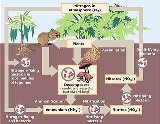
Nitrogen Cycle
Biological Nitrogen Fixation (BNF) occurs when atmospheric nitrogen is converted to ammonia by a pair of bacterial enzymes called nitrogenase
Nitrogenase

Nitrogenase is the enzyme used by some organisms to fix atmospheric nitrogen gas . It is the only known family of enzymes which accomplishes this process....
. The formula for BNF is:

N2 + 8H+ + 8e- + 16 ATP
Adenosine triphosphate

This article is about the chemical used by cells as an energy carrier. For other uses, see ATP .Adenosine-5'-triphosphate is a multifunctional nucleotide, and plays an important role in cell biology as a coenzyme that is the "molecule unit of currency" of intracellular energy transfer....
 ? 2NH3 + H2 + 16ADP
Adenosine diphosphate

Adenosine diphosphate, abbreviated ADP, is a nucleotide. It is an ester of pyrophosphoric acid with the nucleoside adenosine. ADP consists of the pyrophosphate Functional group, the pentose sugar ribose, and the nucleobase adenine....
 + 16 Pi
Phosphate

A phosphate, an inorganic chemical, is a Salt of phosphoric acid. Inorganic phosphates are mining to obtain phosphorus for use in agriculture and industry....


Although ammonia
Ammonia

Ammonia is a chemical compound with the chemical formula nitrogenhydrogen. It is normally encountered as a gas with a characteristic pungent odor....
 (NH3) is the direct product of this reaction, it is quickly protonated into ammonium
Ammonium

The ammonium cation is a positively electric charge polyatomic ion of the chemical formula NH4+. It has a formula weight of 18.05 and is formed by protonation of ammonia ....
 (NH4+). In free-living diazotrophs, the nitrogenase-generated ammonium is assimilated into glutamate through the glutamine synthetase/glutamate synthase pathway.

In most bacteria, the nitrogenase enzymes are very susceptible to destruction by oxygen (and many bacteria cease production of the enzyme in the presence of oxygen). Low oxygen tension is achieved by different bacteria by: living in anaerobic conditions, respiring to draw down oxygen levels, or binding the oxygen with a protein such as Leghemoglobin
Leghemoglobin

The oxygen carrier leghemoglobin is a hemoprotein found in the Nitrogen fixation root nodules of legume plants. It is produced by legumes in response to the roots being infected by nitrogen-fixing bacteria, so-called rhizobia, as part of the symbiosis interaction between plant and bacterium: roots uninfected with Rhizobium do not synthes...
 (also spelt leghaemoglobin).

The best-known plants which contribute to nitrogen fixation in nature, are in the legume
Legume

A legume is a plant in the family Fabaceae , or a fruit of these specific plants. A legume fruit is a Fruit#Simple fruit that develops from a simple carpel and usually Dehiscence on two sides....
 family - Fabaceae
Fabaceae

Fabaceae or Leguminosae is a large and economically important family of flowering plants, which is commonly known as the legume family, pea family, bean family or pulse family....
, which includes such taxa as clover
Clover

Clover , or trefoil, is a genus of about 300 species of plants in the pea family Fabaceae. The genus has a cosmopolitan distribution; the highest diversity is found in the temperate Northern Hemisphere, but many species also occur in South America and Africa, including at high altitudes on mountains in the tropics....
, beans, alfalfa
Alfalfa

Alfalfa is a flowering plant in the pea family Fabaceae cultivated as an important forage crop. In the United Kingdom, Australia and New Zealand it is known as lucerne and as lucerne grass in south Asia....
, lupines and peanut
Peanut

The peanut, or groundnut , is a species in the legume Fabaceae native to South America, Mexico and Central America. It is an annual plant herbaceous plant growing to 30 to 50 cm tall....
s. They contain symbiotic
Symbiosis

The term symbiosis commonly describes close and often long-term interactions between different biological species. The term was first used in 1879 by the Germany mycology Heinrich Anton de Bary, who defined it as "the living together of unlike organisms"....
 bacteria called rhizobia
Rhizobia

Rhizobia are soil bacterium that Nitrogen fixation nitrogen after becoming established inside root nodules of legumes . Rhizobia require a plant host; they cannot independently fix nitrogen....
 within nodules
Root nodule

Root nodules occur on the roots of plants that associate with symbiotic bacterium.Under nitrogen limiting conditions, plants from the pea family Fabaceae form a symbiotic relationship with a host-specific strain of bacteria known as rhizobia....
 in their root systems
Root

In vascular plants, the root is the organ of a plant body that typically lies below the surface of the soil. This is not always the case, however, since a root can also be aerial root or aerating ....
, producing nitrogen compounds that help the plant to grow and compete with other plants. When the plant dies, the fixed nitrogen is released, making it available to other plants and this helps to fertilize the soil
Soil

Soil is the naturally occurring, unconsolidated or loose covering on the Earth's surface. Soil is composed of particles of broken rock that have been altered by chemical and environmental processes including weathering and erosion....
 The great majority of legumes have this association, but a few genera (e.g., Styphnolobium
Styphnolobium

Styphnolobium is a small genus of three or four species of small trees and shrubs in the subfamily Faboideae of the pea family Fabaceae, formerly included within a broader interpretation of the genus Sophora....
) do not. In many traditional and organic farming practices, fields are rotated through various types of crops, which usually includes one consisting mainly or entirely of clover or buckwheat (family Polygonaceae
Polygonaceae

Polygonaceae is a family of flowering plants also known as the "knotweed family" or "smartweed family". The name is based on the genus Polygonum....
), which were often referred to as "green manure", since the other natural way of adding nitrogen to the soil is via animal waste products. The entire plant is often ploughed back into the field, thus not only adding more nitrogen, but also improving the soil's organic
Organic

Organic may refer to:* Organism, a living entity.* Organ , of or relating to a bodily organ.Life:*LifeMaterials and substances:...
 content and volume.

Non-leguminous nitrogen-fixing plants

Although by far the majority of nitrogen-fixing plants are in the legume family Fabaceae
Fabaceae

Fabaceae or Leguminosae is a large and economically important family of flowering plants, which is commonly known as the legume family, pea family, bean family or pulse family....
, there are a few non-leguminous plants that can also fix nitrogen. These plants, referred to as "actinorhizal plant
Actinorhizal plant

Actinorhizal plants are a group of Angiosperms characterized by their ability to form a symbiosis with the nitrogen fixing actinomycete Frankia....
s", consist of 22 genera of woody shrubs or trees scattered in 8 plant families. The ability to fix nitrogen is not universally present in these families. For instance, of 122 genera in the Rosaceae
Rosaceae

The Rosaceae or rose family is a large family of plants, with about 3,000-4,000 species in 100-160 genera. Traditionally it has been divided into four subfamilies: Rosoideae, Spiraeoideae, Maloideae, and Amygdaloideae....
, only 4 genera are capable of fixing nitrogen. Family: Genera

Betulaceae
Betulaceae

Betulaceae, or the Birch Family, includes six genera of deciduous nut -bearing trees and shrubs, including the birches, alders, hazels, hornbeams and hop-hornbeams, numbering about 130 species....
 (Birch): Alnus (Alder)

Cannabaceae
Cannabaceae

Cannabaceae is a small family of flowering plants.According to the Royal Botanical Gardens database, there are 170 species grouped in nine to fifteen genera, including three well-known genera Cannabis , Hop and Hackberry ....
: Trema
Trema

Trema is a genus of about 15 species of evergreen trees closely related to the hackberries , occurring in subtropical and tropical regions of southern Asia, northern Australasia, Africa and South America and Central America....


Casuarinaceae
Casuarinaceae

Casuarinaceae is a family of dicotyledonous flowering plants placed in the order Fagales, consisting of 3 or 4 genera and approximately 70 species of trees and shrubs native to the Old World tropics , Australia, and the Pacific islands....
 (she-oaks):
Allocasuarina
Allocasuarina

Allocasuarina is a genus in the flowering plant family Casuarinaceae. They are endemic to Australia, occurring primarily in the south. Like the closely related genus Casuarina, they are commonly called sheoaks or she-oaks, they are notable for their long, segmented branchlets that function as leaves....
Casuarina
Casuarina

Casuarina is a genus of 17 species in the family Casuarinaceae, native to Australasia, southeastern Asia, and islands of the western Pacific Ocean....
Gymnostoma


Coriariaceae: Coriaria
Coriaria

Coriaria is the sole genus in the family Coriariaceae. It includes about 30 species of subshrubs, shrubs and small trees, with a widespread but disjunct distribution across warm temperate regions of the world, occurring as far apart as the Mediterranean region, southern and eastern Asia, New Zealand , the Pacific Ocean islands, and...


Datiscaceae
Datiscaceae

Datiscaceae are a family of Dicotyledonous plants, containing two species of the genus Datisca. Two other genera, Octomeles and Tetrameles are now classified in the Tetramelaceae family....
: Datisca

Elaeagnaceae
Elaeagnaceae

Elaeagnaceae, the oleaster family, is a plant family of the order Rosales comprising small trees and shrubs, native to temperate regions of the Northern Hemisphere, south into tropical Asia and Australia....
 (oleaster):
Elaeagnus
Elaeagnus

Elaeagnus is a genus of about 50?70 species of flowering plants in the Elaeagnaceae. The vast majority of the species are native to temperate and subtropical regions of Asia, with one species extending south into northeastern Australia, and another species restricted to North America....
 (silverberry)
Hippophae (sea-buckthorn)
Shepherdia (buffaloberries)


Myricaceae
Myricaceae

The Myricaceae is a small family of dicotyledonous shrubs and small trees in the order Fagales. There are three genera in the family, though some botanists separate many species from Myrica into a fourth genus Morella....
:
Morella arborea
Morella arborea

Morella arborea is a species of plant in the Myricaceae family. It is Endemism to Equatorial Guinea. Category:Flora of Equatorial Guinea Its natural habitats are subtropical or tropical moist lowland forests, subtropical or tropical moist montanes, and subtropical or tropical high-altitude grassland....
Myrica
Myrica

Myrica is a genus of about 35-50 species of small trees and shrubs in the family Myricaceae, order Fagales. The genus has a wide distribution, including Africa, Asia, Europe, North America and South America, and missing only from Australasia....
Comptonia
Comptonia

Comptonia is a monotypic genus in the family Myricaceae, order Fagales. It is native to eastern North America, from southern Quebec south to the extreme north of Georgia , and west to Minnesota....


Rhamnaceae
Rhamnaceae

Rhamnaceae, the Buckthorn family, is a large family of flowering plants, mostly trees, shrubs and some vines.The family contains 50-60 genera and approximately 870-900 species....
 (buckthorn):
Ceanothus
Ceanothus

Ceanothus Carolus Linnaeus is a genus of about 50?60 species of shrubs or small trees in the buckthorn family Rhamnaceae. The genus is confined to North America, the center of its distribution in California, with some species in the eastern United States and southeast Canada, and others extending as far south as Guatemala....
Colletia
Colletia

Colletia is a genus of flowering plants in the family Rhamnaceae, with 15 to 17 species of spiny shrubs. All species of this genus are native to southern South America....
Discaria
Discaria

Discaria is a genus of about 12 species of flowering plants in the family Rhamnaceae, native to temperate regions of the Southern Hemisphere, in Australia, New Zealand and South America....
Kentrothamnus
Retanilla
Trevoa
Trevoa

Trevoa is a genus of actinorhizal plants; these dicotyledon flora are trees or small shrubs. The genus was first proposed by Miers in 1825, but was not fully described until 1830 by Sir William Jackson Hooker....


Rosaceae
Rosaceae

The Rosaceae or rose family is a large family of plants, with about 3,000-4,000 species in 100-160 genera. Traditionally it has been divided into four subfamilies: Rosoideae, Spiraeoideae, Maloideae, and Amygdaloideae....
 (rose):
Cercocarpus (mountain mahogany)
Chamaebatia
Chamaebatia

The plant genus Chamaebatia includes two species of aromatic evergreen shrubs known as mountain misery. They are actinorhizal, meaning they are Fabaceae Nitrogen fixation....
 (mountain misery)
Purshia
Purshia

Purshia is a small genus of 5-8 species of flowering plants in the family Rosaceae, native to western North America, where they grow in dry climates from southeast British Columbia in Canada south throughout the western United States to northern Mexico....
 (bitterbrush or cliff-rose)
Dryas


There are also several nitrogen-fixing symbiotic associations that involve cyanobacteria
Cyanobacteria

Cyanobacteria, also known as blue-green algae, blue-green bacteria or Cyanophyta, is a phylum of bacteria that obtain their energy through photosynthesis....
 (such as Nostoc). These include some lichens such as Lobaria
Lobaria

Lobaria is a genus of lichens commonly known as "lungwort" or "lung moss" because their physical shape somewhat resembles a lung. Lobaria species are unusual in that they have a three-part symbiosis, containing a fungus, an alga and a cyanobacterium, the presence of the cyanobacterium allowing nitrogen fixation....
 and Peltigera
Peltigera

Peltigera is a genus of approximately 75 species of lichenized fungi in the family Peltigeraceae. Commonly known as the dog lichen, lichens of Peltigera are often terricolous , but can also occur on moss, trees, rocks, and many other substrates in many parts of the world....
:
  • Mosquito fern
    Mosquito fern

    Azolla is a genus of seven species of aquatic plant ferns, the only genus in the family Azollaceae. They are extremely reduced in form and specialized, looking nothing like conventional ferns but more resembling duckweed or some mosses....
     (Azolla species)
  • Cycad
    Cycad

    File:Cycad cone.jpgCycads are a group of seed plants characterized by a large crown of compound Leaf and a stout trunk . They are evergreen, gymnospermous, dioecious plants having large pinnately compound leaves....
    s
  • Gunnera
    Gunnera

    Gunnera is a genus of herbaceous flowering plants, some of them gigantic. The genus is the only member of the family Gunneraceae.The 40-50 species vary enormously in leaf size....


Microorganisms that fix nitrogen

  • Diazotroph
    Diazotroph

    Diazotrophs are bacteria that Nitrogen fixation atmospheric nitrogen gas into a more usable form such as ammonia.A diazotroph is an organism that is able to grow without external sources of fixed nitrogen....
    s
  • Cyanobacteria
    Cyanobacteria

    Cyanobacteria, also known as blue-green algae, blue-green bacteria or Cyanophyta, is a phylum of bacteria that obtain their energy through photosynthesis....
  • Azotobacteraceae
    Azotobacteraceae

    The family Azotobacteraceae contains aerobic diazotrophs with two Genera, Azomonas and Azotobacter, distinguished by the ability to form cysts. The family is also characterized by variable cell shape, the classic shape being ovoid while many are pleomorphic....
  • Rhizobia
    Rhizobia

    Rhizobia are soil bacterium that Nitrogen fixation nitrogen after becoming established inside root nodules of legumes . Rhizobia require a plant host; they cannot independently fix nitrogen....
  • Frankia
    Frankia

    Frankia is a genus of nitrogen fixing filamentous bacteria that live in symbiosis with actinorhizal plants, similar to Rhizobia. Bacteria of this genus form root nodules....


Nitrogen Fixation by Cyanobacteria

Cyanobacteria
Cyanobacteria

Cyanobacteria, also known as blue-green algae, blue-green bacteria or Cyanophyta, is a phylum of bacteria that obtain their energy through photosynthesis....
 inhabit nearly all illuminated environments on Earth and play key roles in the carbon and nitrogen cycle
Nitrogen cycle

The nitrogen cycle is the biogeochemical cycle that describes the transformations of nitrogen and nitrogen-containing compounds in nature. It is a cycle which includes Gas components....
 of the biosphere
Biosphere

The biosphere is the global sum of all ecosystems. From the broadest Geophysiology point of view, the biosphere is the global ecology system integrating all living beings and their relationships, including their interaction with the elements of the lithosphere, hydrosphere, and Earth's atmosphere....
. Generally, cyanobacteria
Cyanobacteria

Cyanobacteria, also known as blue-green algae, blue-green bacteria or Cyanophyta, is a phylum of bacteria that obtain their energy through photosynthesis....
 are able to utilize a variety of inorganic and organic sources of combined nitrogen, like nitrate
Nitrate

In inorganic chemistry, a nitrate is a salt of nitric acid with an ion composed of one nitrogen and three oxygen atoms . In organic chemistry the esters of nitric acid and various alcohols are called nitrates....
, nitrite
Nitrite

The nitrite ion is NO2-. The anion is bent, being isoelectronic with ozone. More generally, a nitrite compound is either a Salt or an ester of nitrous acid....
, ammonium
Ammonium

The ammonium cation is a positively electric charge polyatomic ion of the chemical formula NH4+. It has a formula weight of 18.05 and is formed by protonation of ammonia ....
, urea
Urea

Urea is an organic compound with the chemical formula 2carbonoxygen.Urea is also known by the International Nonproprietary Name carbamide, as established by the World Health Organization....
 or some amino acids. Several cyanobacterial strains are also capable of diazotroph
Diazotroph

Diazotrophs are bacteria that Nitrogen fixation atmospheric nitrogen gas into a more usable form such as ammonia.A diazotroph is an organism that is able to grow without external sources of fixed nitrogen....
ic growth. Genome sequencing
Genome sequencing

Genome Sequencing may refer to:* DNA sequencing* Full genome sequencing...
 has provided a large amount of information on the genetic basis of nitrogen metabolism and its control in different cyanobacteria. Comparative genomics
Comparative genomics

Comparative genomics is the study of the relationship of genome structure and function across different biological species or Strain . Comparative genomics is an attempt to take advantage of the information provided by the signatures of selection to understand the function and evolutionary processes that act on genomes....
, together with functional studies, has led to a significant advance in this field over the past years. 2-oxoglutarate has turned out to be the central signalling molecule reflecting the carbon/nitrogen balance of cyanobacteria. Central players of nitrogen control are the global transcriptional factor NtcA, which controls the expression of many genes involved in nitrogen metabolism, as well as the PII signalling protein, which fine-tunes cellular activities in response to changing C/N conditions. These two proteins are sensors of the cellular 2-oxoglutarate level and have been conserved in all cyanobacteria. In contrast, the adaptation to nitrogen starvation involves heterogeneous responses in different strains.

Chemical nitrogen fixation

Nitrogen can also be artificially fixed for use in fertilizer
Fertilizer

Fertilizers are chemical compounds given to plants to promote growth; they are usually applied either through the soil, for uptake by plant roots, or by foliar feeding, for uptake through leaves....
, explosives, or in other products. The most popular method is by the Haber process
Haber process

The Haber process, also called the Haber?Bosch process, is the nitrogen fixation reaction of nitrogen and hydrogen, over an enriched iron Catalysis, to produce ammonia....
. This artificial fertilizer production has achieved such scale that it is now the largest source of fixed nitrogen in the Earth
Earth

Earth is the third planet from the Sun. Earth is the largest of the terrestrial planets in the Solar System in diameter, mass and density. It is also referred to as the World and Wiktionary:Terra.Note that by International Astronomical Union convention, the term "Terra" is used for naming extensive land masses, rather...
's ecosystem
Ecosystem

An ecosystem is a natural unit consisting of all plants, animals and micro-organisms in an area functioning together with all of the non-living physical factors of the environment....
.

The Haber process requires high pressures and very high temperatures and active research is committed to the development of catalyst systems that convert nitrogen to ammonia at ambient temperatures. Many compounds can react with atmospheric nitrogen under ambient conditions (eg lithium makes lithium nitride if left exposed), but the products of such reactions are not easily converted into biologically accessible nitrogen sources. After the first dinitrogen complex
Complex (chemistry)

In chemistry, a complex, also called a "coordination compound" or "metal complex", is a structure consisting of a central atom or molecule connected to surrounding atoms or molecules....
 was discovered in 1965 based on ammonia
Ammonia

Ammonia is a chemical compound with the chemical formula nitrogenhydrogen. It is normally encountered as a gas with a characteristic pungent odor....
 coordinated to ruthenium
Ruthenium

Ruthenium is a chemical element that has the symbol Ru and atomic number 44. A rare transition metal of the platinum group of the periodic table, ruthenium is found associated with platinum ores and used as a catalyst in some platinum alloys....
 ([Ru(NH3)5(N2)]2+), research in chemical fixation focused on transition metal complexes. Since that time a large number of transition metal compounds that contain dinitrogen as ligand have been discovered. The dinitrogen ligand can be bound either to a single metal or bridge two (or more) metals. The coordination chemistry of dinitrogen is rich and under intense study. This research may lead to new ways of using dinitrogen in synthesis and on an industrial scale.

The first example of homolytic cleavage
Homolysis

In chemistry, homolysis or homolytic fission is chemical bond dissociation of a neutral molecule generating two free radicals. That is, two electrons that are involved in the bond are distributed one by one to the two species....
 of dinitrogen under mild conditions was published in 1995. Two equivalents of a molybdenum
Molybdenum

Molybdenum , is a Group 6 element chemical element with the symbol Mo and atomic number 42. It has the List of elements by melting point melting point of any element....
 complex reacted with one equivalent of dinitrogen, creating a triple bonded MoN complex. Since this triple bounded complex has been used to make nitriles . The first catalytic system converting nitrogen to ammonia at room temperature and 1 atmosphere was discovered in 2003 and is based on another molybdenum compound, a proton source and a strong reducing agent
Reducing agent

A reducing agent is the element or compound in a redox reaction that reduces another Chemical species. In doing so, it becomes oxidized, and is therefore the electron donor in the redox....
. Unfortunately, the catalytic reduction only undergoes a few turnovers before the catalyst dies.

In contrast to the graphic shown above, the major product of this reaction is ammonia (NH3) and not an ammonium salt ([NH4][X]). In fact, approximately 75% of the ammonia produced can be distilled away from the reaction vessel (suggesting the ammonia is not protonated) into a vessel containing HCl as a trap. This method of trapping the NH3 was doubtlessly chosen because it makes the product easier to handle. Also, note that because only 1 equiv of Cl anion is available under catalytic conditions (via reduction of the precatalyst molbdenum chloride, shown) therefore it is unlikely that the product ammonium salt would always have this counterion.

Note also that although the dinitrogen complex is shown in brackets this species can be isolated and characterized. Here the brackets do not indicate that the intermediate is not observed.

See also

  • Denitrification
    Denitrification

    Denitrification is a microbially facilitated process of dissimilatory nitrate reduction that may ultimately produce molecular nitrogen through a series of intermediate gaseous nitrogen oxide products....
  • George Washington Carver
    George Washington Carver

    George Washington Carver , was an United States scientist, botanist, educator, and inventor whose studies and teaching revolutionized agriculture in the Southern United States....
  • Nitrification
    Nitrification

    Nitrification is the biological redox of ammonia with oxygen into nitrite followed by the oxidation of these nitrites into nitrates. Degradation of ammonia to nitrite is usually the rate limiting step of nitrification....
  • Nitrogen cycle
    Nitrogen cycle

    The nitrogen cycle is the biogeochemical cycle that describes the transformations of nitrogen and nitrogen-containing compounds in nature. It is a cycle which includes Gas components....
  • Nitrogen deficiency
    Nitrogen deficiency

    Nitrogen deficiency in plants can occur when woody material such as sawdust is added to the soil. Soil organisms will utilise any nitrogen in order to break this down, thus making it temporarily unavailable to growing plants....
  • Nitrogenase
    Nitrogenase

    Nitrogenase is the enzyme used by some organisms to fix atmospheric nitrogen gas . It is the only known family of enzymes which accomplishes this process....
  • Birkeland-Eyde process
    Birkeland-Eyde process

    The Birkeland-Eyde process was developed by Norwegian industrialist and scientist Kristian Birkeland along with his business partner Sam Eyde. This process was used to fix atmospheric nitrogen which was in turn used to produce nitric acid, used for production of synthetic fertilizer....


External links