

Barcelona Metro

Encyclopedia


Catalan language
Catalan is a Romance language, the national and only official language of Andorra and a co-official language in the Spanish autonomous communities of Catalonia, the Balearic Islands and Valencian Community, where it is known as Valencian , as well as in the city of Alghero, on the Italian island...
and Spanish
Spanish language
Spanish , also known as Castilian , is a Romance language in the Ibero-Romance group that evolved from several languages and dialects in central-northern Iberia around the 9th century and gradually spread with the expansion of the Kingdom of Castile into central and southern Iberia during the...
: Metro de Barcelona, ˈmɛtɾu ðə βərsəˈɫonə, ˈmetɾo ðe βarθeˈlona), part of the public transport
Public transport
Public transport is a shared passenger transportation service which is available for use by the general public, as distinct from modes such as taxicab, car pooling or hired buses which are not shared by strangers without private arrangement.Public transport modes include buses, trolleybuses, trams...
ation system of Barcelona
Barcelona
Barcelona is the second largest city in Spain after Madrid, and the capital of Catalonia, with a population of 1,621,537 within its administrative limits on a land area of...
, Catalonia
Catalonia
Catalonia is an autonomous community in northeastern Spain, with the official status of a "nationality" of Spain. Catalonia comprises four provinces: Barcelona, Girona, Lleida, and Tarragona. Its capital and largest city is Barcelona. Catalonia covers an area of 32,114 km² and has an...
, is an extensive network of electrified railways that run underground in central Barcelona and above ground into the city's suburb
Suburb
The word suburb mostly refers to a residential area, either existing as part of a city or as a separate residential community within commuting distance of a city . Some suburbs have a degree of administrative autonomy, and most have lower population density than inner city neighborhoods...
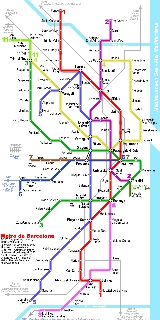
s. Since July 31, 2010, Barcelona Metro system consists of 11 lines with 165 stations and 125 km in total. In 2002 ATM announced that two additional lines would built in the near future, L12 and L13
Barcelona Metro line 13
Line 13 is the name of a proposed service in the Barcelona Metro network which would join La Morera in Badalona, a municipality of Barcelonès to the north of Barcelona, with the hilly area around Can Ruti Hospital...
. There have been 3 driverless lines since 2009: Line 11, Line 9 and Line 10, in chronological order.
History
The Barcelona Metro was founded in 1924 with the construction of the Gran Metro between Lesseps and the Plaça de Catalunya, part of the modern Line 3. Two years later the Metro Transversal (now part of Line 1) was built between the Plaça de Catalunya and la Bordeta to link the city centre with the Plaça d'Espanya and MontjuïcMontjuïc
Montjuïc is a hill located in Barcelona, Catalonia.-Etymology:Montjuïc is translated as 'Jew Hill' in medieval Catalan, or is perhaps related to the Latin phrase Mons Jovicus . The name is found in several locations in the Catalan Countries: the Catalan cities of Girona and Barcelona both have a...
, the site of the 1929 Universal Exhibition.
Today the network consists of ten lines managed by 2 different operators: Transports Metropolitans de Barcelona
Transports Metropolitans de Barcelona
Transports Metropolitans de Barcelona is the main public transit operator in Barcelona, made up of two formerly separate companies, Ferrocarril Metropolità de Barcelona, SA. and Transports de Barcelona, SA....
(TMB), which manages the major underground lines; and Ferrocarrils de la Generalitat de Catalunya
Ferrocarrils de la Generalitat de Catalunya
Ferrocarrils de la Generalitat de Catalunya , or FGC, is a railway company which operates several unconnected lines in Catalonia, Spain....
(FGC, or Catalan Government Railways), which manages three integrated commuter lines running out into the extended metropolitan area
Metropolitan area
The term metropolitan area refers to a region consisting of a densely populated urban core and its less-populated surrounding territories, sharing industry, infrastructure, and housing. A metropolitan area usually encompasses multiple jurisdictions and municipalities: neighborhoods, townships,...
. Fares are integrated into Autoritat del Transport Metropolità
Autoritat del Transport Metropolità
Autoritat del Transport Metropolità , shortened as ATM, is the organization in charge of the coordination of several public transportation systems in the city of Barcelona, its metropolitan area and other regions under its influence, including the setting of a shared fare, as well as the...
, a city-wide system that also includes local and regional bus
Bus
A bus is a road vehicle designed to carry passengers. Buses can have a capacity as high as 300 passengers. The most common type of bus is the single-decker bus, with larger loads carried by double-decker buses and articulated buses, and smaller loads carried by midibuses and minibuses; coaches are...
es and some regional train
Train
A train is a connected series of vehicles for rail transport that move along a track to transport cargo or passengers from one place to another place. The track usually consists of two rails, but might also be a monorail or maglev guideway.Propulsion for the train is provided by a separate...
services. 98% of its railway tracks are subsurface.
Layout
The metro network proper, operated by TMBTransports Metropolitans de Barcelona
Transports Metropolitans de Barcelona is the main public transit operator in Barcelona, made up of two formerly separate companies, Ferrocarril Metropolità de Barcelona, SA. and Transports de Barcelona, SA....
, consists of eight lines, numbered L1 to L5 and L9 to L11, and distinguished on network maps by different colours. FGC
Ferrocarrils de la Generalitat de Catalunya
Ferrocarrils de la Generalitat de Catalunya , or FGC, is a railway company which operates several unconnected lines in Catalonia, Spain....
lines are numbered L6, L7 and L8. None of the Barcelona Metro lines have a name of their own but are generally referred to by their colour or by the number and the names of their termini. The Funicular de Montjuïc
Funicular de Montjuïc
The Funicular de Montjuïc, or Montjuïc funicular, is a funicular railway in the city of Barcelona, in Catalonia, Spain. The line is largely in tunnel and connects the Barcelona Metro Paral·lel station with the hill of Montjuïc and the various sporting and other facilities there. The funicular uses...
, a funicular railway
Funicular
A funicular, also known as an inclined plane or cliff railway, is a cable railway in which a cable attached to a pair of tram-like vehicles on rails moves them up and down a steep slope; the ascending and descending vehicles counterbalance each other.-Operation:The basic principle of funicular...
, is fare-integrated and listed on maps as part of the metro network, being connected directly to the metro at Paral·lel station.
The lines run as follows:
| Line Number | Termini | Operator | Current Length | Approved Length | Current Stations | Approved Stations | Year of Opening |
|---|---|---|---|---|---|---|---|
Image:L1.gif>25x25px rect 0 0 500 500 Barcelona Metro line 1 Barcelona Metro line 1 — Line 1, shortened to L1 and known as "Hospital de Bellvitge - Fondo", coloured red and often simply called Línia vermella , is the second oldest metro line in Barcelona, after L3. It is operated by Transports Metropolitans de Barcelona . It appeared as a means to join the rail stations the city... desc none |
Hospital de Bellvitge Hospital de Bellvitge (Barcelona Metro) Hospital de Bellvitge is a Barcelona Metro station located in Bellvitge, L'Hospitalet de Llobregat, in the southern part of the Metropolitan Area of Barcelona. It's named after the Bellvitge University Hospital... –Fondo Fondo (Barcelona Metro) Fondo is the name of a Barcelona Metro station in the municipality of Santa Coloma de Gramenet, in the northern part of the metropolitan area of Barcelona. It's served by two metro lines. L1 , of which it's currently the northern terminus... |
TMB Transports Metropolitans de Barcelona Transports Metropolitans de Barcelona is the main public transit operator in Barcelona, made up of two formerly separate companies, Ferrocarril Metropolità de Barcelona, SA. and Transports de Barcelona, SA.... |
29 | 38 | 1929 | ||
Image:L2.gif>25x25px rect 0 0 500 500 Barcelona Metro line 2 Barcelona Metro line 2 Line 2 is a metro line in Barcelona operated by TMB, coloured purple and sometimes simply called línia lila. It's part of the city's ATM fare-integrated transport network... desc none |
Paral·lel Paral·lel (Barcelona Metro) right|thumb|300px|View of platforms for both lines 2 and 3, Paral·lel metro stationParal·lel is the name of a Barcelona metro station, currently the southern terminus of L2 and also served by L3... –Badalona Pompeu Fabra |
TMB Transports Metropolitans de Barcelona Transports Metropolitans de Barcelona is the main public transit operator in Barcelona, made up of two formerly separate companies, Ferrocarril Metropolità de Barcelona, SA. and Transports de Barcelona, SA.... |
18 | 34 | 1959 | ||
Image:L3.gif>25x25px rect 0 0 500 500 Barcelona Metro line 3 Barcelona Metro line 3 — Line 3, currently known as Zona Universitària - Trinitat Nova, coloured green and often simply referred to as Línia verda , is a metro line in Barcelona operated by TMB, and therefore part of the fare-integrated ATM transport network of the urban region... desc none |
Zona Universitària Zona Universitària (Barcelona Metro) Zona Universitària is a station in the Barcelona Metro network, named after the Universitat de Barcelona campus of the same name, and currently the southern terminus of L3 . It's located underground Avinguda Diagonal, where it has four entrances, two on each side of the avenue... –Trinitat Nova Trinitat Nova (Barcelona Metro) thumb|300px|right|Entrance to Trinitat Nova metro station, below platform levelTrinitat Nova is a Barcelona metro station located in the neighbourhood of the same name, in the Nou Barris district.... |
TMB Transports Metropolitans de Barcelona Transports Metropolitans de Barcelona is the main public transit operator in Barcelona, made up of two formerly separate companies, Ferrocarril Metropolità de Barcelona, SA. and Transports de Barcelona, SA.... |
26 | 36 | 1924 | ||
Image:L4.gif>25x25px rect 0 0 500 500 Barcelona Metro line 4 Barcelona Metro line 4 — Line 4, currently known as Trinitat Nova – La Pau, usually called "línia groga" , is a line in the Barcelona Metro network operated by TMB, and part of the ATM fare-integrated transport network... desc none |
Trinitat Nova Trinitat Nova (Barcelona Metro) thumb|300px|right|Entrance to Trinitat Nova metro station, below platform levelTrinitat Nova is a Barcelona metro station located in the neighbourhood of the same name, in the Nou Barris district.... –La Pau La Pau (Barcelona Metro) right|thumb|300px|La Pau [[Barcelona Metro line 2|L2]] platformsLa Pau is a Barcelona metro station located in the neighbourhood of the same name, in the Sant Martí district.... |
TMB Transports Metropolitans de Barcelona Transports Metropolitans de Barcelona is the main public transit operator in Barcelona, made up of two formerly separate companies, Ferrocarril Metropolità de Barcelona, SA. and Transports de Barcelona, SA.... |
22 | 26 | 1926 | ||
Image:L5.gif>25x25px rect 0 0 500 500 Barcelona Metro line 5 Barcelona Metro line 5 — Line 5, currently known as Cornellà Centre - Vall d'Hebron, its termini, and often simply called "Línia Blava" is line belonging to the Barcelona Metro network operated by TMB, and part of the ATM fare-integrated transport network.... desc none |
Cornellà Centre–Vall d'Hebron Vall d'Hebron (Barcelona Metro) right|thumb|300pxVall d'Hebron is a station on line 3 and line 5 of the Barcelona Metro.The station is located underneath Passeig de la Vall d'Hebron, between Avinguda Jordà and Camí de la Granja... |
TMB Transports Metropolitans de Barcelona Transports Metropolitans de Barcelona is the main public transit operator in Barcelona, made up of two formerly separate companies, Ferrocarril Metropolità de Barcelona, SA. and Transports de Barcelona, SA.... |
26 | 27 | 1959 | ||
Image:L6.gif>25x25px rect 0 0 500 500 Barcelona Metro line 6 Barcelona Metro line 6 — Line 6, coloured navy blue, is the name of a metro-like commuter train service in Barcelona operated by FGC, and part of the ATM fare-integrated transport system. It links Plaça Catalunya, the city centre, with Sarrià-Sant Gervasi... desc none |
Pl. Catalunya–Reina Elisenda Reina Elisenda (Barcelona Metro) thumb|300px|right|Reina Elisenda as the line's depot at night after the last service.Reina Elisenda is a station operated by Ferrocarrils de la Generalitat de Catalunya , on Barcelona Metro L6, of which it is its current terminus and depot. It's located under Passeig de la Reina Elisenda de... |
FGC Ferrocarrils de la Generalitat de Catalunya Ferrocarrils de la Generalitat de Catalunya , or FGC, is a railway company which operates several unconnected lines in Catalonia, Spain.... |
9 | 12 | 1863 | ||
Image:L7.gif>25x25px rect 0 0 500 500 Barcelona Metro line 7 Barcelona Metro line 7 — Line 7, coloured brown , is a metro-like commuter train line in the Barcelona Metro network operated by FGC, and part of the ATM fare-integrated transport system. Also known as Línia de Balmes, as it climbs Carrer de Balmes uphill into Tibidabo, it shares three stations with FGC L6... desc none |
Pl. Catalunya–Av. Tibidabo Avinguda Tibidabo (Barcelona Metro) right|300px|thumb|Platforms at Avinguda TibidaboAvinguda Tibidabo is a station of the Barcelona Metro, the terminus of FGC-operated line 7 .Situated under Carrer de Balmes, the station has an entrance in the Plaça de John F... |
FGC Ferrocarrils de la Generalitat de Catalunya Ferrocarrils de la Generalitat de Catalunya , or FGC, is a railway company which operates several unconnected lines in Catalonia, Spain.... |
7 | 7 | 1954 | ||
Image:L8.gif>25x25px rect 0 0 500 500 Barcelona Metro line 8 Barcelona Metro line 8 — Line 8, coloured pink and operated by FGC, is part of the Barcelona Metro network, and therefore of the larger ATM fare-integrated transport system... desc none |
Pl. Espanya Espanya (Barcelona Metro) Espanya or Plaça Espanya is one of the most important stations of the Barcelona Metro network, located under one of the city's largest squares, Plaça Espanya, in the Sants-Montjuïc district... –Molí Nou-Ciutat Cooperativa Molí Nou-Ciutat Cooperativa (Barcelona Metro) Molí Nou | Ciutat Cooperativa is a railway station near Molí Nou in the municipality of Sant Boi de Llobregat operated by Ferrocarrils de la Generalitat de Catalunya as part of the Metro del Baix Llobregat and since 2002 a line of the extended Barcelona Metro network. It opened on February 13,... |
FGC Ferrocarrils de la Generalitat de Catalunya Ferrocarrils de la Generalitat de Catalunya , or FGC, is a railway company which operates several unconnected lines in Catalonia, Spain.... |
11 | 11 | 1983 | ||
File:L9.gif>25x25px rect 0 0 500 500 Barcelona Metro line 9 Barcelona Metro line 9 Line 9 is a line of the Barcelona Metro network that is currently under construction, with five stations open in the Santa Coloma de Gramenet suburb since December 2009... desc none |
La Sagrera–Can Zam Can Zam (Barcelona Metro) Can Zam is the name of a Barcelona Metro station in the municipality of Santa Coloma de Gramenet, in the northern part of the metropolitan area of Barcelona. The station is located at the intersection of Avinguda Francesc Macià and Carrer Balmes. It's served by L9, the first part of line 9 to be... |
TMB Transports Metropolitans de Barcelona Transports Metropolitans de Barcelona is the main public transit operator in Barcelona, made up of two formerly separate companies, Ferrocarril Metropolità de Barcelona, SA. and Transports de Barcelona, SA.... |
8 | 52 | 2009 | ||
File:L10 barcelona.svg>25x25px rect 0 0 500 500 Barcelona Metro line 10 Barcelona Metro line 10 Line 10 is the name of one of the two branches of the Barcelona metro extension line 9, currently under construction and to be operated by TMB.-Overview:... desc none |
La Sagrera–Gorg Gorg (Barcelona Metro) Gorg is a Barcelona Metro and TRAMbesòs station located in the neighbourhood of the same name, in Badalona municipality. It is located in Avinguda del Marquès de Mont-roig, very close to Palau Municipal d'Esports de Badalona... |
TMB Transports Metropolitans de Barcelona Transports Metropolitans de Barcelona is the main public transit operator in Barcelona, made up of two formerly separate companies, Ferrocarril Metropolità de Barcelona, SA. and Transports de Barcelona, SA.... |
6 | 2010 | |||
Image:L11.gif>25x25px rect 0 0 500 500 Barcelona Metro line 11 Barcelona Metro line 11 Barcelona Metro line 11 is a full metro line with short trains in Barcelona, Spain. — Line 11, coloured light green and currently known as Trinitat Nova - Can Cuiàs, is a recently built line in the Barcelona Metro network, operated by TMB, and part of the ATM fare-ingrated transport network in the... desc none |
Trinitat Nova Trinitat Nova (Barcelona Metro) thumb|300px|right|Entrance to Trinitat Nova metro station, below platform levelTrinitat Nova is a Barcelona metro station located in the neighbourhood of the same name, in the Nou Barris district.... –Can Cuiàs Can Cuiàs (Barcelona Metro) right|thumb|300px|Entrance to Can Cuiàs stationCan Cuiàs is the name of a station in the Barcelona Metro network, and currently the underground light-rail L11's western terminus , before it is extended into UAB and Ripollet. As the other stations in the line, it was opened in 2003... |
TMB Transports Metropolitans de Barcelona Transports Metropolitans de Barcelona is the main public transit operator in Barcelona, made up of two formerly separate companies, Ferrocarril Metropolità de Barcelona, SA. and Transports de Barcelona, SA.... |
5 | 2003 | |||
Image:Fmontjuic.svg>25x25px rect 0 0 500 500 Funicular de Montjuïc Funicular de Montjuïc The Funicular de Montjuïc, or Montjuïc funicular, is a funicular railway in the city of Barcelona, in Catalonia, Spain. The line is largely in tunnel and connects the Barcelona Metro Paral·lel station with the hill of Montjuïc and the various sporting and other facilities there. The funicular uses... desc none |
Parc de Montjuïc–Paral·lel Paral·lel (Barcelona Metro) right|thumb|300px|View of platforms for both lines 2 and 3, Paral·lel metro stationParal·lel is the name of a Barcelona metro station, currently the southern terminus of L2 and also served by L3... |
TMB Transports Metropolitans de Barcelona Transports Metropolitans de Barcelona is the main public transit operator in Barcelona, made up of two formerly separate companies, Ferrocarril Metropolità de Barcelona, SA. and Transports de Barcelona, SA.... |
2 | 1928 |
In addition to those, Renfe
RENFE
Renfe Operadora is the state-owned company which operates freight and passenger trains on the 1668-mm "Iberian gauge" and 1435-mm "European gauge" networks of the Spanish national railway infrastructure company ADIF .- History :The name RENFE is derived from that of the former Spanish National...
and FGC
Ferrocarrils de la Generalitat de Catalunya
Ferrocarrils de la Generalitat de Catalunya , or FGC, is a railway company which operates several unconnected lines in Catalonia, Spain....
trains and the increasingly important Trambaix
Trambaix
The Trambaix is a light rail system operated by TRAMMET connecting the Baix Llobregat area with the city of Barcelona, Catalonia. It opened to the public on April 5, 2004 after a weekend when the tram could be used free of charge....
and Trambesòs
Trambesòs
The Trambesòs is a light rail system operated by TRAMMET connecting Sant Adrià de Besòs and Badalona with the city of Barcelona in Catalonia. The original line, known as T4, opened on May 8, 2004 and runs from Ciutadella-Vila Olímpica in Barcelona to the east of the city and extends roughly...
routes and stations are displayed on most recent maps, including the info maps in the metro stations, all in a single variety of dark green.
L9 and L10
Construction work is taking place currently on L9Barcelona Metro line 9
Line 9 is a line of the Barcelona Metro network that is currently under construction, with five stations open in the Santa Coloma de Gramenet suburb since December 2009...
/L10
Barcelona Metro line 10
Line 10 is the name of one of the two branches of the Barcelona metro extension line 9, currently under construction and to be operated by TMB.-Overview:...
, which will run from Badalona
Badalona
Badalona is a city in eastern Catalonia, Spain. It is located in the comarca of the Barcelonès, near the city of Barcelona and part of its metropolitan area. It is situated on the left bank of the small Besòs River and on the Mediterranean Sea, backed by the Serra de la Marina mountain range...
and Santa Coloma to the Zona Franca
Zona Franca (Barcelona)
Zona Franca is a logistics and industrial area located in the Sants-Montjuïc district of Barcelona, Catalonia . It is near the C-31 road and la Marina de Sants , el Prat de Llobregat and l'Hospitalet de Llobregat...
district and El Prat International Airport. The lines, which share a central section between Bon Pastor and Torrassa (L1), will be one of the longest automated metro lines in Europe, at 47.8 kilometres (29.7 mi), and will have 55 stations. , eleven stations are open. The project was approved in 2000 but has been challenged by some technical difficulties and some of their sections are pending further geological analysis.
Proposed lines
Lines L12 and L13Barcelona Metro line 13
Line 13 is the name of a proposed service in the Barcelona Metro network which would join La Morera in Badalona, a municipality of Barcelonès to the north of Barcelona, with the hilly area around Can Ruti Hospital...
are two current planned additions to the network.
L12 R3
A version of the project for this line, which has been recently given the name of R3, would connect some of the urban area municipalities in Baix LlobregatBaix Llobregat
Baix Llobregat is a comarca on the coast of Catalonia, Spain. Its capital is Sant Feliu de Llobregat.-Municipalities:Populations are from 2002.* Abrera - pop. 9,166* Begues - pop. 5,023* Castelldefels - pop. 52,405...
, such as Esplugues de Llobregat
Esplugues de Llobregat
Esplugues de Llobregat is a municipality of the Barcelona metropolitan area. It belongs to the comarca of Baix Llobregat, Barcelona province, Catalonia, Spain. It has some schools, such as the German School of Barcelona and American School of Barcelona, which attract rich families, thus increasing...
, Sant Joan Despí
Sant Joan Despí
Sant Joan Despí is a city and municipality located in the Baix Llobregat area . It is situated on the left bank of the Llobregat river...
or Sant Just Desvern
Sant Just Desvern
Sant Just Desvern is a town near Barcelona, in the comarca of the Baix Llobregat, Catalonia,....
, more efficiently than the original idea, bringing them closer to the capital by optimising connections with the bus, tram and train systems. It is due to be completed in 2015 with a budget of close to
L13
This line would become, along with L11Barcelona Metro line 11
Barcelona Metro line 11 is a full metro line with short trains in Barcelona, Spain. — Line 11, coloured light green and currently known as Trinitat Nova - Can Cuiàs, is a recently built line in the Barcelona Metro network, operated by TMB, and part of the ATM fare-ingrated transport network in the...
, one of the two underground light-rail lines fully integrated into the network. As with L11, the intention is to provide access to a hilly area of the metropolitan area: the hospital in Can Ruti in Badalona
Badalona
Badalona is a city in eastern Catalonia, Spain. It is located in the comarca of the Barcelonès, near the city of Barcelona and part of its metropolitan area. It is situated on the left bank of the small Besòs River and on the Mediterranean Sea, backed by the Serra de la Marina mountain range...
. The original project includes only three stations (which may not preclude expansion):
- Morera
- Canyet
- Can Ruti
New FGC line
A new Ferrocarrils de la Generalitat (FGC) urban line was proposed in late 2010. If completed, it would run from the new PoblenouPoblenou
El Poblenou is an extensive neighborhood of Barcelona that borders the Mediterranean sea to the south, Sant Adrià del Besòs to the east, Parc de la Ciutadella in Ciutat Vella to the west, and Horta-Guinardó and Sant Andreu to the north...
developments to the Autonomous University of Barcelona
Autonomous University of Barcelona
The Autonomous University of Barcelona is a public university mostly located in Cerdanyola, near the city of Barcelona in Catalonia, Spain....
(UAB), in Cerdanyola del Vallès
Cerdanyola del Vallès
Cerdanyola del Vallès is a municipality in the comarca of the Vallès Occidental in Catalonia . It is situated in the on the north side of the Collserola ridge. The town is served by the A-7 and C-58 autopistes, the N-150 road and the RENFE railway commuter lines R4, R7 and railway regional line Ca4...
through La Sagrera
La Sagrera
La Sagrera is a neighborhood in the Sant Andreu district of Barcelona, Catalonia ....
and the district
Districts of Barcelona
Barcelona, Catalonia, Spain proper is presently divided into 10 districts. These are administrated by a councillor designated by the main city council, and each of them have some powers relating to issues such as urbanism or infrastructure in their area. The current division of the city into...
of Horta-Guinardó
Horta-Guinardó
Horta-Guinardó is the name of one of the districts of Barcelona, located in its North-Eastern corner. It is named after two very heterogeneous areas of the city, Horta and el Guinardó, which together cover a large area of 11.92 km², which sums up for the 11,9% of the total extension of the...
. This line doesn't have a number or name yet.
Past projects
Besides the current projects above mentioned, from the 1960s onwards some projects were put forward. Among these were a service numbered line VI (following the Roman numeral convention of the network at the time) and a 1980s project for a line crossing Avinguda Diagonal from north-west to south-east, the Diagonal line.Cards and pricing
In addition to the one way ticket (€1.40 there are a number of other tickets and cards. All of the Autoritat del Transport MetropolitàAutoritat del Transport Metropolità
Autoritat del Transport Metropolità , shortened as ATM, is the organization in charge of the coordination of several public transportation systems in the city of Barcelona, its metropolitan area and other regions under its influence, including the setting of a shared fare, as well as the...
(ATM) transport cards are valid and can be used in the Barcelona Metro. These are:
- T10
- T50/30–50 journeys made in 30 consecutive days from the first use
- T Familiar (70/30)
- T Mes
- T Trimestre
- T Dia
- T Jove
All of the metro stations are within fare zone 1. Tariffs (as of 2010), including all zones, are the following:
| T 10 | T Jove | T 50/30 | T Mes | T Dia | T Trimestre | T Familiar (70/30) | T 12 for children | |
|---|---|---|---|---|---|---|---|---|
| Fare zone 1 | €7.95 | €115.00 | €32.40 | €49.30 | €6.00 | €135.50 | €46.75 | €35.00 |
| Fare zone 2 | €15.85 | €166.50 | €54.35 | €71.10 | €9.40 | €196.50 | €65.85 | |
| Fare zone 3 | €21.60 | €223.50 | €76.30 | €96.10 | €11.85 | €265.50 | €90.35 | |
| Fare zone 4 | €27.75 | €268.50 | €94.90 | €114.00 | €13.35 | €316.00 | €110.50 | |
| Fare zone 5 | €31.90 | €305.50 | €112.00 | €131.00 | €15.15 | €360.00 | €127.00 | |
| Fare zone 6 | €33.90 | €317.00 | €124.50 | €140.00 | €16.95 | €373.00 | €137.00 |
Stations
As of mid 2007, there are currently 150 operational stations in the Barcelona Metro, served by the 9 lines in current use, which will increase to 209 when lines L9Barcelona Metro line 9
Line 9 is a line of the Barcelona Metro network that is currently under construction, with five stations open in the Santa Coloma de Gramenet suburb since December 2009...
and L10
Barcelona Metro line 10
Line 10 is the name of one of the two branches of the Barcelona metro extension line 9, currently under construction and to be operated by TMB.-Overview:...
are finally completed. The average distance between stations is 650 metres.
An overwhelming majority of stations in the network lack related buildings or structures aboveground, as opposed to other subway networks as the London Underground
London Underground
The London Underground is a rapid transit system serving a large part of Greater London and some parts of Buckinghamshire, Hertfordshire and Essex in England...
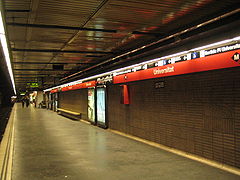
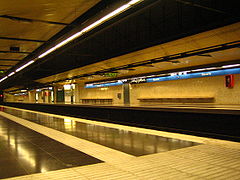
, mostly consisting of an access with stairs, escalators and sometimes an elevator. The official TMB metro indicator, a red rhombus with a M inside, remains unused by FGC lines, which use their company logo and a different rhombus-shaped logo inside stations. Below ground their decoration is remarkably sober, with the exception of a few stations.
Disused stations
A number of stations in the network have been closed, were never inaugurated, or a have been moved to a nearby location. See the main article for more details.Accessibility
Accessibility for wheelchairs and for parents with pushchairs is being improved but the metro system is not yet fully accessible. A project of improvements is gradually adding more lifts from street level to ticket office level and then from ticket office level to the platforms, though many stations remain without access. See Transports Metropolitans de Barcelona for more information on which stations are currently accessible.Transportation in the Metropolitan Area of Barcelona
The Barcelona Metro is part of a larger transportation network, regulated and fare-integrated by Autoritat del Transport MetropolitàAutoritat del Transport Metropolità
Autoritat del Transport Metropolità , shortened as ATM, is the organization in charge of the coordination of several public transportation systems in the city of Barcelona, its metropolitan area and other regions under its influence, including the setting of a shared fare, as well as the...
. See: Central ATM network chart, General ATM network chart.
Among these services, there are two large systems which operate both inside and outside the city limits of Barcelona
Barcelona
Barcelona is the second largest city in Spain after Madrid, and the capital of Catalonia, with a population of 1,621,537 within its administrative limits on a land area of...
: the commuter train lines operated by Renfe
RENFE
Renfe Operadora is the state-owned company which operates freight and passenger trains on the 1668-mm "Iberian gauge" and 1435-mm "European gauge" networks of the Spanish national railway infrastructure company ADIF .- History :The name RENFE is derived from that of the former Spanish National...
, amalgamated in the Rodalies Barcelona
Rodalies Barcelona
Rodalies Barcelona is the commuter rail service that serves Barcelona, and its metropolitan area as well as other parts of the province.Rodalies Barcelona is made up of 13 lines, 6 of which are operated by the Spanish company RENFE and 7 by Generalitat-owned FGC. The whole network—and fare...
, or Ferrocarrils de la Generalitat de Catalunya
Ferrocarrils de la Generalitat de Catalunya
Ferrocarrils de la Generalitat de Catalunya , or FGC, is a railway company which operates several unconnected lines in Catalonia, Spain....
lines which start in the metro lines the company operates (L6
Barcelona Metro line 6
— Line 6, coloured navy blue, is the name of a metro-like commuter train service in Barcelona operated by FGC, and part of the ATM fare-integrated transport system. It links Plaça Catalunya, the city centre, with Sarrià-Sant Gervasi...
, L7
Barcelona Metro line 7
— Line 7, coloured brown , is a metro-like commuter train line in the Barcelona Metro network operated by FGC, and part of the ATM fare-integrated transport system. Also known as Línia de Balmes, as it climbs Carrer de Balmes uphill into Tibidabo, it shares three stations with FGC L6...
and L8
Barcelona Metro line 8
— Line 8, coloured pink and operated by FGC, is part of the Barcelona Metro network, and therefore of the larger ATM fare-integrated transport system...
and which become a fully-fledged railway system which serves most of the metropolitan area: list of FGC lines. FGC is developing Sabadell Metro
Sabadell Metro
Sabadell Metro will be the name of the future subway in Sabadell, Catalonia, Spain, operated by the Catalan government-owned rail company Ferrocarrils de la Generalitat de Catalunya...
and Terrassa Metro
Terrassa Metro
Terrassa Metro will be the name of the future subway in Terrassa, Catalonia, Spain, operated by the Catalan government-owned rail company Ferrocarrils de la Generalitat de Catalunya...
as subway extensions of its network in the large cities of Sabadell
Sabadell
Sabadell is the second largest city in the comarca of the Vallès Occidental in Catalonia, Spain. It is in the south of the comarca, on the River Ripoll, 20 km north-west of Barcelona...
and Terrassa
Terrassa
Terrassa is a city in the east central region of Catalonia, Spain, in the comarca of Vallès Occidental, of which it is the co-capital along with Sabadell, the historic capital....
respectively.
Barcelona Metro topics
- List of Barcelona metro stations
- Disused Barcelona metro stationsDisused Barcelona Metro stationsThere are a number of disused stations in the Barcelona Metro network, abandoned for various reasons. This is a comprehensive list:- Disappeared :...
- Autoritat del Transport MetropolitàAutoritat del Transport MetropolitàAutoritat del Transport Metropolità , shortened as ATM, is the organization in charge of the coordination of several public transportation systems in the city of Barcelona, its metropolitan area and other regions under its influence, including the setting of a shared fare, as well as the...
- Spanish solutionSpanish solutionThe Spanish solution is a method of using two railway platforms, one on each side of the track, in order to speed up boarding and alighting from trains. Alighting passengers get off the train on one side and boarding passengers get on from the other...
, also known as Barcelona solution
Rapid transit in Barcelona
- Transport in BarcelonaTransport in BarcelonaPublic transport in Barcelona is operated by several companies, most of which are part of the Autoritat del Transport Metropolità, a transport authority managing services in the Barcelonès and the rest of the metropolitan area of Barcelona...
- List of railway stations in Barcelona
- RENFERENFERenfe Operadora is the state-owned company which operates freight and passenger trains on the 1668-mm "Iberian gauge" and 1435-mm "European gauge" networks of the Spanish national railway infrastructure company ADIF .- History :The name RENFE is derived from that of the former Spanish National...
and FGCFerrocarrils de la Generalitat de CatalunyaFerrocarrils de la Generalitat de Catalunya , or FGC, is a railway company which operates several unconnected lines in Catalonia, Spain....
-operated Rodalies BarcelonaRodalies BarcelonaRodalies Barcelona is the commuter rail service that serves Barcelona, and its metropolitan area as well as other parts of the province.Rodalies Barcelona is made up of 13 lines, 6 of which are operated by the Spanish company RENFE and 7 by Generalitat-owned FGC. The whole network—and fare... - List of Rodalies Barcelona railway stations
- FGC suburban lines
- TrambaixTrambaixThe Trambaix is a light rail system operated by TRAMMET connecting the Baix Llobregat area with the city of Barcelona, Catalonia. It opened to the public on April 5, 2004 after a weekend when the tram could be used free of charge....
and TrambesòsTrambesòsThe Trambesòs is a light rail system operated by TRAMMET connecting Sant Adrià de Besòs and Badalona with the city of Barcelona in Catalonia. The original line, known as T4, opened on May 8, 2004 and runs from Ciutadella-Vila Olímpica in Barcelona to the east of the city and extends roughly... - Tramvia blauTramvia BlauTramvia Blau is one of Barcelona's three tram systems. It is a heritage streetcar line serving a hilly area of the Sarrià-Sant Gervasi district between the terminus of FGC Barcelona Metro L7 and the Funicular del Tibidabo...
- List of tram stations in Barcelona
- Funicular de MontjuïcFunicular de MontjuïcThe Funicular de Montjuïc, or Montjuïc funicular, is a funicular railway in the city of Barcelona, in Catalonia, Spain. The line is largely in tunnel and connects the Barcelona Metro Paral·lel station with the hill of Montjuïc and the various sporting and other facilities there. The funicular uses...
- Funicular de VallvidreraFunicular de Vallvidreraright|300px|thumb|Funicular cab at Vallvidrera Superior stationThe Funicular de Vallvidrera, or Vallvidrera funicular, is a funicular railway in the Vallvidrera district of the city of Barcelona, in Catalonia, Spain...
Other metro systems in Spain
- Metro BilbaoMetro BilbaoMetro Bilbao is a rapid transit system serving the city of Bilbao and the region of Greater Bilbao. Its lines have a "Y" shape, with two lines that transit both banks of the Nervión river and then combine to form one line that ends in the south of Bilbao...
- Madrid MetroMadrid MetroThe Madrid Metro is a metro system serving the city of Madrid, capital of Spain. The system is the sixth longest metro in the world though Madrid is approximately the fiftieth most populous metropolitan area in the world...
- Palma de Mallorca MetroPalma de Mallorca MetroThe Palma Metro is a metro line in Palma, Spain. It consists of nine stations and was constructed between 2005 and 2007 at cost of 312 million euros.Trains run daily from 06:15 to 23:00....
- Seville MetroSeville metroThe Seville metro is a light metro network serving the city of Seville, Spain and its metropolitan area. The system is totally independent of any other rail or street traffic. All stations were built with platform screen doors....
- Valencia Metro
- Málaga MetroMetro de MálagaThe Metro de Málaga is a light metro network in Málaga, Spain, currently under construction. A total of six lines are planned.Currently, only the two first lines are under construction. Line 1 will go from the city centre to the university; and line 2, from the city centre to the basketball...
- List of metro systems
External links
- Transports Metropolitans de Barcelona
- Ferrocarrils de la Generalitat de Catalunya
- Barcelona Metro
- CityMayors article on Barcelona Metro
- Barcelona rail network map
- Wefer.com
- A blog
- Barcelona metro map for wheelchair users
- The forum of the Metro de Barcelona. (Traduction in English of Google Traductor