


Delta II

Encyclopedia
Delta II was an American space launch system, originally designed and built by McDonnell Douglas
. Delta II is part of the Delta rocket
family and was in service from 1989 until November 1, 2011. Delta II vehicles included the Delta 6000, the Delta 7000, and two 7000 variants ("Light" and "Heavy").
After McDonnell Douglas merged with Boeing
in 1997, Delta II rockets were built by Boeing Integrated Defense Systems
, until Delta rocket production became the responsibility of United Launch Alliance
(ULA) on December 1, 2006. ULA now markets Delta II to U.S. government customers, and Boeing Launch Services (BLS) markets Delta II to commercial companies.
, but the Challenger disaster
of 1986 led to Delta development being restarted. The Delta II was specifically designed to accommodate the GPS Block II series of positioning satellites. As of August 2007, Delta IIs have successfully launched 125 projects, including several NASA
missions to Mars
:
Delta II manufacturing, assembly and integration take place at facilities in Decatur, Alabama
; Harlingen, Texas
; San Diego, California
; and Denver, Colorado
.
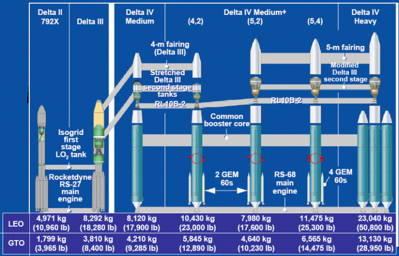
For example, a Delta 7925 has the later first stage, nine GEM boosters, and a PAM third stage. A Delta 7320 is a two-stage vehicle with three boosters.
Three payload fairings are available. The original aluminum fairing, seen above, is 9.5 feet in diameter. A 10-foot fairing is made of composite, and can be distinguished by its tapering front and rear. A lengthened 10-foot fairing is used for the largest payloads.
Fueling : It takes approximately 20 minutes to load the first stage with 10000 gallons (37,854.1 l) of fuel.
However, the Delta II system does not have a perfect success record. One mission, the launch of Koreasat-1 in 1995, was a partial failure in which the satellite payload was able to compensate when the launch system placed the vehicle in an incorrect orbit.
Another failure, this time complete, occurred on January 17, 1997, when a Delta II 7925 carrying the first GPS
Block IIR satellite, GPS IIR-1
, exploded only 13 seconds after liftoff, raining flaming debris all over Launch Complex 17 at Cape Canaveral Air Force Station. No one was injured, and the launchpad itself was not seriously damaged, though several cars were destroyed and a few buildings were damaged. It was later determined that a "17-foot crack" in the rocket booster had caused the failure.
satellites into orbit.
 A 2007 article published by the Wall Street Journal speculated about the fate of the Delta II launch system after the U.S. Air Force discontinues its use of the Delta II. Thomas Young, who was director of Goddard Space Flight Center
from 1980 to 1982, is quoted as saying, "It's definitely an item people are quite worried about."
As of October 28, 2011, no further Delta II missions are scheduled. ULA has indicated it has "around half a dozen" unsold Delta II rockets on hand. A spokesperson indicated that ULA will change some aspects of the Delta II system once the current Medium Launch Vehicle 3 contract with the Air Force ends and requirements imposed by the contract are lifted. The Air Force contract required that Delta II be kept ready to launch within 40 days of call up, which led ULA to maintain two launch pads at Cape Canaveral. ULA indicated it would not continue to operate two launch pads.
In August 2009, the NASA assistant associate administrator for launch services stated that NASA might purchase additional Delta II launches beyond those it had planned at that time. Five additional Delta II vehicles have been built but remain unassigned to planned flights. Under the terms of the NASA Launch Services II (NLS-II) contract, only three Delta II configurations are available – the 7320-10, 7420-10 and 7920-10 – and launches are only available from SLC-2W at Vandenberg Air Force Base
. The NLS-II contract provides for up to five Delta II launches.
McDonnell Douglas
McDonnell Douglas was a major American aerospace manufacturer and defense contractor, producing a number of famous commercial and military aircraft. It formed from a merger of McDonnell Aircraft and Douglas Aircraft in 1967. McDonnell Douglas was based at Lambert-St. Louis International Airport...
. Delta II is part of the Delta rocket
Delta rocket
Delta is a versatile family of expendable launch systems that has provided space launch capability in the United States since 1960. There have been more than 300 Delta rockets launched, with a 95 percent success rate. Two Delta launch systems – Delta II and Delta IV – are in active use...
family and was in service from 1989 until November 1, 2011. Delta II vehicles included the Delta 6000, the Delta 7000, and two 7000 variants ("Light" and "Heavy").
After McDonnell Douglas merged with Boeing
Boeing
The Boeing Company is an American multinational aerospace and defense corporation, founded in 1916 by William E. Boeing in Seattle, Washington. Boeing has expanded over the years, merging with McDonnell Douglas in 1997. Boeing Corporate headquarters has been in Chicago, Illinois since 2001...
in 1997, Delta II rockets were built by Boeing Integrated Defense Systems
Boeing Integrated Defense Systems
Boeing Defense, Space & Security formerly known as Boeing Integrated Defense Systems is a unit of The Boeing Company responsible for defense and aerospace products and services. Boeing Integrated Defense Systems was formed in 2002 by combining the former "Military Aircraft and Missile Systems"...
, until Delta rocket production became the responsibility of United Launch Alliance
United Launch Alliance
United Launch Alliance is a joint venture of Lockheed Martin and Boeing. ULA was formed in December 2006 by combining the teams at these companies which provide spacecraft launch services to the government of the United States. U.S...
(ULA) on December 1, 2006. ULA now markets Delta II to U.S. government customers, and Boeing Launch Services (BLS) markets Delta II to commercial companies.
History
All United States expendable launch vehicles were planned to be phased out in favour of the Space ShuttleSpace Shuttle
The Space Shuttle was a manned orbital rocket and spacecraft system operated by NASA on 135 missions from 1981 to 2011. The system combined rocket launch, orbital spacecraft, and re-entry spaceplane with modular add-ons...
, but the Challenger disaster
Space Shuttle Challenger disaster
The Space Shuttle Challenger disaster occurred on January 28, 1986, when Space Shuttle Challenger broke apart 73 seconds into its flight, leading to the deaths of its seven crew members. The spacecraft disintegrated over the Atlantic Ocean, off the coast of central Florida at 11:38 am EST...
of 1986 led to Delta development being restarted. The Delta II was specifically designed to accommodate the GPS Block II series of positioning satellites. As of August 2007, Delta IIs have successfully launched 125 projects, including several NASA
NASA
The National Aeronautics and Space Administration is the agency of the United States government that is responsible for the nation's civilian space program and for aeronautics and aerospace research...
missions to Mars
Mars
Mars is the fourth planet from the Sun in the Solar System. The planet is named after the Roman god of war, Mars. It is often described as the "Red Planet", as the iron oxide prevalent on its surface gives it a reddish appearance...
:
- Mars Global SurveyorMars Global SurveyorThe Mars Global Surveyor was a US spacecraft developed by NASA's Jet Propulsion Laboratory and launched November 1996. It began the United States's return to Mars after a 10-year absence. It completed its primary mission in January 2001 and was in its third extended mission phase when, on 2...
in 1996 - Mars PathfinderMars PathfinderMars Pathfinder was an American spacecraft that landed a base station with roving probe on Mars in 1997. It consisted of a lander, renamed the Carl Sagan Memorial Station, and a lightweight wheeled robotic rover named Sojourner.Launched on December 4, 1996 by NASA aboard a Delta II booster a...
in 1996 - Mars Climate OrbiterMars Climate OrbiterThe Mars Climate Orbiter was a 338 kilogram robotic space probe launched by NASA on December 11, 1998 to study the Martian climate, atmosphere, surface changes and to act as the communications relay in the Mars Surveyor '98 program, for Mars Polar Lander...
in 1998 - Mars Polar LanderMars Polar LanderThe Mars Polar Lander, also referred to as the Mars Surveyor '98 Lander, was a 290-kilogram robotic spacecraft lander, launched by NASA on January 3, 1999, to study the soil and climate of Planum Australe, a region near the south pole on Mars, as part of the Mars Surveyor '98 mission...
in 1999 - Mars Odyssey in 2001
- Mars Exploration Rovers (MER-A, Spirit and MER-B, Opportunity) in 2003
- Mars Phoenix Lander in 2007
Delta II manufacturing, assembly and integration take place at facilities in Decatur, Alabama
Decatur, Alabama
Decatur is a city in Limestone and Morgan Counties in the U.S. state of Alabama. The city, affectionately known as "The River City", is located in Northern Alabama on the banks of Wheeler Lake, along the Tennessee River. It is the largest city and county seat of Morgan County...
; Harlingen, Texas
Harlingen, Texas
Harlingen is a city in Cameron County in the heart of the Rio Grande Valley of south Texas, United States, about from the coast of the Gulf of Mexico. The city covers more than , and is the second largest city in Cameron County and the sixth largest in the Rio Grande Valley...
; San Diego, California
San Diego, California
San Diego is the eighth-largest city in the United States and second-largest city in California. The city is located on the coast of the Pacific Ocean in Southern California, immediately adjacent to the Mexican border. The birthplace of California, San Diego is known for its mild year-round...
; and Denver, Colorado
Denver, Colorado
The City and County of Denver is the capital and the most populous city of the U.S. state of Colorado. Denver is a consolidated city-county, located in the South Platte River Valley on the western edge of the High Plains just east of the Front Range of the Rocky Mountains...
.
Vehicle description
Deltas are expendable launch vehicles (ELVs), which means they can only be used once. Each Delta II launch vehicle consists of:- Stage I: RP-1RP-1RP-1 is a highly refined form of kerosene outwardly similar to jet fuel, used as a rocket fuel. Although having a lower specific impulse than liquid hydrogen , RP-1 is cheaper, can be stored at room temperature, is far less of an explosive hazard and is far denser...
and liquid oxygenLiquid oxygenLiquid oxygen — abbreviated LOx, LOX or Lox in the aerospace, submarine and gas industries — is one of the physical forms of elemental oxygen.-Physical properties:...
tanks that feed the Rocketdyne RS-27RS-27A (rocket engine)The RS-27A is a liquid-fuel rocket engine developed by Rocketdyne for use on the first stage of the Delta II and Delta III launch vehicles. It provides 1.05 meganewtons of thrust burning RP-1 and LOX in a gas-generator cycle...
main engine for the ascent. - Solid rocket boosterSolid rocket boosterSolid rocket boosters or Solid Rocket Motors, SRM, are used to provide thrust in spacecraft launches from the launchpad up to burnout of the SRBs. Many launch vehicles include SRBs, including the Ariane 5, Atlas V , and the NASA Space Shuttle...
motors: Used to increase thrust during the initial two minutes of flight. The medium-capacity Delta II has nine motors total (six fire on the ground, three in flight); the other models use only three or four. - Interstage: A spacer between stage I and stage II. The first friction stir weldedFriction stir weldingFriction-stir welding is a solid-state joining process and is used for applications where the original metal characteristics must remain unchanged as far as possible...
interstage module was launched in 1999. - Stage II: Fuel and oxidizer tanks feeding a restartable hypergolic AerojetAerojetAerojet is an American rocket and missile propulsion manufacturer based primarily in Rancho Cordova, California with divisions in Redmond, Washington, Orange, Gainesville and Camden, Arkansas. Aerojet is owned by GenCorp. They are the only US propulsion company that provides both solid rocket...
AJ10-118K engine that fires one or more times to insert the vehicle-spacecraft stack into low Earth orbitLow Earth orbitA low Earth orbit is generally defined as an orbit within the locus extending from the Earth’s surface up to an altitude of 2,000 km...
. This propellant mixture is highly corrosive, so once loaded the launch must occur within approximately 37 days, or the stage will have to be refurbished or replaced. This stage also contains the vehicle's "brains", a combined inertial platform and guidance systemGuidance systemA guidance system is a device or group of devices used to navigate a ship, aircraft, missile, rocket, satellite, or other craft. Typically, this refers to a system that navigates without direct or continuous human control...
that controls all flight events. - Stage III: Optional ATK-Thiokol solid rocket motor provides the majority of the velocity change needed to leave Earth orbit and inject the spacecraft on a trajectory to Mars or other target beyond Earth orbit. It is connected to the spacecraft until it is done firing, and then separates. This stage is spin-stabilizedSpin-stabilized satelliteA spin-stabilized satellite is a satellite which has the motion of one axis held fixed by spinning the satellite around that axis, using the gyroscopic effect.The attitude of a satellite or any rigid body is its orientation in space...
and has no active guidance control; it depends on the second stage for proper orientation prior to Stage II/III separation. It also includes a yo-yo de-spinYo-yo de-spinframe|[[Payload Assist Module|PAM-D]] upper stage with the [[Phoenix |Phoenix]] spacecraft. The [[Star 48|Star 48-B]] engine is shown being spun, fired, yo-yo de-spun and jettisoned....
mechanism to slow the spin before spacecraft release, as many spacecraft cannot handle the high spin rates needed for stability of this stage. Note that some Delta II vehicles are two-stage only, these generally being used for Earth-orbit missions. - Payload fairing: Thin metal or composite payload fairing (aka "nose cone") to protect the spacecraft during the ascent through Earth's atmosphere.
Naming system
The Delta II family uses a four-digit system to generate its technical names:- The first digit is either 6 or 7, denoting the 6000- or 7000-series Deltas. The 6000-series, last flown in 1992, had an Extra Extended Long Tank first stage with RS-27 main engine, plus CastorCastor (rocket stage)The Castor family of solid-fuel rocket stages and boosters were built by Thiokol and used on a variety of launch vehicles. They were initially developed as the second stage motor of the Scout rocket...
IVA solid rocket boosters. The current model 7000-series have an RS-27ARS-27A (rocket engine)The RS-27A is a liquid-fuel rocket engine developed by Rocketdyne for use on the first stage of the Delta II and Delta III launch vehicles. It provides 1.05 meganewtons of thrust burning RP-1 and LOX in a gas-generator cycle...
engine, with a longer nozzle for higher expansion ratio and better high-altitude performance, and GEM (Graphite-Epoxy MotorGraphite-Epoxy MotorA Graphite-Epoxy Motor is a high-performance, solid rocket motor, used for supplemental thrust on several launch vehicles, including the Boeing Delta II and Delta IV. They are designed to allow launch vehicles to deliver larger payloads to orbit...
) boosters. GEMs are larger, and have a composite casing to reduce mass versus the steel-cased Castors. In addition, two LR101-NA-11 vernier engines provide guidance for the first stage.
- The second digit indicates the number of boosters, usually 9. In such cases, six are lit at liftoff and three are lit one minute into flight. On vehicles with 3 or 4 boosters, all are ignited at liftoff.
- The third digit is 2, denoting a second stage with an Aerojet AJ10 engine. This engine is restartable, for complex missions. Only Deltas prior to the 6000-series used a different engine, the TR-201.
- The last digit denotes the third stage. 0 denotes no third stage, 5 indicates a Payload Assist ModulePayload Assist Moduleframe|PAM-D with the [[Phoenix |Phoenix]] spacecraft. The [[Star 48|Star 48-B]] engine is shown being spun, fired, [[Yo-yo de-spin|yo-yo de-spun]] and jettisoned.thumb|SBS-3 satellite with PAM-D stage inside the space shuttle...
(PAM) stage with Star 48B solid motor, 6 indicates a Star 37FM motor.
For example, a Delta 7925 has the later first stage, nine GEM boosters, and a PAM third stage. A Delta 7320 is a two-stage vehicle with three boosters.
- A Delta II-Heavy has the larger GEM-46 boosters, originally designed for the Delta IIIDelta III rocketThe Delta III rocket was an expendable launch vehicle made by Boeing. The first Delta III launch was on August 26, 1998. Of its three flights, the first two were failures, and the third, though declared successful, reached the low end of its targeted orbit range and carried only a dummy payload...
. These are designated 79xxH.
Three payload fairings are available. The original aluminum fairing, seen above, is 9.5 feet in diameter. A 10-foot fairing is made of composite, and can be distinguished by its tapering front and rear. A lengthened 10-foot fairing is used for the largest payloads.
Launch description
Launch vehicle build-up : A Delta II launch vehicle is assembled vertically on the launch pad. Assembly starts by hoisting the first stage into position. The solid rocket boosters are then hoisted into position and mated with the first stage. Launch vehicle build-up then continues with the second stage being hoisted atop the first stage.Fueling : It takes approximately 20 minutes to load the first stage with 10000 gallons (37,854.1 l) of fuel.
Delta II launches
The Delta II system has been used for 151 launches. On September 18, 2007, Delta II completed its 75th consecutive successful launch. This is a record for modern launch vehicles. At the time of its retirement on 1 November 2011, it was the most reliable launch vehicle in service, behind the retired Tsyklon 2. Eight launches took place in 2007.However, the Delta II system does not have a perfect success record. One mission, the launch of Koreasat-1 in 1995, was a partial failure in which the satellite payload was able to compensate when the launch system placed the vehicle in an incorrect orbit.
Another failure, this time complete, occurred on January 17, 1997, when a Delta II 7925 carrying the first GPS
Global Positioning System
The Global Positioning System is a space-based global navigation satellite system that provides location and time information in all weather, anywhere on or near the Earth, where there is an unobstructed line of sight to four or more GPS satellites...
Block IIR satellite, GPS IIR-1
GPS IIR-1
GPS IIR-1 or GPS SVN-42 was the first Block IIR GPS satellite to be launched. It was to have been operated as part of the United States Air Force Global Positioning System. It was launched on 17 January 1997, however it was destroyed thirteen seconds into its flight due to a malfunction of the...
, exploded only 13 seconds after liftoff, raining flaming debris all over Launch Complex 17 at Cape Canaveral Air Force Station. No one was injured, and the launchpad itself was not seriously damaged, though several cars were destroyed and a few buildings were damaged. It was later determined that a "17-foot crack" in the rocket booster had caused the failure.
Notable payloads
Furthermore, between May 1997 and November 1998, Delta II vehicles placed 55 IridiumIridium (satellite)
Iridium Communications Inc. is a company, based in McLean, VA, United States which operates the Iridium satellite constellation, a system of 66 active satellites used for worldwide voice and data communication from hand-held satellite phones and other transceiver units...
satellites into orbit.
Retirement of system
Goddard Space Flight Center
The Goddard Space Flight Center is a major NASA space research laboratory established on May 1, 1959 as NASA's first space flight center. GSFC employs approximately 10,000 civil servants and contractors, and is located approximately northeast of Washington, D.C. in Greenbelt, Maryland, USA. GSFC,...
from 1980 to 1982, is quoted as saying, "It's definitely an item people are quite worried about."
As of October 28, 2011, no further Delta II missions are scheduled. ULA has indicated it has "around half a dozen" unsold Delta II rockets on hand. A spokesperson indicated that ULA will change some aspects of the Delta II system once the current Medium Launch Vehicle 3 contract with the Air Force ends and requirements imposed by the contract are lifted. The Air Force contract required that Delta II be kept ready to launch within 40 days of call up, which led ULA to maintain two launch pads at Cape Canaveral. ULA indicated it would not continue to operate two launch pads.
In August 2009, the NASA assistant associate administrator for launch services stated that NASA might purchase additional Delta II launches beyond those it had planned at that time. Five additional Delta II vehicles have been built but remain unassigned to planned flights. Under the terms of the NASA Launch Services II (NLS-II) contract, only three Delta II configurations are available – the 7320-10, 7420-10 and 7920-10 – and launches are only available from SLC-2W at Vandenberg Air Force Base
Vandenberg Air Force Base
Vandenberg Air Force Base is a United States Air Force Base, located approximately northwest of Lompoc, California. It is under the jurisdiction of the 30th Space Wing, Air Force Space Command ....
. The NLS-II contract provides for up to five Delta II launches.
Comparable rockets
- Ariane 4Ariane 4Ariane 4 was an expendable launch system, designed by the Centre National d'Etudes Spatiales and manufactured and marketed by its subsidiary Arianespace. Ariane 4 was justly known as the ‘workhorse’ of the Ariane family. Since its first flight on 15 June 1988 until the last, on 15 February 2003, it...
(retired) - Delta IV
- Falcon 9Falcon 9Falcon 9 is a rocket-powered spaceflight launch system designed and manufactured by SpaceX. Both stages of its two-stage-to-orbit vehicle use liquid oxygen and rocket-grade kerosene propellants...
- Long March 3BLong March 3BThe Long March 3B , also known as the Chang Zheng 3B, CZ-3B and LM-3B, is a Chinese orbital carrier rocket. Introduced in 1996, it is launched from Launch Area 2 at the Xichang Satellite Launch Centre...
- GSLVGeosynchronous Satellite Launch VehicleThe Geosynchronous Satellite Launch Vehicle is an expendable launch system operated by the Indian Space Research Organisation...
- Soyuz-USoyuz-UThe Soyuz-U launch vehicle is an improved version of the original Soyuz LV. Soyuz-U is part of the R-7 family of rockets based on the R-7 Semyorka missile. Members of this rocket family were designed by the TsSKB design bureau and constructed at the Progress Factory in Samara, Russia....
- Taurus IITaurus IITaurus II is an expendable launch system being developed by Orbital Sciences Corporation. It is a two stage vehicle designed to launch payloads weighing up to into low-Earth orbit...
(whose development was started to fill the gap left by the retirement of the Delta II)
External links
- Delta II page at Boeing.com
- Delta I, II und III launch data at Skyrocket.de
- History of the Delta launch vehicle