

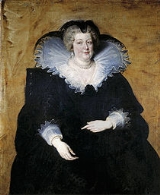
Marie de' Medici

Encyclopedia
Marie de Médicis Italian Maria de' Medici, was queen consort
of France, as the second wife of King Henry IV of France
, of the House of Bourbon
. She herself was a member of the wealthy and powerful House of Medici. Following the assassination of her husband in 1610, which occurred the day after her coronation
, she acted as regent
for her son, King Louis XIII of France
, until he came of age. She was famed for her ceaseless political intrigues at the court of France and extensive artistic patronage.
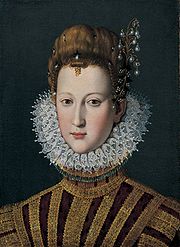 Born in Florence
, Italy, Marie was the daughter of Francesco I de' Medici, Grand Duke of Tuscany, and Johanna, Archduchess of Austria
. Her maternal grandparents were Ferdinand I, Holy Roman Emperor
, and Anna of Bohemia and Hungary
. She was one of seven children, but only she and her sister Eleonora de' Medici
survived to adulthood.
in October 1600 following the annulment of his marriage to Margaret of Valois. The proxy wedding ceremony in Florence was celebrated with lavish entertainments, including examples of the newly-invented musical genre of opera
. She brought as part of her dowry 600,000 crowns. Her eldest son, the future King Louis XIII
, was born at Fontainebleau
the following year.
The marriage was not a successful one. The queen feuded with Henry's mistresses in language that shocked French courtiers. She quarrelled mostly with her husband's leading mistress, Catherine Henriette de Balzac d'Entragues
, whom he had promised he would marry following the death of his former "official mistress", Gabrielle d'Estrées
. When he failed to do so, and instead married Marie, the result was constant bickering and political intrigues behind the scenes. Although the king could have easily banished his mistress, supporting his queen, he never did so. She, in turn, showed great sympathy and support to her husband's banished ex-wife Margaret of Valois, prompting Henry to allow her back into the realm.
Marie was crowned
Queen of France on 13 May 1610, a day before her husband's death. Hours after Henry's assassination, she was confirmed as regent by the Parlement of Paris. She immediately banished his mistress Catherine Henriette de Balzac d'Entragues from the court.
The construction and furnishing of the Palais du Luxembourg, which she referred to as her "Palais Médicis", formed her major artistic project during her regency. The site was purchased in 1612 and construction began in 1615, to designs of Salomon de Brosse
. Her court painter was Peter Paul Rubens.
. Dori conspired with her unscrupulous Italian husband, Concino Concini
, who was created Marquis d'Ancre and a Marshal of France
, even though he had never fought a battle.
The Concinis had Henry IV's able minister, the Duke of Sully
, dismissed, and Italian representatives of the Roman Catholic Church
hoped to force the suppression of Protestantism
in France by means of their influence. Half Habsburg herself, Marie abandoned the traditional anti-Habsburg French foreign policy. She lent support to Habsburg Spain by arranging the marriage of her daughter Elisabeth to the future Philip IV of Spain
.
Under the regent's lax and capricious rule, the princes of the blood and the great nobles of the kingdom revolted. The queen, too weak to assert her authority, consented to buy them off on 15 May 1614. The opposition to the regency was led by Henri de Bourbon
, Duke of Enghien
, who pressured Marie into convoking the Estates General
in 1614 and 1615, the last time they would meet in France until the opening events of the French Revolution
.
In 1616 Marie's rule was strengthened by the addition to her councils of Armand Jean du Plessis (later Cardinal Richelieu)
, who had come to prominence at the meetings of the Estates General. However, her son Louis XIII
, already several years into his legal majority, asserted his authority the next year. The king overturned the pro-Habsburg, pro-Spanish foreign policy pursued by his mother, ordered the assassination of Concini, exiled the queen to the Château de Blois
and appointed Richelieu to his bishopric.
After two years of virtual imprisonment "in the wilderness", as she put it, Marie escaped from Blois in the night of 21/22 February 1619 and became the figurehead of a new aristocratic revolt headed by Louis's brother Gaston d'Orléans
, which Louis's forces easily dispersed. Through the mediation of Richelieu the king was reconciled with his mother, who was allowed to hold a small court at Angers. She resumed her place in the royal council in 1621.
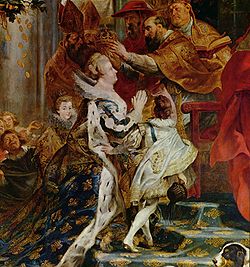 The portrait by Rubens (above right) was painted at this time. Marie rebuilt the Luxembourg Palace
(Palais du Luxembourg) in Paris, with an extravagantly flattering cycle of paintings by Rubens as part of the luxurious decor, called The Marie de' Medici Cycle
(detail from one painting on left).
After the death of his favourite
, the duke of Luynes, Louis turned increasingly for guidance to Richelieu. Marie de Medici's attempts to displace Richelieu ultimately led to her attempted coup; for a single day, the "Day of the Dupes
", in November 1630, she seemed to have succeeded; but the triumph of Richelieu was followed by her exile to Compiègne
in 1630, from where she escaped to Brussels
in 1631 and Amsterdam
in 1638.
Her visit to Amsterdam was considered a diplomatic triumph by the Dutch, as her visit lent official recognition to the newly-formed Dutch Republic
; accordingly she was accorded an elaborate ceremonial royal entry
, of the sort the Republic avoided for its own rulers. Spectacular displays (by Claes Corneliszoon Moeyaert
) and water pageants took place in the city's harbor in celebration of her visit. There was a procession led by two mounted trumpet
ers, and a large temporary structure erected on an artificial island in the Amstel River was built especially for the festival. The structure was designed to display a series of dramatic tableaux
in tribute to her once she set foot on the floating island and entered its pavilion
. Afterwards she was offered an Indonesian rice table
by the burgomaster Albert Burgh
. He also sold her a famous rosary
, captured in Brazil. The visit prompted Caspar Barlaeus
to write his Medicea hospes ("The Medicean Guest") (1638).
Marie subsequently travelled to Cologne
, where she died in 1642, scheming against Richelieu to the end.
Honoré de Balzac
encapsulated the Romantic generation's negative view:
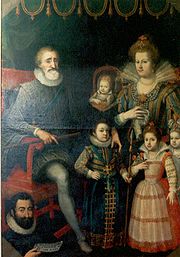
See also Descendants of Marie de' Medici
which maps how the Medici
became part of the European Royal families.
Queen consort
A queen consort is the wife of a reigning king. A queen consort usually shares her husband's rank and holds the feminine equivalent of the king's monarchical titles. Historically, queens consort do not share the king regnant's political and military powers. Most queens in history were queens consort...
of France, as the second wife of King Henry IV of France
Henry IV of France
Henry IV , Henri-Quatre, was King of France from 1589 to 1610 and King of Navarre from 1572 to 1610. He was the first monarch of the Bourbon branch of the Capetian dynasty in France....
, of the House of Bourbon
House of Bourbon
The House of Bourbon is a European royal house, a branch of the Capetian dynasty . Bourbon kings first ruled Navarre and France in the 16th century. By the 18th century, members of the Bourbon dynasty also held thrones in Spain, Naples, Sicily, and Parma...
. She herself was a member of the wealthy and powerful House of Medici. Following the assassination of her husband in 1610, which occurred the day after her coronation
Coronation
A coronation is a ceremony marking the formal investiture of a monarch and/or their consort with regal power, usually involving the placement of a crown upon their head and the presentation of other items of regalia...
, she acted as regent
Regent
A regent, from the Latin regens "one who reigns", is a person selected to act as head of state because the ruler is a minor, not present, or debilitated. Currently there are only two ruling Regencies in the world, sovereign Liechtenstein and the Malaysian constitutive state of Terengganu...
for her son, King Louis XIII of France
Louis XIII of France
Louis XIII was a Bourbon monarch who ruled as King of France and of Navarre from 1610 to 1643.Louis was only eight years old when he succeeded his father. His mother, Marie de Medici, acted as regent during Louis' minority...
, until he came of age. She was famed for her ceaseless political intrigues at the court of France and extensive artistic patronage.
Early life
Florence
Florence is the capital city of the Italian region of Tuscany and of the province of Florence. It is the most populous city in Tuscany, with approximately 370,000 inhabitants, expanding to over 1.5 million in the metropolitan area....
, Italy, Marie was the daughter of Francesco I de' Medici, Grand Duke of Tuscany, and Johanna, Archduchess of Austria
Johanna of Austria
Joanna of Austria was born an Archduchess of Austria as the youngest daughter of Ferdinand I, Holy Roman Emperor and Anna of Bohemia and Hungary. By marriage, she was the Grand Princess of Tuscany and later the Grand Duchess of Tuscany...
. Her maternal grandparents were Ferdinand I, Holy Roman Emperor
Ferdinand I, Holy Roman Emperor
Ferdinand I was Holy Roman Emperor from 1558 and king of Bohemia and Hungary from 1526 until his death. Before his accession, he ruled the Austrian hereditary lands of the Habsburgs in the name of his elder brother, Charles V, Holy Roman Emperor.The key events during his reign were the contest...
, and Anna of Bohemia and Hungary
Anna of Bohemia and Hungary
Anna of Bohemia and Hungary, also sometimes known as Anna Jagellonica was, by marriage to Ferdinand I, King of the Romans and later Holy Roman Emperor, Queen of the Romans.-Family:She was the elder child and only daughter of king Vladislaus II of Bohemia and Hungary and his third...
. She was one of seven children, but only she and her sister Eleonora de' Medici
Eleonora de' Medici
Eleonora de' Medici was the eldest child of Francesco I de' Medici and Johanna of Austria. She was a family member of the famous House of Medici.-Family:...
survived to adulthood.
Queen
Uncommonly beautiful in her youth, she married Henry IV of FranceHenry IV of France
Henry IV , Henri-Quatre, was King of France from 1589 to 1610 and King of Navarre from 1572 to 1610. He was the first monarch of the Bourbon branch of the Capetian dynasty in France....
in October 1600 following the annulment of his marriage to Margaret of Valois. The proxy wedding ceremony in Florence was celebrated with lavish entertainments, including examples of the newly-invented musical genre of opera
Opera
Opera is an art form in which singers and musicians perform a dramatic work combining text and musical score, usually in a theatrical setting. Opera incorporates many of the elements of spoken theatre, such as acting, scenery, and costumes and sometimes includes dance...
. She brought as part of her dowry 600,000 crowns. Her eldest son, the future King Louis XIII
Louis XIII of France
Louis XIII was a Bourbon monarch who ruled as King of France and of Navarre from 1610 to 1643.Louis was only eight years old when he succeeded his father. His mother, Marie de Medici, acted as regent during Louis' minority...
, was born at Fontainebleau
Fontainebleau
Fontainebleau is a commune in the metropolitan area of Paris, France. It is located south-southeast of the centre of Paris. Fontainebleau is a sub-prefecture of the Seine-et-Marne department, and it is the seat of the arrondissement of Fontainebleau...
the following year.
The marriage was not a successful one. The queen feuded with Henry's mistresses in language that shocked French courtiers. She quarrelled mostly with her husband's leading mistress, Catherine Henriette de Balzac d'Entragues
Catherine Henriette de Balzac d'Entragues
Catherine Henriette de Balzac d'Entragues, Marquise de Verneuil was the favourite mistress of Henry IV of France after Gabrielle d'Estrées died...
, whom he had promised he would marry following the death of his former "official mistress", Gabrielle d'Estrées
Gabrielle d'Estrées
Gabrielle d'Estrées, Duchess of Beaufort and Verneuil, Marchioness of Monceaux was a French mistress of King Henry IV of France, born at either the Château de la Bourdaisière in Montlouis-sur-Loire, in Touraine, or at the château de Cœuvres, in Picardy....
. When he failed to do so, and instead married Marie, the result was constant bickering and political intrigues behind the scenes. Although the king could have easily banished his mistress, supporting his queen, he never did so. She, in turn, showed great sympathy and support to her husband's banished ex-wife Margaret of Valois, prompting Henry to allow her back into the realm.
Marie was crowned
Coronation of the French monarch
The accession of the King of France was legitimated by coronation ceremony performed with the Crown of Charlemagne at Notre-Dame de Reims. However, the person did not need to be crowned in order to be recognized as French monarch; the new king ascended the throne when the coffin of the previous...
Queen of France on 13 May 1610, a day before her husband's death. Hours after Henry's assassination, she was confirmed as regent by the Parlement of Paris. She immediately banished his mistress Catherine Henriette de Balzac d'Entragues from the court.
The construction and furnishing of the Palais du Luxembourg, which she referred to as her "Palais Médicis", formed her major artistic project during her regency. The site was purchased in 1612 and construction began in 1615, to designs of Salomon de Brosse
Salomon de Brosse
Salomon de Brosse was the most influential early 17th-century French architect, a major influence on François Mansart. Salomon was from a prominent Huguenot family, the grandson through his mother of the designer Jacques I Androuet du Cerceau and the son of the architect Jean de Brosse...
. Her court painter was Peter Paul Rubens.
Politics
During her husband's lifetime Marie showed little sign of political acumen, and her abilities scarcely improved after she assumed the regency. Extremely stubborn and of limited intelligence, she was soon entirely under the influence of her maid Leonora "Galigai" DoriLeonora Dori
Leonora Dori , later Galigaï d'Ancre, , was an Italian alleged witch. She was a favourite of Marie de Médicis or Maria de' Medici, queen consort and later regent of France....
. Dori conspired with her unscrupulous Italian husband, Concino Concini
Concino Concini
Concino Concini, Count della Penna, Marquis et Maréchal d'Ancre , was an Italian politician, best known for being a minister of Louis XIII of France, as the favourite of his mother.-Life:...
, who was created Marquis d'Ancre and a Marshal of France
Marshal of France
The Marshal of France is a military distinction in contemporary France, not a military rank. It is granted to generals for exceptional achievements...
, even though he had never fought a battle.
The Concinis had Henry IV's able minister, the Duke of Sully
Maximilien de Béthune, duc de Sully
Maximilien de Béthune, first Duke of Sully was the doughty soldier, French minister, staunch Huguenot and faithful right-hand man who assisted Henry IV of France in the rule of France.-Early years:...
, dismissed, and Italian representatives of the Roman Catholic Church
Roman Catholic Church
The Catholic Church, also known as the Roman Catholic Church, is the world's largest Christian church, with over a billion members. Led by the Pope, it defines its mission as spreading the gospel of Jesus Christ, administering the sacraments and exercising charity...
hoped to force the suppression of Protestantism
Protestantism
Protestantism is one of the three major groupings within Christianity. It is a movement that began in Germany in the early 16th century as a reaction against medieval Roman Catholic doctrines and practices, especially in regards to salvation, justification, and ecclesiology.The doctrines of the...
in France by means of their influence. Half Habsburg herself, Marie abandoned the traditional anti-Habsburg French foreign policy. She lent support to Habsburg Spain by arranging the marriage of her daughter Elisabeth to the future Philip IV of Spain
Philip IV of Spain
Philip IV was King of Spain between 1621 and 1665, sovereign of the Spanish Netherlands, and King of Portugal until 1640...
.
Under the regent's lax and capricious rule, the princes of the blood and the great nobles of the kingdom revolted. The queen, too weak to assert her authority, consented to buy them off on 15 May 1614. The opposition to the regency was led by Henri de Bourbon
Henry II de Bourbon, prince de Condé
Henri de Bourbon became Prince of Condé shortly after his birth, following the death of his father Henri I...
, Duke of Enghien
Duke of Enghien
The title of Duke of Enghien may, like many noble titles, refer to any of several historical figures.-Dukes of Enghien - first creation :...
, who pressured Marie into convoking the Estates General
French States-General
In France under the Old Regime, the States-General or Estates-General , was a legislative assembly of the different classes of French subjects. It had a separate assembly for each of the three estates, which were called and dismissed by the king...
in 1614 and 1615, the last time they would meet in France until the opening events of the French Revolution
French Revolution
The French Revolution , sometimes distinguished as the 'Great French Revolution' , was a period of radical social and political upheaval in France and Europe. The absolute monarchy that had ruled France for centuries collapsed in three years...
.
In 1616 Marie's rule was strengthened by the addition to her councils of Armand Jean du Plessis (later Cardinal Richelieu)
Armand Jean du Plessis, Cardinal Richelieu
Armand Jean du Plessis, Cardinal-Duc de Richelieu et de Fronsac was a French clergyman, noble, and statesman.Consecrated as a bishop in 1608, he later entered politics, becoming a Secretary of State in 1616. Richelieu soon rose in both the Catholic Church and the French government, becoming a...
, who had come to prominence at the meetings of the Estates General. However, her son Louis XIII
Louis XIII of France
Louis XIII was a Bourbon monarch who ruled as King of France and of Navarre from 1610 to 1643.Louis was only eight years old when he succeeded his father. His mother, Marie de Medici, acted as regent during Louis' minority...
, already several years into his legal majority, asserted his authority the next year. The king overturned the pro-Habsburg, pro-Spanish foreign policy pursued by his mother, ordered the assassination of Concini, exiled the queen to the Château de Blois
Château de Blois
The Royal Château de Blois is located in the Loir-et-Cher département in the Loire Valley, in France, in the center of the city of Blois. The residence of several French kings, it is also the place where Joan of Arc went in 1429 to be blessed by the Archbishop of Reims before departing with her...
and appointed Richelieu to his bishopric.
After two years of virtual imprisonment "in the wilderness", as she put it, Marie escaped from Blois in the night of 21/22 February 1619 and became the figurehead of a new aristocratic revolt headed by Louis's brother Gaston d'Orléans
Gaston, Duke of Orléans
Gaston of France, , also known as Gaston d'Orléans, was the third son of King Henry IV of France and his wife Marie de Medici. As a son of the king, he was born a Fils de France. He later acquired the title Duke of Orléans, by which he was generally known during his adulthood...
, which Louis's forces easily dispersed. Through the mediation of Richelieu the king was reconciled with his mother, who was allowed to hold a small court at Angers. She resumed her place in the royal council in 1621.
Luxembourg Palace
The Luxembourg Palace in the 6th arrondissement of Paris, north of the Luxembourg Garden , is the seat of the French Senate.The formal Luxembourg Garden presents a 25-hectare green parterre of gravel and lawn populated with statues and provided with large basins of water where children sail model...
(Palais du Luxembourg) in Paris, with an extravagantly flattering cycle of paintings by Rubens as part of the luxurious decor, called The Marie de' Medici Cycle
Marie de' Medici cycle
The Marie de' Medici Cycle is a series of twenty-four paintings by Peter Paul Rubens commissioned by Marie de' Medici, wife of Henry IV of France, for the Luxembourg Palace in Paris. Rubens received the commission in the autumn of 1621...
(detail from one painting on left).
After the death of his favourite
Favourite
A favourite , or favorite , was the intimate companion of a ruler or other important person. In medieval and Early Modern Europe, among other times and places, the term is used of individuals delegated significant political power by a ruler...
, the duke of Luynes, Louis turned increasingly for guidance to Richelieu. Marie de Medici's attempts to displace Richelieu ultimately led to her attempted coup; for a single day, the "Day of the Dupes
Day of the Dupes
Day of the Dupes is the name given to the day in November of 1630 on which the enemies of Cardinal Richelieu mistakenly believed that they had succeeded in persuading Louis XIII, King of France, to dismiss Richelieu from power...
", in November 1630, she seemed to have succeeded; but the triumph of Richelieu was followed by her exile to Compiègne
Compiègne
Compiègne is a city in northern France. It is designated municipally as a commune within the département of Oise.The city is located along the Oise River...
in 1630, from where she escaped to Brussels
Brussels
Brussels , officially the Brussels Region or Brussels-Capital Region , is the capital of Belgium and the de facto capital of the European Union...
in 1631 and Amsterdam
Amsterdam
Amsterdam is the largest city and the capital of the Netherlands. The current position of Amsterdam as capital city of the Kingdom of the Netherlands is governed by the constitution of August 24, 1815 and its successors. Amsterdam has a population of 783,364 within city limits, an urban population...
in 1638.
Her visit to Amsterdam was considered a diplomatic triumph by the Dutch, as her visit lent official recognition to the newly-formed Dutch Republic
Dutch Republic
The Dutch Republic — officially known as the Republic of the Seven United Netherlands , the Republic of the United Netherlands, or the Republic of the Seven United Provinces — was a republic in Europe existing from 1581 to 1795, preceding the Batavian Republic and ultimately...
; accordingly she was accorded an elaborate ceremonial royal entry
Royal Entry
The Royal Entry, also known by various other names, including Triumphal Entry and Joyous Entry, embraced the ceremonial and festivities accompanying a formal entry by a ruler or his representative into a city in the Middle Ages and Early Modern Period in Europe...
, of the sort the Republic avoided for its own rulers. Spectacular displays (by Claes Corneliszoon Moeyaert
Claes Corneliszoon Moeyaert
Claes Corneliszoon Moeyaert or Nicolaes Moyaert or Mooyaert was an authoritative Catholic Dutch painter. He followed Rembrandt in his use of red chalk....
) and water pageants took place in the city's harbor in celebration of her visit. There was a procession led by two mounted trumpet
Trumpet
The trumpet is the musical instrument with the highest register in the brass family. Trumpets are among the oldest musical instruments, dating back to at least 1500 BCE. They are played by blowing air through closed lips, producing a "buzzing" sound which starts a standing wave vibration in the air...
ers, and a large temporary structure erected on an artificial island in the Amstel River was built especially for the festival. The structure was designed to display a series of dramatic tableaux
Tableau vivant
Tableau vivant is French for "living picture." The term describes a striking group of suitably costumed actors or artist's models, carefully posed and often theatrically lit. Throughout the duration of the display, the people shown do not speak or move...
in tribute to her once she set foot on the floating island and entered its pavilion
Pavilion (structure)
In architecture a pavilion has two main meanings.-Free-standing structure:Pavilion may refer to a free-standing structure sited a short distance from a main residence, whose architecture makes it an object of pleasure. Large or small, there is usually a connection with relaxation and pleasure in...
. Afterwards she was offered an Indonesian rice table
Indonesian rice table
The Indonesian rijsttafel , a Dutch word that literally translates to "rice table", is an elaborate meal adapted by the Dutch from the Indonesian feast called nasi padang. It consists of many side dishes served in small portions, accompanied by rice prepared in several different ways...
by the burgomaster Albert Burgh
Albert Burgh
Albert Coenraadsz. Burgh was a Dutch physician who was mayor of Amsterdam and a councillor in the Admiralty of Amsterdam.-Biography:...
. He also sold her a famous rosary
Rosary
The rosary or "garland of roses" is a traditional Catholic devotion. The term denotes the prayer beads used to count the series of prayers that make up the rosary...
, captured in Brazil. The visit prompted Caspar Barlaeus
Caspar Barlaeus
Caspar Barlaeus was a Dutch polymath and Renaissance humanist, a theologian, poet, and historian.-Life:...
to write his Medicea hospes ("The Medicean Guest") (1638).
Marie subsequently travelled to Cologne
Cologne
Cologne is Germany's fourth-largest city , and is the largest city both in the Germany Federal State of North Rhine-Westphalia and within the Rhine-Ruhr Metropolitan Area, one of the major European metropolitan areas with more than ten million inhabitants.Cologne is located on both sides of the...
, where she died in 1642, scheming against Richelieu to the end.
Honoré de Balzac
Honoré de Balzac
Honoré de Balzac was a French novelist and playwright. His magnum opus was a sequence of short stories and novels collectively entitled La Comédie humaine, which presents a panorama of French life in the years after the 1815 fall of Napoleon....
encapsulated the Romantic generation's negative view:
- "Marie de' Medici, all of whose actions were prejudicial to France, has escaped the shame which ought to cover her name. Marie de' Medici wasted the wealth amassed by Henry IV; she never purged herself of the charge of having known of the king's assassination; her intimate was d'ÉpernonJean Louis de Nogaret de La ValetteJean Louis de Nogaret de La Valette , created Duke of Épernon, was a powerful member of the French nobility at the turn of the 17th century. He was deeply involved in plots and politics throughout his life....
, who did not ward off Ravaillac's blow, and who was proved to have known the murderer personally for a long time. Marie's conduct was such that she forced her son to banish her from France, where she was encouraging her other son, Gaston, to rebel; and the victory Richelieu at last won over her (on the Day of the Dupes) was due solely to the discovery the cardinal made, and imparted to Louis XIII, of secret documents relating to the death of Henry IV." – Essay Catherine de Medicis.
Issue
| Name | Birth | Death | Notes |
|---|---|---|---|
| Louis XIII, King of France Louis XIII of France Louis XIII was a Bourbon monarch who ruled as King of France and of Navarre from 1610 to 1643.Louis was only eight years old when he succeeded his father. His mother, Marie de Medici, acted as regent during Louis' minority... |
27 September 1601 | 14 May 1643 | Married Anne of Austria Anne of Austria Anne of Austria was Queen consort of France and Navarre, regent for her son, Louis XIV of France, and a Spanish Infanta by birth... (1601–1666) in 1615. Had issue. |
| Elisabeth, Queen of Spain | 22 November 1602 | 6 October 1644 | Married Philip IV, King of Spain Philip IV of Spain Philip IV was King of Spain between 1621 and 1665, sovereign of the Spanish Netherlands, and King of Portugal until 1640... (1605–1665) in 1615. Had issue. |
| Christine, Duchess of Savoy Christine Marie of France Christine of France was the sister of Louis XIII and the Duchess of Savoy by marriage. At the death of her husband Victor Amadeus I in 1637, she acted as regent of Savoy between 1637 and 1648.... |
12 February 1606 | 27 December 1663 | Married Victor Amadeus I, Duke of Savoy Victor Amadeus I, Duke of Savoy Victor Amadeus I was the Duke of Savoy from 1630 to 1637. He was also titular King of Cyprus and Jerusalem. He was also known as the Lion of Susa-Biography:... (1587–1637) in 1619. Had issue. |
| Nicholas Henri, Duke of Orléans Nicholas Henri, Duke of Orléans Nicolas Henri de France, Duke of Orléans, was the second son and fourth child of Henry IV of France and his Italian queen Marie de' Medici.-Biography:... |
16 April 1607 | 17 November 1611 | Died young. |
| Gaston, Duke of Orléans Gaston, Duke of Orléans Gaston of France, , also known as Gaston d'Orléans, was the third son of King Henry IV of France and his wife Marie de Medici. As a son of the king, he was born a Fils de France. He later acquired the title Duke of Orléans, by which he was generally known during his adulthood... |
25 April 1608 | 2 February 1660 | Married (1) Marie de Bourbon Marie de Bourbon, Duchess of Montpensier Marie de Bourbon , Duchess of Montpensier, and Duchess of Orléans by marriage, was a French noblewoman and one of the last members of the House of Bourbon-Montpensier... (1605–1627) in 1626. Had issue. Married (2) Marguerite of Lorraine Marguerite of Lorraine Marguerite of Lorraine was a duchess of Orléans and Alençon. She was born in Nancy, Lorraine to Francis II, Duke of Lorraine, and Countess Christina of Salm. On 31 January 1632, she married Gaston, Duke of Orléans, son of Henry IV of France and Marie de' Medici... (1615–1672) in 1632. Had issue. |
| Henrietta Maria, Queen of England | 25 November 1609 | 10 September 1669 | Married Charles I, King of England Charles I of England Charles I was King of England, King of Scotland, and King of Ireland from 27 March 1625 until his execution in 1649. Charles engaged in a struggle for power with the Parliament of England, attempting to obtain royal revenue whilst Parliament sought to curb his Royal prerogative which Charles... (1600–1649) in 1625. Had issue. |
See also Descendants of Marie de' Medici
Descendants of Marie de Medici
-External links:* Definitive statements of Baroque art.** ] the entrance of Maria de Medici in Amsterdam]*...
which maps how the Medici
Medici
The House of Medici or Famiglia de' Medici was a political dynasty, banking family and later royal house that first began to gather prominence under Cosimo de' Medici in the Republic of Florence during the late 14th century. The family originated in the Mugello region of the Tuscan countryside,...
became part of the European Royal families.
Titles and styles
- 26 April 1575 – 17 December 1600 Her Highness Princess Maria
- 17 December 1600 - 14 May 1610 Her Most Christian Majesty The Queen
- 14 May 1610 - 20 October 1614 Her Most Christian Majesty The Queen regent
- 20 October 1614 - 4 July 1642 Her Most Christian Majesty The Queen mother
Ancestry
See also
- Henry IV of France's wives and mistressesHenry IV of France's wives and mistressesHenry IV of France's wives and mistresses played a significant role in the politics of his reign. Both Henry and his first wife Marguerite of Valois, whom he married in 1572, were repeatedly unfaithful to each other, and the collapse of their marriage led to their estrangement and living apart...
- House of Medici
External links
- Rubens cycle of paintings apotheosizing Marie de Medici Definitive statements of BaroqueBaroqueThe Baroque is a period and the style that used exaggerated motion and clear, easily interpreted detail to produce drama, tension, exuberance, and grandeur in sculpture, painting, literature, dance, and music...
art. - National Maritime Museum
- http://www.mfa.org/collections/search_art.asp?recview=true&id=718&coll_keywords=Moeyaert&coll_accession=&coll_name=&coll_artist=&coll_place=&coll_medium=&coll_culture=&coll_classification=&coll_credit=&coll_provenance=&coll_location=&coll_has_images=1&coll_on_view=&coll_sort=0&coll_sort_order=0&coll_package=0&coll_start=1,Drawing by Claes Cornelisz. Moeyaert the entrance of Maria de Medici in Amsterdam]
- Festival Books