

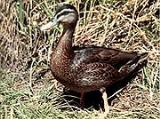
Mariana Mallard

Encyclopedia
The Mariana Mallard or Oustalet's Duck is an extinct type of duck
of the genus
Anas
that was endemic to the Mariana Islands
. Its taxonomic status is debated, and it has variously been treated as a full species
, a subspecies
of the Mallard
or the Pacific Black Duck
, or sometimes as a subspecies of the Indian Spot-billed Duck.
by Tommaso Salvadori
as full species in the genus Anas, named after its collector, the French zoologist Emile Oustalet
. Salvadori suggested it was related to the Pacific Black Duck. It was previously known to the Chamorro people, who called it ngånga' (palao) in Chamorro
, and to the Carolinian people, who called it ghereel'bwel in Carolinian
.
After Salvadori, most taxonomists, such as Dean Amadon
and Ernst Mayr
considered it a subspecies of the Mallard. Yoshimaro Yamashina
examined those specimens in Japanese museums in 1948, and decided that the Mariana Mallard was an example of hybrid speciation
, and was descended from the Mallard and the Pacific Black Duck's Palau subspecies (Anas superciliosa pelewensis). However, no molecular genetic evidence is available to support this hypothesis. Some scientists, such as Jean Delacour, have considered the Mariana Mallard a simple hybrid, so it was absent from Delacours four-volume monograph on the ducks and from the IUCN Red List
. If Yamashina's hypothesis is correct, the Mariana Mallard would have presumably evolved into near species status in only about ten thousand years.
Neither Mariana Mallards nor their progenitor species are known from fossils on the Marianas, casting into doubt the assumption that a resident Black Duck population had been long established on the islands. However, most rock shelter
s and caves on the Marianas were obliterated in the 1944 Battle of Guam. A species of flightless duck is known from a prehistoric bone found on Rota
in 1994; was apparently not closely related to the Mariana Mallard.
Only the former had a distinct nuptial (breeding) plumage: the head was green as in mallard drakes, but less glossy, with some buff feathers on the sides, a dark brown eyestripe and a faint whitish ring at the base of the neck. The upper breast was dark ruddish chestnut brown with blackish-brown spots. The wing patch (speculum
) and the tail was also like in mallard drakes' nuptial plumage, including curled-up central tail feathers, but the tips of the speculum feathers were buff. The underside was a mix between the vermiculated grey feathers of the mallard and the brown ones of the Pacific Black Duck. The remainder of the bird looked like a male Pacific Black Duck with lighter underwings. The bill was black at the base and olive at the tip, the feet reddish orange with darker webs and the iris brown. The eclipse plumage looked similar to a dark eclipse mallard drake.
Males of the "superciliosa" type resembled a Pacific Black Duck with a less distinctly marked head, the supercilium
and cheeks being buffy and the cheek (malar) stripe hardly visible. The upper breast, flank and scapula
r feathers had broader buff edges, and the underwings were lighter. The speculum was usually as in the "platyrhynchos" type, i.e. mallard-like, but at least two specimens have the green speculum of the Pacific Black Duck. The bill was like that of A. superciliosa, and the iris and legs similar to the "platyrhynchos" type.
Females looked essentially like a dark mallard female with the orange of the feet and near the bill tip usually a bit more pure.
, Saipan
and Tinian
. Two unidentified ducks were seen on Rota in 1945, but as no movement of A. oustaleti between Saipan and Tinian, which are just 8 kilometres (5 mi) apart, was recorded, these were probably vagrant migrating ducks, although Marshall (1949) suspected from circumstantial evidence that such movement did indeed take place. However, the distance between Guam and Rota is nearly 80 kilometres (49.7 mi), making intentional migration between these islands not likely.
valley, on Tinian on Lake Hagoi and Lake Makpo (now Makpo Swamp) before it was drained, and on Saipan on the Garpan lagoon and on and around Lake Susupe. The birds were rather reclusive, preferring sheltered habitat
with plenty of wetland/water plants - fern
thickets (Acrostichum
aureum) and reed bed
s (Scirpus
, Cyperus
and Phragmites (australis) karka
), as described in detail by Tenorio et al. (1979) and Stemmermann (1981) -, where they also nested. Usually, pairs or small flocks were encountered, but in the key habitats larger groups of dozens and rarely up to 50-60 individuals could be found. Apart from possible inter-island movement, the birds were not migratory.
Feeding and reproduction are not well documented, but cannot expected to differ significantly from its immediate relatives. The Mariana Mallard fed on aquatic invertebrates, small vertebrates and plants, and although up-ending was not observed, they probably utilized it too.
Breeding was recorded from at least January to July, with a peak in June/July at the end of the dry season. One male specimen taken in October was also in breeding condition; thus, the birds may have bred nealy year-round at least on occasion. Unfortunately, the courtship behavior, which in the strongly sexually dimorphic
mallard is focused more on presentation of visual cues than in the monomorphic Pacific Black Duck (although it is generally similar in both species), was never recorded. The clutch
consisted of 7-12 pale grey-green oval eggs measuring 61.6 x 38.9 mm on average. Incubation lasted around 28 days, males took no part in it and neither in caring for the ducklings. The precocial
and nidifugous
young fledge
d when c. 8 weeks old and became sexually mature the following year.
(see also below). By the 1940s, flocks of more than a dozen birds were seldom seen. On Guam, the last sightings were in 1949 and 1967 - the latter being a single, possibly vagrant, bird - and on Tinian in 1974. As Lake Susupe offered the most plentiful and least accessible habitat, although it too suffered from pollution by sugar mill wastes, the Saipan population lingered on for a few more years. The Mariana Mallard was listed as federally endangered
on June 2, 1977. In 1979, two males and a female were found on Saipan and caught; one male was later released, the last wild bird ever to be encountered. The pair was brought to Pohakuloa Training Area
, Hawaii
, and later to SeaWorld
, San Diego, where it was attempted to have them reproduce in captivity. However, this was unsuccessful and the species became extinct with the death of the last individual in 1981. Surveys were conducted in the following years, but the species was certainly gone by then. It was removed from the USFWS Endangered Species List on February 23, 2004, due to extinction.
Collection of specimens for museums and private collections must have had a temporary impact during the Japanese control over the islands. Although less than 100 specimens are on record, most were taken in the 1930s and 1940s for Japanese collectors; given the rather sedentary habits and small population size of the species, this may have jeopardized local populations to the point of extinction. Outside Japan, 7 specimens (including the type) are in the MNHN, Paris
, one in the Walter Rothschild Zoological Museum
, Tring
, two in the USNM
, Washington D.C. and six in the AMNH, New York City
. There are reports of additional specimens in Cambridge, Massachusetts
and Lisbon
.
Duck
Duck is the common name for a large number of species in the Anatidae family of birds, which also includes swans and geese. The ducks are divided among several subfamilies in the Anatidae family; they do not represent a monophyletic group but a form taxon, since swans and geese are not considered...
of the genus
Genus
In biology, a genus is a low-level taxonomic rank used in the biological classification of living and fossil organisms, which is an example of definition by genus and differentia...
Anas
Anas
Anas is a genus of dabbling ducks. It includes mallards, wigeons, teals, pintails and shovelers in a number of subgenera. Some authorities prefer to elevate the subgenera to genus rank...
that was endemic to the Mariana Islands
Mariana Islands
The Mariana Islands are an arc-shaped archipelago made up by the summits of 15 volcanic mountains in the north-western Pacific Ocean between the 12th and 21st parallels north and along the 145th meridian east...
. Its taxonomic status is debated, and it has variously been treated as a full species
Species
In biology, a species is one of the basic units of biological classification and a taxonomic rank. A species is often defined as a group of organisms capable of interbreeding and producing fertile offspring. While in many cases this definition is adequate, more precise or differing measures are...
, a subspecies
Subspecies
Subspecies in biological classification, is either a taxonomic rank subordinate to species, ora taxonomic unit in that rank . A subspecies cannot be recognized in isolation: a species will either be recognized as having no subspecies at all or two or more, never just one...
of the Mallard
Mallard
The Mallard , or Wild Duck , is a dabbling duck which breeds throughout the temperate and subtropical Americas, Europe, Asia, and North Africa, and has been introduced to New Zealand and Australia....
or the Pacific Black Duck
Pacific Black Duck
The Pacific Black Duck is a dabbling duck found in much of Indonesia, New Guinea, Australia, New Zealand, and many islands in the southwestern Pacific, reaching to the Caroline Islands in the north and French Polynesia in the east. It is usually called the Grey Duck in New Zealand...
, or sometimes as a subspecies of the Indian Spot-billed Duck.
Taxonomy
The taxonomic status of the Mariana Mallard is disputed, since it resembles an intermediate of the Mallard and the Pacific Black Duck, two closely related allopatric species which frequently hybridise. Its males had two intergrading color morphs, called the "platyrhynchos" and the "superciliosa" types after the species they resembled more. It was first scientifically describedBinomial nomenclature
Binomial nomenclature is a formal system of naming species of living things by giving each a name composed of two parts, both of which use Latin grammatical forms, although they can be based on words from other languages...
by Tommaso Salvadori
Tommaso Salvadori
Count Adelardo Tommaso Salvadori Paleotti was an Italian zoologist and ornithologist.Salvadori was born in Porto San Giorgio, son of Count Luigi Salvadori and Ethel. He took an early interest in birds and published a catalogue of the birds of Sardinia in 1862...
as full species in the genus Anas, named after its collector, the French zoologist Emile Oustalet
Émile Oustalet
Jean-Frédéric Émile Oustalet was a French zoologist.Oustalet was born at Montbéliard, in the department of Doubs. He studied at the Ecole des Hautes-Etudes and his first scientific work was on the respiratory organs of dragonfly larvae...
. Salvadori suggested it was related to the Pacific Black Duck. It was previously known to the Chamorro people, who called it ngånga' (palao) in Chamorro
Chamorro language
Chamorro is a Malayo-Polynesian language, spoken on the Mariana Islands by about 47,000 people Chamorro (Chamorro: Fino' Chamoru or simply Chamoru) is a Malayo-Polynesian (Austronesian) language, spoken on the Mariana Islands (Guam, Rota, Tinian, and Saipan) by about 47,000 people Chamorro...
, and to the Carolinian people, who called it ghereel'bwel in Carolinian
Carolinian language
Carolinian is an Austronesian language spoken in the Northern Mariana Islands, where it is an official language along with English and Chamorro. Spoken mostly by the Carolinian people, Carolinian is most closely related to Satawalese, Woleaian, and Puluwatese...
.
After Salvadori, most taxonomists, such as Dean Amadon
Dean Amadon
Dean Arthur Amadon was an American ornithologist and an authority on birds of prey.Amadon was born in Milwaukee, Wisconsin to Arthur and Mary Amadon. He received a BS from Hobart College in 1934 and a Ph.D. from Cornell University in 1947...
and Ernst Mayr
Ernst Mayr
Ernst Walter Mayr was one of the 20th century's leading evolutionary biologists. He was also a renowned taxonomist, tropical explorer, ornithologist, historian of science, and naturalist...
considered it a subspecies of the Mallard. Yoshimaro Yamashina
Yoshimaro Yamashina
Marquis was a Japanese ornithologist. He was the founder of the Yamashina Institute for Ornithology.-Biography:Yamashina was born in Kōjimachi, Tokyo, the second son of Prince Kikumaro Yamashina. He developed a love of birds at an early age, which were found in abundance on the vast Yamashina...
examined those specimens in Japanese museums in 1948, and decided that the Mariana Mallard was an example of hybrid speciation
Hybrid speciation
Hybrid speciation is the process wherein hybridization between two different closely related species leads to a distinct phenotype. This phenotype in very rare cases can also be fitter than the parental lineage and as such natural selection may then favor these individuals. Eventually, if...
, and was descended from the Mallard and the Pacific Black Duck's Palau subspecies (Anas superciliosa pelewensis). However, no molecular genetic evidence is available to support this hypothesis. Some scientists, such as Jean Delacour, have considered the Mariana Mallard a simple hybrid, so it was absent from Delacours four-volume monograph on the ducks and from the IUCN Red List
IUCN Red List
The IUCN Red List of Threatened Species , founded in 1963, is the world's most comprehensive inventory of the global conservation status of biological species. The International Union for Conservation of Nature is the world's main authority on the conservation status of species...
. If Yamashina's hypothesis is correct, the Mariana Mallard would have presumably evolved into near species status in only about ten thousand years.
Neither Mariana Mallards nor their progenitor species are known from fossils on the Marianas, casting into doubt the assumption that a resident Black Duck population had been long established on the islands. However, most rock shelter
Rock shelter
A rock shelter is a shallow cave-like opening at the base of a bluff or cliff....
s and caves on the Marianas were obliterated in the 1944 Battle of Guam. A species of flightless duck is known from a prehistoric bone found on Rota
Rota (island)
Rota also known as the "peaceful island", is the southernmost island of the United States Commonwealth of the Northern Mariana Islands and the second southernmost of the Marianas Archipelago. It lies approximately 40 miles north-northeast of the United States territory of Guam...
in 1994; was apparently not closely related to the Mariana Mallard.
Description
Mariana Mallards were 51–56 cm long and weighed approximately one kilogram, making them marginally smaller than mallards. Two intergrading color morphs were found in males, called the "platyrhynchos" and the "superciliosa" type after the species they resembled more.Only the former had a distinct nuptial (breeding) plumage: the head was green as in mallard drakes, but less glossy, with some buff feathers on the sides, a dark brown eyestripe and a faint whitish ring at the base of the neck. The upper breast was dark ruddish chestnut brown with blackish-brown spots. The wing patch (speculum
Speculum feathers
The speculum is a patch, often distinctly coloured, on the inner remiges of some birds.Examples of the colour of the speculum in a number of ducks are:* Common Teal and Green-winged Teal: Iridescent green edged with buff....
) and the tail was also like in mallard drakes' nuptial plumage, including curled-up central tail feathers, but the tips of the speculum feathers were buff. The underside was a mix between the vermiculated grey feathers of the mallard and the brown ones of the Pacific Black Duck. The remainder of the bird looked like a male Pacific Black Duck with lighter underwings. The bill was black at the base and olive at the tip, the feet reddish orange with darker webs and the iris brown. The eclipse plumage looked similar to a dark eclipse mallard drake.
Males of the "superciliosa" type resembled a Pacific Black Duck with a less distinctly marked head, the supercilium
Supercilium
The supercilium is a plumage feature found on the heads of some bird species. It is a stripe which runs from the base of the bird's beak above its eye, finishing somewhere towards the rear of the bird's head. Also known as an "eyebrow", it is distinct from the eyestripe, which is a line which runs...
and cheeks being buffy and the cheek (malar) stripe hardly visible. The upper breast, flank and scapula
Scapula
In anatomy, the scapula , omo, or shoulder blade, is the bone that connects the humerus with the clavicle ....
r feathers had broader buff edges, and the underwings were lighter. The speculum was usually as in the "platyrhynchos" type, i.e. mallard-like, but at least two specimens have the green speculum of the Pacific Black Duck. The bill was like that of A. superciliosa, and the iris and legs similar to the "platyrhynchos" type.
Females looked essentially like a dark mallard female with the orange of the feet and near the bill tip usually a bit more pure.
Distribution
It occurred, in recent times at least, on the islands of GuamGuam
Guam is an organized, unincorporated territory of the United States located in the western Pacific Ocean. It is one of five U.S. territories with an established civilian government. Guam is listed as one of 16 Non-Self-Governing Territories by the Special Committee on Decolonization of the United...
, Saipan
Saipan
Saipan is the largest island of the United States Commonwealth of the Northern Mariana Islands , a chain of 15 tropical islands belonging to the Marianas archipelago in the western Pacific Ocean with a total area of . The 2000 census population was 62,392...
and Tinian
Tinian
Tinian is one of the three principal islands of the Commonwealth of the Northern Mariana Islands.-Geography:Tinian is about 5 miles southwest of its sister island, Saipan, from which it is separated by the Saipan Channel. It has a land area of 39 sq.mi....
. Two unidentified ducks were seen on Rota in 1945, but as no movement of A. oustaleti between Saipan and Tinian, which are just 8 kilometres (5 mi) apart, was recorded, these were probably vagrant migrating ducks, although Marshall (1949) suspected from circumstantial evidence that such movement did indeed take place. However, the distance between Guam and Rota is nearly 80 kilometres (49.7 mi), making intentional migration between these islands not likely.
Ecology
The Mariana Mallard inhabited wetlands, mostly inland but occasionally also in coastal areas. On Guam, it was most abundant in the Talofofo RiverTalofofo River
The Talofofo River is one of the longest rivers on the Pacific Ocean island of Guam. Rising on the eastern slopes of Mount Lamlam in the island's southwest, it traverses the island in a northeastward direction, flowing into the sea at Talofofo Bay....
valley, on Tinian on Lake Hagoi and Lake Makpo (now Makpo Swamp) before it was drained, and on Saipan on the Garpan lagoon and on and around Lake Susupe. The birds were rather reclusive, preferring sheltered habitat
Habitat (ecology)
A habitat is an ecological or environmental area that is inhabited by a particular species of animal, plant or other type of organism...
with plenty of wetland/water plants - fern
Fern
A fern is any one of a group of about 12,000 species of plants belonging to the botanical group known as Pteridophyta. Unlike mosses, they have xylem and phloem . They have stems, leaves, and roots like other vascular plants...
thickets (Acrostichum
Acrostichum
Acrostichum was one of the original pteridophyte genera delineated by Linnaeus. It was originally drawn very broadly, including all ferns that had sori apparently "acrostichoid", or distributed in a solid mass across the back of the frond, rather than organized in discrete sori...
aureum) and reed bed
Reed bed
Reed beds are natural habitats found in floodplains, waterlogged depressions andestuaries. Reed beds are part of a succession from young reed colonising open water or wet ground through a gradation of increasingly dry ground...
s (Scirpus
Scirpus
The plant genus Scirpus consists of a large number of aquatic, grass-like species in the family Cyperaceae , many with the common names club-rush or bulrush . Other common names are deergrass or grassweed.The genus has a cosmopolitan distribution, and grows in wetlands and moist soil...
, Cyperus
Cyperus
Cyperus is a large genus of about 600 species of sedges, distributed throughout all continents in both tropical and temperate regions. They are annual or perennial plants, mostly aquatic and growing in still or slow-moving water up to 0.5 m deep. The species vary greatly in size, with small species...
and Phragmites (australis) karka
Phragmites
Phragmites, the Common reed, is a large perennial grass found in wetlands throughout temperate and tropical regions of the world. Phragmites australis is sometimes regarded as the sole species of the genus Phragmites, though some botanists divide Phragmites australis into three or four species...
), as described in detail by Tenorio et al. (1979) and Stemmermann (1981) -, where they also nested. Usually, pairs or small flocks were encountered, but in the key habitats larger groups of dozens and rarely up to 50-60 individuals could be found. Apart from possible inter-island movement, the birds were not migratory.
Feeding and reproduction are not well documented, but cannot expected to differ significantly from its immediate relatives. The Mariana Mallard fed on aquatic invertebrates, small vertebrates and plants, and although up-ending was not observed, they probably utilized it too.
Breeding was recorded from at least January to July, with a peak in June/July at the end of the dry season. One male specimen taken in October was also in breeding condition; thus, the birds may have bred nealy year-round at least on occasion. Unfortunately, the courtship behavior, which in the strongly sexually dimorphic
Sexual dimorphism
Sexual dimorphism is a phenotypic difference between males and females of the same species. Examples of such differences include differences in morphology, ornamentation, and behavior.-Examples:-Ornamentation / coloration:...
mallard is focused more on presentation of visual cues than in the monomorphic Pacific Black Duck (although it is generally similar in both species), was never recorded. The clutch
Clutch (eggs)
A clutch of eggs refers to all the eggs produced by birds or reptiles, often at a single time, particularly those laid in a nest.In birds, destruction of a clutch by predators, , results in double-clutching...
consisted of 7-12 pale grey-green oval eggs measuring 61.6 x 38.9 mm on average. Incubation lasted around 28 days, males took no part in it and neither in caring for the ducklings. The precocial
Precocial
In biology, the term precocial refers to species in which the young are relatively mature and mobile from the moment of birth or hatching. The opposite developmental strategy is called "altricial," where the young are born or hatched helpless. Extremely precocial species may be called...
and nidifugous
Nidifugous
Nidifugous organisms are those that leave the nest shortly after hatching or birth. It is derived from Latin nidus for "nest" and fugere meaning "to flee". The terminology is most often used to describe birds and was introduced by Lorenz Oken in 1916...
young fledge
Fledge
Fledge is the stage in a young bird's life when the feathers and wing muscles are sufficiently developed for flight. It also describes the act of a chick's parents raising it to a fully grown state...
d when c. 8 weeks old and became sexually mature the following year.
Extinction
The birds declined due to draining of wetlands for agriculture and construction. Hunting pressure was probably heavy, despite a ban on gun ownership under Japanese control (1914–1945), as the birds were unwary to be trapped, and at any rate the gun ban was lifted after World War IIWorld War II
World War II, or the Second World War , was a global conflict lasting from 1939 to 1945, involving most of the world's nations—including all of the great powers—eventually forming two opposing military alliances: the Allies and the Axis...
(see also below). By the 1940s, flocks of more than a dozen birds were seldom seen. On Guam, the last sightings were in 1949 and 1967 - the latter being a single, possibly vagrant, bird - and on Tinian in 1974. As Lake Susupe offered the most plentiful and least accessible habitat, although it too suffered from pollution by sugar mill wastes, the Saipan population lingered on for a few more years. The Mariana Mallard was listed as federally endangered
Endangered Species Act
The Endangered Species Act of 1973 is one of the dozens of United States environmental laws passed in the 1970s. Signed into law by President Richard Nixon on December 28, 1973, it was designed to protect critically imperiled species from extinction as a "consequence of economic growth and...
on June 2, 1977. In 1979, two males and a female were found on Saipan and caught; one male was later released, the last wild bird ever to be encountered. The pair was brought to Pohakuloa Training Area
Pohakuloa Training Area
Pōhakuloa Training Area is located on the island of Hawaii in the high plateau between Mauna Loa, Mauna Kea and the Hualālai volcanic mountains...
, Hawaii
Hawaii
Hawaii is the newest of the 50 U.S. states , and is the only U.S. state made up entirely of islands. It is the northernmost island group in Polynesia, occupying most of an archipelago in the central Pacific Ocean, southwest of the continental United States, southeast of Japan, and northeast of...
, and later to SeaWorld
SeaWorld
SeaWorld is a United States chain of marine mammal parks, oceanariums, and animal theme parks owned by SeaWorld Parks & Entertainment. The parks feature captive orca, sea lion, and dolphin shows and zoological displays featuring various other marine animals. There are operations in Orlando,...
, San Diego, where it was attempted to have them reproduce in captivity. However, this was unsuccessful and the species became extinct with the death of the last individual in 1981. Surveys were conducted in the following years, but the species was certainly gone by then. It was removed from the USFWS Endangered Species List on February 23, 2004, due to extinction.
Collection of specimens for museums and private collections must have had a temporary impact during the Japanese control over the islands. Although less than 100 specimens are on record, most were taken in the 1930s and 1940s for Japanese collectors; given the rather sedentary habits and small population size of the species, this may have jeopardized local populations to the point of extinction. Outside Japan, 7 specimens (including the type) are in the MNHN, Paris
Paris
Paris is the capital and largest city in France, situated on the river Seine, in northern France, at the heart of the Île-de-France region...
, one in the Walter Rothschild Zoological Museum
Walter Rothschild Zoological Museum
The Natural History Museum at Tring was the private museum of Lionel Walter, 2nd Baron Rothschild, today it is under the control of the Natural History Museum. It houses one of the finest collections of stuffed mammals, birds, reptiles and insects in the United Kingdom...
, Tring
Tring
Tring is a small market town and also a civil parish in the Chiltern Hills in Hertfordshire, England. Situated north-west of London and linked to London by the old Roman road of Akeman Street, by the modern A41, by the Grand Union Canal and by rail lines to Euston Station, Tring is now largely a...
, two in the USNM
Smithsonian Institution
The Smithsonian Institution is an educational and research institute and associated museum complex, administered and funded by the government of the United States and by funds from its endowment, contributions, and profits from its retail operations, concessions, licensing activities, and magazines...
, Washington D.C. and six in the AMNH, New York City
New York City
New York is the most populous city in the United States and the center of the New York Metropolitan Area, one of the most populous metropolitan areas in the world. New York exerts a significant impact upon global commerce, finance, media, art, fashion, research, technology, education, and...
. There are reports of additional specimens in Cambridge, Massachusetts
Cambridge, Massachusetts
Cambridge is a city in Middlesex County, Massachusetts, United States, in the Greater Boston area. It was named in honor of the University of Cambridge in England, an important center of the Puritan theology embraced by the town's founders. Cambridge is home to two of the world's most prominent...
and Lisbon
Lisbon
Lisbon is the capital city and largest city of Portugal with a population of 545,245 within its administrative limits on a land area of . The urban area of Lisbon extends beyond the administrative city limits with a population of 3 million on an area of , making it the 9th most populous urban...
.
Literature cited
- Fish and Wildlife Information Exchange (1996). [Mariana Mallard, ESIS101048 (draft)]. Virginia Tech. HTML fulltext Disclaimer