

Anas

Encyclopedia
Anas is a genus
of dabbling ducks. It includes mallard
s, wigeon
s, teal
s, pintails and shoveler
s in a number of subgenera
. Some authorities prefer to elevate the subgenera to genus rank. Indeed, as the moa-nalo
s are very close to this clade and may have evolved later than some of these lineages, it is rather the absence of a thorough review than lack of necessity that this genus is rather over-lumped
.
s and mallard groups – took place in a very short time and fairly recently, roughly in the mid-late Pleistocene
. Furthermore, hybridization may have long played a major role
in Anas evolution, with within-subgenus hybrids regularly and between-subgenus hybrids not infrequently being fully fertile. The relationships between species are much obscured by this fact, and mtDNA sequence
data is of dubious value in resolving their relationships; on the other hand, nuclear DNA
sequences evolve too slowly to resolve the phylogeny of the subgenus Anas for example.
Some major clades can be discerned. For example, that the traditional subgenus
Anas, the mallard group, forms a monophyletic (in the loose sense, i.e. non-holophyletic) group has never been seriously questioned by modern science and is as good as confirmed (but see below). On the other hand, the phylogeny of the teals is very confusing.
For these reasons, the dabbling duck lineages more distantly related to mallard group (which includes the type species
of Anas) than the wigeons should arguably be separated in their own genera. These would include the Baikal Teal
, the Garganey
, the spotted black-capped Punanetta group, and the shovelers and other blue-winged species. Whether the wigeons, which are very distinct in morphology
and behavior, but much less so in mtDNA cytochrome b
and NADH dehydrogenase
subunit
2 sequence
s, should also be considered a distinct genus Mareca (including the Gadwall and Falcated Duck) is essentially the one remaining point of dispute as regards the question which taxa should remain in this genus and which ones should not.
Probable genus Sibirionetta – Baikal Teal
Probable genus Querquedula – Garganey (may include Punanetta)
Probable genus Punanetta
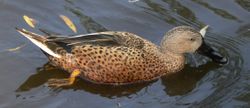 Probable genus Spatula – blue-winged ducks/shovelers and allies (polyphyletic?)
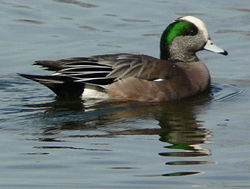 Possible genus Mareca – wigeon
s (may include Chaulelasmus and Eunetta)
Subgenus Chaulelasmus – Gadwall
Subgenus Eunetta – Falcated Duck
Subgenus Dafila – pintails
Subgenus Nettion – teals (paraphyletic)
Subgenus Melananas – African Black Duck
 Subgenus Anas – mallard and relatives (may include Melananas)
Formerly placed in Anas:
species of Anas have been described. Their relationships are often undetermined:
Several prehistoric waterfowl supposedly part of the Anas assemblage are nowadays not placed in this genus anymore, at least not with certainty:
Highly problematic, albeit in a theoretical sense, is the placement of the moa-nalo
s. These are in may be derived from a common ancestor of the Pacific Black Duck
, the Laysan Duck
, and the Mallard
, and an unknown amount of other lineages. Phylogenetically, they may even form a clade
within the traditional genus Anas. However, as opposed to these species – which are well representative of dabbling ducks in general – the moa-nalos are the most radical departure from the anseriform bauplan known to science. This illustrates that in a truly evolutionary sense, a strictly phylogenetic taxonomy may be difficult to apply.
Genus
In biology, a genus is a low-level taxonomic rank used in the biological classification of living and fossil organisms, which is an example of definition by genus and differentia...
of dabbling ducks. It includes mallard
Mallard
The Mallard , or Wild Duck , is a dabbling duck which breeds throughout the temperate and subtropical Americas, Europe, Asia, and North Africa, and has been introduced to New Zealand and Australia....
s, wigeon
Wigeon
The Eurasian Wigeon, also known as Widgeon or Eurasian Widgeon is one of three species of wigeon in the dabbling duck genus Anas. It is common and widespread within its range...
s, teal
Teal (disambiguation)
*Teal is a medium blue-green color.*Teal Wicks is an American singer and stage actress.Teal may also refer to some species of waterfowl in the Anatinae subfamily:...
s, pintails and shoveler
Shoveler
The shovelers, formerly known as shovellers, are four species of dabbling ducks with long, broad spatula-shaped beaks:* Red Shoveler, Anas platalea* Cape Shoveler, Anas smithii* Australasian Shoveler, Anas rhynchotis...
s in a number of subgenera
Subgenus
In biology, a subgenus is a taxonomic rank directly below genus.In zoology, a subgeneric name can be used independently or included in a species name, in parentheses, placed between the generic name and the specific epithet: e.g. the Tiger Cowry of the Indo-Pacific, Cypraea tigris Linnaeus, which...
. Some authorities prefer to elevate the subgenera to genus rank. Indeed, as the moa-nalo
Moa-nalo
The moa-nalo are a group of extinct aberrant, goose-like ducks that lived on the larger Hawaiian Islands, except Hawaii itself, in the Pacific...
s are very close to this clade and may have evolved later than some of these lineages, it is rather the absence of a thorough review than lack of necessity that this genus is rather over-lumped
Lumpers and splitters
Lumping and splitting refers to a well-known problem in any discipline which has to place individual examples into rigorously defined categories. The lumper/splitter problem occurs when there is the need to create classifications and assign examples to them, for example schools of literature,...
.
Systematics
The phylogeny of this genus is one of the most confounded ones of all living birds. Research is hampered by the fact the radiation of the two major groups of Anas – the tealTeal
Teal may mean:* Teal , a medium greenish-blue color* Various ducks:** Baikal Teal, Anas formosa** Black Teal, Aythya novaeseelandiae** Blue-winged Teal, Anas discors** Brown Teal, Anas aucklandica** Campbell Teal Anas nesiotis...
s and mallard groups – took place in a very short time and fairly recently, roughly in the mid-late Pleistocene
Pleistocene
The Pleistocene is the epoch from 2,588,000 to 11,700 years BP that spans the world's recent period of repeated glaciations. The name pleistocene is derived from the Greek and ....
. Furthermore, hybridization may have long played a major role
Bird hybrid
A bird hybrid is a bird that has two different species as parents. The resulting bird can present with any combination of characters from the parent species, from totally identical to completely different. Usually, the bird hybrid shows intermediate characteristics between the two species...
in Anas evolution, with within-subgenus hybrids regularly and between-subgenus hybrids not infrequently being fully fertile. The relationships between species are much obscured by this fact, and mtDNA sequence
DNA sequence
The sequence or primary structure of a nucleic acid is the composition of atoms that make up the nucleic acid and the chemical bonds that bond those atoms. Because nucleic acids, such as DNA and RNA, are unbranched polymers, this specification is equivalent to specifying the sequence of...
data is of dubious value in resolving their relationships; on the other hand, nuclear DNA
Nuclear DNA
Nuclear DNA, nuclear deoxyribonucleic acid , is DNA contained within a nucleus of eukaryotic organisms. In mammals and vertebrates, nuclear DNA encodes more of the genome than the mitochondrial DNA and is composed of information inherited from two parents, one male, and one female, rather than...
sequences evolve too slowly to resolve the phylogeny of the subgenus Anas for example.
Some major clades can be discerned. For example, that the traditional subgenus
Subgenus
In biology, a subgenus is a taxonomic rank directly below genus.In zoology, a subgeneric name can be used independently or included in a species name, in parentheses, placed between the generic name and the specific epithet: e.g. the Tiger Cowry of the Indo-Pacific, Cypraea tigris Linnaeus, which...
Anas, the mallard group, forms a monophyletic (in the loose sense, i.e. non-holophyletic) group has never been seriously questioned by modern science and is as good as confirmed (but see below). On the other hand, the phylogeny of the teals is very confusing.
For these reasons, the dabbling duck lineages more distantly related to mallard group (which includes the type species
Type species
In biological nomenclature, a type species is both a concept and a practical system which is used in the classification and nomenclature of animals and plants. The value of a "type species" lies in the fact that it makes clear what is meant by a particular genus name. A type species is the species...
of Anas) than the wigeons should arguably be separated in their own genera. These would include the Baikal Teal
Baikal Teal
The Baikal Teal , also called the Bimaculate Duck or Squawk Duck, is a dabbling duck that breeds in eastern Russia and winters in East Asia.- Description :...
, the Garganey
Garganey
The Garganey is a small dabbling duck. It breeds in much of Europe and western Asia, but is strictly migratory, with the entire population moving to southern Africa, India Santragachi and Australasia in winter, where large flocks can occur. This species was first described by Linnaeus in 1758...
, the spotted black-capped Punanetta group, and the shovelers and other blue-winged species. Whether the wigeons, which are very distinct in morphology
Morphology (biology)
In biology, morphology is a branch of bioscience dealing with the study of the form and structure of organisms and their specific structural features....
and behavior, but much less so in mtDNA cytochrome b
Cytochrome b
Cytochrome b/b6 is the main subunit of transmembrane cytochrome bc1 and b6f complexes. In addition, it commonly refers to a region of mtDNA used for population genetics and phylogenetics.- Function :...
and NADH dehydrogenase
NADH dehydrogenase
NADH dehydrogenase is an enzyme located in the inner mitochondrial membrane that catalyzes the transfer of electrons from NADH to coenzyme Q...
subunit
Protein subunit
In structural biology, a protein subunit or subunit protein is a single protein molecule that assembles with other protein molecules to form a protein complex: a multimeric or oligomeric protein. Many naturally occurring proteins and enzymes are multimeric...
2 sequence
DNA sequence
The sequence or primary structure of a nucleic acid is the composition of atoms that make up the nucleic acid and the chemical bonds that bond those atoms. Because nucleic acids, such as DNA and RNA, are unbranched polymers, this specification is equivalent to specifying the sequence of...
s, should also be considered a distinct genus Mareca (including the Gadwall and Falcated Duck) is essentially the one remaining point of dispute as regards the question which taxa should remain in this genus and which ones should not.
Species
The following arrangement is based on current morphological, molecular, and behavioral characters and presents apparent major evolutionary groupings compared to the subgenera the species were placed in at one time or another.Probable genus Sibirionetta – Baikal Teal
- Baikal TealBaikal TealThe Baikal Teal , also called the Bimaculate Duck or Squawk Duck, is a dabbling duck that breeds in eastern Russia and winters in East Asia.- Description :...
, Anas formosa (formerly in Nettion)
Probable genus Querquedula – Garganey (may include Punanetta)
- GarganeyGarganeyThe Garganey is a small dabbling duck. It breeds in much of Europe and western Asia, but is strictly migratory, with the entire population moving to southern Africa, India Santragachi and Australasia in winter, where large flocks can occur. This species was first described by Linnaeus in 1758...
, Anas querquedula
Probable genus Punanetta
- Silver TealSilver TealThe Silver Teal or Versicolor Teal is a species of dabbling duck in the genus Anas. It breeds in South America....
, Anas versicolor - Puna TealPuna TealThe Puna Teal is a species of dabbling duck in the genus Anas. It was previously regarded as a subspecies of the Silver Teal....
, Anas puna – formerly included in Anas versicolor - Hottentot TealHottentot TealThe Hottentot Teal is a species of dabbling duck of the genus Anas. It is migratory resident in eastern and southern Africa, from Sudan and Ethiopia west to Niger and Nigeria and south to South Africa and Namibia. In west Africa and Madagascar it is sedentary.The Hottentot Teal breed year round,...
, Anas hottentota
- Blue-winged TealBlue-winged TealThe Blue-winged Teal is a small dabbling duck from North America.-Description:The Blue-winged Teal is long, with a wingspan of , and a weight of . The adult male has a greyish blue head with a white facial crescent, a light brown body with a white patch near the rear and a black tail. The adult...
, Anas discors - Cinnamon TealCinnamon TealThe Cinnamon Teal is a small, reddish dabbling duck found in marshes and ponds of western North and South America.thumb|left|Female Anas cyanoptera septentrionalium...
, Anas cyanoptera- Borrero's Cinnamon Teal, Anas cyanoptera borreroi – possibly extinct (late 20th century?)
- Red ShovelerRed ShovelerThe Red Shoveler , formerly known as Red Shoveller, is a species of dabbling duck of the genus Anas. It is found in southern South America, in Argentina, southern Peru, southern Bolivia, Uruguay, Paraguay, the Falkland Islands, South Georgia and South Sandwich Islands, southern Brazil, and Chile...
, Anas platalea - Cape ShovelerCape ShovelerThe Cape Shoveler Anas smithii formerly known as Cape Shoveller is a species of dabbling duck of the genus Anas. It is resident in South Africa, and uncommon further north in Namibia, Botswana, Zimbabwe, southern Angola, Lesotho, Mozambique, and Zambia.This 51–53 cm long duck is non-migratory,...
, Anas smithii - Australasian ShovelerAustralasian ShovelerThe Australasian Shoveler is a species of dabbling duck in the genus Anas. It ranges from 46–53 cm. It lives in heavily vegetated swamps. In Australia it is protected under the National Parks and Wildlife Act, 1974...
, Anas rhynchotis - Northern ShovelerNorthern ShovelerThe Northern Shoveler , Northern Shoveller in British English, sometimes known simply as the Shoveler, is a common and widespread duck. It breeds in northern areas of Europe and Asia and across most of North America, and is a rare vagrant to Australia...
, Anas clypeata
Wigeon
The Eurasian Wigeon, also known as Widgeon or Eurasian Widgeon is one of three species of wigeon in the dabbling duck genus Anas. It is common and widespread within its range...
s (may include Chaulelasmus and Eunetta)
- Eurasian Wigeon, Anas penelope
- Amsterdam Duck, Anas marecula – tentatively placed here; extinct (c.1800)
- American WigeonAmerican WigeonThe American Wigeon, also American Widgeon or Baldpate, is a species of wigeon in the dabbling duck genus Anas. If this is split up, all wigeons will go into their old genus Mareca again...
, Anas americana - Chiloe WigeonChiloe WigeonThe Chiloe Wigeon is one of three species of wigeon in the dabbling duck genus Anas. Unlike other wigeons, the sexes are similar and pairs are monogamous. This bird has a metallic green head, and a gray bill with a black tip. Its breast is barred black and white and its sides are orange brown...
, Anas sibilatrix
Subgenus Chaulelasmus – Gadwall
- GadwallGadwallThe Gadwall is a common and widespread duck of the family Anatidae.- Description :The Gadwall is 46–56 cm long with a 78–90 cm wingspan. The male is slightly larger than the female, weighing on average 990 g against her 850 g...
, Anas strepera- Coues' GadwallCoues' GadwallCoues' Gadwall or Washington Island Gadwall is an extinct dabbling duck which is only known by two immature specimens from the Pacific island of Teraina Line Islands, Kiribati...
or Washington Island Gadwall, Anas strepera couesi – extinct (late 19th century)
- Coues' Gadwall
Subgenus Eunetta – Falcated Duck
- Falcated DuckFalcated DuckThe Falcated Duck or Falcated Teal is a Gadwall-sized dabbling duck.-Distribution and habitat:The Falcated duck breeds in eastern Asia...
, Anas falcata
Subgenus Dafila – pintails
- Northern PintailNorthern PintailThe Pintail or Northern Pintail is a widely occurring duck which breeds in the northern areas of Europe, Asia and North America. It is strongly migratory and winters south of its breeding range to the equator...
, Anas acuta - Eaton's PintailEaton's PintailThe Eaton's Pintail is a dabbling duck of the genus Anas. The species is restricted to the island groups of Kerguelen and Crozet in the southern Indian Ocean. It resembles a small female Northern Pintail. It was named after the English explorer and naturalist Alfred Edmund Eaton...
, Anas eatoni- Kerguelen Islands Pintail, Anas eatoni eatoni
- Crozet Islands Pintail, Anas eatoni drygalskii
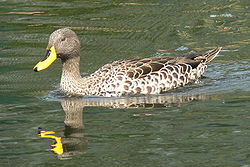
- Yellow-billed PintailYellow-billed PintailThe Yellow-billed Pintail is a South American dabbling duck of the genus Anas with three described subspecies.-Description:...
, Anas georgica- South Georgia PintailSouth Georgia PintailThe South Georgia Pintail , also misleadingly known as the South Georgian Teal, is the nominate subspecies of the Yellow-billed Pintail , a duck in the dabbling duck subfamily Anatinae...
, Anas georgica georgica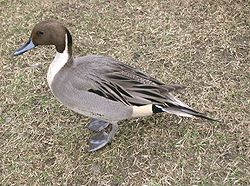
- Chilean PintailChilean PintailThe Chilean Pintail , also known as the Brown Pintail, is a subspecies of the Yellow-billed Pintail , a duck in the dabbling duck subfamily Anatinae...
, Anas georgica spinicauda - Niceforo's PintailNiceforo's PintailNiceforo's Pintail , is an extinct subspecies of the Yellow-billed Pintail , a duck in the dabbling duck subfamily Anatinae...
, Anas georgica niceforoi – extinct (1950s)
- South Georgia Pintail
- White-cheeked PintailWhite-cheeked PintailThe White cheeked Pintail or Bahama Pintail is a dabbling duck of the Caribbean, South America, and the Galápagos Islands....
, Anas bahamensis (formerly in Poecilonetta) - Red-billed TealRed-billed TealThe Red-billed Teal, Anas erythrorhyncha, is a dabbling duck which is an abundant resident breeder in southern and eastern Africa typically south of 10° S. This duck is not migratory, but will fly great distances to find suitable waters...
, Anas erythrorhyncha (formerly in Poecilonetta) - Cape TealCape TealThe Cape Teal is a 44-46 cm long dabbling duck of open wetlands in sub-Saharan Africa.This species is essentially non-migratory, although it moves opportunistically with the rains. Like many southern ducks, the sexes are similar. It is very pale and mainly grey, with a browner back and pink...
, Anas capensis (formerly in Nettion)
Subgenus Nettion – teals (paraphyletic)
- Indian Ocean clade (sometimes subgenus Virago)
- Bernier's TealBernier's TealBernier's Teal Anas bernieri is a duck species of the genus Anas. It is endemic to Madagascar, where it is found only along the west coast....
, Anas bernieri - Mauritian DuckMauritian DuckThe Mauritian Duck , also known as Sauzier's Teal, is an extinct dabbling duck that formerly occurred on the islands of Mauritius and Réunion. It was a small teal of the Anas gibberifrons superspecies of the Anas subgenus Nettion...
, Anas theodori – extinct (late 1690s) - Sunda TealSunda TealThe Sunda Teal, Anas gibberifrons, also known as the Indonesian Teal, is a dabbling duck found in open wetlands in Indonesia. The species formerly included the Andaman Teal Anas albogularis and the Grey Teal, Anas gracilis as subspecies....
, Anas gibberifrons- Rennell Island Teal, Anas gibberifrons remissa – extinct (c.1959)
- Andaman TealAndaman TealThe Andaman Teal is a species of small duck found in the Andaman Islands of India. The species was considered as a subspecies of the Sunda Teal.-Description:...
, Anas albogularis – formerly included in Anas gibberifrons - Grey TealGrey TealThe Grey Teal, Anas gracilis is a dabbling duck found in open wetlands in New Guinea, Australia, New Zealand, Vanuatu and Solomon Islands....
, Anas gracilis – formerly included in Anas gibberifrons - Chestnut TealChestnut TealThe Chestnut Teal is a dabbling duck found in southern Australia. It is protected under the National Parks and Wildlife Act 1974.-Description:The Chestnut Teal is darker and a slightly bigger bird than the Grey Teal....
, Anas castanea
- Bernier's Teal
- Atlantic/Red-and-green head clade
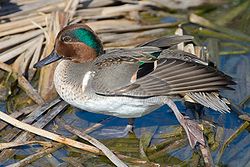
- Eurasian Teal, Anas crecca
- Green-winged TealGreen-winged TealThe Green-winged Teal is a common and widespread duck that breeds in the northern areas of North America except on the Aleutian Islands. It was considered conspecific with the Common Teal The Green-winged Teal (Anas carolinensis) is a common and widespread duck that breeds in the northern areas of...
, Anas carolinensis – formerly included in Anas crecca - Yellow-billed Teal, Anas flavirostris
- Andean TealAndean TealThe Andean Teal is a South American species of duck. Like other teals, it belongs to the diverse genus Anas; more precisely it is one of the "true" teals of subgenus Nettion. It restricted to the Andean highlands of Colombia, Venezuela, and Ecuador. It inhabits freshwater wetlands, preferring...
, Anas andinum
- New Zealand clade (Placement unresolved)
- Auckland Teal, Anas aucklandica
- Brown TealBrown TealThe Brown Teal or New Zealand Teal, is a species of dabbling duck of the genus Anas. The Māori name for it is Pāteke. It was considered to be conspecific with the flightless Auckland and Campbell Teals in Anas aucklandica; the name "Brown Teal" was applied to that entire taxon...
, Anas chlorotis – formerly included in Anas aucklandica - Macquarie Islands Teal, Anas cf. chlorotis – prehistoricLate Quaternary prehistoric birdsPrehistoric birds are various taxa of birds that became extinct before recorded history, or more precisely, before they could be studied alive by bird scientists...
- Campbell Teal, Anas nesiotis – formerly included in Anas aucklandica
Subgenus Melananas – African Black Duck
- African Black DuckAfrican Black DuckThe African Black Duck is a species of duck of the genus Anas. It is genetically closest to the mallard group , but shows some peculiarities in its behavior and plumage; it is accordingly placed in the subgenus Melananas pending further research.The African Black Duck is an...
, Anas sparsa
- Basal African species ("Afranas")
- Meller's DuckMeller's DuckMeller's Duck is a species of the dabbling duck genus Anas. It is endemic to eastern Madagascar. Although a population was established on Mauritius in the mid-18th century, this is on the verge of extinction due to habitat loss and competition by feral domestic ducks...
, Anas melleri - Yellow-billed DuckYellow-billed DuckThe Yellow-billed Duck, Anas undulata, is a 51–58 cm long dabbling duck which is an abundant resident breeder in southern and eastern Africa.This duck is not migratory, but will wander in the dry season to find suitable waters...
, Anas undulata
- Meller's Duck
- American clade
- Mottled DuckMottled DuckThe Mottled Duck or Mottled Mallard is a medium-sized dabbling duck. It is intermediate in appearance between the female Mallard and the American Black Duck. It is closely related to those species, and is sometimes considered a subspecies of the former, but this is inappropriate .There are two...
, Anas fulvigula – sometimes included in Anas platyrhynchos- Florida Duck, Anas fulvigula fulvigula – sometimes included in Anas platyrhynchos
- American Black DuckAmerican Black DuckThe American Black Duck is a large dabbling duck. American Black Ducks are similar to Mallards in size, and resemble the female Mallard in coloration, although the Black Duck's plumage is darker...
, Anas rubripes – sometimes included in Anas platyrhynchos - Mexican DuckMexican DuckThe Mexican Duck is a dabbling duck in the genus Anas which breeds in Mexico and the southern USA. Most of the population is resident, but some northern birds migrate south to Mexico in winter....
, Anas diazi – sometimes included in Anas platyrhynchos
- Mottled Duck
- Pacific clade – the moa-naloMoa-naloThe moa-nalo are a group of extinct aberrant, goose-like ducks that lived on the larger Hawaiian Islands, except Hawaii itself, in the Pacific...
s might be derived from this group.- Mariana MallardMariana MallardThe Mariana Mallard or Oustalet's Duck is an extinct type of duck of the genus Anas that was endemic to the Mariana Islands...
, Anas (platyrhynchos) oustaleti – sometimes considered a subspecies of Anas superciliosa; extinct (1981) - Hawaiian DuckHawaiian DuckThe Hawaiian Duck is a species of bird in the family Anatidae. It is endemic to the large islands of Hawaii. Some authorities treat it as an island subspecies of the Mallard, based on their capacity to produce fertile hybrids, but it appears well distinct and capability of hybridization is...
, Anas wyvilliana – sometimes included in Anas platyrhynchos - Philippine DuckPhilippine DuckThe Philippine Duck is a large dabbling duck of the genus Anas. It is endemic to the Philippines. As few as 5,000 may remain. Overhunting and habitat loss has contributed to its decline....
, Anas luzonica - Laysan DuckLaysan DuckThe Laysan Duck , also known as the Laysan Teal because of its small size, is an endangered dabbling duck endemic to the Hawaiian Islands...
, Anas laysanensis – sometimes included in Anas platyrhynchos- Lisianski Duck, Anas cf. laysanensis – hypothetical; extinct (c.1845)
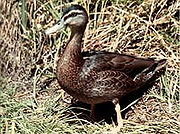
- Pacific Black DuckPacific Black DuckThe Pacific Black Duck is a dabbling duck found in much of Indonesia, New Guinea, Australia, New Zealand, and many islands in the southwestern Pacific, reaching to the Caroline Islands in the north and French Polynesia in the east. It is usually called the Grey Duck in New Zealand...
, Anas superciliosa
- Mariana Mallard
- Ambiguous
- MallardMallardThe Mallard , or Wild Duck , is a dabbling duck which breeds throughout the temperate and subtropical Americas, Europe, Asia, and North Africa, and has been introduced to New Zealand and Australia....
, Anas platyrhynchos - Domestic duck, Anas domesticus sometimes Anas platyrhynchos domesticus
- Spot-billed Duck, Anas poecilorhyncha
- Mallard
Formerly placed in Anas:
- Bronze-winged DuckBronze-winged DuckThe Bronze-winged Duck also known as the Spectacled Duck, is a dabbling duck and the sole member of its genus Speculanas. It is often placed in Anas with most other dabbling ducks, but its closest relative is either the Crested Duck or the Brazilian Duck, which likewise form monotypic genera...
, Speculanas specularis - Crested DuckCrested DuckThe Crested Duck is a species of duck native to South America, the only member of the monotypic genus Lophonetta. It is sometimes included in Anas, but it belongs to a South American clade that diverged early in dabbling duck evolution . There are two subspecies: L...
, Lophonetta specularioides - Salvadori's TealSalvadori's TealThe Salvadori's Teal or Salvadori's Duck is a species of bird native to New Guinea. It is placed in the monotypic genus Salvadorina....
, Salvadorina waigiuensis
Fossil record
A number of fossilFossil
Fossils are the preserved remains or traces of animals , plants, and other organisms from the remote past...
species of Anas have been described. Their relationships are often undetermined:
- Anas sp. (Late Miocene of China)
- Anas sp. (Late Miocene of Rudabánya, Hungary)
- Anas greeni (Ash Hollow Late Miocene?/Early Pliocene of South Dakota, USA) – Nettion red-and-green head clade (doubtful)?
- Anas ogallalae (Ogalalla Late Miocene?/Early Pliocene of Kansas, USA) – Nettion red-and-green head clade (doubtful)?
- Anas pullulans (Juntura Late Miocene?/Early Pliocene of JunturaJuntura, OregonJuntura is an unincorporated community in Malheur County, Oregon, United States on U.S. Route 20. The word juntura is Spanish for "juncture", and the community was named for its proximity to the confluence of the Malheur River with its north fork. The name was probably selected by local settler B. L...
, Malheur CountyMalheur County, OregonMalheur County is a county located in the southeast corner of the U.S. state of Oregon. It is included in the eight-county definition of Eastern Oregon. Most of the county observes the Mountain Time Zone, although the southern quarter of the county observes the Pacific Time Zone along with the...
, OregonOregonOregon is a state in the Pacific Northwest region of the United States. It is located on the Pacific coast, with Washington to the north, California to the south, Nevada on the southeast and Idaho to the east. The Columbia and Snake rivers delineate much of Oregon's northern and eastern...
, USA) – Punanetta? - Anas cheuen (Early-Middle Pleistocene of Argentina) – Dafila?
- Anas bunkeri (Early -? Middle Pliocene – Early Pleistocene of WC USA) – Nettion red-and-green head clade?
- Bermuda Islands Flightless Duck Anas pachyscelus (Shore Hills Late Pleistocene of Bermuda, W Atlantic)
- Anas schneideri (Late Pleistocene of Little Box Elder Cave, USA)
Several prehistoric waterfowl supposedly part of the Anas assemblage are nowadays not placed in this genus anymore, at least not with certainty:
- "Anas" basaltica (Late Oligocene of "Warnsdorf", Czechia) is apparently an indeterminate heronHeronThe herons are long-legged freshwater and coastal birds in the family Ardeidae. There are 64 recognised species in this family. Some are called "egrets" or "bitterns" instead of "heron"....
. - "Anas" blanchardi, "A." consobrina, "A." natator are now in Mionetta
- "Anas" creccoides (Early-mid Oligocene of Belgium), "A." risgoviensis (Late Miocene of Bavaria, Germany) and "A." skalicensis (Early Miocene of "Skalitz", Czechia), though possibly anseriform, cannot be placed with any certainty among modern birds at all.
- "Anas" albae (Late Miocene of Polgárdi, Hungary), "A." eppelsheimensis (Early Pliocene of Eppelsheim, Germany), "A." isarensis (Late Miocene of Aumeister, Germany) and "A." luederitzensis (Kalahari Early Miocene of Lüderitzbucht, Namibia) are apparently AnatidaeAnatidaeAnatidae is the biological family of birds that includes ducks, geese and swans. The family has a cosmopolitan distribution, occurring on all the world's continents except Antarctica and on most of the world's islands and island groups...
of unclear affiliations; the first might be a seaduck. - "Anas" integra and "A." oligocaena are now in Dendrochen
- "Anas" robusta is now tentatively placed in Anserobranta
- "Anas" velox (Middle – Late? Miocene of C Europe) and "A." meyerii (Middle Miocene of Öhningen, Germany; possibly the same species) do not seem to belong into the present genus either; they may still turn out to be ancestral dabbling ducks.
Highly problematic, albeit in a theoretical sense, is the placement of the moa-nalo
Moa-nalo
The moa-nalo are a group of extinct aberrant, goose-like ducks that lived on the larger Hawaiian Islands, except Hawaii itself, in the Pacific...
s. These are in may be derived from a common ancestor of the Pacific Black Duck
Pacific Black Duck
The Pacific Black Duck is a dabbling duck found in much of Indonesia, New Guinea, Australia, New Zealand, and many islands in the southwestern Pacific, reaching to the Caroline Islands in the north and French Polynesia in the east. It is usually called the Grey Duck in New Zealand...
, the Laysan Duck
Laysan Duck
The Laysan Duck , also known as the Laysan Teal because of its small size, is an endangered dabbling duck endemic to the Hawaiian Islands...
, and the Mallard
Mallard
The Mallard , or Wild Duck , is a dabbling duck which breeds throughout the temperate and subtropical Americas, Europe, Asia, and North Africa, and has been introduced to New Zealand and Australia....
, and an unknown amount of other lineages. Phylogenetically, they may even form a clade
Clade
A clade is a group consisting of a species and all its descendants. In the terms of biological systematics, a clade is a single "branch" on the "tree of life". The idea that such a "natural group" of organisms should be grouped together and given a taxonomic name is central to biological...
within the traditional genus Anas. However, as opposed to these species – which are well representative of dabbling ducks in general – the moa-nalos are the most radical departure from the anseriform bauplan known to science. This illustrates that in a truly evolutionary sense, a strictly phylogenetic taxonomy may be difficult to apply.