
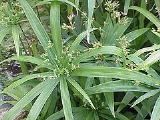
Cyperus is a large
genusIn biology, a genus is a low-level taxonomic rank used in the biological classification of living and fossil organisms, which is an example of definition by genus and differentia...
of about 600
speciesIn biology, a species is one of the basic units of biological classification and a taxonomic rank. A species is often defined as a group of organisms capable of interbreeding and producing fertile offspring. While in many cases this definition is adequate, more precise or differing measures are...
of
sedgeCyperaceae are a family of monocotyledonous graminoid flowering plants known as sedges, which superficially resemble grasses or rushes. The family is large, with some 5,500 species described in about 109 genera. These species are widely distributed, with the centers of diversity for the group...
s, distributed throughout all continents in both tropical and temperate regions. They are
annualAn annual plant is a plant that usually germinates, flowers, and dies in a year or season. True annuals will only live longer than a year if they are prevented from setting seed...
or perennial plants, mostly
aquaticAn aquatic ecosystem is an ecosystem in a body of water. Communities of organisms that are dependent on each other and on their environment live in aquatic ecosystems. The two main types of aquatic ecosystems are marine ecosystems and freshwater ecosystems....
and growing in still or slow-moving water up to 0.5 m deep. The species vary greatly in size, with small species only 5 cm tall, while others can reach 5 m in height. Common names include
papyrus sedges,
flatsedges,
nutsedges,
umbrella-sedges and
galingales.
Cyperus is a large
genusIn biology, a genus is a low-level taxonomic rank used in the biological classification of living and fossil organisms, which is an example of definition by genus and differentia...
of about 600
speciesIn biology, a species is one of the basic units of biological classification and a taxonomic rank. A species is often defined as a group of organisms capable of interbreeding and producing fertile offspring. While in many cases this definition is adequate, more precise or differing measures are...
of
sedgeCyperaceae are a family of monocotyledonous graminoid flowering plants known as sedges, which superficially resemble grasses or rushes. The family is large, with some 5,500 species described in about 109 genera. These species are widely distributed, with the centers of diversity for the group...
s, distributed throughout all continents in both tropical and temperate regions. They are
annualAn annual plant is a plant that usually germinates, flowers, and dies in a year or season. True annuals will only live longer than a year if they are prevented from setting seed...
or perennial plants, mostly
aquaticAn aquatic ecosystem is an ecosystem in a body of water. Communities of organisms that are dependent on each other and on their environment live in aquatic ecosystems. The two main types of aquatic ecosystems are marine ecosystems and freshwater ecosystems....
and growing in still or slow-moving water up to 0.5 m deep. The species vary greatly in size, with small species only 5 cm tall, while others can reach 5 m in height. Common names include
papyrus sedges,
flatsedges,
nutsedges,
umbrella-sedges and
galingales.
The stems are circular in cross-section in some, triangular in others, usually leafless for most of their length, with the slender
grassThe Poaceae is a large and nearly ubiquitous family of flowering plants. Members of this family are commonly called grasses, although the term "grass" is also applied to plants that are not in the Poaceae lineage, including the rushes and sedges...
-like leaves at the base of the plant, and in a whorl at the apex of the flowering stems. The
flowerA flower, sometimes known as a bloom or blossom, is the reproductive structure found in flowering plants . The biological function of a flower is to effect reproduction, usually by providing a mechanism for the union of sperm with eggs...
s are greenish, and
wind pollinatedAnemophily or wind pollination is a form of pollination whereby pollen is distributed by wind. Anemophilous plants may be either gymnosperms or angiosperms ....
; they are produced in clusters among the apical leaves. The
seedA seed is a small embryonic plant enclosed in a covering called the seed coat, usually with some stored food. It is the product of the ripened ovule of gymnosperm and angiosperm plants which occurs after fertilization and some growth within the mother plant...
is a small
nutletPyrena or pyrene is the name for a nutlet resembling a seed, or the kernel of a drupe or drupelet....
.
Ecology
Cyperus species are used as food plants by the
larvaA larva is a distinct juvenile form many animals undergo before metamorphosis into adults. Animals with indirect development such as insects, amphibians, or cnidarians typically have a larval phase of their life cycle...
e of some
LepidopteraLepidoptera is a large order of insects that includes moths and butterflies . It is one of the most widespread and widely recognizable insect orders in the world, encompassing moths and the three superfamilies of butterflies, skipper butterflies, and moth-butterflies...
species, including
Batrachedra cuniculata. The seeds and tubers are an important food for many small
birdBirds are feathered, winged, bipedal, endothermic , egg-laying, vertebrate animals. Around 10,000 living species and 188 families makes them the most speciose class of tetrapod vertebrates. They inhabit ecosystems across the globe, from the Arctic to the Antarctic. Extant birds range in size from...
s and
mammalMammals are members of a class of air-breathing vertebrate animals characterised by the possession of endothermy, hair, three middle ear bones, and mammary glands functional in mothers with young...
s.
Cyperus microcristatus and
C. multifolius are possibly extinct; the former was only found once, in 1995, and the latter has not been seen in the last 200 years. The "true" papyrus sedge of
Ancient EgyptAncient Egypt was an ancient civilization of Northeastern Africa, concentrated along the lower reaches of the Nile River in what is now the modern country of Egypt. Egyptian civilization coalesced around 3150 BC with the political unification of Upper and Lower Egypt under the first pharaoh...
,
C. papyrus ssp.
hadidii, is also very rare today due to draining of its wetland habitat; feared extinct in the mid-20th century, it is still found at a few sites in the
Wadi El NatrunWadi El Natrun is a valley located in Beheira Governorate, Egypt, including a town with the same name. The name refers to the presence of eight different lakes in the region that produce natron salt. In Christian literature, the region is also referred to as the Nitrian Desert...
region and northern
SudanSudan , officially the Republic of the Sudan , is a country in North Africa, sometimes considered part of the Middle East politically. It is bordered by Egypt to the north, the Red Sea to the northeast, Eritrea and Ethiopia to the east, South Sudan to the south, the Central African Republic to the...
.
Some tuber-bearing species on the other hand, most significantly the Purple Nutsedge (
C. rotundus), are considered invasive weeds.
Use by humans
Papyrus Sedge (
C. papyrus) of
AfricaAfrica is the world's second largest and second most populous continent, after Asia. At about 30.2 million km² including adjacent islands, it covers 6% of the Earth's total surface area and 20.4% of the total land area...
was of major historical importance in providing
papyrusPapyrus is a thick paper-like material produced from the pith of the papyrus plant, Cyperus papyrus, a wetland sedge that was once abundant in the Nile Delta of Egypt....
.
C. giganteusCyperus giganteus is a plant in the genus Cyperus. It is native to central Mexico as far south as Uruguay, and also grows on the islands of the Caribbean.-References:*...
, locally known as
cañita, is used by the Yokot'an
MayaThe Maya people constitute a diverse range of the Native American people of southern Mexico and northern Central America. The overarching term "Maya" is a collective designation to include the peoples of the region who share some degree of cultural and linguistic heritage; however, the term...
of
TabascoTabasco officially Estado Libre y Soberano de Tabasco is one of the 31 states which, with the Federal District, comprise the 32 Federal Entities of Mexico. It is divided in 17 municipalities and its capital city is Villahermosa....
,
MexicoThe United Mexican States , commonly known as Mexico , is a federal constitutional republic in North America. It is bordered on the north by the United States; on the south and west by the Pacific Ocean; on the southeast by Guatemala, Belize, and the Caribbean Sea; and on the east by the Gulf of...
, for weaving
petates (sleeping mats) and
sombreroSombrero in English refers to a type of wide-brimmed hat originating in Mexico. In Spanish, however, it is the generic word for "hat", which originates from "sombra", meaning "shade"....
s.
C. textilis and
C. pangorei are traditionally used to produce the typical mats of
PalakkadPalakkad , formerly known as Palghat, is a municipality and a town in the state of Kerala in southern India, spread over an area of 26.60 km2.The city is situated about north of state capital Thiruvananthapuram. It is the administrative headquarters of Palakkad District...
in
IndiaIndia , officially the Republic of India , is a country in South Asia. It is the seventh-largest country by geographical area, the second-most populous country with over 1.2 billion people, and the most populous democracy in the world...
, and the
makaloa mats of
NiihauNiihau or Niihau is the seventh largest of the inhabited Hawaiian Islands in the U.S. state of Hawaii, having an area of . Niihau lies southwest of Kauai across the Kaulakahi Channel. Several intermittent playa lakes provide wetland habitats for the Hawaiian Coot, the Black-winged Stilt, and the...
were made from
C. laevigatusCyperus laevigatus is a species of sedge known by the common name smooth flatsedge.-Distribution:It is native to most continents and grows in wet areas, especially in brackish water, wet alkaline soils, mineral-rich hot springs, and other moist saline and alkaline habitat...
.
The Chufa Flatsedge (
C. esculentus) has edible
tuberTubers are various types of modified plant structures that are enlarged to store nutrients. They are used by plants to survive the winter or dry months and provide energy and nutrients for regrowth during the next growing season and they are a means of asexual reproduction...
s and is grown commercially for these; they are eaten as vegetables, made into sweets, or used to produce the
horchataHorchata or orxata is the name of several kinds of traditional beverage, made of ground almonds, sesame seeds, rice, barley, or tigernuts .-Etymology:...
of the
ValenciaThe Valencian Community is an autonomous community of Spain located in central and south-eastern Iberian Peninsula. Its capital and largest city is Valencia...
region. Several other species - e.g. Australian Bush Onion (
C. bulbosus) - are eaten to a smaller extent. For some Northern Paiutes,
Cyperus tubers were a mainstay food, to the extent that they were known as
tövusi-dökadö ("nutsedge tuber eaters").
Most species are of little economic value. Some are grown as
ornamentalOrnamental plants are plants that are grown for decorative purposes in gardens and landscape design projects, as house plants, for cut flowers and specimen display...
or pot plants, namely the Umbrella Papyrus (
C. alternifolius ), the Dwarf Umbrella-sedge (
C. albostriatus, formerly called
C. diffusus), and related species. There is increasing interest in the larger, fast-growing species as crops for
paperPaper is a thin material mainly used for writing upon, printing upon, drawing or for packaging. It is produced by pressing together moist fibers, typically cellulose pulp derived from wood, rags or grasses, and drying them into flexible sheets....
and
biofuelBiofuel is a type of fuel whose energy is derived from biological carbon fixation. Biofuels include fuels derived from biomass conversion, as well as solid biomass, liquid fuels and various biogases...
production.
Some
Cyperus are used in
folk medicine-Description:Refers to healing practices and ideas of body physiology and health preservation known to a limited segment of the population in a culture, transmitted informally as general knowledge, and practiced or applied by anyone in the culture having prior experience.All cultures and societies...
. Roots of
Near EastThe Near East is a geographical term that covers different countries for geographers, archeologists, and historians, on the one hand, and for political scientists, economists, and journalists, on the other...
species were a component of
kyphiKyphi is a compound incense that was used in ancient Egypt for religious and medical purposes. The term "kyphi" is Greek and a transcription of the ancient Egyptian term kp.t.-Historical references:...
, a medical
incenseIncense is composed of aromatic biotic materials, which release fragrant smoke when burned. The term "incense" refers to the substance itself, rather than to the odor that it produces. It is used in religious ceremonies, ritual purification, aromatherapy, meditation, for creating a mood, and for...
of
Ancient EgyptAncient Egypt was an ancient civilization of Northeastern Africa, concentrated along the lower reaches of the Nile River in what is now the modern country of Egypt. Egyptian civilization coalesced around 3150 BC with the political unification of Upper and Lower Egypt under the first pharaoh...
. Purple Nutsedge (
C. rotundus) tubers are used in
Kampō, alternatively shortened as just , is the Japanese study and adaptation of Traditional Chinese medicine. The basic works of Chinese medicine came to Japan between the 7th and 9th centuries. Since then, the Japanese have created their own unique herbal medical system and diagnosis...
. An unspecified
Cyperus is mentioned as an
abortifacientAn abortifacient is a substance that induces abortion. Abortifacients for animals that have mated undesirably are known as mismating shots....
in the 11th-century poem
De viribus herbarum.
Selected species


- Cyperus acuminatus
Cyperus acuminatus is a common species of sedge known by several common names, including tapertip flatsedge and pale umbrella-sedge. This plant is native to North America, where its distribution spans the continent, except northern Canada and southern Mexico. It is found in wet areas from large...
- Cyperus albostriatus (syn. C. diffusus) – Dwarf Umbrella-sedge
- Cyperus alopecuroides
- Cyperus alternifolius
Cyperus alternifolius is a grass-like plant in the very large genus Cyperus of the sedge family, Cyperaceae. It is native to Madagascar, but is frequently cultivated worldwide. The subspecies Cyperus alternifolius ssp...
– Umbrella Papyrus, "umbrella palm", "umbrella plant"
- Cyperus alternifolius ssp. flabelliformis (syn. C. involucratus)
- Cyperus angustatus
- Cyperus aquatilis
- Cyperus arenarius
- Cyperus bipartitus
Cyperus bipartitus is a common species of sedge known by several common names, including shining flatsedge and river cyperus. The name "slender flatsedge" is also sometimes used but more properly applies to Cyperus gracilis. C...
– Shining Flat sedge, River Cyperus
- Cyperus bowmannii
- Cyperus breviculmis
- Cyperus bulbosus
Cyperus bulbosus is a species of sedge found across Africa, India, and Australia. In the latter it is commonly called Bush Onion or "wild onion", but is not related to the onion or other alliaceae. It is a component of Australian bushfood but is considered an agricultural weed in other...
– Australian Bush Onion, "wild onion" (AustraliaAustralia , officially the Commonwealth of Australia, is a country in the Southern Hemisphere comprising the mainland of the Australian continent, the island of Tasmania, and numerous smaller islands in the Indian and Pacific Oceans. It is the world's sixth-largest country by total area...
)
- Cyperus capitatus
- Cyperus carinatus
- Cyperus cephalotes
- Cyperus compressus
- Cyperus concinnus
- Cyperus congestus – Dense Flatsedge
- Cyperus conglomeratus
- Cyperus conicus
- Cyperus crassipes
- Cyperus cyperoides
- Cyperus decompositus
- Cyperus dentatus – Toothed Umbrella-sedge
- Cyperus diandrus – Umbrella Flatsedge
- Cyperus difformis
Cyperus difformis is a species of sedge known by several common names, including variable flatsedgeand smallflower umbrella-sedge. This plant is native to southern Europe, most of Africa and Asia, and Australia, and it is naturalized in other areas of the world, including large parts of the...
– Variable Flatsedge, Small-flowered Umbrella-sedge
- Cyperus distachyos
- Cyperus distans
- Cyperus dives
- Cyperus duripes
- Cyperus echinatus
Cyperus echinatus is a species of plant in the sedge family. It is native to most of eastern North America....
– Globe Flatsedge
- Cyperus enervis
- Cyperus eragrostis
Cyperus eragrostis is a species of sedge known by several common names, including tall flatsedge and pale galingale. It is a green sedge with tall, erect stems, and long, thin, pointed leaves. Its flowers are found within tough, rounded, greenish-yellow or beige spikelets...
– Tall Flatsedge, Pale Galingale
- Cyperus erythrorhizos
Cyperus erythrorhizos is a species of sedge known by the common name redroot flatsedge. It is found throughout North America from central Canada to central Mexico. It is a plant of wet areas such as rivers and ditches, generally at low elevations. It gets its common and scientific names from the...
– Redroot Flatsedge
- Cyperus esculentus
Cyperus esculentus is a species of sedge native to warm temperate to subtropical regions of the Northern Hemisphere, often cultivated for its edible tubers . It is an annual or perennial plant, growing to 90 cm tall, with solitary stems growing from a tuber...
– Chufa Flatsedge, Tigernut Sedge, Yellow Nutsedge, Yellow Nutgrass, Yellow Umbrella-sedge, Earthalmond
- Cyperus fauriei
Cyperus fauriei is a rare species of sedge known by the common name alpine flatsedge. It is endemic to Hawaii, where it grows on the islands of Molokai and Hawaii. It is a federally listed endangered species of the United States.This sedge grows 10 to 50 centimeters tall with a solitary stem or a...
- Cyperus fertilis
- Cyperus flaccidus
- Cyperus flavescens – Yellow Flatsedge, Yellow Galingale, Yellow Cyperus
- Cyperus fulvus
- Cyperus fuscus
Cyperus fuscus is a species of sedge known by the common name brown galingale, or brown flatsedge. This plant is native to temperate Eurasia but it is an introduced species in much of North America, where it is naturalized in some areas. This is a plant of wet areas, particularly disturbed places...
– Brown Flatsedge, Brown Galingale
- Cyperus gracilis
Cyperus gracilis is a sedge found in Australia. This grass like plant is closely related to the papyrus. It grows to 40 cm high. The habitat is eastern Australia, sometimes seen in drier areas in woodlands, such as Lightning Ridge. It can also be seen growing at high rainfall areas near the...
– Slender Flat sedge
- Cyperus grayoides
- Cyperus giganteus
Cyperus giganteus is a plant in the genus Cyperus. It is native to central Mexico as far south as Uruguay, and also grows on the islands of the Caribbean.-References:*...
– "piripiri", cañita
- Cyperus haspan
Cyperus haspan is a dwarf papyrus sedge from Mexico, has mop heads of flowers in Summer. Not frost hardy in the UK and therefore should be removed from ponds and kept in a frost free greenhouse.Plant in zones 1,2,3 ....
(syn. C. halpan)
- Cyperus helferi
- Cyperus hillebrandii
- Cyperus hillebrandii ssp. decipiens
- Cyperus hillebrandii ssp. hillebrandii
- Cyperus holoschoenus
- Cyperus houghtonii – Houghton's Umbrella-sedge, Houghton's Flatsedge, Houghton's Cyperus
- Cyperus imbecillis
- Cyperus ixiocarpus
- Cyperus javanicus
- Cyperus laevigatus
Cyperus laevigatus is a species of sedge known by the common name smooth flatsedge.-Distribution:It is native to most continents and grows in wet areas, especially in brackish water, wet alkaline soils, mineral-rich hot springs, and other moist saline and alkaline habitat...
– makaloa (NiihauNiihau or Niihau is the seventh largest of the inhabited Hawaiian Islands in the U.S. state of Hawaii, having an area of . Niihau lies southwest of Kauai across the Kaulakahi Channel. Several intermittent playa lakes provide wetland habitats for the Hawaiian Coot, the Black-winged Stilt, and the...
)
- Cyperus laevis
- Cyperus longus – Common Galingale
- Cyperus longus var. badius
- Cyperus lucidus
- Cyperus lupulinus – Great Plains Flatsedge
- Cyperus lupulinus ssp. macilentus
- Cyperus luzulae
- Cyperus malaccensis – Malacca Galingale
- Cyperus michelianus
- Cyperus microcephalus
- Cyperus microcristatus
- Cyperus multifolius
- Cyperus niger
Cyperus niger is a species of sedge known by the common name black flatsedge. This plant is native to the Americas, where it can be found in wet areas from South and Central America to the southwestern United States. It is a perennial herb with small, wispy rhizomes. There may be a few long, thin...
- Cyperus odoratus
Cyperus odoratus is a species of sedge known by the common names fragrant flatsedge and rusty flatsedge. This plant can be found in much of the tropical and warm temperate world, including South, Central, and North America, much of Asia and the Pacific, Australia, and parts of Africa. It is a plant...
– Rusty Flatsedge
- Cyperus ornatus
- Cyperus pangorei
- Cyperus papyrus
Cyperus papyrus is a monocot belonging to the sedge family Cyperaceae. It is a herbaceous perennial native to Africa, and forms tall stands of reed-like swamp vegetation in shallow water....
– Papyrus Sedge
- Cyperus papyrus ssp. hadidii – Egyptian Papyrus Sedge
- Cyperus papyrus cv.
A cultivar'Cultivar has two meanings as explained under Formal definition. When used in reference to a taxon, the word does not apply to an individual plant but to all those plants sharing the unique characteristics that define the cultivar. is a plant or group of plants selected for desirable...
'Perkamentos'
- Cyperus parishii
Cyperus parishii is a species of sedge known by the common name Parish's flatsedge. It is native to the southwestern United States, where it grows in desert, mountain, and coastal habitat. It is an annual sedge forming small clumps up to about 25 centimeters tall...
- Cyperus pedunculatus
- Cyperus pedunculosus
- Cyperus pennatiformis
Cyperus pennatiformis is a rare species of sedge known by the common name coastal flatsedge. It is endemic to Hawaii, where it grows on the islands of Maui, Kauai, and Laysan...
- Cyperus pennatiformis ssp. bryanii – Laysan Sedge
- Cyperus phleoides
- Cyperus platystylis
- Cyperus polystachyos
Cyperus polystachyos, also known as Pycreus polystachyos is a herbaceous species in the family Cyperaceae, found in Hawaii.It is common in the neotropics as a weed in grass lawns....
- Cyperus prolifer – Dwarf Papyrus
- Cyperus pulchellus
- Cyperus rheophytorum
- Cyperus rotundus
Cyperus rotundus is a species of sedge native to Africa, southern and central Europe , and southern Asia. The word cyperus derives from the Greek "κύπερος" and rotundus is from Latin, meaning "round"...
– Purple Nutsedge, Red Nutsedge, Coco Grass, butones butones (PhilippinesThe Philippines , officially known as the Republic of the Philippines , is a country in Southeast Asia in the western Pacific Ocean. To its north across the Luzon Strait lies Taiwan. West across the South China Sea sits Vietnam...
)
- Cyperus scaber
- Cyperus scariosus
Cyperus scariosus, also known in English as cypriol and in Hindi as Nagarmotha, is a plant of the Cyperaceae family, that grows wild in the Madhya Pradesh region of India.-Uses:...
- Cyperus schweinitzii – Schweinitz' Flatsedge, Schweinitz' Umbrella-sedge
- Cyperus serotinus
- Cyperus sexflorus
- Cyperus sphaerolepis
- Cyperus sporobolus
- Cyperus squarrosus
Cyperus squarrosus is a species of sedge known by several common names, including bearded flatsedge and awned flatsedge. It is found in wet environments nearly worldwide. It is a small sedge, reaching a maximum height between 10 and 16 centimeters. There are one to three short, thin leaves around...
– Awned Cyperus
- Cyperus strigosus
Cyperus strigosus is a species of sedge known by the common names false nutsedge and straw-colored flatsedge. It is native to most of the United States and Canada, where it grows in wet areas in many habitat types, including disturbed and cultivated areas such as roadsides and crop fields. It is...
– Straw-coloured Flatsedge, Straw-colored Cyperus
- Cyperus subulatus
- Cyperus tegetiformis
Shichitoi or Short-leaved Malacca Galingale is a species of thin long sedge grass. It is planted in the land between the sea water and fresh water, mainly in Vietnam, and processed in Dongguan. It is also called salt water grass.It is used in packaging in South China, mainly before the 1980s, for...
(syn. C. malaccensis var. brevifolius) – Shichitoi, Short-leaved Malacca Galingale
- Cyperus tetraphyllus
Cyperus tetraphyllus is a sedge found in Australia. This grass like plant is closely related to the papyrus. It grows to 50 cm high. The habitat is eastern Australia in high rainfall areas. Found in and near rainforest from Kiama north to Queensland. Flowering occurs in spring and summer...
- Cyperus textilis
- Cyperus trachysanthos
Cyperus trachysanthos is a rare species of sedge known by the common names pu`uka`a and sticky flatsedge. It is endemic to Hawaii, where it is known from Kauai and Oahu. It was known from Niihau, Molokai and Lanai, but it has been extirpated from these islands...
- pu`uka`a
- Cyperus trinervis
- Cyperus umbilensis
- Cyperus unioloides
- Cyperus ustulatus
- Cyperus vaginatus
- Cyperus ventricosus
- Cyperus virens
See also
- Amphoe Nong Prue
Nong Prue is a district in the northeastern part of Kanchanaburi Province, central Thailand.The district is named after the Prue plant, Cyperus sp.-History:...
, a district in ThailandThailand , officially the Kingdom of Thailand , formerly known as Siam , is a country located at the centre of the Indochina peninsula and Southeast Asia. It is bordered to the north by Burma and Laos, to the east by Laos and Cambodia, to the south by the Gulf of Thailand and Malaysia, and to the...
. The name of its capital Nong Prue (หนองปรือ) literally means "Cyperus swamp".
- The Cyperus-like Sedge (Carex pseudocyperus) is a related plant convergent
Convergent evolution describes the acquisition of the same biological trait in unrelated lineages.The wing is a classic example of convergent evolution in action. Although their last common ancestor did not have wings, both birds and bats do, and are capable of powered flight. The wings are...
in appearance to Cyperus. It is often called "Cyperus Sedge" in regions where no true Cyperus occurs.
External links