


Mantilla

Encyclopedia
Lace
Lace is an openwork fabric, patterned with open holes in the work, made by machine or by hand. The holes can be formed via removal of threads or cloth from a previously woven fabric, but more often open spaces are created as part of the lace fabric. Lace-making is an ancient craft. True lace was...
or silk
Silk
Silk is a natural protein fiber, some forms of which can be woven into textiles. The best-known type of silk is obtained from the cocoons of the larvae of the mulberry silkworm Bombyx mori reared in captivity...
veil
Veil
A veil is an article of clothing, worn almost exclusively by women, that is intended to cover some part of the head or face.One view is that as a religious item, it is intended to show honor to an object or space...
or shawl
Shawl
A shawl is a simple item of clothing, loosely worn over the shoulders, upper body and arms, and sometimes also over the head. It is usually a rectangular or square piece of cloth, that is often folded to make a triangle but can also be triangular in shape...
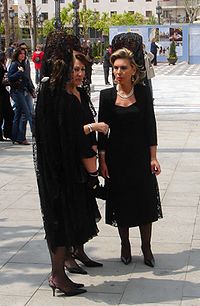
worn over the head and shoulders, often over a high comb, popular with women in Spain
Spain
Spain , officially the Kingdom of Spain languages]] under the European Charter for Regional or Minority Languages. In each of these, Spain's official name is as follows:;;;;;;), is a country and member state of the European Union located in southwestern Europe on the Iberian Peninsula...
. It is particularly associated with traditional devotional practices among women in Catholicism.
History
The lightweight ornamental mantilla came into use in the warmer regions of Spain towards the end of the sixteenth century, and ones made of lace became popular with women in the 17th and 18th centuries being depicted most notably in the portraits of Diego VelázquezDiego Velázquez
Diego Rodríguez de Silva y Velázquez was a Spanish painter who was the leading artist in the court of King Philip IV. He was an individualistic artist of the contemporary Baroque period, important as a portrait artist...
and Goya. In the nineteenth century, Queen Isabel II
Isabella II of Spain
Isabella II was the only female monarch of Spain in modern times. She came to the throne as an infant, but her succession was disputed by the Carlists, who refused to recognise a female sovereign, leading to the Carlist Wars. After a troubled reign, she was deposed in the Glorious Revolution of...
(1833–1868) actively encouraged its use. The practice diminished after her death, and by 1900 the use of the mantilla became largely limited to special ceremonies, such as bullfights
Bullfighting
Bullfighting is a traditional spectacle of Spain, Portugal, southern France and some Latin American countries , in which one or more bulls are baited in a bullring for sport and entertainment...
, Holy Week
Holy Week
Holy Week in Christianity is the last week of Lent and the week before Easter...
and weddings.
Peineta
A peinetaPeineta (comb)
In Spain, a peineta is a large decorative comb usually worn under a mantilla, or lace head covering.The hair ornament, worn by women, consists of a convex body and a set of teeth that affix it to hair worn in a bun...
similar in appearance to a large comb is used to hold up a mantilla. This ornamental comb, usually in tortoiseshell color, originated in the 19th century. It consists of a convex body and a set of prongs and is often used in conjunction with the mantilla. It adds the illusion of extra height to the wearer and also holds the hair in place when worn during weddings, processions and dance. It is a consistent element of some regional costumes of Valencia
Valencian Community
The Valencian Community is an autonomous community of Spain located in central and south-eastern Iberian Peninsula. Its capital and largest city is Valencia...
and Andalusia
Andalusia
Andalusia is the most populous and the second largest in area of the autonomous communities of Spain. The Andalusian autonomous community is officially recognised as a nationality of Spain. The territory is divided into eight provinces: Huelva, Seville, Cádiz, Córdoba, Málaga, Jaén, Granada and...
and it is also often found in costumes used in the Moorish and Gypsy influenced music and dance called Flamenco
Flamenco
Flamenco is a genre of music and dance which has its foundation in Andalusian music and dance and in whose evolution Andalusian Gypsies played an important part....
.
Usage in Catholicism

Motu proprio
A motu proprio is a document issued by the Pope on his own initiative and personally signed by him....
Summorum Pontificum
Summorum Pontificum
Summorum Pontificum is an Apostolic Letter of Pope Benedict XVI, issued "motu proprio" . The document specified the rules, for the Latin Rite of the Catholic Church, for celebrating Mass according to the "Missal promulgated by John XXIII in 1962" , and for administering most of the sacraments in...
.
Perhaps due to the promotion of the mantilla by Queen Isabella II
Isabella II of Spain
Isabella II was the only female monarch of Spain in modern times. She came to the throne as an infant, but her succession was disputed by the Carlists, who refused to recognise a female sovereign, leading to the Carlist Wars. After a troubled reign, she was deposed in the Glorious Revolution of...
, it became traditional for ladies to wear a mantilla when received in audience by the Pope
Pope
The Pope is the Bishop of Rome, a position that makes him the leader of the worldwide Catholic Church . In the Catholic Church, the Pope is regarded as the successor of Saint Peter, the Apostle...
, though other head coverings for women prevailed before it and after it. In the second half of the twentieth century its use declined markedly, though it is not completely out of use.
Irish presidents Mary Robinson
Mary Robinson
Mary Therese Winifred Robinson served as the seventh, and first female, President of Ireland from 1990 to 1997, and the United Nations High Commissioner for Human Rights, from 1997 to 2002. She first rose to prominence as an academic, barrister, campaigner and member of the Irish Senate...
and Mary McAleese
Mary McAleese
Mary Patricia McAleese served as the eighth President of Ireland from 1997 to 2011. She was the second female president and was first elected in 1997 succeeding Mary Robinson, making McAleese the world's first woman to succeed another as president. She was re-elected unopposed for a second term in...
, Soviet Union
Soviet Union
The Soviet Union , officially the Union of Soviet Socialist Republics , was a constitutionally socialist state that existed in Eurasia between 1922 and 1991....
First Lady
First Lady
First Lady or First Gentlemanis the unofficial title used in some countries for the spouse of an elected head of state.It is not normally used to refer to the spouse or partner of a prime minister; the husband or wife of the British Prime Minister is usually informally referred to as prime...
Raisa Gorbachev, and German
Germany
Germany , officially the Federal Republic of Germany , is a federal parliamentary republic in Europe. The country consists of 16 states while the capital and largest city is Berlin. Germany covers an area of 357,021 km2 and has a largely temperate seasonal climate...
Chancellor Angela Merkel
Angela Merkel
Angela Dorothea Merkel is the current Chancellor of Germany . Merkel, elected to the Bundestag from Mecklenburg-Vorpommern, has been the chairwoman of the Christian Democratic Union since 2000, and chairwoman of the CDU-CSU parliamentary coalition from 2002 to 2005.From 2005 to 2009 she led a...
all met popes without wearing mantillas.
Queen Sofía of Spain
Queen Sofía of Spain
Queen Sofía of Spain is the wife of King Juan Carlos I of Spain.-Early life and family:Princess Sophia of Greece and Denmark was born in Psychiko, Athens, Greece on 2 November 1938, the eldest child of the King Paul of Greece and his wife, Queen Frederika , a former princess of Hanover...
, as a Catholic Queen
Catholic King
The titles Catholic King and Catholic Queen are awarded by the Pope as head of the Catholic Church to monarchs who in the eyes of the papacy embody Catholic principles in their personal lives and state policies. The title remains attached to monarchs descended from whoever received the original,...
, exercised a royal privilege known as Privilège du blanc, an entitlement and royal privilege to wear white attire instead of black in the presence of the Pope. Only Roman Catholic queens and kings are allowed to have an audience with the Pope wearing white clothing, while the rest are advised and expected to wear black. At the inauguration of Pope Benedict XVI
Pope Benedict XVI
Benedict XVI is the 265th and current Pope, by virtue of his office of Bishop of Rome, the Sovereign of the Vatican City State and the leader of the Catholic Church as well as the other 22 sui iuris Eastern Catholic Churches in full communion with the Holy See...
and the requiem mass for John Paul II, Queen Sofía wore a white mantilla while Queen Paola of Belgium
Queen Paola of Belgium
Paola, Queen of the Belgians , is the queen consort of Albert II of Belgium....
wore a black one.
Mantillas were worn by Laura Bush
Laura Bush
Laura Lane Welch Bush is the wife of the 43rd President of the United States, George W. Bush. She was the First Lady of the United States from January 20, 2001, to January 20, 2009. She has held a love of books and reading since childhood and her life and education have reflected that interest...
while visiting the Holy See in 2006; members of Grand Ducal Family of Luxembourg
Grand Ducal Family of Luxembourg
The Grand Ducal Family of Luxembourg consists of the extended family of the sovereign Grand Duke....
during inauguration festivities; and Michelle Obama while visiting the Holy See in July 2009.
In popular culture
The mantilla is sometimes seen on television programmes. In the BritishUnited Kingdom
The United Kingdom of Great Britain and Northern IrelandIn the United Kingdom and Dependencies, other languages have been officially recognised as legitimate autochthonous languages under the European Charter for Regional or Minority Languages...
television soap Hollyoaks
Hollyoaks
Hollyoaks is a long-running British television soap opera, first broadcast on Channel 4 on 23 October 1995. It was originally devised by Phil Redmond, who has also devised shows including Brookside and Grange Hill...
, Catholic
Catholic
The word catholic comes from the Greek phrase , meaning "on the whole," "according to the whole" or "in general", and is a combination of the Greek words meaning "about" and meaning "whole"...
character Carmel Valentine wore a mantilla while in mourning for her deceased sister, Tina Reilly. Mimi Maguire
Mimi Maguire
Katherine Harmonica Joy Catherine "Mimi" Tutton is a fictional character from the Channel 4 drama Shameless., Mimi is the foul-mouthed, loud, brash and violent matriarch of the Maguire family. She is also a drug dealer on the Chatsworth Estate and is frequently seen selling drugs on the show...
from Channel 4
Channel 4
Channel 4 is a British public-service television broadcaster which began working on 2 November 1982. Although largely commercially self-funded, it is ultimately publicly owned; originally a subsidiary of the Independent Broadcasting Authority , the station is now owned and operated by the Channel...
drama-comedy, Shameless
Shameless
Shameless is a British television drama series set in Manchester on the fictional Chatsworth council estate. Produced by Company Pictures for Channel 4, the first seven-episode series aired weekly on Tuesday nights at 10pm from 13 January 2004...
, also wore one. Lady Gaga
Lady GaGa
Stefani Joanne Angelina Germanotta , better known by her stage name Lady Gaga, is an American singer and songwriter. Born and raised in New York City, she primarily studied at the Convent of the Sacred Heart and briefly attended New York University's Tisch School of the Arts before withdrawing to...
wore a mantilla in the video for her song, Alejandro
Alejandro (song)
"Alejandro" is a song by American recording artist Lady Gaga. It was released as the third single from her third extended play and second major release The Fame Monster...
.