

Manti

Encyclopedia
Dumpling
Dumplings are cooked balls of dough. They are based on flour, potatoes or bread, and may include meat, fish, vegetables, or sweets. They may be cooked by boiling, steaming, simmering, frying, or baking. They may have a filling, or there may be other ingredients mixed into the dough. Dumplings may...
in Turkish
Turkish cuisine
Turkish cuisine is largely the heritage of Ottoman cuisine, which can be described as a fusion and refinement of Central Asian, Middle Eastern and Balkan cuisines. Turkish cuisine has in turn influenced those and other neighbouring cuisines, including that of western Europe...
and various Central Asian and Northwest China and Caucasian
Caucasus
The Caucasus, also Caucas or Caucasia , is a geopolitical region at the border of Europe and Asia, and situated between the Black and the Caspian sea...
cuisines, closely related to the east Asian mantou
Mantou
Mantou, often referred to as Chinese steamed bun/bread, is a kind of steamed bun originating in China. They are typically eaten as a staple in northern parts of China where wheat, rather than rice, is grown. They are made with milled wheat flour, water and leavening agents...
, baozi
Baozi
A bāozi or simply known as bao, bau, humbow, nunu, bausak, pow or pau is a type of steamed, filled bun or bread-like item in various Chinese cuisines, as there is much variation as to the fillings and the preparations...
, and mandu
Mandu (dumpling)
Mandu are dumplings in Korean cuisine. They are similar to pelmeni and pierogi in some Slavic cultures. The name is a cognate to the names of similar types of meat-filled dumplings in Central Asia, such as Turkish manti, Kazakh manty, and Uzbek manti.In Korean cuisine, mandu generally denotes a...
and the Nepali
Nepali people
Nepali people can refer to:*People of Nepal*Ethnic Nepalis of Indian citizenry residing in Gorkhaland area of West Bengal, Sikkim, Assam, Meghalaya, Mizoram and other parts of India.* Indian Gorkhas*Lhotshampas of Bhutan.*Nepali diaspora the world over....
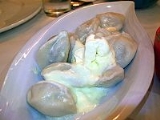
momo. Manti dumplings archetypically consist of a spiced meat mixture, usually lamb or ground beef, in a dough wrapper, either boiled or steamed. 'Manti' indicates either singular or plural.
History
Mantu were carried across Central AsiaCentral Asia
Central Asia is a core region of the Asian continent from the Caspian Sea in the west, China in the east, Afghanistan in the south, and Russia in the north...
to Anatolia
Anatolia
Anatolia is a geographic and historical term denoting the westernmost protrusion of Asia, comprising the majority of the Republic of Turkey...
by migrating Turks in the Chingizid
Mongol Empire
The Mongol Empire , initially named as Greater Mongol State was a great empire during the 13th and 14th centuries...
-Timurid periods. According to Holly Chase, "Turkic and Mongol horsemen on the move are supposed to have carried frozen or dried manti, which could be quickly boiled over a camp-fire". In Turkey it is also called Tatar böregi (Tatar
Tatars
Tatars are a Turkic speaking ethnic group , numbering roughly 7 million.The majority of Tatars live in the Russian Federation, with a population of around 5.5 million, about 2 million of which in the republic of Tatarstan.Significant minority populations are found in Uzbekistan, Kazakhstan,...
burek
Burek
Börek is a family of baked or fried filled pastries made of a thin flaky dough known as yufka . It can be filled with cheese, often feta, sirene or kaşar; minced meat, or vegetables...
s), which indicates its relation to nomadic peoples. A mid-15th century Ottoman recipe survives, with the manti filled with pounded lamb and crushed chickpeas, steamed, and served topped with yogurt mixed with crushed garlic and sprinkled with sumac. Manti are popular throughout the former Soviet Union, where the dish spread from the Central Asian republics.
In Armenian cuisine
In Armenian cuisineArmenian cuisine
Armenian cuisine includes the foods and cooking techniques of the Armenian people, the Armenian diaspora and traditional Armenian foods and dishes. The cuisine reflects the history and geography where Armenians have lived as well as incorporating outside influences...
, the manti are filled with minced lamb, or beef (less common), with finely minced onions and various other delicious spices. The manti are first fried lightly in butter then boiled or steamed in a tomato-based broth and topped with garlic yogurt; they may also be baked and have chicken-based broth. Dry sumac
Sumac
Sumac is any one of approximately 250 species of flowering plants in the genus Rhus and related genera, in the family Anacardiaceae. Sumacs grow in subtropical and temperate regions throughout the world, especially in Africa and North America....
and pepper are sprinkled on top to taste, along with yogurt. The size of the individual manti varies from dumpling-size to penny-size, depending upon the region and chef.
In Kazakh cuisine
In Kazakh cuisineKazakh cuisine
Kazakh cuisine is the cuisine of Kazakhstan. Traditional Kazakh cuisine revolves around mutton and horse meat and as well as various milk products. For hundreds of years Kazakhs were herders who raised fat-tailed sheep, Bactrian camels, and horses, relying on these animals for transportation,...
, the manti filling is normally ground lamb (or beef or horse meat
Horse meat
Horse meat is the culinary name for meat cut from a horse. It is a major meat in only a few countries, notably in Central Asia, but it forms a significant part of the culinary traditions of many others, from Europe to South America to Asia. The top eight countries consume about 4.7 million horses...
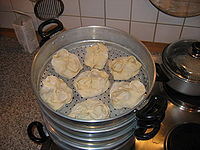
) spiced with black pepper, sometimes with the addition of chopped pumpkin or squash. Manti are cooked in a multi-level steamer and served topped with butter, sour cream, or onion (or garlic) sauce. When sold as street food in Kazakhstan
Kazakhstan
Kazakhstan , officially the Republic of Kazakhstan, is a transcontinental country in Central Asia and Eastern Europe. Ranked as the ninth largest country in the world, it is also the world's largest landlocked country; its territory of is greater than Western Europe...
, manti are typically presented sprinkled with hot red pepper powder.
In Kyrgyz cuisine
In Kyrgyz cuisine, manti are usually made of one (or a combination) of the following ingredients: lamb, beef, potato, or pumpkin, with fat often added to meat manti. Steaming, frying and boiling are all common. Manti are usually topped with butter and served with sour cream, tomato sauce, or fresh onion rings (sprinkled with vinegar and black pepper). A sauce made by mixing vinegarVinegar
Vinegar is a liquid substance consisting mainly of acetic acid and water, the acetic acid being produced through the fermentation of ethanol by acetic acid bacteria. Commercial vinegar is produced either by fast or slow fermentation processes. Slow methods generally are used with traditional...
and chilli powder is also common. Time and energy-consuming, the preparation of manti is often a family activity, even enlisting the help of the young.
In Tajik, Afghan cuisine
In Tajik and Afghan cuisine, the mantu are filled with raw beef or lamb mixed with minced onions and spices, steamed and then topped with a very typical sauce (Seer Moss, lit. "garlic yogurt") of yogurt, dried or fresh mint, lemon juice, and minced or pressed garlic. The mantu are also typically topped with a very small amount of tomato-based sauce which can include split peas, red kidney beans, and/or some sauteed ground meat. The amount of yogurt sauce is typically much greater than the tomato sauce; the tomato sauce is meant to be dotted on top - not covering the dish. Chatney, a spicy green or red pepper condiment sauce, may be sprinkled on top.In Turkish cuisine
In Turkish cuisineTurkish cuisine
Turkish cuisine is largely the heritage of Ottoman cuisine, which can be described as a fusion and refinement of Central Asian, Middle Eastern and Balkan cuisines. Turkish cuisine has in turn influenced those and other neighbouring cuisines, including that of western Europe...
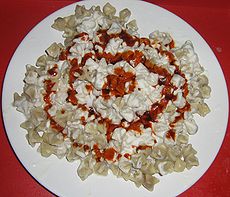
, manti are typically served topped with yogurt and garlic
Garlic
Allium sativum, commonly known as garlic, is a species in the onion genus, Allium. Its close relatives include the onion, shallot, leek, chive, and rakkyo. Dating back over 6,000 years, garlic is native to central Asia, and has long been a staple in the Mediterranean region, as well as a frequent...
and spiced with red pepper
Capsicum
Capsicum is a genus of flowering plants in the nightshade family, Solanaceae. Its species are native to the Americas where they have been cultivated for thousands of years, but they are now also cultivated worldwide, used as spices, vegetables, and medicines - and have become are a key element in...
powder and melted butter, and topped with ground sumac
Sumac
Sumac is any one of approximately 250 species of flowering plants in the genus Rhus and related genera, in the family Anacardiaceae. Sumacs grow in subtropical and temperate regions throughout the world, especially in Africa and North America....
and/or dried mint
Mentha
Mentha is a genus of flowering plants in the family Lamiaceae . The species are not clearly distinct and estimates of the number of species varies from 13 to 18. Hybridization between some of the species occurs naturally...
by the consumer. Although there are many different variations of manti -in terms of shape and way of serving- the most praised type of manti is known as Kayseri Mantisi -a special kind of manti belong to Kayseri -an Anatolian city of Turkey. The characteristics of Kayseri Mantisi is that it is very tiny and it is served with yogurt, oil (caramelized with tomato paste) and seasonings. Manti may be made from shredded meat of quail or chicken in some regions of Turkey, while 'boş mantı' ('empty dumpling') lack filling entirely. Turkish manti resembles tortellini
Tortellini
Tortellini are ring-shaped pasta. They are typically stuffed with a mix of meat or cheese. Originally from the Italian region of Emilia , they are usually served in broth, meat broth, either of beef, chicken, or both...
.
See also
- KhinkaliKhinkaliKhinkali are Caucasian dumplings filled with various fillings such as mushrooms or cheese, but mostly with spiced meat with greens, onions and garlic. They are eaten plain, or with coarse black pepper. The meat filling is uncooked when the Khinkali is assembled, so when cooked the meat's juices...
- ChuchvaraChuchvaraChuchvara is a very small dumpling typical of Uzbek cuisine. Made of unleavened dough squares filled with meat, it is similar to the Russian pelmeni and the Chinese wonton, but in observance of the Islamic dietary rules, the meat filling is without pork. The dough for chuchvara is made with flour,...
- VarenikiVarenikithumb|right|Varenyks with [[curd]]Varenyky are a kind of stuffed dumpling associated with Ukrainian cuisine. Variants are also found in Moldovan, Mennonite, Belarusian, Russian, Lithuanian, and Polish cooking. They are believed to originate from Chinese and Siberian influences, although sometimes...
- PelmeniPelmeniPelmeni are dumplings consisting of a filling wrapped in thin, unleavened dough that originated in Siberia and is a dish of Russian cuisine. Pelmeni are common in Russia and have similar names in other languages: , pyal’meni; pilmän; , pel’meni; ; .- Ingredients :The dough is made from flour and...
- PierogiPierogiPierogi are dumplings of unleavened dough - first boiled, then they are baked or fried usually in butter with onions - traditionally stuffed with potato filling, sauerkraut, ground meat, cheese, or fruit...
- ManduMandu (dumpling)Mandu are dumplings in Korean cuisine. They are similar to pelmeni and pierogi in some Slavic cultures. The name is a cognate to the names of similar types of meat-filled dumplings in Central Asia, such as Turkish manti, Kazakh manty, and Uzbek manti.In Korean cuisine, mandu generally denotes a...
- MomoMomo (food)Momo is a type of pastry native to Nepal as well as among the Tibetans. It is similar to the Mongolian buuz or the Chinese jiaozi.The Tibetan word momo is a loanword from the Chinese mómo .-Production:...
- KaldunyKaldunyKalduny or kolduny are stuffed dumplings made of unleavened dough in Belarusian, Lithuanian, and Polish cuisines, akin to the Russian pelmeni and the Ukrainian vareniki. In Slavic languages the word means “magicians” or “sorcerers”, but it is unclear how the word became associated with the dish...
- KreplachKreplachKreplach are small dumplings filled with ground meat, mashed potatoes or another filling, usually boiled and served in chicken soup. They are similar to Italian tortellini and Chinese wontons. The dough is traditionally made of flour, water and eggs, kneaded and rolled out thin...
- TortelliniTortelliniTortellini are ring-shaped pasta. They are typically stuffed with a mix of meat or cheese. Originally from the Italian region of Emilia , they are usually served in broth, meat broth, either of beef, chicken, or both...
- RavioliRavioliRavioli are a traditional type of Italian filled pasta. They are composed of a filling sealed between two layers of thin egg pasta dough and are served either in broth or with a pasta sauce. The word ravioli is reminiscent of the Italian verb riavvolgere , though the two words are not...
- MaultascheMaultascheMaultaschen are a Swabian specialty food, consisting of an outer layer of pasta dough with a filling traditionally made of minced meat, smoked meat, spinach, bread crumbs and onions and flavored with various herbs and spices...
- WontonWontonNot to be confused with WantonA wonton is a type of dumpling commonly found in a number of Chinese cuisines.-Filling:...
- BaoziBaoziA bāozi or simply known as bao, bau, humbow, nunu, bausak, pow or pau is a type of steamed, filled bun or bread-like item in various Chinese cuisines, as there is much variation as to the fillings and the preparations...
(steamed) - JiaoziJiaoziJiǎozi 餃子 or 饺子 , bánh bột luộc , gyōza , Mo:Mo: or Momocha म:म: or ममचा , or pot sticker is a Chinese dumpling widely spread to Japan, Eastern and Western Asia.Jiaozi typically consist of a ground meat and/or vegetable filling wrapped into...
(boiled or fried) - BuuzBuuzBuuz are a type of Mongolian steamed dumpling filled with minced mutton, or beef meat. The meat is flavoured with onion or garlic and salted. Occasionally, they are flavoured with sprouted fennel seeds and other seasonal herbs...
- SiopaoSiopaoSiopao is a Hokkien term for bāozi , literally meaning "steamed buns". It has also been incorporated in to Thai cuisine where it is called salapao ....
- ShishbarakShishbarakShishbarak is a pasta or jiaozi dish made in Lebanon, Syria, Jordan and Palestine that has been described as a kind of local variation on ravioli. After being stuffed with ground beef and spices, thin wheat dough parcels are cooked in yogurt and served hot in this sauce....
- PitepaltPitepaltPitepalt is a palt, a dish related to kroppkakor, and the specialty of the city of Piteå, though it is not eaten only in Piteå. This Swedish dish has almost as many variants as households in Piteå. Pitepalt are mostly made out of raw potatoes and barley flour, which is not the case with kroppkakor....