
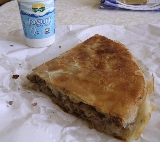
Burek (also
börek,
boereg,
piroq, and other variants on the name) is a type of baked or fried filled
pastryPastry is the name given to various kinds of baked goods made from ingredients such as flour, butter, shortening, baking powder or eggs. Small cakes, tarts and other sweet baked goods are called "pastries"....
, popular in the
ArabArab people or Arabs are an ethnic group whose members identify along linguistic, cultural or genealogical grounds...
world, some countries around the Mediterranean Sea, the
SlavicThe Slavic Peoples are an ethnic and linguistic branch of Indo-European peoples, living mainly in eastern and central Europe. From the early 6th century they spread from their original homeland to inhabit most of eastern Central Europe, Eastern Europe and the Balkans...
cuisines, throughout the
BalkansThe Balkans is a geopolitical and cultural region of southeastern Europe...
and the former
Ottoman EmpireThe Ottoman Empire or Ottoman State , also known by its contemporaries as the Turkish Empire or Turkey , was an empire that lasted from 1299 to November 1, 1922 The Ottoman Empire or Ottoman State (Ottoman Turkish: دَوْلَتِ عَلِیَّهِ عُثْمَانِیَّه Dawlet-il ʿAliyyat-il ʿOs̠māniyye, Modern Turkish:...
. They are made of a thin flaky dough known as
phylloPhyllo, filo, or fillo dough is paper-thin sheets of raw, unleavened flour dough used for making pastries in Middle Eastern, Greek and other regional cuisines....
dough (or
yufkaYufka is a Turkish bread. It is a thin, round and unleavened flat bread similar to lavash, about 18 inches in diameter usually made from wheat flour, water and table salt. After kneading, the dough is allowed to rest for 30 min. Dough pieces are rounded and rolled into a circular sheet...
dough), and are filled with salty
cheeseCheese is a food consisting of proteins and fat from milk, usually the milk of cows, buffalo, goats, or sheep. It is produced by coagulation of the milk protein casein. Typically, the milk is acidified and addition of the enzyme rennet causes coagulation. The solids are separated and pressed into...
(often
fetaFeta is a brined curd cheese traditionally made in Feta is a brined curd cheese traditionally made in Feta is a brined curd cheese traditionally made in (Greece. A sheep's milk cheese, varying amounts of goats’ milk may be added, as long as goat milk makes up less than 30% of the total...
), minced meat, potatoes or other vegetables.
Burek may be prepared in a large pan and cut into portions after baking, or as individual pastries. The top of the Burek is often sprinkled with sesame seeds.
Turkey
In Turkish,
börek is the name used for pastries made with
phylloPhyllo, filo, or fillo dough is paper-thin sheets of raw, unleavened flour dough used for making pastries in Middle Eastern, Greek and other regional cuisines....
dough.
Su böreği ("water burek") is the most common type. Layers of dough are boiled briefly in large pans, then a mixture of feta cheese, parsley and oil is scattered between the layers.
Sigara böreği ("cigar burek," named for its shape) is often filled with feta cheese, potato, parsley and sometimes with minced meat or sausage. A variety of vegetables, herbs and spices are used in böreks such as spinach, nettle, leek, potato, eggplant, courgette, ground black pepper.
Kol böreği ("arm burek") is a type of burek prepared in long rolls, either rounded (also named
Gül böreği) or lined and filled with either mincemeat, feta cheese or potato and baked under low heat.
Çiğ börek ("raw burek") is a half round shaped burek, filled with raw mincemeat and fried in olive oil.
Albanian byrek or lakror
In
AlbaniaAlbania , officially the Republic of Albania , is a Mediterranean country in South Eastern Europe. It is bordered by Montenegro to the north, Kosovo to the northeast, Macedonia to the east and Greece to the south-east...
, this dish is called byrek or sometimes lakror and it contains mainly spinach but sometimes also meat or cheese. Albanian byrek may also contain pumpkin (which is sweet); it is also often spelled "burek", especially among Albanians in
KosovoKosovo is a disputed territory in the Balkans. Its majority is governed by the partially-recognised Republic of Kosovo , a self-declared independent state which has de facto control over the territory; the exceptions are some Serb enclaves...
,
MacedoniaMacedonia , officially the Republic of Macedonia , is a country in the central Balkan peninsula in southeastern Europe. It is one of the successor states of the former Yugoslavia, from which it declared independence in 1991...
and
MontenegroMontenegro , is a country located in Southeastern Europe. It has a coast on the Adriatic Sea to the south-west and is bordered by Croatia to the west, Bosnia and Herzegovina to the northwest, Serbia to the northeast, Kosovo to the east and Albania to the south...
, as well as
Albanian-AmericanAlbanian Americans are United States citizens of Albanian ancestry. According to the 2000 US census, there are 113,661 Americans of full or partial Albanian descent.-Geographic distribution:...
emigrants.
Albanian byrek are typically savoury, not sweet, and are often served as the main dish of a meal.
Arab burek
Arab burek is often stuffed with minced or diced lamb, but often beef or a mixture are used. Various herbs and spices are used to flavour the meat, including
curcuminCurcumin is the principal curcuminoid of the popular Indian spice turmeric, which is a member of the ginger family . The other two curcuminoids are desmethoxycurcumin and bis-desmethoxycurcumin. The curcuminoids are polyphenols and are responsible for the yellow color of turmeric. Curcumin can...
, fresh
parsleyParsley is a bright green biennial herb, often used as spice. It is common in Middle Eastern, European, and American cooking...
and
nutmegNutmeg or Myristica fragrans is an evergreen tree indigenous to the Banda Islands in the Moluccas of Indonesia, or Spice Islands. Until the mid 19th century this was the world's only source...
, as well as often concentrated
pomegranateThe pomegranate is a fruit-bearing deciduous shrub or small tree growing to between five and eight meters tall. The pomegranate is native to Southwest Asia and has been cultivated in the Caucasus since ancient times...
juice which gives the mixture a unique sweet and tangy taste. Fried or caramalised onions are usually always added to the meat, as well as the traditional Arab staple of fried almonds and sultanas or raisins. Traditional Arab cheeses, including
Jibin Baladi and
Jibin Arab are often used instead of, or alongside the meat. The mixture is wrapped in a sheet of dough, and then fried or deep-fried until crisp, and resembles a large
egg rollFor the traditional Easter activity, see Egg rolling.For the Japanese dish sometimes referred to as Egg rolls, see Tamago.An egg roll is an appetizer which was originally eaten in East Asia but has spread throughout the world as a staple of Asian cuisine...
. While most Burek are made with phyllo dough, some traditional cooks and those in the tribal areas prefer a home-kneaded dough covering.
Arab burek are most often served with other "dry" foods including
kibbehKibbeh or kibbe is a Levantine Arab/Assyrian dish made of burghul and chopped meat. The best-known variety is a torpedo-shaped fried croquette stuffed with minced beef or lamb...
, with a jaljeek dip, forming an integral part of a tradional
mezeMeze or mezze in the Eastern Mediterranean is a selection of appetizers or small dishes often served with beverage, like anise-flavored liqueurs such as arak, ouzo, raki or...
meal.
Armenian boereg
In Armenia, boeregs are stuffed with cheese. They are also stuffed with other fillings such as spinach or ground beef, and the filling is typically spiced.
Assyrian burek
Assyrian burek is usually stuffed with ground beef that has various spices added to it, though potatoes are also sometimes used instead of meat. The stuffing is wrapped in a sheet of dough and then fried in oil and resembles egg rolls.
Bulgarian byurek
The
BulgarianBulgarian cuisine is a representative of the cuisine of Southeastern Europe. Essentially South Slavic, it shares characteristics with other Balkans cuisines...
version of the pastry, locally called
byurek (Cyrillic: бюрек), is typically regarded as a variation of
banitsa (баница), a similar Bulgarian dish. Bulgarian byurek is a type of banitsa with
sireneSirene , officially called the "white brine sirene" is a type of brine cheese made in South-Eastern Europe, especially popular in Bulgaria, the Republic of Macedonia and other Balkan countries. It was originally made of goat's milk, but the predominant variation today is made of the cheaper cow's...
cheese, the difference being that byurek also has eggs added.
In
BulgarianBulgarian is an Indo-European language, a member of the Slavic linguistic group.Bulgarian demonstrates several linguistic innovations that set it apart from all other Slavic languages except the Macedonian language, such as the elimination of case declension, the development of a suffixed definite...
, the word
byurek has also come to be applied to other dishes similarly prepared with cheese and eggs, such as
chushka byurek (чушка бюрек), a peeled and roasted pepper filled with cheese, and
tikvichka byurek (тиквичка бюрек), blanched or uncooked bits of squash with a cheese and eggs filling.
Greek bouréki or bourekáki
In
GreeceGreece , officially the Hellenic Republic , is a country in southeastern Europe, situated on the southern end of the Balkan Peninsula....
and
CyprusCyprus , officially the Republic of Cyprus , is a Eurasian island country situated in the eastern Mediterranean, south of Turkey and west of Syria and Lebanon....
, boureki (μπουρέκι [bur'eki]) or bourekaki (μπουρεκάκι [bure'kaki], the diminutive form of the word), are small pastries made with phyllo dough or with pastry crust. A special type of boureki is found in the local cuisine of
CreteCrete is the largest of the Greek islands and the fifth largest island in the Mediterranean Sea at 8,336 km²...
and especially in the area of
ChaniaChaniá is the second largest city of Crete and the capital of the Chania Prefecture...
. It is made with sliced
zucchiniZucchini or courgette is a small summer squash. Along with some other squashes, it belongs to the species Cucurbita pepo...
, sliced potatoes, mizithra or
fetaFeta is a brined curd cheese traditionally made in Feta is a brined curd cheese traditionally made in Feta is a brined curd cheese traditionally made in (Greece. A sheep's milk cheese, varying amounts of goats’ milk may be added, as long as goat milk makes up less than 30% of the total...
cheese and
spearmintMentha spicata is a species of mint native to much of Europe and southwest Asia, though its exact natural range is uncertain due to extensive early cultivation. It grows in wet soils...
. The mixture can be covered by a thick layer of traditional phyllo (pastry crust), but it is quite common to be left plain as well.
GalaktobourekoGalaktoboureko is a Greek dessert of custard in phyllo. It may be made in a pan, with phyllo layered on top and underneath, or rolled into individual 10cm long servings....
is a syrupy phyllo pastry filled with custard, common throughout Greece and Cyprus. In the
EpirusEpirus , is a periphery in northwestern Greece. It borders the peripheries of West Macedonia and Thessaly to the east, West Greece to the south, the Ionian Sea and the Ionian Islands to the west and Albania to the north. The province has an area of about 9,200 km²...
, σκερ-μπουρέκ (derives from the Turkish şeker-börek, "sugar-börek") is a small
rosewaterRose water or rose syrup is the hydrosol portion of the distillate of rose petals...
-flavored
marzipanMarzipan is a confection consisting primarily of sugar and almond meal.It derives its characteristic flavor from bitter almonds, which constitute 4% to 6% of the total almond content by weight. Some marzipan is also flavored with rosewater...
sweet.
Israel
Bourekas are made from
puff pastryIn baking, a puff pastry is a light, flaky, unleavened pastry containing several layers of fat which is in solid state at 20°C .-History:...
filled with various fillings. Among the most popular fillings are
cheeseCheese is a food consisting of proteins and fat from milk, usually the milk of cows, buffalo, goats, or sheep. It is produced by coagulation of the milk protein casein. Typically, the milk is acidified and addition of the enzyme rennet causes coagulation. The solids are separated and pressed into...
,
mashed potatoMashed potato or Smashed potatoes is one way of serving potatoes. It is made by mashing freshly boiled , or sometimes baked, potatoes with a ricer, fork or potato masher...
,
spinachSpinach is an edible flowering plant in the family of Amaranthaceae. It is native to central and southwestern Asia. It is an annual plant , which grows to a height of up to 30 cm. Spinach may survive over winter in temperate regions...
, eggplant,
pizzaPizza is a world-popular dish of Italian origin, made with an oven-baked, flat, generally round bread that is often covered with tomatoes or a tomato-based sauce and cheese. Other toppings are added according to region, culture, or personal preference.Originating in a part of Italian cuisine, the...
-flavor, and mushrooms. The name
bourekas is derived from the Ladino language, spoken in the past by Jewish communities in the Mediterranean area.
IsraeliIsraeli cuisine is a diverse cuisine consisting of local dishes and dishes brought to Israel by Jewish immigrants from around the world...
bourekas come in several shapes, which are usually indicative of their fillings. Cheese bourekas come in right-angled and isosceles triangles, and have two different sizes. Potato-filled bourekas come in a box shape. Bourekas with a pizza filling resemble a cylindrical shape, while spinach filled bourekas resemble a pastry knot. There are also the so-called "Turkish bourekas" which form rounded equilateral triangles, and are filled with various fillings, whose type can usually be determined by an additional element on the outside.
Bourekas come in small, "snack" size, often available in self-service bakeries, and larger size, approximately 2 inches by 4 inches. The larger ones can serve as a snack or a meal, and can be sliced open, and stuffed with hard-boiled egg, pickles and
SkhugSkhug, also spelled zhug, is a Yemenite hot sauce popular in Middle Eastern cuisine....
, a spicy Yemenite paste.
Former Yugoslavia
Across the territories of
former YugoslaviaThe Socialist Federal Republic of Yugoslavia was the Yugoslav state that existed from the second half of World War II until it was formally dissolved in 1992 amid the Yugoslav wars. It was a socialist state and a federation made up of Bosnia and Herzegovina, Croatia, Macedonia, Montenegro,...
, burek is not used in a hyperonymous sense (like pie, cake, etc.), as in Turkey. Burek is regularly available at most
bakerA baker bakes and sells bread. Cakes and similar and foods may also be produced, as the traditional boundaries between what is produced by a baker as opposed to a pastry chef have blurred in recent decades. The place where a baker works is called a bakehouse, bakeshop, or bakery...
ies, and usually eaten as "
fast foodFast food is the term given to food that can be prepared and served very quickly. While any meal with low preparation time can be considered to be fast food, typically the term refers to food sold in a restaurant or store with low quality preparation and served to the customer in a packaged form...
". It is often consumed with
yoghurtYoghurt or yogurt is a dairy product produced by bacterial fermentation of milk. Fermentation of lactose produces lactic acid, which acts on milk protein to give yoghurt its texture and its characteristic tang...
. Apart from being sold at bakeries, burek is served in specialized stores selling burek (or pitas) and yogurt exclusively (
Buregdžinica).
Serbian, Macedonian and Croatian (round) burek
In
SerbiaSerbia , officially the Republic of Serbia , is a country located in both Central and Southeastern Europe. Its territory covers the southern part of the Pannonian Plain and central part of the Balkans...
,
MacedoniaMacedonia , officially the Republic of Macedonia , is a country in the central Balkan peninsula in southeastern Europe. It is one of the successor states of the former Yugoslavia, from which it declared independence in 1991...
and
CroatiaCroatia , officially the Republic of Croatia , is a country in southeast Europe, at the crossroads of the Pannonian Plain, the Balkans, and the Mediterranean Sea. Its capital is Zagreb...
,
burek is made from layers of thin dough, alternating with layers of other fillings in a circular baking pan and topped with a layer of dough. Traditional fillings are stewed ground meat, cheese,
appleThe apple is the pomaceous fruit of the apple tree, species Malus domestica in the rose family Rosaceae. It is one of the most widely cultivated tree fruits...
,
sour cherriesPrunus cerasus, or the sour cherry, is a species of Prunus in the subgenus Cerasus , native to much of Europe and southwest Asia. It is closely related to the wild cherry Prunus cerasus, or the sour cherry, is a species of Prunus in the subgenus Cerasus (cherries), native to much of Europe and...
,
mushroomA mushroom is the fleshy, spore-bearing fruiting body of a fungus, typically produced above ground on soil or on its food source. The standard for the name "mushroom" is the cultivated white button mushroom, Agaricus bisporus, hence the word mushroom is most often applied to those fungi that have...
s, and a modern variant, "
pizzaPizza is a world-popular dish of Italian origin, made with an oven-baked, flat, generally round bread that is often covered with tomatoes or a tomato-based sauce and cheese. Other toppings are added according to region, culture, or personal preference.Originating in a part of Italian cuisine, the...
" burek.
Prazan burek ("empty burek", i.e. without filling) is also made.
The recipe for modern "round" burek was developed in the Serbian town of
NišNiš is a city in Nišava District, Serbia situated at 43.3° N 21.9° E, on the Nišava River. With more than 253,077 inhabitants it is the largest city in southern Serbia and the third-largest city in the country, after Belgrade and Novi Sad, according to the data from May 2009...
, where it was introduced by a famous Turkish baker, Mehmed Oglu, from
IstanbulIstanbul is the largest city in Turkey and fifth largest city proper in the world with a population of 12.6 million. Istanbul is also a megacity, as well as the cultural and financial centre of Turkey. The city covers 39 districts of the Istanbul province...
in 1498.
The first burek in
ZagrebZagreb is the capital and the largest city of Croatia. Zagreb is the cultural, scientific, economic and governmental center of Croatia, and a global city. According to the city government, the population of Zagreb in 2008 was 804,200...
was made by famous bakers near the main railway station (Kolodvor) after
World War IIWorld War II, or the Second World War , was a global military conflict which involved a majority of the world's nations, including all great powers, organized into two opposing military alliances: the Allies and the Axis...
.
NišNiš is a city in Nišava District, Serbia situated at 43.3° N 21.9° E, on the Nišava River. With more than 253,077 inhabitants it is the largest city in southern Serbia and the third-largest city in the country, after Belgrade and Novi Sad, according to the data from May 2009...
hosts an annual burek competition called
Buregdžijada. In 2005, a 100 kg/200 lb. burek was made, with a
diameterIn geometry, a diameter of a circle is any straight line segment that passes through the center of the circle and whose endpoints are on the circle. The diameters are the longest chords of the circle...
of 2 meters / 6 feetand it's considered to have been the biggest burek ever made.
Bosnian burek
In
Bosnia and HerzegovinaBosnia and Herzegovina Bosnia and Herzegovina Bosnia and Herzegovina ( or (Bosnian, Croatian, Serbian Latin: Bosna i Hercegovina; Serbian Cyrillic: Босна и Херцеговина) is a country in Southeast Europe, on the Balkan Peninsula...
the word burek refers only to a meat-filled pastry dish. Thin dough layers are stuffed and then rolled and cut into spirals (resembling an American cinnamon bun).
The same dish with cottage cheese is called
sirnica, one with
spinachSpinach is an edible flowering plant in the family of Amaranthaceae. It is native to central and southwestern Asia. It is an annual plant , which grows to a height of up to 30 cm. Spinach may survive over winter in temperate regions...
and cheese
zeljanica, one with
potatoThe potato is a starchy, tuberous crop from the perennial Solanum tuberosum of the Solanaceae family . The word potato may refer to the plant itself as well. In the region of the Andes, there are some other closely related cultivated potato species. Potatoes are the world's fourth largest food...
es
krompiruša, and all of them are generically referred to as
pita (trans.
pieA pie is a baked dish which is usually made of a pastry dough shell that covers or completely contains a filling of various sweet or savoury ingredients...
).
EggsAn egg is a round or oval body laid by the female of any number of different species, consisting of an ovum surrounded by layers of membranes and an outer casing, which acts to nourish and protect a developing embryo and its nutrient reserves...
are used as a binding agent when making
sirnica and
zeljanica.
This kind of dough dish is also popular in
CroatiaCroatia , officially the Republic of Croatia , is a country in southeast Europe, at the crossroads of the Pannonian Plain, the Balkans, and the Mediterranean Sea. Its capital is Zagreb...
, where it was imported by Bosnian Croats, and is usually called
rolani burek (rolled burek).
In Serbian towns Bosnian pastry dishes were imported by war refugees in the 1990s, and are usually called
sarajevske pite or
bosanske pite (Sarajevo/Bosnian pies). Similar dishes, although somewhat wider and with thinner dough layers are called
savijača or just "pita" in Serbia.
However, these are usually homemade and not traditionally offered in bakeries.
In Bosnia, burek only refers to one special pastry dish filled with meat. In Serbia and Croatia, one always specifies the type of stuffing (
burek sa mesom - 'burek with meat', for instance).
Crimea
The Tatar version, one of the national dishes of the Crimean Tatars, is called "cheburek" and is made from unleavened dough filled with ground lamb, onions and spices, fried in oil. It is a common
street foodStreet food is food obtainable from a streetside vendor, often from a makeshift or portable stall. While some street foods are regional, many are not, having spread beyond their region of origin. The food and green groceries sold in farmers' markets may also fall into this category, including the...
in Tatarstan and other former ex-USSR countries like Ukraine and Georgia. "Cheburek" is the Russian pronunciation of the
Crimean TatarCrimean Tatars or Crimeans are a Turkic ethnic group originally residing in Crimea. They speak the Crimean Tatar language...
"çibörek", which means "delicious burek". It is also wildly popular in Turkey where it is called "çiğbörek" [chiboreque] which means "raw burek" because of the uncooked raw meat filled in before the burek is fried, as opposed to other types of Turkish burek..
Tunisian brik
BrikBrik or Brick is a Tunisian burek consisting of thin pastry around a filling. The best-known version is the egg brik, a whole egg in a triangular pastry pocket with chopped onion, tuna, harissa and parsley....
is a Tunisian burek, often fried; its best-known variant is composed of a whole egg in a triangular pastry pocket with chopped onion and parsley.
Origin and name
Burek has its origins in the
Turkish cuisineTurkish cuisine is largely the heritage of Ottoman cuisine, which can be described as a fusion and refinement of Central Asian, Middle Eastern and Balkan cuisines. Turkish cuisine has in turn influenced those and other neighbouring cuisines, including that of western Europe...
(
cf. BaklavaBaklava is a rich, sweet pastry featured in many cuisines in the area once controlled by the former Ottoman Empire, in Central Asia and in the lands in between. It and its variants are thus popular in Turkey, the Balkans, Cyprus, much of the Arab world, Iran, the Caucasus, Afghanistan and the lands...
) and is one of its most significant and, in fact, ancient elements of the Turkish cuisine, having been developed by the Turks of Central Asia before their westward migration to
AnatoliaAnatolia is a geographic region of Western Asia, comprising most of the modern Republic of Turkey. The region is bounded by the Black Sea to the north, the Caucasus to the northeast, the Iranian plateau to the southeast, the Mediterranean Sea to the south and the Aegean Sea to the west...
.
Burek in
Turkish languageTurkish is spoken as a first language by over 63 million people worldwide, making it the most commonly spoken of the Turkic languages. Its speakers are located predominantly in Turkey and Cyprus, with smaller groups in Iraq, Greece, Bulgaria, the Republic of Macedonia, Kosovo, Albania and other...
refers to any dish made with "
yufkaYufka is a Turkish bread. It is a thin, round and unleavened flat bread similar to lavash, about 18 inches in diameter usually made from wheat flour, water and table salt. After kneading, the dough is allowed to rest for 30 min. Dough pieces are rounded and rolled into a circular sheet...
", the Turkish word for the
phylloPhyllo, filo, or fillo dough is paper-thin sheets of raw, unleavened flour dough used for making pastries in Middle Eastern, Greek and other regional cuisines....
pastry. The name comes from the
TurkicThe Turkic languages constitute a language family of some thirty languages, spoken by Turkic peoples across a vast area from Eastern Europe and the Mediterranean to Siberia and Western China, and are considered to be part of the proposed Altaic language family.Turkic languages are spoken by some...
root
bur- 'to twist', (similar to Serbian word
savijača (from
savijati - to twist) which also describes a layered dough dish) or possibly from
PersianPersian is an Iranian language within the Indo-Iranian branch of the Indo-European languages. It is widely spoken in Iran, Afghanistan, Tajikistan, Uzbekistan and to some extent in Iraq and Bahrain, and has a status of official language in the first three countries under different names...
būrek.
Most of the time, the word "börek" is accompanied in the Turkish language by a descriptive word referring to the shape, ingredients of the pastry, for the cooking methods or for or a specific region where it is typically prepared, (for example,
kol böreği,
su böreği,
talaş böreği,
Tatar böreği or
Sarıyer böreği).
In the Turkish language, the word "börek" has a wider range of meanings, and can refer to a
puff pastryIn baking, a puff pastry is a light, flaky, unleavened pastry containing several layers of fat which is in solid state at 20°C .-History:...
, known as
nemse böreği in Turkish language, and to other types of "börek", where the dough is processed somewhat differently from the standard phyllo recipe, like
su böreği (water burek), where the dough sheets are briefly boiled in water before layering, and
saray böreği (palace burek), where butter is rolled between the dough sheets.
In some other languages, which have borrowed this word, they are using it in a more specific and more narrow sense, as a general term for all kind of dishes prepared with phyllo dough.
Cultural references
- Burek was and still remains one of the most ubiquitous food in all regions of the former Yugoslavian SFR. In the 1984 Winter Olympic Games
The 1984 Winter Olympics, officially known as the XIV Olympic Winter Games, were a winter multi-sport event which was celebrated in Sarajevo in Bosnia and Herzegovina, which was at the time part of the Socialist Federal Republic of Yugoslavia. Other candidate cities were Sapporo, Japan; and...
in SarajevoSarajevo is the capital and largest city of Bosnia and Herzegovina, with a population of 304,614 people in the four municipalities that make up the city proper, and an estimated urban area population of 421,289 people in the Sarajevo Canton . It is also the capital of the Federation of Bosnia and...
, Slovenian skier Jure FrankoJure Franko is a Slovenian and Yugoslavian former alpine skier, best known for winning a giant slalom silver medal at the 1984 Winter Olympics in Sarajevo....
, rather unexpectedly won the first Winter Olympic medal ever for Yugoslavia. During the medal award ceremony, thousands of fans greeted him with the slogan "we love Jurek more than we love burek" ("volimo Jureka više nego bureka").
- Slovenian hip-hop artist Ali En (now named Dalaj Egol) recorded a song named "Burek" which was a major hit in Slovenia.
- Macedonian comedians, known under the name K-15, in their musical group called Duo-Trio, recorded a song called "Burek", and it was all about the dish.
- To this day in Turkey, one may hear an expression often used by the poor, and even by the middle class, saying, "I am not rich enough to eat baklava and burek every day."
- In Lithuania, bureks (čeburekai) are sold on Palanga
Palanga is a seaside resort town in western Lithuania, on the shore of the Baltic Sea. It is the busiest summer resort in Lithuania and has beaches of sand and beautiful sand dunes...
Beach, where peddlers walk around the beach and sell bureks, beer and ice-cream.
- In 2004 Dino Merlin
Edin Dervišhalidović Edin Dervišhalidović Edin Dervišhalidović (born 12 September, 1962 in Sarajevo, Bosnia and Herzegovina, stage name Dino Merlin, is a Bosnian singer-songwriter and musician...
, a popular Bosnian singer, issued a song and an album called "BurekBurek is the ninth studio album by Bosnian musician Dino Merlin, fourth of him as a solo artist. Burek was released in 2004. Three songs were featured as singles: "Burek", "Supermen" and "Ako Nastaviš Ovako". This album includes 15 tracks, many of which are new. The song "Supermen" is sung by Dino...
".
- Burek Forum is the name of the largest Internet Forum in Serbia, with (as of March 2009) nearly 700,000 registered users.
- In Israel, popular films (mostly from the 70s) were given the nickname "Bourekas films
Bourekas films , or movies, are a film genre, that was popular in Israeli cinema during the 1960s and 1970s.The term was supposedly coined by the Israeli film director Boaz Davidson, the creator of several such films as a play-on-words of the "spaghetti western" genre Bourekas films , or movies,...
" due to their simple nature, their depiction of everyday people and their common target audience, much like the bourekas is a common people food.