

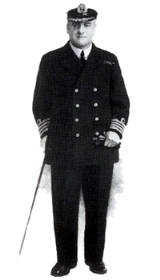
Mansfield Smith-Cumming

Encyclopedia
Captain
Sir George Mansfield Smith-Cumming, KCMG
, CB
(1 April 1859 – 14 June 1923) was the first director of what would become the Secret Intelligence Service
(SIS), also known as MI6. In this role he was particularly successful in building a post-imperial intelligence service.
, of Föelallt House, Cardigan Kent
, and his wife, Maria Sarah Tyser. His father was the great grandson of John Smith (a director of both the South Sea Company and the East India Company), the second son of Abel Smith (d.1756) the Nottingham Banker. Smith attended the Royal Naval College
at Dartmouth
from the age of thirteen and, upon graduation, was commissioned to the Navy as a sub-lieutenant. He was posted to HMS Bellerophon
in 1878, and for the next seven years served in operations against Malay pirates (during 1875–6) and in Egypt
in 1883. However, he increasingly suffered from severe seasickness, and in 1885 was placed on the retired list as "unfit for service".
He was recalled to duty into the foreign section of Naval Intelligence
in 1898, and undertook ‘special service’, including occasional intelligence work abroad, but his main work for the next decade was the construction and command of the Southampton
boom defences. He also travelled through eastern Germany
and the Balkans
pretending to be a highly successful German businessman
, despite not speaking German
. His work was so successful that he was recruited to the Secret Service Bureau (SSB) as the director of the foreign section.
In 1885 Cumming married Dora, daughter of Henry Cloete of Great Constantia, Cape Colony. After her death he married, on 13 March 1889, a Scottish heiress, Leslie Marian (May), daughter of Captain Lockhart Muir Valiant (afterwards Cumming), of the 1st Bombay Lancers and Logie, Moray. As part of the marriage settlement he changed his surname to Smith-Cumming, later becoming known as Cumming. Their only son, Alastair, a dangerous driver like his father, was killed in October 1914, driving Cumming's Rolls in France. According to an unconfirmed legend, Cumming himself hacked off his own broken leg with a penknife in the same accident.
and Military Intelligence Branch arms of the Royal Navy and British Army were responsible. Over the next few years he became known as 'C', after his habit of initialing papers he had read with a C written in green ink. This habit became a custom for later directors, although the C now stands for "Chief". Ian Fleming
took these aspects for his "M", Sir Miles Messervy - using Cumming's other initial for the name and having M always write in green ink.
In 1914, he was involved in a serious road accident in France, in which his son was killed. Legend has it that in order to escape the car wreck he was forced to amputate his own leg using a pen knife. Hospital records have shown however that while both his legs were broken, his left foot was only amputated the day after the accident. Later he often told all sorts of fantastic stories as to how he lost his leg, and would shock people by interrupting meetings in his office by suddenly stabbing his artificial leg with a knife, letter opener or fountain pen.
Budgets were severely limited prior to World War I
, and Smith-Cumming came to rely heavily on Sidney Reilly
(aka the Ace of Spies), a secret agent
of dubious veracity based in Saint Petersburg
. He described pre-1914 espionage as ‘capital sport’, but was given few resources with which to pursue it. His early operations were directed almost entirely against Germany. Between 1909 and 1914 he recruited part-time ‘casual agents’ in the shipping and arms business to keep track of naval construction in German shipyards and acquire other technical intelligence. He also had agents collecting German intelligence in Brussels
, Rotterdam
, and St Petersburg.
of the Special Branch
to arrest twenty-two German spies in England. Eleven were executed, as was Sir Roger Casement
, found guilty of treason
in 1916. During the war, the offices were renamed: the Home Section became MI5
or Security Service
, while Smith-Cumming's Foreign Section became MI6 or the Secret Intelligence Service. Agents who worked for MI6 during the war included Augustus Agar
, Paul Dukes, John Buchan
, Compton Mackenzie
and W. Somerset Maugham
.
When SSB discovered that semen
made a good invisible ink
his agents adopted the motto "Every man his own stylo
".
With the outbreak of the First World War, Cumming's control of strategic intelligence gathering as head of the wartime MI1c was challenged by two rival networks run by general headquarters. Cumming eventually out-performed his rivals. His most important wartime network, ‘La Dame Blanche
’, had by January 1918 over 400 agents reporting on German troop movements from occupied Belgium and northern France. Cumming was less successful in post-revolutionary Russia. Despite a series of colourful exploits, his agents obtained little Russian intelligence of value.
Secret Service budgets were once again severely cut after the end of World War I, and MI6 stations in Madrid
, Lisbon
, Zürich
and Luxembourg
were closed. Cumming succeeded, however, in gaining a monopoly of espionage and counter-intelligence outside Britain and the empire. He also established a network of SIS station commanders operating overseas under diplomatic cover.
With MI5 reduced to a skeleton staff of just 28 officers and relegated to the sidelines, and with Thomson unable to contain or penetrate the revitalized IRA with a series of clumsy and hastily organized police intelligence operations, it fell to Smith-Cumming and SIS (then MI1(c)) to organize a new espionage unit in Ireland, based on continental lines and called the Dublin District Special Branch, in mid-1920.
The DDSB consisted of some 20 line officers drawn from the regular army and trained by Smith-Cumming's department in London. Beyond that, however, Smith-Cumming began importing some of his own veteran case officers into Ireland from Egypt, Palestine and India, while Basil Thomson organized a special unit consisting of 60 hastily vetted ethnically Irish street agents managed via impersonal communications from Scotland Yard in London.
On Sunday, 21 November 1920, the Headquarters Intelligence Staff of the IRA, and its special Counterintelligence Branch (known as "The Squad") under the leadership of IRA Intelligence Chief and IRA Adjutant General Michael Collins
, mounted a successful operation
to assassinate 14 of Smith-Cumming's case officers. While many more appear to have escaped the IRA execution squads that morning, Whitehall feared that more of its professional agents would be identified and suffer the same fate and this prompted the hasty withdrawal of most of the remaining SIS agents from Ireland in the days that followed. This was the single greatest catastrophe in the history of the British Secret Service, and according to author Nigel West, Smith-Cumming was forever after reluctant to involve the SIS in Irish operations.
He also had a fascination with most forms of transport, driving his Rolls at high speed around the streets of London. In his early fifties he took up flying, gaining both French aviators' and Royal Aero Club certificates. But his main passion was boating in Southampton Water
and other waters calmer than those which had ended his active service career. In addition to owning ‘any number’ of yachts, Cumming acquired six motor boats. In 1905 he became one of the founders and first rear-commodore of the Royal Motor Yacht Club.
He was appointed CB in 1914 and KCMG in 1919. He died suddenly at his home, 1 Melbury Road, Kensington, London, on 14 June 1923, shortly before he was due to retire.
, he was portrayed by Norman Rodway
.
He was mentioned in the Comedy Central
television satire-newscast, Colbert Report October 11, 2010. http://www.colbertnation.com/full-episodes/mon-october-11-2010-robert-reich
Cumming's life was discussed in a third series episode of QI
.
Captain (Royal Navy)
Captain is a senior officer rank of the Royal Navy. It ranks above Commander and below Commodore and has a NATO ranking code of OF-5. The rank is equivalent to a Colonel in the British Army or Royal Marines and to a Group Captain in the Royal Air Force. The rank of Group Captain is based on the...
Sir George Mansfield Smith-Cumming, KCMG
Order of St Michael and St George
The Most Distinguished Order of Saint Michael and Saint George is an order of chivalry founded on 28 April 1818 by George, Prince Regent, later George IV of the United Kingdom, while he was acting as Prince Regent for his father, George III....
, CB
Order of the Bath
The Most Honourable Order of the Bath is a British order of chivalry founded by George I on 18 May 1725. The name derives from the elaborate mediæval ceremony for creating a knight, which involved bathing as one of its elements. The knights so created were known as Knights of the Bath...
(1 April 1859 – 14 June 1923) was the first director of what would become the Secret Intelligence Service
Secret Intelligence Service
The Secret Intelligence Service is responsible for supplying the British Government with foreign intelligence. Alongside the internal Security Service , the Government Communications Headquarters and the Defence Intelligence , it operates under the formal direction of the Joint Intelligence...
(SIS), also known as MI6. In this role he was particularly successful in building a post-imperial intelligence service.
Early military career
Born Mansfield George Smith on April 1, 1859 in British India, the youngest in the family of five sons and eight daughters of Colonel John Thomas Smith (1805–1882) of the Royal EngineersRoyal Engineers
The Corps of Royal Engineers, usually just called the Royal Engineers , and commonly known as the Sappers, is one of the corps of the British Army....
, of Föelallt House, Cardigan Kent
Kent
Kent is a county in southeast England, and is one of the home counties. It borders East Sussex, Surrey and Greater London and has a defined boundary with Essex in the middle of the Thames Estuary. The ceremonial county boundaries of Kent include the shire county of Kent and the unitary borough of...
, and his wife, Maria Sarah Tyser. His father was the great grandson of John Smith (a director of both the South Sea Company and the East India Company), the second son of Abel Smith (d.1756) the Nottingham Banker. Smith attended the Royal Naval College
Britannia Royal Naval College
Britannia Royal Naval College is the initial officer training establishment of the Royal Navy, located on a hill overlooking Dartmouth, Devon, England. While Royal Naval officer training has taken place in the town since 1863, the buildings which are seen today were only finished in 1905, and...
at Dartmouth
Dartmouth, Devon
Dartmouth is a town and civil parish in the English county of Devon. It is a tourist destination set on the banks of the estuary of the River Dart, which is a long narrow tidal ria that runs inland as far as Totnes...
from the age of thirteen and, upon graduation, was commissioned to the Navy as a sub-lieutenant. He was posted to HMS Bellerophon
HMS Bellerophon (1865)
HMS Bellerophon was a central battery ironclad built for the Royal Navy in the mid-1860s.-Design and description:In this ship, designed by Sir Edward Reed, the power-to-weight ratio was increased; the long rows of guns on the broadside were replaced by a small number of guns, centrally placed, of...
in 1878, and for the next seven years served in operations against Malay pirates (during 1875–6) and in Egypt
Egypt
Egypt , officially the Arab Republic of Egypt, Arabic: , is a country mainly in North Africa, with the Sinai Peninsula forming a land bridge in Southwest Asia. Egypt is thus a transcontinental country, and a major power in Africa, the Mediterranean Basin, the Middle East and the Muslim world...
in 1883. However, he increasingly suffered from severe seasickness, and in 1885 was placed on the retired list as "unfit for service".
He was recalled to duty into the foreign section of Naval Intelligence
Naval Intelligence Division
The Naval Intelligence Division was the intelligence arm of the British Admiralty before the establishment of a unified Defence Staff in 1965. It dealt with matters concerning British naval plans, with the collection of naval intelligence...
in 1898, and undertook ‘special service’, including occasional intelligence work abroad, but his main work for the next decade was the construction and command of the Southampton
Southampton
Southampton is the largest city in the county of Hampshire on the south coast of England, and is situated south-west of London and north-west of Portsmouth. Southampton is a major port and the closest city to the New Forest...
boom defences. He also travelled through eastern Germany
Germany
Germany , officially the Federal Republic of Germany , is a federal parliamentary republic in Europe. The country consists of 16 states while the capital and largest city is Berlin. Germany covers an area of 357,021 km2 and has a largely temperate seasonal climate...
and the Balkans
Balkans
The Balkans is a geopolitical and cultural region of southeastern Europe...
pretending to be a highly successful German businessman
Businessperson
A businessperson is someone involved in a particular undertaking of activities for the purpose of generating revenue from a combination of human, financial, or physical capital. An entrepreneur is an example of a business person...
, despite not speaking German
German language
German is a West Germanic language, related to and classified alongside English and Dutch. With an estimated 90 – 98 million native speakers, German is one of the world's major languages and is the most widely-spoken first language in the European Union....
. His work was so successful that he was recruited to the Secret Service Bureau (SSB) as the director of the foreign section.
In 1885 Cumming married Dora, daughter of Henry Cloete of Great Constantia, Cape Colony. After her death he married, on 13 March 1889, a Scottish heiress, Leslie Marian (May), daughter of Captain Lockhart Muir Valiant (afterwards Cumming), of the 1st Bombay Lancers and Logie, Moray. As part of the marriage settlement he changed his surname to Smith-Cumming, later becoming known as Cumming. Their only son, Alastair, a dangerous driver like his father, was killed in October 1914, driving Cumming's Rolls in France. According to an unconfirmed legend, Cumming himself hacked off his own broken leg with a penknife in the same accident.
Pre-1914
In 1909, Major (later Colonel Sir) Vernon Kell became director of the newly formed Secret Intelligence Bureau (SIB), created as a response to growing public opinion that all Germans living in England were spies. In 1911, the various security organizations were re-organised under the SIB, Kell's division becoming the Home Section, and Cumming's becoming the new Foreign Section, responsible for all operations outside Britain. His remit did not cover the gathering of information on foreign navies or military for which the Naval Intelligence DivisionNaval Intelligence Division
The Naval Intelligence Division was the intelligence arm of the British Admiralty before the establishment of a unified Defence Staff in 1965. It dealt with matters concerning British naval plans, with the collection of naval intelligence...
and Military Intelligence Branch arms of the Royal Navy and British Army were responsible. Over the next few years he became known as 'C', after his habit of initialing papers he had read with a C written in green ink. This habit became a custom for later directors, although the C now stands for "Chief". Ian Fleming
Ian Fleming
Ian Lancaster Fleming was a British author, journalist and Naval Intelligence Officer.Fleming is best known for creating the fictional British spy James Bond and for a series of twelve novels and nine short stories about the character, one of the biggest-selling series of fictional books of...
took these aspects for his "M", Sir Miles Messervy - using Cumming's other initial for the name and having M always write in green ink.
In 1914, he was involved in a serious road accident in France, in which his son was killed. Legend has it that in order to escape the car wreck he was forced to amputate his own leg using a pen knife. Hospital records have shown however that while both his legs were broken, his left foot was only amputated the day after the accident. Later he often told all sorts of fantastic stories as to how he lost his leg, and would shock people by interrupting meetings in his office by suddenly stabbing his artificial leg with a knife, letter opener or fountain pen.
Budgets were severely limited prior to World War I
World War I
World War I , which was predominantly called the World War or the Great War from its occurrence until 1939, and the First World War or World War I thereafter, was a major war centred in Europe that began on 28 July 1914 and lasted until 11 November 1918...
, and Smith-Cumming came to rely heavily on Sidney Reilly
Sidney Reilly
Lieutenant Sidney George Reilly, MC , famously known as the Ace of Spies, was a Jewish Russian-born adventurer and secret agent employed by Scotland Yard, the British Secret Service Bureau and later the Secret Intelligence Service . He is alleged to have spied for at least four nations...
(aka the Ace of Spies), a secret agent
Secret Agent
Secret Agent is a British film directed by Alfred Hitchcock, loosely based on two stories in Ashenden: Or the British Agent by W. Somerset Maugham. The film starred John Gielgud, Peter Lorre, Madeleine Carroll, and Robert Young...
of dubious veracity based in Saint Petersburg
Saint Petersburg
Saint Petersburg is a city and a federal subject of Russia located on the Neva River at the head of the Gulf of Finland on the Baltic Sea...
. He described pre-1914 espionage as ‘capital sport’, but was given few resources with which to pursue it. His early operations were directed almost entirely against Germany. Between 1909 and 1914 he recruited part-time ‘casual agents’ in the shipping and arms business to keep track of naval construction in German shipyards and acquire other technical intelligence. He also had agents collecting German intelligence in Brussels
Brussels
Brussels , officially the Brussels Region or Brussels-Capital Region , is the capital of Belgium and the de facto capital of the European Union...
, Rotterdam
Rotterdam
Rotterdam is the second-largest city in the Netherlands and one of the largest ports in the world. Starting as a dam on the Rotte river, Rotterdam has grown into a major international commercial centre...
, and St Petersburg.
WW1
At the outbreak of war he was able to work with Vernon Kell and Sir Basil ThomsonBasil Thomson
Sir Basil Home Thomson, KCB was a British intelligence officer, police officer, prison governor, colonial administrator, and writer.-Early life:...
of the Special Branch
Special Branch
Special Branch is a label customarily used to identify units responsible for matters of national security in British and Commonwealth police forces, as well as in the Royal Thai Police...
to arrest twenty-two German spies in England. Eleven were executed, as was Sir Roger Casement
Roger Casement
Roger David Casement —Sir Roger Casement CMG between 1911 and shortly before his execution for treason, when he was stripped of his British honours—was an Irish patriot, poet, revolutionary, and nationalist....
, found guilty of treason
Treason
In law, treason is the crime that covers some of the more extreme acts against one's sovereign or nation. Historically, treason also covered the murder of specific social superiors, such as the murder of a husband by his wife. Treason against the king was known as high treason and treason against a...
in 1916. During the war, the offices were renamed: the Home Section became MI5
MI5
The Security Service, commonly known as MI5 , is the United Kingdom's internal counter-intelligence and security agency and is part of its core intelligence machinery alongside the Secret Intelligence Service focused on foreign threats, Government Communications Headquarters and the Defence...
or Security Service
MI5
The Security Service, commonly known as MI5 , is the United Kingdom's internal counter-intelligence and security agency and is part of its core intelligence machinery alongside the Secret Intelligence Service focused on foreign threats, Government Communications Headquarters and the Defence...
, while Smith-Cumming's Foreign Section became MI6 or the Secret Intelligence Service. Agents who worked for MI6 during the war included Augustus Agar
Augustus Agar
Captain Augustus Willington Shelton Agar, VC, DSO, RN was a noted Royal Navy officer in both World War I and World War II and a recipient of the Victoria Cross, the highest and most prestigious award for gallantry in the face of the enemy that can be awarded to British and Commonwealth forces.In...
, Paul Dukes, John Buchan
John Buchan, 1st Baron Tweedsmuir
John Buchan, 1st Baron Tweedsmuir was a Scottish novelist, historian and Unionist politician who served as Governor General of Canada, the 15th since Canadian Confederation....
, Compton Mackenzie
Compton Mackenzie
Sir Compton Mackenzie, OBE was a writer and a Scottish nationalist.-Background:Compton Mackenzie was born in West Hartlepool, England, into a theatrical family of Mackenzies, but many of whose members used Compton as their stage surname, starting with his grandfather Henry Compton, a well-known...
and W. Somerset Maugham
W. Somerset Maugham
William Somerset Maugham , CH was an English playwright, novelist and short story writer. He was among the most popular writers of his era and, reputedly, the highest paid author during the 1930s.-Childhood and education:...
.
When SSB discovered that semen
Semen
Semen is an organic fluid, also known as seminal fluid, that may contain spermatozoa. It is secreted by the gonads and other sexual organs of male or hermaphroditic animals and can fertilize female ova...
made a good invisible ink
Invisible ink
Invisible ink, also known as security ink, is a substance used for writing, which is invisible either on application or soon thereafter, and which later on can be made visible by some means. Invisible ink is one form of steganography, and it has been used in espionage...
his agents adopted the motto "Every man his own stylo
Stylus
A stylus is a writing utensil, or a small tool for some other form of marking or shaping, for example in pottery. The word is also used for a computer accessory . It usually refers to a narrow elongated staff, similar to a modern ballpoint pen. Many styli are heavily curved to be held more easily...
".
With the outbreak of the First World War, Cumming's control of strategic intelligence gathering as head of the wartime MI1c was challenged by two rival networks run by general headquarters. Cumming eventually out-performed his rivals. His most important wartime network, ‘La Dame Blanche
La Dame blanche
La dame blanche is an opéra comique in three acts by the French composer François-Adrien Boieldieu. The libretto was written by Eugène Scribe and is based on episodes from no less than five of the works by Scottish writer Sir Walter Scott, including his novels The Monastery, Guy Mannering, and The...
’, had by January 1918 over 400 agents reporting on German troop movements from occupied Belgium and northern France. Cumming was less successful in post-revolutionary Russia. Despite a series of colourful exploits, his agents obtained little Russian intelligence of value.
Secret Service budgets were once again severely cut after the end of World War I, and MI6 stations in Madrid
Madrid
Madrid is the capital and largest city of Spain. The population of the city is roughly 3.3 million and the entire population of the Madrid metropolitan area is calculated to be 6.271 million. It is the third largest city in the European Union, after London and Berlin, and its metropolitan...
, Lisbon
Lisbon
Lisbon is the capital city and largest city of Portugal with a population of 545,245 within its administrative limits on a land area of . The urban area of Lisbon extends beyond the administrative city limits with a population of 3 million on an area of , making it the 9th most populous urban...
, Zürich
Zürich
Zurich is the largest city in Switzerland and the capital of the canton of Zurich. It is located in central Switzerland at the northwestern tip of Lake Zurich...
and Luxembourg
Luxembourg
Luxembourg , officially the Grand Duchy of Luxembourg , is a landlocked country in western Europe, bordered by Belgium, France, and Germany. It has two principal regions: the Oesling in the North as part of the Ardennes massif, and the Gutland in the south...
were closed. Cumming succeeded, however, in gaining a monopoly of espionage and counter-intelligence outside Britain and the empire. He also established a network of SIS station commanders operating overseas under diplomatic cover.
Anglo-Irish War
When Britain's Government Committee on Intelligence decided to slash Kell's budget and staff and subordinate MI5 under a new Home Office Civil Intelligence Directorate led by Special Branch's Sir Basil Thomson in January 1919, the powerful MI5/Special Branch partnership that admirably managed counterintelligence and subversives during the war was suddenly thrown into disarray. These bureaucratic intrigues happened at the very moment that the Irish abstentionist party, Sinn Féin, and the Irish Republican Army (IRA) were launching their own independence campaign.With MI5 reduced to a skeleton staff of just 28 officers and relegated to the sidelines, and with Thomson unable to contain or penetrate the revitalized IRA with a series of clumsy and hastily organized police intelligence operations, it fell to Smith-Cumming and SIS (then MI1(c)) to organize a new espionage unit in Ireland, based on continental lines and called the Dublin District Special Branch, in mid-1920.
The DDSB consisted of some 20 line officers drawn from the regular army and trained by Smith-Cumming's department in London. Beyond that, however, Smith-Cumming began importing some of his own veteran case officers into Ireland from Egypt, Palestine and India, while Basil Thomson organized a special unit consisting of 60 hastily vetted ethnically Irish street agents managed via impersonal communications from Scotland Yard in London.
On Sunday, 21 November 1920, the Headquarters Intelligence Staff of the IRA, and its special Counterintelligence Branch (known as "The Squad") under the leadership of IRA Intelligence Chief and IRA Adjutant General Michael Collins
Michael Collins (Irish leader)
Michael "Mick" Collins was an Irish revolutionary leader, Minister for Finance and Teachta Dála for Cork South in the First Dáil of 1919, Director of Intelligence for the IRA, and member of the Irish delegation during the Anglo-Irish Treaty negotiations. Subsequently, he was both Chairman of the...
, mounted a successful operation
Bloody Sunday (1920)
Bloody Sunday was a day of violence in Dublin on 21 November 1920, during the Irish War of Independence. In total, 31 people were killed – fourteen British, fourteen Irish civilians and three republican prisoners....
to assassinate 14 of Smith-Cumming's case officers. While many more appear to have escaped the IRA execution squads that morning, Whitehall feared that more of its professional agents would be identified and suffer the same fate and this prompted the hasty withdrawal of most of the remaining SIS agents from Ireland in the days that followed. This was the single greatest catastrophe in the history of the British Secret Service, and according to author Nigel West, Smith-Cumming was forever after reluctant to involve the SIS in Irish operations.
Other interests
To the end of his life Cumming retained an infectious, if sometimes eccentric, enthusiasm for the tradecraft and mystification of espionage, experimenting personally with disguises, mechanical gadgets, and secret inks in his own laboratory.He also had a fascination with most forms of transport, driving his Rolls at high speed around the streets of London. In his early fifties he took up flying, gaining both French aviators' and Royal Aero Club certificates. But his main passion was boating in Southampton Water
Southampton Water
Southampton Water is a tidal estuary north of the Solent and the Isle of Wight in England. The city of Southampton lies at its most northerly point. Along its salt marsh-fringed western shores lie the New Forest villages of Hythe and "the waterside", Dibden Bay, and the Esso oil refinery at Fawley...
and other waters calmer than those which had ended his active service career. In addition to owning ‘any number’ of yachts, Cumming acquired six motor boats. In 1905 he became one of the founders and first rear-commodore of the Royal Motor Yacht Club.
He was appointed CB in 1914 and KCMG in 1919. He died suddenly at his home, 1 Melbury Road, Kensington, London, on 14 June 1923, shortly before he was due to retire.
Portrayal in popular culture
In the television series Reilly, Ace of SpiesReilly, Ace of Spies
Reilly, Ace of Spies is a 1983 television miniseries dramatizing the life of Sidney Reilly, a Russian Jew who became one of the greatest spies to ever work for the British. Among his exploits in the early 20th century were the infiltration of the German General Staff in 1917 and a near-overthrow of...
, he was portrayed by Norman Rodway
Norman Rodway
-Early life:Rodway was born in Dublin to English parents, Frank and Lillian Rodway. He studied classics, graduating at Trinity College. He worked as an accountant, teacher, and university lecturer before acting.-Career:...
.
He was mentioned in the Comedy Central
Comedy Central
Comedy Central is an American cable television and satellite television channel that carries comedy programming, both original and syndicated....
television satire-newscast, Colbert Report October 11, 2010. http://www.colbertnation.com/full-episodes/mon-october-11-2010-robert-reich
Cumming's life was discussed in a third series episode of QI
QI
QI is a British comedy panel game television quiz show created and co-produced by John Lloyd, hosted by Stephen Fry, and featuring permanent panellist Alan Davies. Most of the questions are extremely obscure, making it unlikely that the correct answer will be given...
.
Further reading
- Judd, Alan: The Quest For C - Mansfield Cumming And The Founding Of The Secret Service; HarperCollinsPublishers, 1999, ISBN 0002559013
- Andrew, C: Secret service: the making of the British intelligence community; 1985
- Hiley, N: The failure of British espionage against Germany, 1907–1914, HJ, 26 (1983), 867–89
- West, N: MI5 London: Prendeville Publishers, 1972.
See also
- Vernon Kell
- Sir Robert Bruce Lockhart
- Sidney ReillySidney ReillyLieutenant Sidney George Reilly, MC , famously known as the Ace of Spies, was a Jewish Russian-born adventurer and secret agent employed by Scotland Yard, the British Secret Service Bureau and later the Secret Intelligence Service . He is alleged to have spied for at least four nations...
- Boris SavinkovBoris SavinkovBoris Viktorovich Savinkov was a Russian writer and revolutionary terrorist...
- William MelvilleWilliam MelvilleWilliam Melville was an Irish law enforcement officer and the first chief of the British Secret Service, forerunner of MI5.-Birth:...
- Charles CummingCharles CummingCharles Cumming is a British writer of spy fiction. The son of Ian Cumming and Caroline Pilkington , he was educated at Ludgrove School , Eton College and the University of Edinburgh , where he graduated with 1st Class Honours in English Literature...