

Orogeny

Encyclopedia
Orogeny refers to forces and events leading to a severe structural deformation of the Earth's crust due to the engagement of tectonic plates. Response to such engagement results in the formation of long tracts of highly deformed rock called orogens or orogenic belts. The word "orogeny" comes from the Greek
(oros for "mountain" plus genesis for "creation" or "origin"), and it is the primary mechanism by which mountains are built
on continents. Orogens develop while a continental plate is crumpled and thickened to form mountain range
s, and involve a great range of geological processes collectively called orogenesis.
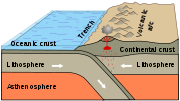
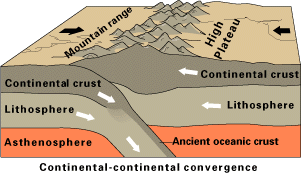 Formation of an orogen is accomplished in part by the tectonic processes of subduction
, where a continent
rides forcefully over an oceanic plate (noncollisional orogens), or convergence of two or more continents (collisional orogens).
Orogeny usually produces long arcuate (from arcuare, to bend like a bow) structures, known as orogenic belts. Generally, orogenic belts consist of long parallel strips of rock
exhibiting similar characteristics along the length of the belt. Orogenic belts are associated with subduction zones, which consume crust
, produce volcanoes, and build island arc
s. The arcuate structure is attributed to the rigidity of the descending plate, and island arc cusps are related to tears in the descending lithosphere. These island arcs may be added to a continent
during an orogenic event.
The processes of orogeny can take tens of millions of years and build mountains from plains or the ocean floor
. The topographic height of orogenic mountains is related to the principle of isostasy
, that is, a balance of the downward gravitational force
upon an upthrust mountain range (composed of light, continental crust
material) and the buoyant upward forces exerted by the dense underlying mantle
.
Frequently, rock formation
s that undergo orogeny are severely deformed and undergo metamorphism
. During orogeny, deeply buried rocks may be pushed to the surface. Sea bottom and near shore material may cover some or all of the orogenic area. If the orogeny is due to two continents colliding, the resulting mountains can be very high (see Himalaya).
An orogenic event may be studied as (a) a tectonic structural event, (b) as a geographical event, and (c) a chronological event. Orogenic events (a) cause distinctive structural phenomena related to tectonic activity, (b) affect rocks and crust in particular regions, and (c) happen within a specific period of time.
, the tectonic forces result in a variety of associated phenomena, including magma
tization, metamorphism
, crustal melting, and crustal thickening. Just what happens in a specific orogen depends upon the strength and rheology
of the continental lithosphere, and how these properties change during orogenesis.
In addition to orogeny, the orogen once formed is subject to other processes, such as sedimentation
and erosion
. The sequence of repeated cycles of sedimentation
, deposition
and erosion
, followed by burial and metamorphism
, and then by formation of granitic batholiths and tectonic uplift
to form mountain chains, is called the orogenic cycle. For example, the Caledonian Orogeny
refers to the Silurian
and Devonian
events that resulted from the collision of Laurentia
with Eastern Avalonia
and other former fragments of Gondwana
. The Caledonian Orogen resulted from these events and various others that are part of its peculiar orogenic cycle.
In summary, an orogeny is a long-lived deformational episode in which many geological phenomena play a role. The orogeny of an orogen is only part of the orogen's orogenic cycle. Among the other phases is erosion, described next.
inevitably removes much of the mountains, exposing the core or mountain roots (metamorphic rocks brought to the surface from a depth of several kilometres). Such exhumation may be helped by isostatic movements balancing out the buoyancy of the evolving orogen. There is debate about the extent to which erosion modifies the patterns of tectonic deformation (see erosion and tectonics
). Thus, the final form of the majority of old orogenic belts is a long arcuate strip of crystalline metamorphic rocks sequentially below younger sediments which are thrust atop them and dip away from the orogenic core.
An orogen may be almost completely eroded
away, and only recognizable by studying (old) rocks that bear traces of orogenesis. Orogens are usually long, thin, arcuate tracts of rock that have a pronounced linear structure resulting in terrane
s or blocks of deformed rocks, separated generally by suture zones
or dipping
thrust fault
s. These thrust faults carry relatively thin slices of rock (which are called nappe
s or thrust sheets, and differ from tectonic plates) from the core of the shortening orogen out toward the margins, and are intimately associated with folds
and the development of metamorphism
.
(the study of the distribution and evolution of flora and fauna), geography
and mid ocean ridges in the 1950s and 1960s, contributed greatly to the theory of plate tectonics. Even at a very early stage, life played a significant role in the continued existence of oceans, by affecting the composition of the atmosphere. The existence of oceans is critical to sea-floor spreading and subduction.
occurs through a number of mechanisms.
Large modern orogenies often lie on the margins of continents; the Alleghenian
(Appalachian), Laramide
, and Andean orogenies are examples of these in the Americas. Older inactive orogenies, such as the Algoman
, Penokean
and Antler
, are represented by deformed rocks and sedimentary basins further inland.
Areas that are rifting apart, such as mid-ocean ridge
s and the East African Rift
, have mountains due to thermal buoyancy related to the hot mantle underneath them; this thermal buoyancy is known as dynamic topography
. In strike-slip systems, such as the San Andreas Fault
, restraining bends result in regions of localized crustal shortening and mountain building without a plate-margin-wide orogeny. Hotspot
volcanism results in the formation of isolated mountains and mountain chains that are not necessarily on tectonic plate boundaries.
Regions can also experience uplift as a result of delamination of the lithosphere
, in which an unstable portion of cold lithospheric
root drips down into the mantle, decreasing the density of the lithosphere and causing buoyant uplift. An example is the Sierra Nevada in California. This range of fault-block mountain
s experienced renewed uplift after a delamination of the lithosphere beneath them.
Finally, uplift and erosion related to epeirogenesis
(large-scale vertical motions of portions of continents without much associated folding, metamorphism, or deformation) can create local topographic highs.
during the 19th century, the presence of mountains was explained in Christian
contexts as a result of the Biblical Deluge. This was an extension of Neoplatonic thought, which influenced early Christian writers.
Orogeny was used by Amanz Gressly
(1840) and Jules Thurmann (1854) as orogenic in terms of the creation of mountain elevations, as the term mountain building was still used to describe the processes.
Elie de Beaumont (1852) used the evocative "Jaws of a Vise" theory to explain orogeny, but was more concerned with the height rather than the implicit structures created by and contained in orogenic belts. His theory essentially held that mountains were created by the squeezing of certain rocks.
Eduard Suess
(1875) recognised the importance of horizontal movement of rocks. The concept of a precursor geosyncline
or initial downward warping of the solid earth (Hall, 1859) prompted James Dwight Dana
(1873) to include the concept of compression in the theories surrounding mountain-building. With hindsight, we can discount Dana's conjecture that this contraction was due to the cooling of the Earth (aka the cooling Earth
theory).
The cooling Earth theory was the chief paradigm for most geologists until the 1960s. It was, in the context of orogeny, fiercely contested by proponents of vertical movements in the crust (similar to tephrotectonics), or convection within the asthenosphere
or mantle
.
Gustav Steinmann (1906) recognised different classes of orogenic belts, including the Alpine type orogenic belt, typified by a flysch
and molasse
geometry to the sediments; ophiolite sequences, tholeiitic basalts, and a nappe
style fold structure.
In terms of recognising orogeny as an event, Leopold von Buch (1855) recognised that orogenies could be placed in time by bracketing between the youngest deformed rock and the oldest undeformed rock, a principle which is still in use today, though commonly investigated by geochronology
using radiometric dating.
H.J. Zwart (1967) drew attention to the metamorphic differences in orogenic belts, proposing three types, modified by W. S. Pitcher in 1979 and further modified as:
The advent of plate tectonics has explained the vast majority of orogenic belts and their features. The cooling earth theory (principally advanced by Descartes) is dispensed with, and tephrotectonic style vertical movements have been explained primarily by the process of isostasy
.
Some oddities exist, where simple collisional tectonics are modified in a transform plate boundary, such as in New Zealand
, or where island arc orogenies, for instance in New Guinea
occur away from a continental backstop. Further complications such as Proterozoic continent-continent collisional orogens, explicitly the Musgrave Block
in Australia, previously inexplicable (see Dennis, 1982) are being brought to light with the advent of seismic imaging techniques which can resolve the deep crust structure of orogenic belts.
Greek language
Greek is an independent branch of the Indo-European family of languages. Native to the southern Balkans, it has the longest documented history of any Indo-European language, spanning 34 centuries of written records. Its writing system has been the Greek alphabet for the majority of its history;...
(oros for "mountain" plus genesis for "creation" or "origin"), and it is the primary mechanism by which mountains are built
Mountain formation
Mountain formation refers to the geological processes that underlie the formation of mountains. These processes are associated with large-scale movements of the earth's crust ....
on continents. Orogens develop while a continental plate is crumpled and thickened to form mountain range
Mountain range
A mountain range is a single, large mass consisting of a succession of mountains or narrowly spaced mountain ridges, with or without peaks, closely related in position, direction, formation, and age; a component part of a mountain system or of a mountain chain...
s, and involve a great range of geological processes collectively called orogenesis.
Physiography
Subduction
In geology, subduction is the process that takes place at convergent boundaries by which one tectonic plate moves under another tectonic plate, sinking into the Earth's mantle, as the plates converge. These 3D regions of mantle downwellings are known as "Subduction Zones"...
, where a continent
Continent
A continent is one of several very large landmasses on Earth. They are generally identified by convention rather than any strict criteria, with seven regions commonly regarded as continents—they are : Asia, Africa, North America, South America, Antarctica, Europe, and Australia.Plate tectonics is...
rides forcefully over an oceanic plate (noncollisional orogens), or convergence of two or more continents (collisional orogens).
Orogeny usually produces long arcuate (from arcuare, to bend like a bow) structures, known as orogenic belts. Generally, orogenic belts consist of long parallel strips of rock
Rock (geology)
In geology, rock or stone is a naturally occurring solid aggregate of minerals and/or mineraloids.The Earth's outer solid layer, the lithosphere, is made of rock. In general rocks are of three types, namely, igneous, sedimentary, and metamorphic...
exhibiting similar characteristics along the length of the belt. Orogenic belts are associated with subduction zones, which consume crust
Crust (geology)
In geology, the crust is the outermost solid shell of a rocky planet or natural satellite, which is chemically distinct from the underlying mantle...
, produce volcanoes, and build island arc
Island arc
An island arc is a type of archipelago composed of a chain of volcanoes which alignment is arc-shaped, and which are situated parallel and close to a boundary between two converging tectonic plates....
s. The arcuate structure is attributed to the rigidity of the descending plate, and island arc cusps are related to tears in the descending lithosphere. These island arcs may be added to a continent
Continent
A continent is one of several very large landmasses on Earth. They are generally identified by convention rather than any strict criteria, with seven regions commonly regarded as continents—they are : Asia, Africa, North America, South America, Antarctica, Europe, and Australia.Plate tectonics is...
during an orogenic event.
The processes of orogeny can take tens of millions of years and build mountains from plains or the ocean floor
Seabed
The seabed is the bottom of the ocean.- Ocean structure :Most of the oceans have a common structure, created by common physical phenomena, mainly from tectonic movement, and sediment from various sources...
. The topographic height of orogenic mountains is related to the principle of isostasy
Isostasy
Isostasy is a term used in geology to refer to the state of gravitational equilibrium between the earth's lithosphere and asthenosphere such that the tectonic plates "float" at an elevation which depends on their thickness and density. This concept is invoked to explain how different topographic...
, that is, a balance of the downward gravitational force
Newton's law of universal gravitation
Newton's law of universal gravitation states that every point mass in the universe attracts every other point mass with a force that is directly proportional to the product of their masses and inversely proportional to the square of the distance between them...
upon an upthrust mountain range (composed of light, continental crust
Continental crust
The continental crust is the layer of igneous, sedimentary, and metamorphic rocks which form the continents and the areas of shallow seabed close to their shores, known as continental shelves. This layer is sometimes called sial due to more felsic, or granitic, bulk composition, which lies in...
material) and the buoyant upward forces exerted by the dense underlying mantle
Mantle (geology)
The mantle is a part of a terrestrial planet or other rocky body large enough to have differentiation by density. The interior of the Earth, similar to the other terrestrial planets, is chemically divided into layers. The mantle is a highly viscous layer between the crust and the outer core....
.
Frequently, rock formation
Rock formation
This is a list of rock formations that include isolated, scenic, or spectacular surface rock outcrops. These formations are usually the result of weathering and erosion sculpting the existing rock...
s that undergo orogeny are severely deformed and undergo metamorphism
Metamorphism
Metamorphism is the solid-state recrystallization of pre-existing rocks due to changes in physical and chemical conditions, primarily heat, pressure, and the introduction of chemically active fluids. Mineralogical, chemical and crystallographic changes can occur during this process...
. During orogeny, deeply buried rocks may be pushed to the surface. Sea bottom and near shore material may cover some or all of the orogenic area. If the orogeny is due to two continents colliding, the resulting mountains can be very high (see Himalaya).
An orogenic event may be studied as (a) a tectonic structural event, (b) as a geographical event, and (c) a chronological event. Orogenic events (a) cause distinctive structural phenomena related to tectonic activity, (b) affect rocks and crust in particular regions, and (c) happen within a specific period of time.
Orogenic cycle
Although orogeny involves plate tectonicsPlate tectonics
Plate tectonics is a scientific theory that describes the large scale motions of Earth's lithosphere...
, the tectonic forces result in a variety of associated phenomena, including magma
Magma
Magma is a mixture of molten rock, volatiles and solids that is found beneath the surface of the Earth, and is expected to exist on other terrestrial planets. Besides molten rock, magma may also contain suspended crystals and dissolved gas and sometimes also gas bubbles. Magma often collects in...
tization, metamorphism
Metamorphism
Metamorphism is the solid-state recrystallization of pre-existing rocks due to changes in physical and chemical conditions, primarily heat, pressure, and the introduction of chemically active fluids. Mineralogical, chemical and crystallographic changes can occur during this process...
, crustal melting, and crustal thickening. Just what happens in a specific orogen depends upon the strength and rheology
Rheology
Rheology is the study of the flow of matter, primarily in the liquid state, but also as 'soft solids' or solids under conditions in which they respond with plastic flow rather than deforming elastically in response to an applied force....
of the continental lithosphere, and how these properties change during orogenesis.
In addition to orogeny, the orogen once formed is subject to other processes, such as sedimentation
Sedimentation
Sedimentation is the tendency for particles in suspension to settle out of the fluid in which they are entrained, and come to rest against a barrier. This is due to their motion through the fluid in response to the forces acting on them: these forces can be due to gravity, centrifugal acceleration...
and erosion
Erosion
Erosion is when materials are removed from the surface and changed into something else. It only works by hydraulic actions and transport of solids in the natural environment, and leads to the deposition of these materials elsewhere...
. The sequence of repeated cycles of sedimentation
Sedimentation
Sedimentation is the tendency for particles in suspension to settle out of the fluid in which they are entrained, and come to rest against a barrier. This is due to their motion through the fluid in response to the forces acting on them: these forces can be due to gravity, centrifugal acceleration...
, deposition
Deposition (geology)
Deposition is the geological process by which material is added to a landform or land mass. Fluids such as wind and water, as well as sediment flowing via gravity, transport previously eroded sediment, which, at the loss of enough kinetic energy in the fluid, is deposited, building up layers of...
and erosion
Erosion
Erosion is when materials are removed from the surface and changed into something else. It only works by hydraulic actions and transport of solids in the natural environment, and leads to the deposition of these materials elsewhere...
, followed by burial and metamorphism
Metamorphism
Metamorphism is the solid-state recrystallization of pre-existing rocks due to changes in physical and chemical conditions, primarily heat, pressure, and the introduction of chemically active fluids. Mineralogical, chemical and crystallographic changes can occur during this process...
, and then by formation of granitic batholiths and tectonic uplift
Tectonic uplift
Tectonic uplift is a geological process most often caused by plate tectonics which increases elevation. The opposite of uplift is subsidence, which results in a decrease in elevation. Uplift may be orogenic or isostatic.-Orogenic uplift:...
to form mountain chains, is called the orogenic cycle. For example, the Caledonian Orogeny
Caledonian orogeny
The Caledonian orogeny is a mountain building era recorded in the northern parts of the British Isles, the Scandinavian Mountains, Svalbard, eastern Greenland and parts of north-central Europe. The Caledonian orogeny encompasses events that occurred from the Ordovician to Early Devonian, roughly...
refers to the Silurian
Silurian
The Silurian is a geologic period and system that extends from the end of the Ordovician Period, about 443.7 ± 1.5 Mya , to the beginning of the Devonian Period, about 416.0 ± 2.8 Mya . As with other geologic periods, the rock beds that define the period's start and end are well identified, but the...
and Devonian
Devonian
The Devonian is a geologic period and system of the Paleozoic Era spanning from the end of the Silurian Period, about 416.0 ± 2.8 Mya , to the beginning of the Carboniferous Period, about 359.2 ± 2.5 Mya...
events that resulted from the collision of Laurentia
Laurentia
Laurentia is a large area of continental craton, which forms the ancient geological core of the North American continent...
with Eastern Avalonia
Avalonia
Avalonia was a microcontinent in the Paleozoic era. Crustal fragments of this former microcontinent underlie south-west Great Britain, and the eastern coast of North America. It is the source of many of the older rocks of Western Europe, Atlantic Canada, and parts of the coastal United States...
and other former fragments of Gondwana
Gondwana
In paleogeography, Gondwana , originally Gondwanaland, was the southernmost of two supercontinents that later became parts of the Pangaea supercontinent. It existed from approximately 510 to 180 million years ago . Gondwana is believed to have sutured between ca. 570 and 510 Mya,...
. The Caledonian Orogen resulted from these events and various others that are part of its peculiar orogenic cycle.
In summary, an orogeny is a long-lived deformational episode in which many geological phenomena play a role. The orogeny of an orogen is only part of the orogen's orogenic cycle. Among the other phases is erosion, described next.
Erosion
ErosionErosion
Erosion is when materials are removed from the surface and changed into something else. It only works by hydraulic actions and transport of solids in the natural environment, and leads to the deposition of these materials elsewhere...
inevitably removes much of the mountains, exposing the core or mountain roots (metamorphic rocks brought to the surface from a depth of several kilometres). Such exhumation may be helped by isostatic movements balancing out the buoyancy of the evolving orogen. There is debate about the extent to which erosion modifies the patterns of tectonic deformation (see erosion and tectonics
Erosion and tectonics
The interplay between erosion and tectonics has been a matter of debate since the early 1990s. While tectonic effects on surface processes such as erosion have been long recognized, the reverse has only recently been addressed thanks to the availability of computer...
). Thus, the final form of the majority of old orogenic belts is a long arcuate strip of crystalline metamorphic rocks sequentially below younger sediments which are thrust atop them and dip away from the orogenic core.
An orogen may be almost completely eroded
Erosion
Erosion is when materials are removed from the surface and changed into something else. It only works by hydraulic actions and transport of solids in the natural environment, and leads to the deposition of these materials elsewhere...
away, and only recognizable by studying (old) rocks that bear traces of orogenesis. Orogens are usually long, thin, arcuate tracts of rock that have a pronounced linear structure resulting in terrane
Terrane
A terrane in geology is short-hand term for a tectonostratigraphic terrane, which is a fragment of crustal material formed on, or broken off from, one tectonic plate and accreted or "sutured" to crust lying on another plate...
s or blocks of deformed rocks, separated generally by suture zones
Suture (geology)
In structural geology, a suture is a major fault zone through an orogen or mountain range. Sutures separate terranes, tectonic units that have different plate tectonic, metamorphic and paleogeographic histories...
or dipping
Strike and dip
Strike and dip refer to the orientation or attitude of a geologic feature. The strike line of a bed, fault, or other planar feature is a line representing the intersection of that feature with a horizontal plane. On a geologic map, this is represented with a short straight line segment oriented...
thrust fault
Thrust fault
A thrust fault is a type of fault, or break in the Earth's crust across which there has been relative movement, in which rocks of lower stratigraphic position are pushed up and over higher strata. They are often recognized because they place older rocks above younger...
s. These thrust faults carry relatively thin slices of rock (which are called nappe
Nappe
In geology, a nappe is a large sheetlike body of rock that has been moved more than or 5 km from its original position. Nappes form during continental plate collisions, when folds are sheared so much that they fold back over on themselves and break apart. The resulting structure is a...
s or thrust sheets, and differ from tectonic plates) from the core of the shortening orogen out toward the margins, and are intimately associated with folds
Fold (geology)
The term fold is used in geology when one or a stack of originally flat and planar surfaces, such as sedimentary strata, are bent or curved as a result of permanent deformation. Synsedimentary folds are those due to slumping of sedimentary material before it is lithified. Folds in rocks vary in...
and the development of metamorphism
Metamorphism
Metamorphism is the solid-state recrystallization of pre-existing rocks due to changes in physical and chemical conditions, primarily heat, pressure, and the introduction of chemically active fluids. Mineralogical, chemical and crystallographic changes can occur during this process...
.
Biology
The study of orogeny, coupled with biogeographyBiogeography
Biogeography is the study of the distribution of species , organisms, and ecosystems in space and through geological time. Organisms and biological communities vary in a highly regular fashion along geographic gradients of latitude, elevation, isolation and habitat area...
(the study of the distribution and evolution of flora and fauna), geography
Geography
Geography is the science that studies the lands, features, inhabitants, and phenomena of Earth. A literal translation would be "to describe or write about the Earth". The first person to use the word "geography" was Eratosthenes...
and mid ocean ridges in the 1950s and 1960s, contributed greatly to the theory of plate tectonics. Even at a very early stage, life played a significant role in the continued existence of oceans, by affecting the composition of the atmosphere. The existence of oceans is critical to sea-floor spreading and subduction.
Relationship to mountain building
Mountain formationMountain formation
Mountain formation refers to the geological processes that underlie the formation of mountains. These processes are associated with large-scale movements of the earth's crust ....
occurs through a number of mechanisms.
Large modern orogenies often lie on the margins of continents; the Alleghenian
Alleghenian orogeny
The Alleghenian orogeny or Appalachian orogeny is one of the geological mountain-forming events that formed the Appalachian Mountains and Allegheny Mountains. The term and spelling Alleghany orogeny was originally proposed by H.P. Woodward in 1957....
(Appalachian), Laramide
Laramide orogeny
The Laramide orogeny was a period of mountain building in western North America, which started in the Late Cretaceous, 70 to 80 million years ago, and ended 35 to 55 million years ago. The exact duration and ages of beginning and end of the orogeny are in dispute, as is the cause. The Laramide...
, and Andean orogenies are examples of these in the Americas. Older inactive orogenies, such as the Algoman
Algoman orogeny
During the Late Archaen Eon repeated episodes of continental collisions, compressions and subductions generated a mountain-building episode known as the Algoman orogeny; it is known as the Kenoran orogeny in Canada. The Superior province and the Minnesota River Valley microcontinent collided about...
, Penokean
Penokean orogeny
The Penokean orogeny was a mountain-building episode that occurred in the early Proterozoic about 1.85 to 1.84 billion years ago, in the area of North America that would eventually become Minnesota, Wisconsin, Michigan and Ontario...
and Antler
Antler orogeny
The Antler orogeny is a mountain-building episode that is named for Antler Peak, at Battle Mountain, Nevada. The orogeny extensively deformed Paleozoic rocks of the Great Basin in Nevada and western Utah during Late Devonian and Early Mississippian time...
, are represented by deformed rocks and sedimentary basins further inland.
Areas that are rifting apart, such as mid-ocean ridge
Mid-ocean ridge
A mid-ocean ridge is a general term for an underwater mountain system that consists of various mountain ranges , typically having a valley known as a rift running along its spine, formed by plate tectonics. This type of oceanic ridge is characteristic of what is known as an oceanic spreading...
s and the East African Rift
East African Rift
The East African Rift is an active continental rift zone in eastern Africa that appears to be a developing divergent tectonic plate boundary. It is part of the larger Great Rift Valley. The rift is a narrow zone in which the African Plate is in the process of splitting into two new tectonic plates...
, have mountains due to thermal buoyancy related to the hot mantle underneath them; this thermal buoyancy is known as dynamic topography
Dynamic topography
The term dynamic topography is used in geodynamics and oceanography to refer to elevation differences caused by the flow within the Earth's mantle and the ocean water, respectively.-Geodynamics:...
. In strike-slip systems, such as the San Andreas Fault
San Andreas Fault
The San Andreas Fault is a continental strike-slip fault that runs a length of roughly through California in the United States. The fault's motion is right-lateral strike-slip...
, restraining bends result in regions of localized crustal shortening and mountain building without a plate-margin-wide orogeny. Hotspot
Hotspot (geology)
The places known as hotspots or hot spots in geology are volcanic regions thought to be fed by underlying mantle that is anomalously hot compared with the mantle elsewhere. They may be on, near to, or far from tectonic plate boundaries. There are two hypotheses to explain them...
volcanism results in the formation of isolated mountains and mountain chains that are not necessarily on tectonic plate boundaries.
Regions can also experience uplift as a result of delamination of the lithosphere
Delamination (geology)
In geophysics, delamination refers to the loss and sinking of the portion of the lowermost lithosphere from the tectonic plate to which it was attached.This can occur when the lower portion of the lithosphere becomes more dense than the surrounding mantle...
, in which an unstable portion of cold lithospheric
Lithosphere
The lithosphere is the rigid outermost shell of a rocky planet. On Earth, it comprises the crust and the portion of the upper mantle that behaves elastically on time scales of thousands of years or greater.- Earth's lithosphere :...
root drips down into the mantle, decreasing the density of the lithosphere and causing buoyant uplift. An example is the Sierra Nevada in California. This range of fault-block mountain
Fault-block mountain
Fault-block landforms are formed when large areas of bedrock are widely broken up by faults creating large vertical displacements of continental crust....
s experienced renewed uplift after a delamination of the lithosphere beneath them.
Finally, uplift and erosion related to epeirogenesis
Epeirogenic movement
In geology, epeirogenic movement refers to upheavals or depressions of land exhibiting long wavelengths and little folding apart from broad undulations. The broad central parts of continents are called cratons, and are subject to epeirogeny. The movement may be one of subsidence toward, or of...
(large-scale vertical motions of portions of continents without much associated folding, metamorphism, or deformation) can create local topographic highs.
History of the concept
Before the development of geologic conceptsGeology
Geology is the science comprising the study of solid Earth, the rocks of which it is composed, and the processes by which it evolves. Geology gives insight into the history of the Earth, as it provides the primary evidence for plate tectonics, the evolutionary history of life, and past climates...
during the 19th century, the presence of mountains was explained in Christian
Christian
A Christian is a person who adheres to Christianity, an Abrahamic, monotheistic religion based on the life and teachings of Jesus of Nazareth as recorded in the Canonical gospels and the letters of the New Testament...
contexts as a result of the Biblical Deluge. This was an extension of Neoplatonic thought, which influenced early Christian writers.
Orogeny was used by Amanz Gressly
Amanz Gressly
Amanz Gressly was a Swiss geologist and paleontologist. He introduced the use of the term facies in geology, he is considered one of the founders of modern stratigraphy and paleoecology.-References:...
(1840) and Jules Thurmann (1854) as orogenic in terms of the creation of mountain elevations, as the term mountain building was still used to describe the processes.
Elie de Beaumont (1852) used the evocative "Jaws of a Vise" theory to explain orogeny, but was more concerned with the height rather than the implicit structures created by and contained in orogenic belts. His theory essentially held that mountains were created by the squeezing of certain rocks.
Eduard Suess
Eduard Suess
Eduard Suess was a geologist who was an expert on the geography of the Alps. He is responsible for hypothesising two major former geographical features, the supercontinent Gondwana and the Tethys Ocean.Born in London to a Jewish Saxon merchant, when he was three his family relocated toPrague,...
(1875) recognised the importance of horizontal movement of rocks. The concept of a precursor geosyncline
Geosyncline
In geology, geosyncline is a term still occasionally used for a subsiding linear trough that was caused by the accumulation of sedimentary rock strata deposited in a basin and subsequently compressed, deformed, and uplifted into a mountain range, with attendant volcanism and plutonism...
or initial downward warping of the solid earth (Hall, 1859) prompted James Dwight Dana
James Dwight Dana
James Dwight Dana was an American geologist, mineralogist and zoologist. He made pioneering studies of mountain-building, volcanic activity, and the origin and structure of continents and oceans around the world.-Early life and career:...
(1873) to include the concept of compression in the theories surrounding mountain-building. With hindsight, we can discount Dana's conjecture that this contraction was due to the cooling of the Earth (aka the cooling Earth
Geophysical global cooling
Before the concept of plate tectonics, global cooling was a reference to a geophysical theory by James Dwight Dana, also referred to as the contracting earth theory. It suggested that the Earth had been in a molten state, and features such as mountains formed as it cooled and shrank. As the...
theory).
The cooling Earth theory was the chief paradigm for most geologists until the 1960s. It was, in the context of orogeny, fiercely contested by proponents of vertical movements in the crust (similar to tephrotectonics), or convection within the asthenosphere
Asthenosphere
The asthenosphere is the highly viscous, mechanically weak and ductilely-deforming region of the upper mantle of the Earth...
or mantle
Mantle (geology)
The mantle is a part of a terrestrial planet or other rocky body large enough to have differentiation by density. The interior of the Earth, similar to the other terrestrial planets, is chemically divided into layers. The mantle is a highly viscous layer between the crust and the outer core....
.
Gustav Steinmann (1906) recognised different classes of orogenic belts, including the Alpine type orogenic belt, typified by a flysch
Flysch
Flysch is a sequence of sedimentary rocks that is deposited in a deep marine facies in the foreland basin of a developing orogen. Flysch is typically deposited during an early stage of the orogenesis. When the orogen evolves the foreland basin becomes shallower and molasse is deposited on top of...
and molasse
Molasse
The term "molasse" refers to the sandstones, shales and conglomerates formed as terrestrial or shallow marine deposits in front of rising mountain chains. The molasse is deposited in a foreland basin, especially on top of flysch, for example that left from the rising Alps, or erosion in the Himalaya...
geometry to the sediments; ophiolite sequences, tholeiitic basalts, and a nappe
Nappe
In geology, a nappe is a large sheetlike body of rock that has been moved more than or 5 km from its original position. Nappes form during continental plate collisions, when folds are sheared so much that they fold back over on themselves and break apart. The resulting structure is a...
style fold structure.
In terms of recognising orogeny as an event, Leopold von Buch (1855) recognised that orogenies could be placed in time by bracketing between the youngest deformed rock and the oldest undeformed rock, a principle which is still in use today, though commonly investigated by geochronology
Geochronology
Geochronology is the science of determining the age of rocks, fossils, and sediments, within a certain degree of uncertainty inherent to the method used. A variety of dating methods are used by geologists to achieve this, and schemes of classification and terminology have been proposed...
using radiometric dating.
H.J. Zwart (1967) drew attention to the metamorphic differences in orogenic belts, proposing three types, modified by W. S. Pitcher in 1979 and further modified as:
- Hercynotype (back-arc basinBack-arc basinBack-arc basins are geologic features, submarine basins associated with island arcs and subduction zones.They are found at some convergent plate boundaries, presently concentrated in the Western Pacific ocean. Most of them result from tensional forces caused by oceanic trench rollback and the...
type);- Shallow, low-pressure metamorphismMetamorphic rockMetamorphic rock is the transformation of an existing rock type, the protolith, in a process called metamorphism, which means "change in form". The protolith is subjected to heat and pressure causing profound physical and/or chemical change...
; thin metamorphic zones - Metamorphism dependent on increase in temperature
- Abundant graniteGraniteGranite is a common and widely occurring type of intrusive, felsic, igneous rock. Granite usually has a medium- to coarse-grained texture. Occasionally some individual crystals are larger than the groundmass, in which case the texture is known as porphyritic. A granitic rock with a porphyritic...
and migmatiteMigmatiteMigmatite is a rock at the frontier between igneous and metamorphic rocks. They can also be known as diatexite.Migmatites form under extreme temperature conditions during prograde metamorphism, where partial melting occurs in pre-existing rocks. Migmatites are not crystallized from a totally... - Few ophiolites, ultramafic rocks virtually absent
- very wide orogen with small and slow uplift
- nappeNappeIn geology, a nappe is a large sheetlike body of rock that has been moved more than or 5 km from its original position. Nappes form during continental plate collisions, when folds are sheared so much that they fold back over on themselves and break apart. The resulting structure is a...
structures rare
- Shallow, low-pressure metamorphism
- Alpinotype (ocean trench style);
- deep, high pressure, thick metamorphic zones
- metamorphism of many facies, dependent on decrease in pressure
- few granites or migmatites
- abundant ophiolites with ultramafic rocks
- Relatively narrow orogen with large and rapid uplift
- Nappe structures predominant
- Cordilleran (arc) type;
- dominated by calc-alkaline igneous rockIgneous rockIgneous rock is one of the three main rock types, the others being sedimentary and metamorphic rock. Igneous rock is formed through the cooling and solidification of magma or lava...
s, andesiteAndesiteAndesite is an extrusive igneous, volcanic rock, of intermediate composition, with aphanitic to porphyritic texture. In a general sense, it is the intermediate type between basalt and dacite. The mineral assemblage is typically dominated by plagioclase plus pyroxene and/or hornblende. Magnetite,...
s, graniteGraniteGranite is a common and widely occurring type of intrusive, felsic, igneous rock. Granite usually has a medium- to coarse-grained texture. Occasionally some individual crystals are larger than the groundmass, in which case the texture is known as porphyritic. A granitic rock with a porphyritic...
batholithBatholithA batholith is a large emplacement of igneous intrusive rock that forms from cooled magma deep in the Earth's crust...
s - general lack of migmatiteMigmatiteMigmatite is a rock at the frontier between igneous and metamorphic rocks. They can also be known as diatexite.Migmatites form under extreme temperature conditions during prograde metamorphism, where partial melting occurs in pre-existing rocks. Migmatites are not crystallized from a totally...
s, low geothermal gradientGeothermal gradientGeothermal gradient is the rate of increasing temperature with respect to increasing depth in the Earth's interior. Away from tectonic plate boundaries, it is 25–30°C per km of depth in most of the world. Strictly speaking, geo-thermal necessarily refers to the Earth but the concept may be applied... - lack of ophiolite and abyssal sedimentary rockSedimentary rockSedimentary rock are types of rock that are formed by the deposition of material at the Earth's surface and within bodies of water. Sedimentation is the collective name for processes that cause mineral and/or organic particles to settle and accumulate or minerals to precipitate from a solution....
s (black shaleShaleShale is a fine-grained, clastic sedimentary rock composed of mud that is a mix of flakes of clay minerals and tiny fragments of other minerals, especially quartz and calcite. The ratio of clay to other minerals is variable. Shale is characterized by breaks along thin laminae or parallel layering...
, chertChertChert is a fine-grained silica-rich microcrystalline, cryptocrystalline or microfibrous sedimentary rock that may contain small fossils. It varies greatly in color , but most often manifests as gray, brown, grayish brown and light green to rusty red; its color is an expression of trace elements...
, etcetera) - low-pressure metamorphism, moderate uplift
- lack of nappeNappeIn geology, a nappe is a large sheetlike body of rock that has been moved more than or 5 km from its original position. Nappes form during continental plate collisions, when folds are sheared so much that they fold back over on themselves and break apart. The resulting structure is a...
s
- dominated by calc-alkaline igneous rock
The advent of plate tectonics has explained the vast majority of orogenic belts and their features. The cooling earth theory (principally advanced by Descartes) is dispensed with, and tephrotectonic style vertical movements have been explained primarily by the process of isostasy
Isostasy
Isostasy is a term used in geology to refer to the state of gravitational equilibrium between the earth's lithosphere and asthenosphere such that the tectonic plates "float" at an elevation which depends on their thickness and density. This concept is invoked to explain how different topographic...
.
Some oddities exist, where simple collisional tectonics are modified in a transform plate boundary, such as in New Zealand
New Zealand
New Zealand is an island country in the south-western Pacific Ocean comprising two main landmasses and numerous smaller islands. The country is situated some east of Australia across the Tasman Sea, and roughly south of the Pacific island nations of New Caledonia, Fiji, and Tonga...
, or where island arc orogenies, for instance in New Guinea
New Guinea
New Guinea is the world's second largest island, after Greenland, covering a land area of 786,000 km2. Located in the southwest Pacific Ocean, it lies geographically to the east of the Malay Archipelago, with which it is sometimes included as part of a greater Indo-Australian Archipelago...
occur away from a continental backstop. Further complications such as Proterozoic continent-continent collisional orogens, explicitly the Musgrave Block
Musgrave Block
The Musgrave Block is an east-west trending belt of Proterozoic granulite-gneiss basement rocks approximately 500km long. The Musgrave Block extends from western South Australia into Western Australia....
in Australia, previously inexplicable (see Dennis, 1982) are being brought to light with the advent of seismic imaging techniques which can resolve the deep crust structure of orogenic belts.
See also
- BiogeographyBiogeographyBiogeography is the study of the distribution of species , organisms, and ecosystems in space and through geological time. Organisms and biological communities vary in a highly regular fashion along geographic gradients of latitude, elevation, isolation and habitat area...
- Continental collisionContinental collisionContinental collision is a phenomenon of the plate tectonics of Earth that occurs at convergent boundaries. Continental collision is a variation on the fundamental process of subduction, whereby the subduction zone is destroyed, mountains produced, and two continents sutured together...
- Fault mechanicsFault mechanicsFault mechanics is a field of study that investigates the behavior of geologic faults.Behind every good earthquake is some weak rock. Whether the rock remains weak becomes an important point in determining the potential for bigger earthquakes....
- InternideInternideIn geology, internides are the internal part of an orogenic belt, farthest away from the craton, which is commonly the site of a eugeosyncline during its early phases and is later subjected to plastic folding and plutonism. Also known as primary arc....
- GuyotGuyotA guyot , also known as a tablemount, is an isolated underwater volcanic mountain , with a flat top over 200 meters below the surface of the sea. The diameters of these flat summits can exceed ....
- List of orogenies
- Mantle convectionMantle convectionMantle convection is the slow creeping motion of Earth's rocky mantle caused by convection currents carrying heat from the interior of the Earth to the surface. The Earth's surface lithosphere, which rides atop the asthenosphere , is divided into a number of plates that are continuously being...
- Mountain building
- Tectonic upliftTectonic upliftTectonic uplift is a geological process most often caused by plate tectonics which increases elevation. The opposite of uplift is subsidence, which results in a decrease in elevation. Uplift may be orogenic or isostatic.-Orogenic uplift:...
- Epeirogenic movementEpeirogenic movementIn geology, epeirogenic movement refers to upheavals or depressions of land exhibiting long wavelengths and little folding apart from broad undulations. The broad central parts of continents are called cratons, and are subject to epeirogeny. The movement may be one of subsidence toward, or of...