

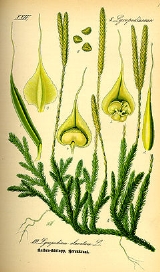
Lycopodium clavatum

Encyclopedia
Lycopodium clavatum is the most widespread species in the genus
Lycopodium
of the clubmoss family Lycopodiaceae
.
It is a spore
-bearing vascular plant
, growing mainly prostrate along the ground with stems up to 1 m long; the stems are much branched, and densely clothed with small spirally-arranged leaves
. The leaves are 3-5 mm long and 0.7-1 mm broad, tapered to a fine hair-like white point. The branches bearing spore cones turn erect, reaching 5-15 cm above ground, and have fewer leaves than the horizontal branches. The spore cones are yellow-green, 2-3 cm long and 5 mm broad. The horizontal stems produce root
s at frequent intervals along their length, allowing the stem to grow indefinitely along the ground. The stems superficially resemble small seedlings of coniferous
trees, though it is not related to these.
It has a subcosmopolitan
distribution, with distinct subspecies
and varieties
in different parts of its range:
Although globally widespread, like many clubmosses, it is confined to undisturbed sites, disappearing from farm
ed areas and sites with regular burning
. As a result, it is endangered
in many areas. In the UK it is one of 101 species named as a high priority for conservation by the wild plant charity Plantlife
.
Other common names
Common clubmoss, Stagshorn clubmoss, Wolfpaw clubmoss, Foxtail clubmoss, Running clubmoss, Running ground-pine, Running pine, Running moss, Princess Pine, and others.
Use
The spores of this moss, "Lycopodium powder
", are explosive if present in the air in high enough densities. They were used as flash powder in early photography.
Genus
In biology, a genus is a low-level taxonomic rank used in the biological classification of living and fossil organisms, which is an example of definition by genus and differentia...
Lycopodium
Lycopodium
Lycopodium is a genus of clubmosses, also known as ground pines or creeping cedar, in the family Lycopodiaceae, a family of fern-allies...
of the clubmoss family Lycopodiaceae
Lycopodiaceae
The Lycopodiaceae is a family of primitive vascular plants, including all of the core clubmosses. These plants bear spores on specialized structures at the apex of a shoot; they resemble a tiny battle club, from which the common name derives...
.
It is a spore
Spore
In biology, a spore is a reproductive structure that is adapted for dispersal and surviving for extended periods of time in unfavorable conditions. Spores form part of the life cycles of many bacteria, plants, algae, fungi and some protozoa. According to scientist Dr...
-bearing vascular plant
Vascular plant
Vascular plants are those plants that have lignified tissues for conducting water, minerals, and photosynthetic products through the plant. Vascular plants include the clubmosses, Equisetum, ferns, gymnosperms and angiosperms...
, growing mainly prostrate along the ground with stems up to 1 m long; the stems are much branched, and densely clothed with small spirally-arranged leaves
Leaf
A leaf is an organ of a vascular plant, as defined in botanical terms, and in particular in plant morphology. Foliage is a mass noun that refers to leaves as a feature of plants....
. The leaves are 3-5 mm long and 0.7-1 mm broad, tapered to a fine hair-like white point. The branches bearing spore cones turn erect, reaching 5-15 cm above ground, and have fewer leaves than the horizontal branches. The spore cones are yellow-green, 2-3 cm long and 5 mm broad. The horizontal stems produce root
Root
In vascular plants, the root is the organ of a plant that typically lies below the surface of the soil. This is not always the case, however, since a root can also be aerial or aerating . Furthermore, a stem normally occurring below ground is not exceptional either...
s at frequent intervals along their length, allowing the stem to grow indefinitely along the ground. The stems superficially resemble small seedlings of coniferous
Pinophyta
The conifers, division Pinophyta, also known as division Coniferophyta or Coniferae, are one of 13 or 14 division level taxa within the Kingdom Plantae. Pinophytes are gymnosperms. They are cone-bearing seed plants with vascular tissue; all extant conifers are woody plants, the great majority being...
trees, though it is not related to these.
It has a subcosmopolitan
Cosmopolitan distribution
In biogeography, a taxon is said to have a cosmopolitan distribution if its range extends across all or most of the world in appropriate habitats. For instance, the killer whale has a cosmopolitan distribution, extending over most of the world's oceans. Other examples include humans, the lichen...
distribution, with distinct subspecies
Subspecies
Subspecies in biological classification, is either a taxonomic rank subordinate to species, ora taxonomic unit in that rank . A subspecies cannot be recognized in isolation: a species will either be recognized as having no subspecies at all or two or more, never just one...
and varieties
Variety (biology)
In botanical nomenclature, variety is a taxonomic rank below that of species: as such, it gets a three-part infraspecific name....
in different parts of its range:
- Lycopodium clavatum subsp. clavatum
- Lycopodium clavatum subsp. clavatum var. clavatum (EuropeEuropeEurope is, by convention, one of the world's seven continents. Comprising the westernmost peninsula of Eurasia, Europe is generally 'divided' from Asia to its east by the watershed divides of the Ural and Caucasus Mountains, the Ural River, the Caspian and Black Seas, and the waterways connecting...
, AsiaAsiaAsia is the world's largest and most populous continent, located primarily in the eastern and northern hemispheres. It covers 8.7% of the Earth's total surface area and with approximately 3.879 billion people, it hosts 60% of the world's current human population...
, North AmericaNorth AmericaNorth America is a continent wholly within the Northern Hemisphere and almost wholly within the Western Hemisphere. It is also considered a northern subcontinent of the Americas...
) - Lycopodium clavatum subsp. clavatum var. aristatum (MexicoMexicoThe United Mexican States , commonly known as Mexico , is a federal constitutional republic in North America. It is bordered on the north by the United States; on the south and west by the Pacific Ocean; on the southeast by Guatemala, Belize, and the Caribbean Sea; and on the east by the Gulf of...
, CaribbeanCaribbeanThe Caribbean is a crescent-shaped group of islands more than 2,000 miles long separating the Gulf of Mexico and the Caribbean Sea, to the west and south, from the Atlantic Ocean, to the east and north...
, Central AmericaCentral AmericaCentral America is the central geographic region of the Americas. It is the southernmost, isthmian portion of the North American continent, which connects with South America on the southeast. When considered part of the unified continental model, it is considered a subcontinent...
, northern South AmericaSouth AmericaSouth America is a continent situated in the Western Hemisphere, mostly in the Southern Hemisphere, with a relatively small portion in the Northern Hemisphere. The continent is also considered a subcontinent of the Americas. It is bordered on the west by the Pacific Ocean and on the north and east...
south to northern ArgentinaArgentinaArgentina , officially the Argentine Republic , is the second largest country in South America by land area, after Brazil. It is constituted as a federation of 23 provinces and an autonomous city, Buenos Aires...
) - Lycopodium clavatum subsp. clavatum var. asiaticum (JapanJapanJapan is an island nation in East Asia. Located in the Pacific Ocean, it lies to the east of the Sea of Japan, China, North Korea, South Korea and Russia, stretching from the Sea of Okhotsk in the north to the East China Sea and Taiwan in the south...
, northeast ChinaChinaChinese civilization may refer to:* China for more general discussion of the country.* Chinese culture* Greater China, the transnational community of ethnic Chinese.* History of China* Sinosphere, the area historically affected by Chinese culture...
) - Lycopodium clavatum subsp. clavatum var. borbonicum (central and southern AfricaAfricaAfrica is the world's second largest and second most populous continent, after Asia. At about 30.2 million km² including adjacent islands, it covers 6% of the Earth's total surface area and 20.4% of the total land area...
) - Lycopodium clavatum subsp. clavatum var. kiboanum (mountains of tropical Africa)
- Lycopodium clavatum subsp. clavatum var. clavatum (Europe
- Lycopodium clavatum subsp. contiguum (southern Central AmericaCentral AmericaCentral America is the central geographic region of the Americas. It is the southernmost, isthmian portion of the North American continent, which connects with South America on the southeast. When considered part of the unified continental model, it is considered a subcontinent...
, northern South AmericaSouth AmericaSouth America is a continent situated in the Western Hemisphere, mostly in the Southern Hemisphere, with a relatively small portion in the Northern Hemisphere. The continent is also considered a subcontinent of the Americas. It is bordered on the west by the Pacific Ocean and on the north and east...
; syn. Lycopodium contiguum)
Although globally widespread, like many clubmosses, it is confined to undisturbed sites, disappearing from farm
Farm
A farm is an area of land, or, for aquaculture, lake, river or sea, including various structures, devoted primarily to the practice of producing and managing food , fibres and, increasingly, fuel. It is the basic production facility in food production. Farms may be owned and operated by a single...
ed areas and sites with regular burning
Wildfire
A wildfire is any uncontrolled fire in combustible vegetation that occurs in the countryside or a wilderness area. Other names such as brush fire, bushfire, forest fire, desert fire, grass fire, hill fire, squirrel fire, vegetation fire, veldfire, and wilkjjofire may be used to describe the same...
. As a result, it is endangered
Endangered species
An endangered species is a population of organisms which is at risk of becoming extinct because it is either few in numbers, or threatened by changing environmental or predation parameters...
in many areas. In the UK it is one of 101 species named as a high priority for conservation by the wild plant charity Plantlife
Plantlife
Plantlife is a wild plant conservation charity. As of 2007, its membership was 10,500 and it owned 23 nature reserves around the UK.-History:It was founded in 1989 with its first President being Professor David Bellamy. By 1999 it had 22 nature reserves....
.
Other common names
Common clubmoss, Stagshorn clubmoss, Wolfpaw clubmoss, Foxtail clubmoss, Running clubmoss, Running ground-pine, Running pine, Running moss, Princess Pine, and others.
Use
The spores of this moss, "Lycopodium powder
Lycopodium powder
Lycopodium powder is a yellow-tan dust-like powder historically used as a flash powder. It is composed of the dry spores of clubmoss plants, various fern relatives principally in the genera Lycopodium and Diphasiastrum...
", are explosive if present in the air in high enough densities. They were used as flash powder in early photography.