

Lycopodiaceae

Encyclopedia
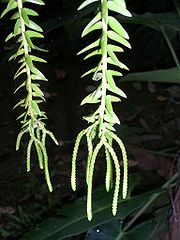
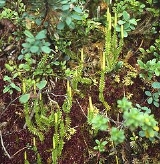
The Lycopodiaceae is a family of primitive vascular plants, including all of the core clubmosses. These plants bear spore
Spore
In biology, a spore is a reproductive structure that is adapted for dispersal and surviving for extended periods of time in unfavorable conditions. Spores form part of the life cycles of many bacteria, plants, algae, fungi and some protozoa. According to scientist Dr...
s on specialized structures at the apex of a shoot; they resemble a tiny battle club
Club (weapon)
A club is among the simplest of all weapons. A club is essentially a short staff, or stick, usually made of wood, and wielded as a weapon since prehistoric times....
, from which the common name derives. They are non-flowering and do not produce seed
Seed
A seed is a small embryonic plant enclosed in a covering called the seed coat, usually with some stored food. It is the product of the ripened ovule of gymnosperm and angiosperm plants which occurs after fertilization and some growth within the mother plant...
s.
The genera Huperzia
Firmoss
Huperzia is a genus of Lycophyte plants, sometimes known as the firmosses or fir clubmosses. This genus was originally included in the related genus Lycopodium, from which it differs in having undifferentiated sporangial leaves, and the sporangia not formed into apical cones...
, Phlegmariurus
Firmoss
Huperzia is a genus of Lycophyte plants, sometimes known as the firmosses or fir clubmosses. This genus was originally included in the related genus Lycopodium, from which it differs in having undifferentiated sporangial leaves, and the sporangia not formed into apical cones...
and Phylloglossum
Phylloglossum
Phylloglossum, a genus in the clubmoss family Huperziaceae, is a small plant superficially resembling a tiny grass plant, growing with a rosette of slender leaves 2-5 cm long from an underground bulb-like root...
, the species of which were generally included in a more broadly defined Lycopodium in older classifications, are treated in the separate family Huperziaceae
Huperziaceae
The family Huperziaceae is one of two families sometimes recognized in the order Lycopodiales, and contains two or three extant genera:*Huperzia ; 10-15 species; terrestrial....
in some classifications, and are treated so here; they differ in producing spores in small lateral structures in the leaf axils. There is as yet no consensus on the recognition of Huperziaceae as a separate family; a more broadly defined Lycopodiaceae, including these genera, is still recognized in some classifications.
The species within this family generally have chromosome counts of n=34. A notable exception are the species in genus Diphasiastrum
Diphasiastrum
Diphasiastrum is a genus of clubmosses in the plant family Lycopodiaceae. It is closely related to the genus Lycopodium, and some botanists treat it within a broad view of that genus as a section, Lycopodium sect. Complanata...
, which have counts of n=23.
Uses
- The running clubmosses (genus DiphasiastrumDiphasiastrumDiphasiastrum is a genus of clubmosses in the plant family Lycopodiaceae. It is closely related to the genus Lycopodium, and some botanists treat it within a broad view of that genus as a section, Lycopodium sect. Complanata...
) have long been used as greenery for ChristmasChristmasChristmas or Christmas Day is an annual holiday generally celebrated on December 25 by billions of people around the world. It is a Christian feast that commemorates the birth of Jesus Christ, liturgically closing the Advent season and initiating the season of Christmastide, which lasts twelve days...
decoration. - The spores have long been used as a flash powder. See Lycopodium powderLycopodium powderLycopodium powder is a yellow-tan dust-like powder historically used as a flash powder. It is composed of the dry spores of clubmoss plants, various fern relatives principally in the genera Lycopodium and Diphasiastrum...
. - The spores have been used by violin makerLuthierA luthier is someone who makes or repairs lutes and other string instruments. In the United States, the term is used interchangeably with a term for the specialty of each maker, such as violinmaker, guitar maker, lute maker, etc...
s for centuries as a pore filler. - In CornwallCornwallCornwall is a unitary authority and ceremonial county of England, within the United Kingdom. It is bordered to the north and west by the Celtic Sea, to the south by the English Channel, and to the east by the county of Devon, over the River Tamar. Cornwall has a population of , and covers an area of...
, club mosses gathered during certain lunar phases were historically used as a remedy for eye disease.