

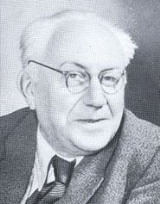
Ludwik Hirszfeld

Encyclopedia
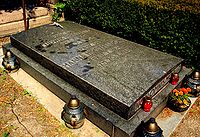
Poland
Poland , officially the Republic of Poland , is a country in Central Europe bordered by Germany to the west; the Czech Republic and Slovakia to the south; Ukraine, Belarus and Lithuania to the east; and the Baltic Sea and Kaliningrad Oblast, a Russian exclave, to the north...
microbiologist
Microbiology
Microbiology is the study of microorganisms, which are defined as any microscopic organism that comprises either a single cell , cell clusters or no cell at all . This includes eukaryotes, such as fungi and protists, and prokaryotes...
and a serologist
Serology
Serology is the scientific study of blood serum and other bodily fluids. In practice, the term usually refers to the diagnostic identification of antibodies in the serum...
. He is considered one of the co-discoverers of the inheritance of ABO blood type
ABO blood group system
The ABO blood group system is the most important blood type system in human blood transfusion. The associated anti-A antibodies and anti-B antibodies are usually IgM antibodies, which are usually produced in the first years of life by sensitization to environmental substances such as food,...
. He established a laboratory of experimental medicine at the State Institute of Hygiene in Poland shortly after World War I
World War I
World War I , which was predominantly called the World War or the Great War from its occurrence until 1939, and the First World War or World War I thereafter, was a major war centred in Europe that began on 28 July 1914 and lasted until 11 November 1918...
. In 1946, he published his autobiography, The Story of One Life.
After attending the Gymnasium
Gymnasium (school)
A gymnasium is a type of school providing secondary education in some parts of Europe, comparable to English grammar schools or sixth form colleges and U.S. college preparatory high schools. The word γυμνάσιον was used in Ancient Greece, meaning a locality for both physical and intellectual...
in Łódź, Hirszfeld, born into a Jewish family and later a convert to Catholicism
Catholicism
Catholicism is a broad term for the body of the Catholic faith, its theologies and doctrines, its liturgical, ethical, spiritual, and behavioral characteristics, as well as a religious people as a whole....
, decided to study medicine
Medicine
Medicine is the science and art of healing. It encompasses a variety of health care practices evolved to maintain and restore health by the prevention and treatment of illness....
in Germany
Germany
Germany , officially the Federal Republic of Germany , is a federal parliamentary republic in Europe. The country consists of 16 states while the capital and largest city is Berlin. Germany covers an area of 357,021 km2 and has a largely temperate seasonal climate...
. In 1902 he entered the University of Würzburg
University of Würzburg
The University of Würzburg is a university in Würzburg, Germany, founded in 1402. The university is a member of the distinguished Coimbra Group.-Name:...
and transferred in 1904 to Berlin
Berlin
Berlin is the capital city of Germany and is one of the 16 states of Germany. With a population of 3.45 million people, Berlin is Germany's largest city. It is the second most populous city proper and the seventh most populous urban area in the European Union...
, where he attended lectures in medicine and philosophy. Hirszfeld completed his doctoral dissertation, "Über Blutagglutination," in 1907, thus taking the first step in what was to become his specialty. But first he became a junior assistant in cancer research at the Heidelberg Institute for Experimental Cancer Research, where E. von Dungern
Emil Freiherr von Dungern
Baron Emil von Dungern was a German internist.Von Dungern was born in Würzburg and died in Ludwigshafen am Bodensee. In 1910–11, E. von Dungern and Ludwik Hirszfeld discovered the heritability of ABO blood groups....
was his department head. Hirszfeld soon formed a close personal friendship with Dungern which proved to be scientifically fruitful. At Heidelberg they did the first joint work on animal and human blood groups which, in 1900, had been identified as isoagglutinins by Karl Landsteiner
Karl Landsteiner
Karl Landsteiner , was an Austrian-born American biologist and physician of Jewish origin. He is noted for having first distinguished the main blood groups in 1900, having developed the modern system of classification of blood groups from his identification of the presence of agglutinins in the...
.
Hirszfeld gradually found the working conditions at Heidelberg
Heidelberg
-Early history:Between 600,000 and 200,000 years ago, "Heidelberg Man" died at nearby Mauer. His jaw bone was discovered in 1907; with scientific dating, his remains were determined to be the earliest evidence of human life in Europe. In the 5th century BC, a Celtic fortress of refuge and place of...
too confining and to familiarize himself with the entire field of hygiene and microbiology, in 1911 he accepted an assistantship at the Hygiene Institute of the University of Zurich
University of Zurich
The University of Zurich , located in the city of Zurich, is the largest university in Switzerland, with over 25,000 students. It was founded in 1833 from the existing colleges of theology, law, medicine and a new faculty of philosophy....
, just after he had married. His wife, also a physician, became an assistant at the Zurich Children's Clinic under Emil Feer.
In 1914 Hirszfeld was made an academic lecturer on the basis of his work on anaphylaxis
Anaphylaxis
Anaphylaxis is defined as "a serious allergic reaction that is rapid in onset and may cause death". It typically results in a number of symptoms including throat swelling, an itchy rash, and low blood pressure...
and anaphylatoxin
Anaphylatoxin
Anaphylatoxins, or anaphylotoxins, are fragments that are produced as part of the activation of the complement system.. Complement components C3, C4 and C5 are large glycoproteins that have important functions in the immune response and host defense...
and their relationships to coagulation
Coagulation
Coagulation is a complex process by which blood forms clots. It is an important part of hemostasis, the cessation of blood loss from a damaged vessel, wherein a damaged blood vessel wall is covered by a platelet and fibrin-containing clot to stop bleeding and begin repair of the damaged vessel...
; he was also named "Privatdozent." When World War I broke out Serbia
Serbia
Serbia , officially the Republic of Serbia , is a landlocked country located at the crossroads of Central and Southeast Europe, covering the southern part of the Carpathian basin and the central part of the Balkans...
was devastated by epidemics of typhus
Typhus
Epidemic typhus is a form of typhus so named because the disease often causes epidemics following wars and natural disasters...
and bacillary dysentery
Dysentery
Dysentery is an inflammatory disorder of the intestine, especially of the colon, that results in severe diarrhea containing mucus and/or blood in the faeces with fever and abdominal pain. If left untreated, dysentery can be fatal.There are differences between dysentery and normal bloody diarrhoea...
. In 1915 Hirszfeld applied for duty there. He remained with the Serbian army until the end of the war, serving as serological and bacteriological adviser. At this time, in the hospital for contagious diseases in Thessaloniki
Thessaloniki
Thessaloniki , historically also known as Thessalonica, Salonika or Salonica, is the second-largest city in Greece and the capital of the region of Central Macedonia as well as the capital of the Decentralized Administration of Macedonia and Thrace...
he discovered the bacillus "Salmonella paratyphi" C, today called "Salmonella hirszfeldi."
After the end of the war Hirszfeld and his wife returned to Warsaw
Warsaw
Warsaw is the capital and largest city of Poland. It is located on the Vistula River, roughly from the Baltic Sea and from the Carpathian Mountains. Its population in 2010 was estimated at 1,716,855 residents with a greater metropolitan area of 2,631,902 residents, making Warsaw the 10th most...
, where he established a Polish serum institute modeled after the Ehrlich Institute for Experimental Therapy in Frankfurt
Frankfurt
Frankfurt am Main , commonly known simply as Frankfurt, is the largest city in the German state of Hesse and the fifth-largest city in Germany, with a 2010 population of 688,249. The urban area had an estimated population of 2,300,000 in 2010...
. He soon became deputy director and scientific head of the State Hygiene Institute in Warsaw and, in 1924, professor there. In 1931 he was named full professor at the University of Warsaw and served on many international boards. After the occupation of Poland by the German army Hirszfeld was dismissed as a "non-Aryan" from the Hygiene Institute but, through the protection of friends, managed to do further scientific work at home until February 1941; it was, however, almost impossible for him to publish.
On 20 February 1941 Hirszfeld was forced to move into the Warsaw ghetto
Warsaw Ghetto
The Warsaw Ghetto was the largest of all Jewish Ghettos in Nazi-occupied Europe during World War II. It was established in the Polish capital between October and November 15, 1940, in the territory of General Government of the German-occupied Poland, with over 400,000 Jews from the vicinity...
with his wife and daughter. There he organized anti-epidemic measures and vaccination campaigns against typhus and typhoid, as well as conducting secret medical courses. In 1943 he and his family fled the ghetto and were able to survive underground through using false names and continually changing their hiding place; his daughter died of tuberculosis
Tuberculosis
Tuberculosis, MTB, or TB is a common, and in many cases lethal, infectious disease caused by various strains of mycobacteria, usually Mycobacterium tuberculosis. Tuberculosis usually attacks the lungs but can also affect other parts of the body...
in the same year.
When a part of Poland was liberated in 1944, Hirszfeld immediately collaborated in the establishment of the University of Lublin
Lublin
Lublin is the ninth largest city in Poland. It is the capital of Lublin Voivodeship with a population of 350,392 . Lublin is also the largest Polish city east of the Vistula river...
and became prorector
Prorector
In many countries in Europe , a prorector is deputy to rector and a member of the management body of a university. In cases with more than one prorector each prorector manages a particular area of university life...
of the university. In 1945 he became director of the Institute for Medical Microbiology at Wrocław and dean of the medical faculty. He taught at the institute, now affiliated with the Polish Academy of Sciences
Polish Academy of Sciences
The Polish Academy of Sciences, headquartered in Warsaw, is one of two Polish institutions having the nature of an academy of sciences.-History:...
and named after him, until his death.
Hirszfeld received many honors, including honorary doctorates from the universities of Prague (1950) and Zurich (1951). He wrote almost 400 works in German, French, English, and Polish, many in collaboration with other well-known scholars and many with his wife as well.
Hirszfeld and von Dungern were responsible for naming the blood groups A, B, AB, and O; previously they were known as groups I, II, III, and IV. He proposed the A and B designations for the agglutinin
Agglutinin
An agglutinin is a substance that causes particles to coagulate to form a thickened mass . Agglutinins can be antibodies that cause antigens to aggregate by binding to the antigen-binding sites of antibodies. Agglutinins can also be any substance other than antibodies such as sugar-binding...
s. In 1910-1911 Hirszfeld discovered the heritability of blood groups and with this discovery established serological paternity exclusion. During World War I he and his wife wrote works on sero-anthropology, which brought forth fundamental findings on the racial composition of recent and historical peoples. According to his so-called Pleiades theory of blood groups, the other groups probably developed from the archaic O group in the course of evolution.
Hirszfeld was the first to foresee the serological conflict between mother and child, which was confirmed by the discovery of the Rhesus factor
Rhesus blood group system
The Rh blood group system is one of thirty current human blood group systems. Clinically, it is the most important blood group system after ABO. At Present, the Rh blood group system consists of 50 defined blood-group antigens, among which the 5 antigens D, C, c, E, and e are the most important...
. Upon this basis he developed, in the last years of his life, an "allergic" theory of miscarriage and recommended antihistamine therapy. Hirszfeld also investigated tumors and the serology of tuberculosis. His discovery of the infectious agent of paratyphoid C had far-reaching consequences for differential diagnosis.
In 1914, together with R. Klinger
Klinger
Klinger may refer to:* Klinger , a band based in Melbourne, Australia, from 1996–2003* Klingers, Michigan, community in St. Joseph County* 22369 Klinger, a main-belt asteroid- People :* Bob Klinger , American baseball player...
, Hirszfeld developed a serodiagnostic reaction test for syphilis, which did not, however, replace the Wasserman test introduced in 1906. His studies of goiter in Swiss endemic regions brought him into sharp disagreement with E. Bircher over the theory -- today widely confirmed -- that endemic Goitre
Goitre
A goitre or goiter , is a swelling in the thyroid gland, which can lead to a swelling of the neck or larynx...
s are caused by iodine
Iodine
Iodine is a chemical element with the symbol I and atomic number 53. The name is pronounced , , or . The name is from the , meaning violet or purple, due to the color of elemental iodine vapor....
deficiency in water and food, in opposition to the hydrotelluric theory.