


Lord High Treasurer

Encyclopedia
Kingdom of England
The Kingdom of England was, from 927 to 1707, a sovereign state to the northwest of continental Europe. At its height, the Kingdom of England spanned the southern two-thirds of the island of Great Britain and several smaller outlying islands; what today comprises the legal jurisdiction of England...
government position and has been a British
Kingdom of Great Britain
The former Kingdom of Great Britain, sometimes described as the 'United Kingdom of Great Britain', That the Two Kingdoms of Scotland and England, shall upon the 1st May next ensuing the date hereof, and forever after, be United into One Kingdom by the Name of GREAT BRITAIN. was a sovereign...
government position since the Act of Union of 1707. A holder of the post would be the third highest ranked Great Officer of State
Great Officer of State
In the United Kingdom, the Great Officers of State are traditional Crown ministers, who either inherit their positions or are appointed to exercise certain largely ceremonial functions. Separate Great Officers exist for England and Scotland, and formerly for Ireland...
, below the Lord High Chancellor and above the Lord President of the Council
Lord President of the Council
The Lord President of the Council is the fourth of the Great Officers of State of the United Kingdom, ranking beneath the Lord High Treasurer and above the Lord Privy Seal. The Lord President usually attends each meeting of the Privy Council, presenting business for the monarch's approval...
. The Lord High Treasurer functions as the head of Her Majesty's Treasury
HM Treasury
HM Treasury, in full Her Majesty's Treasury, informally The Treasury, is the United Kingdom government department responsible for developing and executing the British government's public finance policy and economic policy...
. Since the 17th century the office has often been held, not by a single person, but placed in commission, so that a board of individuals jointly exercise the powers of the Lord High Treasurer. Such persons are known as Lords Commissioners of the Treasury. The office has been in commission continuously since the resignation of Charles Talbot, 1st Duke of Shrewsbury
Charles Talbot, 1st Duke of Shrewsbury
Charles Talbot, 1st Duke of Shrewsbury, KG, PC was an English statesman. Born to Roman Catholic parents, he remained in that faith until 1679 when—during the time of the Popish Plot and following the advice of the divine John Tillotson—he converted to the Church of England...
in 1714.
In modern times, by convention, the Lords Commissioners of the Treasury include the Prime Minister of the United Kingdom
Prime Minister of the United Kingdom
The Prime Minister of the United Kingdom of Great Britain and Northern Ireland is the Head of Her Majesty's Government in the United Kingdom. The Prime Minister and Cabinet are collectively accountable for their policies and actions to the Sovereign, to Parliament, to their political party and...
, usually serving as the "First Lord of the Treasury", and the Chancellor of the Exchequer
Chancellor of the Exchequer
The Chancellor of the Exchequer is the title held by the British Cabinet minister who is responsible for all economic and financial matters. Often simply called the Chancellor, the office-holder controls HM Treasury and plays a role akin to the posts of Minister of Finance or Secretary of the...
, serving as the "Second Lord of the Treasury". Other members of the government, usually whips
Whip (politics)
A whip is an official in a political party whose primary purpose is to ensure party discipline in a legislature. Whips are a party's "enforcers", who typically offer inducements and threaten punishments for party members to ensure that they vote according to the official party policy...
in the House of Commons
British House of Commons
The House of Commons is the lower house of the Parliament of the United Kingdom, which also comprises the Sovereign and the House of Lords . Both Commons and Lords meet in the Palace of Westminster. The Commons is a democratically elected body, consisting of 650 members , who are known as Members...
, are appointed to serve as the junior Lords Commissioners of the Treasury.
Origins
The English Treasury seems to have come into existence around 1126, during the reign of Henry IHenry I of England
Henry I was the fourth son of William I of England. He succeeded his elder brother William II as King of England in 1100 and defeated his eldest brother, Robert Curthose, to become Duke of Normandy in 1106...
, as the financial responsibilities were separated from the rest of the job that evolved into Lord Great Chamberlain
Lord Great Chamberlain
The Lord Great Chamberlain of England is the sixth of the Great Officers of State, ranking beneath the Lord Privy Seal and above the Lord High Constable...
. The Treasury was originally a section of the Royal Household with custody of the King's money. In 1216, a Treasurer was appointed to take control of the Treasury in Winchester. The Treasurer was also an officer of the Exchequer
Exchequer
The Exchequer is a government department of the United Kingdom responsible for the management and collection of taxation and other government revenues. The historical Exchequer developed judicial roles...
, and supervised the royal accounts. By Tudor
Tudor dynasty
The Tudor dynasty or House of Tudor was a European royal house of Welsh origin that ruled the Kingdom of England and its realms, including the Lordship of Ireland, later the Kingdom of Ireland, from 1485 until 1603. Its first monarch was Henry Tudor, a descendant through his mother of a legitimised...
times, the Lord High Treasurer had achieved a place among the Great Officers of State, behind the Lord Chancellor
Lord Chancellor
The Lord High Chancellor of Great Britain, or Lord Chancellor, is a senior and important functionary in the government of the United Kingdom. He is the second highest ranking of the Great Officers of State, ranking only after the Lord High Steward. The Lord Chancellor is appointed by the Sovereign...
and above the Master of the Horse
Master of the Horse
The Master of the Horse was a position of varying importance in several European nations.-Magister Equitum :...
. Under the Treason Act 1351
Treason Act 1351
The Treason Act 1351 is an Act of the Parliament of England which codified and curtailed the common law offence of treason. No new offences were created by the statute. It is one of the earliest English statutes still in force, although it has been very significantly amended. It was extended to...
it was treason
Treason
In law, treason is the crime that covers some of the more extreme acts against one's sovereign or nation. Historically, treason also covered the murder of specific social superiors, such as the murder of a husband by his wife. Treason against the king was known as high treason and treason against a...
to kill him.
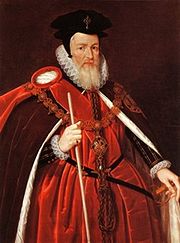
During the sixteenth century, the Lord High Treasurer was often considered the most important official of the government, and became a de facto Prime Minister. Exemplifying the power of the Lord High Treasurer is William Cecil, 1st Baron Burghley
William Cecil, 1st Baron Burghley
William Cecil, 1st Baron Burghley , KG was an English statesman, the chief advisor of Queen Elizabeth I for most of her reign, twice Secretary of State and Lord High Treasurer from 1572...
, who served in the post from 1572 to 1598. During his tenure, he dominated the administration under Elizabeth I
Elizabeth I of England
Elizabeth I was queen regnant of England and Ireland from 17 November 1558 until her death. Sometimes called The Virgin Queen, Gloriana, or Good Queen Bess, Elizabeth was the fifth and last monarch of the Tudor dynasty...
.
The modern commissioners
A rarely-varied system has evolved since then. Today, the First Lord of the TreasuryFirst Lord of the Treasury
The First Lord of the Treasury is the head of the commission exercising the ancient office of Lord High Treasurer in the United Kingdom, and is now always also the Prime Minister...
is as a rule the Prime Minister
Prime Minister of the United Kingdom
The Prime Minister of the United Kingdom of Great Britain and Northern Ireland is the Head of Her Majesty's Government in the United Kingdom. The Prime Minister and Cabinet are collectively accountable for their policies and actions to the Sovereign, to Parliament, to their political party and...
, and the Second Lord of the Treasury
Second Lord of the Treasury
The Second Lord of the Treasury is a member of the commission exercising the ancient office of Lord High Treasurer in the United Kingdom. Since 1827, the Chancellor of the Exchequer has always simultaneously held the office of Second Lord of the Treasury when he has not also been the Prime Minister...
is the Chancellor of the Exchequer
Chancellor of the Exchequer
The Chancellor of the Exchequer is the title held by the British Cabinet minister who is responsible for all economic and financial matters. Often simply called the Chancellor, the office-holder controls HM Treasury and plays a role akin to the posts of Minister of Finance or Secretary of the...
, who has inherited most of the functional financial responsibilities. Next rank the "Junior Lords of the Treasury" who, though theoretically members of the Treasury Board, in practice serve as Government Whips under the Parliamentary Secretary to the Treasury (Chief Whip).
Current commissioners consist of the Rt Hon David Cameron
David Cameron
David William Donald Cameron is the current Prime Minister of the United Kingdom, First Lord of the Treasury, Minister for the Civil Service and Leader of the Conservative Party. Cameron represents Witney as its Member of Parliament ....
and George Osborne
George Osborne
George Gideon Oliver Osborne, MP is a British Conservative politician. He is the Chancellor of the Exchequer of the United Kingdom, a role to which he was appointed in May 2010, and has been the Member of Parliament for Tatton since 2001.Osborne is part of the old Anglo-Irish aristocracy, known in...
; with junior lords as Michael Fabricant
Michael Fabricant
Michael Louis David Fabricant is a British Conservative Party politician. He is the Member of Parliament for Lichfield in Staffordshire.-Early life:...
MP, Angela Watkinson
Angela Watkinson
Angela Eileen Watkinson is a politician in the United Kingdom. She is Conservative Party Member of Parliament for Hornchurch and Upminster, and was first elected in 2001 to the earlier seat of Upminster, beating Keith Darvill who had taken the seat from the Conservatives in 1997...
MP, Jeremy Wright
Jeremy Wright
Jeremy Wright may refer to:* Jeremy Wright , British Conservative Member of Parliament for Kenilworth and Southam* Jeremy Wright , Canadian blogger...
MP, Brooks Newmark
Brooks Newmark
Brooks Phillip Victor Newmark is the Conservative Member of Parliament for Braintree.-Early life:Brooks was born in Westport CT, USA on 8th May 1958 to Howard Newmark and Gilda Gourlay . He moved to England aged 9 years old and attended Caldicott Prep School and Bedford School and graduated from...
MP, and James Duddridge MP.