
All Topics  
Caledonian Railway

 
Caledonian Railway

   Email Print
   Bookmark   Link


Caledonian Railway


The Caledonian Railway was a major Scottish
Scotland

conventional_long_name = ScotlandAlba|common_name= Scotland|image_flag = Flag of Scotland.svg|flag_width = 130px...
 railway company operating in Scotland. It was formed in the early 19th century and it was absorbed almost a century later into the London, Midland and Scottish Railway
London, Midland and Scottish Railway

The London Midland and Scottish Railway was a United Kingdom railway company. It was formed on 1 January 1923 under the Railways Act 1921, which required the grouping of over 300 separate railway companies into just four....
, in the 1923 railway grouping, by means of the Railways Act 1921
Railways Act 1921

The Railways Act of 1921, also known as the Grouping Act, was an Act of Parliament by the British government of David Lloyd George intended to stem the losses being made by many of the country's 120 railway companies, move the railways away from internal competition, and to retain some of the benefits which the country had derived from...
. Due to legal complications this did not take place on 1 January 1923 when the majority of the amalgamations took place, but was delayed until 1 July 1923 (along with the North Staffordshire Railway
North Staffordshire Railway

The North Staffordshire Railway was a Great Britain railway company formed in 1845 to promote a number of lines in the Staffordshire Potteries....
).

Introduction
The Caledonian Railway Company was well supported by Glasgow
Glasgow

Glasgow is the largest city in Scotland and List of largest United Kingdom settlements by population in the United Kingdom. The city is situated on the River Clyde in the country's Scottish Lowlands....
 and Edinburgh
Edinburgh

Edinburgh ; is the Capital city of Scotland, a position it has held since 1437. It is the seventh largest city in the United Kingdom and the second largest Scottish City status in the United Kingdom after Glasgow....
 shareholders; however, more than half of its shares were held in England
England

native_name =|conventional_long_name = England|common_name = England|image_flag = Flag of England.svg|image_coat = England COA.svg|symbol_type = Royal Coat of Arms...
.


Discussion
Ask a question about 'Caledonian Railway'
Start a new discussion about 'Caledonian Railway'
Answer questions from other users
Full Discussion Forum


Encyclopedia


The Caledonian Railway was a major Scottish
Scotland

conventional_long_name = ScotlandAlba|common_name= Scotland|image_flag = Flag of Scotland.svg|flag_width = 130px...
 railway company operating in Scotland. It was formed in the early 19th century and it was absorbed almost a century later into the London, Midland and Scottish Railway
London, Midland and Scottish Railway

The London Midland and Scottish Railway was a United Kingdom railway company. It was formed on 1 January 1923 under the Railways Act 1921, which required the grouping of over 300 separate railway companies into just four....
, in the 1923 railway grouping, by means of the Railways Act 1921
Railways Act 1921

The Railways Act of 1921, also known as the Grouping Act, was an Act of Parliament by the British government of David Lloyd George intended to stem the losses being made by many of the country's 120 railway companies, move the railways away from internal competition, and to retain some of the benefits which the country had derived from...
. Due to legal complications this did not take place on 1 January 1923 when the majority of the amalgamations took place, but was delayed until 1 July 1923 (along with the North Staffordshire Railway
North Staffordshire Railway

The North Staffordshire Railway was a Great Britain railway company formed in 1845 to promote a number of lines in the Staffordshire Potteries....
).

Introduction


The Caledonian Railway Company was well supported by Glasgow
Glasgow

Glasgow is the largest city in Scotland and List of largest United Kingdom settlements by population in the United Kingdom. The city is situated on the River Clyde in the country's Scottish Lowlands....
 and Edinburgh
Edinburgh

Edinburgh ; is the Capital city of Scotland, a position it has held since 1437. It is the seventh largest city in the United Kingdom and the second largest Scottish City status in the United Kingdom after Glasgow....
 shareholders; however, more than half of its shares were held in England
England

native_name =|conventional_long_name = England|common_name = England|image_flag = Flag of England.svg|image_coat = England COA.svg|symbol_type = Royal Coat of Arms...
. The total capital at the grouping was £57 million.

It was an integrated railway company, in that it built and owned both the railway lines and the trains. It had a locomotive
Locomotive

A locomotive is a Rail transport vehicle that provides the motive power for a train. The word originates from the Latin language loco - "from a place", Ablative case of locus, "place" + Medieval Latin motivus, "causing motion", and is a shortened form of the term locomotive engine,....
 works, St. Rollox railway works
St. Rollox railway works

St. Rollox Locomotive Works and St Rollox Carriage and Wagon Works were built in 1856 in Springburn, an area in the north-east of Glasgow, for the Caledonian Railway, moving away from their works at Greenock....
, in Springburn
Springburn

Springburn is a semi-suburban area in the north of the Scotland city of Glasgow, home to various working- and middle-class families.Springburn developed from a small hamlet at the beginning of the nineteenth century....
, Glasgow, which became part of British Rail
British Rail

British Railways , which later traded as British Rail, was the operator of most of the Rail transport in Great Britain from the nationalisation of the Big Four British railway companies in 1948 until Privatisation of British Rail in stages from 1994 to 1997....
 and is currently still in use, as a railway maintenance depot. From its headquarters in Glasgow, the company controlled a total length of line, including sidings, of 2,827 miles. It was also the owner or part owner of steamers, hotels (including the Caledonian Hotel at Edinburgh), docks, and harbours; and of two canals, the Forth and Clyde Navigation and the Monkland.

The company was formed in the 1830s to link local railways around Glasgow and Edinburgh to the railway network in England, at Carlisle
Carlisle

Carlisle is in the City of Carlisle, a district of Cumbria in North West England. It is located at the confluence of the rivers River Eden, Cumbria, River Caldew and River Petteril, south of the Anglo-Scottish border....
. It sought to open the only cross-border main line (it was thought that only one main line was needed). Its empire was then extended to cover the triangle
Triangle

A triangle is one of the basic shapes of geometry: a polygon with three corners or wikt:vertex and three sides or edges which are line segments....
: Glasgow, Stirling
Stirling

Stirling is a City status in the United Kingdom and former ancient burgh in Scotland, and is at the heart of the wider Stirling .The city is clustered around a large Stirling Castle and medi?val old-town....
 and Edinburgh; and later reached out to serve Oban
Oban

Oban is a resort town within the Argyll and Bute council area of Scotland. It has a total resident population of 8,120. Despite its small size, it is the largest town between Helensburgh and Fort William, Highland and during the tourist season the town can be crowded by up to 25,000 people....
, Ballachulish
Ballachulish

The village of Ballachulish in Lochaber, Scottish Highlands, Scotland, is centred around former slate quarries. The name Ballachulish was more correctly applied to the area now called North Ballachulish, to the north of Loch Leven , but was usurped for the quarry villages at East Laroch and West Laroch, either side of the...
, Dundee
Dundee

Dundee is the fourth-largest City status in the United Kingdom in Scotland and, fully named as Dundee City, one of Scotland's 32 Local government in Scotland Council areas of Scotland....
, Perth
Perth, Scotland

Perth is a town and former royal burgh in central Scotland. Sitting on the banks of the River Tay, it is the administrative headquarters of Perth and Kinross council area....
 and Aberdeen
Aberdeen

Aberdeen is Scotland's third most populous City status in the United Kingdom and one of Scotland's 32 Local government in Scotland Council areas of Scotland....
. The cross-border services were operated in conjunction with the London and North Western Railway
London and North Western Railway

The London and North Western Railway was a railway company of the United Kingdom which existed between 1846 and 1922. It was created by the merger of three railway companies - the Grand Junction Railway, the London and Birmingham Railway and the Manchester and Birmingham Railway, and is effectively an ancestor of today's West Coast Main L...
, the carriages being owned jointly as the West Coast Joint Stock.

In the Scottish Lowlands
Scottish Lowlands

The Scottish Lowlands , although not officially a geographical area of the country, in normal usage is generally meant to include those parts of Scotland not referred to as the Scottish Highlands , that is, everywhere due south and east of a line between Stonehaven and Helensburgh ....
 it competed against both the Glasgow and South Western Railway
Glasgow and South Western Railway

The Glasgow and South Western Railway , one of the pre-Railways Act 1921, served a triangular area of south-west Scotland, between Glasgow, Stranraer and Carlisle....
 (G&SWR) and the North British Railway
North British Railway

The North British Railway was a Scotland rail transport company that was absorbed into the London and North Eastern Railway at the Railways Act 1921 in 1923....
; but, in the case of the G&SWR, not north of the River Clyde
River Clyde

The River Clyde is a major river in Scotland. It is the eighth longest river in the United Kingdom, and the third longest in Scotland. Flowing through the major city of Glasgow, it was an important river for shipbuilding and trade in the British Empire....
. There was little or no competition north of Oban, Ballachulish, Dundee, Perth and Aberdeen; this area was served mainly by the Highland Railway
Highland Railway

The Highland Railway was one of the smaller United Kingdom railways before the Railways Act 1921; it operated north of Perth railway station, Scotland in Scotland and served the farthest north of Britain....
.

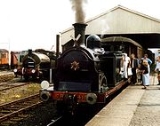
Cr 419 At Bo'ness

Early history

The earliest railways in Scotland and England were unconnected. Before the Caledonian railway, the quickest journey between Glasgow and London would have been Glasgow to Liverpool
Liverpool

Liverpool [] is a city and metropolitan borough of Merseyside, England, along the eastern side of the Mersey Estuary. It was founded as a History of borough status in England and Wales in 1207 and was granted City status in the United Kingdom in 1880....
 by sea and then Liverpool to London by train. However, from March 1841 it was possible to catch the train between Glasgow and Greenock
Greenock

Greenock is a large town and former burgh of barony in the Inverclyde council area of western Scotland. It forms part of a contiguous urban area with Gourock to the west and Port Glasgow to the east....
, then travel between Greenock and Liverpool by sea; and then to London by train (see below).

A railway link from London
London

London is the capital of both England and the United Kingdom, and the most populous municipality in the European Union. An important settlement for two millennia, History of London goes back to its founding by the Roman Empire....
 to the north of England was developed in piecemeal fashion. From about 1838 the London and Birmingham Railway
London and Birmingham Railway

The London and Birmingham Railway was an early railway company in the United Kingdom from 1833 until 1846, at which date it became a constituent part of the London and North Western Railway....
 had linked those two destinations; the Grand Junction Railway
Grand Junction Railway

The Grand Junction Railway was an early railway company in the United Kingdom, which existed between 1833 and 1846. The line built by the company was the first trunk railway to be completed in England, and arguably the world's first long-distance railway....
 linked Birmingham
Birmingham

Birmingham is a city status in the United Kingdom and metropolitan borough in the West Midlands of England. Birmingham is the most populous of England's English Core Cities Group, and is the List of United Kingdom cities by population British city after London, with a population of 1,010,200 ....
 to Warrington
Warrington

Warrington is a large town, borough status in the United Kingdom and unitary authority area in Cheshire, England. It stands on the banks of the River Mersey, which is tidal to the west of the weir at Howley....
; the North Union Railway
North Union Railway

The North Union Railway was an early United Kingdom railway company, formed in 1834....
 was projected to reach Preston
Preston

Preston is a city and non-metropolitan district of Lancashire, in North West England. It is located on the north bank of the River Ribble, and was granted City status in the United Kingdom in 2002, becoming England's 50th city in the 50th year of Elizabeth II of the United Kingdom's reign....
; and the Grand Junction Railway
Grand Junction Railway

The Grand Junction Railway was an early railway company in the United Kingdom, which existed between 1833 and 1846. The line built by the company was the first trunk railway to be completed in England, and arguably the world's first long-distance railway....
 intended to extend the line to both Glasgow
Glasgow

Glasgow is the largest city in Scotland and List of largest United Kingdom settlements by population in the United Kingdom. The city is situated on the River Clyde in the country's Scottish Lowlands....
 and Edinburgh
Edinburgh

Edinburgh ; is the Capital city of Scotland, a position it has held since 1437. It is the seventh largest city in the United Kingdom and the second largest Scottish City status in the United Kingdom after Glasgow....
. They got their engineer Joseph Locke
Joseph Locke

Joseph Locke was a notable England civil engineer of the 19th century, particularly associated with railway projects. Locke ranked alongside Robert Stephenson and Isambard Kingdom Brunel as one of the major pioneers of railway development....
 to survey a route from Carlisle
Carlisle

Carlisle is in the City of Carlisle, a district of Cumbria in North West England. It is located at the confluence of the rivers River Eden, Cumbria, River Caldew and River Petteril, south of the Anglo-Scottish border....
. The obvious way was to follow Thomas Telford
Thomas Telford

Thomas Telford was born in Langholm, Scotland, UK. He was a stonemason, architect and civil engineer and a noted road, bridge and canal builder....
's coach
Coach (vehicle)

In British English and Australian English, the term coach is used to refer to a large motor vehicle for conveying passengers. To differentiate from other types of bus, a coach has a luggage hold separate from the passenger cabin....
 road through Annandale and Clydesdale
Clydesdale

Clydesdale was formerly one of nineteen local government district s in the Strathclyde region of Scotland.The district was formed by the Local Government Act 1973 from part of the former counties of Scotland of Lanarkshire: namely the burghs of Biggar, South Lanarkshire and Lanark and the First, Second and Third Districts....
. He did not believe a locomotive
Locomotive

A locomotive is a Rail transport vehicle that provides the motive power for a train. The word originates from the Latin language loco - "from a place", Ablative case of locus, "place" + Medieval Latin motivus, "causing motion", and is a shortened form of the term locomotive engine,....
 could climb the hills at Moffat
Moffat

Moffat is a former burgh and spa town in Dumfries and Galloway, Scotland, lying on the River Annan, with a population of around 2,500. The most notable building in the town is the Moffat House Hotel, designed by John Adam ....
 and his preferred route was a longer route through Nithsdale
Nithsdale

Nithsdale , also known by its anglicised gaelic name Strathnith or Stranit. It is possible that Strath Nid actually represents the Cumbric Ystrad Nidd as Cumbric was the dominant language in this area from before Roman times until the 11th or 12th Century whereas Gaelic influence here was late and transient....
 to link up with the Glasgow, Paisley, Kilmarnock and Ayr Railway
Glasgow, Paisley, Kilmarnock and Ayr Railway

The Glasgow, Paisley, Kilmarnock and Ayr Railway was a railway in Scotland that provided train services between Glasgow, Kilmarnock and Ayr. For a short period, it also provided West Coast services between Glasgow and London....
. However Locke was persuaded to resurvey the Annandale route.

This route was opened up as a railway line, the Caledonian Railway. The Caledonian wished to ensure that it was the only railway line built between Carlisle and Scotland, but they did not succeed in this. Two other lines were opened from Carlisle: these rival lines were the Glasgow and South Western Railway
Glasgow and South Western Railway

The Glasgow and South Western Railway , one of the pre-Railways Act 1921, served a triangular area of south-west Scotland, between Glasgow, Stranraer and Carlisle....
 to Glasgow and the Waverley Line
Waverley Line

The Waverley Route is an abandoned double track railway line that ran south from Edinburgh in Scotland through Midlothian and the Scottish Borders to Carlisle in England....
 to Edinburgh.

After the Caledonian main line
Caledonian Railway Main Line

Description of the routeThe Caledonian Railway Main Line runs from Carlisle, via Annandale, Beattock Summit and the River Clyde, to Central Scotland....
 opened in 1849 it was possible to travel between London and Glasgow, by express train, without needing to change trains. It cut the total journey time to 12.5 hours.

The main line

main article Caledonian Railway Main Line
Caledonian Railway Main Line

Description of the routeThe Caledonian Railway Main Line runs from Carlisle, via Annandale, Beattock Summit and the River Clyde, to Central Scotland....


Branches in Dumfries and Galloway

A branch of the Caledonian railway, known as the Solway Junction Railway
Solway Junction Railway

The Solway Junction Railway was opened in 1869, between Bowness-on-Solway and Annan, Dumfries and Galloway across the Solway Firth in Scotland....
, at Kirtlebridge, led down to Annan
Annan, Dumfries and Galloway

The former royal burgh of Annan is a well-built town, red sandstone being the material mainly used. Among its public buildings is Annan Academy of which the writer Thomas Carlyle was a pupil, a Georgian architecture building now known as "Bridge House"....
 and crossed the Solway Firth
Solway Firth

The Solway Firth is a firth that forms part of the Anglo-Scottish border, between Cumbria and Dumfries and Galloway. It stretches from St Bees Head, just south of Whitehaven in Cumbria, to the Mull of Galloway, on the western end of Dumfries and Galloway....
, by a 1,940 yard (1,791 m) viaduct
Viaduct

A viaduct is a bridge composed of several small spans. The term viaduct is derived from the Latin via for road and ducere to lead something....
, to Bowness-on-Solway and Whitrigg. The line was opened, with Caledonian Railway backing, completely by 8 August 1870. The Scottish part was bought by the Caledonian Railway on 5 August 1873; and the whole line on 6 July 1895. It joined up with the Maryport and Carlisle Railway
Maryport and Carlisle Railway

The Maryport & Carlisle Railway was incorporated in 1837 to connect the two towns of Carlisle and Maryport. George Stephenson was the engineer of the line, which first opened on February 10, 1845....
. This line sought to bring iron ore
Iron ore

Iron ores are Rock and minerals from which metallic iron can be economically extracted. The ores are usually rich in iron oxides and vary in colour from dark grey, bright yellow, deep purple, to rusty red....
, hematite
Hematite

Hematite, Spelling differences#Simplification of ae .28.C3.A6.29 and oe .28.C5.93.29 h?matite, is the mineral form of Iron oxide , one of several iron oxides....
, from Cumberland
Cumberland

Cumberland is one of the 39 historic counties of England. It formed an Administrative counties of England from 1889 to 1974 and now forms part of Cumbria....
 to the Lanarkshire
Lanarkshire

Lanarkshire , officially the County of Lanark, was formerly a Counties of Scotland of Scotland.It was bounded to the north by Stirlingshire and a detached portion of Dunbartonshire, to the northeast by Stirlingshire, West Lothian, to the east by Peeblesshire, to the southeast and south by Dumfriesshire, to the southwest by Dumfriesshi...
 steelworks. It was successful, but the iron ore started to run out by the end of the 19th century.

Another branch of the Caledonian railway at Lockerbie
Lockerbie

Lockerbie is a burgh in the Dumfries and Galloway region of south-western Scotland. It lies approximately 70 miles south of Glasgow, 70 miles south east of Edinburgh, and north of the border with England....
, known as the Dumfries, Lochmaben & Lockerby Railway (sic), led to Dumfries
Dumfries

Dumfries is a town and former royal burgh within the Dumfries and Galloway council area of Scotland and is situated close to the Solway Firth, near the mouth of the River Nith....
, with intermediate stations at Lochmaben
Lochmaben

Lochmaben is a small town in Scotland, and site of a once-important castle. It lies four miles west of Lockerbie, in Dumfries and Galloway....
, Shieldhill
Shieldhill

Shieldhill is a village in the Falkirk council area , in central Scotland. The village is situated near the villages of Reddingmuirhead and California, Falkirk, and is south of Falkirk....
, Amisfield
Amisfield

Amisfield is a village in Dumfries and Galloway, Scotland....
 and Locharbriggs
Locharbriggs

Locharbriggs is a village in former Dumfriesshire, Dumfries and Galloway, Scotland home of Rachael Kirk who strikes fears into the surrounding ethnic minorities....
. The line opened on 1 September 1863, with Caledonian Railway backing, and it was bought by the Caledonian Railway on 31 July 1865.

The Caledonian gained running rights over the Glasgow and South Western Railway's Castle Douglas and Dumfries Railway
Castle Douglas and Dumfries Railway

The Castle Douglas and Dumfries Railway was a nominally independent railway in south west Scotland which linked Dumfries to Castle Douglas....
, between Dumfries and Castle Douglas
Castle Douglas

Castle Douglas , a town in the south of Scotland in Dumfries and Galloway, lies in the eastern part of Galloway known as the Stewartry of Kirkcudbright, between the towns of Dalbeattie and Gatehouse of Fleet....
; and hence from Castle Douglas to Portpatrick
Portpatrick

Portpatrick is a village hanging on to the extreme south-westerly tip of mainland Scotland, cut into a cleft in steep cliffs.Dating back historically some 500 years, and built adjacent to the ruins of nearby Dunskey Castle, it boasts a position on the Rhins of Galloway that affords visitors views of the Northern Irish coast to the west, wi...
, Stranraer
Stranraer

Stranraer is a town in the south of Scotland in the west of the region of Dumfries and Galloway and in the county of Wigtownshire.Stranraer lies on the shores of Loch Ryan on the northern side of the isthmus joining the Rhins of Galloway to the mainland....
 and Stranraer harbour over a jointly owned line
Joint railway

A joint railway is a railway operating under the control of more than one railway company: those companies very often supplying the traction over the railway....
, the Portpatrick and Wigtownshire Joint Railway, which was formed on 6 August 1885. This allowed the Caledonian to run Irish boat trains from the south without having to go though Ayrshire
Ayrshire

Ayrshire is a registration county, and former counties of Scotland in south-west Scotland, located on the shores of the Firth of Clyde. Its principal towns include Ayr, Kilmarnock and Irvine, North Ayrshire....
.

A branch, the Moffat Railway, just over one mile (1.6 km) and 5 furlongs long, ran between Beattock and Moffat
Moffat

Moffat is a former burgh and spa town in Dumfries and Galloway, Scotland, lying on the River Annan, with a population of around 2,500. The most notable building in the town is the Moffat House Hotel, designed by John Adam ....
. It was opened on 2 April 1883 and was taken over by the Caledonian, by Act of Parliament, on 11 November 1889.

Branches in Peebles and South Lanarkshire

  • The Symington, Biggar and Broughton Railway
    Symington, Biggar and Broughton Railway

    The Symington, Biggar and Broughton Railway Company was a railway in southern Scotland. It was later absorbed by the Caledonian Railway, and is now closed....
     led from the main line at Symington to Broughton
    Broughton, Tweeddale

    Broughton is a village in Tweeddale in the Scotland Scottish Borders. Towns and villages nearby include Biggar, South Lanarkshire, Drumelzier, Kilbucho, and Peebles....
    . The Caledonian acquired it in 1861 and the line was extended to a new station at Peebles
    Peebles

    Peebles is a burgh in the committee area of Tweeddale, in the Scotland Scottish Borders, lying on the River Tweed.Initially a market town, Peebles played a role in the woollen industry of the Scottish Borders up until the 1960s....
     West, the extension opening in 1864. They ran the "Tinto Express" in competition with the North British Railway's "Peebles-shire Express".
  • A branch to Lanark
    Lanark railway station

    Lanark railway station is in South Lanarkshire, Scotland. It is managed by First ScotRail and is the southern terminus of the Argyle Line....
    .


  • There were several Caledonian Railway branches that had an end-on-junction with branches of the Glasgow and South Western Railway
    Glasgow and South Western Railway

    The Glasgow and South Western Railway , one of the pre-Railways Act 1921, served a triangular area of south-west Scotland, between Glasgow, Stranraer and Carlisle....
     (G&SWR).
  • These included:
  1. a branch from Lanark
    Lanark railway station

    Lanark railway station is in South Lanarkshire, Scotland. It is managed by First ScotRail and is the southern terminus of the Argyle Line....
     to Douglas, Douglas West, Inches and Glenbuck railway stations; with an end-on-junction to Muirkirk railway station, on the G&SWR's branch from Cronberry
    Cronberry railway station

    Cronberry railway station was a train station serving the hamlet of Cronberry, East Ayrshire, Scotland. The station was originally part of the Glasgow, Paisley, Kilmarnock and Ayr Railway....
    .
  2. a branch from Stonehouse railway station to Strathaven Central, Douglas, Ryeland and Drumclog railway stations; with an end-on-junction to Loudonhill railway station, on the G&SWR's Darvel Branch
    Darvel Branch

    The Darvel Branch was an extension of the former Glasgow, Paisley, Kilmarnock and Ayr Railway in Scotland built by the Glasgow and South Western Railway to allow trains to travel between Kilmarnock and Darvel....
    .


River Clyde and Clyde Coast branches


South side

On 9 July 1847, the Caledonian amalgamated with the Glasgow, Paisley and Greenock Railway
Glasgow, Paisley and Greenock Railway

The Glasgow, Paisley and Greenock Railway was an early railway, which merged with the Caledonian Railway. It was created to provide train services between Greenock and Glasgow....
 (GP&G), which allowed it to gain access to coastal shipping services at Greenock and to enter into direct competition against the G&SWR's shipping services. The section between Glasgow and Paisley, the Glasgow and Paisley Joint Railway
Glasgow and Paisley Joint Railway

The Glasgow and Paisley Joint Railway company was formed in 1837 to provide a railway link between Glasgow and Paisley, Scotland. It was promoted jointly by the Glasgow, Paisley and Greenock Railway and the Glasgow, Paisley, Kilmarnock and Ayr Railway....
, which opened in 1841, was jointly owned with the Glasgow, Paisley, Kilmarnock and Ayr Railway
Glasgow, Paisley, Kilmarnock and Ayr Railway

The Glasgow, Paisley, Kilmarnock and Ayr Railway was a railway in Scotland that provided train services between Glasgow, Kilmarnock and Ayr. For a short period, it also provided West Coast services between Glasgow and London....
 (GPK&A) (later to become part of the G&SWR). Both the GP&G's and the GPK&A's Glasgow terminus was Bridge Street railway station, adjacent to the River Clyde; and this remained so for another 60 years due to difficulties in obtaining agreement from the Admiralty
Admiralty

The Admiralty was formerly the authority in the United Kingdom responsible for the command of the Royal Navy. Originally exercised by a single person, the office of Lord High Admiral was from the 18th century onward almost invariably put "in commission", and was exercised by a Board of Admiralty....
 to build bridges over the Clyde.

In 1873 the Caledonian Railway finally obtained an Act to build a railway bridge across the Clyde, and initially planned to widen Glasgow Bridge and use part of this; however, their plans were changed in 1875, when a new Act was obtained to build a separate railway bridge. A four track railway bridge was built by Sir William Arrol across the Clyde. By 1879, construction work had been completed on Glasgow Central station and Bridge Street station was also rebuilt. The Caledonian Railway mainline services to London were transferred from Buchanan Street railway station
Buchanan Street railway station

Buchanan Street Station was the least known of Glasgow's four main terminal railway stations, the other three being Glasgow Central railway station, Glasgow Queen Street railway station and St Enoch railway station....
 to Central Station. Bridge Street station however remained the terminus of the Caledonian Railways Clyde Coast services until Central Station was rebuilt 1901 - 1905. It then closed.

In 1862 the Greenock and Wemyss Bay Railway
Greenock and Wemyss Bay Railway

The Greenock and Wemyss Bay Railway was a railway owned by Caledonian Railway providing services between Greenock and Wemyss Bay....
 was authorised. It opened on 13 May 1865 and in August 1893 it amalgamated with the Caledonian Railway, having been operated by the Caledonian Railway since its opening.

The opening of the Greenock and Ayrshire Railway
Greenock and Ayrshire Railway

The Greenock and Ayrshire Railway ran from Greenock, Scotland to Bridge of Weir. It closed progressively between 1959 and 1983. Despite its name it never reached Ayrshire; however by means of the line to Johnstone railway station on the Bridge of Weir Railway trains could head directly to Ayrshire....
 by the G&SWR in 1869, against the opposition of the Caledonian Railway, led to a price cutting war between the Caledonian Railway and the G&SWR.

North side

The Glasgow Central Railway
Glasgow Central Railway

The Glasgow Central Railway was a railway that ran from Maryhill in the north west of Glasgow through the West End and City Centre to Rutherglen and Newton to the south east of the city....
 was a six mile (10 km) underground railway passing through Glasgow from east to west.

The Lanarkshire and Dunbartonshire Railway
Lanarkshire and Dunbartonshire Railway

Early days The Lanarkshire and Dunbartonshire Railway was authorised in 1891, and opened in stages between 26 November 1894 and 1 October 1896....
, from the West End of Glasgow along the north shore of the River Clyde, to Dumbarton, was vested in the Caledonian Railway on 1 August 1909 by Act of Parliament.

Expansion lines of around Glasgow and Paisley

In addition to the early lines, such as the Glasgow and Paisley Joint Railway
Glasgow and Paisley Joint Railway

The Glasgow and Paisley Joint Railway company was formed in 1837 to provide a railway link between Glasgow and Paisley, Scotland. It was promoted jointly by the Glasgow, Paisley and Greenock Railway and the Glasgow, Paisley, Kilmarnock and Ayr Railway....
 and the Glasgow, Paisley and Greenock Railway
Glasgow, Paisley and Greenock Railway

The Glasgow, Paisley and Greenock Railway was an early railway, which merged with the Caledonian Railway. It was created to provide train services between Greenock and Glasgow....
 which opened in the early 1840s, both Glasgow and Paisley saw a huge railway expansion which continued into the early 1900s. Many of these lines were built as part of the rivalry between the Caledonian Railway and the Glasgow and South Western Railway to gain passengers and goods at the other's expense.

The Paisley and Barrhead District Railway
Paisley and Barrhead District Railway

The Paisley and Barrhead District Railway was a railway in Scotland that ran between the towns of Paisley and Barrhead. Despite stations being built on the line, the railway was only ever open to freight services....
 was vested with the company under an Act of Parliament on 31 July 1902,

Lines built by the Caledonian Railway included:
  • Busby Railway (absorbed by the Caledonian in 1882)
  • Cathcart District Railway
    Cathcart District Railway

    The Cathcart District Railway was authorised on 7 September 1880. The eastern section to Cathcart opened to the Mount Florida station on 1 March 1886....
    , also known as the Cathcart Circle Line. Operated by the Caledonian Railway.
  • Lanarkshire and Ayrshire Railway
    Lanarkshire and Ayrshire Railway

    The Lanarkshire and Ayrshire Railway was a railway company in Scotland built in the late 19th century that provided services between Ardrossan and Glasgow, with branches to Irvine, North Ayrshire and Kilbirnie....
     from Newton to the Clyde Coast at Ardrossan.


There were also interests in several Joint Railway
Joint railway

A joint railway is a railway operating under the control of more than one railway company: those companies very often supplying the traction over the railway....
s in the Glasgow area:
  • Caledonian and Dunbartonshire Junction Railway
    Caledonian and Dunbartonshire Junction Railway

    The Caledonian and Dunbartonshire Junction Railway also known as Dumbarton & Balloch Joint Railway was built to connect Balloch at the southern end of Loch Lomond down the course of the river Leven to the railway network at Dumbarton....
  • Glasgow, Barrhead and Kilmarnock Joint Railway
    Glasgow, Barrhead and Kilmarnock Joint Railway

    The Glasgow, Barrhead and Kilmarnock Joint Railway was a railway co-owned by Caledonian Railway and Glasgow and South Western Railway and was an amalgation of two different lines: the Glasgow, Barrhead and Neilston Direct Railway and the Glasgow and Kilmarnock Joint Railway....


Edinburgh and Lothians

The Caledonian Railway entered Edinburgh on 15 February 1848 when the Edinburgh branch of the Caledonian Railway Main Line
Caledonian Railway Main Line

Description of the routeThe Caledonian Railway Main Line runs from Carlisle, via Annandale, Beattock Summit and the River Clyde, to Central Scotland....
 opened from Carstairs
Carstairs railway station

Carstairs railway station in South Lanarkshire, Scotland, is a major junction station on the West Coast Main Line , situated close to the point at which the lines from London Euston to Glasgow Central railway station and Edinburgh Waverley railway station diverge....
 to a terminus at Lothian Road. This was the first line to open between Edinburgh and England, beating the rival North British Railway
North British Railway

The North British Railway was a Scotland rail transport company that was absorbed into the London and North Eastern Railway at the Railways Act 1921 in 1923....
 which was unable to operate through trains to the south until completion of the Royal Border Bridge
Royal Border Bridge

Royal Border Bridge spans the River Tweed between Berwick-upon-Tweed and Berwick-upon-Tweed in Northumberland, England. It is a listed building rail transport viaduct built between 1847 and 1850, when it was opened by Victoria of the United Kingdom....
 in 1850. Services between Edinburgh and Glasgow were also possible, if somewhat indirect, and a period of ruinous competition with the established Edinburgh and Glasgow Railway
Edinburgh and Glasgow Railway

The Edinburgh and Glasgow Railway was a railway built to link Glasgow and Edinburgh. The Act of Parliament for building the railway received its Royal Assent in 1838 which was open on 28 July 1863....
 began.

Seeking a share of the lucrative goods traffic generated by Leith
Leith

Leith is a district and former municipal burgh in the north of the city of Edinburgh at the mouth of the Water of Leith and is the Seaport of Edinburgh, Scotland....
 and Granton
Granton, Edinburgh

Granton is an area in the north of Edinburgh, Scotland. Granton forms part of Edinburgh's waterfront along the Firth of Forth, and is historically an industrial area, having a large harbour....
 docks, the Caledonian built a connecting line from Slateford Junction
Slateford railway station

Slateford railway station is a railway station serving Slateford in the city of Edinburgh, Scotland. It is located on the Shotts Line from Glasgow Central railway station to Edinburgh Waverley railway station via Shotts....
 to Haymarket
Haymarket railway station

Haymarket railway station is in Haymarket, Edinburgh, Edinburgh, Scotland. It is Edinburgh's second largest railway station after Edinburgh Waverley railway station, a major commuter and long-distance destination, located quite centrally near the West End....
 on the Edinburgh and Glasgow Railway, hoping to access the docks over E&G metals. However, the latter firm was not prepared to co-operate with its competitor. When it opened in 1853 the Haymarket branch served industrial premises and a bay platform on the south side of the E&G‘s Haymarket station. This platform was also used by Scottish Central Railway
Scottish Central Railway

The Scottish Central Railway was formed in 1845 to link the Caledonian Railway near Castlecary to the Scottish Midland Junction Railway at Perth....
 passenger trains from Stirling
Stirling

Stirling is a City status in the United Kingdom and former ancient burgh in Scotland, and is at the heart of the wider Stirling .The city is clustered around a large Stirling Castle and medi?val old-town....
 and the north, which reached the city by way of running powers
Arrangements between railroads

Railway company can interact with and control others in many ways. These relationships can be complicated by bankruptcies....
 from Larbert
Larbert railway station

Larbert railway station is a railway station serving Larbert near Falkirk, Scotland....
 to Haymarket East Junction. These powers were subsequently exercised by the Caledonian, after its acquisition of the Scottish Central in 1865. The Haymarket branch did not achieve its original purpose until 1964 when British Rail
British Rail

British Railways , which later traded as British Rail, was the operator of most of the Rail transport in Great Britain from the nationalisation of the Big Four British railway companies in 1948 until Privatisation of British Rail in stages from 1994 to 1997....
 opened a short connection from Duff Street Junction to Haymarket East Junction, allowing trains from the Caledonian line to reach Waverley station
Edinburgh Waverley railway station

Edinburgh Waverley railway station, commonly referred to as just "Waverley" locally, is the main railway station in the Scotland capital Edinburgh....
.

A second attempt to reach the docks resulted in a goods line to Granton Harbour opening on 28 August 1861. The branch was originally owned jointly with the Duke of Buccleuch
Walter Montagu-Douglas-Scott, 5th Duke of Buccleuch

Walter Francis Montagu Douglas Scott, 5th Duke of Buccleuch, 7th Duke of Queensberry KG, PC was a British politician and nobleman....
, who wanted to end the North British Railway
North British Railway

The North British Railway was a Scotland rail transport company that was absorbed into the London and North Eastern Railway at the Railways Act 1921 in 1923....
’s monopoly at Granton. It left the Haymarket branch at Granton Junction, and at the Granton end a connection was made with the NBR’s Granton branch. This connection served as the main interchange point for goods traffic between the Caledonian and NBR systems in Edinburgh until the Slateford-Craiglockhart curve was opened by BR in 1960.

Leith Docks were eventually reached on 1 September 1864 with the opening of a branch from Crewe Junction on the Granton branch to North Leith. Opening on the same day, a curve between Pilton East and West Junctions allowed direct Leith-Granton movements, and a curve from Dalry Junction on the main line and Coltbridge Junction on the Granton line allowed direct trains from Lothian Road to the two ports.

A direct route from Glasgow
Shotts Line

The Shotts Line is a suburban railway line linking Glasgow Central railway station and Edinburgh Waverley railway station via Shotts railway station in Scotland....
 opened on 9 July 1869, joining the main line at Midcalder
Kirknewton railway station

Kirknewton railway station is a railway station serving Kirknewton, West Lothian in West Lothian, Scotland, opened as Midcalder and Kirknewton, then simply known as Midcalder....
. This allowed the Caledonian to offer a more convenient passenger service between the two cities, although by this time competition for this traffic was no longer so intense.

By now the main terminus at Lothian Road was inadequate, and passenger services were relocated to a new terminus at Princes Street station, slightly further up Lothian Road, on 2 May 1870. On 3 July 1876 a new connection from Haymarket West Junction to Dalry Middle Junction allowed trains from Stirling to reach Princes Street, and Caledonian trains ceased to use Haymarket station. Princes Street station was rebuilt and enlarged in the 1890s, and the railway-owned Caledonian Hotel opened in 1903.

Suburban passenger services between Princes Street and North Leith commenced on 1 August 1879. These had required the construction of new passenger lines parallel to the goods lines between Newhaven Junction and the new passenger terminus at North Leith.

Further branches to Balerno and Barnton opened on 1 August 1874 and 1 March 1894 respectively, these places being rural villages at the time. The Balerno line was actually a loop, paralleling the Carstairs/Glasgow main line between Balerno Junction (west of Slateford) and Ravelrig Junction. The Barnton branch originated at Craigleith Junction on the Leith/Granton line. Both lines had passenger services to Princes Street as well as local goods traffic.

The Caledonian’s last new line in Edinburgh was part of the ill-fated Leith New Lines project. The line which was built originated at Newhaven Junction on the North Leith branch, and ran south east around the edge of Leith, before turning north towards a new terminus at South Leith and a spur from Seafield Junction to the eastern docks. It opened to goods traffic on 1 August 1903. The unbuilt second phase of the project was to have been an ambitious underground line through the city centre to create a circular route for suburban passenger services. However the City Council strongly objected to plans for cut and cover tunnels
Tunnel

A tunnel is an underground passageway. The definition of what constitutes a tunnel is not universally agreed upon. However, in general tunnels are at least twice as long as they are wide....
 through the New Town
New Town, Edinburgh

The New Town, a central area of Edinburgh, the capital of Scotland, is often considered to be a masterpiece of city planning, and is a UNESCO World Heritage Site....
, and by the time the first phase was complete the company had lost interest in the expensive suburban circle proposal due to the level of competition from trams
Tram

A tram, tramcar, trolley, trolley car, or streetcar is a railroad car, of lighter weight and construction than a train, designed for the transport of passengers within, close to, or between villages, towns and/or cities, on tracks running primarily on streets....
 and cable cars
Cable car (railway)

A cable car or cable railway is a mass transit system using rail cars that are propelled by a continuously moving Wire rope running at a constant speed....
. Later, during World War II
World War II

World War II, or the Second World War , was a global military conflict which involved a Participants in World War II, including all of the great powers, organised into two opposing military alliances: the Allies of World War II and the Axis powers....
, a connecting line was built between Seafield Junction and Meadows Yard on the LNER
London and North Eastern Railway

The London and North Eastern Railway was the second-largest of the "Big Four British railway companies" railway companies created by the Railways Act 1921 in Britain....
's South Leith branch.

The Central Scotland lines

The core of the Central Scotland Lines came as a result of the absorption of the Scottish Central Railway
Scottish Central Railway

The Scottish Central Railway was formed in 1845 to link the Caledonian Railway near Castlecary to the Scottish Midland Junction Railway at Perth....
 in 1865.

Argyle and Perth


Callander and Oban Railway


The Callander and Oban Railway
Callander and Oban Railway

The Callander and Oban Railway company was formed in 1864 with the objective of linking Callander, Scotland to the west coast port of Oban over challenging terrain, particularly at Glen Ogle and the Pass of Brander at Loch Awe....
 was an independent railway company but it was supported by the Caledonian Railway. The Caledonian railway company ran the train services, but the line remained independent until it was taken over by the London, Midland and Scottish Railway
London, Midland and Scottish Railway

The London Midland and Scottish Railway was a United Kingdom railway company. It was formed on 1 January 1923 under the Railways Act 1921, which required the grouping of over 300 separate railway companies into just four....
 at Grouping. An extension from Connel Ferry to Ballachulish was authorised on 1 August 1896 and opened on 24 August 1903.

The Crieff Lines


Crieff Junction Railway

The Crieff Junction Railway
Crieff Junction Railway

The Crieff Junction Railway was constituted to link Crieff to the then Scottish Central Railway, later part of the Caledonian Railway at Gleneagles railway station....
 connected the main line from Stirling
Stirling

Stirling is a City status in the United Kingdom and former ancient burgh in Scotland, and is at the heart of the wider Stirling .The city is clustered around a large Stirling Castle and medi?val old-town....
 to Perth
Perth, Scotland

Perth is a town and former royal burgh in central Scotland. Sitting on the banks of the River Tay, it is the administrative headquarters of Perth and Kinross council area....
 at Gleneagles
Gleneagles railway station

Gleneagles railway station serves the town of Auchterarder in Perth and Kinross, Scotland.The station was opened by the Caledonian Railway in 1919 following their takeover of the Scottish Central Railway....
 to Crieff.

Perth, Almond Valley & Methven Railway; and Crieff & Methven Railway

Around one and half miles north of Perth
Perth railway station, Scotland

Perth railway station is a railway station located in Perth, Scotland, Scotland. The station, designed by William Tite,won an architecture prize....
, was the junction with the Perth, Almond Valley & Methven Railway
Perth, Almond Valley & Methven Railway

The Perth, Almond Valley and Methven Railway ran from Almond Valley Junction, 1? miles north of Perth, Scotland to the small town of Methven, Perth and Kinross 6? miles along the Almond Valley....
. This line was added to by the Crieff & Methven Railway
Crieff & Methven Railway

The Crieff and Methven Junction Railway joined the Perth, Almond Valley and Methven Railway at Methven Junction railway station and connected the latter line to Crieff railway station....
 to reach Perth from the east.

Lochearnhead, St Fillans and Comrie Railway

This line connected Comrie to the Callander and Oban Railway
Callander and Oban Railway

The Callander and Oban Railway company was formed in 1864 with the objective of linking Callander, Scotland to the west coast port of Oban over challenging terrain, particularly at Glen Ogle and the Pass of Brander at Loch Awe....
 at Balquhidder Junction
Balquhidder railway station

Balquhidder was a railway station around two miles south of Lochearnhead, Stirling . It was the where the Callander and Oban Railway was joined by the Comrie, St Fillans & Lochearnhead Railway from Crieff....
 south of Lochearnhead.

Crieff and Comrie Railway

The Crieff and Comrie Railway was incorporated on 25 July 1890 following the abandonment of a previous scheme in 1856. The line opened in July 1893 and was operated by the Caledonian Railway, and being absorbed by the same in August 1898....

This line connected the line entering Crieff from the south and east to the Lochearnhead, St Fillans and Comrie Railway at Comrie.

Chief Mechanical Engineers


  • Robert Sinclair
    Robert Sinclair (locomotive engineer)

    Robert Sinclair was Chief Mechanical Engineer of the Caledonian Railway from 1847-1856 and of the Great Eastern Railway from 1862-1866....
     1847-1856
  • Benjamin Connor
    Benjamin Connor

    Benjamin Connor was Locomotive Superintendent of the Caledonian Railway from 1856 to 1876....
     1856-1876
  • George Brittain
    George Brittain

    George Brittain was Locomotive Superintendent of the Caledonian Railway from 1876 to 1882, between Benjamin Connor and Dugald Drummond.Previously he had been locomotive superintendent of the Dundee, Perth and Aberdeen Junction Railway and assistant to Alexander Allan on the Scottish Central Railway ....
     1876-1882
  • Dugald Drummond
    Dugald Drummond

    Dugald Drummond was a Scottish steam locomotive engineer. He had a career with the North British Railway, LB&SCR, Caledonian Railway and London and South Western Railway....
     1882-1890
  • Hugh Smellie
    Hugh Smellie

    Hugh Smellie was a Scotland engineer. He was born in Ayr on 3rd March 1840 and died at Bridge of Allan on 19th April 1891.He was locomotive superintendent of the Maryport and Carlisle Railway from 1870-1878, the Glasgow and South Western Railway from 1878-1890 and the Caledonian Railway in 1890....
     1890
  • John Lambie
    John Lambie (engineer)

    John Lambie was a Scotland engineer. He was born in Saltcoats, Ayrshire, in 1833 and died in Glasgow on 1st February 1895. He was Locomotive Superintendent of the Caledonian Railway from 1891 to 1895 ....
     1891-1895
  • John F. McIntosh
    John F. McIntosh

    John Farquharson McIntosh was a Scotland engineer. He was Chief Mechanical Engineer of the Caledonian Railway from 1895-1914 . He was succeeded by William Pickersgill....
     1895-1914
  • William Pickersgill
    William Pickersgill

    William Pickersgill was born in Nantwich in 1861 and died in Bournemouth on 2 May 1928. He was Chief Mechanical Engineer of the Caledonian Railway from 1914 until Railways Act 1921 in 1923....
     1914-1923


See also


  • List of early British railway companies
    List of early British railway companies

    The following list sets out to show all the railway companies set up by Acts of Parliament in the 19th century until the late 1850s. Most of them became constituent parts of the emerging main-line railway companies, often immediately after being built....
  • Caledonian Railway Single
    Caledonian Railway Single

    Caledonian Railway Single No. 123 is a preserved Great Britain steam locomotive. The unique 4-2-2 was built by Neilson and Company in 1886, works No....
  • Caledonian Railway 72 Class
    Caledonian Railway 72 Class

    Caledonian Railway 72 Class was a class of 4-4-0 steam locomotives introduced by William Pickersgill in 1920. Thirty-two locomotives were built and all survived to be taken over by the LMS in 1923 and by British Railways in 1948....
  • Caledonian Railway 498 Class
    Caledonian Railway 498 Class

    The Caledonian Railway 498 Class was a class of 0-6-0side tank locomotive designed for dock shunting. They were designed by John F. McIntosh and introduced in 1911....
  • Caledonian Railway 782 Class
    Caledonian Railway 782 Class

    The Caledonian Railway 782 Class was a class of 0-6-0T steam locomotives designed by John F. McIntosh and introduced in 1896. The 29 Class was apparently similar but fitted with Steam locomotive condensing apparatus....
  • Caledonian Railway 812 Class
    Caledonian Railway 812 Class

    The Caledonian Railway 812 Class is a class of 0-6-0 steam tender locomotive designed by John F. McIntosh and introduced in 1899. It featured the boiler from the Caledonian Railway 721 Class 4-4-0s....
  • Locomotives of the Caledonian Railway
    Locomotives of the London, Midland and Scottish Railway

    The London, Midland and Scottish Railway had the largest stock of steam locomotives of any of the 'Big Four' pre-Nationalisation railway companies. Despite early troubles arising from factions within the new company, the LMS went on to build some very successful designs; many lasted until the end of steam traction on British Railways in 1968....


External links


Sources